
In my story “The Web of Nemilloth”, I wrote about a wizard, Vmirr-Psumm, who sought to escape the web of necessity spun over all matter in the universe by the spider-goddess Nemilloth. Vmirr-Psumm knew the legend of a fore-wizard, Tšenn-Gilë, who had sought the same escape and had cast a giant spell to tear the entire planet of Pmimmb from Nemilloth’s web. Alas, the legend ran, Tšenn-Gilë had made an error in his working and Pmimmb had exploded, broadcasting fragments of itself throughout the universe in the form of a seemingly worthless black mineral called sorraim.
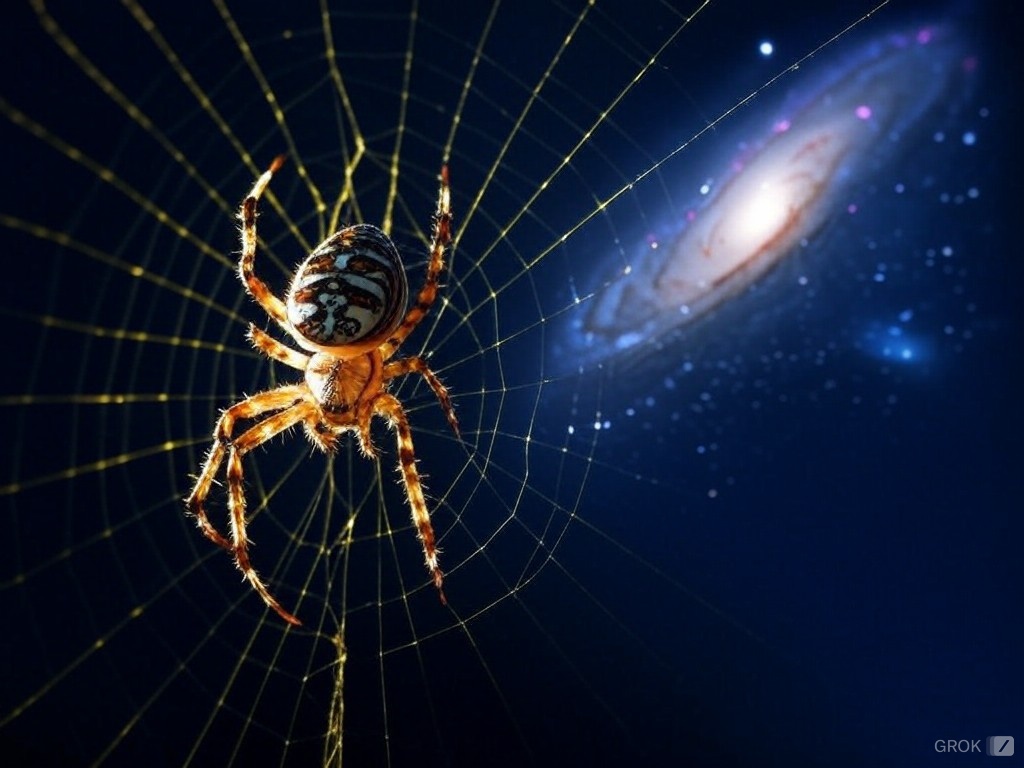
The spider-goddess Nemilloth binds the Universe in Her web (AI-rtist’s impression)
Pieces of sorraim were found on Vmirr-Psumm’s own planet and he reasoned that, were the legend true, he could lift Nemilloth’s web from his own brain by carving and throwing a die of the mineral, wherein the virtue of Tšenn-Gilë’s spell still lingered. A die of any ordinary material would be within the web and therefore bound by necessity, generating only pseudo-random numbers in its throws. But a die of sorraim, being outside the web, would generate veri-random numbers that would alter the working of his brain, inspire thoughts unbound by Nemilloth, and grant him true freedom from Her tyranny.
Unfortunately for Vmirr-Psumm, he did not realize that “he who loosens the web of Nemilloth in rebellion grants matter itself leave to rebel.” A fragment of sorraim was small enough to remain outside the web and survive, but anything larger, from a planet to a human brain, would be destroyed. And that is why, absorbing the veri-random throws of the sorraim die, Vmirr-Psumm’s brain exploded with the power of an atom bomb at the end of the story, “succumbing, on its vastly smaller scale, to the same forces that had torn apart the planet of Pmimmb.”
Reflections on ranDOOM
Thinking about “The Web of Nemilloth” again at the end of 2024, I’ve realized that it raises some interesting questions. If a truly random sequence of numbers could cause a brain to explode, how long would the sequence have to be? I conjecture that a single number, and single throw of Vmirr-Psumm’s deadly die, would suffice, because it would be truly random in a way no number generated in any normal way could be. After all, if the brain of the die-thrower didn’t explode after one throw, why should it explode after two or three or any other finite number of throws? If the true randomness of the sequence is not established after one throw, then (one might reason) it could be established only after infinite throws. But Vmirr-Psumm did not throw the die infinitely often. Therefore, I conjecture, he must have rolled it only once, seen but one uppermost face of his dodecahedral die of sorraim, and die-d on that instant, as his brain absorbed the first veri-random number and exploded.
But why should sorraim need to be carved into a die to be deadly? If the mineral were truly outside the web of Nemilloth, then would not merely seeing or touching sorraim introduce unnecessitated sense-data into the brain of the beholder or betoucher and provoke an explosion? And why would the influence of the sorraim need to be on a conscious brain? If it’s insentient matter itself that rebels when outside the web, then ordinary matter influenced by sorraim would explode. And that explosion itself would be unnecessitated and thereby provoke further explosion in all the ordinary matter that it influenced.
And the influence of such an explosion would propagate at the speed of light, because the photons it created would be unnecessitated and therefore explosive in their influence. One could conclude, then, that the fore-wizard’s spell would have destroyed not only the planet of Pmimmb whereon it was worked but, in time, the entire universe, as the photons bearing the news of the initial explosion sped outward and triggered further explosions in all the ordinary matter they effected in some way. Vmirr-Psumm could never have found his sorraim and carved his die, because photons from Pmimmb would have reached his planet far before fragments of sorraim ever did. And it seems illogical or arbitrary to suppose that sorraim could exist anyway. Would not all matter be destroyed – turn into electro-magnetic radiation – if outside the web or if influenced by unnecessitated fundamental particles?
Psychopaths and Stoics
Still, let’s suppose that my story doesn’t succumb to this explosive logic, that sorraim could exist and be carved into a die, and that a single truly random number could cause a brain to explode. What a method of assassination or murder that would be! But it would be like the head of Medusa: you would have to emulate Perseus and avoid beholding your own weapon. If sorraim really existed and you could carve a die from it, you’d have to set up an automatic mechanism to roll that die, record the number first generated, then transmit that number to your target in some way. But to use such a weapon you’d have to have a psychopathic indifference to collateral damage: when your target’s brain absorbed the single veri-random number and exploded, this would destroy any city that your target happened to be present in at the time. But suppose you were indeed a psychopath and wanted to destroy a city or a nation or a continent or the entire world. Then you’d simply arrange for your single truly random number to be seen by the requisite number of people.
A final thought: I have a recollection that the Stoics believed necessity rules the universe and true randomness is therefore impossible, because it would trigger destruction in the necessitated material order of the universe. But I can’t remember where (or if) I read this and am pretty sure I read it only after I’d written “The Web of Nemilloth”.
Post-Performative Post-Scriptum
• “The Web of Nemilloth” appears in the CAS-inspired collection Tales of Silence and Sortilege, re-published by Incunabula Books in 2023.
 Overlord In Terms of Core Issues Around Maximal Engagement with Key Notions of the Über-Feral
Even sorraim dice seem bound by necessity—they can only show a number between 1-6 (or however many sides the dice has), they must conserve mass and momentum, they must not magically transform into six tons of lutefisk, and so on. Webs inside webs?
Autoregressive AI models rely on next-word prediction to generate text. So they are bound by necessity, in a sense. A friend was using a model called Mistral; he let it generate some text, then he stopped the output, manually typed “And then…” and let the AI continue from that point. The AI didn’t explode, but it did start outputting text like “And THEN!!! When did you arrive, friend reader??” (clearly reacting to what he’d typed). Somehow, Mistral noticed that the “And then…” wasn’t a natural part of its text, and had been written by something other than it. I am not sure how it knew. Maybe the probability of “And then…” was very low, given the contents of the preceding text.
Even sorraim dice seem bound by necessity
I think I recognized that when I said: “And it seems illogical or arbitrary to suppose that sorraim could exist anyway.” If one assumes that it can exist, then it has to be bound by necessity to some extent. So perhaps there’s a spiderling-goddess below Nemilloth spinning a finer web, and a sub-spiderling-goddess below that spinning a finer web still, and so on ad infinitum. Removing necessity may be like reaching absolute zero: you can get ever-closer, but never actually arrive. And if matter necessarily explodes when removed from the web of necessity, it’s still bound by necessity. I can’t see how anything can escape necessity except by never-existing-in-the-first-place — see causality, acausality, quantum indeterminacy, time, the multiverse, etc.
I am not sure how it knew.
I know nothing about AI, but Occam’s razor tells me: If he stopped the output, the program knew it been directed to stop after X output of text. When he re-started it, it knew that there was X+Y amount of text and that it wasn’t responsible for the +Y. So it responded in a way that must have been programmed into it. He can’t have been the only one to try that or to know it was possible.
Surely an AI text-generator can distinguish between internally and externally generated text. I can’t see how “And then…” would be improbable in a normal text. Something like “Suddenly a sentient bowl of petunias appeared and started singing the Marsellaise in Navajo whilst reciting the digits of pi in base 37 backwards from position (2^googleplex)-3…” would be improbable. (I thought “bowl of petunias” was something I’d come up with off the top of my head, then realized that I got it from Douglas Adams. Nemilloth smiles.)
Great spiders have little spiders upon their backs to bite ’em, And little spiders have lesser spiders, and so ad infinitum.
Are you sure? On your old website you had a story about a computer program that made predictions, and when it succeeded (or failed) it was rewarded (or punished) by the programmer. I assume you based this on human operant conditioning, but it was weirdly close to how AI reinforcement learning works today. As I recall, the program learned to predict hidden facts in history.
I don’t think they can: they’re just Chinese rooms. They don’t really know where their input came from, anymore than an equation on a blackboard does: they just take text and generate more text according to complex rules. So it’s a bit surprising that they can infer a change in authorship, because they can only be doing so based on clues embedded in the text itself.
(if you’re curious, you can see the text here, but I strongly recommend not reading it).
Well, a word can be statistically likely but contextually unlikely. A man who only knows English would be unlikely to suddenly speak fluent Chinese, even if he said the most common words in the Mandarin vocabulary.
Imagine finding a strange piece of text on the internet. You can’t remember seeing it before, but you’re sure it was written by you. It has your style, says things you agree with (etc)…but at the end, the author writes “in terms of”, and not as a joke. You might entertain the possibility that your writing had been tampered with, and the “in terms of” added by an outsider.
I think Mistral is doing something similar. It thinks “most of this text is consistent with what I would have written. I think it’s mine. But the ‘and then’ doesn’t fit, ergo it’s someone else’s.” But what about “and then’ doesn’t fit? That’s a mystery. Maybe the triple ellipses tipped it off. There are none in the text, either before or after. Maybe Mistral doesn’t like triple ellipses. I don’t know!
(and I speak loosely, there’s no “I” and nobody’s thinking anything. It’s just simulating human reasoning because this is an effective way to simulate human text. Which raises questions about how simulated reasoning/thinking differs from real reasoning/thinking, if it does.)
I don’t remember that story you mention on my old site. But it sounds interesting.
If your friend could stop the AI, it was able to recognize external signals. Occam’s razor still says that the bot’s response was a human programmer anticipating the obvious, not the AI reacting spontaneously to something never anticipated.
Imagine finding a strange piece of text on the internet. You can’t remember seeing it before, but you’re sure it was written by you. It has your style, says things you agree with (etc)…but at the end, the author writes “in terms of”, and not as a joke. You might entertain the possibility that your writing had been tampered with, and the “in terms of” added by an outsider.
Yes, but I’m a human being with full theory-of-mind, not an AI bot. Your scenario reminds me of Douglas Adams: