
The Fibonacci sequence is beautiful like clockwork. There’s a perfectly clear, rigorously defined mechanism ticking out an entirely predictable result for ever:
0, 1, 1, 2, 3, 5, 8, 13, 21, 34, 55, 89, 144, 233, 377, 610, 987, 1597, 2584, 4181, 6765, 10946, 17711, 28657, 46368, 75025, 121393, 196418, 317811, 514229, 832040, 1346269, 2178309, 3524578, 5702887, 9227465, 14930352, 24157817, 39088169, 63245986, 102334155, … — A000045 at the Online Encyclopedia of Integer Sequences (OEIS)
And there’s a formula to calculate any term in the sequence without calculating all the terms that precede it:
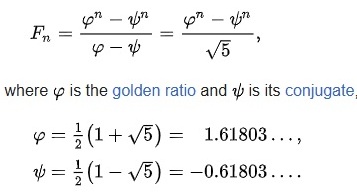
Binet’s formula for Fn, the n-th Fibonacci number
But I also like sequences that you might call definitely arbitrary. That is, there’s a perfectly clear, rigorously defined mechanism, but the results seem arbitrary — not predictable at all:
6, 15, 5, 22, 6, 3, 30, 9, 7, 2, 45, 15, 6, 5, 1, 36, 14, 6, 5, 3, 1, 62, 22, 16, 6, 5, 3, 2, 69, 21, 15, 4, 9, 5, 2, 1, 84, 30, 15, 9, 6, 7, 2, 2, 1, 56, 22, 13, 7, 3, 5, 2, 0, 0, 0, 142, 45, 22, 15, 12, 6, 9, 5, 3, 1, 2, 53, 17, 8, 4, 5, 1, 6, 3, 1, 1, 1, 0, 124, 36, 27, 14, 18, 6, 6, 5, 2, 3, 1, 1, 0, … A349083 at OEIS
What’s the formula there? That sequence is defined at the OEIS as “The number of three-term Egyptian fractions of rational numbers x/y, 0 < x/y < 1, ordered as below. The sequence is the number of (p,q,r) such that x/y = 1/p + 1/q + 1/r where p, q, and r are integers with p < q < r.” For example: “The sixth rational number is 3/4 [and] 3/4 = 1/2 + 1/5 + 1/20 = 1/2 + 1/6 + 1/12 = 1/3 + 1/4 + 1/5, so a(6)=3.”
 Overlord In Terms of Core Issues Around Maximal Engagement with Key Notions of the Über-Feral