Vermilion Glands

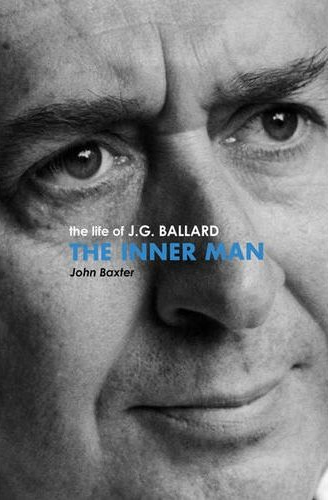
Front cover of The Inner Man The Life of J.G. Ballard by John BaxterReaders’ Advisory: Contains Self-abuse and reference to Mancas.

The Inner Man: The Life of J.G. Ballard, John Baxter (W&N 2011)

“B” is for Bataille, Burroughs, and Ballard. I’ve never read Bataille, I can’t stand Burroughs, I used to love Ballard. Nowadays I have strong doubts about him. Vermilion Sands, yes. Crash, no. Vermilion Sands is surreal, haunting, funny, endlessly inventive, and extravagantly intelligent. Crash, by contrast, is silly and sordid. The last time I tried to read it I quickly gave up. I couldn’t take it seriously any more. It’s a book for pretentious, wanna-be-intellectual adolescents of all ages who like Dark’n’Dangerous Sex’n’Violence. A book for Guardian-readers, in short – the sort of people who continually use and hear the phrase “in terms of”, who believe passionately in Equality, Justice, and the Fight against Hate, and who desperately, desperately, wished they’d been able to stimulate the largest erogenous zone in their bodies by voting for Barack Obama in 2008.

What is that erogenous zone? Well, though not all liberals are Guardianistas, all Guardianistas are liberals, so the largest erogenous zone in a Guardianista’s body is his-or-her narcissism. Guardianistas are also, alas, the sort of people who write biographies of J.G. Ballard. John Baxter is most definitely a committed component of the core community. As a big admirer of Mike Moorcock, Britain’s biggest bearded Burroughsian lit-twat, how could he not be? This is part of why I now have doubts about Ballard. I don’t like liking things that Guardianistas like and I don’t like the fact that Moorcock was mates (on and off) with Ballard. On the other hand, I do like the fact that Moorcock and the Guardian boosted Burroughs big-time back in the day and that the Guardian now bigs up Cormac McCarthy and his Dark’n’Dangerous Sex’n’Violence. Good, I think: they all deserve each other. Perhaps one day, in some drug-stoked, depravity-soaked über-orgy of trans-transgressive hyper-homoeroticism, they’ll all manage to climb up each other’s arseholes and disappear from history.

But Guardianistas don’t just like Burroughs and McCarthy: they like Ballard too. They write books about him. Fortunately, The Inner Man isn’t a good book. That would have been disturbing, believe me. The dedication is by far the best thing in it: “To the insane. I owe them everything.” And guess whose lines those are? After that, it’s mostly Baxter and mostly dull. When it’s not, you’ll usually have Ballard to thank:

Novels sent to him in hope of endorsement got short shrift. He enjoyed describing the satisfying thump of Salman Rushdie’s Midnight’s Children as it hit the bottom of the dustbin. (pg. 47) In September 1995, the Observer, for a piece about odd bequests, invited him to answer the question, “What would you leave to whom, and why?” Jim said, “I would leave Andrea Dworkin my testicles. She could have testicules flambés.” Anti-pornography campaigner Dworkin was a close friend of Mike and Linda Moorcock but a bête noire of Ballard’s. (pg. 308)

I think Ballard was right in his cod-bequest for Dworkin and bum’s-rush for Rushdie. And if Baxter had the same sense of humour and mischief, The Inner Man would have been a much better book. Okay, it’s not that bad, because I managed to finish it, but that was disappointing in its own way. I’d almost have preferred a boldly, flamboyantly pretentious Ballard bio full of solecisms and mixed metaphors to a plodding, mediocre one like this. I like sneering at and feeling sniffily superior to Guardianistas. And all I’ve got to go on here are occasional lines like these:

Like another diligent civil servant, he [Ballard] was Agent 00∞: licensed to chill… (pg. 3) But in surrealism, as in most things, Jim was drawn to the extremity, the dangerous edge, the abyss which, as H.G. Wells warned, will, if you stare into it long enough, stare back at you. (pg. 36)

It’s puzzling that Baxter misattributes such a famous quote and that his editors didn’t spot the misattribution. It’s also puzzling that Baxter doesn’t seem to like Ballard much, to be very interested in Ballard’s life, or to be very enthusiastic about Ballard’s writing. Born in Shanghai, incarcerated (and half-starved) under the Japanese during the war, trained as a doctor: Ballard had an unusual early life for a writer and one can only admire Baxter’s ability to keep the interest out of it. Baxter devotes much more attention to Ballard’s time in advertising and life in suburbia. Yes, the contrast between this apparently staid existence and the wildness of Ballard’s veridically visceral visions is interesting, but it’s obviously related to his early experiences in China. Baxter has got those out of the way within the first 26 pages of a 377-page book. When he himself takes visionary flight, he doesn’t do so to Ballard’s advantage. Why did Ballard turn down the chance to be published in “a series of de luxe limited editions of fantasy classics” by Manchester’s most maverick messiahs, “the radical publishing enterprise of Savoy Books”? Baxter conducts an interview with his own imagination and reports back with this:

He may have felt that involvement with Savoy and [David] Britton – who had already served two prison terms under the Obscene Publications and Dangerous Dogs Acts – risked once again placing him in hazard, as had been the case with “Why I Want to Fuck Ronald Reagan”. (pg. 321)

Eh? Yes, he “may”, but simpler explanations are to hand. Either way, Baxter says the rejection meant that “a sense of grievance” now “permeated his relationship with” the messianic Mancas. Again: Eh? The grievance would have been one-sided, there was never much of a relationship, and although Savoy “put a lot of effort” into persuading Fenella Fielding to record extracts from one of Ballard’s books (no prizes for guessing which), they put in the effort without first asking Ballard if he was interested. When the recordings were made and they did ask, he “refused to cooperate”. It was now that grievance began to permeate the relationship.

Reading about this important episode in Ballard’s career, I felt another feeling begin to permeate me. A familiar feeling. Yes, “S” is for Savoy (B), Sontag (S), and Self (W). All three turn up in this biography, variously offering to publish Ballard, heaping praise on him, and having dinner with him. All three are part of the Guardianista demographic in one way or another: Self nails his colours firmly to the gasbag when he speaks of a “scintilla” of an “affectation” that forms an “armature” (pg. 341). All three add to my doubts about Ballard. If people like that like him, should I like him too, like? I think if Ballard had been born ten or twenty years later, the question wouldn’t arise. A younger Ballard would have been sucked fully into the macroverse of Guardianista subversion, radicalism, and counter-cultural twattishness and I’d never have liked him at all. As it was, he was too big to entirely fit. Crash got sucked and does suck. Vermilion Sands didn’t and doesn’t.

And this biography? Well, it could have been much worse. Yes, it’s dull but that may be partly because Ballard himself is such an interesting and memorable writer. As I’ve pointed out elsewhere, the danger in literary biographies is that the biographee is likely to be a better writer than the biographer. The implicit comparison will always be there and Ballard’s autobiography, Miracles of Life (2008), is likely to remain better, and briefer, than anything a biographer ever turns out. But Baxter tells you about things that Ballard doesn’t, possibly because they’re not true. Like the air of menace Ballard could project and his occasional violence towards his girlfriend Claire Walsh, who “appeared at parties with facial bruises, usually hidden between sunglasses” (pg. 187).

And “girlfriend” is the word: Baxter reports that Ballard “always” and “anachronistically” used it of Walsh (pg. 171), rather than (he implies) the smarmy Guardianista “partner”. Good for Ballard. But bad for Ballard in terms of engagement with issues around the bruises, if true. As George Orwell said:

If Shakespeare returned to the earth to-morrow, and if it were found that his favourite recreation was raping little girls in railway carriages, we should not tell him to go ahead with it on the ground that he might write another King Lear. (“Benefit of Clergy: Some Notes on Salvador Dalí”, 1944)

It would have been better that Ballard hadn’t punched his girlfriend, just as it would have been better that Caravaggio hadn’t been a murderer. But if they hadn’t been violent men, with more than a touch of psychosis, they might not have produced such interesting art. I don’t think Ballard is as significant a figure in European art as Caravaggio, and even if he is, he and his art won’t have as much time to be significant in. One way or another, Europe is now entering its final days. We are about to reap the whirlwinds so diligently sown for us by the Guardianistas and their continental cousins. And science is busy measuring mankind for its coffin. Ballard saw and wrote about parts of this future, but I now prefer his surreal side to his sinister and his dreams to his depravity. It’s bad, v. bad, that Will Self hails Ballard as “My single most important mentor and influence.” But Self (thank Bog) didn’t write this biography. He didn’t write Vermilion Sands either. He couldn’t. Ballard could and did. He could and did write other good stuff. I don’t love him any more, but, despite the Guardian and the Guardianistas, I will continue to read him. Lucky Jim, eh?


Post-Performative Post-Scriptum…

In terms of all Savoy-fans and other non-conformist mavericks, keyly committed core components of the counter-cultural community et al having read this review prior to departing in terms of departure… please can you stop using “in terms of” and “prior to” and stuff? You wouldn’t allow bloated flesh to adversely impact your body, so why do you allow bloated phrases to negatively trajectorize your English?

Ex-term-in-ate! — more on “in terms of”
Prior Analytics — more on “prior to”
Try Trunkle

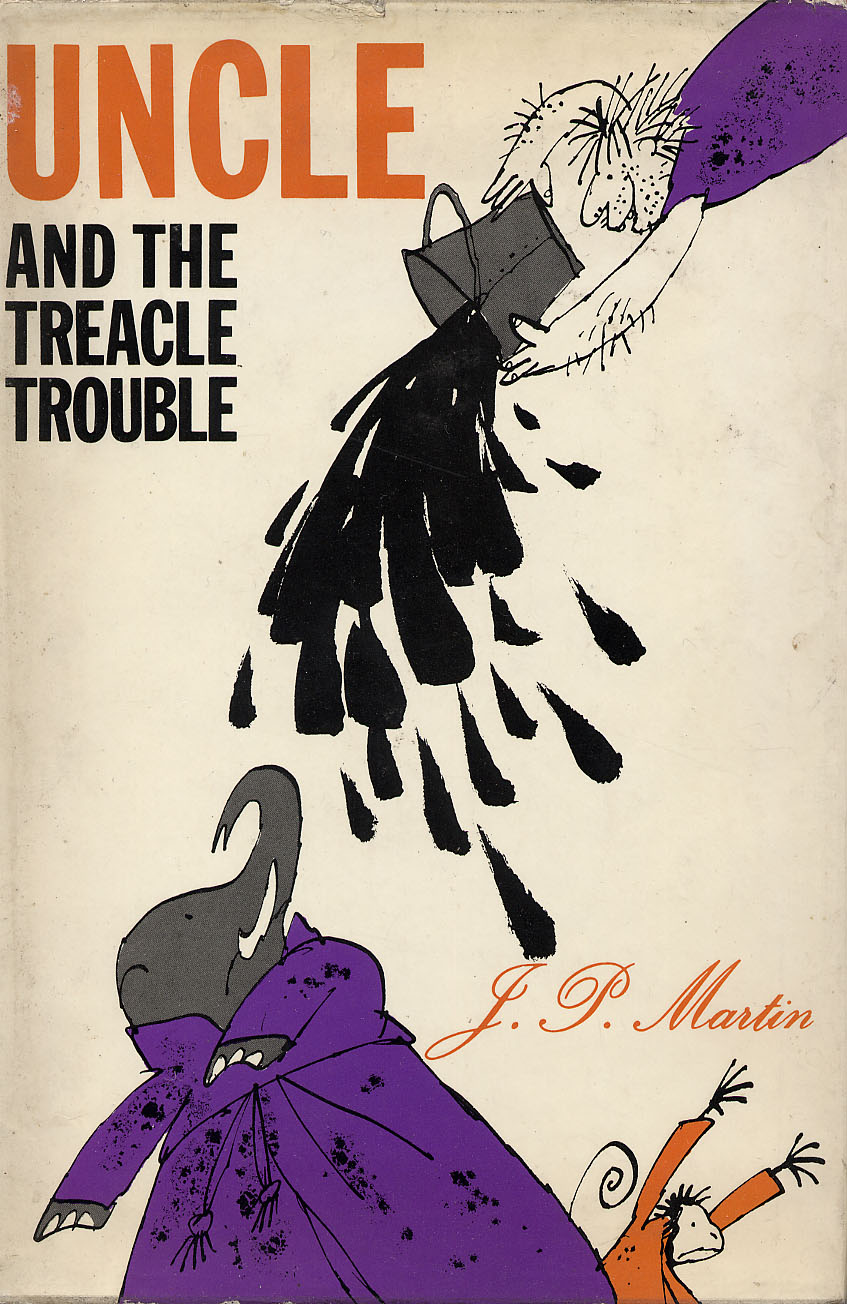
One afternoon, when I was about thirteen or fourteen, I was standing in the queue for the children’s counter in a library in Davyhulme in Manchester. I was carrying four or five books and an older girl read out the title of the one that happened to be on top: Uncle and the Treacle Trouble.

Quentin Blake's cover of J.P. Martin's Uncle and the Treacle Trouble

It was meant to make me feel stupid, but it didn’t much. Don’t judge a book by its cover – or its title. Like Uncle and Claudius the Camel or Uncle and the Battle for Badgertown, Uncle and the Treacle Trouble might sound twee and childish: in fact, it’s one of the cleverest, funniest, most surreal children’s books ever written. The six books in J.P. Martin’s Uncle series deserve to join Lewis Carroll’s Alice in Wonderland, Kenneth Grahame’s Wind in the Willows and A.A. Milne’s Winnie the Pooh among the classics, delighting both children and adults all around the world. Alas, they never have and probably now never will. That gives them a cult cachet, of course, but I’d rather have less cult and more cash for the publishers willing to re-issue them.

How to describe them? “Alice in the Willows” is one way: they combine the surreal invention of Alice in Wonderland with the proper stories of Wind in the Willows. Anthropomorphic animals have odd and interesting adventures. Uncle is a Trunkle: a millionaire elephant living in a city-sized castle with lots of other walking, talking animals. And with humans too, like his loyal librarian Will Shudder, his horticulturalist Butterskin Mute,  and the Badfort Crowd, Uncle’s sworn and socialist enemies. Another way of describing the books is to say they might have written by J.G. Bilne or A.A. Mallard: imagine mixing the vivid surrealism of J.G. Ballard with the sun-kissed camaraderie of A.A. Milne. Or the snow-cloaked camaraderie. The Uncle books are set in all the seasons and appeal to all the senses, including the sense of wonder. Martin’s surreal invention is actually oneirography: in part, the books are transcriptions of his dreams.

That’s one reason I would put them above Alice in Wonderland, Wind in the Willows and Winnie the Pooh. I like all of those books, but they don’t create worlds as large, crowded, and endlessly detailed as the dream-world of Uncle, which has no borders and no barriers. Lewis Carroll’s invention can seem contrived or even didactic. He distorts the real world and plays games with it. Grahame and Milne verge on cosiness or never leave it at all, some would say. Martin doesn’t contrive or do cosy, and his hero has feet of clay. “See that pompous humbug Unc/On the platform raise his trunk…” sing the Badfort Crowd, down but not out after Uncle has thwarted another of their schemes, and they’re right: Uncle, though good and kind-hearted, is pompous. If you wanted to get Nietzschean about it, you could say Uncle represents the calm and ordered world of the Apollonian and the Badfort Gang the chaotic and destructive forces of the Dionysian. But that would probably be taking things too far. Uncle is nearer whimsy than wildness. I would like to know more about J.P. Martin’s education, but if he was influenced by Greek and Roman mythology, he adapted it for a cooler climate and more muted skies. Apollo and Dionysus may do battle in his books, but they do so in the hall of Hypnos, god of sleep. Reading J.P. Martin is like dreaming awake.

But you’ll have sweet dreams, not sour ones: if Martin ever had angst-ridden or ugly dreams, he didn’t transcribe them into his books. He can also, like the late, great Peter Simple, invoke the “mysterious urban poetry” of slag-heaps and abandoned factories. Perhaps Simple, born in 1913, was a fan of Martin, born in 1879, or perhaps they both drew on the same gentle, subtle English traditions of nonsense, whimsy, and satire. Either way, I would place Martin above even Simple. Both are dead now, but the written word, more lasting than bronze, allows their souls to sing on.

Lulu Lunatic Luz

It’s disturbing what you can find online…

Tales of Silence & Sortilege, Simon Whitechapel, Paperback, 111 Pages

May 28, 2012

If you love weird fantasy, if you love the English language, even if you don’t love Clark Ashton Smith, you should read this book. The back cover describes it as “the darkest and most disturbing fantasy” of this millennium, but that’s either sarcastic or tragically optimistic, because what these stories really are is beautiful. The breath of snow-wolves is described as “harsh-spiced.” A mysterious gargoyle leaning from the heights of a great cathedral has “wings still glistening with the rime of interplanetary flight.” Hummingbirds are “gem-feathered… their glittering breasts dusted with the gold of a hundred pollens.” If you cannot appreciate such imagery, then perhaps you are dead to beauty, or simply dead. These tales are very short, but some of them have stayed with me for years, such as “The Treasure of the Temple,” in which a thief seems to lose the greatest fortune he could ever have found by stealing a king’s ransom in actual treasure. Most of the stories are brilliant, one or two is only good, but the masterpieces are “Master of the Pyramid” and “The Return of the Cryomancer.” The sense of loss and mystery evoked by these two companion stories is almost physically painful, it is so haunting. There is nothing like these stories being published today. Reading them, I feel the excitement and wonder that fans of Weird Tales magazine must have known long ago when new stories would appear by H.P. Lovecraft, Clark Ashton Smith, and Robert E. Howard. Simon Whitechapel doesn’t imitate these authors so much as apply their greatest lessons to new forms of fantasy. This is one of the cheapest books I own, but I accord it one of my most valuable. It is easily the best work of art you will find in any form on Lulu. I cannot recommend it highly enough.

The Roses of Hsūlag-Beiolă, Simon Whitechapel, Paperback, 154 Pages

Jun 8, 2012

This collection of weird fantasy is filled with mystery, wonder and a sense of the ineffable. Not every story is a mind-blowing masterpiece, but the best of them are absolutely spectacular. Even the worst are good and all are haunting in one way or another. My two favorites were: 1. “The Mercy of the Osmomancer,” wherein a knight on a mission to investigate the tower of a scent-wizard encounters demons made of smells and even learns the language of odors… 2. “The Swans,” in which a pawnbroker tracks down all the known paintings of a seemingly insane artist who paints his canvases entirely black, nothing but black, for reasons best and most poetically left to Simon Whitechapel to explain… Any fan of H.P. Lovecraft, Robert E. Howard, Clark Ashton Smith, Edgar Allan Poe, Comte de Lautréamont, Charles Baudelaire or William S. Burroughs will find something wonderful to love in here. I sure did.


Even more disturbing is the thought that this individual may be able to pass themself off as normal in real life: there are no spelling mistakes or solecisms. (Then again, perhaps I’m reviewing my own books in my sleep. (But I wouldn’t compare myself to B*rr**ghs, surely? (Unless it’s a bluff or double-bluff. (Disturbing, as I said. (I agree.)))))

Bat’s the Way to Do It!

I think Britain would be much better off without three things that start with “c”: cars, canines, and coos (sic (i.e., pigeons)). But perhaps I should add another c-word to the list: cats. I like cats, but there’s no doubt that, in terms of issues around negative components/aspects of conservation/bio-diversity issues vis-à-vis the feline community/demographic, they’re buggers for killing wildlife:

A recent survey by the Mammal Society was based on a sample of 1,000 cats, countrywide, over the summer of 1997. The results included only “what the cat brought in” and ignored what it ate or left outside. Leaving aside this substantial hidden kill, it still concluded that cats killed about 230,000 bats a year. This is equivalent to more than the entire population of any species other than the two most common pipistrelles. If these 1,000 cats are typical, and there is no reason to believe that they are not, cats kill many more bats than all natural predators combined. They are one of the biggest causes of bat mortality in Britain, perhaps the biggest. (Op. cit., chapter 6, “Conservation”, pg. 139)

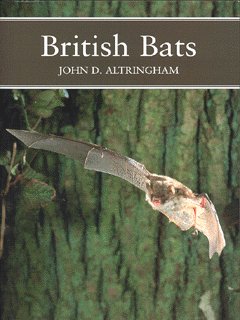
Cover of British Bats by John D. Altringham

That is the unhappy conclusion in John D. Altringham’s very interesting and educative book British Bats (HarperCollins, 2003). Accordingly, I’d rather have fewer cats and more bats. Anyone but a cat-fanatic – and cat-fanatics are found in one or two places – should feel the same, and even the fanatics might reconsider if they read this book. The cat family contains some of the most beautiful and athletic animals on earth; the bat family contains some of the strangest and most interesting. In fact, all bats are strange: they’re mammals capable of sustained powered flight. Little else unites them: in chapter two, Altringham describes the huge variety of bats around the world. They live in many places and live off many things. Some drink nectar, some drink blood; some eat fruit, some eat fish. Some roost in caves, some in trees. Some hibernate, some migrate. Some use echolocation and some don’t. Bats are much more varied than cats and scientifically speaking are much more interesting.

Although echolocation isn’t universal, it is the most interesting aspect of bats’ behaviour and it’s used by all the species found in Britain, from the big ones, like the noctule and greater horseshoe bat, Nyctalus noctula and Rhinolophus ferrumequinum, to the small ones, like the whiskered bat and the pipistrelles, Myotis mystacinum and Pipistrellus spp.[1] Two of the pipistrelles are in fact most easily distinguished by the frequencies they call at: the 45 kHz pipistrelle, Pipistrellus pipistrellus, and the 55 kHz pipistrelle, Pipistrellus pygmaeus. As their English names suggest, one calls at an average of 45 kilo-Herz, or 45,000 cycles a second, and the other at an average of 55. The two species weren’t recognized as separate until recently: they look almost identical, although the 55 kHz is “on average… very slightly smaller”, and they forage for food in the same places, although the 55 kHz is “more closely associated with riparian habitat” (that is, it feeds more over rivers and other bodies of water). But examine their calls on a spectrograph, an electronic instrument for visually representing sounds, and there’s a much more obvious difference. This is a good example of how much the scientific study of bats depends on technology. Human beings didn’t need science to know about and understand the ways a cat uses its senses, because they’re refinements of what we use ourselves. We might marvel at the acuity of a cat’s eyes or ears, as we might marvel at the acuity of a dog’s nose, but we know for ourselves what seeing, hearing, and smelling are like.

Echolocation is something different. Bats don’t just see with their ears, as it were: they illuminate with their mouths, pouring out sound to detect objects around them. And the sound has to be very loud: “The intensity of a pipistrelle’s call, measured 10 centimetres in front of it, is as much as 120 decibels: that is the equivalent of holding a domestic smoke alarm to your ear.”[2] The “inverse square law”, whereby the intensity of sound (or light) falls in ratio to the square of the distance it travels, means that the returning echoes are far, far fainter than the original call. It’s as though Motörhead, playing at full volume, could hear someone at the back of the crowd unwrapping a toffee. How do bats call very loudly and hear very acutely? How do they avoid deafening themselves and drowning their own echoes? These are some of the questions bat-researchers have investigated and Altringham gives a fascinating summary of the answers. For example, they avoid deafening themselves by switching off their ears as they call. They’ve had to solve many other tricky acoustic problems to perfect their powers of echolocation.

Or rather evolution has had to solve the problems. The DNA of bats has changed in many ways as they evolved from the common mammalian ancestor (which also gave rise to you, me, and the author of this book) and those changes in DNA represent changes in their neurology, anatomy, and appearance. It’s easy to see that hearing is important for bats, because their eyes are relatively small and their ears are often large and rigid and come in a great variety of shapes. What isn’t easy to see is what those ears are supplying: the bat-brain and its astonishing ability to process and classify sound-data as though it were light-data. Bats can create sound-pictures of their surroundings in complete darkness. Of course, the feline or human ability to create light-pictures is astonishing too, but we’re too familiar with it to remember that easily. Bats aren’t just marvels in themselves: they should encourage us to marvel at ourselves and what our own brains can do. The digestive system of a bat, cat, or human needs food; the nervous system of a bat, cat, or human needs data. That’s what our sense-organs are there for and in principle it doesn’t matter whether we create a picture of the world with our eyes or with our ears.

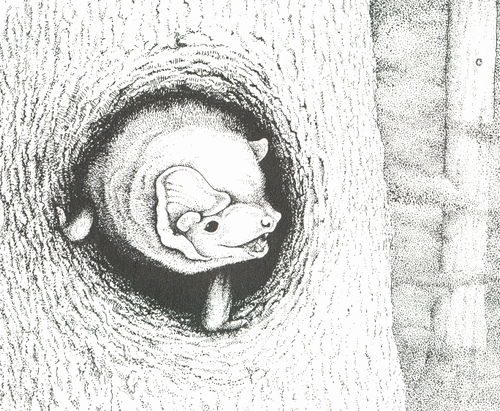
Male noctule (Nyctalus noctula) calling from tree-roost to attract mates

Male noctule calling from tree-roost

In practice, there are some very important differences between sound and light. Light works instantly and powerfully on a terrestrial scale; sound takes its time and is much more easily diluted or blocked. A hunting cat can scan an illuminated or unilluminated environment for free, because it doesn’t have to generate the light it sees by or the sound it hears by. Hunting bats have to pay when they scan their environment, because they’re using energy to create sound and induce echoes. Once they’ve got their data, both cats and bats have to pay to process it: it takes energy to run a brain. But bat-brains are solving more complicated problems than cat-brains: Altringham describes the questions a flying bat has to answer when it detects the echo of an insect:

How far away is the insect?… How big is it?… In which direction does it lie?… How fast is it flying and in what direction?… What is it?… (ch. 3, “The Biology of Temperate Bats”, pp. 42-3)

Like insect-eating birds, bats can answer all these questions in mid-flight, but what is relatively easy for birds, using their eyes, is a much greater computational problem for bats, using their ears. “Computational” is the key word: brains are mathematical mechanisms and process sense-data using algorithms that run on chemicals and electricity. Bats were intuitively using mathematical concepts like doppler shift and frequency modulation (as in FM radio) millions of years before man invented mathematics, but man-made mathematics is an essential tool in the study of echolocation. For example, the concept of wavelength, or the distance between one crest of a sound-wave and the next, is very important in understanding how bats perceive objects. Light has very short wavelengths, so humans and other visual animals can easily resolve small objects. Sound has much longer wavelengths, so bats find it hard to resolve small objects. But some find it harder than others: Daubenton’s bat, Myotis daubentonii, and other Myotis spp. “can resolve distances down to about 5 millimetres when given tasks to perform in the laboratory”. But horseshoe bats, Rhinolophus spp., “can do little better than 12 millimetres.”

Why this difference? You have to look at the nature of the sound being produced by the different species: the Myotis spp. use “high frequency FM calls”; the Rhinolophus use “predominantly CF [constant frequency] calls”. The mathematical nature of the call determines the bats’ powers of perception. Calls can also determine how easily a bat can identify an insect: “relatively long calls can have a ‘flutter detector’… If a call is 50 milliseconds long, then within one echo a bat can detect the full wingbeat of insects beating their wings at more than 50 Hz.”[3] So bats can tell one kind of insect from another, something like the way a blindfolded human can tell a bumblebee from a mosquito. But insects aren’t passive as prey and one of the most interesting sections of the book describes how they try to avoid being eaten. Some moths have “ultrasound detectors” and if a moth hears a calling bat, it “will either stop flying and drop toward the ground, or begin a series of rapid and unpredictable manoeuvres involving dives, loops and spirals”.[4] This kind of ecological interaction creates an “evolutionary arms race”: each side evolves to become better at capture or evasion.

The moth/bat air-battle is reminiscent of the air-battles of the Second World War, which involved radar trying to detect bombers and bombers trying to evade radar. One defensive technique was jamming, or attempts to interfere with radar signals or drown them in noise. Some moths may use this technique too. The tiger moths, the Arctiidae, don’t try to escape detection. Instead, they “emit their own, loud clicks”[5], perhaps to interfere with echolocation or startle a predatory bat. Alternatively, Altringham suggests, the clicks may be the aural equivalent of “bright warning colours and patterns”: the moths may be warning bats of their unpalatability. If so, it would be another example of the difference between the costs of sight and the costs of sound. An unpalatable insect in daylight doesn’t have to pay for its warning colours, after the initial investment of creating them, and doesn’t have to know when a predator is watching. An unpalatable insect in the dark, on the other, can’t send out a constant audible warning: it has to select its moment and know when a predator is nearby. Unless, that is, some insects use passive signals of unpalatability, like body modifications that create a distinctive echo.

Bat-researchers don’t know the full story: there is still a lot to learn about bats’ hunting techniques and the ways insects try to defeat them. But “cost” is a word that comes up again and again in this book, which is partly a study in bio-economics. Bats have to pay a lot for echolocation and flight, but flight is a more general phenomenon in the animal kingdom, so the economics of bat flight also illuminates (insonates?) bird and insect flight. Altringham points out a very important but not very obvious fact: that flight is expensive by the unit of time and cheap by the unit of distance. Movement on foot is the opposite: it’s expensive by the unit of distance and cheap by the unit of time. Bats, birds, and insects expend more energy per second in flight, but can travel further and faster in search of food or new habitats. However, bats don’t all fly in the same way: a bat expert can identify different species by their wings alone. The wings vary in “wing loading”, which is “simply the weight of the bat divided by the total area of its wings. Bats with a high wing loading are large and heavy in relation to their wing area, bats with small bodies and large wings have a low wing loading”.[6] Then there’s “aspect ratio”, the “ratio of wingspan to average wing width”, or, because “bats have such an irregular wing shape”, “wingspan squared divided by wing area.”

It’s mathematics again: there are no explicit numbers in a bat’s life, but everything it does, from echolocating to flying, from eating to mating, is subject to mathematical laws of physics, ecology, and economics. Bats have to invest time and energy and make a profit to survive and have offspring. As warm-blooded, fast-moving animals with high energy needs, they’re usually nearer famine than feast, which is one reason they migrate or hibernate to avoid or survive through cold weather and scarcity. They also vary their diet during the year, to take advantage of changes in the abundance of one insect species or another, and seek out specialized feeding niches. Daubenton’s bat, for example, “habitually feeds very low over water”, using echolocation to catch not just flying insects but floating ones too. That is why it needs smooth water to feed over: ponds, lakes, canals and placid streams and rivers. The floating insects are easier to echolocate on a smooth surface, rather like, for humans, a black spider on a white wall. Once spotted, they “are gaffed with the large feet or the tail mechanism and quickly transferred to the mouth as the bat continues its flight”.[7]

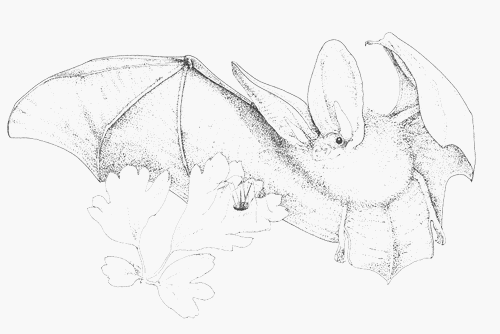
Long-eared bat (Plecotus auritus) gleaning harvestman

Long-eared bat gleaning harvestman

One of the photos in the colour section in the middle of the book shows a Daubenton’s bat mirrored in smooth water, having just scooped up prey from the surface. Other photos show other species roosting, perching, or in flight, but the book also has excellent black-and-white illustrations mixed with the text, hand-drawn using a speckled or pointillist technique that suits bats very well. I particularly like the drawings on pages 48, 67 and 101. The first shows a long-eared bat, Plecotus auritus, “gleaning”, or snapping up, a “harvestman” (a long-legged relation of the spiders) from a leaf (ch. 3); the second shows a “male noctule calling from his tree roost to attract mates” (ch. 3); and the third shows a tawny owl trying to catch another long-eared bat (ch. 4).

Owls could be called the avian equivalents of bats: they’re specialized nocturnal hunters with very sharp hearing, but I think they’re both less interesting and more attractive. Bats, with their leathery wings, sometimes huge ears, and oddly shaped noses, are strange rather than attractive and some people find them repulsive. But some people, or peoples, find them divine or lucky: the introduction describes the Mayan bat-god Zotz, with his leaf-shaped nose modelled on that of the phyllostomids, or vampire bats.[8] The Chinese use a ring of five bats to symbolize the “five great happinesses: health, wealth, good luck, long life and tranquillity.”[9] Altringham blames the less positive image of bats in European cultures partly on Bram Stoker’s Dracula, which was first published in 1897. Before then, he says, “bats were not linked with witches, vampires and the evil side of the supernatural in any significant way.”[10] Dracula may have done for bats what the novel Jaws (1974) and its cinematic offspring did for sharks: encouraged human beings to harm the animal fictionally and falsely depicted as villainous.

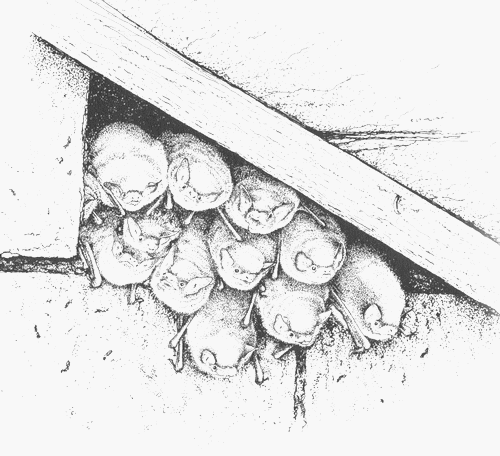
Daubenton's bats (Myotis daubentonii) in a summer roost

Roosting Daubenton’s bats

If so, British Bats is partly redressing the balance. You can learn a lot from this book about both biology in general and bat-biology in particular. It stimulates the mind, pleases the eye, describes the appearance, ecology, and range of all British species, and points the way to further reading and research. So let’s not hear it for John D. Altringham! Without specialized equipment, that is, but that equipment is getting cheaper and more widely available all the time: you don’t have to be a professional zoologist to record and analyse bat-calls any more. There is still a lot for zoologists, both amateur and professional, to learn about bats. Okay, some of the research – like fitting miniature radio-transmitters to wild bats – seems intrusive and smacks of Weber’s Entzauberung, or “disenchantment”, but the more we know about bats, the more we will be able to help conserve them and their habitats. Bats aren’t villains: cats are. I like both kinds of mammal, but I hope we can find some way in future to help stop the latter preying so heavily on the former. If this book helps publicize the problem, it will be valuable for bat-conservation just as it is already valuable for bat-science. In short, no more brick-bats for Brit-bats: we should control our cats better.

Reviewer’s note: Any scientific mistakes, misinterpretations or misunderstandings in this review are entirely your responsibility.

NOTES

1. sp = species, singular; spp = species, plural.

2. ch. 3, “The Biology of Temperate Bats”, pg. 40

3. Ibid., pg. 45

4. ch. 4, “An Ecological Synthesis”, pg. 98

5. Ibid., pg. 99

6. Ibid., pg. 71

7. ch. 5, “British Bats, Past and Present”, pg. 117

8. ch. 1, “Introduction”, pg. 10. “Phyllostomid” is scientific Greek for “leaf-mouthed clan”.

9. Ibid., pg. 11

10. Ibid., pg. 9

Damsels and Dragons

If I were asked to nominate a great work of 21st-century art, I would not choose anything by the likes of Damien Hirst or the architect Frank Gehry (responsible for the giant metal midden in Bilbao known as the Guggenheim Museum). Instead, I’d put forward something by Klaas-Douwe B. Dijkstra, Richard Lewington, and British Wildlife Publishing of Gillingham in Dorset. They’re not big names like Hirst and Gehry and they’re not earning big money or exercising big influence. And they’re unlike Hirst and Gehry in another way: they’ve created a genuinely beautiful and intellectually stimulating piece of art.

The art-work is called the Field Guide to the Dragonflies of Britain and Europe (2006). Dijkstra oversees the detailed, expert, and fascinating text, Lewington supplies the detailed, accurate, and beautiful drawings, complemented by photographs of dragonflies and damselflies in the wild. Lots of people don’t know the difference between these two suborders of the Odonata, but their common names reflect their appearance: the Zygoptera, or damselflies, are delicate and fold their wings at rest; the Anisoptera, or dragonflies, are robust and always hold their wings at right angles to their bodies. Both come in a huge variety of colours, pure and mixed, as their common names prove: damselflies include the Azure, the Goblet-Marked, the Orange White-legged, the Scarce Blue-Tailed and the Scarce Emerald; dragonflies include the Green and Mosaic Darners, the Banded, Red-Veined, Scarlet, Violet-marked and Yellow-winged Darters, the Orange-spotted Emerald, and the Four-spotted Skimmer. There’s also Somatochlora metallica, the Brilliant Emerald dragonfly, which looks as though it’s made of bright green metal or enamel.

These rich colours, with the complex venation of their wings, have made the Odonata a popular subject for artists and jewellers: for example, the art nouveau master René Lalique (1860-1945) made dragonfly mascots for cars. Unfortunately, the book doesn’t cover the Odonata in art: it’s a scientific text, a microcosm of the macrocosm of biology. Biology depends on accurate description and classification, so odonatology has a rich vocabulary: antehumeral stripes, arculus, carina, clypeus, diapause, discoidal cell, gynomorph, medial supplemental vein, pronotum, pseudopterostigma, siccation, and so on. Even the segments of the abdomen are numbered, from S1, just below the wings, to S9 and S10 at the tip of the tail, where the females have their almost clockwork genitalia. Males have theirs beneath S2, so mating in the Odonata is a complicated, almost tantric, business, as some of the photographs prove. Nomenclature in the Odonata is a complicated, almost incantatory business: Calopteryx splendens, virgo, xanthostoma; Enallagma cyathigerum; Pyrrhosoma nymphula; Anax parthenope, imperator; Ophiogomphus cecilia; Onychogomphus forcipatus; Libellula quadrimaculata; Sympetrum depressiusculum; Zygonyx torridus.

That nomenclature, and that sex-life, are two of the ways that the Odonata are CASean creatures; that is, their complexity, strangeness, and beauty remind me of the work of “the Emperor of Dreams”, the Californian writer Clark Ashton Smith (1893-1961). The obsessive, minutely detailed nature of the book is CASean too, and some of its subjects might literally be emperors in dreams: the common name of the Anax genus is the Emperors. One of these Emperors answered a CASean question I had as I leafed through the book: distribution tides washed back and forth across the little map of Europe that accompanied each specific description, submerging here Britain and Ireland, there France and Spain, here Germany and Scandinavia, there Greece and Turkey, and sometimes all of them at once.

But the strange, isolated island of Iceland, though included on every map, always seemed redundant, like a wall-flower at the Odonatan dance. “Was it a dragon- and damselfly desert?” I wondered. Then I came across Anax epihippiger, or the Vagrant Emperor: “A. epihippiger is the only dragonfly ever recorded on Iceland.” From the magnificent to the minute, from damselflies in the burning deserts of Morocco to dragonflies amid the frosty volcanoes of Iceland, it’s all here in a book that truly does deserve to represent European civilization in the twenty-first century. But doesn’t, alas.

It’s The Gweel Thing…

Gweel & Other Alterities, Simon Whitechapel (Ideophasis Books, 2011)

Oh no. Say it ain’t so, Shmoe. I thought we’d heard the last of this vile piece-a-shit after his richly deserved execution for hate-crimes – inter alia, he’d claimed that maverick underground editor Dave Kerekes was a M*n *td f*n, that über-maverick gay aesthetician John Coulthart was a G**rd**n-r**d*r, and that post-über-maverick cultural titan Alan Moore had a *ea**. He might, just might, have got away with double-life for those first two crimes against humanity… but fortunately one of the last acts of the righteous New Labour government in Britain had been to pass a law mandating death for any and all forms of pogonophobia. Accordingly, Whitechapel’s attempted genocide against Alan M. earnt him the electric Blair (don’t ask, or you might feel a twinge of sympathy even for a depraved speech-criminal like Whitechapel).

Anyhows, that SHOULDA been the last we’d ever hear of him. No such luck. Either some deluded disciple’s been on the ouija board or the astral, or Whitechapel left material to some deluded disciple for posthumous publication, like a final fetid fart from a putrefying, maggot-infested corpse. It’s difficult to know where to begin hinting at how hateful’n’horrible this book is – “hint” is all I’m gonna do, because I’ve got something Whitechapel obviously never came within a million miles of acquiring, namely, a social conscience. Did you ever read anything and then feel as though you needed to take a looooong shower? Me too. More’n once. But it’s never been as bad as this. I felt as though I needed a shower after the first word of the first sentence of the first story in Gweel. That’s how reprehensible’n’repulsive this book is in terms of issues around feralness’n’fetidity. I’ve read Sade, I’ve read Guyotat, I’ve read Archer – I have never read anything that made me despair of life and humanity the way Gweel did. And still does. I’ll lay it on the line: I am completely and uncompromisingly in favor of absolute and unconditional freedom of speech – except for racists, sexists, and homophobes, natch – but I would gladly see Gweel burned and its ashes ground to powder before being encased in concrete and blasted off for a rendezvous with the all-cleansing fusional furnace of Father Sol himself.

Why? Well, I’m not gonna tell you the worst of what’s within – I’m not even sure I know the worst, given that I couldn’t get some pages unstuck after I threw up on the book halfway thru the second paragraph of that first story – but how’d’ya like these little green apples?:

The suggestion that prime numbers like 17, 31, and 89 could be used as hallucinogenic drugs (as made in the story “Tutu-3”)? Or the suggestion that the digits of √2 somehow encode a Lovecraftian pastiche about two archaeomysteriologists descending to the bottom of the Atlantic in a bathysphere, drinking “whisky-laced coffee” as they go (as in “Kopfwurmkundalini”)? Or how’s about the über-esoteric hidden channel that some prisoner discovers on an old TV and that, left playing overnight, coats his cell in gold-and-scarlet lichen (as in, er, “Lichen”)? And I don’t even like to recall, let alone mention, the microscopic red mite in “Acariasis” and the Martian musings it prompts in another “banged-up” protagonist. As for “Beating the Meat” and “Santa Ana City Jail” – let’s leave it at the titles, shall we? You don’t wanna go there. I have, and I wish to God I hadn’t.

Yeah, I also wish Whitechapel could be brought back to life… and sentenced to death all over again for what he’s done to H.P. Lovecraft, M.R. James, and Ramsey Campbell. As a committed fan of all three, I can’t tell you how horrified and disgusted I was to see their influence all over Gweel. It was like sipping and savoring a glass of fine wine, then discovering that someone had been washing his syphilitic dick in it. And then some. If you try reading this, Jesus will sob on Mary’s shoulder and Satan will high-five Mephistopheles. Trust me. If you possibly can, get the full width of the planet between yourself and any copy of Gweel that survives the sweep that will begin as soon as I’ve dialled my local hate-crime hotline. (Reviewed by Peter Sotos.)