Ave Aves!

Front cover of Collins Bird Guide by Lars SvenssonCollins Bird Guide: The Most Complete Guide to the Birds of Britain and Europe (second edition), text and maps by Lars Svensson, illustrations and captions by Killian Mullarney and Dan Zetterström, with a significant contribution by Peter J. Grant, translated by David Christie and Lars Svensson (HarperCollins, 2009)

A literate musician can read a score and hear a symphony in his head. I wonder whether the mega-minds of the future will be able to do something similar with genomes: read a DNA recipe and see the animal or plant cooked from it. The mega-minds will need to know about the oven, that is, the womb, egg or seed, but then musicians need to know about instruments, not just notes. The code can’t exist in isolation: it needs a world to be realized in and a musician’s mind can mimic that world.

But mega-minds aren’t here yet for genetics, so we have to use books like this to see the product of DNA-recipes. Collins Bird Guide is effectively a genetic cook-book or genomic score, but we don’t see the naked genes, just the dish or symphony cooked or played from them. Lars Svensson describes thousands of birds of all shapes, sizes, colours, diets and habitats, from the huge golden eagle, Aquila chrysaetos, which can carry off a lamb, to the tiny goldcrest, Regulus regulus, which isn’t much bigger than a bumblebee. But these two, like all other birds, have a common ancestor: when you see a bird sitting in a tree, it is also, metaphorically speaking, sitting in a genetic tree whose twigs, branches and boughs spring from a single trunk. One DNA-recipe has turned into many under the influence of natural and sexual selection.

Birds, which often come in very distinct male and female forms, offer lots of good examples of sexual selection. One of the most spectacular examples isn’t native to the region covered by the book, but it has been introduced here. And so there are pleasant surprises in store for some European ornithophiles. I once came across a wild-living golden pheasant, Chrysolophus pictus, early one morning in a park in northern England. I thought for a moment that I was hallucinating: the bird has a crest of spun gold, a scarlet breast and belly, and an orange/black “nuchal cape”, or neck-feathers, that “can be raised like a fan when displaying” (“Partridges & Pheasants”, pg. 59). It also has yellow legs, blue wings and a long, attractively patterned tail. “Unmistakable!” notes the book.

That’s true of the ♂, at least. The ♀, whose eyes and brain are responsible for the spectacular appearance of the ♂, is undistinguished and similar to the ♀ of Lady Amherst’s pheasant, Chrysolophus amherstiae, whose ♂ is again “Unmistakable!”, thanks to the sexual selection of its ♀. These closely related species are native to eastern Asia and “occasionally hybridize” in Britain (pg. 59). In other words, their common ancestor was fairly recent and their DNA recipes can still work together. But these hybridizations may also be a function of small populations and restricted habitat in Britain. “Function” is the operative word: birds, like all other forms of life, are mechanisms with inputs, throughputs and outputs. For a pheasant, some of the input is sense-data. The throughput is the processing of sense-data in the brain. The output is behaviour: for example, mating with a less-than-ideal partner under the restricted conditions of Britain.

All this can be modelled mathematically, but in the widest and deepest sense it already is mathematical: the human invention of mathematics, with a small “m”, is a symbolic representation of Mathematics with a big “M”. Mathematical symbols represent entities and operations and are manipulated according to logical rules. This mimics the inter-play of entities in the real world, which are subject to the rules of logic implicit in physics and chemistry. Human mathematics is fallible, albeit self-correcting. The mathematics underlying reality realizes the pipe-dreams of the papacy and is infallible, in the sense that it never disobeys the rules by which it is governed.

But this infallible mathematics can fail the entities for whom it operates: birds can die young and fail to reproduce or have fewer offspring than their competitors. But this is the fuel of a larger mechanism: evolution, which is a mathematical process. Genes mutate and vary in frequency under the influence of natural and sexual selection, inter alia. Birds offer more good examples of the effects, because they have wings, beaks and feet. These are mathematical mechanisms, shaped by and for the physics of a particular environment: wings have input from the air and provide the output of flight. Or the output of swimming: some wings are adapted for movement underwater, as in the cormorants, or Phalacrocoracidae, whose beaks are adapted for seizing fish and feet for paddling.
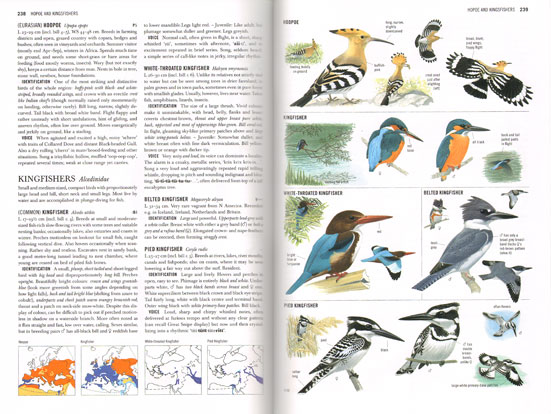
Sample page from Collins Bird Guide by Lars Svensson

You can look through this book and survey the varying geometry of wings, beaks and feet, from gliding gulls to hovering warblers, from seed-cracking finches to flesh-tearing owls, from tiny-toed swifts to wading egrets. The tool-kit of the common ancestor has become many tool-kits and evolution has been morally neutral as it has worked its multiplicative magic. The feet of the odd and endearing wallcreeper, Tichodroma muraria, are adapted to clinging onto vertical rock; the feet of eagles and owls are adapted to puncturing nerve-filled flesh. And presumably each species enjoys using its adaptation. A distinct psychology will accompany each distinct wing, beak and foot, because no organ can change in isolation: it is evolving within the environment of the body, influencing and influenced by other organs, in particular the brain.

But changes in the brain aren’t easily visible. If they were, some parts of evolution would be much less controversial: racial differences in human intelligence, for example. But races differ in other ways: in their attitudes to animals, for example. One generalization is that northern Europeans like listening to songbirds and southern Europeans like shooting them. So it’s not surprising that this book was originally published in Swedish as Fågelguiden, Europas och Medelhavsområdets fåglar i fält (1999). It would also be interesting to see the statistics of ornithological publishing in Europe. Those statistics will reflect genetic differences in the white European race, and so will readers’ reactions to the book.

My interest is partly aesthetic and mathematical, for example, and I quail at the thought of learning the differences between what bird-watchers call “little brown jobs”: the various kinds of warbler are hard enough to tell apart in pictures, let alone in the wild. But things can get even worse at night: Lars Svensson notes of Savi’s warbler, Locustella luscinioides, that “A possible confusion risk at distance and at night in S and C Europe is the mole-cricket” (“Warblers”, pg. 318). Birdsong and bird-cries are another aspect of ornitho-mathematics, but it’s hard to represent them in print: “kru-kih karra-kru-kih chivi trü chivi chih” (clamorous reed warbler, Acrocephalus stentoreus, pg. 322), “glipp-glipp-glipp” (common crossbill, Loxia curvirostra, pg. 386), “trrsh, trre-trre-trre-rrerrerre” (sand martin, Riparia riparia, pg. 258), “pyük…popopo…” (pygmy owl, Glaucidium passerinum, pg. 226), “brrreep, bip bip bip” (red phalarope, Phalaropus fulicarius, pg. 162), and so on.

In an electronic manual of ornithology, you’d be able to hear the songs, rather than imagine them, but electronic manuals, by offering more, in some ways offer less. Because the book has so many species to cover, it can’t describe any species in detail. So there are occasional fleeting comments like this:

Asian Desert Warbler, Sylvia nana V*** [= rare vagrant in northern Europe]… has the peculiar habit of sometimes “tailing” the Desert Wheatear [Oenanthe deserti] (“Warblers”, pg. 310-1)

The accompanying illustration shows a desert warbler standing under a small bush and peering out at a nearby wheatear. It’s anthropomorphic and anthropocentric to be amused by the behaviour, but ornithology is a human invention and humans don’t have to be purely scientific. I get a boy-racer thrill from another “V***” bird, the white-throated needletail, Hirundapus caudacutus:

Big, with heavy compact body, neckless, stub-tailed (shape somewhere between fat cigar and “flying barrel”). Flight impressively fast, the bird seems to draw easily away from other swifts (though these are still fast flyers!). (“Vagrants”, pg. 415)

That I would like to see. In the meantime, I have this book and the multiplex mutational mathematics it captures in pictures and words.

Vapor Tales

Frogs: Inside Their Remarkable World, Ellin Beltz (2005)

Everyone say “eye”. Because I think that is one of the most important reasons that frogs and toads are so endearing. Their large eyes and their large mouths make them seem full of character and full of interest in the world. Their four limbs and plumpness are important too, I think, and I suspect that looking at them activates some of the same regions of the brain as looking at a baby does. All that would certainly help explain why we like them. The Californian herpetologist Ellin Beltz doesn’t spend long examining the roots of the human affection for and interest in the batrachians, as frogs and toads are called. “Is it perhaps that frogs look and act rather like people?” she asks and then gets on with the science. But she herself is obviously a dedicated batrachophile and she’s written an interesting and exhaustive introduction to what is indeed a remarkable world. There are frogs smaller than a human fingernail, like Psyllophryne didactyla, the gold frog of southeastern Brazil, and frogs larger than a human head. Or one species larger than some heads, anyway: Conraua goliath, the goliath frog of Cameroon. There are also frogs, the Malaysian Rhacophorus spp.,* that fly, or glide, at least, on the extended webbing between their toes, and frogs that literally stick around for sex: “males of the genus Breviceps from southern Africa” have very “short front legs” and “use special skin secretions to glue themselves onto the females” (pg. 149). Elsewhere, the Australian desert spadefoot toad, Notaden nichollsi, uses a “smelly skin secretion” to ward off predators (pg. 58).

(*Sp. = species, singular; spp. = species, plural.)

Front cover of Frogs by Ellin Beltz

That species isn’t very dangerous, but the much smaller poison-arrow frogs of South America definitely are: “the golden dart frog, Phyllobates terribilis, is credited with producing ‘the most toxic naturally occurring substance’ ” (pg. 147). In captivity, deprived of the wild food from which they manufacture their toxins, the poison-arrow frogs are harmless, but their remarkable colours remain: they look like harlequins in all shades of the rainbow. Whether these rainbow frogs are also raines beaux, or “beautiful frogs”, as they might be called in French, is a matter of taste, but some frogs definitely are beautiful. So are some toads: the male golden toad, Bufo periglenes, is a vivid golden-orange. Or rather, was: it was once a tourist attraction as it swarmed “out to mate in great congregations” in the Monteverde Cloud Forest Reserve in Costa Rica, but “photographs seem to be all that remains of this exquisite amphibian” (pg. 43). Yes, the ugliness in this book isn’t supplied only by the villainous-looking cane toad, Bufo marinus, which has been munching and poisoning its way through Australia’s native wildlife since it was foolishly introduced there in 1935. There’s also ugliness in the story of what is happening to the world’s amphibians. They’ve been disappearing everywhere and most of chapter four, “Environment & Adaptation”, is given over to the threats they face from pollution, bacteria, viruses, and various fungi, including the chytrid fungus responsible for “chytridiomycosis, a fatal fungus disease that leads to thickening and sloughing of the skin and death by unknown causes” (pg. 118).

African clawed frogs, Xenopus spp., are “asymptomatic carriers” of chytrid fungus. Because they were once used in pregnancy tests, they have been introduced all over the world and may have helped the fungus spread. However, the ever-growing human population is perhaps the greatest threat to the survival of wild amphibia, as it is to fauna and flora in general. More people mean more roads and more cars, for example:

Roadkill numbers are immense. Frogs don’t even have to be hit by a vehicle; the force of its passing can literally suck them inside out. Hundreds of flattened and inverted corpses lie roadways on rainy nights. (pg. 121)

Some species may be disappearing without ever being recorded. Perhaps the strangest and unfroggy-est frog in this book is Nakisakabatrachus sahyadrensis, the Kerala purple frog of southern India, which has tiny eyes and dark, leathery skin. It lives underground most of the year and was only described by scientists in 2003. Its tiny eyes are part of its adaptation to underground life. Eyes are a guide to ecology in other ways: a batrachian’s angle of vision is a clue to its edibility. Frogs, whose eyes are usually positioned so they can see both ahead and behind, are edible and fear predators. Toads, which usually can’t see behind themselves, are inedible and don’t fear predators. I can remember once picking up a tiny toadlet, or juvenile toad, and feeling my fingers sting from the secretions it released. Among Beltz’ personal anecdotes in this book is one about what happened when she and a colleague found a Couch’s spadefoot toad, Scaphiopus couchii, on the U.S.-Mexico border:

It was drizzling, and I brought the toad into the car for a good identification. We were paging through the field guide and put on the defoggers to clear the windows when we were overcome by a wave of noxious vapor emitted by the toad. It was like teargas and we exploded out of the car, put the toad into a ditch and tried to air out the car. Whatever toxin the toad let loose that night, I was down for 24 hours, sleeping with runny eyes and all the symptoms of a major cold. My colleague was similarly affected. Other reports of noxious fumes from southwestern toads have been [made]. (“Frog Miscellany”, pg. 149)

Stories like that are part of what makes this such an enjoyable book and although, at 175 pages with lots of large photos, it’s too brief to explore thoroughly all the biological topics it raises, there are pointers to some interesting aspects of evolution – and mathematics. Try this description of the Eastern spadefoot, Scaphiopus holbrookii, and plains spadefoot, Spea bombifrons, which live in deserts in North America:

When the rains fall, they congregate at temporary pools to breed. It takes the eggs two weeks to hatch into tadpoles. At this point, more rain is needed; otherwise the pools dry up and the plant-eating tadpoles die. Some tadpoles become cannibalistic under these harsh conditions, permitting some individuals to survive long enough to transform into frogs by eating the bodies of their herbivorous relatives. (ch. 2, “Frog Families”, pg. 37)

Consider the evolutionary mathematics of this cannibalism. It’s easy to understand genes instructing an individual to eat. Less easy to understand are genes that might instruct an individual to let itself be eaten. But the tadpoles in a temporary pool can be seen as a kind of super-organism. The super-organism initially has many mouths to turn algae and so on into tadpole-flesh. Then, as the pool shrinks, the super-organism begins to eat itself, having exploited the resources of the pool with maximum efficiency. It’s possible there is even a class of tadpole that exists to put on flesh fast and then be eaten by its siblings. It would never breed, but evolutionarily speaking that behaviour would be no more paradoxical than the sterile workers among ants, bees and wasps. Or the juvenile birds that let themselves starve to death in an over-crowded, underfed nest. The apparently suicidal genes of a cannibalized tadpole or sterile worker or starved nestling do not survive in that non-breeding individual, but they promote behaviour that enables unactivated copies of themselves to survive better in other individuals – as Richard Dawkins explains in The Blind Watchmaker (1986).

Swimming in another kind of pool is responsible for other evolved features in batrachians: their sometimes vivid colours or cunning camouflage. For millions of years, images of batrachians have been created in the chemical sludge of predators’ brains. And so, like snakes and wasps, batrachians signal their toxicity with colour. Or use colour to disguise their outlines or blend into the background. But batrachians are also like octopuses and other cephalopods: they can change their colour using special structures in their skin called chromatophores. One of the briefest but most interesting sections in this book discusses this shade-shifting and the cells responsible for it: the melanophores (responsible for black and brown colouration), xanthophores (yellow), erythrophores (red and orange), and iridophores (responsible for iridescence in the poison-arrow frogs). But what is briefly mentioned is extensively illustrated: almost every page has one or more colourful photographs of frogs and toads, usually in what appears to be their natural habitat.

There are also diagrams of batrachian anatomy and evolutionary relationships and pictures of art and sculpture in chapter five, “Frogs in Myth and Culture”. You’ll learn in the evolutionary discussions that toads aren’t a distinct group, because they don’t have a single common ancestor distinguishing them from frogs. But they look different to us and chapter five says that they were sacred to Heqet, the Egyptian goddess of childbirth and fertility. She’s depicted with an almost scientifically precise green toad, or Bufo viridis, on an ivory obstetric wand found near Thebes and dating from “around 2000 to 1700 BCE” (pg. 131). That “BCE”, like the “humanmade objects” mentioned on page 47, is a reminder that Ellin Beltz is a modern, and politically correct, American, unlike a Californian born in the Victorian era whose absence can’t, alas, be called a flaw in this book. The Auburn writer Clark Ashton Smith (1893-1961) and his interplanetary toad-god Tsathoggua and man-slaying toad-witch Mère “Mother of Toads” Antoinette aren’t famous and Beltz may never have heard of them. Instead, she discusses Shakespeare and the three toad-toxin-brewing witches of Macbeth (1611), Mark Twain and “The Celebrated Jumping Frog of Calaveras County” (1867), and Kenneth Graham and Toad of Toad Hall from Wind in the Willows (1908).

In short, she covers all the batrachian bases, from biology to books by way of batrachophagous bats and a bee-eating Bufo japonicus. The batrachophage, or frog-eater, is the fringe-lipped bat, Trachops cirrhosus of Central America, which tracks its prey by homing in on their calls. And here’s another acoustic anecdote to end on, demonstrating that Hollywood’s hegemony is partly herpetological:

Chorus frogs, Pseudacris spp., include the Pacific treefrog, Pseudacris regilla, the “ribbet frog” known to every movie fan. At some time in the early days of talkies, someone recorded frogs in a pond, probably near the famous Hollywood sign. The same audio loop is used over and over again in movies, leading to hysteria among amphibian researchers who hear “ribbet” in darkest Africa, South America and Australia… The Pacific treefrog is actually restricted to the western edge of North America. (ch. 2, “Frog Families”, pg. 49)

Spin: The Beginning

Spiders, Michael Chinery, with illustrations by Sophie Allington (1996)

Spiders are special: they spin. And they’ve been doing so for millions of years. Their speciality is the root of their name: spider is from Middle English spither, meaning “spinner”. The root is even more obvious in German: Spinne. Not all languages call spiders spinners, but then not all spiders obviously spin. Some don’t make webs, though “all species protect their eggs by packing them in silken cocoons” (pg. 24). Not all spiders use venom either, but all of them are predators, mostly on insects and other arthropods, sometimes on larger prey like lizards, birds, and even fish. That is another part of what is interesting about them: like all predators, they are lurkers on the threshold between life and death. Spiders are dedicated death-dealers and sophisticated slayers. To see that dedication and sophistication in action, just watch a spider spinning its web. It will be using a minute brain to follow complex but flexible rules, because invariable webs would not fit an variable world. This is why spiders, like human beings, need nervous systems: web-making is an instinct, laid down in the genes, but instincts have to be triggered and adjusted according to the messages in sense-data.

Front cover of Spiders by Michael Chinery, illustrated by Sophie Allington

One thing needing adjustment is the kind of silk used: you’ll learn from this book that in most species “individuals possess between three and six different kinds of silk” (pg. 25). It ranges from pyriform and ampullate silk, extruded from the “anterior spinneret” and used for webs and life-lines, to aggregate and flagelliform, extruded from the “posterior spinneret” and used, inter alia, for the sticky threads of orb-spiders’ webs. There’s also cribellate silk, produced by the cribellum, or “little sieve”, a special organ in the cribellate spiders:

The cribellate spider produces perfectly normal silk from its spinnerets and then covers them with the cribellum silk, which is brushed from the cribellum by a compact patch of bristles, called the calamistrum [Latin for “curling-iron”], on each hind leg. Each bristle carries several rows of microscopic teeth and acts like a minute hair brush. The cribellum silk forms ribbons but, because the legs vibrate rapidly when brushing, the individual threads – only 0.000015mm in diameter – are thrown into microscopic loops… Any insect unfortunate to touch the ribbons quickly gets its feet entangled in the loops and is held fast – without any glue. (“Spider Silk”, pg. 28)

Sticky aggregate silk is a chemical solution to the problem of catching prey; entangling cribellate silk is a physical one. Neither has been consciously designed: evolution did the work by selecting and rejecting millions of individuals down millions of generations. It’s important, and awe-inspiring, to remember that spiders and humans have a common ancestor that didn’t use silk. The spider-line, step by unconscious step, perfected the manufacture and manipulation of silk; our line, step by less unconscious step, perfected the manufacture and manipulation of mind. That’s why human beings write books about spiders and not vice versa. But both lines, the arachnid and the human, were undertaking a mathematical journey: we followed complicated trajectories in multi-dimensional information-space, or rather our genes did. Natural selection, and its odder and sometimes antagonistic cousin sexual selection, are editors of a microscopic text called DNA, which lays down recipes for brains, bodies, and behaviour.

Most natural history books describe what is cooked by DNA, not the genetic recipe itself, but then the cooked product is the most obvious thing and what we’ve been familiar with longest. But all biology, whether it’s studying bats or beetles, frogs or fungi (or dragonflies), is about evolutionary variations on an organic theme. DNA is like a giant recipe-book or giant musical score: each species is a particular dish or particular melody. Higher biological divisions are like styles or genres: spiders taste or sound similar, as it were, and they harmonize with scorpions, mites, and ticks, other eight-legged members of the class Arachnida. But the harmonies extend further and terrestrial life can be seen as a giant symphony played by the orchestra of evolution. If we discover life away from the earth, we’ll find it playing a half-familiar tune: mathematics, the Magistra Mundi, or Mistress of the World, will have been waving her baton there too and Richard Dawkins suggests that Darwinian evolution may be a universal principle, as the only means for life to arise from inanimate matter.

Or the only means until we can create life ab novo, that is: human beings are on the verge of being able to synthesize life from chemicals. Intelligent design, a fantasy of the anti-Darwinists, will soon become a reality in human laboratories. It will be further proof of the praeternatural nature of humanity, but this book provides proof of that too. Pages sixty-four to sixty-five, for example, illustrate the arachnid instinct of web-making using the human skill of drawing. One of the attractions of the book is that, apart from a photograph of the yellow-and-black orb-spider, Argiope bruennichi, on the front cover, all the illustrations are hand-drawn, from the anatomical cross-section of a typical spider on page twenty-three to the “balletic courtship dance of a jumping spider” on page eighty-seven. You can admire the sophistication of Sophie Allington’s drawings rather in the way you admire the sophistication of a spider’s web, though the credit of a human’s abilities generally accrue to the individual, rather than to the species. But is drawing a Darwinian activity like web-making? That is, is it a means of enhancing the survival of an individual and the transmission of the individual’s genes? One big difference between drawing and web-spinning, of course, is that not all human beings draw or create other forms of art. And human beings will not have specific genes for drawing in the way that we have specific genes for language. Which is another praeternatural part of human nature: all other forms of life use a symbolic code to survive, because DNA is a symbolic code, but human DNA allows us to use a second symbolic code, language – and sometimes a third, mathematics.

The mathematics in this book is implicit, but Michael Chinery supplies the explicit language. Although his prose is not as obviously and powerfully admirable as the illustrations, it provides the most meat for the mind and the imagination:

Bolas spiders, also called angling or fishing spiders, live in North and South America, Africa and Australasia. Odd-looking creatures whose squat bodies are often studded with horns and “warts”, they are among the very few araneid spiders whose bites are potentially dangerous to people. Typified by Australia’s Dichrostichus magnificus, commonly known as the magnificent spider, they cling motionless to leaves and twigs by day and don’t stir till nightfall. Hanging from a short thread attached to the underside of a twig, each spider pulls out a “fishing line” about 5cm (2 inches) long and carrying one or more blobs of very sticky glue. Whirling the line about with one of its legs, the spider waits for a moth to take the bait. This seems a bit of a hit-and-miss method, and pretty tiring as well, but the spider has a secret weapon in its armoury – a scent just like that released by certain female moths. The male moths can’t resist it and come flocking to the spider’s line… The bolas spider does not usually need to whirl its line around for more than a few minutes each evening. (“Finding Food”, pg. 71-2)

This hunting technique is ingenious, effective, and entirely undesigned: lying isn’t confined to human beings, because this type of spider is lying with a chemical, rather as human fisherman lie with baited hooks. Other spiders fish more literally: the European aquatic spider, Argyroneta aquatica, “inhabits ponds and slow-moving streams all over the temperate regions of Eurasia” (pg. 48-9). It builds a “domed web” underwater, fills it with air from the surface, and uses it as a base for hunting and chamber for feasting: “water would dilute the digestive enzymes poured onto the prey if the spider tried to dine in the water” (pg. 49). But digestive enzymes don’t just help spiders feed: they help spiders overwhelm their food. Like snake venoms, spider venoms are a kind of super-charged saliva, designed to deal death rather than simply help with digestion. Webs are not complete solutions to the problems of predation: large insects can break free, given time, or fight back when cornered. Venom is a force-multiplier, or rather a force-nullifier. And it is a sinister thing to see in operation, as a non-scientific observer of spiders, John Betjeman (1906-84), described in his poem “The Cottage Hospital”:

…Apple and plum espaliers
   basked upon bricks of brown;
The air was swimming with insects
   and children played in the street.
Out of this bright intentness
   into the mulberry shade
Musca domestica (housefly)
   swung from the August light
Slap into slithery rigging
   by the waiting spider made
Which spun the lithe elastic
   till the fly was shrouded tight.
Down came the hairy talons
   and horrible poison blade
And none of the garden noticed
   that fizzing, hopeless fight.

(from A Few Late Chrysanthemums, 1954)

The beauty of a web, and sometimes of the web-mistress too, combine unsettlingly with the deadliness of its purpose: spiders are like tiny vampires. But they aren’t very dangerous to man and it’s puzzling that one of the commonest phobias, arachnophobia, should be inspired by them. There are a lot of arachnophobes in countries that don’t have dangerous spiders and their phobia can seriously affect their lives. Is it an exaggeration of an instinct that was written into our brains long ago, when we were smaller and more vulnerable creatures living in the tropics? Perhaps. I like the idea that human beings have records of spiders not just in our books and idioms, but in our DNA too, transmitted from generation to generation since we left the trees of Africa. For example, I like and am fascinated by spiders, but I am still startled if I see a large spider unexpectedly close at hand, even though I know that no species in Britain is dangerous and that none will bite without being provoked.

But fear is a potent, and piquant, spice at the spider-feast. Spiders are like snakes and sharks: interesting in part because they are associated with pain, injury, and death. This book discusses that aspect of their natural history and much more beside. Its chatty text and attractive illustrations make it an excellent introduction to a strange and wonderful family of animals, and to biology and evolution in general. Spiders have existed long enough and widely enough to have diversified into all manner of ecological niches, from parasitism to mimicry. Some spin silk, some squirt it. Some catch prey, some steal it. Meet them all in this set of symbols and codes.