
Bri’ on the Sky

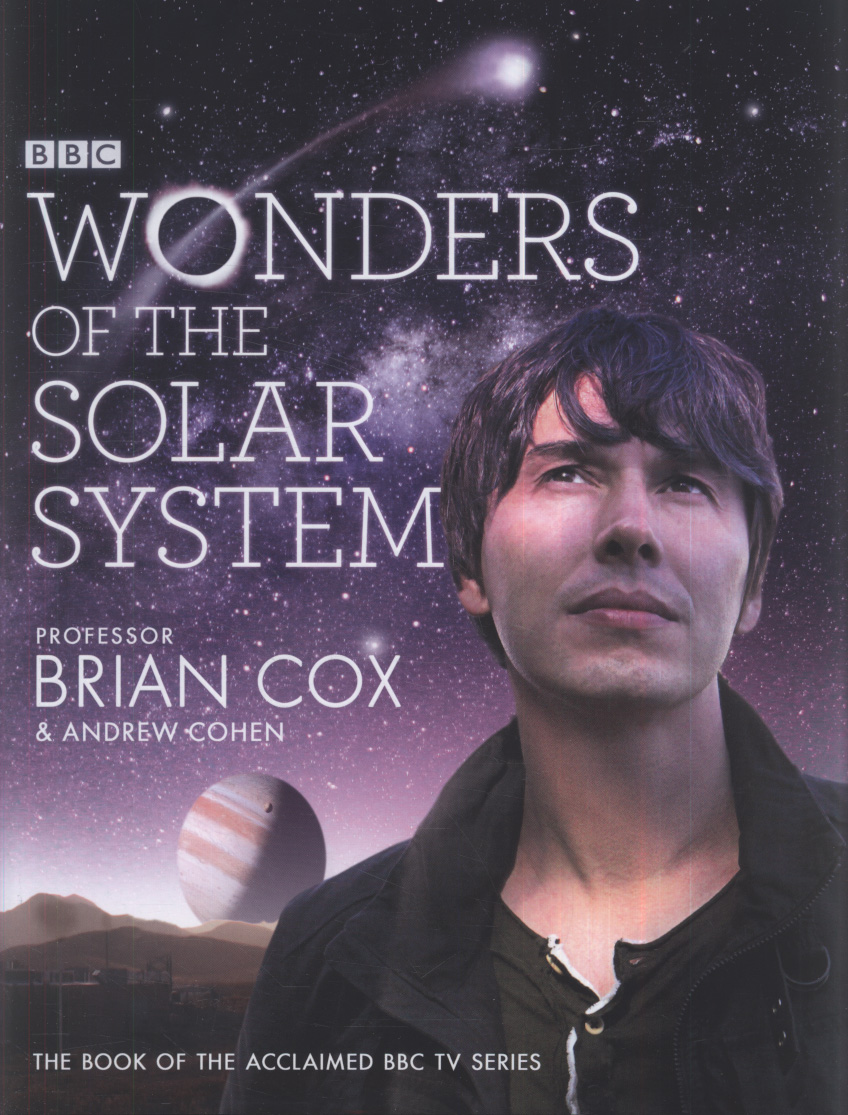
Front cover of Wonders of the Solar System by Brian Cox and Andrew Cohen

Bri’ Eyes the Sky

Wonders of the Solar System, Professor Brian Cox and Andrew Cohen (Collins 2010)

One of the most powerful images in this book is also one of the most understated. It’s an artist’s impression of a dim star seen over the curve of a dwarf-planet called Sedna. The star is a G-type called Sol. We on Earth know it better as the sun. Sedna is a satellite of the sun too, but it’s much, much further out than we are. It takes 12,000 years to complete a single orbit and its surface is a biophobic -240°C. It’s so distant that sunrise is star-rise and it wasn’t discovered until 2003. But the sun’s gravity still keeps it in place: one of the weakest forces in nature is one of the most influential. That’s one important message in an understated, crypto-Lovecraftian image.

Sedna has been there, creeping around its dim mother-star, since long before man evolved. It will still be there long after man disappears, voluntarily or otherwise. This frozen dwarf is a good symbol of the vastness of the universe and its apparent indifference to life. We don’t seem to interest the universe at all, but the universe certainly interests us. Wonders of the Solar System is a good introduction to our tiny corner of it, describing some fundamentals of astronomy with the help of spectacular photographs and well-designed illustrations. You can learn how fusion powers the sun, how Mars lost its atmosphere and how there might be life beneath the frozen surface of Jupiter’s satellite Europa. The text is simple, but not simplistic, though I think the big name on the cover did little of the writing: this book is probably much more Cohen than Cox. Either way, I enjoyed reading the words and not just looking at the pictures, all the way from star-dim Sedna (pp. 26-7) to “Scars on Mars” (pp. 220-1) by way of “The most violent place in the solar system” (pp. 198-9), a.k.a. Jupiter’s gravity-flexed, volcano-pocked satellite Io.
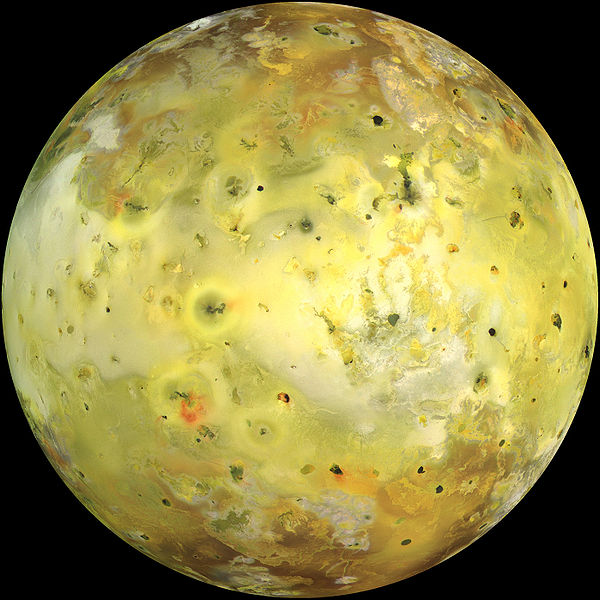
Pockmarked moon -- the Galilean satellite Io

Pockmarked moon — the Galilean satellite Io

Everything described out there is linked to something down here, because that’s how it was done in the television series. Linking the sky with the earth allowed the BBC to film the genial and photogenic physicist Brian Cox in various exotic settings: Hawaii, India, East Africa, Iceland and so on. I’ve not seen any of Cox’s TV-work, but he seems an effective popularizer of science. And the pretty-boy shots here add anthropology to the astronomy. What is the scientific point of Cox striding away in an artistic blur over the Sahara desert (pg. 103), staring soulfully into the distance near the Iguaçu Falls on the Brazilian-Argentine border (pg. 37) or gazing down into the Grand Canyon, hips slung, hands in pockets (pg. 163)? There isn’t a scientific point: the photos are there for his fans, particularly his female ones. He’s a sci-celeb, a geek with chic, and we’re supposed to see the sky through Bri’s eyes.

But he’s also a liberal working for the Bolshevik Broadcasting Corporation, so he’ll be happy with the prominent photo early on: Brian holding protective glasses over the eyes of a dusky-skinned child during a solar eclipse in India. The same simul-scribes’ Wonders of Life (Collins 2013), another book-of-the-BBC-series, opens with a similarly allophilic allophoto: a dusky-skinned Mexican crowned in monarch butterflies. This is narcissistic and patronizing, but the readiness of whites to “Embrace the Other” helps explain science, because science involves looking away from the self, the tribe and the quotidian quest for status and survival. Of course, Cox and Cohen would gasp with horror at the idea of racial differences explaining big things like science and politics. Cox would be sincere in his horror. I’m not so sure about Cohen.

But there are wonders within us as well as without us and though you won’t hear about them on the BBC, the tsunami of HBD, or research into human bio-diversity, is now rolling ashore. It will sweep away almost all of Cox’s and Cohen’s politics, but leave most of their science intact. It isn’t a coincidence that the rings of Saturn were discovered by the Italian Galileo and explained by the Dutchman Huygens and the Italian Cassini, or that the photos of Saturn here were taken by a space-probe launched by white Americans. But the United States has much less money now for space exploration. That’s explained by race too: as the US looks less like its founders, it looks less like a First World nation too. It’s fun to see the world through Bri’s eyes, but he’s careful not to look at everything that’s out there.

Spiral Archipelago

Incomplete map of Earthsea

Incomplete map of Earthsea

Ursula K. Le Guin, creatrix of Earthsea, is a much better writer than J.R.R. Tolkien, creator of Middle-earth: much more subtle, skilful and sophisticated. But for me Middle-earth has one big advantage over Earthsea: I can imagine Middle-earth really existing. I can’t say that for Earthsea, an archipelago-world of fishermen, goatherds and wizards. There’s something dead and disconnected about Earthsea. I’m not sure what it is, but it may have something to do with Le Guin’s dedicated political correctness.

For example, despite the northern European climate and culture on Earthsea, a sea-faring world with lots of rain, mist, snow and mountains, most of the people are supposed to have dark skins. The ones that don’t – the white-skinned, blond-haired Kargs – are the bloodthirsty baddies of A Wizard of Earthsea (1968), the first book in the series. Balls to biology, in other words: there’s propaganda to propagate. So it’s not surprising that Le Guin’s father was a famous and respected figure in the mostly disreputable discipline of anthropology. Earthsea is fantasy for Guardian-readers, in short.

But I still like the idea of an archipelago-world: sea and islands, islands and sea. As Le Guin herself says: “We all have archipelagos in our minds.” That’s one of the reasons I like the Ulam spiral: it reminds me of Earthsea. Unlike Earthsea, however, the sea and islands go on for ever. In the Ulam spiral, the islands are the prime numbers and the sea is the composite numbers. It’s based on a counter-clockwise spiral of integers, like this:

145←144←143←142←141←140139←138←137←136←135←134←133
 ↓                                               ↑
146 101←100←099←098←097←096←095←094←093←092←091 132
 ↓   ↓                                       ↑   ↑
147 102 065←064←063←062←061←060←059←058←057 090 131
 ↓   ↓   ↓                                  ↑   ↑
148 103 066 037←036←035←034←033←032←031 056 089 130
 ↓   ↓   ↓   ↓                       ↑   ↑   ↑   ↑
149 104 067 038 017←016←015←014←013 030 055 088 129
 ↓   ↓   ↓   ↓   ↓               ↑      ↑   ↑   ↑
150 105 068 039 018 005←004←003 012 029 054 087 128
 ↓   ↓   ↓   ↓   ↓   ↓       ↑   ↑   ↑   ↑   ↑   ↑
151 106 069 040 019 006 001002 011 028 053 086 127
 ↓   ↓   ↓   ↓   ↓   ↓           ↑      ↑   ↑   
152 107 070 041 020 007→008→009→010 027 052 085 126
 ↓   ↓   ↓   ↓   ↓                   ↑   ↑   ↑   ↑
153 108 071 042 021→022→023→024→025→026 051 084 125
 ↓   ↓   ↓   ↓                           ↑   ↑   ↑
154 109 072 043→044→045→046→047→048→049→050 083 124
 ↓   ↓   ↓                                   ↑   ↑
155 110 073→074→075→076→077→078→079→080→081→082 123
 ↓   ↓                                           ↑
156 111→112→113→114→115→116→117→118→119→120→121→122
 ↓                                                   ↑
157→158→159→160→161→162→163→164→165→166→167→168→169→170

The spiral is named after Stanislaw Ulam (1909-84), a Polish mathematician who invented it while doodling during a boring meeting. When numbers are represented as pixels and 1 is green, the spiral looks like this – note the unique “knee” formed by 2, 3 (directly above 2) and 11 (to the right of 2):

Ulam spiral

Ulam spiral (animated)

(If the image above does not animate, please try opening it in a new window.)

Some prime-pixels are isolated, like eyots or aits (small islands) in the number-sea, but some touch corner-to-corner and form larger units, larger islands. There are also prime-diamonds, like islands with lakes on them. The largest island, with 19 primes, may come very near the centre of the spiral:

island1

Island 1 = (5, 7, 17, 19, 23, 37, 41, 43, 47, 67, 71, 73, 79, 103, 107, 109, 113, 149, 151) (i=19) (x=-3, y=3, n=37) (n=1 at x=0, y=0)

Here are some more prime-islands – prIslands or priminsulas – in the Ulam-sea that I find interesting or attractive for one reason or other:

island2

Island 2 = (281, 283, 353, 431, 433, 521, 523, 617, 619, 719, 827, 829, 947) (i=13) (x=6, y=-12, n=619)


island3

Island 3 = (20347, 20921, 21499, 21503, 22091, 22093, 22691, 23293, 23297, 23909, 23911, 24533, 25163, 25801, 26449, 27103, 27767, 28439) (i=18) (x=-39, y=-81, n=26449)


island4

Island 4 = (537347, 540283, 543227, 546179, 549139, 552107, 555083, 558067, 561059, 561061, 564059, 564061, 567067, 570083, 573107, 573109) (i=16) (x=375, y=-315, n=561061)


island5

Island 5 = (1259047, 1263539, 1263541, 1268039, 1272547, 1277063, 1281587, 1286119, 1290659, 1295207, 1299763) (i=11) (x=-561, y=399, n=1259047)


island6

Island 6 = (1341841, 1346479, 1351123, 1355777, 1360439, 1360441, 1365107, 1365109, 1369783, 1369787, 1369789, 1374473, 1379167) (i=13) (x=-585, y=-297, n=1369783)


island7

Island 7 = (2419799, 2419801, 2426027, 2426033, 2432263, 2432267, 2438507, 2438509, 2444759, 2451017, 2457283, 2463557) (i=12) (x=558, y=780, n=2432263)


island8

Island 8 = (3189833, 3196979, 3196981, 3204137, 3204139, 3211301, 3211303, 3218471, 3218473, 3218477, 3225653) (i=11) (x=-894, y=858, n=3196981)

He Say, He Sigh, He Sow #9 and #10

“One of mighty union-smashing Maggie’s few big mistakes – along with increasing comprehensive education, letting third-world immigration and enforced multiculturalism rip, leaving the NHS and BBC ‘safe in our hands’, smashing the fisheries, selling out the Northern Irish Protestants, increasing welfarism, ending academic freedom and trying to push through the Poll Tax – was to be unfriendly to German reunification.” — Chris Brand, gFactor.


“Homosexual men are nature’s Petri dishes.” — Greg Cochran, West Hunter.