Post-Performative Post-Scriptum…
osmic adj. Of or relating to the sense of smell. Also: relating to odour. [ancient Greek ὀσμή, osmē, smell, odour + ‑ic suffix] — Oxford English Dictionary

Post-Performative Post-Scriptum…
osmic adj. Of or relating to the sense of smell. Also: relating to odour. [ancient Greek ὀσμή, osmē, smell, odour + ‑ic suffix] — Oxford English Dictionary
You can get a glimpse of the gorgeous very easily. After all, you can work out the following sum in your head: 1 + 2 + 3 + 4 + 5 = ?
The answer is… 1 + 2 + 3 + 4 + 5 = 15. So that sum is example of this pattern: n1:n2 = sum(n1..n2). A simple computer program will soon supply other sums of consecutive numbers following the same pattern. I think these patterns based on the pair n1 and n2 are beautiful, so I’d call them fair pairs:
15 = sum(1..5)
27 = sum(2..7)
429 = sum(4..29)
1353 = sum(13..53)
1863 = sum(18..63)
3388 = sum(33..88)
3591 = sum(35..91)
7119 = sum(7..119)
78403 = sum(78..403)
133533 = sum(133..533)
178623 = sum(178..623)
2282148 = sum(228..2148)
2732353 = sum(273..2353)
3882813 = sum(388..2813)
7103835 = sum(710..3835)
13335333 = sum(1333..5333)
17016076 = sum(1701..6076)
17786223 = sum(1778..6223)
I went looking for variants on that pattern. If the function rev(n) reverses the digits of n, here’s n1:rev(n2) = sum(n1..n2):
155975 = sum(155..579)
223407 = sum(223..704)
4957813 = sum(495..3187)
I like that pattern, but it doesn’t seem beautiful like n1:n2 = sum(n1..n2). Nor does rev(n1):n2 = sum(n1..n2):
1575 = sum(51..75)
96444 = sum(69..444)
304878 = sum(403..878)
392933 = sum(293..933)
3162588 = sum(613..2588)
3252603 = sum(523..2603)
3642738 = sum(463..2738)
3772853 = sum(773..2853)
6653691 = sum(566..3691)
8714178 = sum(178..4178)
But rev(n1):rev(n2) = sum(n1..n2) is beautiful again, in a twisted kind of way:
97944 = sum(79..449)
452489 = sum(254..984)
3914082 = sum(193..2804)
6097063 = sum(906..3607)
6552663 = sum(556..3662)
Now try swapping n1 and n2. Here’s n2:n1 = sum(n1..n2):
204 = sum(4..20)
216 = sum(6..21)
20328 = sum(28..203)
21252 = sum(52..212)
21762 = sum(62..217)
23287 = sum(87..232)
23490 = sum(90..234)
2006118 = sum(118..2006)
2077402 = sum(402..2077)
2132532 = sum(532..2132)
2177622 = sum(622..2177)
Do I find the pattern beautiful? Yes, but it’s not as beautiful as n1:n2 = sum(n1..n2). The beauty disappears in n2:rev(n1) = sum(n1..n2):
21074 = sum(47..210)
21465 = sum(56..214)
22797 = sum(79..227)
2013561 = sum(165..2013)
2046803 = sum(308..2046)
2099754 = sum(457..2099)
2145065 = sum(560..2145)
And rev(n2):n1 = sum(n1..n2):
638 = sum(8..36)
2952 = sum(52..92)
21252 = sum(52..212)
23287 = sum(87..232)
66341 = sum(41..366)
208477 = sum(477..802)
2522172 = sum(172..2252)
2852982 = sum(982..2582)
7493772 = sum(772..3947)
8714178 = sum(178..4178)
Finally, and fairly again, rev(n2):rev(n1) = sum(n1..n2):
638 = sum(8..36)
125541 = sum(145..521)
207972 = sum(279..702)
158046 = sum(640..851)
9434322 = sum(223..4349)
The beauty’s back. And it has almost become self-aware. In rev(n2):rev(n1) = sum(n1..n2), each side of the equation seems to be looking at the other half as those it’s looking into a mirror.
Previously Pre-Posted (Please Peruse)…
• Nuts for Numbers — looking at patterns like 2772 = sum(22..77)
«У Менделеева две жены, но Менделеев-то у меня один!» — Царь Алекса́ндр II
• “Yes, Mendeleev has two wives, but I have only one Mendeleev!” — Tsar Alexander II responds to a complaint about Mendeleev’s bigamy
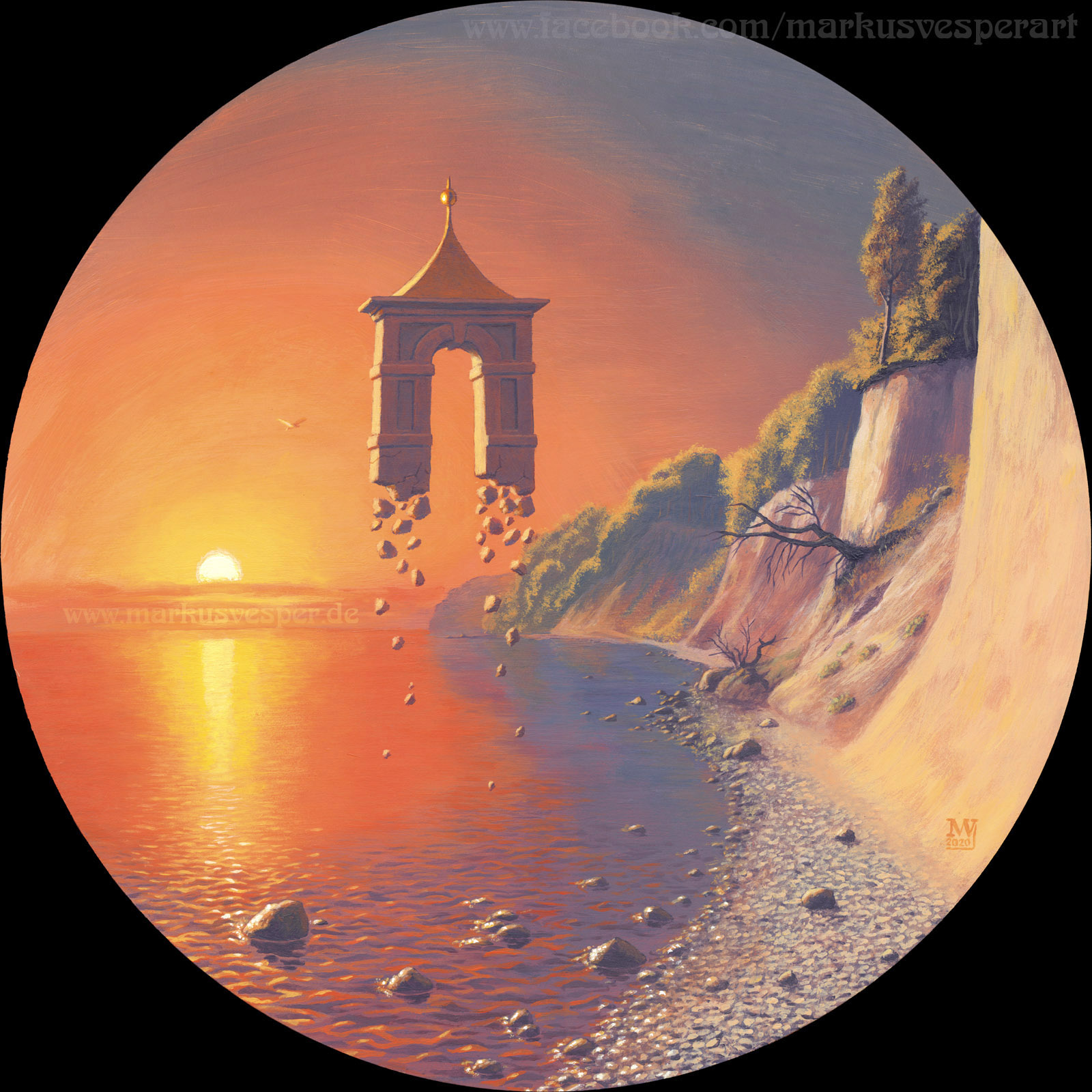
A surreal arch by the German artist Markus Vesper
(click for larger)
 Overlord In Terms of Core Issues Around Maximal Engagement with Key Notions of the Über-Feral