Pallida mors aequo pulsat pede pauperum tabernas
regumque turres. — Quintus Horatius Flaccus, Carmina, I, 4
Pale Death knocks with the same bony fist
At the door of paupers’ huts and kingly towers. — Horace, Odes, I, 4
Pallida mors aequo pulsat pede pauperum tabernas
regumque turres. — Quintus Horatius Flaccus, Carmina, I, 4
Pale Death knocks with the same bony fist
At the door of paupers’ huts and kingly towers. — Horace, Odes, I, 4
From John Julius Norwich’s More Christmas Crackers (1990):
Holorhymes are whole lines which have the same sound but different meanings. For some reason, they seem to go better in French. Louise de Vilmorin gave me two beautiful ones:
Étonnamment monotone et lasse
Est ton âme en mon automne, hélas!And
Gall, amant de la reine, alla tour magnanime,
Gallament de l’arène à la Tour Magne, à Nîmes.This second one is by Victor Hugo.
« Que me proposent-ils là, les imprudents ! Parce que j’ai remué quelques grains de sable sur le rivage, suis-je en état de connaître les abîmes océaniques ? La vie a des secrets, insondables. Le savoir humain sera rayé des archives du monde avant que nous ayons le dernier mot d’un moucheron. » — Souvenirs entomologiques de Jean-Henri Fabre (1823-1915)
— “What do they want from me, those imprudent ones? Because I’ve lifted a few grains of sand on the shore, am I ready to sound the ocean’s depths? Life has secrets, unfathomable secrets. Human knowledge will be erased from the world’s archives before we have the last word on a gnat.”
sun, n., The bright celestial object which is the chief source of natural light and heat on earth and appears to pass across the sky each day from east to west; the central body of the solar system, around which the earth and other planets orbit, and which by its changing position relative to the earth’s axis determines the seasons.
Summary
A word inherited from Germanic.
Cognate with Old Frisian sunne, sonne, senne (West Frisian sinne, North Frisian sen), Old Saxon sunna (Middle Low German sunne), Old Dutch sunna (Middle Dutch sonne, Dutch zon), Old High German sunna (Middle High German sunne, sonne, German Sonne), Old Icelandic sunna (in poetry), Gothic sunno, Crimean Gothic sune,
< a variant of the same Indo-European base as early Scandinavian (runic: Norway) solu (dative singular), Old Icelandic sól, Old Swedish, Swedish sol, Old Danish, Danish sol, Gothic sauil, and also Sanskrit svar (genitive sūraḥ), Old Avestan huuarə̄, ancient Greek ἥλιος, ἠέλιος (Doric ἀέλιος, Cretan ἀβέλιος; compare helio– comb. form), classical Latin sōl, Old Welsh houl (Welsh haul), Old Prussian saule, Lithuanian saulė, all in sense ‘sun’, and Early Irish, Irish súil eye. — Oxford English Dictionary
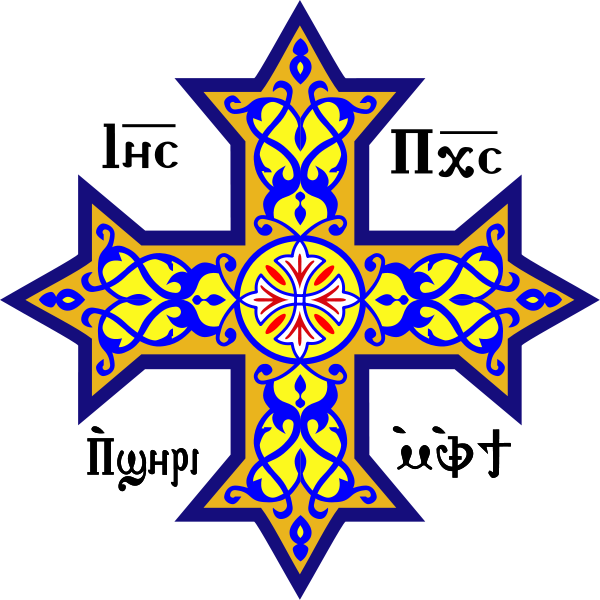
Coptic Cross with abbreviation Ⲓⲏ̅ⲥ̅ Ⲡⲭ̅ⲥ̅ Ⲡ̀ϣⲏⲣⲓ ⲙ̀ⲪϮ standing for Ⲓⲏⲥⲟⲩⲥ Ⲡⲓⲭ̀ⲣⲓⲥⲧⲟⲥ Ⲡ̀ϣⲏⲣⲓ ⲙ̀Ⲫ̀ⲛⲟⲩϯ,
Iêsous Piekhristos Epshêri Emefnouti, “Jesus Christ, Son of God” (see Wikipedia)
Kuching bĕrtandok, “When cats have horns” — Malay proverb used in Anthony Burgess’s Time for a Tiger (1956).
«У Менделеева две жены, но Менделеев-то у меня один!» — Царь Алекса́ндр II
• “Yes, Mendeleev has two wives, but I have only one Mendeleev!” — Tsar Alexander II responds to a complaint about Mendeleev’s bigamy
“A beleza vem primeiro. A vitória é secundária. O que importa é a alegria.” — Sócrates, o futebolista brasileiro
• “Beauty comes first. Victory is secondary. What matters is joy.” — Brazilian footballer Sócrates
I’ve also found the quote as:
“A beleza está primeiro. A vitória é secundária. O que é interessa é o prazer.”
• “Beauty comes first. Victory is secondary. What matters is pleasure.”
« Les valeurs oniriques l’ont définitivement emporté sur les autres et je demande à ce qu’on tienne pour un crétin celui qui se refuserait encore, par exemple, à voir un cheval galoper sur une tomate. » André Breton (1896-1966)
• “Oneiric values have definitely won out over the others, and I maintain that anyone who still refuses to see, for instance, a horse galloping on a tomato, must be an idiot.” — André Breton, viâ Soluble Fish by Incunabula Media
snow (n.) Middle English snou, from Old English snaw “snow, that which falls as snow; a fall of snow; a snowstorm,” from Proto-Germanic *snaiwaz (source also of Old Saxon and Old High German sneo, Old Frisian and Middle Low German sne, Middle Dutch snee, Dutch sneeuw, German Schnee, Old Norse snjor, Gothic snaiws “snow”), from PIE root *sniegwh– “snow; to snow” (source also of Greek νίφα, nipha, Latin nix (genitive nivis), Old Irish snechta, Irish sneachd, Welsh nyf, Lithuanian sniegas, Old Prussian snaygis, Old Church Slavonic snegu, Russian snieg’, Slovak sneh “snow”). The cognate in Sanskrit, स्निह्यति snihyati, came to mean “he gets wet.” — “Snow” at EtymOnline