Light at Night

The Sky at Night: Answers to Questions from Across the Universe, Patrick Moore and Chris North (BBC Books, 2012)

Astronomy, one of the most successful and far-reaching of all sciences, has been largely based on almost nothing. Human beings have pushed their knowledge of the physical universe out over huge stretches of space and time without using anything physical, in the everyday sense of the word. This is because astronomy is largely based on the collection and analysis of tiny, weightless particles known as photons, which can’t be touched, tasted, smelt, or heard, only seen. And sometimes not seen either: visible light is only a small part of the electro-magnetic spectrum occupied by photons at different wavelengths and energies. Move a little in one direction and you meet invisible ultra-violet; move a little in the other direction and you meet invisible infra-red. Move further and you’ll meet radio-waves and gamma-rays. To make all those visible, we need technology, but we also need technology to collect the visible light of dim or distant celestial objects.

That technology is called the telescope and without it modern astronomy wouldn’t exist. The telescope opened a door in the attic of the universe just as the microscope opened a door in the cellar. But astronomy was an advanced subject well before the telescope was invented, in part because it is an essentially simple subject. Unlike human beings and animals, planets and stars behave in relatively stereotyped, predictable ways. That’s why their behaviour is so easily expressed and analysed using mathematics. Thousands of years ago, men could create mathematical models of the universe and accurately predict celestial behaviour in detail. But they couldn’t create mathematical models of animal or human behaviour and make accurate predictions. We still can’t do that, but we’ve getting better and better at applying mathematics to the photons we collect from the sky. Patrick Moore (1923-2012) was the eccentric BBC presenter of a series called The Sky at Night and devoted his life to those photons, particularly the ones that bounced off the surface of the moon. He wasn’t a professional astronomer or an advanced mathematician, but he could recognize the importance of mathematics and the devices that run on it:

What single technological advance over the past 53 years has facilitated the greatest increase in our knowledge and understanding of the cosmos?

Tony Davies (Shoreham-by-Sea, West Sussex)

I think we’ve got to say here the development of electronics in astronomy. Old-fashioned photography has gone out, and electronic devices have taken over. They have led to amazing advances, in all branches of science, not just astronomy. Coupled with the advances in electronic computing, they have allowed discoveries astronomers could only dream of even as recently as a decade ago. So I must say the advent of the Electronic Age. (“Patrick Moore and the Sky at Night”, pg. 424)

I can almost hear Patrick Moore’s slightly clipped, almost stuttering tones as I read that answer. He was an odd character, but I think he led a worthwhile life and odd characters are attracted to subjects like astronomy. It’s on the philatelic side of science and this description by George Orwell of his job in a bookshop might also apply to astronomy:

Like most second-hand bookshops we had various sidelines. We sold second-hand typewriters, for instance, and also stamps — used stamps, I mean. Stamp-collectors are a strange, silent, fish-like breed, of all ages, but only of the male sex; women, apparently, fail to see the peculiar charm of gumming bits of coloured paper into albums. (“Bookshop Memories”, 1936)

Women also mostly fail to see the peculiar charm of astronomy. One of the reasons I like it is that it contains a lot of big ideas and tantalizing possibilities, from the lingering birth-bawl in the Cosmic Microwave Background to the prospect of life beneath the ice-cap of Jupiter’s moon Europa, by way of T.L.P., or Transient Lunar Phenomena, the mysterious fleeting changes that occasionally occur on the moon. This book covers all of those and much more. Another reason I like astronomy is that, so far, it hasn’t often involved killing things and cutting them up. Or worse, not killing them and still cutting them up. H.G. Wells couldn’t have written The Island of Dr Moreau (1896) about an astronomer and part of H.P. Lovecraft’s genius was to combine the grandeurs and glories of astronomy with the intimacy and viscerality of biology. Lovecraft would certainly have liked this book. This sounds like a giant cosmic conspiracy right out of a story like “Dreams in the Witch House” (1932):

…our Galaxy is moving relative… to the Universe… at a speed of around 600 km/s… The cause of the motion, enigmatically known as the “Great Attractor”, was a mystery for several decades, partly because whatever is causing it is hidden behind the material in the disc of our Galaxy. The source of the motion is now thought to be a massive cluster of galaxies in the constellation of Norma, which is attracting not just our Galaxy and its immediate neighbours, but also the much larger Virgo cluster. (“Cosmology: The Expansion of the Universe”, pg. 208)

It’s a large and complicated universe out there and it’s amazing that we’ve managed to learn so much about it from our own tiny corner, using mostly nothing but light and working mostly nowhere but the earth itself. But that is the power of mathematics: Archimedes said of levers that, given a place to stand, he could move the world. Using the lever of mathematics, men can move the universe standing only in their own heads. The co-author of this book, Dr Chris North of the School of Physics and Astronomy at Cardiff University, is one of those men. He does the heavy intellectual lifting here, answering the most advanced questions, but I’m sure that he would acknowledge that Patrick Moore was one of the world’s greatest popularizers of astronomy. The questions themselves range from the naïve to the nuanced, the elementary to the exoplanetary. But I was surprised, given that this is a book issued by the Bolshevik Broadcasting Corporation, that almost all of them seemed to be asked by white males, sometimes from hideously unvibrant parts of Britain like County Durham. Was there no edict to invent some astrophile Ayeshas and Iqbals from Bradford and some budding Afro-physicists from Brixton?

Perhaps there was, but Moore ignored it. He was an old-fashioned character with old-fashioned views, after all, and he says here that he was introduced to astronomy by a book, G.F. Chambers’ The Story of the Solar System, that was published in 1898 (pg. 409). So his astronomy touched three centuries. He also met three very important men: Orville Wright, the first man to fly properly; Yuri Gagarin, the first man into space; and Neil Armstrong, the first man on the moon. Those were three steps towards our permanent occupation of space. To understand what attracts men there and the questions they hope to answer, this book is a good place to start.
Cultic Fringe

Grasses, Ferns, Mosses & Lichens by Roger PhillipsGrasses, Ferns, Mosses and Lichens of Great Britain and Ireland, Roger Phillips (1980)

Language doesn’t create the world, but it can manipulate the way we see it or can focus our attention on things we were overlooking. When I read a book on architecture and learnt about the three classic forms of column – Doric, Ionic, and Corinthian – I started to see them everywhere in towns and cities. Something similar happened to me because of this book. After leafing through its colour photos, I suddenly started noticing moss much more. And it’s worth noticing, both scientifically and aesthetically. It’s a humble but fascinating plant and has a surprising beauty and variety: Thuidium tamariscinum, common tamarisk-moss, for example, looks as though it should be with the ferns, because it has a similar branching structure. Lichens aren’t beautiful in their own right like mosses, but they can create beautiful patterns and colours on rock and stonework. And like mosses, they’re something humble that should make us humble: they’ve been around for much longer than we have and may be around long after we’re gone.

The same is true of ferns and grasses, though I have to admit that I still find it hard to see much interest in grasses. I know that interest is there, but they still seem dull. Ferns don’t, despite being a simpler plant. But they have a romance that grasses lack. You could call them the Celts of the vegetable kingdom: pushed to the fringes by later invaders. Where once they ruled the world, now they’re confined to specialized habitats. Damp ones. Meeting ferns at home can be refreshing in all sorts of ways: the air is cool and moist and their green is easy on the eye. I like their fractal structure too and there’s even a fern that refreshes the nose: mountain fern, Oreopteris limbosperma, which has a “strong almost citron scent released by brushing past or rubbing the leaves”. The scientific names are fascinating too and books like this are spiritually refreshing in our increasingly soulless, mechanized and electronic world. Leafing through Grasses, Ferns, Mosses and Lichens is like taking a walk through woods and mountains without leaving your chair. Lots of people like flowers and trees, and lots of places host them. These botanical groups are much more specialized and easy to overlook, confined to the fringes of our world, and have a cult-appeal that reminds me of obscure forms of music or art.

Pre-previously posted (please peruse):

Mushrooms, Roger Phillips

Vapor Tales

Frogs: Inside Their Remarkable World, Ellin Beltz (2005)

Everyone say “eye”. Because I think that is one of the most important reasons that frogs and toads are so endearing. Their large eyes and their large mouths make them seem full of character and full of interest in the world. Their four limbs and plumpness are important too, I think, and I suspect that looking at them activates some of the same regions of the brain as looking at a baby does. All that would certainly help explain why we like them. The Californian herpetologist Ellin Beltz doesn’t spend long examining the roots of the human affection for and interest in the batrachians, as frogs and toads are called. “Is it perhaps that frogs look and act rather like people?” she asks and then gets on with the science. But she herself is obviously a dedicated batrachophile and she’s written an interesting and exhaustive introduction to what is indeed a remarkable world. There are frogs smaller than a human fingernail, like Psyllophryne didactyla, the gold frog of southeastern Brazil, and frogs larger than a human head. Or one species larger than some heads, anyway: Conraua goliath, the goliath frog of Cameroon. There are also frogs, the Malaysian Rhacophorus spp.,* that fly, or glide, at least, on the extended webbing between their toes, and frogs that literally stick around for sex: “males of the genus Breviceps from southern Africa” have very “short front legs” and “use special skin secretions to glue themselves onto the females” (pg. 149). Elsewhere, the Australian desert spadefoot toad, Notaden nichollsi, uses a “smelly skin secretion” to ward off predators (pg. 58).

(*Sp. = species, singular; spp. = species, plural.)

Front cover of Frogs by Ellin Beltz

That species isn’t very dangerous, but the much smaller poison-arrow frogs of South America definitely are: “the golden dart frog, Phyllobates terribilis, is credited with producing ‘the most toxic naturally occurring substance’ ” (pg. 147). In captivity, deprived of the wild food from which they manufacture their toxins, the poison-arrow frogs are harmless, but their remarkable colours remain: they look like harlequins in all shades of the rainbow. Whether these rainbow frogs are also raines beaux, or “beautiful frogs”, as they might be called in French, is a matter of taste, but some frogs definitely are beautiful. So are some toads: the male golden toad, Bufo periglenes, is a vivid golden-orange. Or rather, was: it was once a tourist attraction as it swarmed “out to mate in great congregations” in the Monteverde Cloud Forest Reserve in Costa Rica, but “photographs seem to be all that remains of this exquisite amphibian” (pg. 43). Yes, the ugliness in this book isn’t supplied only by the villainous-looking cane toad, Bufo marinus, which has been munching and poisoning its way through Australia’s native wildlife since it was foolishly introduced there in 1935. There’s also ugliness in the story of what is happening to the world’s amphibians. They’ve been disappearing everywhere and most of chapter four, “Environment & Adaptation”, is given over to the threats they face from pollution, bacteria, viruses, and various fungi, including the chytrid fungus responsible for “chytridiomycosis, a fatal fungus disease that leads to thickening and sloughing of the skin and death by unknown causes” (pg. 118).

African clawed frogs, Xenopus spp., are “asymptomatic carriers” of chytrid fungus. Because they were once used in pregnancy tests, they have been introduced all over the world and may have helped the fungus spread. However, the ever-growing human population is perhaps the greatest threat to the survival of wild amphibia, as it is to fauna and flora in general. More people mean more roads and more cars, for example:

Roadkill numbers are immense. Frogs don’t even have to be hit by a vehicle; the force of its passing can literally suck them inside out. Hundreds of flattened and inverted corpses lie roadways on rainy nights. (pg. 121)

Some species may be disappearing without ever being recorded. Perhaps the strangest and unfroggy-est frog in this book is Nakisakabatrachus sahyadrensis, the Kerala purple frog of southern India, which has tiny eyes and dark, leathery skin. It lives underground most of the year and was only described by scientists in 2003. Its tiny eyes are part of its adaptation to underground life. Eyes are a guide to ecology in other ways: a batrachian’s angle of vision is a clue to its edibility. Frogs, whose eyes are usually positioned so they can see both ahead and behind, are edible and fear predators. Toads, which usually can’t see behind themselves, are inedible and don’t fear predators. I can remember once picking up a tiny toadlet, or juvenile toad, and feeling my fingers sting from the secretions it released. Among Beltz’ personal anecdotes in this book is one about what happened when she and a colleague found a Couch’s spadefoot toad, Scaphiopus couchii, on the U.S.-Mexico border:

It was drizzling, and I brought the toad into the car for a good identification. We were paging through the field guide and put on the defoggers to clear the windows when we were overcome by a wave of noxious vapor emitted by the toad. It was like teargas and we exploded out of the car, put the toad into a ditch and tried to air out the car. Whatever toxin the toad let loose that night, I was down for 24 hours, sleeping with runny eyes and all the symptoms of a major cold. My colleague was similarly affected. Other reports of noxious fumes from southwestern toads have been [made]. (“Frog Miscellany”, pg. 149)

Stories like that are part of what makes this such an enjoyable book and although, at 175 pages with lots of large photos, it’s too brief to explore thoroughly all the biological topics it raises, there are pointers to some interesting aspects of evolution – and mathematics. Try this description of the Eastern spadefoot, Scaphiopus holbrookii, and plains spadefoot, Spea bombifrons, which live in deserts in North America:

When the rains fall, they congregate at temporary pools to breed. It takes the eggs two weeks to hatch into tadpoles. At this point, more rain is needed; otherwise the pools dry up and the plant-eating tadpoles die. Some tadpoles become cannibalistic under these harsh conditions, permitting some individuals to survive long enough to transform into frogs by eating the bodies of their herbivorous relatives. (ch. 2, “Frog Families”, pg. 37)

Consider the evolutionary mathematics of this cannibalism. It’s easy to understand genes instructing an individual to eat. Less easy to understand are genes that might instruct an individual to let itself be eaten. But the tadpoles in a temporary pool can be seen as a kind of super-organism. The super-organism initially has many mouths to turn algae and so on into tadpole-flesh. Then, as the pool shrinks, the super-organism begins to eat itself, having exploited the resources of the pool with maximum efficiency. It’s possible there is even a class of tadpole that exists to put on flesh fast and then be eaten by its siblings. It would never breed, but evolutionarily speaking that behaviour would be no more paradoxical than the sterile workers among ants, bees and wasps. Or the juvenile birds that let themselves starve to death in an over-crowded, underfed nest. The apparently suicidal genes of a cannibalized tadpole or sterile worker or starved nestling do not survive in that non-breeding individual, but they promote behaviour that enables unactivated copies of themselves to survive better in other individuals – as Richard Dawkins explains in The Blind Watchmaker (1986).

Swimming in another kind of pool is responsible for other evolved features in batrachians: their sometimes vivid colours or cunning camouflage. For millions of years, images of batrachians have been created in the chemical sludge of predators’ brains. And so, like snakes and wasps, batrachians signal their toxicity with colour. Or use colour to disguise their outlines or blend into the background. But batrachians are also like octopuses and other cephalopods: they can change their colour using special structures in their skin called chromatophores. One of the briefest but most interesting sections in this book discusses this shade-shifting and the cells responsible for it: the melanophores (responsible for black and brown colouration), xanthophores (yellow), erythrophores (red and orange), and iridophores (responsible for iridescence in the poison-arrow frogs). But what is briefly mentioned is extensively illustrated: almost every page has one or more colourful photographs of frogs and toads, usually in what appears to be their natural habitat.

There are also diagrams of batrachian anatomy and evolutionary relationships and pictures of art and sculpture in chapter five, “Frogs in Myth and Culture”. You’ll learn in the evolutionary discussions that toads aren’t a distinct group, because they don’t have a single common ancestor distinguishing them from frogs. But they look different to us and chapter five says that they were sacred to Heqet, the Egyptian goddess of childbirth and fertility. She’s depicted with an almost scientifically precise green toad, or Bufo viridis, on an ivory obstetric wand found near Thebes and dating from “around 2000 to 1700 BCE” (pg. 131). That “BCE”, like the “humanmade objects” mentioned on page 47, is a reminder that Ellin Beltz is a modern, and politically correct, American, unlike a Californian born in the Victorian era whose absence can’t, alas, be called a flaw in this book. The Auburn writer Clark Ashton Smith (1893-1961) and his interplanetary toad-god Tsathoggua and man-slaying toad-witch Mère “Mother of Toads” Antoinette aren’t famous and Beltz may never have heard of them. Instead, she discusses Shakespeare and the three toad-toxin-brewing witches of Macbeth (1611), Mark Twain and “The Celebrated Jumping Frog of Calaveras County” (1867), and Kenneth Graham and Toad of Toad Hall from Wind in the Willows (1908).

In short, she covers all the batrachian bases, from biology to books by way of batrachophagous bats and a bee-eating Bufo japonicus. The batrachophage, or frog-eater, is the fringe-lipped bat, Trachops cirrhosus of Central America, which tracks its prey by homing in on their calls. And here’s another acoustic anecdote to end on, demonstrating that Hollywood’s hegemony is partly herpetological:

Chorus frogs, Pseudacris spp., include the Pacific treefrog, Pseudacris regilla, the “ribbet frog” known to every movie fan. At some time in the early days of talkies, someone recorded frogs in a pond, probably near the famous Hollywood sign. The same audio loop is used over and over again in movies, leading to hysteria among amphibian researchers who hear “ribbet” in darkest Africa, South America and Australia… The Pacific treefrog is actually restricted to the western edge of North America. (ch. 2, “Frog Families”, pg. 49)

Double Bubble

The most mysterious thing in the universe is also the most intimate: consciousness. It’s an inti-mystery, something we experience constantly at first hand and yet cannot describe or explain. We are each a double bubble: a bubble of flesh and a bubble of conscious experience. The second bubble bursts regularly, when we sleep. Sooner or later, the first bubble will burst too, when we die. And that will be it for the second bubble, the bubble of consciousness. Or will it? Can consciousness survive death? Can it exist without a material substrate? Or without a particular kind of material substrate: the soggy, sparky substance of the brain? Can the clean, dry metal of a computer be conscious? Who knows? The double bubble attracts lots of double-u’s: what, where, why, when, (w)how. What is consciousness? What is its relation to matter? Is it king or courtier? Where does it exist? Why does it exist? When? And how?

Continue reading Double Bubble

Spin: The Beginning

Spiders, Michael Chinery, with illustrations by Sophie Allington (1996)

Spiders are special: they spin. And they’ve been doing so for millions of years. Their speciality is the root of their name: spider is from Middle English spither, meaning “spinner”. The root is even more obvious in German: Spinne. Not all languages call spiders spinners, but then not all spiders obviously spin. Some don’t make webs, though “all species protect their eggs by packing them in silken cocoons” (pg. 24). Not all spiders use venom either, but all of them are predators, mostly on insects and other arthropods, sometimes on larger prey like lizards, birds, and even fish. That is another part of what is interesting about them: like all predators, they are lurkers on the threshold between life and death. Spiders are dedicated death-dealers and sophisticated slayers. To see that dedication and sophistication in action, just watch a spider spinning its web. It will be using a minute brain to follow complex but flexible rules, because invariable webs would not fit an variable world. This is why spiders, like human beings, need nervous systems: web-making is an instinct, laid down in the genes, but instincts have to be triggered and adjusted according to the messages in sense-data.

Front cover of Spiders by Michael Chinery, illustrated by Sophie Allington

One thing needing adjustment is the kind of silk used: you’ll learn from this book that in most species “individuals possess between three and six different kinds of silk” (pg. 25). It ranges from pyriform and ampullate silk, extruded from the “anterior spinneret” and used for webs and life-lines, to aggregate and flagelliform, extruded from the “posterior spinneret” and used, inter alia, for the sticky threads of orb-spiders’ webs. There’s also cribellate silk, produced by the cribellum, or “little sieve”, a special organ in the cribellate spiders:

The cribellate spider produces perfectly normal silk from its spinnerets and then covers them with the cribellum silk, which is brushed from the cribellum by a compact patch of bristles, called the calamistrum [Latin for “curling-iron”], on each hind leg. Each bristle carries several rows of microscopic teeth and acts like a minute hair brush. The cribellum silk forms ribbons but, because the legs vibrate rapidly when brushing, the individual threads – only 0.000015mm in diameter – are thrown into microscopic loops… Any insect unfortunate to touch the ribbons quickly gets its feet entangled in the loops and is held fast – without any glue. (“Spider Silk”, pg. 28)

Sticky aggregate silk is a chemical solution to the problem of catching prey; entangling cribellate silk is a physical one. Neither has been consciously designed: evolution did the work by selecting and rejecting millions of individuals down millions of generations. It’s important, and awe-inspiring, to remember that spiders and humans have a common ancestor that didn’t use silk. The spider-line, step by unconscious step, perfected the manufacture and manipulation of silk; our line, step by less unconscious step, perfected the manufacture and manipulation of mind. That’s why human beings write books about spiders and not vice versa. But both lines, the arachnid and the human, were undertaking a mathematical journey: we followed complicated trajectories in multi-dimensional information-space, or rather our genes did. Natural selection, and its odder and sometimes antagonistic cousin sexual selection, are editors of a microscopic text called DNA, which lays down recipes for brains, bodies, and behaviour.

Most natural history books describe what is cooked by DNA, not the genetic recipe itself, but then the cooked product is the most obvious thing and what we’ve been familiar with longest. But all biology, whether it’s studying bats or beetles, frogs or fungi (or dragonflies), is about evolutionary variations on an organic theme. DNA is like a giant recipe-book or giant musical score: each species is a particular dish or particular melody. Higher biological divisions are like styles or genres: spiders taste or sound similar, as it were, and they harmonize with scorpions, mites, and ticks, other eight-legged members of the class Arachnida. But the harmonies extend further and terrestrial life can be seen as a giant symphony played by the orchestra of evolution. If we discover life away from the earth, we’ll find it playing a half-familiar tune: mathematics, the Magistra Mundi, or Mistress of the World, will have been waving her baton there too and Richard Dawkins suggests that Darwinian evolution may be a universal principle, as the only means for life to arise from inanimate matter.

Or the only means until we can create life ab novo, that is: human beings are on the verge of being able to synthesize life from chemicals. Intelligent design, a fantasy of the anti-Darwinists, will soon become a reality in human laboratories. It will be further proof of the praeternatural nature of humanity, but this book provides proof of that too. Pages sixty-four to sixty-five, for example, illustrate the arachnid instinct of web-making using the human skill of drawing. One of the attractions of the book is that, apart from a photograph of the yellow-and-black orb-spider, Argiope bruennichi, on the front cover, all the illustrations are hand-drawn, from the anatomical cross-section of a typical spider on page twenty-three to the “balletic courtship dance of a jumping spider” on page eighty-seven. You can admire the sophistication of Sophie Allington’s drawings rather in the way you admire the sophistication of a spider’s web, though the credit of a human’s abilities generally accrue to the individual, rather than to the species. But is drawing a Darwinian activity like web-making? That is, is it a means of enhancing the survival of an individual and the transmission of the individual’s genes? One big difference between drawing and web-spinning, of course, is that not all human beings draw or create other forms of art. And human beings will not have specific genes for drawing in the way that we have specific genes for language. Which is another praeternatural part of human nature: all other forms of life use a symbolic code to survive, because DNA is a symbolic code, but human DNA allows us to use a second symbolic code, language – and sometimes a third, mathematics.

The mathematics in this book is implicit, but Michael Chinery supplies the explicit language. Although his prose is not as obviously and powerfully admirable as the illustrations, it provides the most meat for the mind and the imagination:

Bolas spiders, also called angling or fishing spiders, live in North and South America, Africa and Australasia. Odd-looking creatures whose squat bodies are often studded with horns and “warts”, they are among the very few araneid spiders whose bites are potentially dangerous to people. Typified by Australia’s Dichrostichus magnificus, commonly known as the magnificent spider, they cling motionless to leaves and twigs by day and don’t stir till nightfall. Hanging from a short thread attached to the underside of a twig, each spider pulls out a “fishing line” about 5cm (2 inches) long and carrying one or more blobs of very sticky glue. Whirling the line about with one of its legs, the spider waits for a moth to take the bait. This seems a bit of a hit-and-miss method, and pretty tiring as well, but the spider has a secret weapon in its armoury – a scent just like that released by certain female moths. The male moths can’t resist it and come flocking to the spider’s line… The bolas spider does not usually need to whirl its line around for more than a few minutes each evening. (“Finding Food”, pg. 71-2)

This hunting technique is ingenious, effective, and entirely undesigned: lying isn’t confined to human beings, because this type of spider is lying with a chemical, rather as human fisherman lie with baited hooks. Other spiders fish more literally: the European aquatic spider, Argyroneta aquatica, “inhabits ponds and slow-moving streams all over the temperate regions of Eurasia” (pg. 48-9). It builds a “domed web” underwater, fills it with air from the surface, and uses it as a base for hunting and chamber for feasting: “water would dilute the digestive enzymes poured onto the prey if the spider tried to dine in the water” (pg. 49). But digestive enzymes don’t just help spiders feed: they help spiders overwhelm their food. Like snake venoms, spider venoms are a kind of super-charged saliva, designed to deal death rather than simply help with digestion. Webs are not complete solutions to the problems of predation: large insects can break free, given time, or fight back when cornered. Venom is a force-multiplier, or rather a force-nullifier. And it is a sinister thing to see in operation, as a non-scientific observer of spiders, John Betjeman (1906-84), described in his poem “The Cottage Hospital”:

…Apple and plum espaliers
   basked upon bricks of brown;
The air was swimming with insects
   and children played in the street.
Out of this bright intentness
   into the mulberry shade
Musca domestica (housefly)
   swung from the August light
Slap into slithery rigging
   by the waiting spider made
Which spun the lithe elastic
   till the fly was shrouded tight.
Down came the hairy talons
   and horrible poison blade
And none of the garden noticed
   that fizzing, hopeless fight.

(from A Few Late Chrysanthemums, 1954)

The beauty of a web, and sometimes of the web-mistress too, combine unsettlingly with the deadliness of its purpose: spiders are like tiny vampires. But they aren’t very dangerous to man and it’s puzzling that one of the commonest phobias, arachnophobia, should be inspired by them. There are a lot of arachnophobes in countries that don’t have dangerous spiders and their phobia can seriously affect their lives. Is it an exaggeration of an instinct that was written into our brains long ago, when we were smaller and more vulnerable creatures living in the tropics? Perhaps. I like the idea that human beings have records of spiders not just in our books and idioms, but in our DNA too, transmitted from generation to generation since we left the trees of Africa. For example, I like and am fascinated by spiders, but I am still startled if I see a large spider unexpectedly close at hand, even though I know that no species in Britain is dangerous and that none will bite without being provoked.

But fear is a potent, and piquant, spice at the spider-feast. Spiders are like snakes and sharks: interesting in part because they are associated with pain, injury, and death. This book discusses that aspect of their natural history and much more beside. Its chatty text and attractive illustrations make it an excellent introduction to a strange and wonderful family of animals, and to biology and evolution in general. Spiders have existed long enough and widely enough to have diversified into all manner of ecological niches, from parasitism to mimicry. Some spin silk, some squirt it. Some catch prey, some steal it. Meet them all in this set of symbols and codes.

For the Love of Mycology

Mushrooms, Roger Phillips, assisted by Derek Reid, Ronald Rayner, Geoffrey Kibby, and Alick Henrici, designed by Jill Bryan (MacMillan 2006)

In 1981, Roger Phillips began his career in natural history publishing with a book on mushrooms. In 2006, he was back for another bite at the chanterelle. And it would have been a fitting way to end his career, because this is one of the most important books ever published on fungi. It puts its best photo forward for hundreds of pages and hundreds of species, all the way from the massive, like the Giant Puffball, Calvatia gigantea, which can be bigger than a man’s head, to the minute, like the Conifer Disco, Lachnellula subtilissima, which is smaller than a baby’s fingernail. En route, it takes in the gorgeous, the gaudy, and the grotesque, like the Angel’s Wings, Pleurocybella porrigens, the Vermilion Waxcap, Hygrocybe miniata, and the Goliath Webcap, Cortarius praestans. With the g-crew come the delicious, the deadly, and the delicate: the Oyster Mushroom, Pleurotus ostreatus, the Destroying Angel, Amanita virosa, and the Milky Bonnet, Hemimycena lactea. And let’s not forget the phantasmagoric, the phosphorescent, and the phallic: the Devil’s Fingers, Clathrus archeri, the Jack O’ Lantern, Omphalotus illudens, and the Stinkhorn, Phallus impudicus. Which is Latin for “shameless dick”. Fungi can also look like ears, brains, and birds’-nests: the Jelly Ear, Auricularia auricula-judaei, the Morel, Morchella esculenta, and the Common Bird’s Nest, Crucibulum laeve. Oh, and they can look like cages, clubs, and coral too: the Red Cage, Clathrus ruber, the Giant Club, Clavariadelphus pistillarius, and the Violet Coral, Clavaria zollingeri.

And that covers only their appeal, or offence, to the eye and the taste-buds: they can also appeal to, or offend, the nose and fingertips. On olfactory side there are the Coconut Milkcap, Lactarius glyciosmus, the Pear Fibrecap, Inocybe fraudans, the Geranium Brittlegill, Russula fellea, the Mousepee Pinkgill, Entoloma incanum, the Iodine Bolete and Bonnet, Bolitus impolitus and Mycena filopes, and the “Stinking” set: the Brittlegill, Russula foetens, the Dapperling pair Lepiota cristata and L. felina, and the Earthfan, Thelephora palmata. On the tactile side, there are the various Velvets: the Bolete, Suillus variegatus, the Brittlegill, Russula violeipes, the Shank, Flammulina velvutipes, the Shield, Pluteus umbrosus, the Tooth, Hydnellum spongiosipes, and the Toughshank, Kuehneromyces mutabilis. There are too many shaggies, slimies, and slipperies to list, like the Shaggy Parasol, Macrolepiota rhadoces, the Slimy Waxcap, Hygrocybe irrigata, and the Slippery Jack, Suillus luteus. All in all, mushrooms make me muse on Middle-earth. Tolkien’s world is full of richness and variety. So is the world of fungi. The folk and things of Middle-earth can be beautiful or ugly, delicate or sturdy, colourful or drab, tasty or deadly, lovers of light or dwellers in dark. Mushrooms, toadstools, and their smaller relatives are the same. You could find one or more species in this book to match all of Tolkien’s creations: men, wizards, hobbits, elves, dwarves, orcs, trolls, ents, and more. The Cortinarius genus is hobbit-like, for example: stocky, sturdy, and coloured mostly in earthy ochres, yellows, and reds. More elf- and wizard-like are the genera Lepiota and Macrolepiota: these mushrooms are taller and more attractively proportioned. For pre-Tolkienean elves, look to the small and slender Micromphale, Omphalina and Mycena genera, shaped like little umbrellas, bonnets, and parachutes.

For the dark side of Tolkien’s world, look everywhere: almost every group of fungi can supply poisons and sicken or slay the incautious or ignorant. But the deadliest of all are the Amanitas. There’s something suitably and sardonically Sauronic about the modus operandi of the Deathcap, Amanita phalloides:

Poisoning by the Deathcap is characterized by a delay of 6 to 24 hours between ingestion and the onset of symptoms, during which time the cells of the liver and kidney are attacked… The next stage is one of prolonged and violent vomiting and diarrhoea accompanied by severe abdominal pains, lasting for a day or more. Typically this is followed by an apparent recovery, when the victim may be released from hospital or think their ordeal is over, but death results from kidney and liver failure in a few days. (pg. 144-45)

No antidote has yet been discovered to the amatoxins, as the most dangerous compounds are called, and the mortality rate from Amanita poisoning is “still up to 90%”. The Fly Agaric, Amanita muscaria, with its red, white-spotted cap, is the most famous in the genus, but not responsible for the most fatalities. It’s trippily toxic: “a strong hallucinogen and intoxicant, and used as such by the Sami of northern Scandinavia” (pg. 140). Phillips suggests that the Sami began to use A. muscaria by “observing its effects on reindeer”, which “like it so much that all one has to do to round up a wandering herd is to scatter pieces of Fly Agaric on the ground.” Elsewhere in Europe, it was used against flies: the common English name “comes from the practice of breaking the cap into platefuls of milk… to stupefy flies.” Fungi are not plants and form a separate kingdom in biological classification, but they are like plants in the way they can be either delicious, deadly, or dementing.

But if some weren’t so delicious, some others wouldn’t have dealt death so often: the Amanitas are similar in appearance to the Wood mushrooms in the genus Agaricus and can be found in similar places. Agaricus contains some of the most widely eaten of all mushrooms, including the Cultivated Mushroom, A. bisporus, “believed to be the wild form of the many cultivated crop varieties” (pg. 242). But literally cultivated mushrooms don’t compare to wild-grown: I can still remember the richness and flavour of some Field Mushrooms, A. campestris, I picked near the witches’ haunt of Pendle Hill in Lancashire. My other gastro-mycological excursions have included wild-grown puffball and a large Oyster Mushroom that had sprouted from the wood of a sea-side ice-cream stand. It fell off under its own weight, or I wouldn’t have carried it off: Oyster Mushrooms aren’t just good to eat, they’re also good to look at and I would have left it undisturbed otherwise. But picking a mushroom is rather like picking an apple or pear: the visible part is a fruiting body that sprouts from the thread-like hyphae growing in soil, wood, compost, or dung. So you don’t necessarily kill a fungus by picking the part you can see, though you do obviously interfere with its reproduction. The part you can see is what this book is about: unlike David N. Pegler’s Pocket Guide to Mushrooms and Toadstools, there are no drawings of the microscopic spores, merely descriptions: for example, “9-12×5-7μ, elliptical to almond-shaped. Spore-print dark purplish-brown. Chrysocystidia absent. Cheilocystidia lageniform, thin-walled” is in the entry for the Blueleg Brownie, Psilocybe cyanescens.

The fungus itself is described as “hallucinogenic” and “said to be extremely strong” (pg. 253). This book isn’t just for those seeking succulence: it can guide the searcher for synaesthesia too. The Liberty Cap or Magic Mushroom, Psilocybe semilanceata, doesn’t just open the doors of perception: it can throw down the walls of the senses too and make you hear sights or taste colours. The psycho-active psilocybes are all covered and described, but I’ve preferred to leave psycho-mycology alone and get my mental thrills from the look of, and language about, fungi. The scientific names, as always, are interesting, informative, and occasionally uninspired: with a common name like Angel’s Wings, Pleurocybella porrigens has a disappointing scientific name. But there’s a surprisingly complex descriptive vocabulary to learn if you’re interested in acquiring an expertise in these apparently primitive plant-alikes. You’ll even have to dabble in chemistry: the simplest way to distinguish some species is to dip them. The “chrysocystidia” mentioned above are cells “that turn yellowish” – Greek chrysos, “golden”, is hyperbolic – in “alkali solutions”. That’s from the glossary on page 13, but the weird and wonderful words – chlamydospore, dendrophyses, gloeocystidia, lageniform, merulioid, sphaeropedunculate – aren’t illustrated, only defined. This isn’t a textbook of mycology, but an identification guide. And I wouldn’t say it was a work of art like Pegler’s Pocket Guide. It’s well-designed and aesthetically pleasing, but photographs have a superficiality, even a triviality, that Pegler’s drawings don’t. Yes, you can see exactly how the fungi look from a photograph, but there’s no room for the wit and quirkiness I described in my review of the Pocket Guide: the closest you get to the extra-mycological touches I described there is an occasional pine-cone, as in the photos for the Pine Milkcap, Lactarius musteus, the Pinecone Cap, Strobilurus tenacellus, and the Rosy Spike, Gomphidius roseus.

But David Pegler covered far fewer species in a smaller and more subjective book. His science was stronger because he included images of spores, but Roger Phillips has contributed more to mycology, let alone to other fields of natural history. If I had to choose between the two books, I would choose the Pocket Guide, because it’s richer and earthier, and also more minor, in a way that suits its topic better. Fortunately, I don’t have to choose: both books are available for mycophiles and both help explain what is fascinating about fungi. But there are universal aspects to their appeal, beside the particularity of their fungality: maths, the Magistra Mundi, or Mistress of the World, reigns among mushrooms as She reigns everywhere else. Like beetles, though rather more so, fungi are topological variants on a theme: evolution has shaped, squeezed, slendered, squattened, and swollen them over millions of years to produce the huge variety on display in this book. I think architecture can illuminate how they grow: fungi face some of the same problems as architects in erecting and securing their fruiting bodies, but they’re working with less sturdy material. Fungal flesh doesn’t have the toughness and flexibility of wood or the solidity and sturdiness of stone, but it can do surprising things: the Pavement Mushroom, Agaricus bitorquis, is “sometimes found growing through asphalt” (pg. 241).

“Pavement Mushroom”, like “Orange Peel Fungus”, “Purple Stocking Webcap”, “Rooting Poisonpie”, and “Snaketongue Truffleclub”, is one of the odd common names that may catch your eye in the detailed index, which offers specific and generic names, including the outmoded ones that Phillips wanted to update from his early book. But he’s expanded as well as revised, adding some oversea species that “travellers might find on their visits abroad” (introduction, pg. 6). Or might find unexpectedly at home: the Plantpot Dapperling, Leucocoprinus birnbaumii, is a “tropical species that can be found in heated greenhouses” and is shown growing with a potted cactus on page 135. Not illustrated, but mentioned in the entry for the Deathcap, is the “tropical fungus Galerina sulcipes”, which “has a higher α-amanitin content” and is “occasionally found in hothouses” (pg. 145). That would be a sinister note to end on, so instead I’ll end on the Scarlet Elfcup, Sacroscypha austriaca. This is one of my favourite fungi in the book. It is indeed scarlet, it does indeed look like a cup, in the early stages of its growth at least, and its common name is a reminder of why mushrooms are associated with magic and fungi with the fantastic. They can appear very suddenly in unexpected places and have a special association with the melancholy and mystery of autumn. The more elaborate and evolved plant and animal kingdoms are more obvious and found in more places, but they couldn’t exist without fungi, which “break down leaf litter and dead wood and thus ensure that the surface of the world has a fertile layer of soil rather than being a heap of detritus” (pg. 6). In other words: no fungi, no flowers, firs, or figs. In short: no mushrooms, no man. The fungal kingdom isn’t, and can’t be, conscious of the debt owed to it by the other two kingdoms, but this book can be seen as part payment. To see the inhabitants of that mycological Middle-earth in all their variety and strangeness, look no further, because you’ll find no fungaller.

Beyond Gold: A Weevil

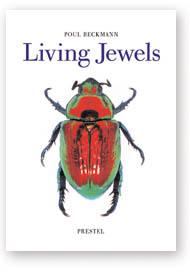
Cover of Living Jewels by Poul Beckmann

Living Jewels: The Natural Design of Beetles, Poul Beckmann (2001)

Richard Dawkins wrote about the Blind Watchmaker, but the Blind Watchmaker often works in collaboration. This book is about his brother, the Blind Jeweller, who creates the cases for the watchwork of beetles. Sometimes those cases are gorgeous, sometimes they’re grotesque, and sometimes they’re both at once. Beetle #77 in this survey, Phanaeus igneus floridanus, is a squat giant with a huge curving horn on its head, but its thorax and abdomen shimmer with metallic purple, green, red, and gold. If that beetle’s a glam-rock sumo-wrestler, then beetle #49, Julodis hiritiventris sanguinipilig (sic – should be hirtiventris sanguinipilis), is pure punk: green legs and a long dark-blue body scattered with tufts of yellow-orange bristles. Elsewhere you’ve got New Romantics with elaborately patterned bodies and sweeping, dandyish antennae (Rosenbergia straussi and Batus barbicornis), death-metal-heads with gleaming black bodies and fearsome-looking but completely harmless horns (Xylotrupes gideon and Allomyr(r?)hina dichotomus taiwana), and even Status-Quo-ites wearing what looks like worn, work-stained denim (various Eupholus species).

It’s entertaining to look through this book and imagine whose backing band or album cover a particular beetle should play in or sit on, but sometimes you won’t be able to match a beetle to a band, because there are more kinds of beetle than musical genres. Beetles, or rather evolution, has invented more than human beings have, but the same forces have been at work. Topologically speaking, a doughnut is identical to a tea-cup, because one is a distorted variant of the other. Similarly, all the beetles in this book are distorted topological variants of each other: like genres of popular music, they’re variants on a theme. Evolution hasn’t altered the ingredients of beetles, just the quantities used to cook each species: changing the width and shape of the thorax, the length and design of the antennae and legs, and so on. But topology isn’t psychology, and just as glam-rock sounds quite different to punk, though the common ancestor is clearly there if you listen, so a doughnut looks quite different to a teacup and Phanaeus igneus floridanus looks quite different to Julodis hirtiventris sanguipilis.

There’s much more to beetles than their appearance, of course, but one of this book’s shortcomings, because it’s a coffee-table conversation-piece rather than a scientific survey, is that it tells you almost nothing about the ecology and behaviour behind the photographs. And the book’s title is misleading, in fact, because the jewels aren’t living: all the photos are of dead beetles on white backgrounds. The book also tells you very little about the meaning and history of the (sometimes misspelt) scientific names, even though these are fascinating, beautiful, and grotesque in their own right. Instead, there’s a brief but interesting – and occasionally wrong: Chrysophora isn’t Latin – introduction, then page after page of the gorgeous and grotesque photographs people will be buying this book for. Finally, there are some brief “Beetle Profiles”, describing where individual species were caught and how their family lives and feeds. I would have liked to know much more, though the beetles’ beauty is in some ways increased by its mystery and by what might be called the futility of its appearance. Countless millions of these beetles have lived and died without any human brain ever appreciating their beauty and strangeness, and if human beings disappeared from the planet they would continue to live and die unappreciated. They’re not here for us, but without us they could never be recognized as the living jewels they are. Some might draw metaphysical conclusions from that and conclude that they are here for us after all, but I draw a mathematical conclusion: mathematics governs the evolution of both beetles and brains, which is why beetles can appeal to us so strongly.

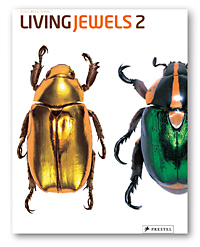
Living Jewels – Website accompanying the book and its sequel.

Cover of Living Jewels 2 by Poul Beckmann

Death and the Midden

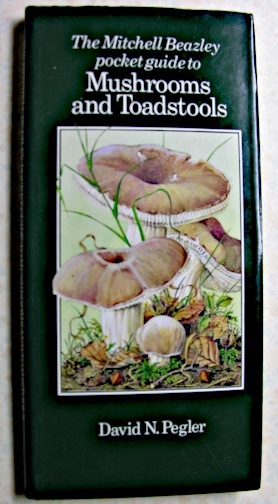
Front cover of The Mitchell Beazley Pocket Guide to Mushrooms and Toadstools by David N. PeglerThe Mitchell Beazley Pocket Guide to Mushrooms and Toadstools, David N. Pegler (1982)

A little gem of a book in a consistently excellent natural history series. Rather like its subject, it’s an example of something very rich and rewarding that’s growing quietly in a neglected niche. Representational art, banished from the academies and galleries over the past century, has survived in natural history illustration. When I think of contemporary art that’s moved or delighted me I often think of men like Richard Lewington, illustrator of Field Guide to the Dragonflies of Britain and Europe, and Ralph Thompson, who illustrated Gerald Durrell’s books about animal-collecting in Africa and South America. David N. Pegler’s art is more realistic and detailed than Thompson’s and he may be an even better draughtsman. But if you think he has less scope for quirkiness and humor, with non-animal, let alone non-mammalian, subjects, you’d be wrong. Each of the fungi illustrated here is a finely detailed, delicately tinted portrait in miniature and in situ, often accompanied by the dried leaves or bark or pine-needles of the spot in which Pegler presumably found it. And one of the pleasures of looking through the book is uncovering the unique and often witty touches Pelger has added to some of the portraits. For example, there’s the beetle crawling towards two specimens of Tricholoma portenosum – ‘so good to eat the French call it “Marvellous Tricholoma” (Tricholome merveilleux)’ – and the crumpled sweet-wrapper lying near three Agaricus xanthodermus, the Yellow-staining mushroom found in or on “Parks, roadsides and wasteland”.

But Pegler usually lets the fungi speak for themselves in their bewildering variety of voices from their startlingly wide range of habitats: there are fungi that specialize in sand, marsh, burnt ground, and dung, as well as the more familiar dead wood and leaf-litter. As so often, the English-speaking world still has a lot to learn from the French: where many Brits or Americans are familiar with two or three edible species, the French are familiar with dozens. The Italians, on the other hand, knew a lot about another kind of mushroom during the Renaissance: the poisonous varieties whose symbols – black-skull-on-white-background for “dangerous” and white-skull-on-black-background for “deadly” – add a regular macabre frisson to Pegler’s drawings.

Inner pages of Mushrooms and Toadstools

One of the deadliest fungi, the Destroying Angel (Amanita virosa), is one of the most beautiful too, like an evil young witch out of Grimms’ Fairy Tales: it’s pure white, slender-stemmed, and with lacy clinging veils, but it reveals its true nature by its “heavy soporific smell”. “Do not mistake for Agaricus silvicola”, Pegler warns (the Latin adjective silvicola, meaning “wood-dwelling”, only exists in the feminine form). One of the ways to avoid mistaking the two is that A. silvicola, the Wood mushroom, “smells of aniseed”. Fungi can delight, or revolt, the nose as well as the eye: there’s the Coconut-scented milk-cap (Lactarius glyciosmus) and the Geranium-scented russula (Russula fellea) on the delightful side, and the Nitrous mycena (Mycena leptocephala), “often smell[ing] of nitric acid”, and the Stinking parasol (Lepiota cristata), with its “unpleasant rubbery smell”, on the revolting.

Unless it can assist identification like that, Pegler doesn’t usually say much about any particular fungus, because he’s writing mainly for identification and has to cram hundreds of species into a pocket-sized space. But each species must have its own unique ecological story and Pegler has managed to make his drawings portraits from the wild and not just mycological mug-shots. And each is accompanied by an illustration of its spores, as a further aid to identification and further invitation for the browsing eye. Spores, like fungi themselves, come in many different shapes and sizes. All of which makes this book my favorite in the Mitchell Beazley series. Every book is worth owning or looking at, but the Pocket Guide to Butterflies, for example, has no artistic charm or whimsy. The butterflies are drawn strictly and severely for identification, with nothing accompanying them: no plants, no landscapes, and no jeux d’esprit. And European butterflies don’t come in many varieties or colors: although they often have hidden charms, most of them are frumpish and dowdy when set beside their glittering, gleaming, multi-spectacular cousins from the tropics.

That isn’t true of European fungi, as Pegler demonstrates: both they and their spores come in all shapes, sizes, and patterns. And all colors too. The Hygrocybe genus gleams with reds, yellows, and lilacs, and the species there look much more like magic mushrooms than the genuine article: the unassuming little Liberty Cap, Psilocybe semilanceata, which can open the doors of perception to a world of wonder. Fungi can drive you mad, kill you, or delight your palate, eye, and intellect, and this book captures their richness and variety better than any other I’ve come across. Art, natural history, and culinary guide: it’s all here and The Mitchell Beazley Pocket Guide to Mushrooms and Toadstools is, in its quiet way, a much greater example of European high culture than anything the modern Turner Prize has produced.

At the Mountains of Mathness

Shakespeare was a gilded ape.

More later.

For now, join me in wondering something I’ve often wondered: What it would be like to experience an asteroid striking the earth. You might be dead before you knew it. You might be woken by the glare and be dead a few seconds later. Slain by the sound of the strike alone. Or the heat alone. There are asteroids that could wipe out every human on earth, or every vertebrate, or every complex form of life. Or you might survive and wish you hadn’t. After some asteroid-strikes, the living would envy the dead.

Continue reading At the Mountains of Mathness