Lulu Lunatic Luz

It’s disturbing what you can find online…

Tales of Silence & Sortilege, Simon Whitechapel, Paperback, 111 Pages

May 28, 2012

If you love weird fantasy, if you love the English language, even if you don’t love Clark Ashton Smith, you should read this book. The back cover describes it as “the darkest and most disturbing fantasy” of this millennium, but that’s either sarcastic or tragically optimistic, because what these stories really are is beautiful. The breath of snow-wolves is described as “harsh-spiced.” A mysterious gargoyle leaning from the heights of a great cathedral has “wings still glistening with the rime of interplanetary flight.” Hummingbirds are “gem-feathered… their glittering breasts dusted with the gold of a hundred pollens.” If you cannot appreciate such imagery, then perhaps you are dead to beauty, or simply dead. These tales are very short, but some of them have stayed with me for years, such as “The Treasure of the Temple,” in which a thief seems to lose the greatest fortune he could ever have found by stealing a king’s ransom in actual treasure. Most of the stories are brilliant, one or two is only good, but the masterpieces are “Master of the Pyramid” and “The Return of the Cryomancer.” The sense of loss and mystery evoked by these two companion stories is almost physically painful, it is so haunting. There is nothing like these stories being published today. Reading them, I feel the excitement and wonder that fans of Weird Tales magazine must have known long ago when new stories would appear by H.P. Lovecraft, Clark Ashton Smith, and Robert E. Howard. Simon Whitechapel doesn’t imitate these authors so much as apply their greatest lessons to new forms of fantasy. This is one of the cheapest books I own, but I accord it one of my most valuable. It is easily the best work of art you will find in any form on Lulu. I cannot recommend it highly enough.

The Roses of Hsūlag-Beiolă, Simon Whitechapel, Paperback, 154 Pages

Jun 8, 2012

This collection of weird fantasy is filled with mystery, wonder and a sense of the ineffable. Not every story is a mind-blowing masterpiece, but the best of them are absolutely spectacular. Even the worst are good and all are haunting in one way or another. My two favorites were: 1. “The Mercy of the Osmomancer,” wherein a knight on a mission to investigate the tower of a scent-wizard encounters demons made of smells and even learns the language of odors… 2. “The Swans,” in which a pawnbroker tracks down all the known paintings of a seemingly insane artist who paints his canvases entirely black, nothing but black, for reasons best and most poetically left to Simon Whitechapel to explain… Any fan of H.P. Lovecraft, Robert E. Howard, Clark Ashton Smith, Edgar Allan Poe, Comte de Lautréamont, Charles Baudelaire or William S. Burroughs will find something wonderful to love in here. I sure did.


Even more disturbing is the thought that this individual may be able to pass themself off as normal in real life: there are no spelling mistakes or solecisms. (Then again, perhaps I’m reviewing my own books in my sleep. (But I wouldn’t compare myself to B*rr**ghs, surely? (Unless it’s a bluff or double-bluff. (Disturbing, as I said. (I agree.)))))

Stoch’! (In the Name of Dove)

Stochasma, In Abysso (2012)

The Sueco-Georgian avant-gardists Stochasma were formed, in their own words, “to interrogate, eviscerate, and exterminate the ultimate experimental envelope of acoustic idiosyncrasy”. That’s “Sueco-” as in Sweden and “Georgian” as in the Eurasian nation, not the American state, by the way. Going one up on some bands from Wales, Ireland and Scotland, who issue their material bilingually, in English and one or another of the Celtic languages, Stochasma issue all their material tri-lingually, in English, Swedish, and Georgian. The strangeness and beauty of the Georgian script match and enhance the strangeness and (occasional) beauty of their music, but, unlike their last two releases, there’s no spoken English, Swedish or Georgian here: In Abysso is intended to be an “abhuman listen”.

Front cover of Stochasma's album In Abysso 

Believe me, it is! The title of the album is Latin for “In the Abyss” and the liner-notes extend thanks to H.P. Lovecraft, Clark Ashton Smith and Stanislaw Ulam for “infernal inspiration”. If the last name makes you think “Who?” (or “U?”), you must be new/nu to Stochasma, who draw inspiration not just from art and literature, but from mathematics too. Stanislaw Ulam (1909-84) was a Polish mathematician perhaps most famous for inventing the “Ulam spiral”, a graphical representation of the prime numbers that reveals mysterious patterns in this strange and fascinating set of integers. Ulam stumbled across the spiral while “doodling” during a boring lecture at a scientific meeting. That kind of serendipity has always been important to Stochasma, who explore the musical abyss/chasm partly through random, or stochastic, techniques. For the first track, “Pr1m4l Skr33m”, the five members of the band had electrodes attached to their nipples before being asked, at random, to indicate, with a nod or shake of the head, whether a randomly selected number between 1 and 10,000 was prime or composite (for example, 1,433 is prime, being divisible by no numbers but itself and 1; 1,434 is composite, being divisible by 2, 3 and 239). If they were wrong, they received a painful electric shock.

The resultant collection of grunts, gasps, and screams was electronically worked over in fully traditional Stochasma fashion to create “Pr1m4l Skr33m”, which sounds like a fully traditional Stochasma track: fucking weird and unsettling! Is the irregular chorus of voices in agony or ecstasy? Are the band being tortured in a hell run by sadists or pleasured in a heaven run for masochists? Or both? It’s hard to decide, and at times hard to listen, but as Stochasma themselves put it: “We’re queasy listening, not easy – easy listening is for cubes.”

Elsewhere, the band have used the ultra-sensitive microphones they first experimented with on 2003’s AnguisaquA (sic – it literally means “SnakewateR”). This time they’ve recorded the bloodflow of a dove and the movements of parasites in its feathers for “Täubchen”, which sounds even stranger than it reads. That and “Pr1m4l Skr33m” are the first two tracks: the next fifteen are entitled “Ignisigil I” to “Ignisigil XV”. Stochasma used a fire-proof microphone to record the sound of books being burned. They selected fifteen wildly different authors for this literally incendiary homage, from “J. Aldapuerta to J. Archer, from K. Marx to K. Minogue”, as they themselves put it. (That’s the über-trangressive Spanish horror-writer Jesús Aldapuerta and the über-cruddy British thriller-writer Jeffrey Archer, and the Anglo-German philosophaster Karl Marx and the Australian pop-pixie Kylie Minogue, for those unfamiliar with the names.) And the band insist, perhaps tongue-in-cheek, that the sonic textures of the recordings are dependent not just on the physical nature of the paper and ink being burnt, but also on the ideological and aesthetic nature of the burning text.

It’s hard to agree: the “Ignisigils” all sound pretty much alike to me, though that sound is uncharacteristically soothing and relaxing by Stochasma standards (on my first listen, I dropped off during “Ignisigil VIII” and didn’t wake up till “Ignisigil XI”). The album is rounded off with three of the strangest pieces of music I’ve heard this century: “Musgomorrah”, “Gradus ad Parnassum”, and “CoMoXoCoI”. The first sounds like a slowed recording of men in armour fighting in thick mud; the second like a choir of giant glass insects singing themselves to splinters; and the third like echoes chasing each another in a collapsing or burning maze. These three might grow on me or might not: for now, “Pr1m4l Skr33m”, “Täubchen”, and “Ignisigil IV” hit the sonic sweet’n’sour spot that Stochasma seem to have copyrighted. I don’t know why “IV” hits the spot and the rest of the Ignisigils don’t, but that’s often the way with Stochasma: you like the sounds they create and you haven’t a clue as to why. In company with a select band of other electronicognoscenti, I look forward to their seventh album, whenever it appears and whatever musical mélanges or macedoines it manages to mulch, mangle, and miscegenate.


Elsewhere other-engageable:

Musings on Music

Bat’s the Way to Do It!

I think Britain would be much better off without three things that start with “c”: cars, canines, and coos (sic (i.e., pigeons)). But perhaps I should add another c-word to the list: cats. I like cats, but there’s no doubt that, in terms of issues around negative components/aspects of conservation/bio-diversity issues vis-à-vis the feline community/demographic, they’re buggers for killing wildlife:

A recent survey by the Mammal Society was based on a sample of 1,000 cats, countrywide, over the summer of 1997. The results included only “what the cat brought in” and ignored what it ate or left outside. Leaving aside this substantial hidden kill, it still concluded that cats killed about 230,000 bats a year. This is equivalent to more than the entire population of any species other than the two most common pipistrelles. If these 1,000 cats are typical, and there is no reason to believe that they are not, cats kill many more bats than all natural predators combined. They are one of the biggest causes of bat mortality in Britain, perhaps the biggest. (Op. cit., chapter 6, “Conservation”, pg. 139)
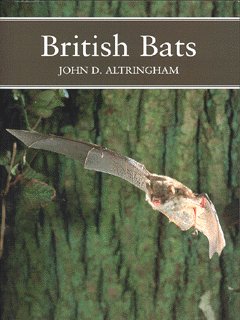
Cover of British Bats by John D. Altringham

That is the unhappy conclusion in John D. Altringham’s very interesting and educative book British Bats (HarperCollins, 2003). Accordingly, I’d rather have fewer cats and more bats. Anyone but a cat-fanatic – and cat-fanatics are found in one or two places – should feel the same, and even the fanatics might reconsider if they read this book. The cat family contains some of the most beautiful and athletic animals on earth; the bat family contains some of the strangest and most interesting. In fact, all bats are strange: they’re mammals capable of sustained powered flight. Little else unites them: in chapter two, Altringham describes the huge variety of bats around the world. They live in many places and live off many things. Some drink nectar, some drink blood; some eat fruit, some eat fish. Some roost in caves, some in trees. Some hibernate, some migrate. Some use echolocation and some don’t. Bats are much more varied than cats and scientifically speaking are much more interesting.

Although echolocation isn’t universal, it is the most interesting aspect of bats’ behaviour and it’s used by all the species found in Britain, from the big ones, like the noctule and greater horseshoe bat, Nyctalus noctula and Rhinolophus ferrumequinum, to the small ones, like the whiskered bat and the pipistrelles, Myotis mystacinum and Pipistrellus spp.[1] Two of the pipistrelles are in fact most easily distinguished by the frequencies they call at: the 45 kHz pipistrelle, Pipistrellus pipistrellus, and the 55 kHz pipistrelle, Pipistrellus pygmaeus. As their English names suggest, one calls at an average of 45 kilo-Herz, or 45,000 cycles a second, and the other at an average of 55. The two species weren’t recognized as separate until recently: they look almost identical, although the 55 kHz is “on average… very slightly smaller”, and they forage for food in the same places, although the 55 kHz is “more closely associated with riparian habitat” (that is, it feeds more over rivers and other bodies of water). But examine their calls on a spectrograph, an electronic instrument for visually representing sounds, and there’s a much more obvious difference. This is a good example of how much the scientific study of bats depends on technology. Human beings didn’t need science to know about and understand the ways a cat uses its senses, because they’re refinements of what we use ourselves. We might marvel at the acuity of a cat’s eyes or ears, as we might marvel at the acuity of a dog’s nose, but we know for ourselves what seeing, hearing, and smelling are like.

Echolocation is something different. Bats don’t just see with their ears, as it were: they illuminate with their mouths, pouring out sound to detect objects around them. And the sound has to be very loud: “The intensity of a pipistrelle’s call, measured 10 centimetres in front of it, is as much as 120 decibels: that is the equivalent of holding a domestic smoke alarm to your ear.”[2] The “inverse square law”, whereby the intensity of sound (or light) falls in ratio to the square of the distance it travels, means that the returning echoes are far, far fainter than the original call. It’s as though Motörhead, playing at full volume, could hear someone at the back of the crowd unwrapping a toffee. How do bats call very loudly and hear very acutely? How do they avoid deafening themselves and drowning their own echoes? These are some of the questions bat-researchers have investigated and Altringham gives a fascinating summary of the answers. For example, they avoid deafening themselves by switching off their ears as they call. They’ve had to solve many other tricky acoustic problems to perfect their powers of echolocation.

Or rather evolution has had to solve the problems. The DNA of bats has changed in many ways as they evolved from the common mammalian ancestor (which also gave rise to you, me, and the author of this book) and those changes in DNA represent changes in their neurology, anatomy, and appearance. It’s easy to see that hearing is important for bats, because their eyes are relatively small and their ears are often large and rigid and come in a great variety of shapes. What isn’t easy to see is what those ears are supplying: the bat-brain and its astonishing ability to process and classify sound-data as though it were light-data. Bats can create sound-pictures of their surroundings in complete darkness. Of course, the feline or human ability to create light-pictures is astonishing too, but we’re too familiar with it to remember that easily. Bats aren’t just marvels in themselves: they should encourage us to marvel at ourselves and what our own brains can do. The digestive system of a bat, cat, or human needs food; the nervous system of a bat, cat, or human needs data. That’s what our sense-organs are there for and in principle it doesn’t matter whether we create a picture of the world with our eyes or with our ears.
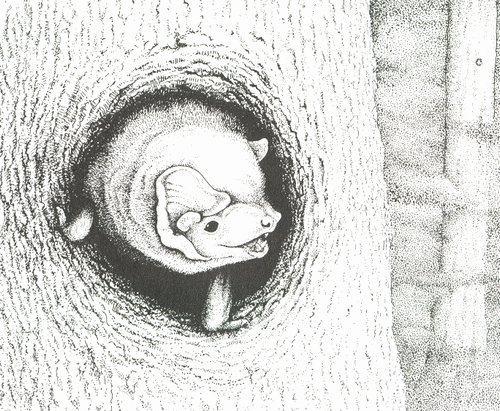
Male noctule (Nyctalus noctula) calling from tree-roost to attract mates

Male noctule calling from tree-roost

In practice, there are some very important differences between sound and light. Light works instantly and powerfully on a terrestrial scale; sound takes its time and is much more easily diluted or blocked. A hunting cat can scan an illuminated or unilluminated environment for free, because it doesn’t have to generate the light it sees by or the sound it hears by. Hunting bats have to pay when they scan their environment, because they’re using energy to create sound and induce echoes. Once they’ve got their data, both cats and bats have to pay to process it: it takes energy to run a brain. But bat-brains are solving more complicated problems than cat-brains: Altringham describes the questions a flying bat has to answer when it detects the echo of an insect:

How far away is the insect?… How big is it?… In which direction does it lie?… How fast is it flying and in what direction?… What is it?… (ch. 3, “The Biology of Temperate Bats”, pp. 42-3)

Like insect-eating birds, bats can answer all these questions in mid-flight, but what is relatively easy for birds, using their eyes, is a much greater computational problem for bats, using their ears. “Computational” is the key word: brains are mathematical mechanisms and process sense-data using algorithms that run on chemicals and electricity. Bats were intuitively using mathematical concepts like doppler shift and frequency modulation (as in FM radio) millions of years before man invented mathematics, but man-made mathematics is an essential tool in the study of echolocation. For example, the concept of wavelength, or the distance between one crest of a sound-wave and the next, is very important in understanding how bats perceive objects. Light has very short wavelengths, so humans and other visual animals can easily resolve small objects. Sound has much longer wavelengths, so bats find it hard to resolve small objects. But some find it harder than others: Daubenton’s bat, Myotis daubentonii, and other Myotis spp. “can resolve distances down to about 5 millimetres when given tasks to perform in the laboratory”. But horseshoe bats, Rhinolophus spp., “can do little better than 12 millimetres.”

Why this difference? You have to look at the nature of the sound being produced by the different species: the Myotis spp. use “high frequency FM calls”; the Rhinolophus use “predominantly CF [constant frequency] calls”. The mathematical nature of the call determines the bats’ powers of perception. Calls can also determine how easily a bat can identify an insect: “relatively long calls can have a ‘flutter detector’… If a call is 50 milliseconds long, then within one echo a bat can detect the full wingbeat of insects beating their wings at more than 50 Hz.”[3] So bats can tell one kind of insect from another, something like the way a blindfolded human can tell a bumblebee from a mosquito. But insects aren’t passive as prey and one of the most interesting sections of the book describes how they try to avoid being eaten. Some moths have “ultrasound detectors” and if a moth hears a calling bat, it “will either stop flying and drop toward the ground, or begin a series of rapid and unpredictable manoeuvres involving dives, loops and spirals”.[4] This kind of ecological interaction creates an “evolutionary arms race”: each side evolves to become better at capture or evasion.

The moth/bat air-battle is reminiscent of the air-battles of the Second World War, which involved radar trying to detect bombers and bombers trying to evade radar. One defensive technique was jamming, or attempts to interfere with radar signals or drown them in noise. Some moths may use this technique too. The tiger moths, the Arctiidae, don’t try to escape detection. Instead, they “emit their own, loud clicks”[5], perhaps to interfere with echolocation or startle a predatory bat. Alternatively, Altringham suggests, the clicks may be the aural equivalent of “bright warning colours and patterns”: the moths may be warning bats of their unpalatability. If so, it would be another example of the difference between the costs of sight and the costs of sound. An unpalatable insect in daylight doesn’t have to pay for its warning colours, after the initial investment of creating them, and doesn’t have to know when a predator is watching. An unpalatable insect in the dark, on the other, can’t send out a constant audible warning: it has to select its moment and know when a predator is nearby. Unless, that is, some insects use passive signals of unpalatability, like body modifications that create a distinctive echo.

Bat-researchers don’t know the full story: there is still a lot to learn about bats’ hunting techniques and the ways insects try to defeat them. But “cost” is a word that comes up again and again in this book, which is partly a study in bio-economics. Bats have to pay a lot for echolocation and flight, but flight is a more general phenomenon in the animal kingdom, so the economics of bat flight also illuminates (insonates?) bird and insect flight. Altringham points out a very important but not very obvious fact: that flight is expensive by the unit of time and cheap by the unit of distance. Movement on foot is the opposite: it’s expensive by the unit of distance and cheap by the unit of time. Bats, birds, and insects expend more energy per second in flight, but can travel further and faster in search of food or new habitats. However, bats don’t all fly in the same way: a bat expert can identify different species by their wings alone. The wings vary in “wing loading”, which is “simply the weight of the bat divided by the total area of its wings. Bats with a high wing loading are large and heavy in relation to their wing area, bats with small bodies and large wings have a low wing loading”.[6] Then there’s “aspect ratio”, the “ratio of wingspan to average wing width”, or, because “bats have such an irregular wing shape”, “wingspan squared divided by wing area.”

It’s mathematics again: there are no explicit numbers in a bat’s life, but everything it does, from echolocating to flying, from eating to mating, is subject to mathematical laws of physics, ecology, and economics. Bats have to invest time and energy and make a profit to survive and have offspring. As warm-blooded, fast-moving animals with high energy needs, they’re usually nearer famine than feast, which is one reason they migrate or hibernate to avoid or survive through cold weather and scarcity. They also vary their diet during the year, to take advantage of changes in the abundance of one insect species or another, and seek out specialized feeding niches. Daubenton’s bat, for example, “habitually feeds very low over water”, using echolocation to catch not just flying insects but floating ones too. That is why it needs smooth water to feed over: ponds, lakes, canals and placid streams and rivers. The floating insects are easier to echolocate on a smooth surface, rather like, for humans, a black spider on a white wall. Once spotted, they “are gaffed with the large feet or the tail mechanism and quickly transferred to the mouth as the bat continues its flight”.[7]
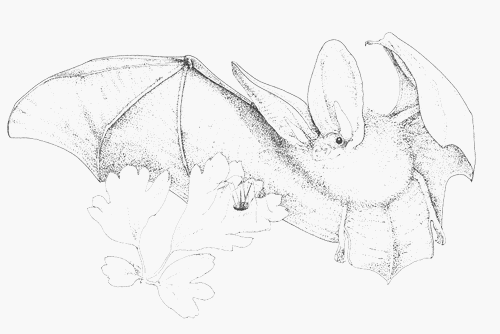
Long-eared bat (Plecotus auritus) gleaning harvestman

Long-eared bat gleaning harvestman

One of the photos in the colour section in the middle of the book shows a Daubenton’s bat mirrored in smooth water, having just scooped up prey from the surface. Other photos show other species roosting, perching, or in flight, but the book also has excellent black-and-white illustrations mixed with the text, hand-drawn using a speckled or pointillist technique that suits bats very well. I particularly like the drawings on pages 48, 67 and 101. The first shows a long-eared bat, Plecotus auritus, “gleaning”, or snapping up, a “harvestman” (a long-legged relation of the spiders) from a leaf (ch. 3); the second shows a “male noctule calling from his tree roost to attract mates” (ch. 3); and the third shows a tawny owl trying to catch another long-eared bat (ch. 4).

Owls could be called the avian equivalents of bats: they’re specialized nocturnal hunters with very sharp hearing, but I think they’re both less interesting and more attractive. Bats, with their leathery wings, sometimes huge ears, and oddly shaped noses, are strange rather than attractive and some people find them repulsive. But some people, or peoples, find them divine or lucky: the introduction describes the Mayan bat-god Zotz, with his leaf-shaped nose modelled on that of the phyllostomids, or vampire bats.[8] The Chinese use a ring of five bats to symbolize the “five great happinesses: health, wealth, good luck, long life and tranquillity.”[9] Altringham blames the less positive image of bats in European cultures partly on Bram Stoker’s Dracula, which was first published in 1897. Before then, he says, “bats were not linked with witches, vampires and the evil side of the supernatural in any significant way.”[10] Dracula may have done for bats what the novel Jaws (1974) and its cinematic offspring did for sharks: encouraged human beings to harm the animal fictionally and falsely depicted as villainous.
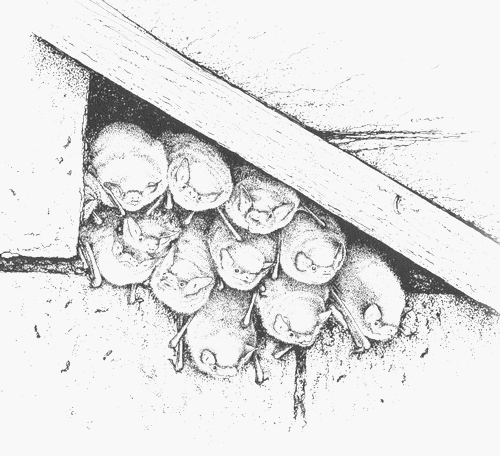
Daubenton's bats (Myotis daubentonii) in a summer roost

Roosting Daubenton’s bats

If so, British Bats is partly redressing the balance. You can learn a lot from this book about both biology in general and bat-biology in particular. It stimulates the mind, pleases the eye, describes the appearance, ecology, and range of all British species, and points the way to further reading and research. So let’s not hear it for John D. Altringham! Without specialized equipment, that is, but that equipment is getting cheaper and more widely available all the time: you don’t have to be a professional zoologist to record and analyse bat-calls any more. There is still a lot for zoologists, both amateur and professional, to learn about bats. Okay, some of the research – like fitting miniature radio-transmitters to wild bats – seems intrusive and smacks of Weber’s Entzauberung, or “disenchantment”, but the more we know about bats, the more we will be able to help conserve them and their habitats. Bats aren’t villains: cats are. I like both kinds of mammal, but I hope we can find some way in future to help stop the latter preying so heavily on the former. If this book helps publicize the problem, it will be valuable for bat-conservation just as it is already valuable for bat-science. In short, no more brick-bats for Brit-bats: we should control our cats better.

Reviewer’s note: Any scientific mistakes, misinterpretations or misunderstandings in this review are entirely your responsibility.

NOTES

1. sp = species, singular; spp = species, plural.

2. ch. 3, “The Biology of Temperate Bats”, pg. 40

3. Ibid., pg. 45

4. ch. 4, “An Ecological Synthesis”, pg. 98

5. Ibid., pg. 99

6. Ibid., pg. 71

7. ch. 5, “British Bats, Past and Present”, pg. 117

8. ch. 1, “Introduction”, pg. 10. “Phyllostomid” is scientific Greek for “leaf-mouthed clan”.

9. Ibid., pg. 11

10. Ibid., pg. 9

Prime Youver

The utilitarian philosopher Jeremy Bentham (1748-1832) thought that the notion of “natural rights” was “nonsense on stilts”. I’m inclined to agree with him, but I think the dismissal applies a fortiori to theology. In fact, I think theology is nonsense on stilts on roller-skates. It’s the pursuit of the unknowable, unprovable or impossible by the irrational, illogical or insane. The illiterate too, nowadays: at least Newman and C.S. Lewis are enjoyable to read, unlike most modern theologians. But there is a theological idea I’ve always found interesting: that you created the universe. And I did too. More than that: the idea says that you or I, or both of us, created God Him/Her/Itself. The idea works like this: if free will exists (I don’t think it does) and human beings can exercise it, every instance of free will must be an act ex nihilo, an act out of nothing, undetermined by what has gone before it, and not a necessary act, in the technical sense. But that act of free will can only take place because the actor exists in a universe. To put it another way: the necessary precondition of an unnecessitated act of free will is that the universe exist. One could conclude, then, that God is forced to create the universe in order to allow you, me and other human beings to exercise our free will: in other words, the primum movens, the prime mover or initial uncaused cause of the universe, is any act of free will by a human being. In short, you’re the prime youver and I’m the prime mever. But in order for God to create the universe, God has to exist. So an uncaused act of free will doesn’t just create creation, it creates the creator. The slightest freely chosen, undetermined act, from rubbing one’s nose to writing a postcard, brings about the Ultimate Whole and the Ultimate Holy. Whodunnit? Youdunnit! And I did too.

Okay, that’s nonsense on stilts on roller-skates on oily ice (in a hurricane) and undoubtedly blasphemous or sacrilegious by any normal theological standard. But it seems a sensical conclusion from nonsensical premises and it gives me the excuse for another piece of paronomasia.

Damsels and Dragons

If I were asked to nominate a great work of 21st-century art, I would not choose anything by the likes of Damien Hirst or the architect Frank Gehry (responsible for the giant metal midden in Bilbao known as the Guggenheim Museum). Instead, I’d put forward something by Klaas-Douwe B. Dijkstra, Richard Lewington, and British Wildlife Publishing of Gillingham in Dorset. They’re not big names like Hirst and Gehry and they’re not earning big money or exercising big influence. And they’re unlike Hirst and Gehry in another way: they’ve created a genuinely beautiful and intellectually stimulating piece of art.

The art-work is called the Field Guide to the Dragonflies of Britain and Europe (2006). Dijkstra oversees the detailed, expert, and fascinating text, Lewington supplies the detailed, accurate, and beautiful drawings, complemented by photographs of dragonflies and damselflies in the wild. Lots of people don’t know the difference between these two suborders of the Odonata, but their common names reflect their appearance: the Zygoptera, or damselflies, are delicate and fold their wings at rest; the Anisoptera, or dragonflies, are robust and always hold their wings at right angles to their bodies. Both come in a huge variety of colours, pure and mixed, as their common names prove: damselflies include the Azure, the Goblet-Marked, the Orange White-legged, the Scarce Blue-Tailed and the Scarce Emerald; dragonflies include the Green and Mosaic Darners, the Banded, Red-Veined, Scarlet, Violet-marked and Yellow-winged Darters, the Orange-spotted Emerald, and the Four-spotted Skimmer. There’s also Somatochlora metallica, the Brilliant Emerald dragonfly, which looks as though it’s made of bright green metal or enamel.

These rich colours, with the complex venation of their wings, have made the Odonata a popular subject for artists and jewellers: for example, the art nouveau master René Lalique (1860-1945) made dragonfly mascots for cars. Unfortunately, the book doesn’t cover the Odonata in art: it’s a scientific text, a microcosm of the macrocosm of biology. Biology depends on accurate description and classification, so odonatology has a rich vocabulary: antehumeral stripes, arculus, carina, clypeus, diapause, discoidal cell, gynomorph, medial supplemental vein, pronotum, pseudopterostigma, siccation, and so on. Even the segments of the abdomen are numbered, from S1, just below the wings, to S9 and S10 at the tip of the tail, where the females have their almost clockwork genitalia. Males have theirs beneath S2, so mating in the Odonata is a complicated, almost tantric, business, as some of the photographs prove. Nomenclature in the Odonata is a complicated, almost incantatory business: Calopteryx splendens, virgo, xanthostoma; Enallagma cyathigerum; Pyrrhosoma nymphula; Anax parthenope, imperator; Ophiogomphus cecilia; Onychogomphus forcipatus; Libellula quadrimaculata; Sympetrum depressiusculum; Zygonyx torridus.

That nomenclature, and that sex-life, are two of the ways that the Odonata are CASean creatures; that is, their complexity, strangeness, and beauty remind me of the work of “the Emperor of Dreams”, the Californian writer Clark Ashton Smith (1893-1961). The obsessive, minutely detailed nature of the book is CASean too, and some of its subjects might literally be emperors in dreams: the common name of the Anax genus is the Emperors. One of these Emperors answered a CASean question I had as I leafed through the book: distribution tides washed back and forth across the little map of Europe that accompanied each specific description, submerging here Britain and Ireland, there France and Spain, here Germany and Scandinavia, there Greece and Turkey, and sometimes all of them at once.

But the strange, isolated island of Iceland, though included on every map, always seemed redundant, like a wall-flower at the Odonatan dance. “Was it a dragon- and damselfly desert?” I wondered. Then I came across Anax epihippiger, or the Vagrant Emperor: “A. epihippiger is the only dragonfly ever recorded on Iceland.” From the magnificent to the minute, from damselflies in the burning deserts of Morocco to dragonflies amid the frosty volcanoes of Iceland, it’s all here in a book that truly does deserve to represent European civilization in the twenty-first century. But doesn’t, alas.

Ink For Your Elf

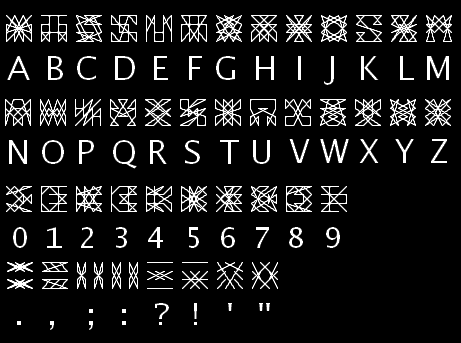
The Majikalph Script

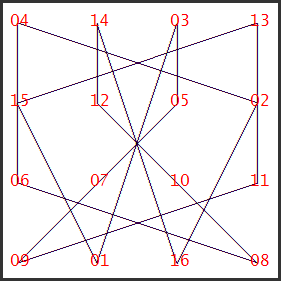
Majikalph was created by Simon Whitechapel in 2012 to combine his interests in artificial alphabets and recreational mathematics. It is based on the patterns created when lines are drawn between numbers of various 4×4 magic squares. In a magic square, every row, column, and diagonal of numbers adds to the same total. In the 4×4 magic square below, the most interesting patterns are created when each number is connected to the number 2 or 4 places higher than it (e.g. 2 goes to 4 or 6; 13 goes to 15 or 1).

Majikalph is used for writing English and is written from right to left. There is no distinction between upper and lower case. No character of the script is invented: each is based on one or another of the 880 possible 4×4 magic squares (for further information, please see MagicSquares.net).

The sample text is an extract from Tennyson’s The Princess (1847):

Oh, hark, oh, hear! how thin and clear,
And thinner, clearer, farther going!
Oh, sweet and far from cliff and scar
The horns of Elfland faintly blowing!
Blow, let us hear the purple glens replying:
Blow, bugle; answer, echoes, dying, dying, dying.

Alfred, Lord Tennyson (1809-1892).

Sample Text

Hymn to Herm

The Cult of Infinite Hermaphrodites

When neophytes enter the Cult of Infinite Hermaphrodites at Xidar, they are taught, amidst their initial duties of sweeping and service, the operations of simple arithmetic. Then, at the end of their first year, now most practised in this arithmetic, they are asked to say which number it is that, self-mated, beareth 4. And they reply, of course, that 4 is born of self-mated 2. And asked the same of 9, they reply 3; and of 16, they reply 4. Thus it is (they now learn) that 2 is called by the Cult the hermaphrodite of 4, as 3 is the hermaphrodite of 9, and 4 of 16. Then the neophytes are asked to say which number it is that, self-mated, beareth 1: which is to say, what is the hermaphrodite of 1? And they reply, of course, that 1 is auto-hermaphroditic, self-mating to bear itself. And then, in mildest, most deceptive tones, they are asked to name the hermaphrodite of 2. And here, in this simplest of questions, they stand (tho’ they know it not) on the brink of a Mysterium Magnissimum et Tremendissimum, a Riddle Most Mighty and Awesome.

Now, ’tis evident that the hermaphrodite of 2 falleth betwixt 1 and 2, for 1 is the Auto-Hermaphrodite, self-mating to bear itself, and self-mated 2 beareth 4, as remarked above. But where-betwixt doth the requested hermaphrodite fall? The neophytes know not. So they are told: test the mid of 1 and 2, which is 1½, or 3/2. Self-mated, this bears 9/4, or 2¼. And this falls too high. So, subtract a ½ of a ½ from 1½, for 1¼, or 5/4. Self-mated, this bears 25/16, or 1 and 9/16. And this falls too low. So, add a ½ of a ¼ to 1¼, for 1⅜, or 11/8. Self-mated, this bears 121/64, or 1 and 57/64. Again, too low. So, add a ½ of an ⅛ to 1⅜, for 23/16, or 1 and 7/16. Self-mated, this bears 529/256, or 2 and 17/256. Too high. And thus the neophytes proceed for a day, dividing and subtracting, dividing and adding, ever approximating the hermaphrodite of 2.

But do they ever reach it? Could they ever reach it, by this or any other mode of rational approximation? And here is the Mighty Mystery, the Riddle that Wrencheth the Brain, for the Cult replieth: Nay, Nay, Never! For It hath an incontrovertible proof that demonstrateth, by easy steps of simple logic, that the hermaphrodite of 2 is impossibly a ratio of finite integer to finite integer: which is to say, it must be infinite. Were the sky all parchment, the seas all ink, and gulls all plucked for quills, the hermaphrodite of 2 remained irrecordable. And more than this: the Cult can prove, by adaptation of the aforementioned logic, that the hermaphrodites of all integers, save the perfect squares, are similarly infinite and irrecordable, eternally elusive of finite man, yet definable even in their boundless nature by his skull-boxed brain-speck. And this truth the Cult flaunteth to the profane in its very name, which titillateth and tempteth, yet yieldeth not the guessed-at, the hoped-for fruit.

Now sing:

All hail, O World, the lowly Worm,
Which, same to same, exchangeth sperm!
And twines its twin, beneath the moon,
To grant itself renewal’s boon!

Next bow, yea bow, and loudly hail
The spiral-foot, the crawling Snail!
That twines its twin, ’midst nuptial slime,
To slay the slayer, scything Time!

From The Hymn to Hermaphroditi.