Nostra Signora della Cunetta

Our Lady of the Gutter

Walking on the shaded side of Longsands Avenue, he saw a small lady’s-mantle in the gutter. Alchemilla mollis. The soft little alchemical one. It was new-grown and its pleated leaves were fresh and green against the cement. He wished he could spin a poem out of it, out of the unexpected sight, something deep and mysterious and Larkinesque. A line, or two lines, occurred to him. The line of the gutter/Stutters with green. But where to go after that? Later, walking back along Longsands Road, he heard a twittering, or thought he did, and looked up to see swifts high up, swirling, swooping, seeking insects he couldn’t see. Aëroplankton. Again he wished he could capture the moment, condense the sight into potent language. He thought a little. Sickle-wing swifts/Reap the insected air. But again, where to go after that? He liked “insected air”, though. It had an assonance of “infected air”. But why not a portmanteau? Reap the insfected air. He’d always liked words that started with sph and sf. Sphinx. Sphragistics. Sfumato. Sforzando. “Insfected air” would be air that had insects and pollution in it. Reaped by sickle-wing swifts, fluttering their wings like eyelashes. He remembered that Ted Hughes had written a poem about swifts, but he didn’t like it. It had reminded him of Gerard Manley Hopkins, left out in the rain for a week or two. Perhaps Larkin had written about swifts too, or mentioned them. He hadn’t finished The Complete Poems yet.

Later in the day, he was walking along the promenade. The tide was out, but a tongue of water had been left at the foot of the gold-lichen-splashed sea-wall. He climbed down the steps to it, squatting on his haunches and looking into the wind-rippled water. He saw a shrimp first, then, perhaps when the shock of his shadow or the tremors of his arrival had subsided, tiny flounder began to flick to and fro over the sandy mud. When you saw them move and settle, you could just see their outlines. Otherwise it would be impossible to know where they were. The previous year, on a very hot day, another flounder had been defeated by its camouflage: not protected by it, but doomed. The same tongue of water had stretched along the foot of the sea-wall, but it had been shrinking in the fierce sun. He had rescued some of the dozens of shrimp that crowded the damp but drying sand at one end of the tongue. They were flicking themselves into the air as they dried, hoping to land in water, disappointed again and again. He collected them on his palm and threw them into the deeper water in the middle of the tongue.

As always when he did something like that, he wondered whether it was better not to interfere. Perhaps preserving the weak just means greater misery in future. But they weren’t weak, they were unlucky. Probably. But perhaps unluckiness was weakness too. Because weakness led to unluckiness. Then he left the sand and the shrimps to walk to Merrimont Park. Later, walking back along the promenade, he walked down the steps again and looked at the sand where he had rescued the shrimps. It was completely dry now and he saw what he hadn’t seen before: a tiny dead flounder. If he had seen it before, he would have rescued it, but its camouflage had been too good, defeating his eye, so it had dried and died with dozens of shrimp, hundreds of them, thousands. A hammic hecatomb. Unnoticed and unmourned, except by him. Nature was always sacrificing her self to herself. Insects, arthropods, myriad little lives lost daily, hourly. Presided by whom? Perhaps Our Lady of the Gutter.  Nostra Signora della Cunetta. Nuestra Señora de la Cuneta. Our Lady of the Overlooked and Interstitial. He wished he could write a poem about her, complete the poems he had begun about the lady’s mantle and the swifts, but perhaps it was better that he couldn’t. Prose was better for stumbling, for incompleteness, for the rhythmless and rhymeless way the world threw fragments of beauty and consolation at you.

It’s Only Rot’n’Roll…

It’s Only Rot’n’Roll

A Porphyropolyhedric Tribute to Clark Ashton Smith

Banal, mundane, and dreary. Something needs to be done about the writing of Clark Ashton Smith — and I’ve tried to do it. The problem seems to me that the writing of CAS has been Roman in the gloamin’: that is, its twilight mystery, touched with Grecian glamor, plods across the page in the Roman alphabet, which is highly functional, but aesthetically unadventurous. Has any edition of CAS in English tried to match the beauty and complexity of the text with the beauty and complexity of a font? Not to my knowledge. Calligraphy, in the wider sense, is peripheral, at best, to English literature and and even the hyperlogomania of a book like Finnegans Wake takes place on a highly restricted graphological stage. Imagine what Joyce could have done with other alphabets, other ideographies, to stir into his mad meadish Sternen-stew of polyglossemanticity! And imagine CAS printed, or hand-written, in a script that reflects something of the beauty and complexity of his language. The beauty and fluidity of Georgian or Arabic would suit his tales of Zothique, for example; the complexity and density of Devanagari or Tamil would suit his tales of Hyperborea: but best of all would be a script invented specifically for CAS.

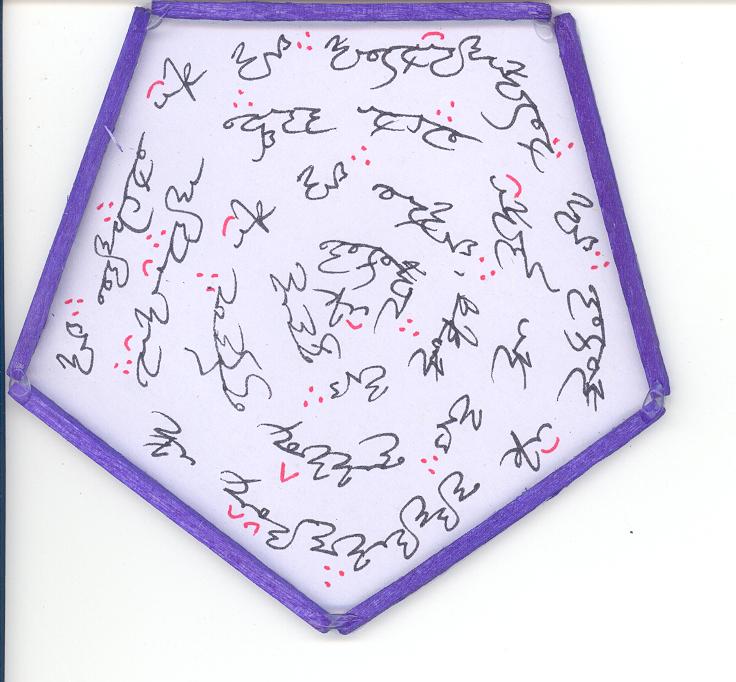
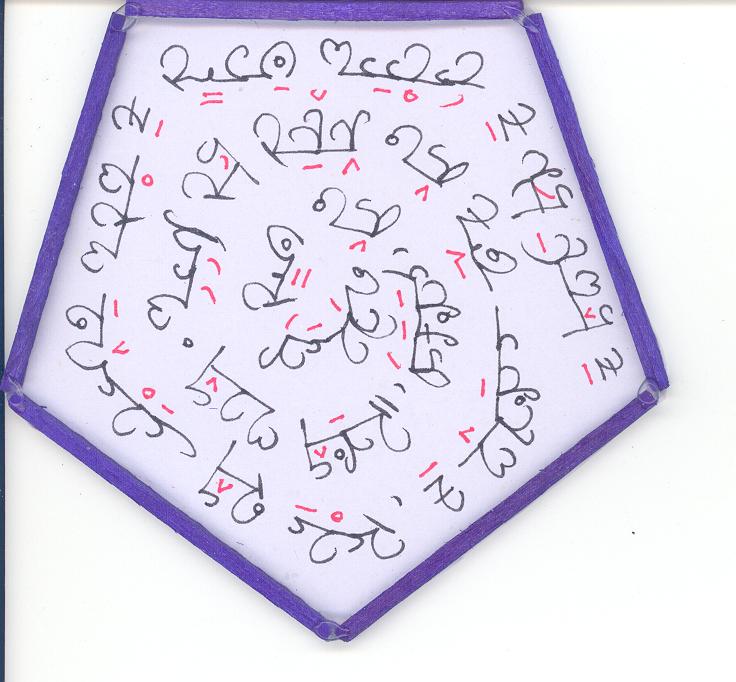
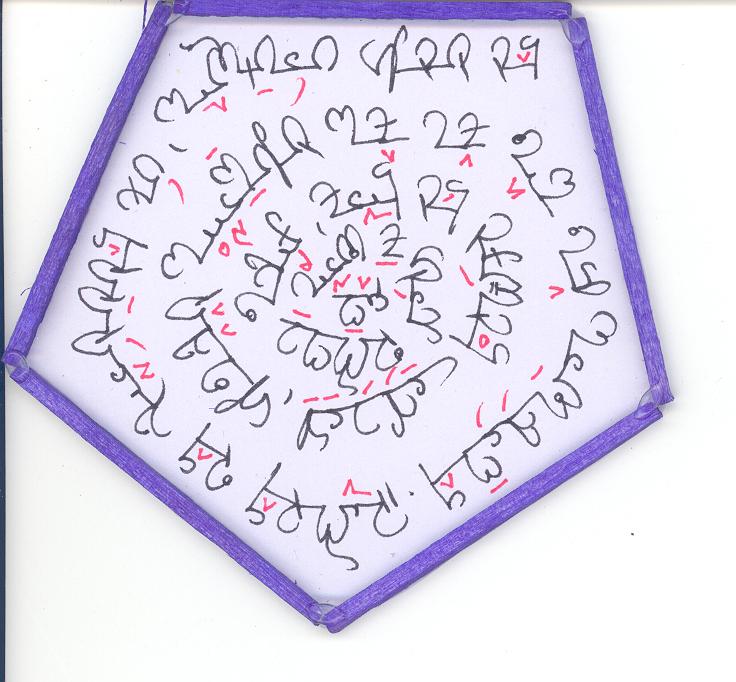
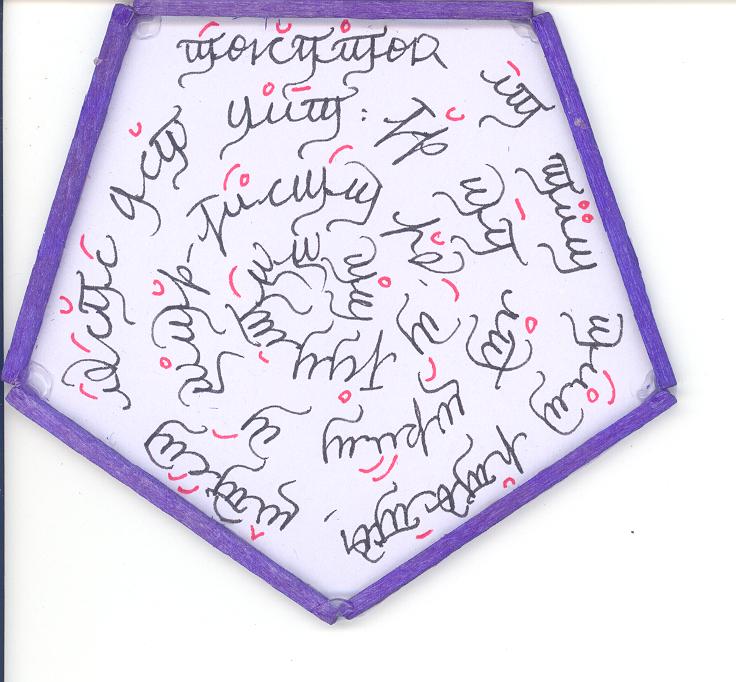
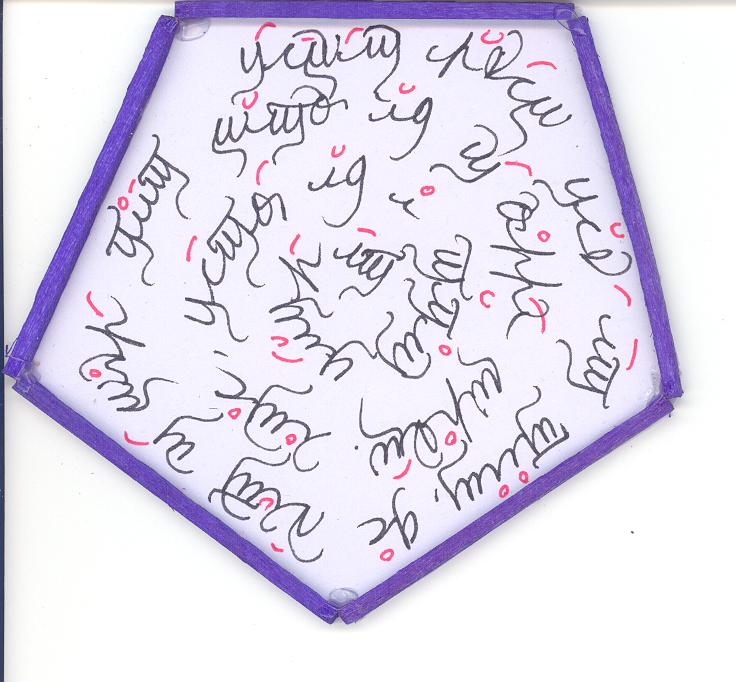
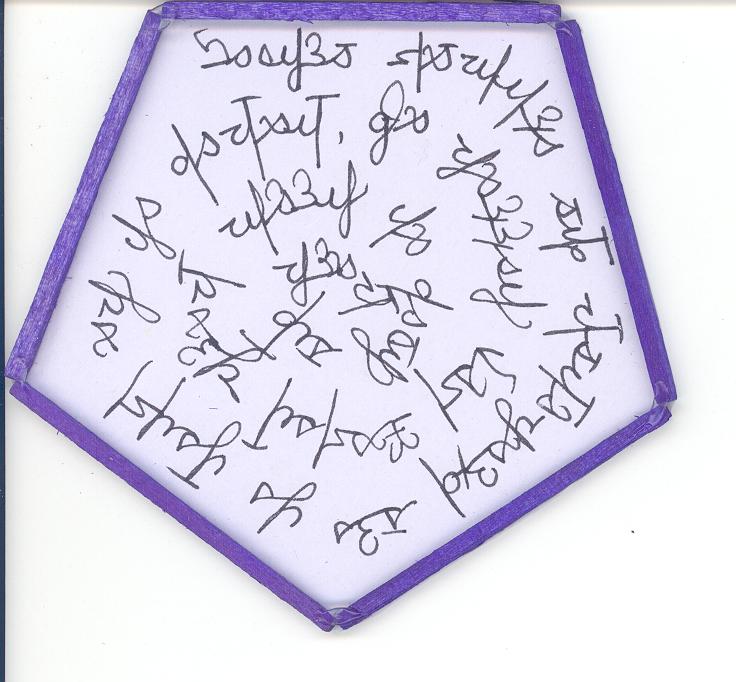
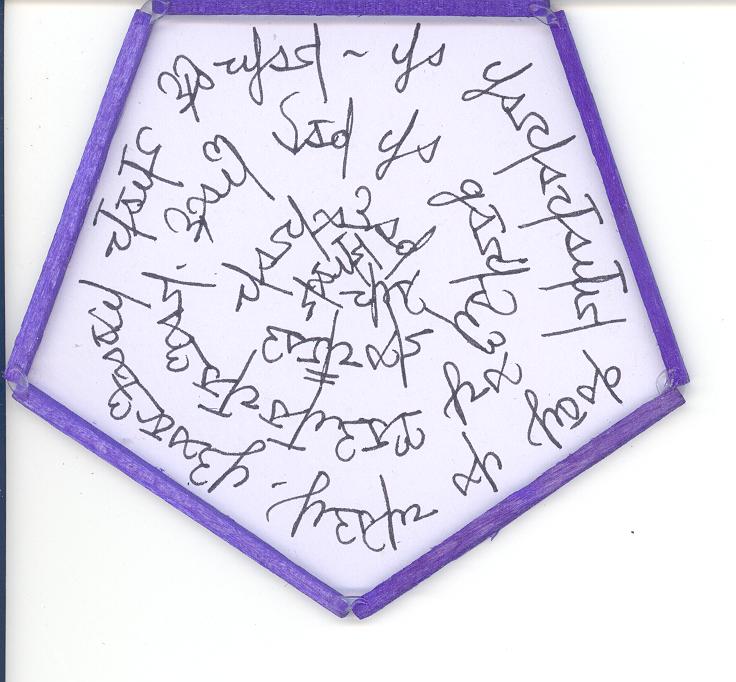
I haven’t supplied that, but I’ve tried to point the way with what I call a CAS-Whole, or porphyropolyhedric tribute to Clark Ashton Smith. It consists of a dodecahedron of paper and purple matches that uses four invented scripts to capture the opening lines of five of CAS’s best stories. In Plato’s cosmology, four of the regular (or Platonic) polyhedrons — the tetrahedron, the hexahedron, the octahedron, and the icosahedron — represent the four elements of which the universe is composed. The final regular polyhedron, the dodecahedron, represents the universe as a whole.[1] Hence, “CAS-Whole”. The purple matches — creating a porphyro-polyhedron — recall CAS’s words in The Black Book: “Strange pleasures are known to him who flaunts the immarcesible purple of poetry before the color-blind.”[2]

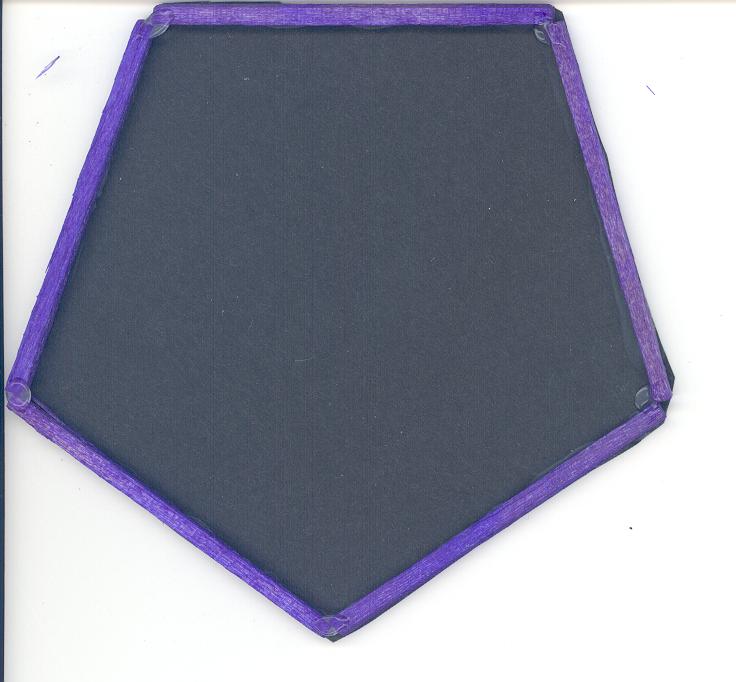
The dodecahedron itself, consisting of twelve regular dodecahedrons, is replete with the golden ratio, long regarded as of special significance in aesthetics.[3] One face is entirely black and might be called panglossic, representing all possible scripts in all possible languages; another, on the opposite side of the CAS-Whole, is entirely white and might be called an’glossic, representing silence and the blank page. Between the two, in a kind of “Goldilocks zone” between too much meaning and too little, are ten faces enscribed in four invented scripts with the opening words, in English, of five of CAS’s stories. Eight faces use a single, unadulterated script of the four, spiralling to the centre; two faces combine the four scripts. Given that the scripts are used for standard English, the stories can all be deciphered with a little effort and ingenuity. We are used, when reading in our mother tongues, to understanding with little effort and ingenuity, so the CAS-Whole might be regarded as a reminder of something we should not so carelessly take for granted. Furthermore, like all the Platonic solids, the dodecahedron can serve as a die, so the CAS-Whole reflects those central CASean themes of chance and fortune. Due to my ineptitude and impatience, not all of the faces are good regular pentagons, but that too can be woven into the symbolism of the CAS-Whole. The dodecahedron is not perfect, but I am not CAS and perfect dodecahedra do not occur in nature. Nor will the die roll true: fortune is biased.[4] Critics have pointed out that almost all CAS’s stories about death, so I hope that, imperfect as it is, one might say of the CAS-Whole: “It’s only rot’n’roll — but I like it.”

Notes

1. “There still remained a fifth construction, which God used for embroidering the constellations on the whole heaven.” Timaeus, c. 360 B.C. See http://www.ellopos.net/elpenor/physis/plato-timaeus/triangles.asp?pg=3

2. The Black Book of Clark Ashton Smith, Arkham House, 1979. See http://www.eldritchdark.com/writings/bibliography/writings/nonfiction/35/the-black-book-of-clark-ashton-smith

3. For more on the golden ratio, or golden section, please see http://www.maths.surrey.ac.uk/hosted-sites/R.Knott/Fibonacci/phi.html

4. A biased coin can be thrown “fair”, using a simple technique that can be adapted to a biased dodecahedron. Suppose a coin is much likelier to land heads than tails (or vice versa). Simply toss it twice. If it lands HH or TT, toss again. Otherwise, use the first of the two throws: simple probability will prove that even on a biased coin, HT is as likely as TH. Similarly, for a a biased dodecahedron, roll it twelve times. If any face repeats during the twelve rolls, roll twelve times again. When you have a sequence of twelve different faces, choose the first face. Based on my (far from reliable) caculations, there are 8,916,100,448,256 ways to roll a dodecahedral die twelve times, of which 479,001,600 contain no repeating number. One would therefore have to roll the die 18,614 times, on average, to produce a sequence in which no number repeats.

Pearly Riser

Pearls & Pyramids / Temples & Torments, Simon Whitechapel
 
Nice covers, shame about the text. As if the polysyllabic vocab and convoluted (not to say strangulated) syntax of the first two stories in Pearls & Pyramids weren’t bad enough, along come the blatant racism and misogyny of the third, in which members of the Black community are showered with the kind of vilely bigoted slavery-era clichés that even the reddest neck in the deepest south might think twice about using nowadays. Yes, more sensitive members of the anti-racist community won’t even make it past the first line of “The Pearls of Ngaháksha”, which introduces its anti-heroine as a “corpulent black (sic) cannibal witch”. Count the racist discourses at work there, cultural theoreticians! Then read on, if your stomach’s strong enough, and see how they’re repulsively developed and expanded.
 
Whitechapel’s racist and misogynistic agenda isn’t so foully evident everywhere else, but it is evident from the epigraphs in pretentiously untranslated Italian, Latin and French that he fancies himself as some kind of rogue literary scholar. Real literary scholars won’t be taken in for a moment: if you’re going to pretend that you read Horace in the original, it helps not to make errors as egregious as “vas inferior…naturalis” in the story that follows. But Whitechapel can’t avoid egregious errors in English either: get your laughing gear around “all those whom (sic) his spies discovered had slain…”, for example. Not having a pair of rubber gloves to hand, I’m not going to probe the psychology of the story that’s taken from (“The Similitude of Anina-Casor”), but there are enough philias, phobias, and fetishes on display to keep a team of psychiatrists at work for weeks. Throw in the other stories and you’ve got a feast of mental pathologies that even the Marquis de Sade might have found too rich for one sitting – if the prose and plots were ten times better.
 
But okay, I admit that Pearls & Pyramids did get me thinking hard, and Temples & Torments thinking even harder. I thought: What did Clark Ashton Smith do to deserve a “disciple” as despicable as this? Did he set fire to an orphanage or something? Well, probably not: it’s just an example of how the miserable luck that dogged CAS in life has extended beyond the grave. I’d rather not know how Whitechapel bribed or blackmailed an otherwise admirable small press like Rainfall Books into publishing this garbage, but they should be ashamed of themselves.

Los Ojos Os Miran…

[Slightly edited from the original review at Savage Word, author unknown.]

Contemporary Surrealist Classic no. 1

Jesús Ignacio Aldapuerta: The Eyes

Right, roll up your sleeves. This is going to get very messy.

You may recall how, when I started this little blog, I made reference to the fact it would contain material of a contentious nature. That I would be going up to my elbows in stuff that dealt with the more extreme ends of human experience, real and imagined. Well, the raw matter I’m about to discuss hails from that area. It’s Serious Drugs. I present the following to you, not as a dare, not as some kind of macho pissing competition, but because I believe that, in the end, it’s worthwhile. (Warning! WOOT! WOOT! Whacking great portions of the following will be N.S.F.W.)

Try this…

“We stopped the ambulance and carried her out of sight of the road, one or two of us sampling her roast flesh, pulling strips of her from her breasts, even before we had laid her to a suitably flat surface. I, uninterested in her as meat, was allowed a minute or two to sample her vagina with my penis. I scalded myself doing it: even internally she was boilingly hot. The congealed fat in my pubes I wouldn’t be entirely free of for more than a day.”

And this…

“I examined her now, laying her slack exhausted frame upon the floor of the cell and running my fingers over her for a place to begin anew. The gaping orifice of anus or vagina seemed a likely point, but my probing fingers could gain no sufficient purchase to begin the tearing out of her flesh. The piece of cement I had used in the breaking-open of her skull was roughly blade shaped. I worked out an edge for it, singing a little to myself to the rhythm of its reiterated rasp against the floor, and used it to begin cutting fillets from her pudenda.”

The first excerpt is from a story called “À La Japonaise”, concerning the paedophilic and necrophiliac exploits of a party of sex-tourist libertines posing as ambulance men in a heavily bombed city. The second comes from “Armful”, in which a paedophile, arrested and imprisoned with the scandalising object of his obsession, rapes, kills and eats her to dispose of the evidence. Both short stories come from a collection called The Eyes, by Jesús Ignacio Aldapuerta. It’s not nice, I’m not even sure I recommend it, but it’s lodged itself in my cranium, refuses to leave and I’m interested in why.

Here’s a portion of the back blurb:

“A woman’s severed head renders obscene sexual service beyond death to a blazing, petrol-soaked visionary.
A Nazi rocket-plane rises from the Götterdämmerung of the Third Reich to enter an hyper-oneiric world of sadistic delirium.
An asphyxiated prostitute serves as an embodiment of an entire nation for an insane, necrophiliac American soldier.”

Now bear in mind, I’ve read a lot of stuff not too dissimilar to the above. Like many a pale and interesting young boy I read Burroughs at thirteen and progressed through the tried and tested route: De Sade, Genet, Guyotat, Artaud. Literary descriptions of extreme behaviour are nothing new to me. Like a horror fan whose palate has become jaded after watching one too many exploding heads, I consider myself to be pretty much unshockable, artistically speaking anyway. But there is something about The Eyes, something about its blank-eyed, uncaring malevolence, that scares me shitless. And I think it might be because I recognise something in it. Something scared and sad and not a hundred miles away from human.

From the biography at the beginning of the book, written by its translator, Lucía Teodora, we can glean that Jesús Ignacio Aldapuerta was born in Seville in 1950 and died, burned to death, in 1987. The introduction sets out the facts of a life full of perversion and petty criminality. Prison sentences, prostitution, rumours of AIDS and a fascination with human remains and sex tourism are all there. His fatal immolation is rumoured to have been the work of drug dealers; he stole a foreskin from a medical ward and later ate it; he owned a sex aid which he claimed was made from the femur of a child. He sounds like a complete twat, to be honest. A grubby, snickering tosser, but I digress.

He is hinted to be something of a liar, who liked to embolden his stories with outrageous detail. Something he refers to directly in “Armful”:

“That is if I, we, assume that this is not a sexual fantasy having no other existence than in my own imagination, in which case logic need not apply. But assume that it is not a fantasy. You will enjoy it more, assuming thus.”

This strikes me as someone attempting to have his cake and eat it. One can imagine Aldapuerta (if he even existed: to be honest I have my doubts) recounting some horrific tale before justifying himself with a sly “Or did I?” Whatever, it’s a pretty impressive way to implicate your audience, Henry: Portrait of a Serial Killer-style.

The book is subtitled “Emetic fables from the Andalusian De Sade”, which doesn’t really do it justice. Undoubtedly De Sade is an influence — you can’t deal with sexually deviant libertinage without invoking the old gasbag it seems — but trying to compare it to other De Sade-influenced books is a waste of time. The Eyes is thoroughly modern, having little in common with all those wankathons set in châteaus that regularly squirt out of the underground, like steady drips from a flaccid cock. (I’m not naming any names. Apart from that tedious tosser Jeremy Reed. Do give up, Jezza. There’s a good chap.)

No, there’s none of that God-awful “By-Christ-my-prick-is-hard-I’m-hot-for-this-wench’s-arse-and-no-mistake” dialogue, no swishings of the cat-o’-nine-tails, no tedious pontificating on the nature of morality and, crucially, no stories over twelve pages long. What The Eyes has to say it says quickly. Like a story printed in Penthouse or a scene in a porn film, it does the job and gets the fuck out.

Now, I can tell you that The Eyes reads like pornography (something that I’m sure wasn’t far from Aldapuerta’s mind when he wrote it), but whether it works as pornography I’m afraid I don’t know. You’ll no doubt be pleased to hear that I don’t share any of its characters’ sexual proclivities. I prefer my partners still breathing and above the legal age limit, thanks very much. So if The Eyes is basically the necrophile equivalent of that “Roy Orbison wrapped in cling film” book, why am I drawn to it? Why am I spending a sunny day writing about it and not sipping Chablis on the roof-garden?

Good point. Let’s you and me go further.

In the second story in the collection, “Ikarus”, a WWII pilot flies a Nazi rocket-plane into the hull of a passing B-17 (military accuracy not being the first thing on Aldapuerta’s mind when he wrote it, I’m sure). Inside the bomber he witnesses the evisceration of a young woman strapped into a vividly described torture-device:

“It was a sculpture, a crucifix of broken and jagged spears and sheets of iron and steel and copper stretched between the floor and roof and walls of the fuselage into which had been set — nailed, clamped, impaled, pincered — the body of a woman.”

So far so vile, and when it comes to the description of the woman’s body being torn limb from limb we aren’t spared any details. This is sexually powered transgressive fiction of a particularly nasty stripe. However, if it’s simply meant to function as pornography, then what are the final paragraphs all about?

“Cradling her [head] in two hands, he walked over to the flak hole in the fuselage wall. The moon rode beneath him, a negative pupil in a giant eye of water. He sat down on the edge of the hole, legs dangling over kilometres of emptiness, and waited, dandling the head in his lap like a child, for the impulse to come to push himself and her out and down into the black, unending sea.”

Unlike your average piece of pornography this sustains itself after the moment of orgasm, carrying on to a point of desolation. Whatever the author’s intention, as an image that’s up there with any piece of literary surrealism I can think of. Possessing an authenticity and clarity of vision to rival Magritte or Ernst.

Similarly vivid and surreal images appear at points throughout the book, and it’s those moments that serve to elevate it above mere torture porn. An arctic scavenger rearranges the internal organs of plane-crash victims into occult patterns on the ice flow; a nameless man drives across a nameless desert for a rendezvous with a celebrity car-wreck; a survivor huddles under the wings of a crashed plane, waiting “for wings to sweep out black wounds in the star-cankered flesh of the heavens above him.”

It’s these images, and others, that serve to give The Eyes its sense of timeless melancholy. The aftermath of the sexual acts described nearly always end in isolation, as if the nameless protagonists suddenly become acutely aware of their distance from any kind of society, any kind of love. The emptiness after the orgasm.

In the story “B.V.M.” a torturer recounts his philosophy of pain:

“Even if I were a woman, and could string orgasm on orgasm like beads upon a necklace, in time I should sicken of it. Do you think Messalina, in that competition of hers with a courtesan, knew pleasure as much on the first occasion as the last? Impossible.
“Yet consider.
“Consider pain.
“Give me a cubic centimetre of your flesh and I could give you pain that would swallow you as an ocean swallows a grain of salt. And you would always be ripe for it, from before the time of your birth to the moment of your death. We are always in season for the embrace of pain…”

“Consider,” I said.
“Consider the ways in which we may gain pleasure.
“Consider.
“Consider the ways in which we may be given pain.
“The one is to the other as the moon is to the sun.”

Aldapuerta elevates the acts of agony to a religious level (“I seek only to sacrifice minds. There is no surer way than pain”). The employment of his dry, dispassionate style increases the reader’s revulsion. The prose rings with authenticity. It feels real, experienced. It is this combination of clinical, Ballardian prose with some of the most vivid surrealist imagery I’ve read that keeps me coming back to this book. The carnage depicted seems merely an adjunct, a twisted carnival distraction on the road to nowhere. It’s this feeling of emptiness and futility that serves to give the grotesque erotica its sting.

The Eyes is not a book without antecedents. At various points it reads like Ballard, De Sade, Burroughs, or a combination of all three. Yet I have never read anything quite like it for foul, lingering impression. A hell is being evoked, one all the more scorching because of its prescience. The debauched libertines (or fucked-up perverts, if you prefer) of Aldapuerta’s fictions are all the more believable because rather than being disgraced aristocrats or night-haunting dandies, they are modern men — pilots, emigrés, professionals — wandering through sexual hells of their own jaded designs. Doomed, after that ultimate orgasm, that final detonating fuck, not to follow their victims into oblivion, but to be trapped in lonely wastelands, forever searching for ways to escape. When you finally shut the book you can’t help but feel that it’s the least they deserve.

I hesitate to recommend The Eyes. This kind of book demands more than a simple “Like that? Try this!” However, I will say that in strength of imagery, surrealistic clarity and visionary brutality it’s up there with the best post-second-world-war underground fiction, worthy of comparisons with Ballard, Burroughs and David Britton. Praise doesn’t come much higher, nor has it ever come with more provisos. Those with strong stomachs, by all means take a swig. Just don’t blame me if you end up being sick over yourselves.

[Slightly edited from the original review at Savage Word, author unknown.]


Towards a New Surrealism

Recently, while gazing from the roof terrace of my London bachelor pad, I’ve been giving some thought to the idea of canons. No, not the aggressively noisy things that men in spangly suits and crash helmets are occasionally fired from, but rather those boring lists of books, films and what-have-you that get trotted out semi-regularly in an attempt to uncover what really are the best, most exemplary, seminal (urgh) works in a particular field. Now everyone hates it when the usual Oxbridge tossers are asked for theirs and we end up with the usual round of Miltons, Blakes, Orwells and Shakespeares, but it struck me that we dwellers in the dank passes have our canon as well. It goes a little like this: Burroughs, Ballard, Bataille, Artaud, Dick, Bukowski, Genet, etc. All good stuff, undoubtedly but a little tired now, especially when such good work is still continuing on the margins.

Now all this talk of canons made me think of the Surrealists. In an issue of one of their periodicals, André Breton listed a series of books that were crucial influences on the movement. It included Lautréamont, Jarry, Roussell and a host of others that had provided the initial spark that began the great revolution. As someone who thinks that a vital new strand of Surrealism is long overdue in today’s culture I thought it might be fun to begin to compile a similar list. You can see the first fruits of this search for new beginnings above. I will add more as and when they reveal themselves to me. Hope you enjoy.

[The post that preceded the Aldapuerta review at Savage Word, author unknown.]

It’s The Gweel Thing…

Gweel & Other Alterities, Simon Whitechapel (Ideophasis Books, 2011)

Oh no. Say it ain’t so, Shmoe. I thought we’d heard the last of this vile piece-a-shit after his richly deserved execution for hate-crimes – inter alia, he’d claimed that maverick underground editor Dave Kerekes was a M*n *td f*n, that über-maverick gay aesthetician John Coulthart was a G**rd**n-r**d*r, and that post-über-maverick cultural titan Alan Moore had a *ea**. He might, just might, have got away with double-life for those first two crimes against humanity… but fortunately one of the last acts of the righteous New Labour government in Britain had been to pass a law mandating death for any and all forms of pogonophobia. Accordingly, Whitechapel’s attempted genocide against Alan M. earnt him the electric Blair (don’t ask, or you might feel a twinge of sympathy even for a depraved speech-criminal like Whitechapel).

Anyhows, that SHOULDA been the last we’d ever hear of him. No such luck. Either some deluded disciple’s been on the ouija board or the astral, or Whitechapel left material to some deluded disciple for posthumous publication, like a final fetid fart from a putrefying, maggot-infested corpse. It’s difficult to know where to begin hinting at how hateful’n’horrible this book is – “hint” is all I’m gonna do, because I’ve got something Whitechapel obviously never came within a million miles of acquiring, namely, a social conscience. Did you ever read anything and then feel as though you needed to take a looooong shower? Me too. More’n once. But it’s never been as bad as this. I felt as though I needed a shower after the first word of the first sentence of the first story in Gweel. That’s how reprehensible’n’repulsive this book is in terms of issues around feralness’n’fetidity. I’ve read Sade, I’ve read Guyotat, I’ve read Archer – I have never read anything that made me despair of life and humanity the way Gweel did. And still does. I’ll lay it on the line: I am completely and uncompromisingly in favor of absolute and unconditional freedom of speech – except for racists, sexists, and homophobes, natch – but I would gladly see Gweel burned and its ashes ground to powder before being encased in concrete and blasted off for a rendezvous with the all-cleansing fusional furnace of Father Sol himself.

Why? Well, I’m not gonna tell you the worst of what’s within – I’m not even sure I know the worst, given that I couldn’t get some pages unstuck after I threw up on the book halfway thru the second paragraph of that first story – but how’d’ya like these little green apples?:

The suggestion that prime numbers like 17, 31, and 89 could be used as hallucinogenic drugs (as made in the story “Tutu-3”)? Or the suggestion that the digits of √2 somehow encode a Lovecraftian pastiche about two archaeomysteriologists descending to the bottom of the Atlantic in a bathysphere, drinking “whisky-laced coffee” as they go (as in “Kopfwurmkundalini”)? Or how’s about the über-esoteric hidden channel that some prisoner discovers on an old TV and that, left playing overnight, coats his cell in gold-and-scarlet lichen (as in, er, “Lichen”)? And I don’t even like to recall, let alone mention, the microscopic red mite in “Acariasis” and the Martian musings it prompts in another “banged-up” protagonist. As for “Beating the Meat” and “Santa Ana City Jail” – let’s leave it at the titles, shall we? You don’t wanna go there. I have, and I wish to God I hadn’t.

Yeah, I also wish Whitechapel could be brought back to life… and sentenced to death all over again for what he’s done to H.P. Lovecraft, M.R. James, and Ramsey Campbell. As a committed fan of all three, I can’t tell you how horrified and disgusted I was to see their influence all over Gweel. It was like sipping and savoring a glass of fine wine, then discovering that someone had been washing his syphilitic dick in it. And then some. If you try reading this, Jesus will sob on Mary’s shoulder and Satan will high-five Mephistopheles. Trust me. If you possibly can, get the full width of the planet between yourself and any copy of Gweel that survives the sweep that will begin as soon as I’ve dialled my local hate-crime hotline. (Reviewed by Peter Sotos.)