Mice Thrice

Twice before on Overlord-in-terms-of-Core-Issues-around-Maximal-Engagement-with-Key-Notions-of-the-Über-Feral, I’ve interrogated issues around pursuit curves. Imagine four mice or four beetles each sitting on one corner of a square and looking towards the centre of the square. If each mouse or beetle begins to run towards the mouse or beetle to its left, it will follow a curving path that takes it to the centre of the square, like this:

vertices = 4, pursuit = +1


The paths followed by the mice or beetles are pursuit curves. If you arrange eight mice clockwise around a square, with a mouse on each corner and a mouse midway along each side, you get a different set of pursuit curves:

v = 4 + 1 on the side, p = +1


Here each mouse is pursuing the mouse two places to its left:
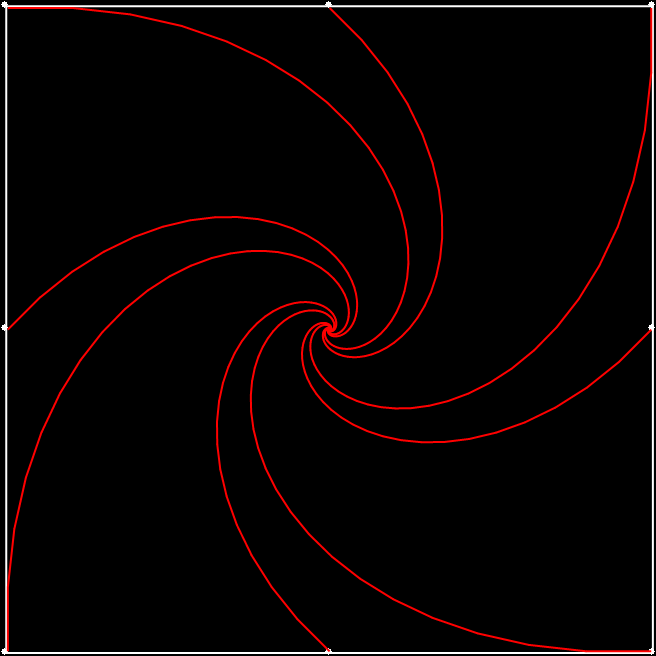
v = 4+s1, p = +2


And here each mouse is pursuing the mouse three places to its left:

v = 4+s1, p = +3


Now try a different arrangement of the mice. In the square below, the mice are arranged clockwise in rows from the bottom right-hand corner. That is, mouse #1 begins on the bottom left-hand corner, mouse #2 begins between that corner and the centre, mouse #3 begins on the bottom left-hand corner, and so on. When each mice runs towards the mouse three places away, these pursuit curves appear:

v = 4 + 1 internally, p = +3


Here are some more:

v = 4 + i1, p = +5
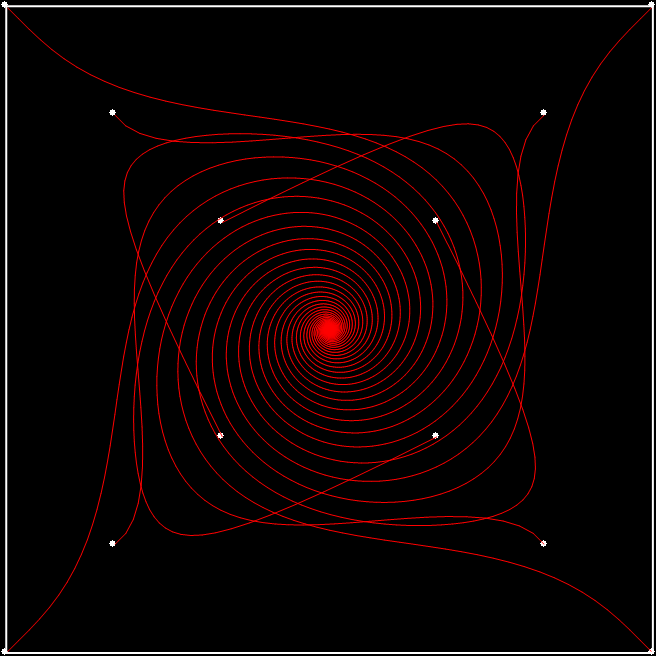

v = 4 + i2, p = +1


v = 4 + i2, p = +2


So far, all the mice have eventually run to the centre of the square, but that doesn’t happen here:
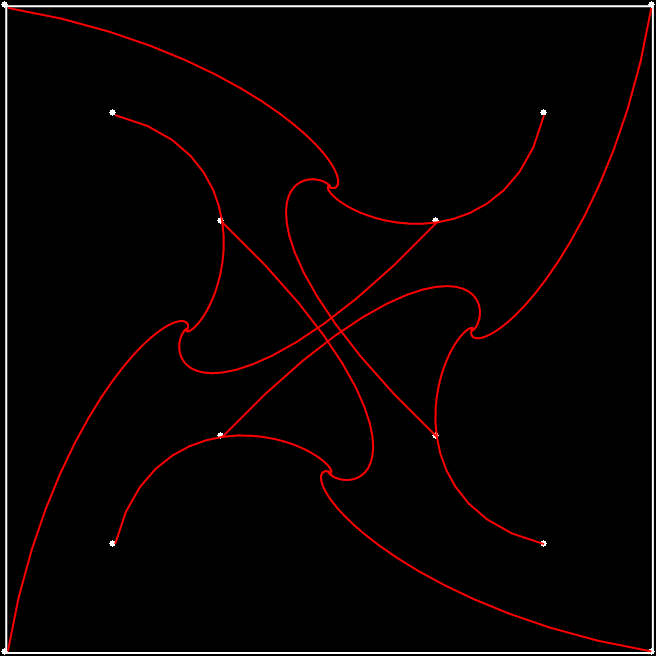
v = 4 + i2, p = 4


Here are more pursuit curves for the v4+i2 mice, using an animated gif:
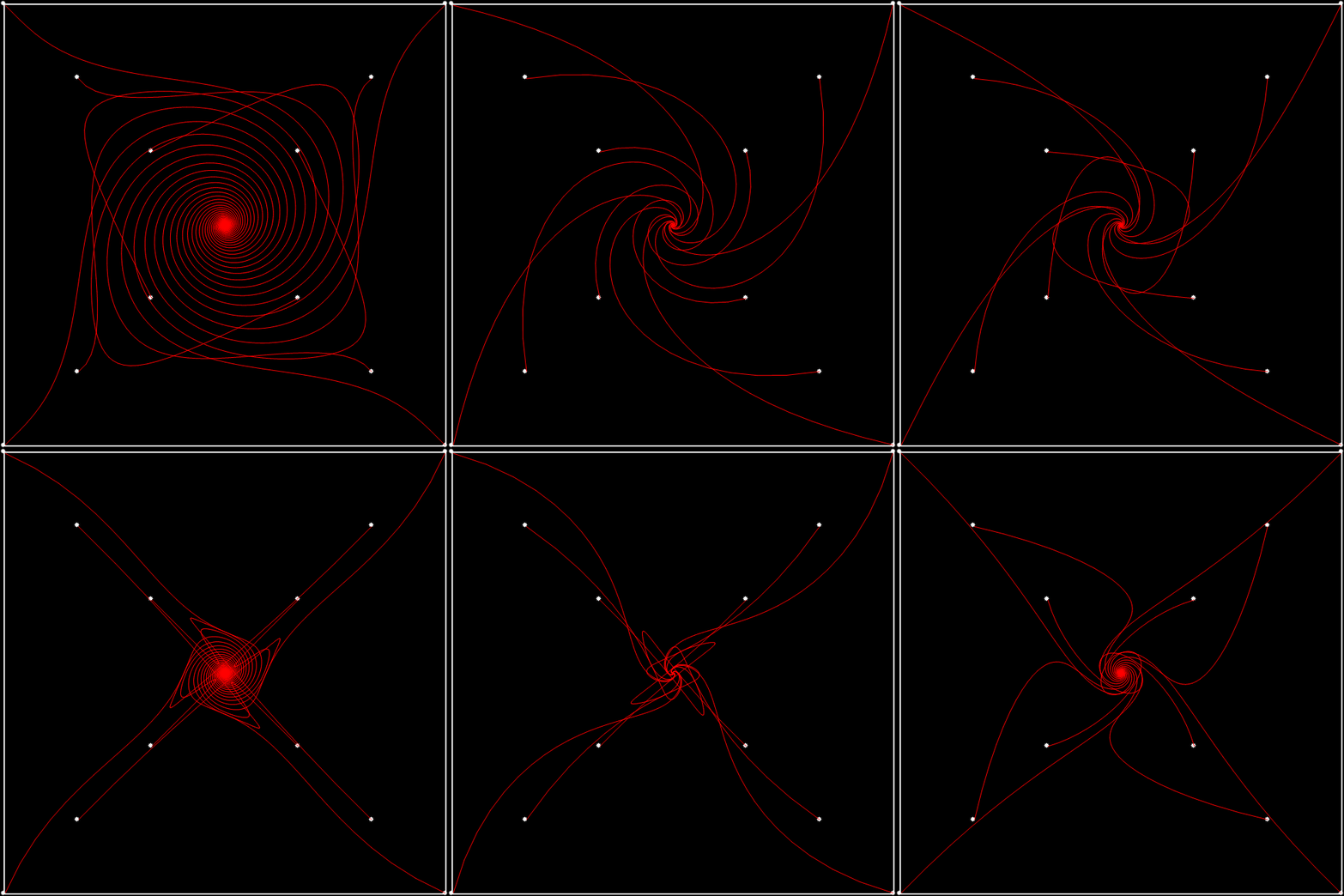
v = 4 + i2, p = various (animated — open in new tab for clearer image)


And here are more pursuit curves that don’t end in the centre of the square:
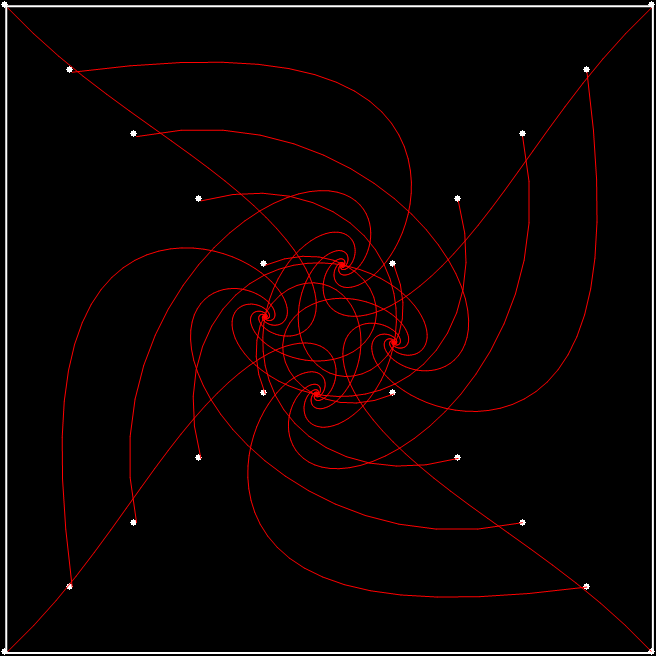
v = 4 + i4, p = 4
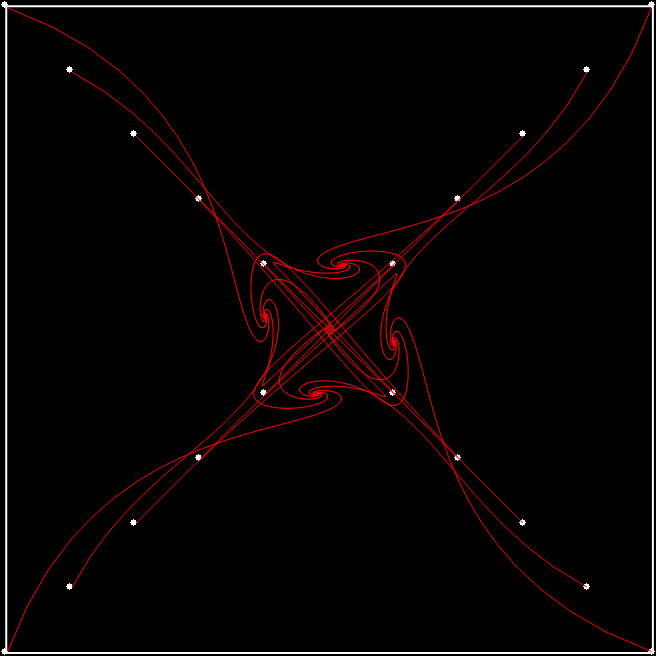

v = 4 + i4, p = 8
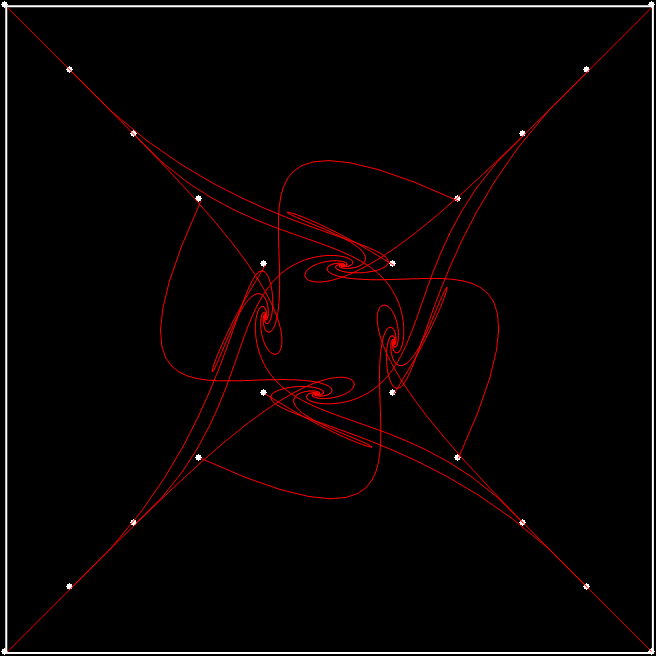

v = 4 + i4, p = 12
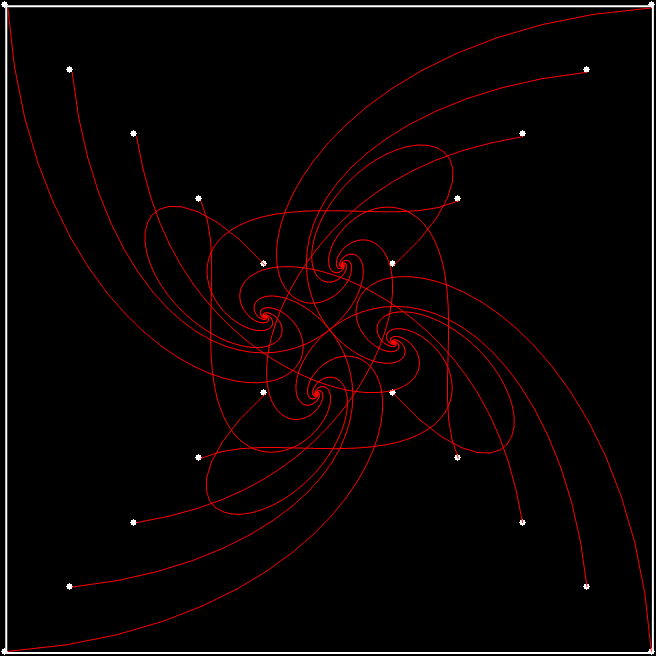

v = 4 + i4, p = 16


But the v4+i4 pursuit curves more usually look like this:

v = 4 + i4, p = 7


Now try adapting the rules so that mice don’t run directly towards another mouse, but towards the point midway between two other mice. In this square, the odd- and even-numbered mice follow different rules. Mice #1, #3, #5 and #7 run towards the point midway between the mice one and two places away, while ice #2, #4, #6 and #8 run towards the point midway between the mice two and seven places away:

v = 4 + s1, p(1,3,5,7) = 1,2, p(2,4,6,8) = 2,7


I think the curves are very elegant. Here’s a slight variation:

v = 4 + s1, p1 = 1,3, p2 = 2,7


Now try solid curves:
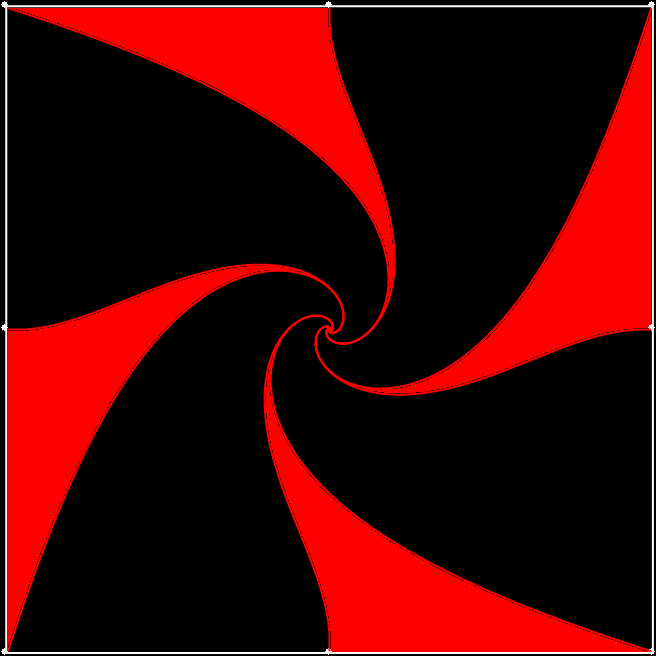
v = 4 + s1, p1 = 1,3, p2 = 2,7 (red)


v = 4 + s1, p1 = 1,3, p2 = 2,7 (yellow-and-blue)


And some variants:

v = 4 + s1, p1 = 1,7, p2 = 1,2
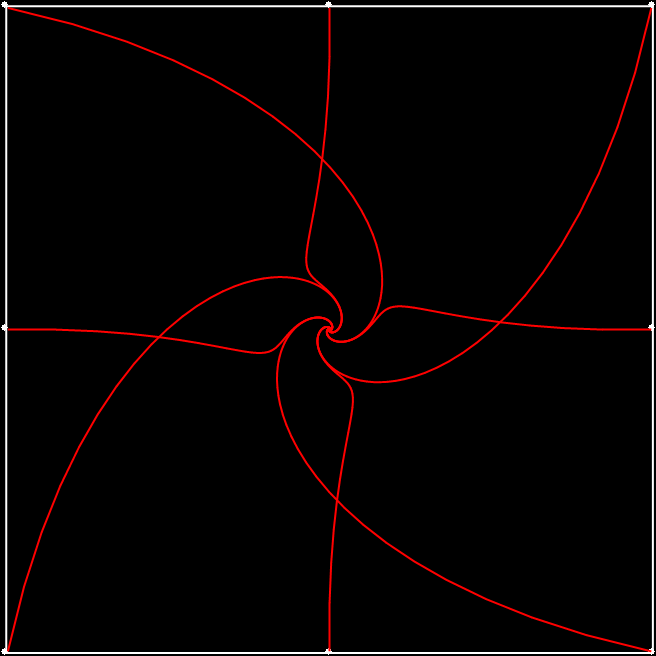

v = 4 + s1, p1 = 2,3, p2 = 2,5


v = 4 + s1, p1 = 5,6, p2 = 1,3


v = 4 + s1, p1 = 5,6, p2 = 1,4
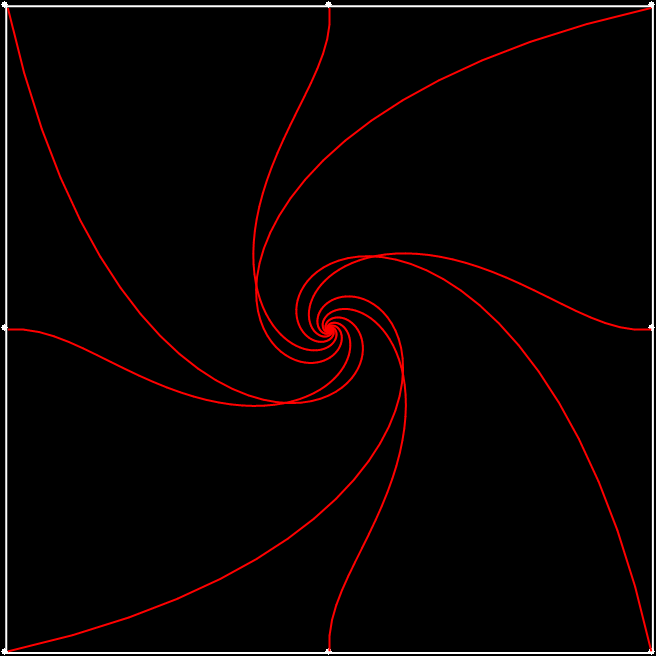

v = 4 + s1, p1 = 5,6, p2 = 1,6


Elsewhere other-posted:
Polymorphous Pursuit
Persecution Complex

Beyond Gold: A Weevil

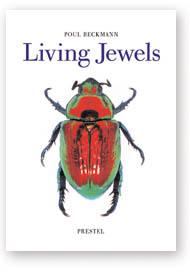
Cover of Living Jewels by Poul Beckmann

Living Jewels: The Natural Design of Beetles, Poul Beckmann (2001)

Richard Dawkins wrote about the Blind Watchmaker, but the Blind Watchmaker often works in collaboration. This book is about his brother, the Blind Jeweller, who creates the cases for the watchwork of beetles. Sometimes those cases are gorgeous, sometimes they’re grotesque, and sometimes they’re both at once. Beetle #77 in this survey, Phanaeus igneus floridanus, is a squat giant with a huge curving horn on its head, but its thorax and abdomen shimmer with metallic purple, green, red, and gold. If that beetle’s a glam-rock sumo-wrestler, then beetle #49, Julodis hiritiventris sanguinipilig (sic – should be hirtiventris sanguinipilis), is pure punk: green legs and a long dark-blue body scattered with tufts of yellow-orange bristles. Elsewhere you’ve got New Romantics with elaborately patterned bodies and sweeping, dandyish antennae (Rosenbergia straussi and Batus barbicornis), death-metal-heads with gleaming black bodies and fearsome-looking but completely harmless horns (Xylotrupes gideon and Allomyr(r?)hina dichotomus taiwana), and even Status-Quo-ites wearing what looks like worn, work-stained denim (various Eupholus species).

It’s entertaining to look through this book and imagine whose backing band or album cover a particular beetle should play in or sit on, but sometimes you won’t be able to match a beetle to a band, because there are more kinds of beetle than musical genres. Beetles, or rather evolution, has invented more than human beings have, but the same forces have been at work. Topologically speaking, a doughnut is identical to a tea-cup, because one is a distorted variant of the other. Similarly, all the beetles in this book are distorted topological variants of each other: like genres of popular music, they’re variants on a theme. Evolution hasn’t altered the ingredients of beetles, just the quantities used to cook each species: changing the width and shape of the thorax, the length and design of the antennae and legs, and so on. But topology isn’t psychology, and just as glam-rock sounds quite different to punk, though the common ancestor is clearly there if you listen, so a doughnut looks quite different to a teacup and Phanaeus igneus floridanus looks quite different to Julodis hirtiventris sanguipilis.

There’s much more to beetles than their appearance, of course, but one of this book’s shortcomings, because it’s a coffee-table conversation-piece rather than a scientific survey, is that it tells you almost nothing about the ecology and behaviour behind the photographs. And the book’s title is misleading, in fact, because the jewels aren’t living: all the photos are of dead beetles on white backgrounds. The book also tells you very little about the meaning and history of the (sometimes misspelt) scientific names, even though these are fascinating, beautiful, and grotesque in their own right. Instead, there’s a brief but interesting – and occasionally wrong: Chrysophora isn’t Latin – introduction, then page after page of the gorgeous and grotesque photographs people will be buying this book for. Finally, there are some brief “Beetle Profiles”, describing where individual species were caught and how their family lives and feeds. I would have liked to know much more, though the beetles’ beauty is in some ways increased by its mystery and by what might be called the futility of its appearance. Countless millions of these beetles have lived and died without any human brain ever appreciating their beauty and strangeness, and if human beings disappeared from the planet they would continue to live and die unappreciated. They’re not here for us, but without us they could never be recognized as the living jewels they are. Some might draw metaphysical conclusions from that and conclude that they are here for us after all, but I draw a mathematical conclusion: mathematics governs the evolution of both beetles and brains, which is why beetles can appeal to us so strongly.

Living Jewels – Website accompanying the book and its sequel.

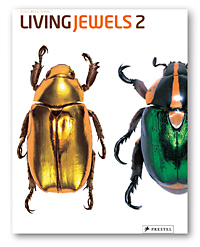
Cover of Living Jewels 2 by Poul Beckmann