
No Plaice Like Olm

European Reptile and Amphibian Guide by Axel KwetEuropean Reptile and Amphibian Guide, Axel Kwet (New Holland 2009)

An attractive book about animals that are mostly attractive, sometimes strange, always interesting. It devotes photographs and descriptive text to all the reptiles and amphibians found in Europe, from tree-frogs to terrapins, from skinks to slow-worms. Some of the salamanders look like heraldic mascots, some of the lizards like enamel jewellery, and some of the toads like sumo wrestlers with exotic skin-diseases. When you leaf through the book, you’ve moving through several kinds of space: geographic and evolutionary, aesthetic and psychological. Europe is a big place and has a lot of reptilian and amphibian variety, including one species of turtle, the loggerhead, Caretta caretta, and one species of chameleon, the Mediterranean, Chamaeleo chamaeleon.

But every species, no matter how dissimilar in size and appearance, has a common ancestor: the tiny crested newt (Triturus cristatus) to the far north-west in Scotland and the two-and-a-half metre whip snake (Dolichophis caspius) to the far south-east in Greece; the sun-loving Hermann’s tortoise (Testudo hermanni), with its sturdy shell, and the pallid and worm-like olm (Proteus anguinus), which lives in “underground streams in limestone karst country along the coast from north-east Italy to Montenegro” (pg. 55). Long-limbed or limbless, sun-loving or sun-shunning, soft-skinned or scaly – they’re all variations on a common theme.
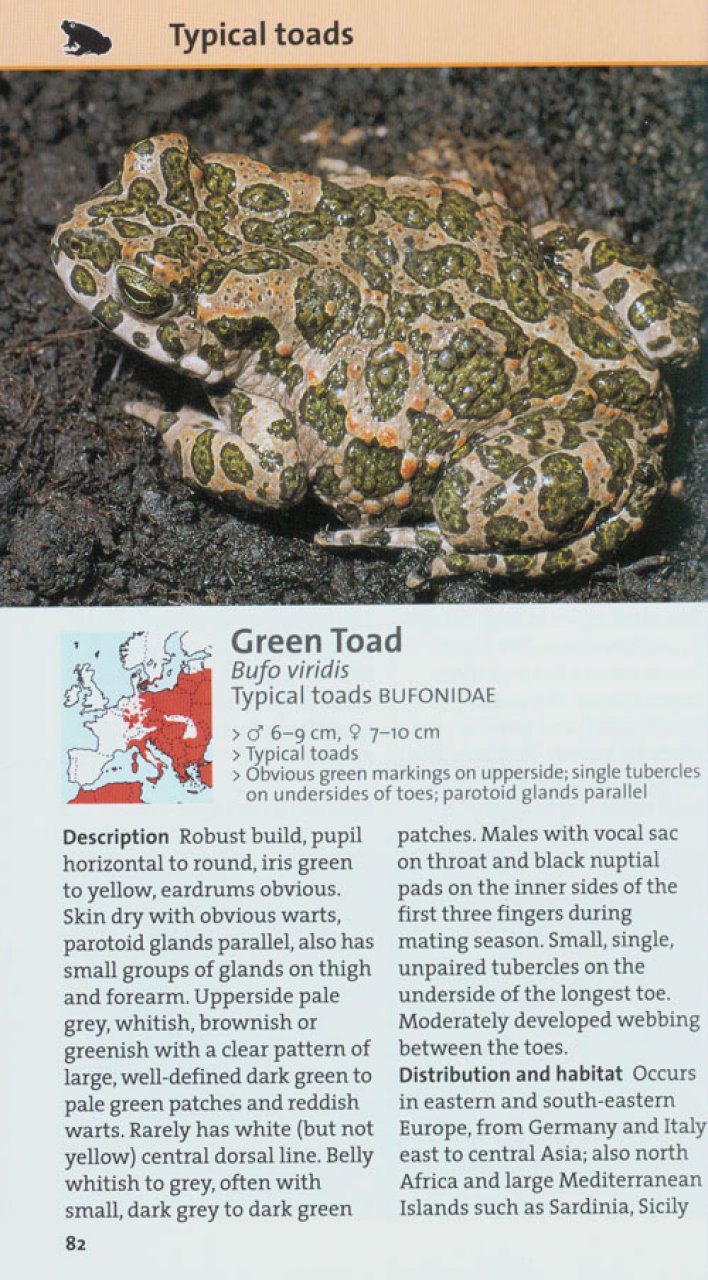
Sample page

Sample page from European Reptile and Amphibian Guide


And that’s where aesthetic and psychological space comes in, because different species and families evoke different impressions and emotions. Why do snakes look sinister and skinks look charming? But snakes are sinuous too and in a way it’s a shame that a photograph can capture their endlessly varying loops and curves as easily as it can capture the ridigity of a tortoise. At one time a book like this would have had paintings or drawings. Nowadays, it has photographs. The images are more realistic but less enchanted: the images are no longer mediated by the hand, eye and brain of an artist. But some enchantment remains: the glass lizard, Pseudopus apodus, peering from a holly bush on page 199 reminds me of Robert E. Howard’s “The God in the Bowl”, because there’s an alien intelligence in its gaze. Glass lizards are like snakes but can blink and retain “tiny, barely visible vestiges of the hind legs” (pg. 198).

Other snake-like reptiles retain vestiges of the fore-limbs too, like the Italian three-toed skink (Chalcides chalcides). The slow-worm, Anguis fragilis, has lost its limbs entirely, but doesn’t look sinister like a snake and can still blink. Elsewhere, some salamanders have lost not limbs but lungs: the Italian cave salamander, Speleomantes italicus, breathes through its skin and the lining of its mouth. So does Gené’s cave salamander, Speleomantes genei, which is found only on the island of Sardinia. It “emits an aromatic scent when touched” (pg. 54). Toads can emit toxins and snakes can inject venoms: movement in evolutionary space means movement in chemical space, because every alteration in an animal’s appearance and anatomy involves an alteration in the chemicals created by its body. But chemical space is two-fold: genotypic and phenotypic. The genes change and so the products of the genes change. The external appearance of every species is like a bookmark sticking out of the Book of Life, fixing its position in gene-space. You have to open that book to see the full recipe for the animal’s anatomy, physiology and behaviour, though not everything is specified by the genes.
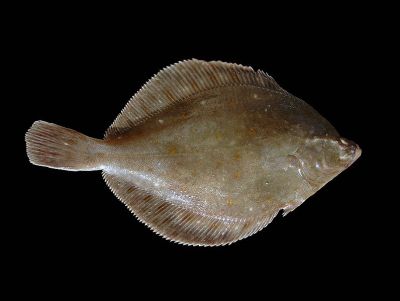
Pleuronectes platessa on the sea-floor

Pleuronectes platessa on the sea-floor


The force of gravity is one ingredient in an animal’s development, for example. So is sunlight or its absence. Or water, sand, warmth, cold. The descendants of that common ancestor occupy many ecological niches. And in fact one of those descendants wrote this book: humans and all other mammals share an ancestor with frogs, skinks and vipers. Before that, we were fish. So a plaice is a distant cousin of an olm, despite the huge difference in their appearance and habitat. One is flat, one is tubular. One lives in the sea, one lives in caves. But step by step, moving through genomic and topological space, you can turn a plaice into an olm. Or into anything else in this book. Just step back through time to the common ancestor, then take another evolutionary turning. One ancestor, many descendants. That ancestor was itself one descendant among many of something even earlier.
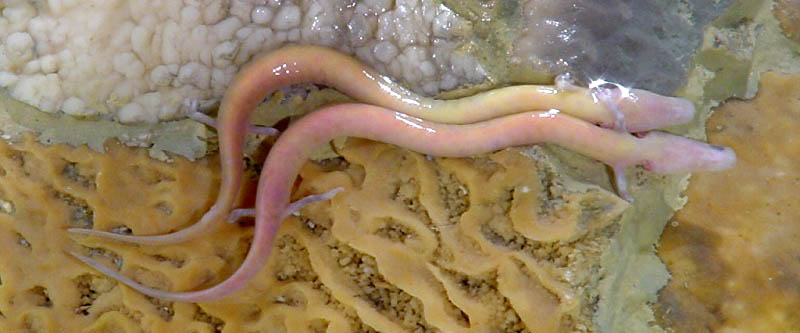
Olm in a Slovenian cave

Olm in a Slovenian cave


But there’s another important point: once variety appeared, it began to interact with itself. Evolutionary environment includes much more than the inanimate and inorganic. We mammals share more than an ancestor with reptiles and amphibians: we’ve also shared the earth. So we’re written into their genes and some of them are probably written into ours. Mammalian predators have influenced the evolution of skin-colour and psychology, making some animals camouflaged and cautious, others obtrusive and aggressive. But it works both ways: perhaps snakes seem sinister because we’re born with snake-sensitive instincts. If it’s got no limbs and it doesn’t blink, it might have a dangerous bite. That’s why the snake section of this book seems so different to the salamander section or the frog section. But all are interesting and all are important. This is a small book with some big themes.

Ave Aves!

Front cover of Collins Bird Guide by Lars SvenssonCollins Bird Guide: The Most Complete Guide to the Birds of Britain and Europe (second edition), text and maps by Lars Svensson, illustrations and captions by Killian Mullarney and Dan Zetterström, with a significant contribution by Peter J. Grant, translated by David Christie and Lars Svensson (HarperCollins, 2009)

A literate musician can read a score and hear a symphony in his head. I wonder whether the mega-minds of the future will be able to do something similar with genomes: read a DNA recipe and see the animal or plant cooked from it. The mega-minds will need to know about the oven, that is, the womb, egg or seed, but then musicians need to know about instruments, not just notes. The code can’t exist in isolation: it needs a world to be realized in and a musician’s mind can mimic that world.

But mega-minds aren’t here yet for genetics, so we have to use books like this to see the product of DNA-recipes. Collins Bird Guide is effectively a genetic cook-book or genomic score, but we don’t see the naked genes, just the dish or symphony cooked or played from them. Lars Svensson describes thousands of birds of all shapes, sizes, colours, diets and habitats, from the huge golden eagle, Aquila chrysaetos, which can carry off a lamb, to the tiny goldcrest, Regulus regulus, which isn’t much bigger than a bumblebee. But these two, like all other birds, have a common ancestor: when you see a bird sitting in a tree, it is also, metaphorically speaking, sitting in a genetic tree whose twigs, branches and boughs spring from a single trunk. One DNA-recipe has turned into many under the influence of natural and sexual selection.

Birds, which often come in very distinct male and female forms, offer lots of good examples of sexual selection. One of the most spectacular examples isn’t native to the region covered by the book, but it has been introduced here. And so there are pleasant surprises in store for some European ornithophiles. I once came across a wild-living golden pheasant, Chrysolophus pictus, early one morning in a park in northern England. I thought for a moment that I was hallucinating: the bird has a crest of spun gold, a scarlet breast and belly, and an orange/black “nuchal cape”, or neck-feathers, that “can be raised like a fan when displaying” (“Partridges & Pheasants”, pg. 59). It also has yellow legs, blue wings and a long, attractively patterned tail. “Unmistakable!” notes the book.

That’s true of the ♂, at least. The ♀, whose eyes and brain are responsible for the spectacular appearance of the ♂, is undistinguished and similar to the ♀ of Lady Amherst’s pheasant, Chrysolophus amherstiae, whose ♂ is again “Unmistakable!”, thanks to the sexual selection of its ♀. These closely related species are native to eastern Asia and “occasionally hybridize” in Britain (pg. 59). In other words, their common ancestor was fairly recent and their DNA recipes can still work together. But these hybridizations may also be a function of small populations and restricted habitat in Britain. “Function” is the operative word: birds, like all other forms of life, are mechanisms with inputs, throughputs and outputs. For a pheasant, some of the input is sense-data. The throughput is the processing of sense-data in the brain. The output is behaviour: for example, mating with a less-than-ideal partner under the restricted conditions of Britain.

All this can be modelled mathematically, but in the widest and deepest sense it already is mathematical: the human invention of mathematics, with a small “m”, is a symbolic representation of Mathematics with a big “M”. Mathematical symbols represent entities and operations and are manipulated according to logical rules. This mimics the inter-play of entities in the real world, which are subject to the rules of logic implicit in physics and chemistry. Human mathematics is fallible, albeit self-correcting. The mathematics underlying reality realizes the pipe-dreams of the papacy and is infallible, in the sense that it never disobeys the rules by which it is governed.

But this infallible mathematics can fail the entities for whom it operates: birds can die young and fail to reproduce or have fewer offspring than their competitors. But this is the fuel of a larger mechanism: evolution, which is a mathematical process. Genes mutate and vary in frequency under the influence of natural and sexual selection, inter alia. Birds offer more good examples of the effects, because they have wings, beaks and feet. These are mathematical mechanisms, shaped by and for the physics of a particular environment: wings have input from the air and provide the output of flight. Or the output of swimming: some wings are adapted for movement underwater, as in the cormorants, or Phalacrocoracidae, whose beaks are adapted for seizing fish and feet for paddling.

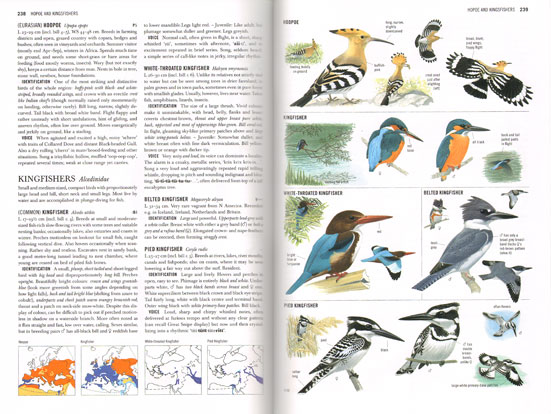
Sample page from Collins Bird Guide by Lars Svensson

You can look through this book and survey the varying geometry of wings, beaks and feet, from gliding gulls to hovering warblers, from seed-cracking finches to flesh-tearing owls, from tiny-toed swifts to wading egrets. The tool-kit of the common ancestor has become many tool-kits and evolution has been morally neutral as it has worked its multiplicative magic. The feet of the odd and endearing wallcreeper, Tichodroma muraria, are adapted to clinging onto vertical rock; the feet of eagles and owls are adapted to puncturing nerve-filled flesh. And presumably each species enjoys using its adaptation. A distinct psychology will accompany each distinct wing, beak and foot, because no organ can change in isolation: it is evolving within the environment of the body, influencing and influenced by other organs, in particular the brain.

But changes in the brain aren’t easily visible. If they were, some parts of evolution would be much less controversial: racial differences in human intelligence, for example. But races differ in other ways: in their attitudes to animals, for example. One generalization is that northern Europeans like listening to songbirds and southern Europeans like shooting them. So it’s not surprising that this book was originally published in Swedish as Fågelguiden, Europas och Medelhavsområdets fåglar i fält (1999). It would also be interesting to see the statistics of ornithological publishing in Europe. Those statistics will reflect genetic differences in the white European race, and so will readers’ reactions to the book.

My interest is partly aesthetic and mathematical, for example, and I quail at the thought of learning the differences between what bird-watchers call “little brown jobs”: the various kinds of warbler are hard enough to tell apart in pictures, let alone in the wild. But things can get even worse at night: Lars Svensson notes of Savi’s warbler, Locustella luscinioides, that “A possible confusion risk at distance and at night in S and C Europe is the mole-cricket” (“Warblers”, pg. 318). Birdsong and bird-cries are another aspect of ornitho-mathematics, but it’s hard to represent them in print: “kru-kih karra-kru-kih chivi trü chivi chih” (clamorous reed warbler, Acrocephalus stentoreus, pg. 322), “glipp-glipp-glipp” (common crossbill, Loxia curvirostra, pg. 386), “trrsh, trre-trre-trre-rrerrerre” (sand martin, Riparia riparia, pg. 258), “pyük…popopo…” (pygmy owl, Glaucidium passerinum, pg. 226), “brrreep, bip bip bip” (red phalarope, Phalaropus fulicarius, pg. 162), and so on.

In an electronic manual of ornithology, you’d be able to hear the songs, rather than imagine them, but electronic manuals, by offering more, in some ways offer less. Because the book has so many species to cover, it can’t describe any species in detail. So there are occasional fleeting comments like this:

Asian Desert Warbler, Sylvia nana V*** [= rare vagrant in northern Europe]… has the peculiar habit of sometimes “tailing” the Desert Wheatear [Oenanthe deserti] (“Warblers”, pg. 310-1)

The accompanying illustration shows a desert warbler standing under a small bush and peering out at a nearby wheatear. It’s anthropomorphic and anthropocentric to be amused by the behaviour, but ornithology is a human invention and humans don’t have to be purely scientific. I get a boy-racer thrill from another “V***” bird, the white-throated needletail, Hirundapus caudacutus:

Big, with heavy compact body, neckless, stub-tailed (shape somewhere between fat cigar and “flying barrel”). Flight impressively fast, the bird seems to draw easily away from other swifts (though these are still fast flyers!). (“Vagrants”, pg. 415)

That I would like to see. In the meantime, I have this book and the multiplex mutational mathematics it captures in pictures and words.