I Like Gryke

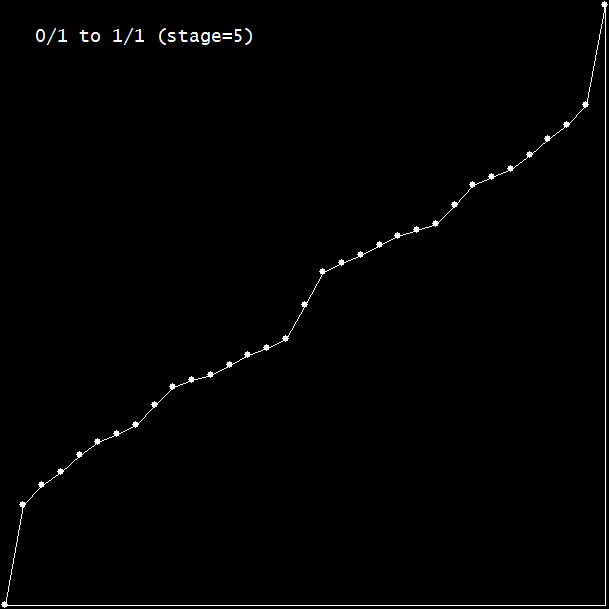
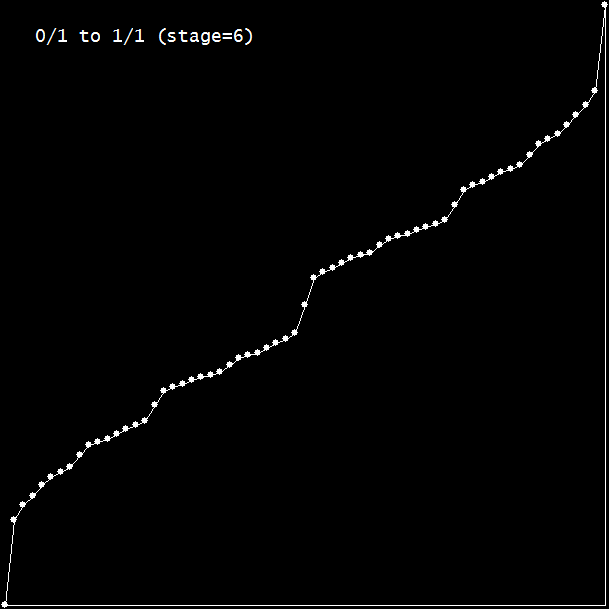
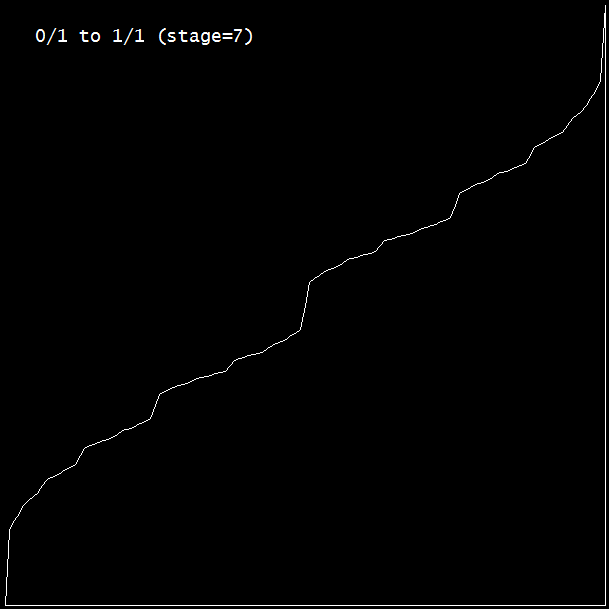
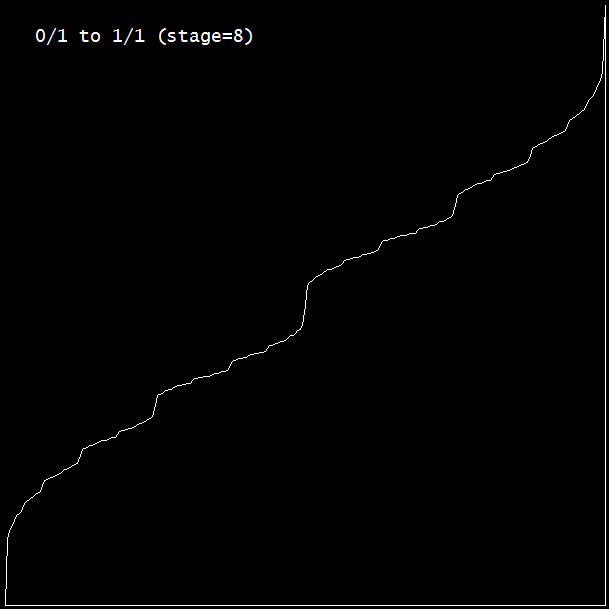
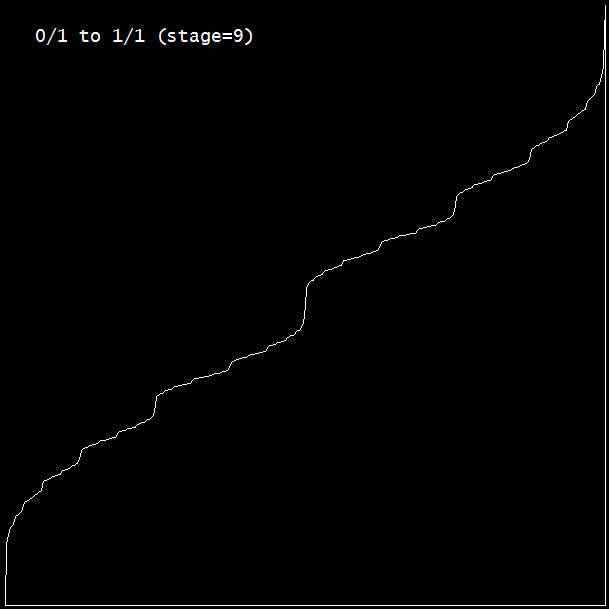
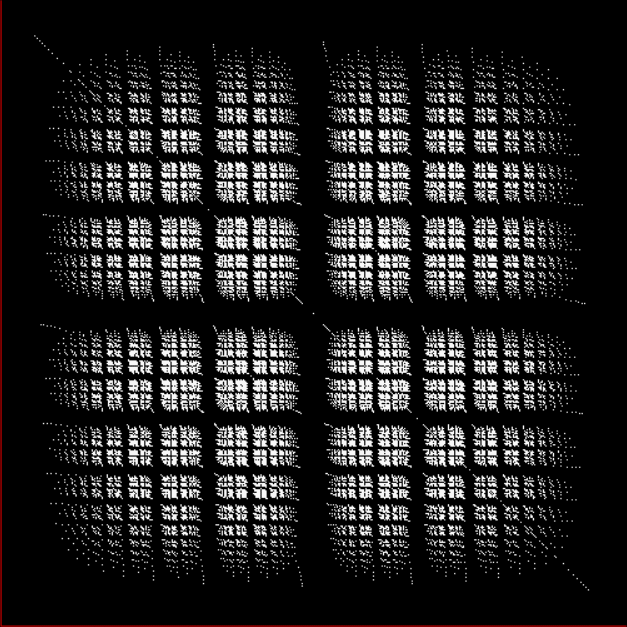
Sometimes I find fractals. And sometimes fractals find me. Here’s a fractal that found me:
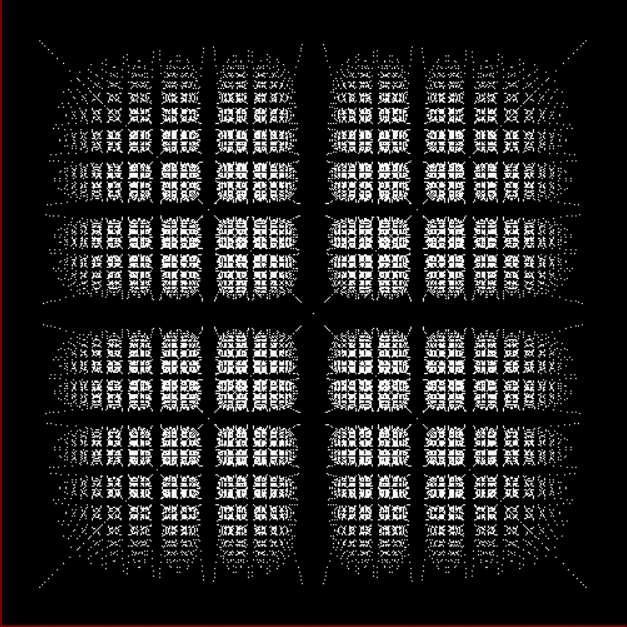
Limestone fractal #1


I call it a limestone fractal or pavement fractal or gryke fractal, because it reminds me of the fissured patterns you see in the limestone pavements of the Yorkshire Dales:
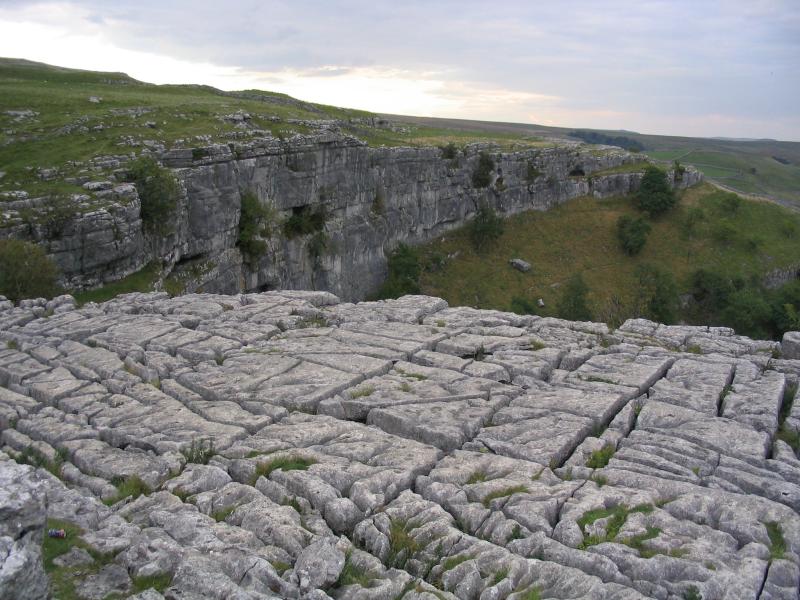
Fissured limestone pavement, Yorkshire Dales (Wikipedia)


The limestone blocks are called clints and the larger fissures between them are called grykes, with kamenitza and karren (from Slavic and German, respectively) for smaller pits and grooves:

Limestone linguistics (Dales Rocks)


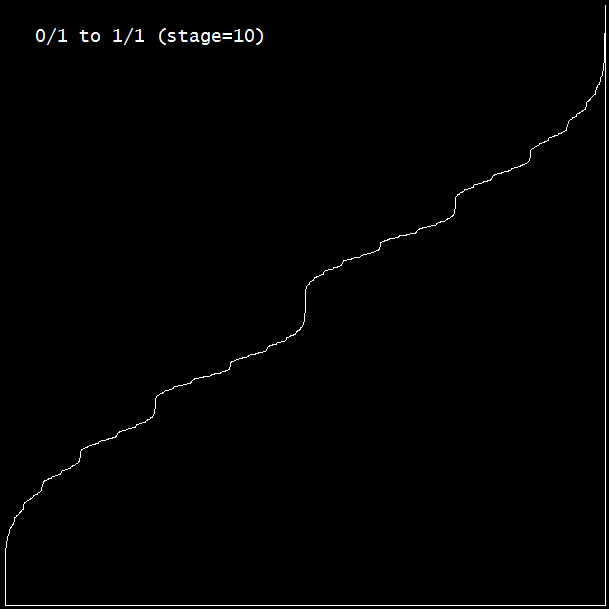
Here’s the me-finding fractal again, in a slightly different version:
Limestone fractal #2


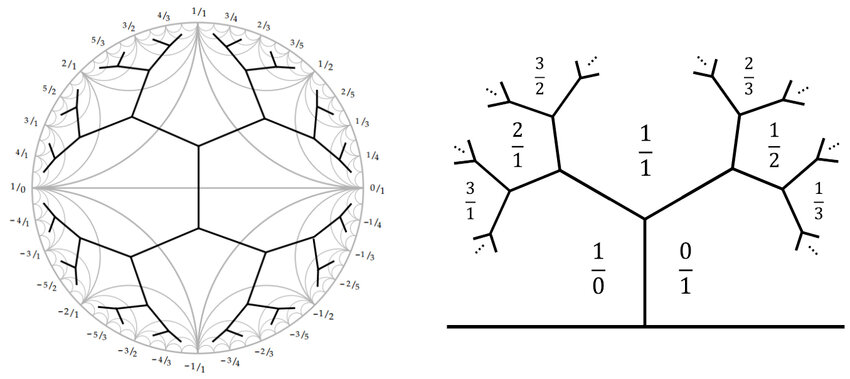
How did it find me? Well, I wasn’t looking for fractals, but looking at fractions. Farey fractions and Calkin-Wilf fractions, to be precise. They can both be represented as bifurcating trees, like this:
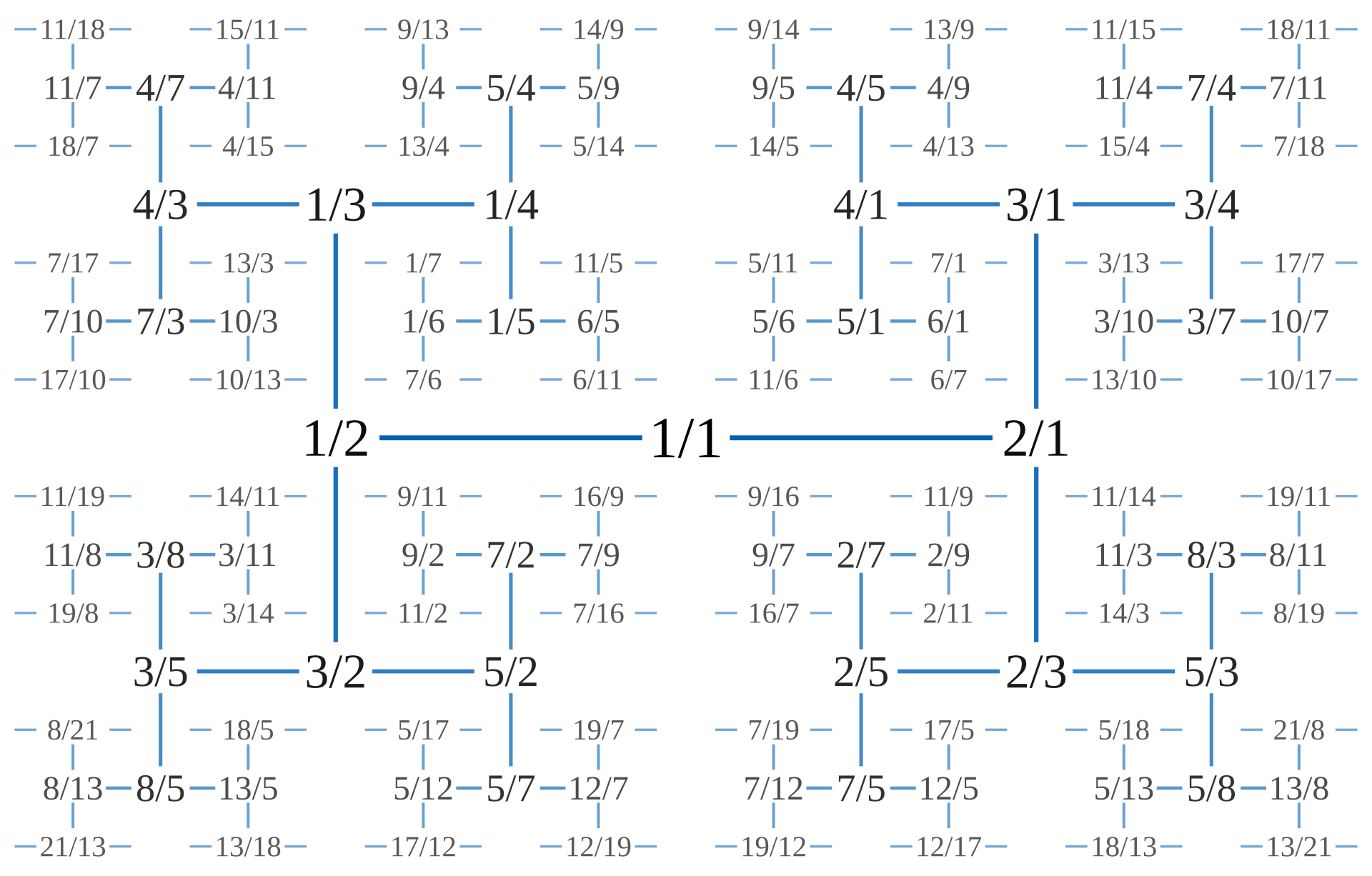
Calkin-Wilf tree (Wikipedia)


Both trees produce all the irreducible rational fractions — but in a different order. That’s why they create a fractal (rather than a 45° line). By following the same path in both bifurcating trees, I generated parallel sequences of Farey and Calkin-Wilf fractions, then used the Farey fractions to represent x in a 1×1 square and the Calkin-Wilf fractions to represent y (where the Calkin-Wilfs, a/b, were greater than 1, I simply a/b → b/a). When you do that (or use Stern-Brocot fractions instead of the Farey fractions), you get the limestone fractal.

I think it looks better in the second version (which is the one that found me, in fact). For LF #2, I was using standard binary numbers to generate the parallel sequences, so the leftmost digit was always 1 and final step of the tree-search was always in the same direction. Here’s LF #2 as black-on-white rather than white-on-black:

Limestone fractal #2 (black-on-white)


And here is the formation of LF #1 as an animated gif:
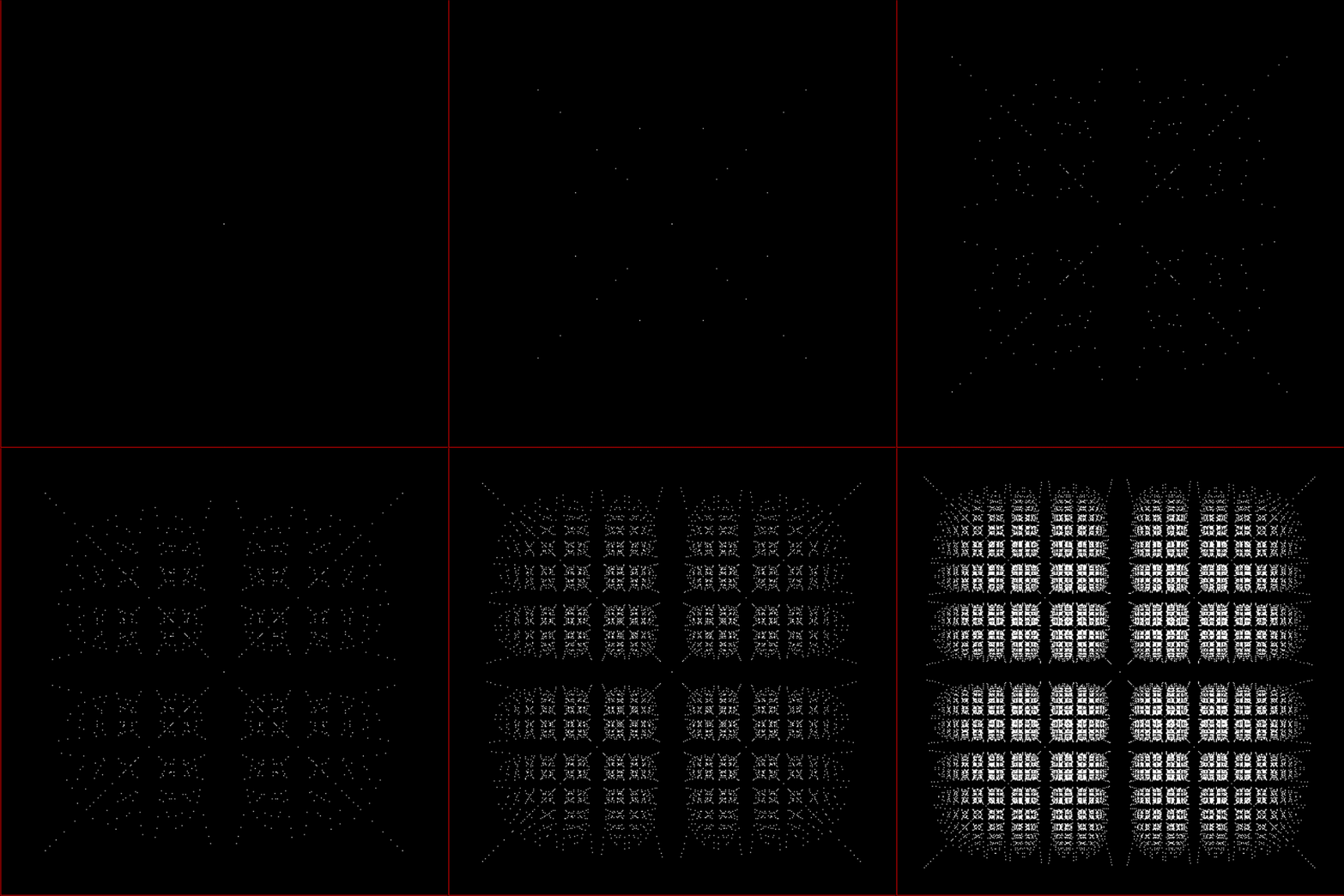
Growth of limestone fractal (animated at ezGIF)


And if that’s a me-finding fractal, what about me-found fractals? Here’s one:
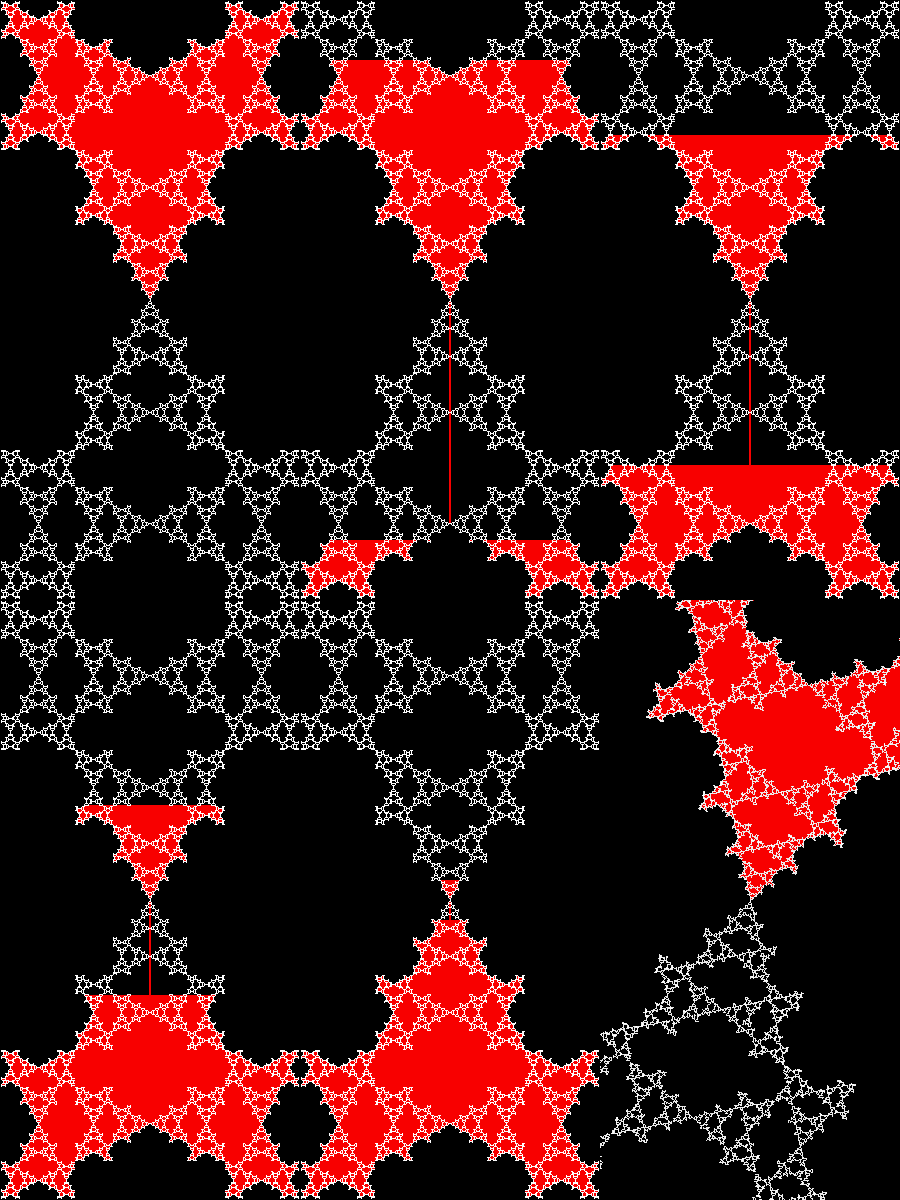
The Hourglass Fractal (animated gif optimized at ezGIF)

Hourglass fractal


I can say “I found that fractal” because I was looking for fractals when it appeared on the screen. And re-appeared (and re-re-appeared), because I’ve found it using different methods.


Elsewhere Other-Accessible

Hour Power — more on the hourglass fractal
Jewel Tree

Dual tree for Farey tessellation and positive Farey tree (from ResearchGate)


• Die Geometrie besitzt zwei große Schätze: einer ist der Satz von Pythagoras, der andere die Teilung einer Strecke nach dem äußeren und mittleren Verhältnis. Den ersten dürfen wir mit einem Scheffel Gold vergleichen; den zweiten nennen wir ein kostbares Juwel. — Johannes Kepler

• “Geometry has two great treasures: one is the Theorem of Phythagoras, the other the division of a line in extreme and mean ratio. The first we can compare to a mass of gold; the other we may call a precious jewel.”

Fract-Hills

The Farey sequence is a fascinating sequence of fractions that divides the interval between 0/1 and 1/1 into smaller and smaller parts. To find the Farey fraction a[i] / b[i], you simply find the mediant of the Farey fractions on either side:

• a[i] / b[i] = (a[i-1] + a[i+1]) / (b[i-1] + b[i+1])

Then, if necessary, you reduce the numerator and denominator to their simplest possible terms. So the sequence starts like this:

• 0/1, 1/1

To create the next stage, find the mediant of the two fractions above: (0+1) / (1+1) = 1/2

• 0/1, 1/2, 1/1

For the next stage, there are two mediants to find: (0+1) / (1+2) = 1/3, (1+1) / (2+3) = 2/3

• 0/1, 1/3, 1/2, 2/3, 1/1

Note that 1/2 is the mediant of 1/3 and 2/3, that is, 1/2 = (1+2) / (3+3) = 3/6 = 1/2. The next stage is this:

• 0/1, 1/4, 1/3, 2/5, 1/2, 3/5, 2/3, 3/4, 1/1

Now 1/2 is the mediant of 2/5 and 3/5, that is, 1/2 = (2+3) / (5+5) = 5/10 = 1/2. Further stages go like this:

• 0/1, 1/5, 1/4, 2/7, 1/3, 3/8, 2/5, 3/7, 1/2, 4/7, 3/5, 5/8, 2/3, 5/7, 3/4, 4/5, 1/1

• 0/1, 1/6, 1/5, 2/9, 1/4, 3/11, 2/7, 3/10, 1/3, 4/11, 3/8, 5/13, 2/5, 5/12, 3/7, 4/9, 1/2, 5/9, 4/7, 7/12, 3/5, 8/13, 5/8, 7/11, 2/3, 7/10, 5/7, 8/11, 3/4, 7/9, 4/5, 5/6, 1/1

• 0/1, 1/7, 1/6, 2/11, 1/5, 3/14, 2/9, 3/13, 1/4, 4/15, 3/11, 5/18, 2/7, 5/17, 3/10, 4/13, 1/3, 5/14, 4/11, 7/19, 3/8, 8/21, 5/13, 7/18, 2/5, 7/17, 5/12, 8/19, 3/7, 7/16, 4/9, 5/11, 1/2, 6/11, 5/9, 9/16, 4/7, 11/19, 7/12, 10/17, 3/5, 11/18, 8/13, 13/21, 5/8, 12/19, 7/11, 9/14, 2/3, 9/13, 7/10, 12/17, 5/7, 13/18, 8/11, 11/15, 3/4, 10/13, 7/9, 11/14, 4/5, 9/11, 5/6, 6/7, 1/1

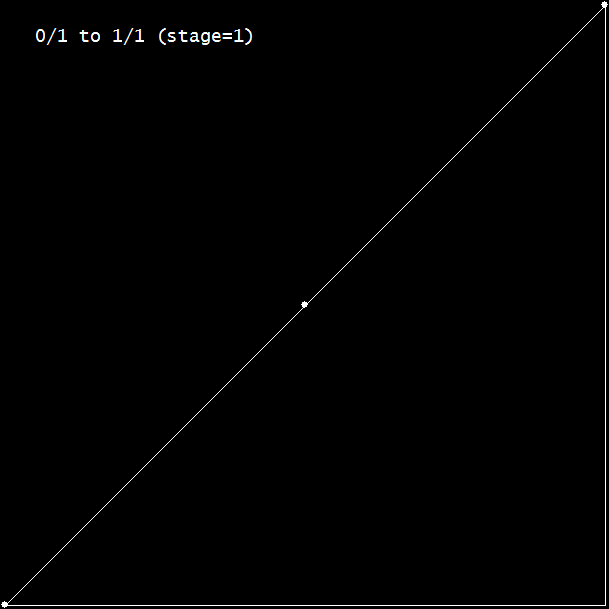
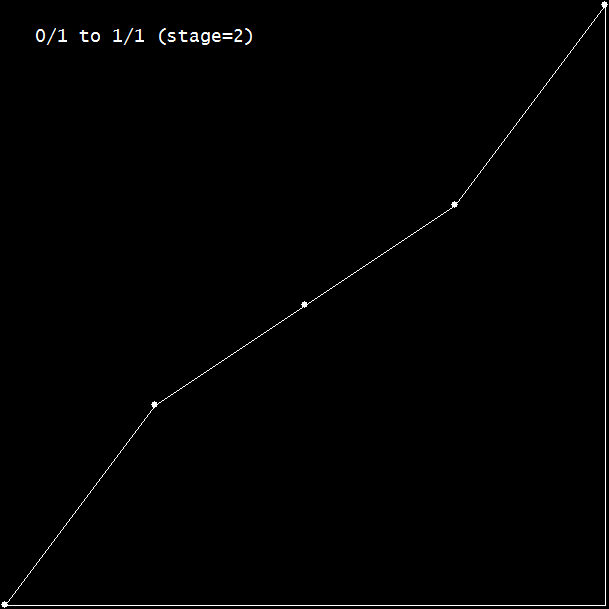
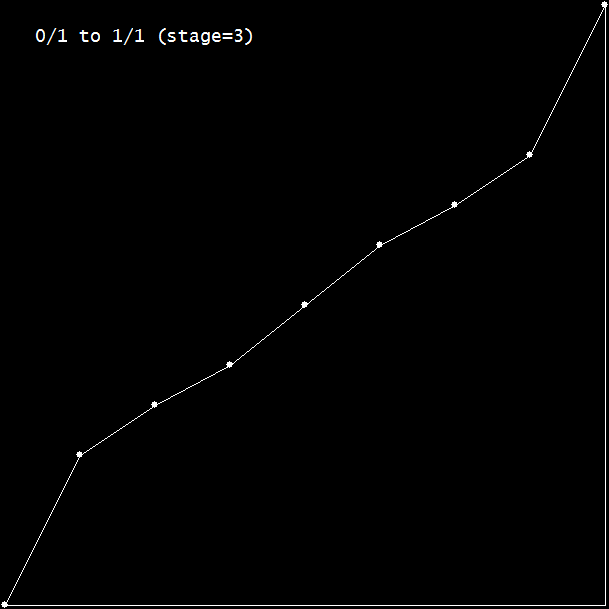
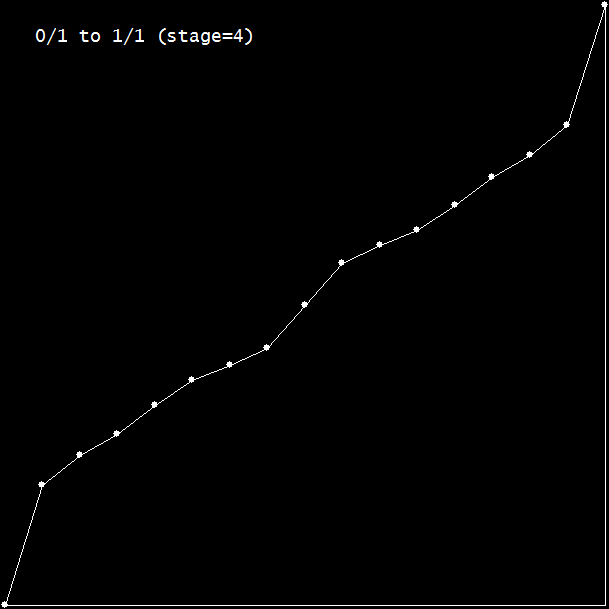
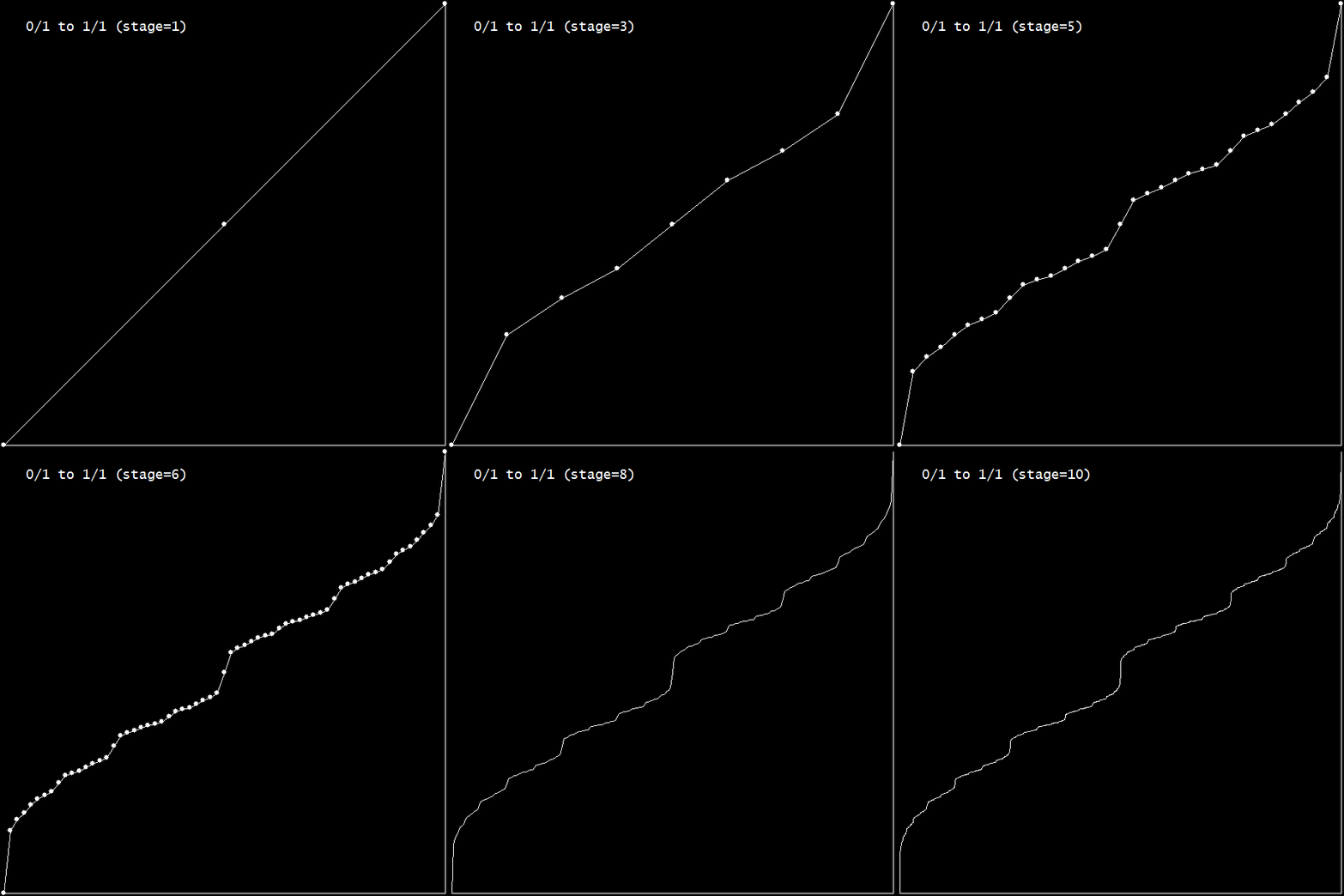
The Farey sequence is actually a fractal, as you can see more easily when it’s represented as an image:

Farey fractal stage #1, representing 0/1, 1/2, 1/1
Farey fractal stage #2, representing 0/1, 1/3, 1/2, 2/3, 1/1
Farey fractal stage #3, representing 0/1, 1/4, 1/3, 2/5, 1/2, 3/5, 2/3, 3/4, 1/1
Farey fractal stage #4, representing 0/1, 1/5, 1/4, 2/7, 1/3, 3/8, 2/5, 3/7, 1/2, 4/7, 3/5, 5/8, 2/3, 5/7, 3/4, 4/5, 1/1
Farey fractal stage #5
Farey fractal stage #6
Farey fractal stage #7
Farey fractal stage #8
Farey fractal stage #9

Farey fractal stage #10

Farey fractal (animated)

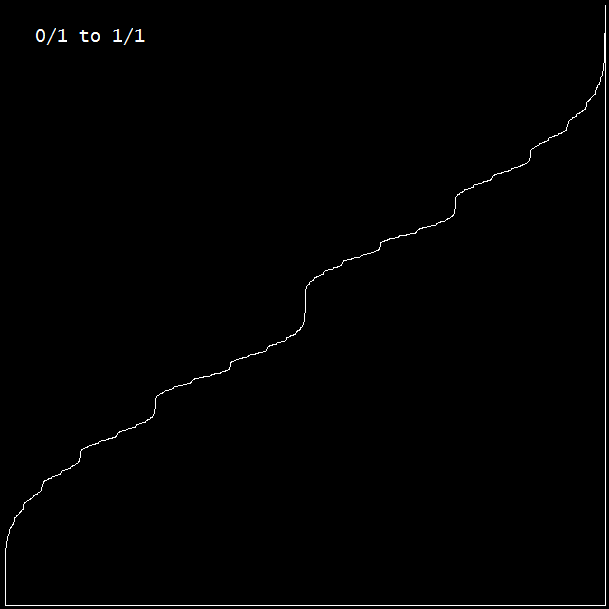
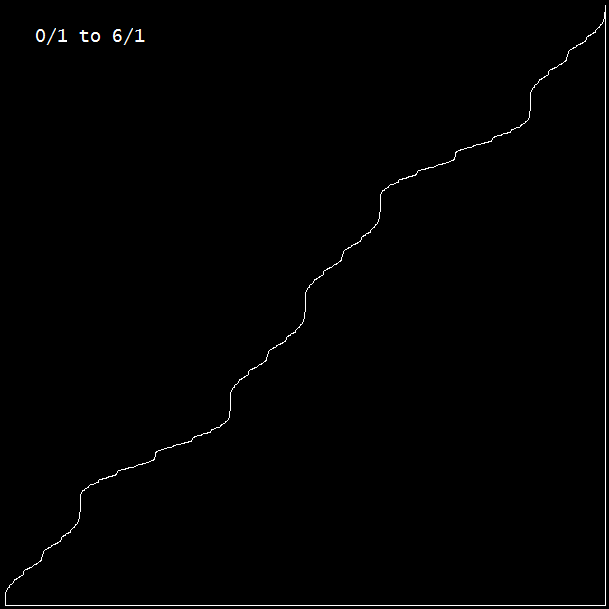
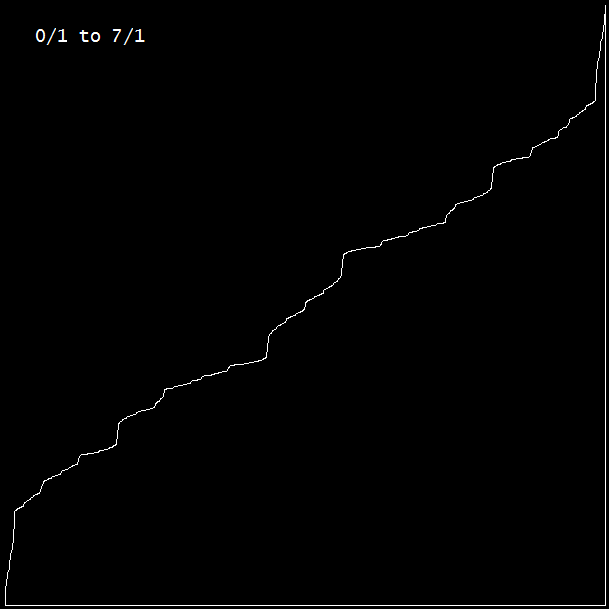
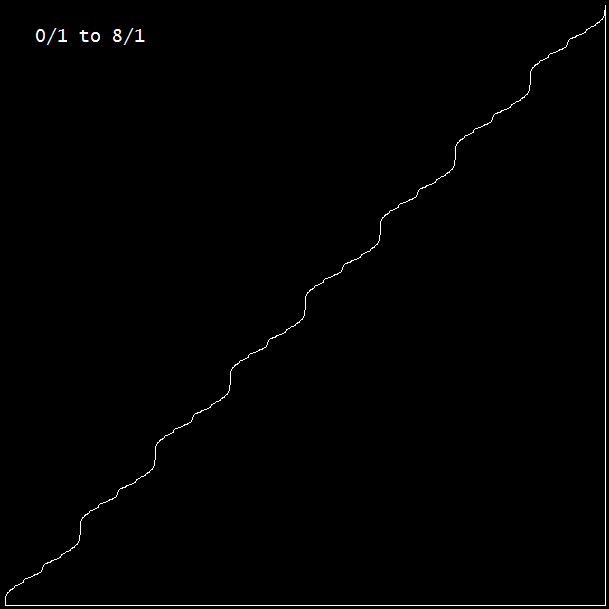
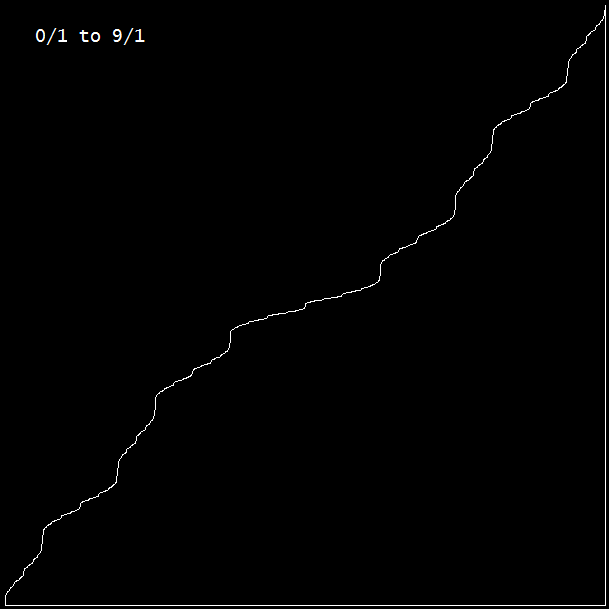
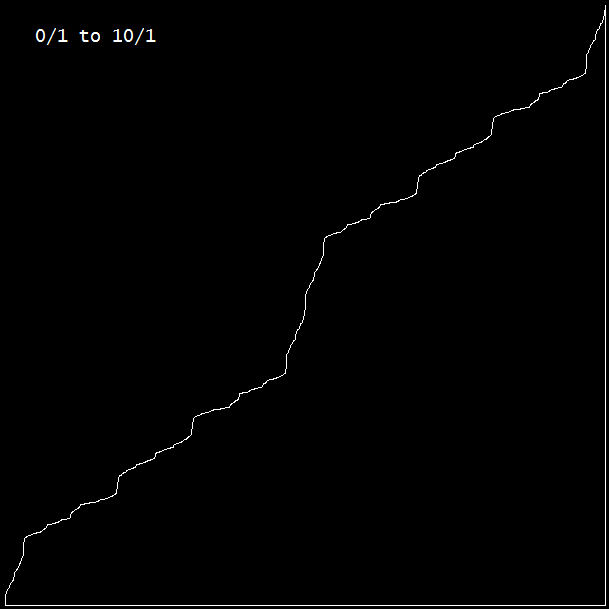
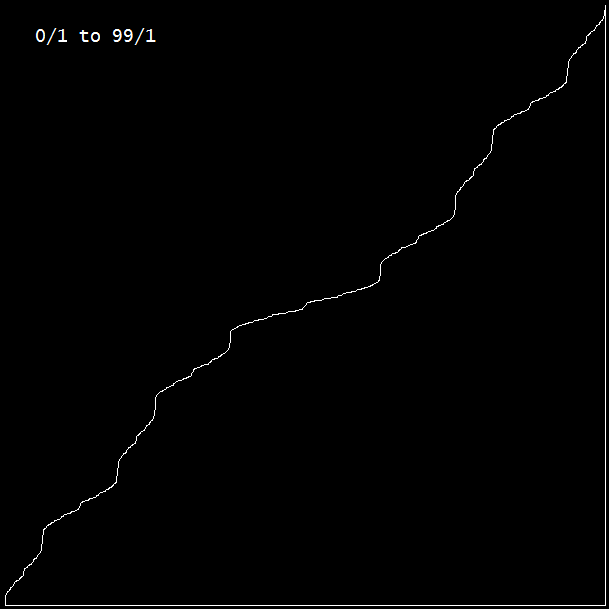
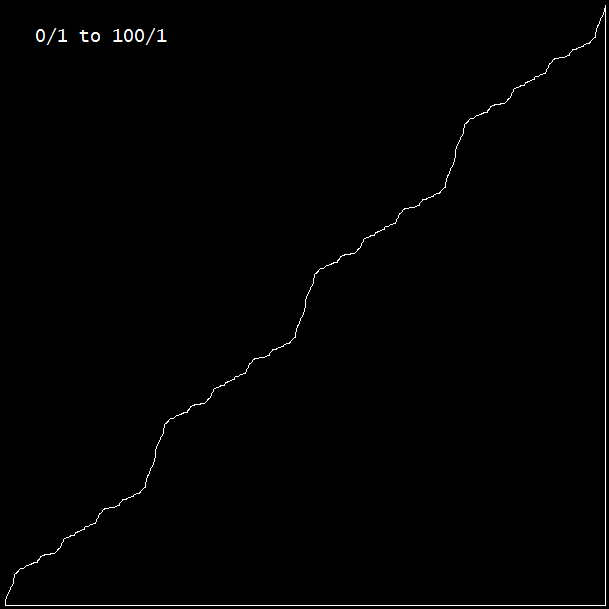
That looks like the slope of a hill to me, so you could call it a Farey fract-hill. But Farey fract-hills or Farey fractals aren’t confined to the unit interval, 0/1 to 1/1. Here are Farey fractals for the intervals 0/1 to n/1, n = 1..10:

Farey fractal for interval 0/1 to 1/1

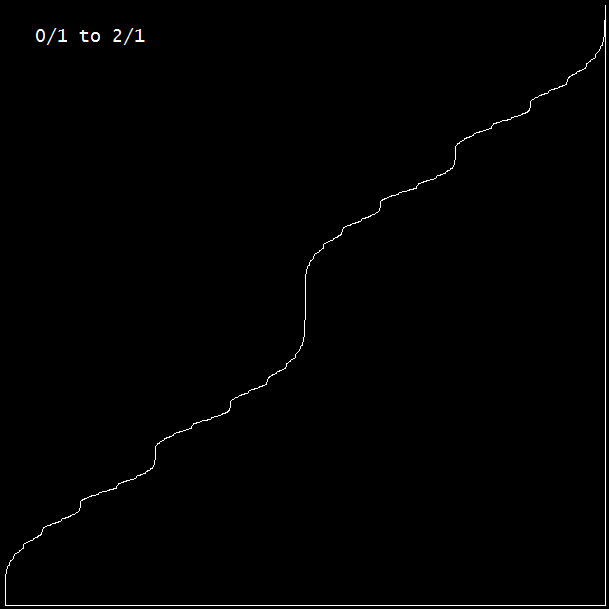
Farey fractal for interval 0/1 to 2/1, beginning 0/1, 1/4, 1/3, 2/5, 1/2, 3/5, 2/3, 3/4, 1/1, 5/4, 4/3, 7/5, 3/2, 8/5, 5/3, 7/4, 2/1

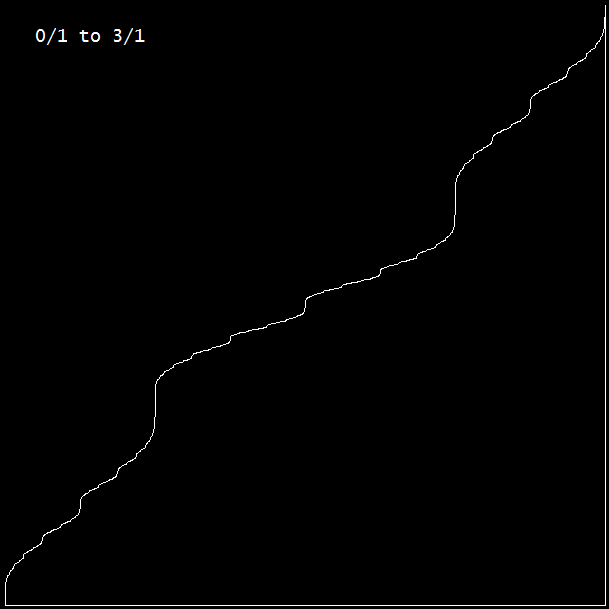
Farey fractal for interval 0/1 to 3/1, beginning 0/1, 1/3, 1/2, 2/3, 1/1, 5/4, 4/3, 7/5, 3/2, 8/5, 5/3, 7/4, 2/1, 7/3, 5/2, 8/3, 3/1

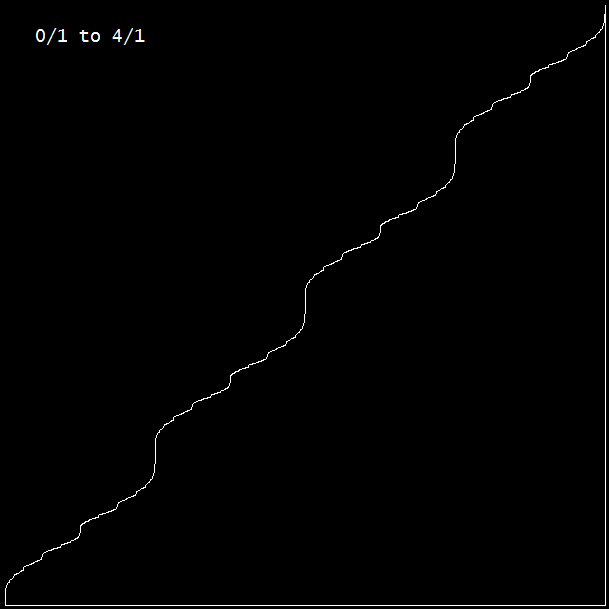
Farey fractal for interval 0/1 to 4/1, beginning
0/1, 1/3, 1/2, 2/3, 1/1, 4/3, 3/2, 5/3, 2/1, 7/3, 5/2, 8/3, 3/1, 10/3, 7/2, 11/3, 4/1

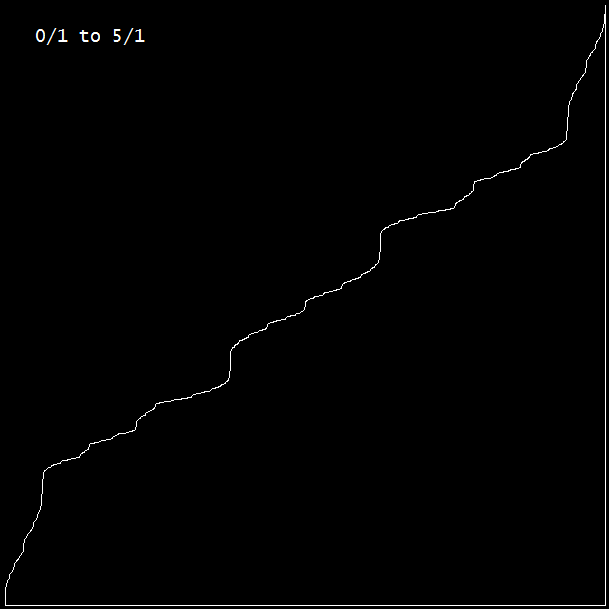
Farey fractal for interval 0/1 to 5/1, beginning 0/1, 1/1, 5/4, 10/7, 5/3, 7/4, 2/1, 7/3, 5/2, 8/3, 3/1, 13/4, 10/3, 25/7, 15/4, 4/1, 5/1

Farey fractal for interval 0/1 to 6/1, beginning 0/1, 1/2, 1/1, 4/3, 3/2, 5/3, 2/1, 5/2, 3/1, 7/2, 4/1, 13/3, 9/2, 14/3, 5/1, 11/2, 6/1

Farey fractal for interval 0/1 to 7/1, beginning 0/1, 7/5, 7/4, 2/1, 7/3, 21/8, 14/5, 3/1, 7/2, 4/1, 21/5, 35/8, 14/3, 5/1, 21/4, 28/5, 7/1

Farey fractal for interval 0/1 to 8/1, beginning 0/1, 1/2, 1/1, 3/2, 2/1, 5/2, 3/1, 7/2, 4/1, 9/2, 5/1, 11/2, 6/1, 13/2, 7/1, 15/2, 8/1

Farey fractal for interval 0/1 to 9/1, beginning 0/1, 1/1, 3/2, 2/1, 3/1, 7/2, 4/1, 13/3, 9/2, 14/3, 5/1, 11/2, 6/1, 7/1, 15/2, 8/1, 9/1

Farey fractal for interval 0/1 to 10/1, beginning 0/1, 5/4, 5/3, 2/1, 5/2, 3/1, 10/3, 15/4, 5/1, 25/4, 20/3, 7/1, 15/2, 8/1, 25/3, 35/4, 10/1

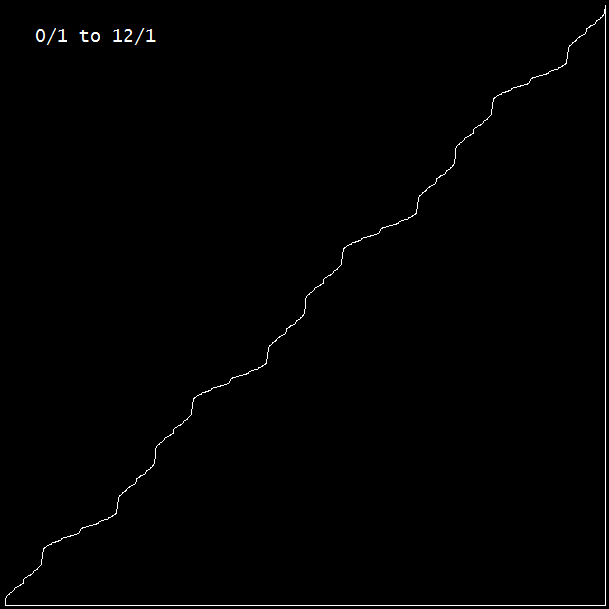
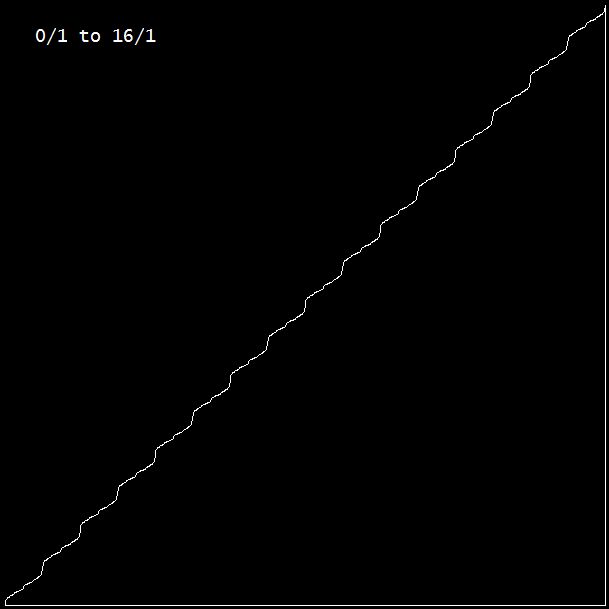
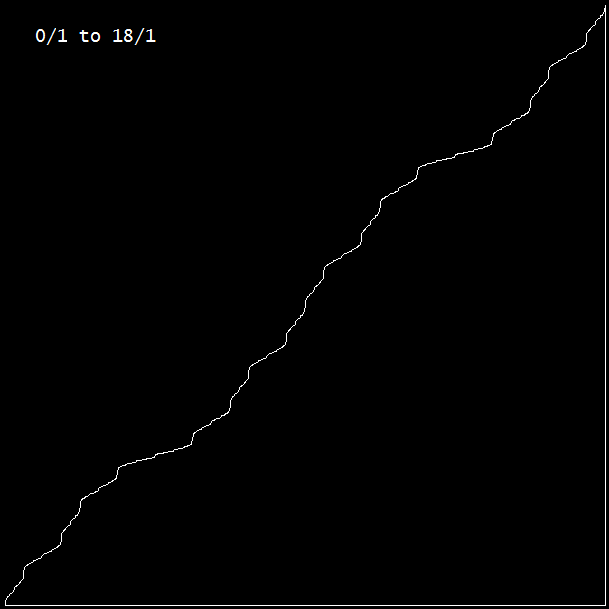
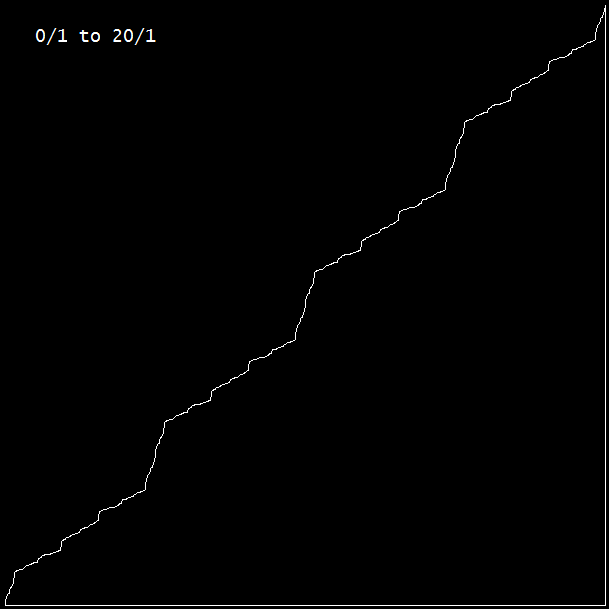
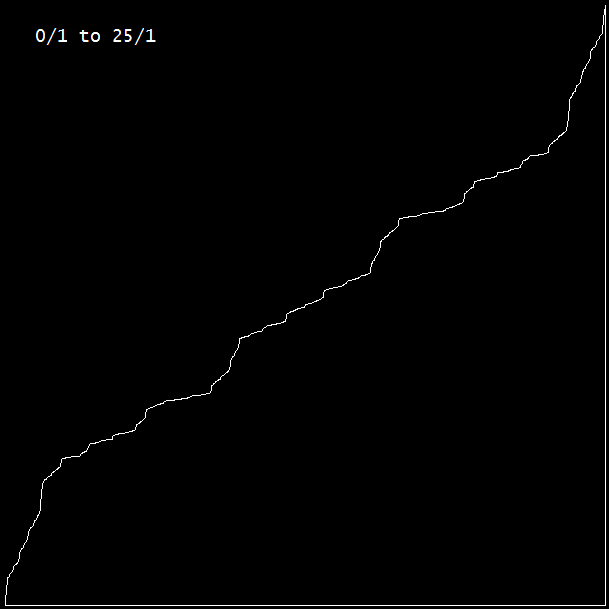
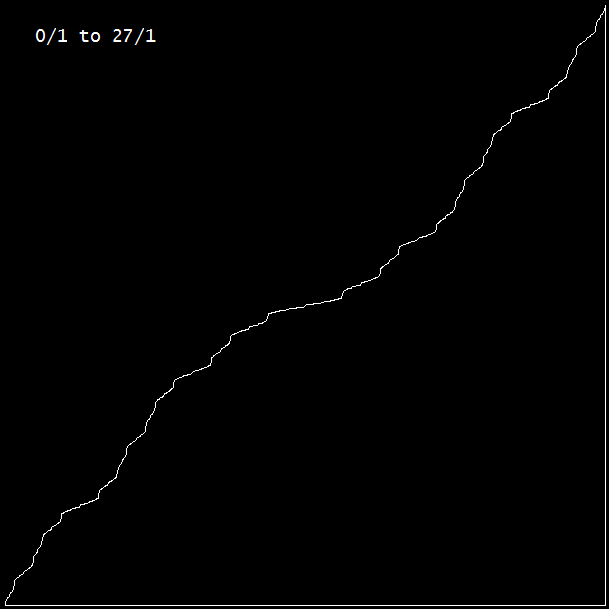
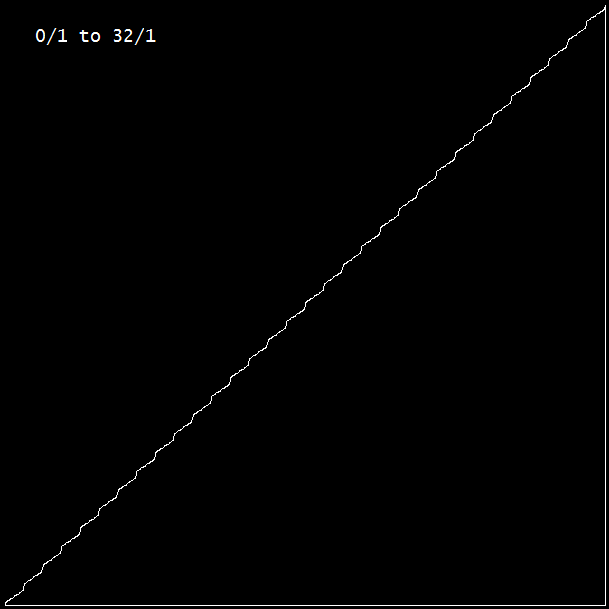
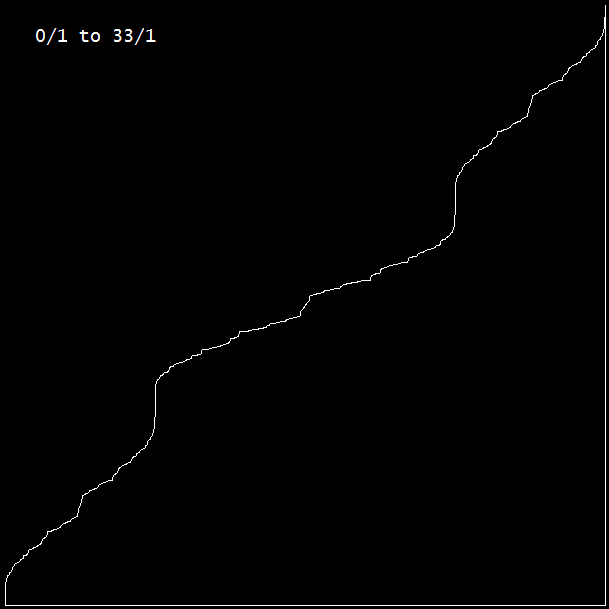
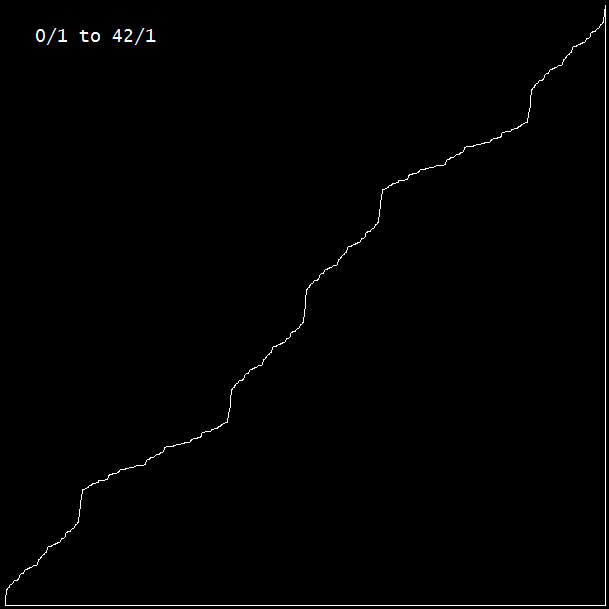
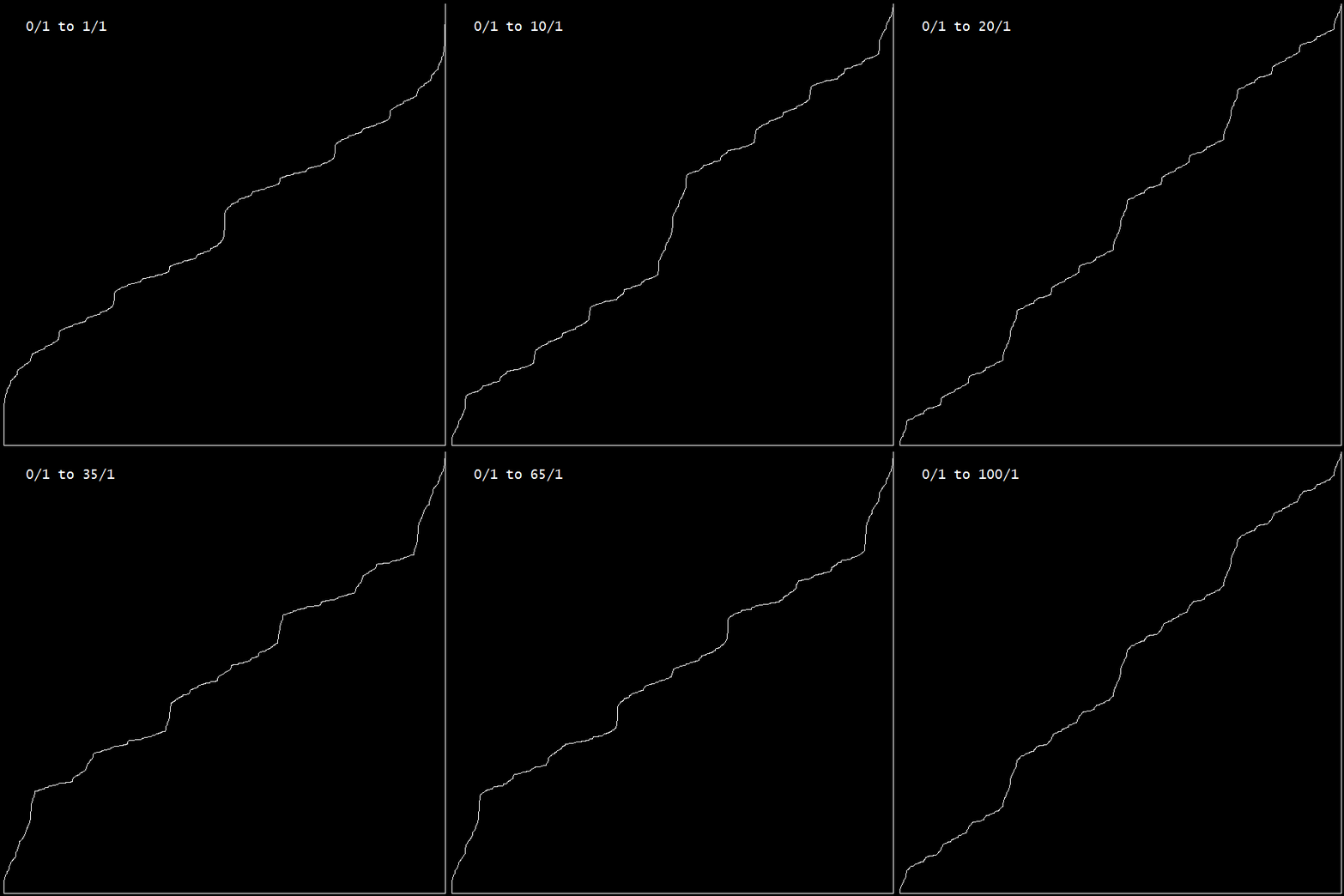
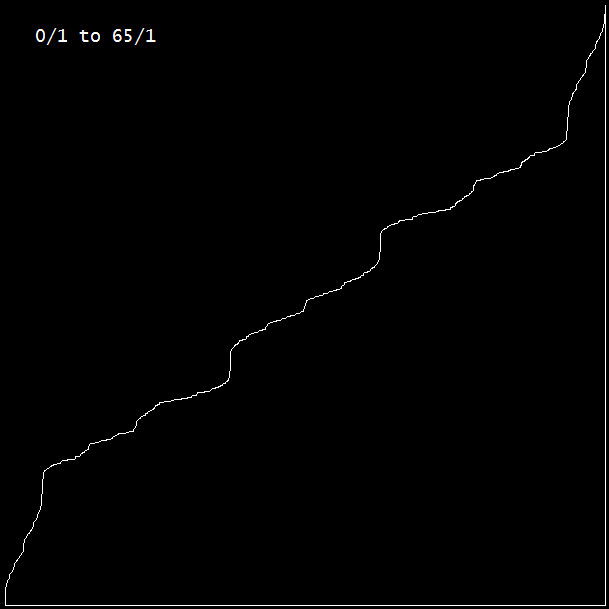
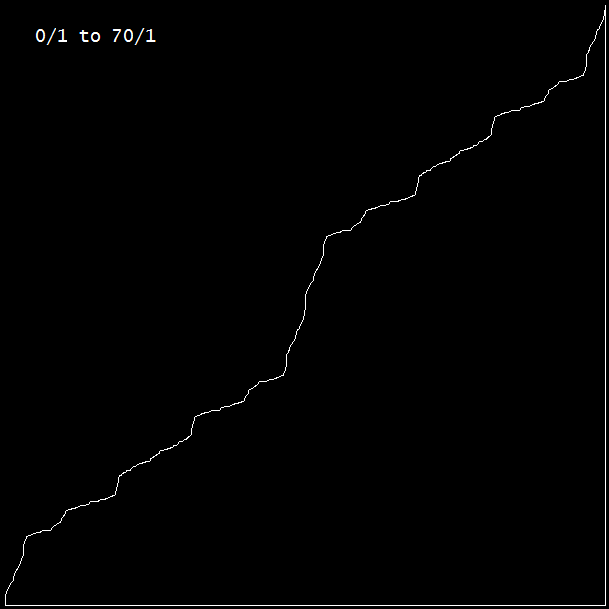
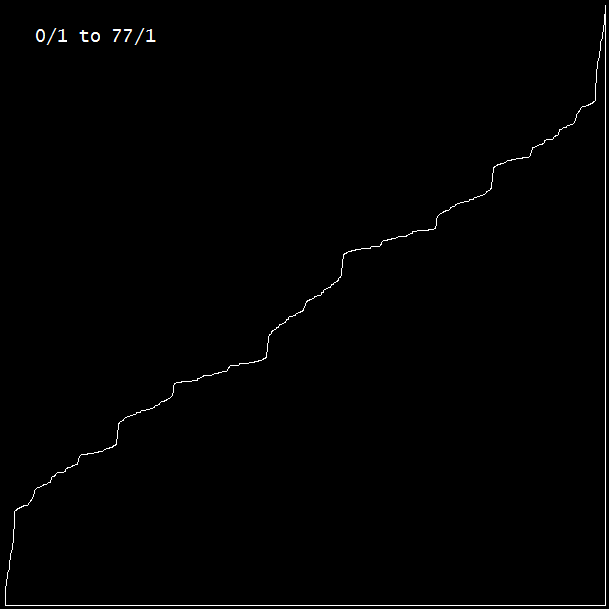
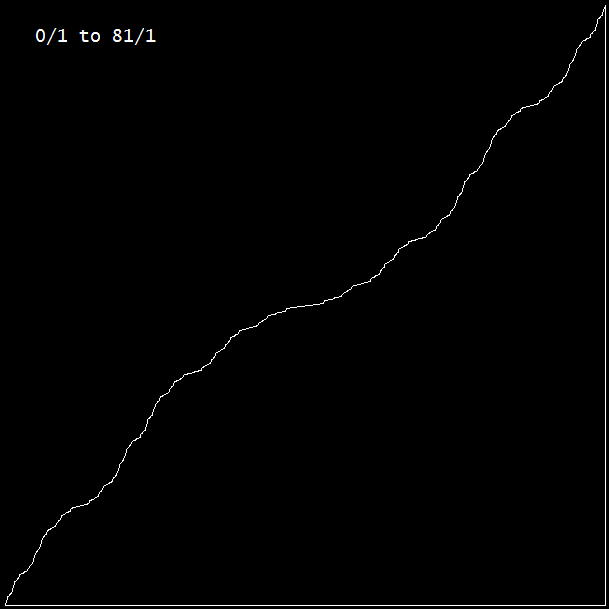
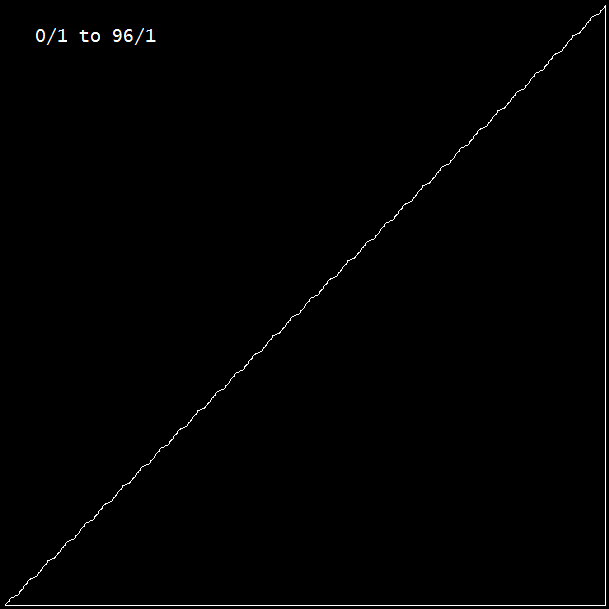
The shape of the slope is determined by the factorization of n:

n = 12 = 2^2 * 3

n = 16 = 2^4

n = 18 = 2 * 3^2

n = 20 = 2^2 * 5

n = 25 = 5^2

n = 27 = 3^3

n = 32 = 2^5

n = 33 = 3 * 11

n = 42 = 2 * 3 * 7

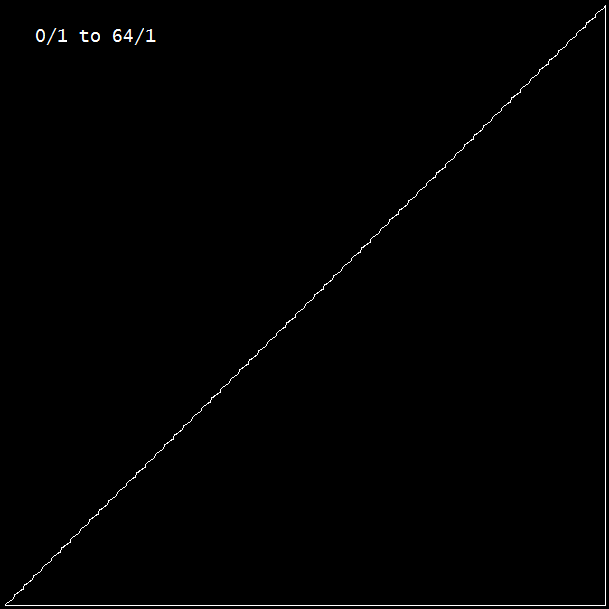
n = 64 = 2^6

n = 65 = 5 * 13

n = 70 = 2 * 5 * 7

n = 77 = 7 * 11

n = 81 = 3^4

n = 96 = 2^5 * 3

n = 99 = 3^2 * 11

n = 100 = 2^2 * 5^2

Farey fractal-hills, n = various