
In the wake of the spread of Protestantism, the literacy rates in the newly reforming populations in Britain, Sweden, and the Netherlands surged past more cosmopolitan places like Italy and France. Motivated by [the demands of] eternal salvation, parents and leaders made sure the children learned to read. […] The Protestant impact on literacy and education can still be observed today in the differential impact of Protestant vs. Catholic missions in Africa and India. In Africa, regions with early Protestant missions at the beginning of the Twentieth Century (now long gone) are associated with literacy rates that are about 16 percentage points higher, on average, than those associated with Catholic missions. In some analyses, Catholics have no impact on literacy at all unless they faced direct competition for souls from Protestant missions. These impacts can also be found in early twentieth-century China.
Tag Archives: literacy
Think Ink
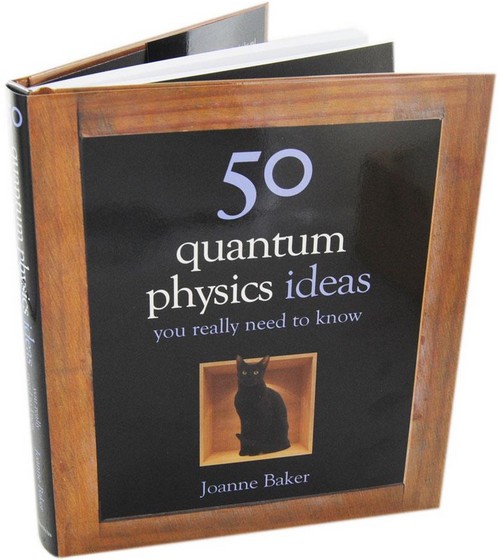 50 Quantum Physics Ideas You Really Need to Know, Joanne Baker (Quercus 2013)
A very good introduction to a very difficult subject. A very superficial introduction too, because it doesn’t use proper mathematics. If it did, I’d be lost: like most people’s, my maths is far too weak for me to understand quantum physics. Here’s one of the side-quotes that help make this book such an interesting read: “We must be clear that when it comes to atoms, language can be used only as in poetry.”
That’s by the Jewish-Danish physicist Niels Bohr (1885-1962). It applies to quantum physics in general. Without the full maths, you’re peering through a frost-covered window into a sweetshop, you’re not inside sampling the wares. But even without the full maths, the concepts and ideas in this book are still difficult and challenging, from the early puzzles thrown up by the ultra-violet catastrophe to the ingenious experiments that have proved particle-wave duality and action at a distance.
But there’s a paradox here.
Continue reading: Think Ink…
 Overlord In Terms of Core Issues Around Maximal Engagement with Key Notions of the Über-Feral