Ink For Your Elf

The Majikalph Script

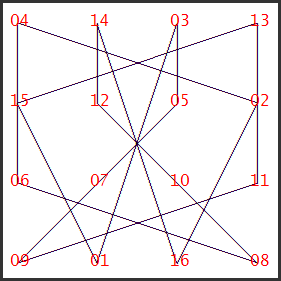
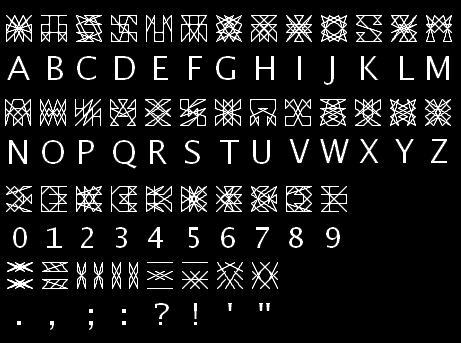
Majikalph was created by Simon Whitechapel in 2012 to combine his interests in artificial alphabets and recreational mathematics. It is based on the patterns created when lines are drawn between numbers of various 4×4 magic squares. In a magic square, every row, column, and diagonal of numbers adds to the same total. In the 4×4 magic square below, the most interesting patterns are created when each number is connected to the number 2 or 4 places higher than it (e.g. 2 goes to 4 or 6; 13 goes to 15 or 1).

Majikalph is used for writing English and is written from right to left. There is no distinction between upper and lower case. No character of the script is invented: each is based on one or another of the 880 possible 4×4 magic squares (for further information, please see MagicSquares.net).

The sample text is an extract from Tennyson’s The Princess (1847):

Oh, hark, oh, hear! how thin and clear,
And thinner, clearer, farther going!
Oh, sweet and far from cliff and scar
The horns of Elfland faintly blowing!
Blow, let us hear the purple glens replying:
Blow, bugle; answer, echoes, dying, dying, dying.

Alfred, Lord Tennyson (1809-1892).

Sample Text

Hymn to Herm

The Cult of Infinite Hermaphrodites

When neophytes enter the Cult of Infinite Hermaphrodites at Xidar, they are taught, amidst their initial duties of sweeping and service, the operations of simple arithmetic. Then, at the end of their first year, now most practised in this arithmetic, they are asked to say which number it is that, self-mated, beareth 4. And they reply, of course, that 4 is born of self-mated 2. And asked the same of 9, they reply 3; and of 16, they reply 4. Thus it is (they now learn) that 2 is called by the Cult the hermaphrodite of 4, as 3 is the hermaphrodite of 9, and 4 of 16. Then the neophytes are asked to say which number it is that, self-mated, beareth 1: which is to say, what is the hermaphrodite of 1? And they reply, of course, that 1 is auto-hermaphroditic, self-mating to bear itself. And then, in mildest, most deceptive tones, they are asked to name the hermaphrodite of 2. And here, in this simplest of questions, they stand (tho’ they know it not) on the brink of a Mysterium Magnissimum et Tremendissimum, a Riddle Most Mighty and Awesome.

Now, ’tis evident that the hermaphrodite of 2 falleth betwixt 1 and 2, for 1 is the Auto-Hermaphrodite, self-mating to bear itself, and self-mated 2 beareth 4, as remarked above. But where-betwixt doth the requested hermaphrodite fall? The neophytes know not. So they are told: test the mid of 1 and 2, which is 1½, or 3/2. Self-mated, this bears 9/4, or 2¼. And this falls too high. So, subtract a ½ of a ½ from 1½, for 1¼, or 5/4. Self-mated, this bears 25/16, or 1 and 9/16. And this falls too low. So, add a ½ of a ¼ to 1¼, for 1⅜, or 11/8. Self-mated, this bears 121/64, or 1 and 57/64. Again, too low. So, add a ½ of an ⅛ to 1⅜, for 23/16, or 1 and 7/16. Self-mated, this bears 529/256, or 2 and 17/256. Too high. And thus the neophytes proceed for a day, dividing and subtracting, dividing and adding, ever approximating the hermaphrodite of 2.

But do they ever reach it? Could they ever reach it, by this or any other mode of rational approximation? And here is the Mighty Mystery, the Riddle that Wrencheth the Brain, for the Cult replieth: Nay, Nay, Never! For It hath an incontrovertible proof that demonstrateth, by easy steps of simple logic, that the hermaphrodite of 2 is impossibly a ratio of finite integer to finite integer: which is to say, it must be infinite. Were the sky all parchment, the seas all ink, and gulls all plucked for quills, the hermaphrodite of 2 remained irrecordable. And more than this: the Cult can prove, by adaptation of the aforementioned logic, that the hermaphrodites of all integers, save the perfect squares, are similarly infinite and irrecordable, eternally elusive of finite man, yet definable even in their boundless nature by his skull-boxed brain-speck. And this truth the Cult flaunteth to the profane in its very name, which titillateth and tempteth, yet yieldeth not the guessed-at, the hoped-for fruit.

Now sing:

All hail, O World, the lowly Worm,
Which, same to same, exchangeth sperm!
And twines its twin, beneath the moon,
To grant itself renewal’s boon!

Next bow, yea bow, and loudly hail
The spiral-foot, the crawling Snail!
That twines its twin, ’midst nuptial slime,
To slay the slayer, scything Time!

From The Hymn to Hermaphroditi.

It’s Only Rot’n’Roll…

It’s Only Rot’n’Roll

A Porphyropolyhedric Tribute to Clark Ashton Smith

Banal, mundane, and dreary. Something needs to be done about the writing of Clark Ashton Smith — and I’ve tried to do it. The problem seems to me that the writing of CAS has been Roman in the gloamin’: that is, its twilight mystery, touched with Grecian glamor, plods across the page in the Roman alphabet, which is highly functional, but aesthetically unadventurous. Has any edition of CAS in English tried to match the beauty and complexity of the text with the beauty and complexity of a font? Not to my knowledge. Calligraphy, in the wider sense, is peripheral, at best, to English literature and and even the hyperlogomania of a book like Finnegans Wake takes place on a highly restricted graphological stage. Imagine what Joyce could have done with other alphabets, other ideographies, to stir into his mad meadish Sternen-stew of polyglossemanticity! And imagine CAS printed, or hand-written, in a script that reflects something of the beauty and complexity of his language. The beauty and fluidity of Georgian or Arabic would suit his tales of Zothique, for example; the complexity and density of Devanagari or Tamil would suit his tales of Hyperborea: but best of all would be a script invented specifically for CAS.

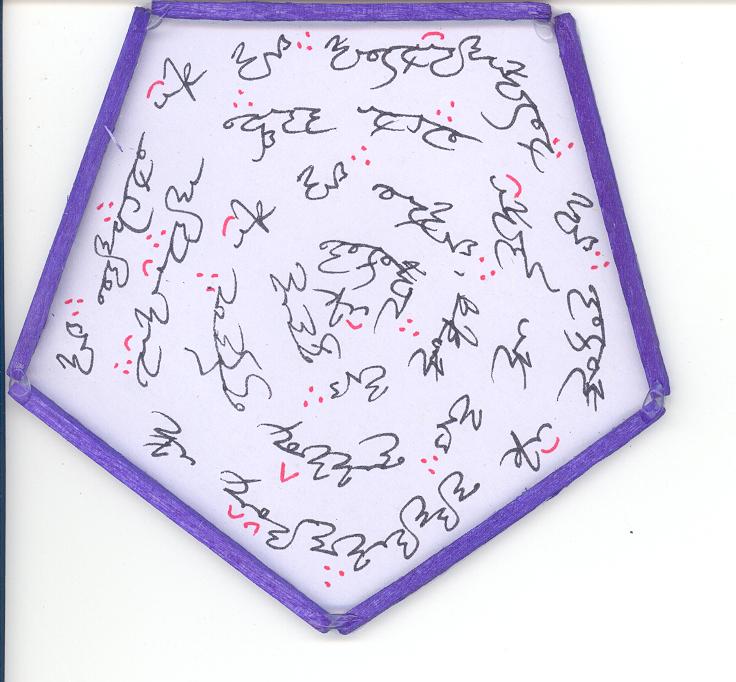
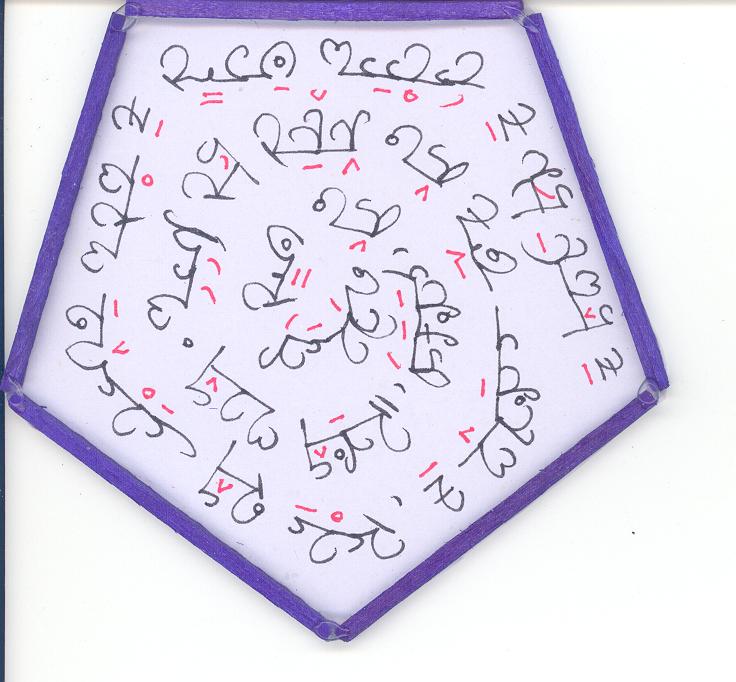
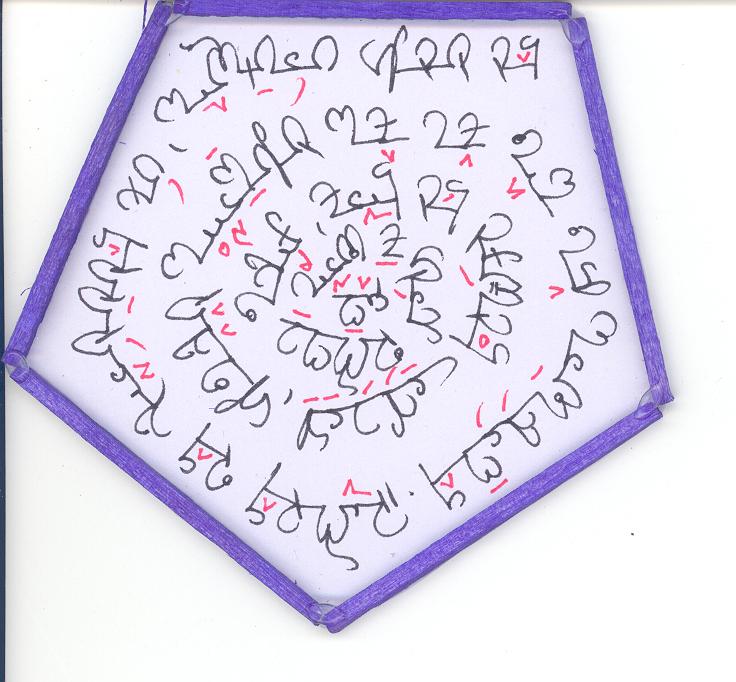
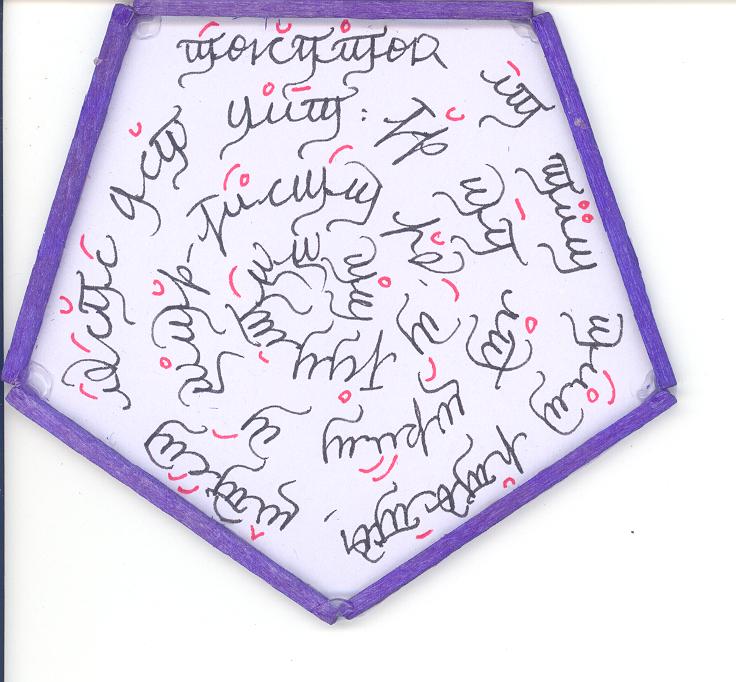
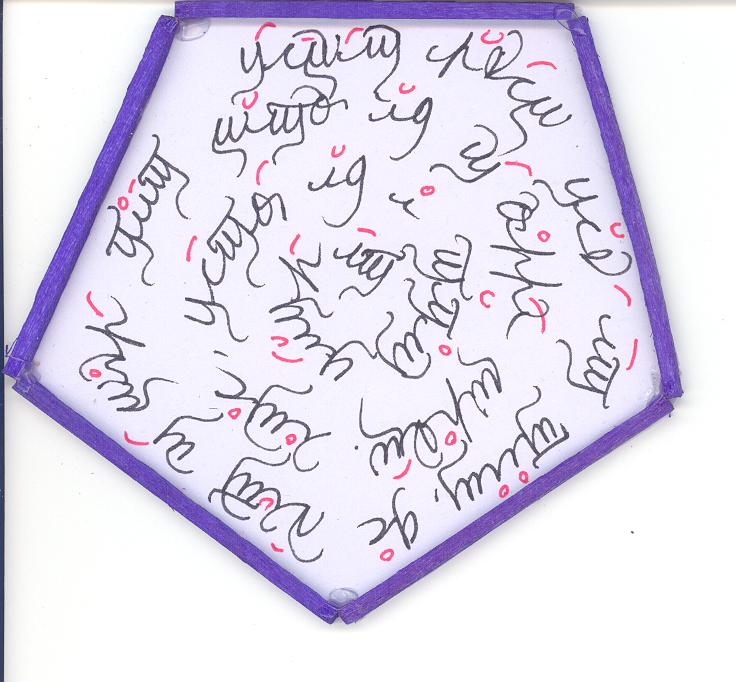
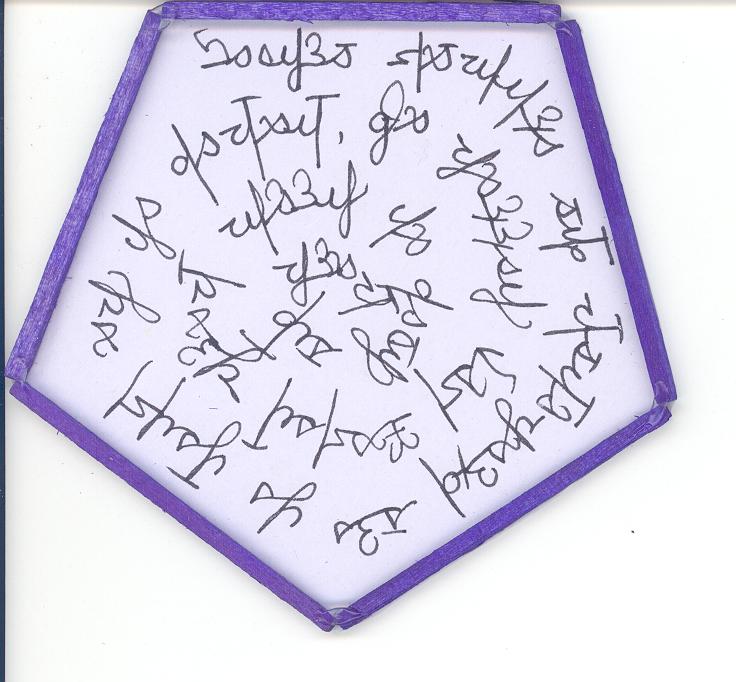
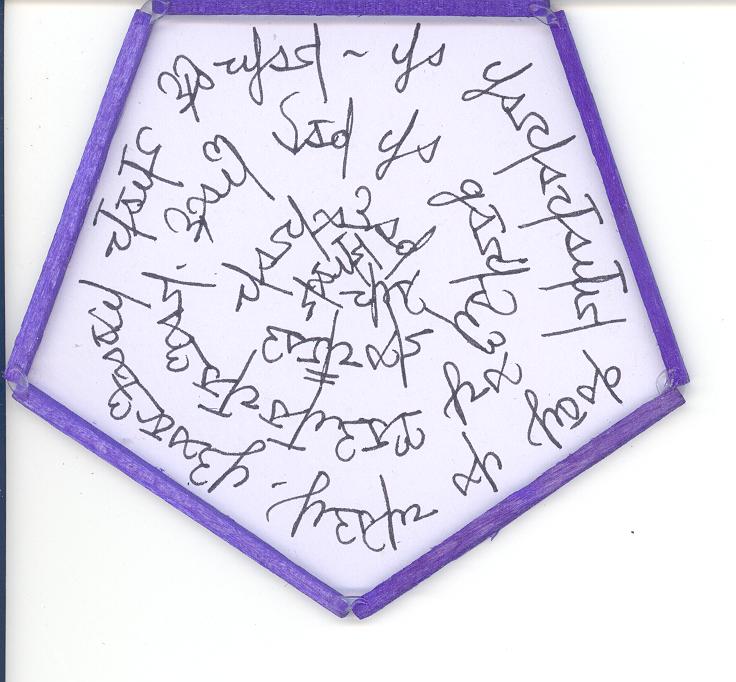
I haven’t supplied that, but I’ve tried to point the way with what I call a CAS-Whole, or porphyropolyhedric tribute to Clark Ashton Smith. It consists of a dodecahedron of paper and purple matches that uses four invented scripts to capture the opening lines of five of CAS’s best stories. In Plato’s cosmology, four of the regular (or Platonic) polyhedrons — the tetrahedron, the hexahedron, the octahedron, and the icosahedron — represent the four elements of which the universe is composed. The final regular polyhedron, the dodecahedron, represents the universe as a whole.[1] Hence, “CAS-Whole”. The purple matches — creating a porphyro-polyhedron — recall CAS’s words in The Black Book: “Strange pleasures are known to him who flaunts the immarcesible purple of poetry before the color-blind.”[2]

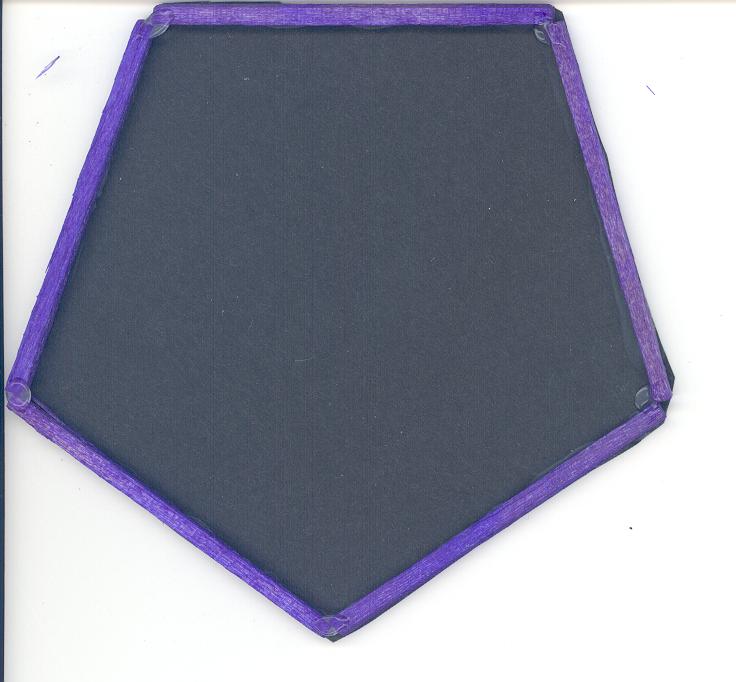
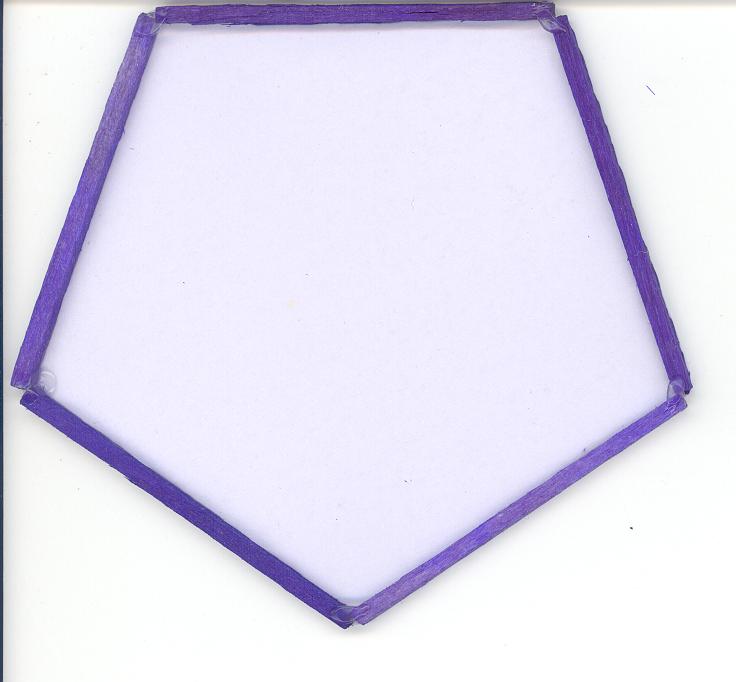
The dodecahedron itself, consisting of twelve regular dodecahedrons, is replete with the golden ratio, long regarded as of special significance in aesthetics.[3] One face is entirely black and might be called panglossic, representing all possible scripts in all possible languages; another, on the opposite side of the CAS-Whole, is entirely white and might be called an’glossic, representing silence and the blank page. Between the two, in a kind of “Goldilocks zone” between too much meaning and too little, are ten faces enscribed in four invented scripts with the opening words, in English, of five of CAS’s stories. Eight faces use a single, unadulterated script of the four, spiralling to the centre; two faces combine the four scripts. Given that the scripts are used for standard English, the stories can all be deciphered with a little effort and ingenuity. We are used, when reading in our mother tongues, to understanding with little effort and ingenuity, so the CAS-Whole might be regarded as a reminder of something we should not so carelessly take for granted. Furthermore, like all the Platonic solids, the dodecahedron can serve as a die, so the CAS-Whole reflects those central CASean themes of chance and fortune. Due to my ineptitude and impatience, not all of the faces are good regular pentagons, but that too can be woven into the symbolism of the CAS-Whole. The dodecahedron is not perfect, but I am not CAS and perfect dodecahedra do not occur in nature. Nor will the die roll true: fortune is biased.[4] Critics have pointed out that almost all CAS’s stories about death, so I hope that, imperfect as it is, one might say of the CAS-Whole: “It’s only rot’n’roll — but I like it.”

Notes

1. “There still remained a fifth construction, which God used for embroidering the constellations on the whole heaven.” Timaeus, c. 360 B.C. See http://www.ellopos.net/elpenor/physis/plato-timaeus/triangles.asp?pg=3

2. The Black Book of Clark Ashton Smith, Arkham House, 1979. See http://www.eldritchdark.com/writings/bibliography/writings/nonfiction/35/the-black-book-of-clark-ashton-smith

3. For more on the golden ratio, or golden section, please see http://www.maths.surrey.ac.uk/hosted-sites/R.Knott/Fibonacci/phi.html

4. A biased coin can be thrown “fair”, using a simple technique that can be adapted to a biased dodecahedron. Suppose a coin is much likelier to land heads than tails (or vice versa). Simply toss it twice. If it lands HH or TT, toss again. Otherwise, use the first of the two throws: simple probability will prove that even on a biased coin, HT is as likely as TH. Similarly, for a a biased dodecahedron, roll it twelve times. If any face repeats during the twelve rolls, roll twelve times again. When you have a sequence of twelve different faces, choose the first face. Based on my (far from reliable) caculations, there are 8,916,100,448,256 ways to roll a dodecahedral die twelve times, of which 479,001,600 contain no repeating number. One would therefore have to roll the die 18,614 times, on average, to produce a sequence in which no number repeats.

Pearly Riser

Pearls & Pyramids / Temples & Torments, Simon Whitechapel
 
Nice covers, shame about the text. As if the polysyllabic vocab and convoluted (not to say strangulated) syntax of the first two stories in Pearls & Pyramids weren’t bad enough, along come the blatant racism and misogyny of the third, in which members of the Black community are showered with the kind of vilely bigoted slavery-era clichés that even the reddest neck in the deepest south might think twice about using nowadays. Yes, more sensitive members of the anti-racist community won’t even make it past the first line of “The Pearls of Ngaháksha”, which introduces its anti-heroine as a “corpulent black (sic) cannibal witch”. Count the racist discourses at work there, cultural theoreticians! Then read on, if your stomach’s strong enough, and see how they’re repulsively developed and expanded.
 
Whitechapel’s racist and misogynistic agenda isn’t so foully evident everywhere else, but it is evident from the epigraphs in pretentiously untranslated Italian, Latin and French that he fancies himself as some kind of rogue literary scholar. Real literary scholars won’t be taken in for a moment: if you’re going to pretend that you read Horace in the original, it helps not to make errors as egregious as “vas inferior…naturalis” in the story that follows. But Whitechapel can’t avoid egregious errors in English either: get your laughing gear around “all those whom (sic) his spies discovered had slain…”, for example. Not having a pair of rubber gloves to hand, I’m not going to probe the psychology of the story that’s taken from (“The Similitude of Anina-Casor”), but there are enough philias, phobias, and fetishes on display to keep a team of psychiatrists at work for weeks. Throw in the other stories and you’ve got a feast of mental pathologies that even the Marquis de Sade might have found too rich for one sitting – if the prose and plots were ten times better.
 
But okay, I admit that Pearls & Pyramids did get me thinking hard, and Temples & Torments thinking even harder. I thought: What did Clark Ashton Smith do to deserve a “disciple” as despicable as this? Did he set fire to an orphanage or something? Well, probably not: it’s just an example of how the miserable luck that dogged CAS in life has extended beyond the grave. I’d rather not know how Whitechapel bribed or blackmailed an otherwise admirable small press like Rainfall Books into publishing this garbage, but they should be ashamed of themselves.

It’s The Gweel Thing…

Gweel & Other Alterities, Simon Whitechapel (Ideophasis Books, 2011)

Oh no. Say it ain’t so, Shmoe. I thought we’d heard the last of this vile piece-a-shit after his richly deserved execution for hate-crimes – inter alia, he’d claimed that maverick underground editor Dave Kerekes was a M*n *td f*n, that über-maverick gay aesthetician John Coulthart was a G**rd**n-r**d*r, and that post-über-maverick cultural titan Alan Moore had a *ea**. He might, just might, have got away with double-life for those first two crimes against humanity… but fortunately one of the last acts of the righteous New Labour government in Britain had been to pass a law mandating death for any and all forms of pogonophobia. Accordingly, Whitechapel’s attempted genocide against Alan M. earnt him the electric Blair (don’t ask, or you might feel a twinge of sympathy even for a depraved speech-criminal like Whitechapel).

Anyhows, that SHOULDA been the last we’d ever hear of him. No such luck. Either some deluded disciple’s been on the ouija board or the astral, or Whitechapel left material to some deluded disciple for posthumous publication, like a final fetid fart from a putrefying, maggot-infested corpse. It’s difficult to know where to begin hinting at how hateful’n’horrible this book is – “hint” is all I’m gonna do, because I’ve got something Whitechapel obviously never came within a million miles of acquiring, namely, a social conscience. Did you ever read anything and then feel as though you needed to take a looooong shower? Me too. More’n once. But it’s never been as bad as this. I felt as though I needed a shower after the first word of the first sentence of the first story in Gweel. That’s how reprehensible’n’repulsive this book is in terms of issues around feralness’n’fetidity. I’ve read Sade, I’ve read Guyotat, I’ve read Archer – I have never read anything that made me despair of life and humanity the way Gweel did. And still does. I’ll lay it on the line: I am completely and uncompromisingly in favor of absolute and unconditional freedom of speech – except for racists, sexists, and homophobes, natch – but I would gladly see Gweel burned and its ashes ground to powder before being encased in concrete and blasted off for a rendezvous with the all-cleansing fusional furnace of Father Sol himself.

Why? Well, I’m not gonna tell you the worst of what’s within – I’m not even sure I know the worst, given that I couldn’t get some pages unstuck after I threw up on the book halfway thru the second paragraph of that first story – but how’d’ya like these little green apples?:

The suggestion that prime numbers like 17, 31, and 89 could be used as hallucinogenic drugs (as made in the story “Tutu-3”)? Or the suggestion that the digits of √2 somehow encode a Lovecraftian pastiche about two archaeomysteriologists descending to the bottom of the Atlantic in a bathysphere, drinking “whisky-laced coffee” as they go (as in “Kopfwurmkundalini”)? Or how’s about the über-esoteric hidden channel that some prisoner discovers on an old TV and that, left playing overnight, coats his cell in gold-and-scarlet lichen (as in, er, “Lichen”)? And I don’t even like to recall, let alone mention, the microscopic red mite in “Acariasis” and the Martian musings it prompts in another “banged-up” protagonist. As for “Beating the Meat” and “Santa Ana City Jail” – let’s leave it at the titles, shall we? You don’t wanna go there. I have, and I wish to God I hadn’t.

Yeah, I also wish Whitechapel could be brought back to life… and sentenced to death all over again for what he’s done to H.P. Lovecraft, M.R. James, and Ramsey Campbell. As a committed fan of all three, I can’t tell you how horrified and disgusted I was to see their influence all over Gweel. It was like sipping and savoring a glass of fine wine, then discovering that someone had been washing his syphilitic dick in it. And then some. If you try reading this, Jesus will sob on Mary’s shoulder and Satan will high-five Mephistopheles. Trust me. If you possibly can, get the full width of the planet between yourself and any copy of Gweel that survives the sweep that will begin as soon as I’ve dialled my local hate-crime hotline. (Reviewed by Peter Sotos.)