Lulu Lunatic Luz

It’s disturbing what you can find online…

Tales of Silence & Sortilege, Simon Whitechapel, Paperback, 111 Pages

May 28, 2012

If you love weird fantasy, if you love the English language, even if you don’t love Clark Ashton Smith, you should read this book. The back cover describes it as “the darkest and most disturbing fantasy” of this millennium, but that’s either sarcastic or tragically optimistic, because what these stories really are is beautiful. The breath of snow-wolves is described as “harsh-spiced.” A mysterious gargoyle leaning from the heights of a great cathedral has “wings still glistening with the rime of interplanetary flight.” Hummingbirds are “gem-feathered… their glittering breasts dusted with the gold of a hundred pollens.” If you cannot appreciate such imagery, then perhaps you are dead to beauty, or simply dead. These tales are very short, but some of them have stayed with me for years, such as “The Treasure of the Temple,” in which a thief seems to lose the greatest fortune he could ever have found by stealing a king’s ransom in actual treasure. Most of the stories are brilliant, one or two is only good, but the masterpieces are “Master of the Pyramid” and “The Return of the Cryomancer.” The sense of loss and mystery evoked by these two companion stories is almost physically painful, it is so haunting. There is nothing like these stories being published today. Reading them, I feel the excitement and wonder that fans of Weird Tales magazine must have known long ago when new stories would appear by H.P. Lovecraft, Clark Ashton Smith, and Robert E. Howard. Simon Whitechapel doesn’t imitate these authors so much as apply their greatest lessons to new forms of fantasy. This is one of the cheapest books I own, but I accord it one of my most valuable. It is easily the best work of art you will find in any form on Lulu. I cannot recommend it highly enough.

The Roses of Hsūlag-Beiolă, Simon Whitechapel, Paperback, 154 Pages

Jun 8, 2012

This collection of weird fantasy is filled with mystery, wonder and a sense of the ineffable. Not every story is a mind-blowing masterpiece, but the best of them are absolutely spectacular. Even the worst are good and all are haunting in one way or another. My two favorites were: 1. “The Mercy of the Osmomancer,” wherein a knight on a mission to investigate the tower of a scent-wizard encounters demons made of smells and even learns the language of odors… 2. “The Swans,” in which a pawnbroker tracks down all the known paintings of a seemingly insane artist who paints his canvases entirely black, nothing but black, for reasons best and most poetically left to Simon Whitechapel to explain… Any fan of H.P. Lovecraft, Robert E. Howard, Clark Ashton Smith, Edgar Allan Poe, Comte de Lautréamont, Charles Baudelaire or William S. Burroughs will find something wonderful to love in here. I sure did.


Even more disturbing is the thought that this individual may be able to pass themself off as normal in real life: there are no spelling mistakes or solecisms. (Then again, perhaps I’m reviewing my own books in my sleep. (But I wouldn’t compare myself to B*rr**ghs, surely? (Unless it’s a bluff or double-bluff. (Disturbing, as I said. (I agree.)))))
Hymn to Herm

The Cult of Infinite Hermaphrodites

When neophytes enter the Cult of Infinite Hermaphrodites at Xidar, they are taught, amidst their initial duties of sweeping and service, the operations of simple arithmetic. Then, at the end of their first year, now most practised in this arithmetic, they are asked to say which number it is that, self-mated, beareth 4. And they reply, of course, that 4 is born of self-mated 2. And asked the same of 9, they reply 3; and of 16, they reply 4. Thus it is (they now learn) that 2 is called by the Cult the hermaphrodite of 4, as 3 is the hermaphrodite of 9, and 4 of 16. Then the neophytes are asked to say which number it is that, self-mated, beareth 1: which is to say, what is the hermaphrodite of 1? And they reply, of course, that 1 is auto-hermaphroditic, self-mating to bear itself. And then, in mildest, most deceptive tones, they are asked to name the hermaphrodite of 2. And here, in this simplest of questions, they stand (tho’ they know it not) on the brink of a Mysterium Magnissimum et Tremendissimum, a Riddle Most Mighty and Awesome.

Now, ’tis evident that the hermaphrodite of 2 falleth betwixt 1 and 2, for 1 is the Auto-Hermaphrodite, self-mating to bear itself, and self-mated 2 beareth 4, as remarked above. But where-betwixt doth the requested hermaphrodite fall? The neophytes know not. So they are told: test the mid of 1 and 2, which is 1½, or 3/2. Self-mated, this bears 9/4, or 2¼. And this falls too high. So, subtract a ½ of a ½ from 1½, for 1¼, or 5/4. Self-mated, this bears 25/16, or 1 and 9/16. And this falls too low. So, add a ½ of a ¼ to 1¼, for 1⅜, or 11/8. Self-mated, this bears 121/64, or 1 and 57/64. Again, too low. So, add a ½ of an ⅛ to 1⅜, for 23/16, or 1 and 7/16. Self-mated, this bears 529/256, or 2 and 17/256. Too high. And thus the neophytes proceed for a day, dividing and subtracting, dividing and adding, ever approximating the hermaphrodite of 2.

But do they ever reach it? Could they ever reach it, by this or any other mode of rational approximation? And here is the Mighty Mystery, the Riddle that Wrencheth the Brain, for the Cult replieth: Nay, Nay, Never! For It hath an incontrovertible proof that demonstrateth, by easy steps of simple logic, that the hermaphrodite of 2 is impossibly a ratio of finite integer to finite integer: which is to say, it must be infinite. Were the sky all parchment, the seas all ink, and gulls all plucked for quills, the hermaphrodite of 2 remained irrecordable. And more than this: the Cult can prove, by adaptation of the aforementioned logic, that the hermaphrodites of all integers, save the perfect squares, are similarly infinite and irrecordable, eternally elusive of finite man, yet definable even in their boundless nature by his skull-boxed brain-speck. And this truth the Cult flaunteth to the profane in its very name, which titillateth and tempteth, yet yieldeth not the guessed-at, the hoped-for fruit.

Now sing:

All hail, O World, the lowly Worm,
Which, same to same, exchangeth sperm!
And twines its twin, beneath the moon,
To grant itself renewal’s boon!

Next bow, yea bow, and loudly hail
The spiral-foot, the crawling Snail!
That twines its twin, ’midst nuptial slime,
To slay the slayer, scything Time!

From The Hymn to Hermaphroditi.

It’s Only Rot’n’Roll…

It’s Only Rot’n’Roll

A Porphyropolyhedric Tribute to Clark Ashton Smith

Banal, mundane, and dreary. Something needs to be done about the writing of Clark Ashton Smith — and I’ve tried to do it. The problem seems to me that the writing of CAS has been Roman in the gloamin’: that is, its twilight mystery, touched with Grecian glamor, plods across the page in the Roman alphabet, which is highly functional, but aesthetically unadventurous. Has any edition of CAS in English tried to match the beauty and complexity of the text with the beauty and complexity of a font? Not to my knowledge. Calligraphy, in the wider sense, is peripheral, at best, to English literature and and even the hyperlogomania of a book like Finnegans Wake takes place on a highly restricted graphological stage. Imagine what Joyce could have done with other alphabets, other ideographies, to stir into his mad meadish Sternen-stew of polyglossemanticity! And imagine CAS printed, or hand-written, in a script that reflects something of the beauty and complexity of his language. The beauty and fluidity of Georgian or Arabic would suit his tales of Zothique, for example; the complexity and density of Devanagari or Tamil would suit his tales of Hyperborea: but best of all would be a script invented specifically for CAS.

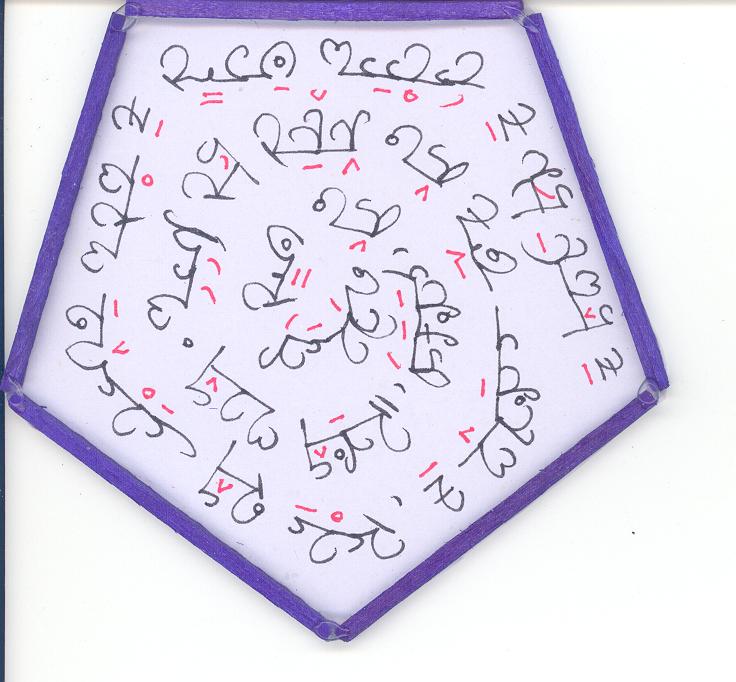
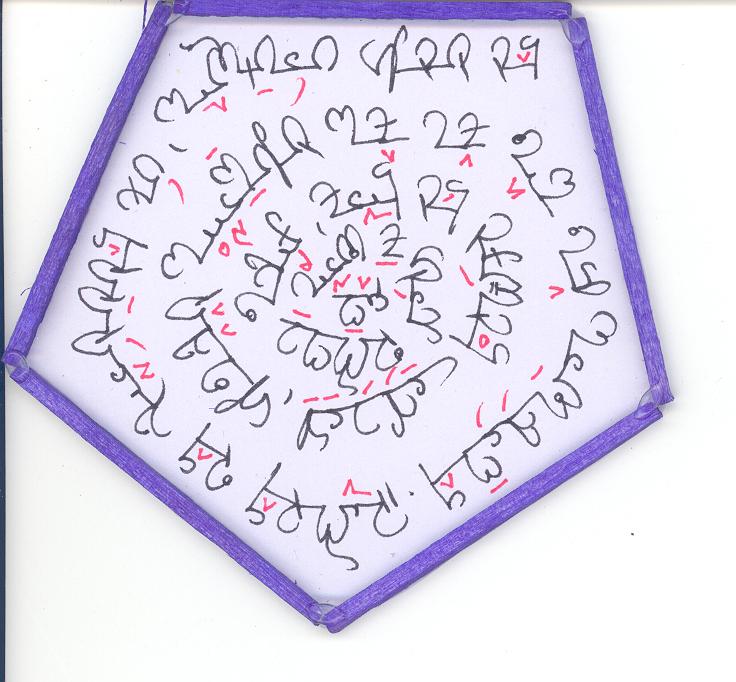
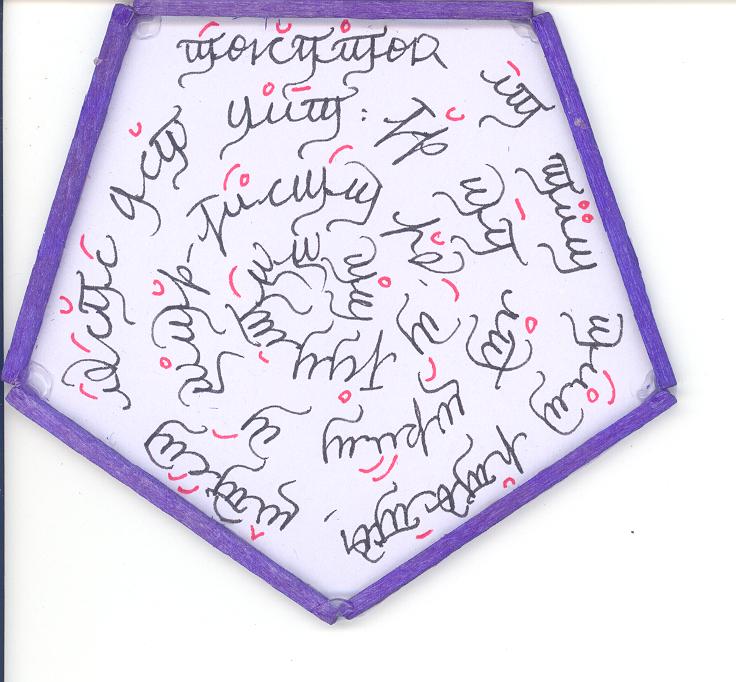
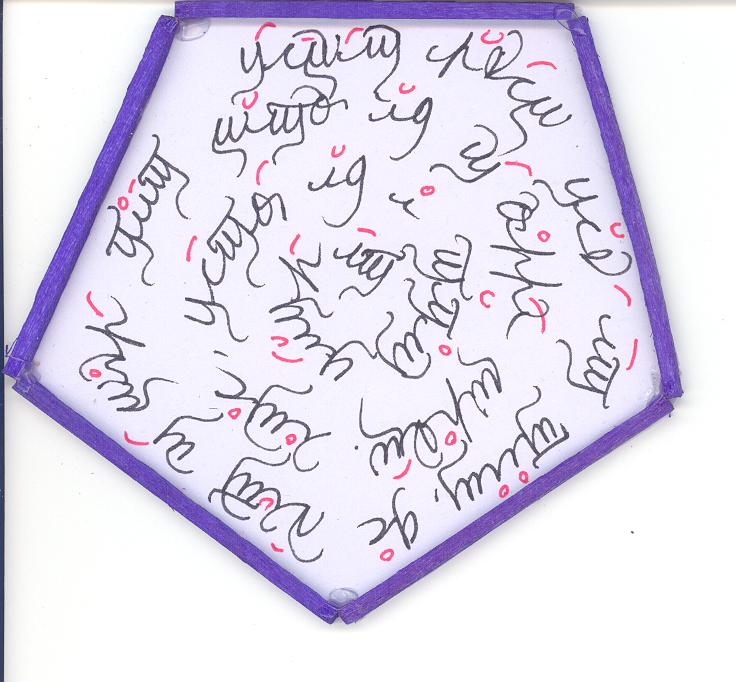
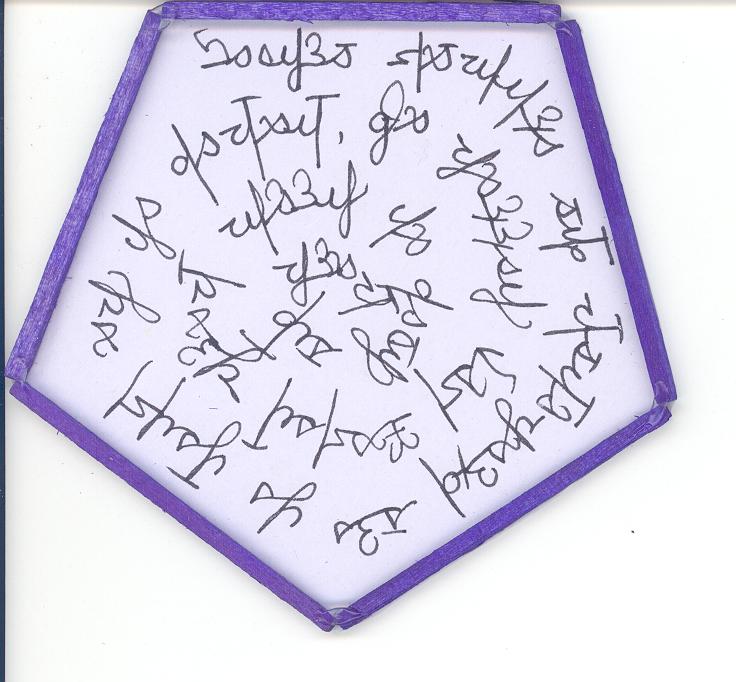
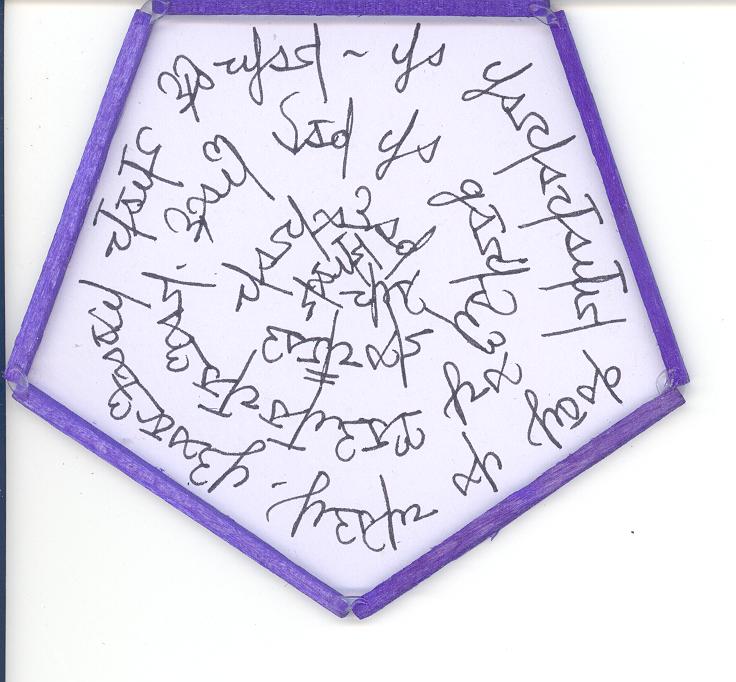
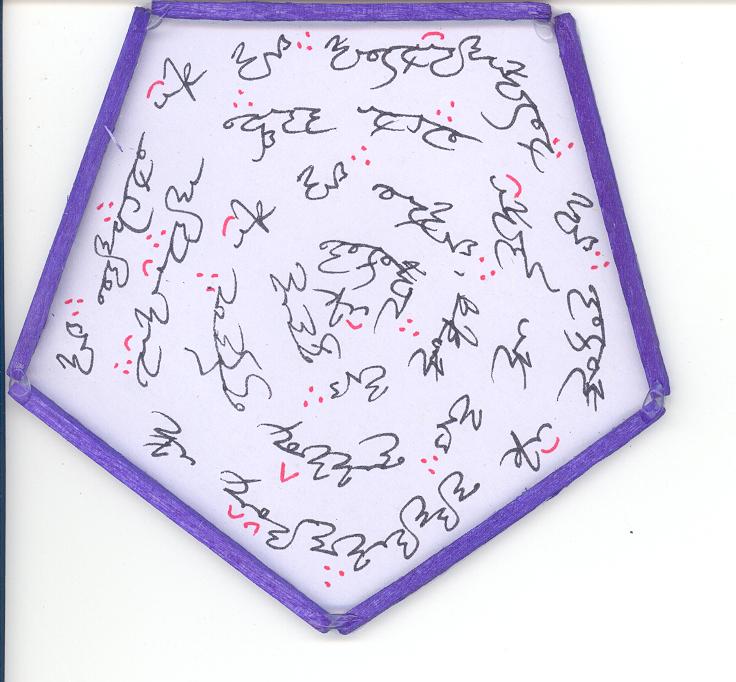
I haven’t supplied that, but I’ve tried to point the way with what I call a CAS-Whole, or porphyropolyhedric tribute to Clark Ashton Smith. It consists of a dodecahedron of paper and purple matches that uses four invented scripts to capture the opening lines of five of CAS’s best stories. In Plato’s cosmology, four of the regular (or Platonic) polyhedrons — the tetrahedron, the hexahedron, the octahedron, and the icosahedron — represent the four elements of which the universe is composed. The final regular polyhedron, the dodecahedron, represents the universe as a whole.[1] Hence, “CAS-Whole”. The purple matches — creating a porphyro-polyhedron — recall CAS’s words in The Black Book: “Strange pleasures are known to him who flaunts the immarcesible purple of poetry before the color-blind.”[2]

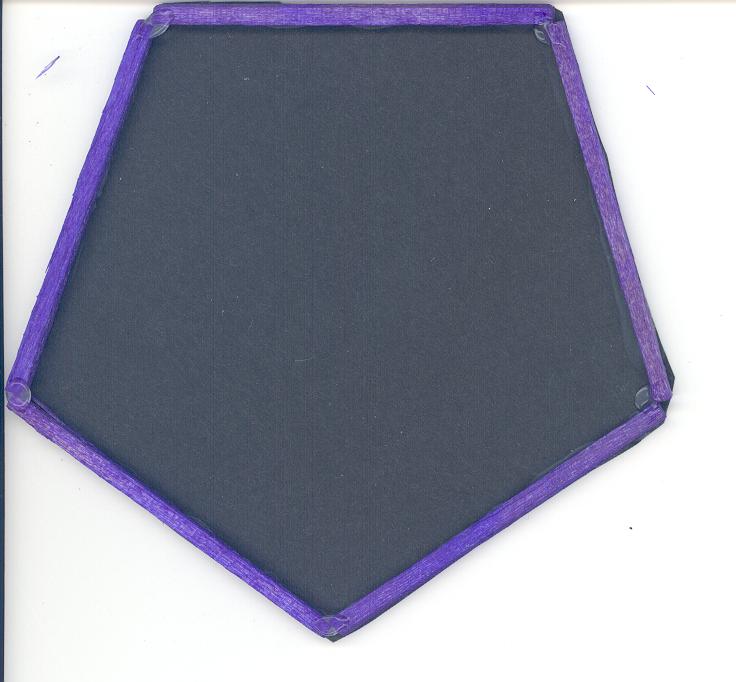
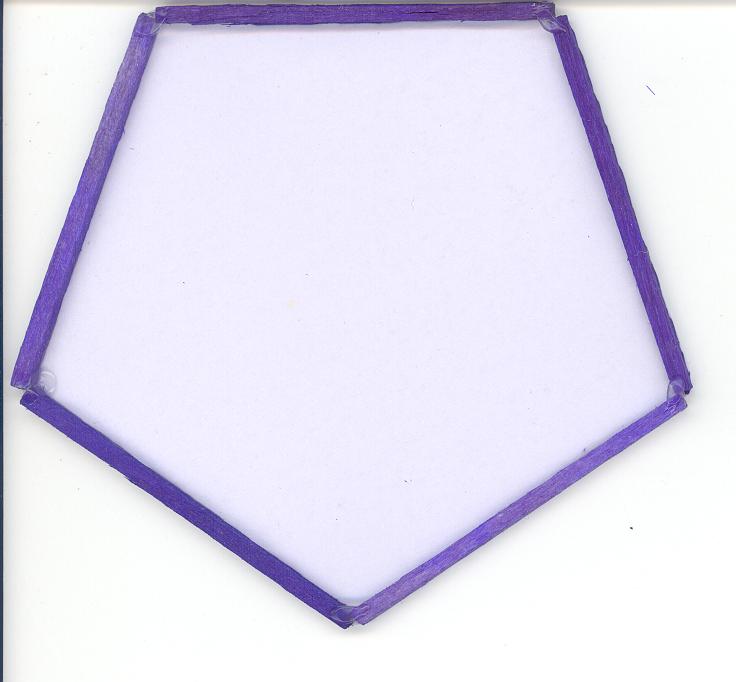
The dodecahedron itself, consisting of twelve regular dodecahedrons, is replete with the golden ratio, long regarded as of special significance in aesthetics.[3] One face is entirely black and might be called panglossic, representing all possible scripts in all possible languages; another, on the opposite side of the CAS-Whole, is entirely white and might be called an’glossic, representing silence and the blank page. Between the two, in a kind of “Goldilocks zone” between too much meaning and too little, are ten faces enscribed in four invented scripts with the opening words, in English, of five of CAS’s stories. Eight faces use a single, unadulterated script of the four, spiralling to the centre; two faces combine the four scripts. Given that the scripts are used for standard English, the stories can all be deciphered with a little effort and ingenuity. We are used, when reading in our mother tongues, to understanding with little effort and ingenuity, so the CAS-Whole might be regarded as a reminder of something we should not so carelessly take for granted. Furthermore, like all the Platonic solids, the dodecahedron can serve as a die, so the CAS-Whole reflects those central CASean themes of chance and fortune. Due to my ineptitude and impatience, not all of the faces are good regular pentagons, but that too can be woven into the symbolism of the CAS-Whole. The dodecahedron is not perfect, but I am not CAS and perfect dodecahedra do not occur in nature. Nor will the die roll true: fortune is biased.[4] Critics have pointed out that almost all CAS’s stories about death, so I hope that, imperfect as it is, one might say of the CAS-Whole: “It’s only rot’n’roll — but I like it.”

Notes

1. “There still remained a fifth construction, which God used for embroidering the constellations on the whole heaven.” Timaeus, c. 360 B.C. See http://www.ellopos.net/elpenor/physis/plato-timaeus/triangles.asp?pg=3

2. The Black Book of Clark Ashton Smith, Arkham House, 1979. See http://www.eldritchdark.com/writings/bibliography/writings/nonfiction/35/the-black-book-of-clark-ashton-smith

3. For more on the golden ratio, or golden section, please see http://www.maths.surrey.ac.uk/hosted-sites/R.Knott/Fibonacci/phi.html

4. A biased coin can be thrown “fair”, using a simple technique that can be adapted to a biased dodecahedron. Suppose a coin is much likelier to land heads than tails (or vice versa). Simply toss it twice. If it lands HH or TT, toss again. Otherwise, use the first of the two throws: simple probability will prove that even on a biased coin, HT is as likely as TH. Similarly, for a a biased dodecahedron, roll it twelve times. If any face repeats during the twelve rolls, roll twelve times again. When you have a sequence of twelve different faces, choose the first face. Based on my (far from reliable) caculations, there are 8,916,100,448,256 ways to roll a dodecahedral die twelve times, of which 479,001,600 contain no repeating number. One would therefore have to roll the die 18,614 times, on average, to produce a sequence in which no number repeats.

Pearly Riser

Pearls & Pyramids / Temples & Torments, Simon Whitechapel
 
Nice covers, shame about the text. As if the polysyllabic vocab and convoluted (not to say strangulated) syntax of the first two stories in Pearls & Pyramids weren’t bad enough, along come the blatant racism and misogyny of the third, in which members of the Black community are showered with the kind of vilely bigoted slavery-era clichés that even the reddest neck in the deepest south might think twice about using nowadays. Yes, more sensitive members of the anti-racist community won’t even make it past the first line of “The Pearls of Ngaháksha”, which introduces its anti-heroine as a “corpulent black (sic) cannibal witch”. Count the racist discourses at work there, cultural theoreticians! Then read on, if your stomach’s strong enough, and see how they’re repulsively developed and expanded.
 
Whitechapel’s racist and misogynistic agenda isn’t so foully evident everywhere else, but it is evident from the epigraphs in pretentiously untranslated Italian, Latin and French that he fancies himself as some kind of rogue literary scholar. Real literary scholars won’t be taken in for a moment: if you’re going to pretend that you read Horace in the original, it helps not to make errors as egregious as “vas inferior…naturalis” in the story that follows. But Whitechapel can’t avoid egregious errors in English either: get your laughing gear around “all those whom (sic) his spies discovered had slain…”, for example. Not having a pair of rubber gloves to hand, I’m not going to probe the psychology of the story that’s taken from (“The Similitude of Anina-Casor”), but there are enough philias, phobias, and fetishes on display to keep a team of psychiatrists at work for weeks. Throw in the other stories and you’ve got a feast of mental pathologies that even the Marquis de Sade might have found too rich for one sitting – if the prose and plots were ten times better.
 
But okay, I admit that Pearls & Pyramids did get me thinking hard, and Temples & Torments thinking even harder. I thought: What did Clark Ashton Smith do to deserve a “disciple” as despicable as this? Did he set fire to an orphanage or something? Well, probably not: it’s just an example of how the miserable luck that dogged CAS in life has extended beyond the grave. I’d rather not know how Whitechapel bribed or blackmailed an otherwise admirable small press like Rainfall Books into publishing this garbage, but they should be ashamed of themselves.