
If reading continually reteaches you how to think, television is a perpetual anesthetic. Philosophy, history, complex thought are all impossible on the tube: “Its form works against the content.” — Noah McCormack, “We Used to Read Things in This Country”, The Baffler #81, November 2025
Category Archives: Literature
Number of the Ceased
Like mine, the veins of these that slumber
Leapt once with dancing fires divine;
The blood of all this noteless number
Ran red like mine.
How still, with every pulse in station,
Frost in the founts that used to leap,
The put to death, the perished nation,
How sound they sleep!
These too, these veins which life convulses,
Wait but a while, shall cease to bound;
I with the ice in all my pulses
Shall sleep as sound.
• A.E. Housman, “XX” in More Poems (1936)
Elsewhere Other-Accessible…
Martin Lutheracy
In the wake of the spread of Protestantism, the literacy rates in the newly reforming populations in Britain, Sweden, and the Netherlands surged past more cosmopolitan places like Italy and France. Motivated by [the demands of] eternal salvation, parents and leaders made sure the children learned to read. […] The Protestant impact on literacy and education can still be observed today in the differential impact of Protestant vs. Catholic missions in Africa and India. In Africa, regions with early Protestant missions at the beginning of the Twentieth Century (now long gone) are associated with literacy rates that are about 16 percentage points higher, on average, than those associated with Catholic missions. In some analyses, Catholics have no impact on literacy at all unless they faced direct competition for souls from Protestant missions. These impacts can also be found in early twentieth-century China.
Night Blight
“Our fantastic civilization has fallen out of touch with many aspects of nature, and with none more completely than with night. Primitive folk, gathered at a cave mouth round a fire, do not fear night; they fear, rather, the energies and creatures to whom night gives power; we of the age of the machines, having delivered ourselves of nocturnal enemies, now have a dislike of night itself. With lights and ever more lights, we drive the holiness and beauty of night back to the forests and the sea; the little villages, the cross-roads even, will have none of it. Are modern folk, perhaps, afraid of night? Do they fear that vast serenity, the mystery of infinite space, the austerity of stars?” — Henry Beston (1888-1968), The Outermost House, 1933
The ’rror
The Haunted Mirrors
Ego non sum…
Evangelium secundum Ioannem XVII, xiv.
The old palace had a thousand corridors, ten thousand mirrors, squares, ovals, and diamonds, which remained bright and clear for all the dust and cobwebs that surrounded them, specking not with the autumn rain that fell through rents in the roof, cracking not in the fierce frosts of midwinter, ever fascinating, ever fearful to the youths and maidens of the villages therearound. For no mirror reflected faithfully, or so ’twas said, having always some sorcerous taint or anomaly, whereby, on early corridors, the faces reflected were not quite those of him or her who stood before them, being distinct in some particular of eye or mouth or cheek, of hair or tint or scarring, as though a brother or sister looked out, not a twin; and on later the faces reflected began to alter more strongly, more unsettlingly, seeming to partake of different nation and race; and on last of all, seen by very few, the faces reflected began to depart the bounds of humanity, borrowing form and feature from beasts, birds, and fish.
But horrider than these, found here and there in the palace, were mirrors wherein viewers saw themselves become giant insects, myriad-eyed, with nodding antennæ, finger-like jaws or coiled proboscis, or else arachnids, crustaceans, or worms, whereat some fled in horror or fainted where they stood, and few indeed could watch the transformations for long. Kinder mirrors might stand a stride or two away, natheless, wherein faces became now flowers, great and glorious, now crystals of many and gorgeous facets or polyhedra of polished metal, reflective themselves within a reflection. But these mirrors too could trouble the brain and linger in dreams, being sorcerous equally with the rest, nor did it seem right that fragrance should leak from the flowers and notes chime from the crystals and polyhedra. Wherefor no mirror in the old palace could be viewed with impunity, save by the dullest-witted, the stupidest, and these too feared to come before one or another of two mirrors said to be horriblest of all.
In one of these, the viewer would see himself seemingly true at first, then note that months were passing in the mirror for moments before it, whereby one aged before one’s very eyes, skin wrinkling, nose expanding, jaw collapsing. And if one watched unwisely long, one saw death possess the face and a haze of maggots eat it to bare and grinning bone.
In the other of these mirrors, the viewer saw somewhat more disturbing still, save to a rarest few: namely, naught at all where a face should have looked back, as though one existed not and the world flowed on unaffected.
Ein Licht im Nichts
„Soweit wir erkennen können, besteht der einzige Zweck der menschlichen Existenz darin, ein Licht in der Dunkelheit des bloßen Seins zu entzünden.“ — Carl Jung (1875-1961)
• “As far as we can discern, the sole purpose of human existence is to kindle a light in the darkness of mere being.”
Pig Brother Is Watching You…
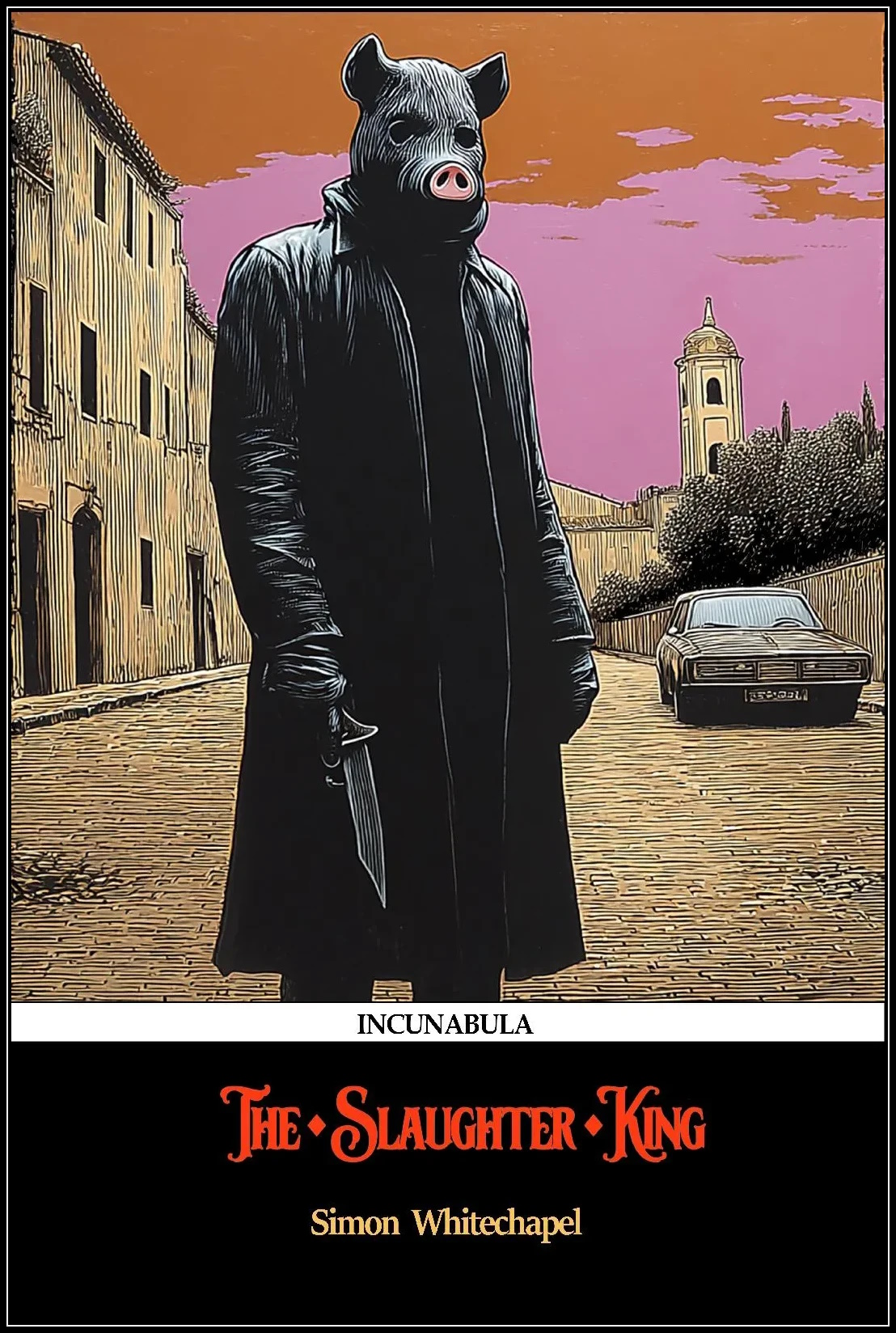
Tu le connais, lecteur, ce monstre délicat, — Hypocrite lecteur, — mon semblable, — mon frère! — Baudelaire
• The Slaughter King — Incunabula’s new edition
• Kore. King. Kompetition. — win a signed edition of this core counter-cultural classic…
Kore. King. Kompetition.
Incunabula have re-printed that core counter-cultural classic The Slaughter King, first published in 1996. To celebrate this auspicious occasion, here’s a competition to win a signed copy of the classic. To be in it with a chance to win it, please read the afterword to the new edition, then answer the questions and complete the tie-breaker.
Épilogue écrit trente ans après le roman
I hadn’t read or seen a copy of The Slaughter King for more than twenty years when Dave Mitchell contacted me and told me he wanted to re-publish it. I said no at first, but Dave is persuasive and so the Beast is Back, brand-new for the twenty-first century. I still don’t want to re-read it and, on balance, would prefer never to have written it.
Then again, I did get to know three fascinating people by writing it: a psychologically complex serial-killer fan called David Slater; a necrotropic gargoyle fan called David Kerekes; and (sorry to say this, but it’s true) an EngLit graduate called James Williamson. James ran Creation Books and was a crook, but also intelligent, imaginative and genuinely devoted to books and literature. The dysmorphic duo of deviant Davids were dim-but-devious adolescent voyeurs and genuinely devoted to scopophilia and slime-sniffing. They were the editors of the key counter-cultural journal Headpress and simul-scribes of the seminal snuff-study Killing for Culture.
I’ve never been interested in transgressive films or images myself and the deviant Daves did nothing to make me re-think my prejudices about those who are. Trying to hold an intelligent conversation with either Psicolo or Princess Dai was like trying to eat soup with chopsticks. Thin soup. And bendy chopsticks. However, I did learn two very interesting things about myself from Psicolo and Princess Dai: that I am homosexual and that I am a keyly committed core component of the coprophile community. Wow. Well, what was it thæt Teuto-Toxic Titan of Transgression said in Princess Dai’s book about his noxious necrophile narratives? Oh, yes: “Sorry to disappoint you”, lads, but you got it wrong. I am right, though, to say of Psicolo that he is, for some reason or other, very anxious to avoid attracting the attention of the police. I’m also right to say of Princess Dai that he has the soul of a lawyer, the mind of a cop, the intellect of a Daily-Mail reader and the psychology of a chav.
Not to mention the intellect and psychology of the late Diana Spencer, quondam Princess of Wales. Princess Di was “fascinated by the forbidden”, you know, and in between cuddling kiddies with cancer often visited a high-security hospital for the criminally insane called Broadmoor. She also liked transgressive images, spying and lashon hara (as we say up north). I can easily imagine her avidly watching some of the noxious necro-narratives deviantly dissected in Killing for Culture. In short, Princess Di was Headpressean, because Headpress and its edgily esoteric editors never provided an alternative to the voyeurism and other vices of the mainstream. Instead, they provided an exaggeration of mephitic mainstream maggot-culture. Dave Mitchell saw that instantly. Alas, it took me much longer.
And what about The Slaughter King? Is it Headpressean too? Is it “fascinated by the forbidden” à la Princess Di and Princess Dai and Psicolo? No, I hope it’s too literary and logophilic for that. And too intelligent. Dave Mitchell thinks it critiques mainstream maggot-culture rather than contributing to it. If he’s right, good. If he’s not, so it goes. Which reminds me to add: although Kurt Vonnegut wasn’t an influence on The Slaughter King, Ed McBain was. Oh, and “Épilogue écrit” etc is a pretentious and presumptuous reference to Huysmans’s À Rebours (1884), which is a very good book and also an influence on The Slaughter King.
Simon Whitechapel, Carlisle, 23×25.
• The Slaughter King — Incunabula’s new edition
Kompetition Kwestchuns
1. What does “Psicolo” mean?
2. What is the point of using “thæt”?
3. What else do we say up north?
Tiebreaker
Please say why The Slaughter King is a core counter-cultural classic in 23 words or fewer.
N.B. Entries by any and all bigots, racists, sexists, transphobes, homophobes, lesbophobes, Islamophobes, neo-Nazis, palaeo-Nazis, and past, present or future members of the I.D.F. are especially welcome. Fans of Guns’n’Roses, otoh, are banned.
Der Pharao des Farnen
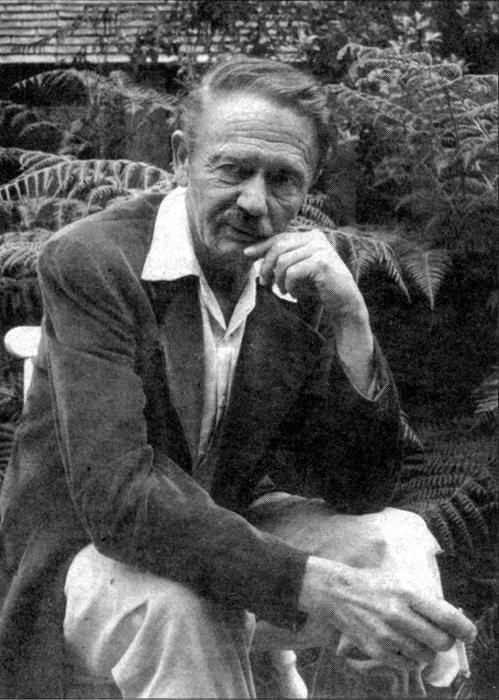
Clark Ashton Smith and some ferns in 1958 (Eldritch Dark)
I, too, am capable of observation; but I am far happier when I create everything in a story, including the milieu. This is why I do my best in work like “Satrampa Zeiros”. Maybe I haven’t enough love for, or interest in, real places to invest them with the atmosphere that I achieve in something purely imaginary. […] As for the problem of phantasy, my own standpoint is that there is absolutely no justification for literature unless it serves to release the imagination from the bounds of everyday life. I have undergone a complete revulsion against the purely realistic school, including the French, and can no longer stomach even Anatole France. […] Well, I must put a scientific — or at least a pseudo-scientific — curb on my fancy if I am to sell anything. — Clark Ashton Smith, letter to H.P. Lovecraft, 9th January 1930
• The Wine of Words: Valorizing the Verbiviniculture of Clark Ashton Smith
Ho Rhodornix
Y Rhosyn a’r Wylan
There’s a rose at Number Seven,
Tho’ the air is wintered now,
And it glows at Number Seven,
In the brain behind thy brow.
There’s a gull that turns the stillness
Of the air above thy head:
’Tis the gull that spurns the illness
Of the creed where color’s dead.
There’s a rose at Number Seven;
There’s a gull that turns the air:
And what glows at Number Seven
Is the spurner turning there.
 Overlord In Terms of Core Issues Around Maximal Engagement with Key Notions of the Über-Feral