Performativizing Papyrocentricity #12

Papyrocentric Performativity Presents:

Hawt’ in the ActWhatshisname: The Life and Death of Charles Hawtrey, Wes Butters (Tomahawk Press 2010)

Lez ReddThe Trials and Triumphs of Les Dawson, Louis Barfe (Atlantic Books 2012)

Fetch and CarryThe Surfrider, compiled by Jack Pollard (K.G. Murray 1963)


Bri’ on the SkyWonders of the Solar System, Professor Brian Cox and Andrew Cohen (Collins 2010) (posted @ Overlord of the Über-Feral)

Playing on the NervesIn A Glass Darkly, Sheridan Le Fanu (@ O.o.t.Ü.-F.)


Or Read a Review at Random: RaRaR

The Whisper from the Sea

─But what is that whisper?

─Ah. Then ye hear it?

─Aye. ’Tis thin and eerie, mingling with the waves, and seemeth to come from great distance. I know not the language thereof, but I hear great rage therein.

─As well ye might. We stand near the spot at which the wizard Zigan-Uvalen bested a demon sent against him by an enemy. ’Tis the demon’s whisper ye hear.

─Tell me the tale.

─It is after this wise…

Zigan-Uvalen woke to a stench of brimstone, a crackle of flame, and found himself staring up at a fearsome ebon face, lapped in blood-red fire, horned with curling jet, fanged in razor-sharp obsidian.

“Wake, Wizard!” the apparition boomed. “And make thy peace with thy gods, for I am come to devour thee!”

Zigan-Uvalen sat up and pinched himself thrice.

“Without introduction?” he asked, having verified that he was truly awake.

“Introduction?”

“Well, ’tis customary, in the better magickal circles.”

“Aye? Then know this: I am the Demon Ormaguz, summoned from the hottest corner of the deepest pit of Hell by your most puissant and malicious enemy, the wizard Muran-Egah. I have been dispatched by him over many leagues of plain and ocean to wreak his long-meditated, slow-readied, at-last-matured vengeance on thee.”

“Very well. And what are your qualifications?”

“Qualifications?”

“Aye. Are ye worthy of him who sent you, O Demon Ormaguz?”

“Aye, that I am! And will now dev–”

“Nay, nay!” The wizard raised a supplicatory hand. “Take not offence, O Ormaguz. I ask merely out of form. ’Tis customary, in the better magickal circles.”

“Truly?”

“Truly.”

“Then know this… Well, of formal qualifications, diplomas, and the like, I have none, ’tis true. But I am a demon, thou puny mortal. I have supernatural powers of body and mind, far beyond thy ken.”

“I doubt them not. At least, I doubt not your powers of body, in that ye have travelled so very far and very fast this very night. Or so ye say. But powers of mind? Of what do they consist?”

“Of aught thou carest to name, O Wizard.”

“Then ye have, for instance, much mathematical skill?”

“Far beyond thy ken.”

“How far?”

“Infinitely far, wizard!”

“Infinitely? Then could ye, for instance, choose a number at hazard from the whole and endless series of the integers?”

“Aye, that I could!”

“Entirely at hazard, as though ye rolled a die of infinite sides?”

“Aye! In less than the blink of an eye!”

“Well, so ye say.”

“So I say? Aye, so I say, and say sooth!”

“Take not offence, O Demon, but appearances are against you.”

“Against me?”

“Ye are a demon, after all, unbound by man’s pusillanimous morality.”

“I speak sooth, I tell thee! I could, in an instant, choose a number, entirely at hazard, from the whole and endless series of the integers.”

“And speak it to me?”

“Ha! So that is thy game, wizard! Thou seekest to occupy me with some prodigious number whilst thou makest thy escape.”

“Nay, nay, ye misjudge me, O Demon. Let me suggest this. If ye can, as ye say, choose such a number, then do so and recite its digits to me after the following wise: in the first second, name a single digit – nay, nay, O Demon, hear me out, I pray! Aye, in the first second, name a single digit thereof; in the second second, name four digits, which is to say, two raised to the second power; in the third second, name a number of digits I, as a mere mortal, cannot describe to you, for ’tis equal to three raised to the third power of three.”

“That would be 7,625,597,484,987 digits named in the third second, O Wizard.”

“Ah, most impressive! And your tongue would not falter to enunciate them?”

“Nay, not at all! Did I not tell thee my powers are supernatural?”

“That ye did, O Demon. And in the fourth second, of course, ye would name a number of digits equal to four raised to four to the fourth power of four. And so proceed till the number is exhausted. Does this seem well to you?”

“Aye, very well. Thou wilt have the satisfaction of knowing that ’tis an honest demon who devoureth thee.”

“That I will. Then, O Ormaguz, prove your honesty. Choose your number and recite it to me, after the wise I described to you. Then devour me at your leisure.”

─Then the Demon chose a number at hazard from the whole and endless series of the integers and began to recite it after the wise Zigan-Uvalen had described. That was eighteen centuries ago. The demon reciteth the number yet. That is the whisper ye hear from the sea, which rose long ago above the tomb of Zigan-Uvalen.

Spiral Archipelago

Incomplete map of Earthsea

Incomplete map of Earthsea

Ursula K. Le Guin, creatrix of Earthsea, is a much better writer than J.R.R. Tolkien, creator of Middle-earth: much more subtle, skilful and sophisticated. But for me Middle-earth has one big advantage over Earthsea: I can imagine Middle-earth really existing. I can’t say that for Earthsea, an archipelago-world of fishermen, goatherds and wizards. There’s something dead and disconnected about Earthsea. I’m not sure what it is, but it may have something to do with Le Guin’s dedicated political correctness.

For example, despite the northern European climate and culture on Earthsea, a sea-faring world with lots of rain, mist, snow and mountains, most of the people are supposed to have dark skins. The ones that don’t – the white-skinned, blond-haired Kargs – are the bloodthirsty baddies of A Wizard of Earthsea (1968), the first book in the series. Balls to biology, in other words: there’s propaganda to propagate. So it’s not surprising that Le Guin’s father was a famous and respected figure in the mostly disreputable discipline of anthropology. Earthsea is fantasy for Guardian-readers, in short.

But I still like the idea of an archipelago-world: sea and islands, islands and sea. As Le Guin herself says: “We all have archipelagos in our minds.” That’s one of the reasons I like the Ulam spiral: it reminds me of Earthsea. Unlike Earthsea, however, the sea and islands go on for ever. In the Ulam spiral, the islands are the prime numbers and the sea is the composite numbers. It’s based on a counter-clockwise spiral of integers, like this:

145←144←143←142←141←140139←138←137←136←135←134←133
 ↓                                               ↑
146 101←100←099←098←097←096←095←094←093←092←091 132
 ↓   ↓                                       ↑   ↑
147 102 065←064←063←062←061←060←059←058←057 090 131
 ↓   ↓   ↓                                  ↑   ↑
148 103 066 037←036←035←034←033←032←031 056 089 130
 ↓   ↓   ↓   ↓                       ↑   ↑   ↑   ↑
149 104 067 038 017←016←015←014←013 030 055 088 129
 ↓   ↓   ↓   ↓   ↓               ↑      ↑   ↑   ↑
150 105 068 039 018 005←004←003 012 029 054 087 128
 ↓   ↓   ↓   ↓   ↓   ↓       ↑   ↑   ↑   ↑   ↑   ↑
151 106 069 040 019 006 001002 011 028 053 086 127
 ↓   ↓   ↓   ↓   ↓   ↓           ↑      ↑   ↑   
152 107 070 041 020 007→008→009→010 027 052 085 126
 ↓   ↓   ↓   ↓   ↓                   ↑   ↑   ↑   ↑
153 108 071 042 021→022→023→024→025→026 051 084 125
 ↓   ↓   ↓   ↓                           ↑   ↑   ↑
154 109 072 043→044→045→046→047→048→049→050 083 124
 ↓   ↓   ↓                                   ↑   ↑
155 110 073→074→075→076→077→078→079→080→081→082 123
 ↓   ↓                                           ↑
156 111→112→113→114→115→116→117→118→119→120→121→122
 ↓                                                   ↑
157→158→159→160→161→162→163→164→165→166→167→168→169→170

The spiral is named after Stanislaw Ulam (1909-84), a Polish mathematician who invented it while doodling during a boring meeting. When numbers are represented as pixels and 1 is green, the spiral looks like this – note the unique “knee” formed by 2, 3 (directly above 2) and 11 (to the right of 2):

Ulam spiral

Ulam spiral (animated)

(If the image above does not animate, please try opening it in a new window.)

Some prime-pixels are isolated, like eyots or aits (small islands) in the number-sea, but some touch corner-to-corner and form larger units, larger islands. There are also prime-diamonds, like islands with lakes on them. The largest island, with 19 primes, may come very near the centre of the spiral:

island1

Island 1 = (5, 7, 17, 19, 23, 37, 41, 43, 47, 67, 71, 73, 79, 103, 107, 109, 113, 149, 151) (i=19) (x=-3, y=3, n=37) (n=1 at x=0, y=0)

Here are some more prime-islands – prIslands or priminsulas – in the Ulam-sea that I find interesting or attractive for one reason or other:

island2

Island 2 = (281, 283, 353, 431, 433, 521, 523, 617, 619, 719, 827, 829, 947) (i=13) (x=6, y=-12, n=619)


island3

Island 3 = (20347, 20921, 21499, 21503, 22091, 22093, 22691, 23293, 23297, 23909, 23911, 24533, 25163, 25801, 26449, 27103, 27767, 28439) (i=18) (x=-39, y=-81, n=26449)


island4

Island 4 = (537347, 540283, 543227, 546179, 549139, 552107, 555083, 558067, 561059, 561061, 564059, 564061, 567067, 570083, 573107, 573109) (i=16) (x=375, y=-315, n=561061)


island5

Island 5 = (1259047, 1263539, 1263541, 1268039, 1272547, 1277063, 1281587, 1286119, 1290659, 1295207, 1299763) (i=11) (x=-561, y=399, n=1259047)


island6

Island 6 = (1341841, 1346479, 1351123, 1355777, 1360439, 1360441, 1365107, 1365109, 1369783, 1369787, 1369789, 1374473, 1379167) (i=13) (x=-585, y=-297, n=1369783)


island7

Island 7 = (2419799, 2419801, 2426027, 2426033, 2432263, 2432267, 2438507, 2438509, 2444759, 2451017, 2457283, 2463557) (i=12) (x=558, y=780, n=2432263)


island8

Island 8 = (3189833, 3196979, 3196981, 3204137, 3204139, 3211301, 3211303, 3218471, 3218473, 3218477, 3225653) (i=11) (x=-894, y=858, n=3196981)

Mental Marine Music

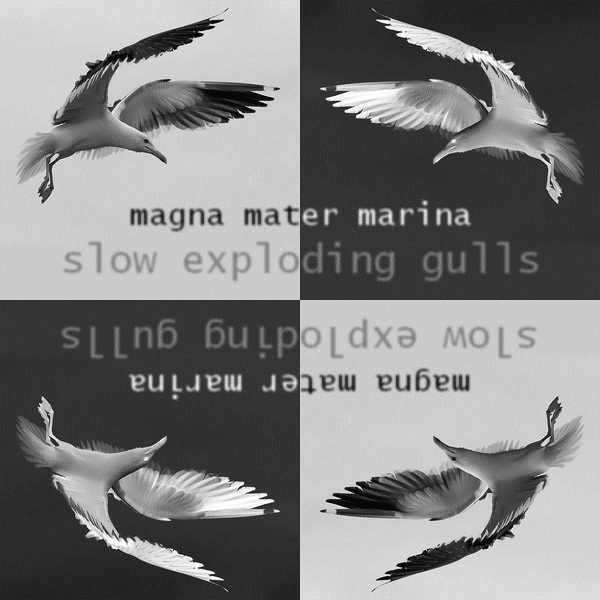
Cover of Magna Mater Marina by Slow Exploding Gulls (CD re-issue)

“Thalassa! Thalassa!” The chant that began the first song on the first side of the first S.E.G. album is still inspiring the group twenty-six years and eighteen albums later. Few fans will need reminding that it is ancient Greek for “The Sea! The Sea!”, as shouted in ecstasy by a mercenary army after a long and dangerous retreat across Asia Minor in 401 BC. Ecstasy is not so much an inspiration to the group as an aspiration. They try to use melody, rhythm and “drowned sound” to take their listeners out of the everyday and into the otherwhere, to sink them “full fathom five” in music as rich and mysterious as the sea. The S.E.G. story begins in 1987, when Joseph Corvin, the ever-present Kapitän und Kappellmeister, as he jokingly calls himself, was living in an old house in the ancient Celto-Roman town of Exeter on the southern English coast. When the sea-wind blew, his living quarters became lowing quarters: “an eerie wailing used to sound from the roof and there were all sorts of weird sound effects in the bathroom, because of air moving in the overflow pipe and the walls. I liked what I heard and I thought I could do something with it, musically speaking.”

Corvin recorded some of the wind-sounds, mixed them with gull-cries and underwater engine-noise, added vocals and electronically treated flute and drums, and put out the results on a cassette-only album called Magna Mater Marina (Latin for Great Marine Mother), under the odd but memorable moniker of Slow Exploding Gulls. The name was inspired by Corvin’s love of the surrealists Salvador Dalí and Max Ernst, but it would dog him and his cohorts for years to come, partly because it pigeon-holed the group as “Kraut-rock” and partly because it suggested cruelty to animals, which was not appreciated by some of his potential audience. Both assumptions were completely wrong: Corvin says, first, that, as a fan, he was then much more into The Cure, The Smiths and Siouxsie and the Banshees than anything electronic or experimental, and, second, that far from advocating cruelty to gulls, he was celebrating them:

Not for one moment was I suggesting any harm to anything with wings or feathers. Gulls are my favourite birds, highly potent symbols of freedom, grace and the life-force. The title was meant to be metaphorical, not literal, and it was partly a reference to the explosion of joy that sudden sight of a flying gull can waken in your heart. There’s something very Nietzschean about them and yeah, I will admit to a Friedrich-fixation in the 1980s, though the Kraut-rock label was an albatross around our necks, no pun intended, for most of the ’90s. It came mainly from a review in the N.M.E. [New Musical Express, one of Britain’s big “pop-papers”] claiming to detect similarities between us and Einstürzende Neubaten, which means “Collapsing New Buildings”. Well, I can’t say there wasn’t a subliminal influence, name-wise, but I’d heard very little by any of the German groups at the time and when I did hear more, I didn’t detect many similarities between their music and ours. We were and always will be inspired by sea-sounds, everything you can hear under and over the water of the British coast. The next label they tried to stick on us was “goth”, on the ground that we made gloomy music and always dressed in black. We didn’t: it was dark blue, it wasn’t all the time and there’s nothing gloomy about our music, if it’s listened to right. (Interview on the fan-site GullSegg, November, 2003)

Corvin’s protests were to no avail: S.E.G.’s next album, A Grey Mist (1989), was reviewed under titles like “Submarine Electro-Goths” and “Solipsistic Entrail-Gazing”. Again he says the press had got hold of the wrong end of the stick: “The title of the album comes from ‘Sea-Fever’, a very beautiful poem by John Masefield, and far from attempting to be gloomy or depressing, it was all about the joy of the sea, the cold in the early morning and the bite of the wind, ‘the white clouds flying’ and mist as a symbol of mystery and possibility, not as anything glum and gothic.” Happily, S.E.G. would outlive that early hostility and journalists’ insistence on labelling, rather than listening to, the music they created, but a lasting effect of both has been the playful name-switching they’ve indulged in since their early days. They’ve released albums under at least eight different names and performed gigs under all those and more, but every name has been based on the acronym S.E.G. and had a maritime theme. 1994’s Mew Upsilon Sigma, for example, came out under the name Swim with Elegant Gods, and 2003’s re-mixed Yr Wylan Ddu (Welsh for The Black Gull) under the name Seaside Excursion Guide. They’ve also recorded songs with titles like “Sunken Etruscan Gold”, “Sailing to Ecstatic Gnosis”, “Submersed in the Eternal Gulf” and “She’s an Exeter Girl” (a reference to Cathleen Orne, Joseph’s then girlfriend, now wife, who is indeed an Exeter girl).

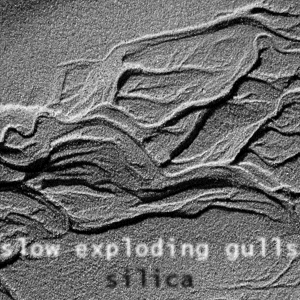
Cover of Silica by Slow Exploding Gulls

This S.E.G. motif means that hardcore fans, of whom they’ve garnered and retained a flighty fair few down the decades, are generally referred to as SEGheads, while their biggest – and best – fan-site is GullSegg, where you can find the earliest and most accurate news on the group’s activities, plus detailed and reasonably objective reviews of every piece of music they’ve ever recorded. So can S.E.G. be described as Shadowy Exeter Goths? No, Soaring Elemental Gods is much closer the mark and I join many mental-marine-music fans in wishing them well in their ambition of recording music in every major sea-side town of the British Isles. Wexford on the eastern coast of Ireland is next, according to GullSegg, and Wassernyxe, album #19 (and German/Greek for “Mermaid-Night”), should be released before the end of the year. It’s unlikely it will sail new seas, or sound new depths, but after twenty-six years of mer-music-making who could expect it to? Yes, never mind the rowlocks! S.E.G.’s Saline Esoterica Gangs on – and gongs on – every time someone plays a classic album like Mew or Thalas/Socratic, their 1996 split-EP with their own whale-song side-project Schatten über Exeter Gruppe (German for “Shadow over Exeter Group”).


Elsewhere other-posted:

• More Musings on Music

Previously pre-posted (please peruse):

Stoch’! (In the Name of Dove)

Proviously post-posted (please peruse):

The Sound of Silex