Performativizing Papyrocentricity #40

Papyrocentric Performativity Presents:

Humanist Hubris The Wreck of Western Culture: Humanism Revisited, John Carroll (Scribe 2010)

Paw is Less – The Plague Dogs, Richard Adams (Penguin 1977)

I Like Bike – Fifty Bicycles That Changed the World, Alex Newson (Conran Octopus 2013)

Morc is LessThe Weird Shadow Over Morecambe, Edmund Glasby (Linford 2013)

Nekro-a-KokoaComfort Corps: Cuddles, Calmatives and Cosy Cups of Cocoa in the Music of Korpse-Hump Kannibale, Dr Miriam B. Stimbers (University of Nebraska Press 2015)


Or Read a Review at Random: RaRaR

Performativizing Papyrocentricity #32

Papyrocentric Performativity Presents:

At the Margins of MapnessMapping the World: The Story of Cartography, Beau Riffenburgh (Carlton Books 2011, 2014)

Vivid ViralFlora: An Artistic Voyage through the World of Plants, Sandra Knapp (Natural History Museum 2014)

Auto MotiveDream Cars: The Hot 100, Sam Philip (BBC Books 2014)


Or Read a Review at Random: RaRaR

She-Shell

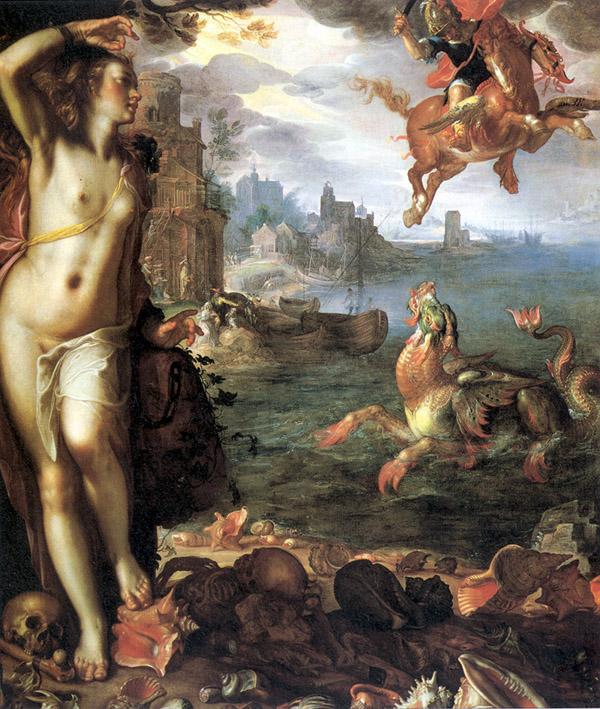
Perseus Releases Andromeda by Joachim Wtewael (mirrored)

Joachim Wtewael (sic), Perseus Rescuing Andromeda (1611) (mirrored)

When I first came across this painting in a recent edition of Arthur Cotterell’s Classic Mythology,* it had mutated in two ways: it was mirror-reversed (as above) and Wtewael’s name (pronounced something like “EET-a-vaal”) was printed “WIEWAEL”. At least, I assume the painting was mirror-reversed, because almost all versions on the web have Andromeda on the left, which means that Perseus is holding his sword in his right hand, as you would expect.

I think I prefer the mirrored version, though I don’t know whether that’s because it was the first one I saw. In either version, it is a rich and dramatic painting, full of meaning, seething with symbolism. It’s displayed in the Louvre and if French etymology had been a little different, I could have called it La Conque d’Andromède. Here is the commoner version:
Perseus Releases Andromeda by Joachim Wtewael


*Mythology of Greece and Rome (Southwater 2003).

Performativizing Papyrocentricity #28

Papyrocentric Performativity Presents:

HimmelangstNo Empty Chairs: The Short and Heroic Lives of the Young Aviators Who Fought and Died in the First World War, Ian Mackersey (Phoenix 2012)

Arioch’n’RollThe White Stuff: Archetype, Anomie and Allegorical Albinism in the Music of Hawkwind, 1972-81, Dr Miriam B. Stimbers (University of Nebraska Press 1996)

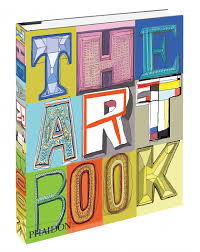
Jewels in the SkullThe Art Book, Phaidon (Second edition 2012) (posted @ Overlord of the Über-Feral)


Or Read a Review at Random: RaRaR

Jewels in the Skull

Phaidon Art BookThe Art Book, Phaidon (Second edition 2012)

An A to Z of artists, mostly painters, occasionally sculptors, installers and performers, with a few photographers and video-makers too. You can trace the development, culmination and corruption of high art all the way from Giotto and Fra Angelico through Van Eyck and Caravaggio to Auerbach and Twombly. But the modernist dreck heightens the power of the pre-modernist delights. A few pages after Pieter Claesz’s remarkable A Vanitas Still Life of 1645 there’s Joseph Cornell’s “Untitled” of 1950. One is a skull, watch and overturned glass, skilfully lit, minutely detailed, richly symbolic; the other is a wooden box containing a “frugal assortment of stamps, newspaper cuttings and other objects with no particular relevance to each other”. From the sublime to the slapdash. Over the page from Eleazar Lissitzky’s Composition of 1941 there’s Stefan Lochner’s The Virgin and Child in a Rose Arbour of 1442. One is like a child’s doodle, the other like a jewel. From the slapdash to the sublime.
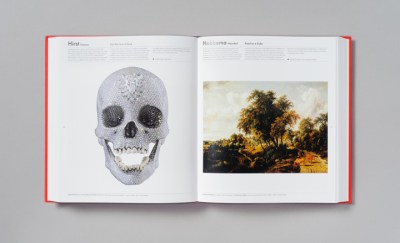
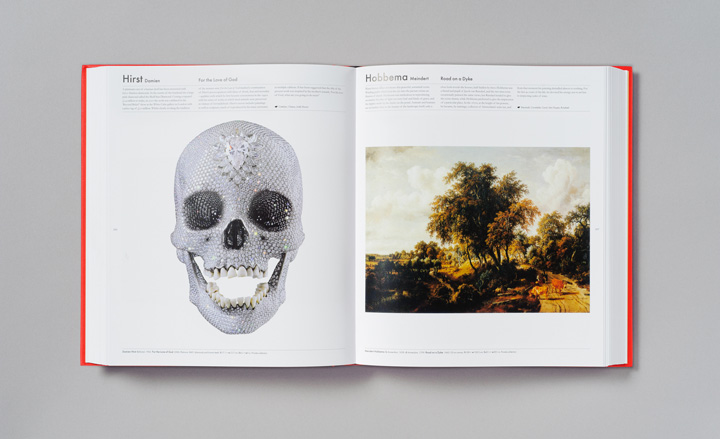
Hirst Skull and landscape
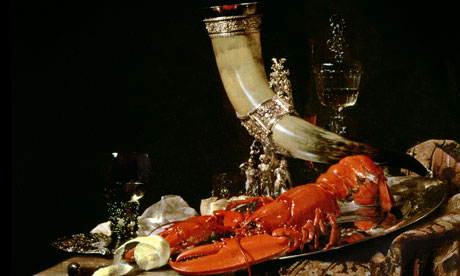
And so it goes on throughout the book, with beautiful art by great artists following or preceding ugly art by poseurs and charlatans. But some of the modern art is attractive or interesting, like Bridget Riley’s eye-alive Cataract 3 (1961) and Damien Hirst’s diamond-encrusted skull For the Love of God (2006). Riley and Hirst aren’t great and Hirst at least is more like an entrepreneur than an artist, but their art here is something that rewards the eye. So is Riley’s art elsewhere, as newcomers to her work might guess from the single example here. That is one of the purposes of a guide like this: to invite – or discourage – further investigation. I vaguely remember seeing the beautiful still-life of a boiled lobster, drinking horn and peeled lemon on page 283 before, but I wouldn’t have recognized the name of the Dutch artist: Willem Kalf (1619-93).

Willem Kalf, Still Life (c. 1653)

Willem Kalf, Still Life (c. 1653)


Elsewhere, I was surprised and pleased to see an old favourite: John Atkinson Grimshaw and his Nightfall on the Thames (1880). Many more people know Grimshaw’s atmospheric and eerie art than know his name, because it often appears on book-covers and as illustrations. If Phaidon are including him in popular guides with giants like Da Vinci, Dürer, Raphael and Titian, perhaps he’ll return to his previous fame. I certainly hope so.

Finding Grimshaw here made a good guide even better. The short texts above each art-work pack in a surprising amount of information and anecdote too. What you learn from the texts raises some interesting questions. For example: Why has one small nation contributed so much to the world’s treasury of art? From Van Eyck to Van Gogh by way of Hieronymus Bosch and Jan Vermeer, Holland is comparable to Italy in its importance. But only in painting, not sculpture or architecture. There aren’t just patterns of pigment, texture and geometry in this book: there are patterns of DNA, culture and evolution too. Brilliant, beautiful and banal; skilful, subtle and slapdash: The Art Book has all that and more. It puts jewels inside your skull.


Elsewhere other-posted:

Ai Wei to HellHow to Read Contemporary Art, Michael Wilson
Eyck’s EyesVan Eyck, Simone Ferrari
Face PaintA Face to the World: On Self-Portraits, Laura Cumming

Performativizing Papyrocentricity #23

Papyrocentric Performativity Presents:

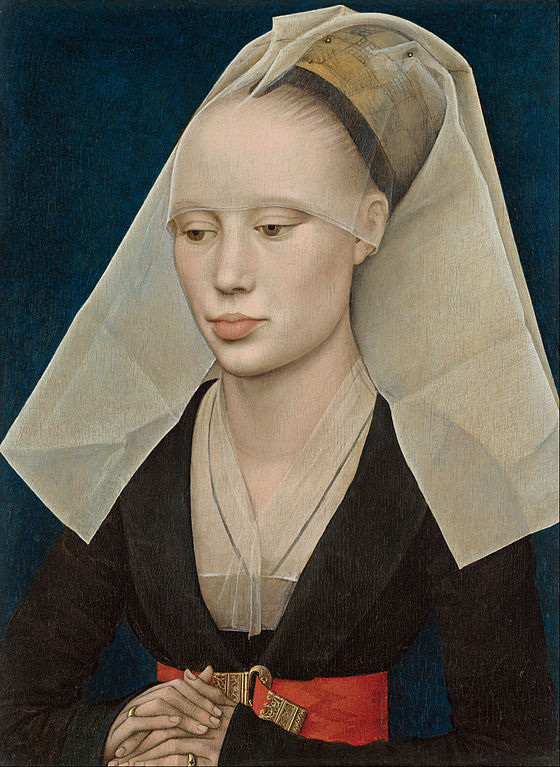
Face PaintA Face to the World: On Self-Portraits, Laura Cumming (HarperPress 2009; paperback 2010)
The Aesthetics of AnimalsLife: Extraordinary Animals, Extreme Behaviour, Martha Holmes and Michael Gunton (BBC Books 2009)

Less Light, More NightThe End of Night: Searching for Natural Darkness in an Age of Artifical Light, Paul Bogard (Fourth Estate 2013)

The Power of Babel – Clark Ashton Smith, Huysmans, Maupassant


Or Read a Review at Random: RaRaR

Performativizing Papyrocentricity #22

Papyrocentric Performativity Presents:

Plates from the GreatShots from the Front: The British Soldier 1914-18, Richard Holmes (HarperPress 2008; paperback 2010)

Math for the MistressA Mathematician’s Apology, G.H. Hardy (1940)

Sinister SinemaScalarama: A Celebration of Subterranean Cinema at Its Sleazy, Slimy and Sinister Best, ed. Norman Foreman, B.A. (TransVisceral Books 2015)

Rick PickingsLost, Stolen or Shredded: Stories of Missing Works of Art and Literature, Rick Gekoski (Profile Books 2013/2014)

Slug is a DrugCollins Complete Guide to British Coastal Wildlife, Paul Sterry and Andrew Cleave (HarperCollins 2012) (posted @ Overlord of the Über-Feral)


Or Read a Review at Random: RaRaR