Cry’ Me A Shiver

It’s not true that Cryogénie are best experienced live. That would imply their music can be experienced some other way. It can’t. The live experience is the only experience. And it’s guaranteed unique. These French avant-gardists aren’t the only band to hand out earplugs on the door, but they don’t do it for the conventional reason: that they play so loud.

In fact, they don’t play loud. They don’t play soft either. In the conventional sense, they don’t play at all. Here’s an interview from 2008 with Tïurbeau magazine:


Tïurbeau: I’ve got your latest album in front of me now. Words fail me.

Alexandre: And us too.

François: As usual.

Tïurbeau: Then one has to ask: why do you bother to release albums?

Alexandre: We see it, you could say, as a little ritual, something solid, something material––

François: Something permanent.

Alexandre: Yes, something permanent, to mark the occasion, that will remain with our audience. Often, we hear, they will buy an album after they have attended a concert, as a souvenir, almost. And they will truly play it!

Tïurbeau: They will play thirty-seven minutes of silence?

Cryogénie, Nix Sonica (2008)

Cryogénie, Nix Sonica (2008)*

François: Yes. The silence creates a space, a kind of opening in the present, for memories of the concert.

Alexandre: Yes, for memories, exactly so. Although, of course, in one sense we have pride in the irreproducibility of our music, in another sense we are recording every moment we are on stage. On the brain.

François: On the brains of the audience.

Alexandre: We are recording memories.

Tïurbeau: And the albums are designed to trigger the memories?

Alexandre: Trigger?

Tïurbeau: Bring the memories back.

Alexandre: Ah, yes, exactly so. The albums are a focus for memories of a concert.

François: Almost talismans.

Tïurbeau: In a magical sense?

Alexandre: Yes, why not? For us, experience is the ultimate magic. In the moment, but also in memory.

Tïurbeau: And does this relate to the sensory restrictions of your concerts, the way you try to turn down some senses in order to heighten the sense you are seeking to stimulate?

François: Yes, exactly so. Earplugs.

Alexandre: No aftershave, no perfume.

François: And please shower carefully before you attend.

Alexandre: Yes, shower carefully. And we ourselves, we will take care of the light. Remove it, make the scene very dark. You are not at a Cryogénie concert for pleasing your ears, your nose, eyes, mouth. Non, vous êtes là pour la chair!

François: Oui, pour la chair.

Tïurbeau: For the flesh.

Alexandre: Yes, the flesh. And how do we stimulate the flesh when we may not use another mode, not exploit another sense? No vibration, no infra-bass even. Then what?

François: Yes, this was the question we faced in our formative days.

Tïurbeau: And the answer…

Cryogénie, Rois du Froid (1996)

Cryogénie, Rois du Froid (1996)**

Alexandre: The cold!

François: Cold.

Alexandre: Please remember a question in the Gay Science of Nietzsche: Ist es nicht kälter geworden?

François: “Has it not become colder?”

Alexandre: And we want, if you attend a Cryogénie concert, for you to say: Ja! Oui! Yes! Kälter, kälter! Plus froid, plus froid! Colder, colder!

Tïurbeau: The triumph of the chill?

François: Yes. Triumph of the chill!

Alexandre: I don’t understand.

François: [Explains briefly in French]

Alexandre: Ah, yes, a triumph.

Tïurbeau: And with the concept came the name?

Alexandre: Yes, and so we had our name also. Cryogénie. With several meanings. Cryogénie is “creation of cold”, but also, for us, “genius of cold”, “spirit of cold”. Remember the concept of ritual. Our concerts, you might say, are rituals of cold, invocations of cold.

François: And: “If it’s too cold, you’re too old!”

Alexandre: Yes, so it’s said. Of course, in truth we welcome all ages, but if you are in poor health, perhaps better not to attend.

François: Nevertheless, visits to the pharmacy surely increase after we have passed through a city.

Tïurbeau: How cold do you go?

Alexandre: Ah, we prefer not to speak of that. No numbers, no statistics. You are there for the music, not to watch le thermomètre.

François: We get cold enough for our purposes.

Tïurbeau: That sounds rather sinister!

François: Yes, perhaps so. But would that not be the ultimate experience, to die pour une grêlodie, for a grêlodie?

Tïurbeau: Grêlodie?

Alexandre: It’s a joke, un calembour, a mixing of words.

François: A pun. In French, grêle is “hail”, you know, the little balls of ice, and mélodie is “melody”, of course, and so you have grêlodie, for a tune as performed by Cryogénie, a tune of ice, a tune of cold.

Tïurbeau: But not literal hail?

Alexandre: No, not literal. Though sometimes the breath of our audience will freeze and fall as a kind of snow. It makes a sound, that, a very delicate sound, le chuchotement des étoiles, comme on dit en Sibérie.

François: Yes, the whisper of the stars, as they say in Siberia. But of course, no-one will hear it, if they have followed their instructions.

Alexandre: Earplugs in!

Cryogénie, Blanchette (2003)

Cryogénie, Blanchette (2003)***

François: But the snow, the breath-snow, can be felt on the skin as it falls. This is acceptable, though it is an indirect effect of our music, not something we have planned for.

Tïurbeau: I have felt it. In the middle section of “Frissonique”, particularly.

Alexandre: Yes, and in “Bruitmal”.

François: When the framplifiers are cooking, as you might say.

Tïurbeau: Framplifiers? Can you explain for the benefit of our readers?

François: It is from froid and amplificateur. Framplicateur, framplifier. Amplifiers of cold, or generators of cold.

Tïurbeau: That is one of the most widely discussed aspects of your music, isn’t it? Your equipment.

Alexandre: Yes.

François: Yes, certainly.

Tïurbeau: But you’re rather secretive about it, aren’t you?

Alexandre: Yes!

François: You discuss, we are sphinxes.

Tïurbeau: Silent?

François: Yes. We have our – what is the term? – our trade-secrets. It’s not in our interests to expose our techniques. Nor in yours, we think.

Tïurbeau: You want to preserve that air of mystery?

Alexandre: Yes, precisely so. The experience is more strong when you don’t understand.

François: Like magic.

Alexandre: Yes, magic. We perform a ritual. The invocation of the cold. We invoke the cold and we throw the cold, we throw it on the audience.

François: Waves of cold. Cryorrhythms. Chords of cold, congelations, grêlodies, chills, thrills, rivers of shivers. That is the Cryogénie experience.

Tïurbeau: But there’s some serious technology behind the experience, isn’t there?

Alexandre: Yes.

François: Yes.

Tïurbeau: And you’re saying no more?

Alexandre: Yes, no more.

François: It’s not in our interests to explain. Or yours.

Tïurbeau: Nothing?

Alexandre: Nothing.

Tïurbeau: Not even a little?

François: Well, maybe a little. We had problems, in the early days, with unwanted noise, from the equipment.

Alexandre: Just a little.

François: I mean, if you think of a refrigerator, there is noise, of course. And we didn’t want noise, we wanted silence, pure silence.

Tïurbeau: A blank canvas, sensorily speaking?

François: Yes, a blank canvas, for us to paint with cold. So there was that problem to solve. The noise, unwanted noise.

Tïurbeau: And you solved it?

François: Yes, I think we did.

Alexandre: I think so.

Tïurbeau: But the earplugs are still necessary?

Alexandre: Yes, necessary, we think. Because, of course, with silent equipment there is still the movement of people, our movement on the stage, movement of the audience.

François: And the whisper of the stars, with some other effects. There are many things to create noise at a concert. We cannot eliminate them all, or we choose not to, because the earplugs are in themselves symbolic. To use them, you say: “See? I choose to close this door, this sensory mode.”

Alexandre: And you give yourself to us, to Cryogénie, to exploit another sense.

François: To submit you to our chill.

Tïurbeau: Esclaves du froid?

François: Yes, very good. Slaves of cold! But equally we are the slaves.

Alexandre: Yes, esclaves du froid. I like it. Perhaps we will write a song of that title one day.


Elsewhere Other-Engageable:

Rois du Froid — Cryogénie’s official site


*Sonic Snow.
**Kings of Cold.
***Little White One.

The Sound of Silex

Some of the most beautiful patterns in nature arise from the interaction of three very simple things: sand and water, sand and air. Sculptrix Sabulorum, a side-project of the Exeter band Slow Exploding Gulls, are an attempt to do with sound what nature does with sand: turn simple ingredients into beautiful patterns. Here are extracts from an interview and review in the Plymouth fanzine EarHax:

Hector Anderton: OK. The obvious first. Sculptrix Sabulorum. What does it mean and why did you choose it?

Joe Corvin: It’s Latin and literally means “Sculptress of the Sands”. We chose it, well, because we thought it looked and sounded good. Good but mysterious.

Hector Anderton: And who is the sculptress? The sea?

Joe Corvin: Well, the sculptress is Mother Nature, in the fullest sense, but she uses the sea. The wind. Gravity. Simple things, but put them together with sand and interesting things happen.

Cath Orne: Which we wanted to explore, but we didn’t think S.E.G. [Slow Exploding Gulls] was the way to explore them.

Cover of Silica by Slow Exploding Gulls

Hector Anderton: But hadn’t you done that in Silica?

Joe Corvin: We’d started to, but Silica hadn’t exhausted the theme. Of sand, I mean. It’s something I’d always been interested in, but with S.E.G. we tend to go with the organic side of the sea, with sea life.

Hector Anderton: Whereas sand is inorganic?

Joe Corvin: Exactly. Silica was a bit of a departure for us, in that respect. It was as though we were walking down a corridor and we opened a door in passing and thought, yeah, that room looks interesting.

Sand Band: Sculptrix Sabulorum

Sand Band: Sculptrix Sabulorum

Cath Orne: So we’ll come back and have a proper look later.

Joe Corvin: Yeah. Under a new name. Which we’ve done. Hence, Sculptrix Sabulorum.

Extract © EarHax (1992)


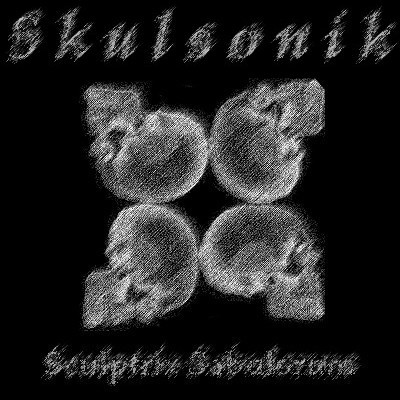
Skulsonik, Sculptrix Sabulorum (Umbra Mundi 1995)

Macca to Madonna: “Listen to the music playing in your head.” In fact, we never do anything else. We don’t experience the world: we experience a sensory simulacrum of the world. Light or sound-waves or chemicals floating in the air stimulate the nerves in our eyes or ears or nose and the brain turns the resultant stream of electrical pulses into sight or sound or smell.

Skulsonik (1995)

Sculptrix Sabulorum: Skulsonik (1995)

But it does more than that: it covers up the cracks. Raw nerve-stuff is not smooth and polished sensation. We have blind-spots, but the brain edits them out. Only a small part of our visual field is actually in clear focus, but we think otherwise. If we could see raw nerve-stuff, it would be a blurry, fuzzy mess.

The same is true of hearing. And Skulsonik is an attempt to record raw nerve-stuff: to capture not sound out there, but sound in here – the music playing in your head. Sculptrix Sabulorum have set out to answer a simple question: “What does music really sound like?” Or rather: what does music cerebrally sound like? What does it sound like in your head?

Extract © EarHax (1995)


Previously pre-posted (please peruse):

Mental Marine Music – Slow Exploding Gulls

A Diet of Quiet

The astonishment one feels on learning of the success of the movement takes second place only to the astonishment that this success has been achieved almost without notice from the mainstream and the underground press alike. Nation-wide weeklies like the NME [New Musical Express] haven’t condescended as yet to feature a single band even vaguely affiliated to the movement, and the fanzines that spring up like mushrooms around any spasmodic “new genre” emptying of popular music’s overclogged bowels have found little nourishment in the only truly fresh development in the field since the earliest days of rap. So far only one or two of the bands on the very fringes of the movement have received any serious attention. Yet Dwaal, who by their own admission are one of the “baby” acts in Quiet, have sold nearly 20,000 of their debut album Slow Hearts in the eight months since its release; the really big boys like Morpheus and Dark could expect to shift this amount in the first week of release of their next albums. Tickets for tours by either of the last mentioned have been known to sell out within an hour of going on sale, and rumours of an imminent ocean-hop by Murmur, the Chicago band seen by many as the kings of Quiet, had the telephones at the offices of London’s GigWise booking agency tied up solid for nearly two days.

So, how has Quiet not merely got off the ground but got well on the way to the outer reaches of the Solar System without collecting a write-up or a review worthy of the name? Why do the names of the most important bands in the movement still mean nothing to the majority of music fans? Well, for a start, Quiet — in every sense — lives up to the name bestowed on by Hank O’Dowell, Murmur’s lead guitarist. To see how this is so, it’s necessary to take a look at its history.


• Continue reading A Diet of Quiet

Mental Marine Music

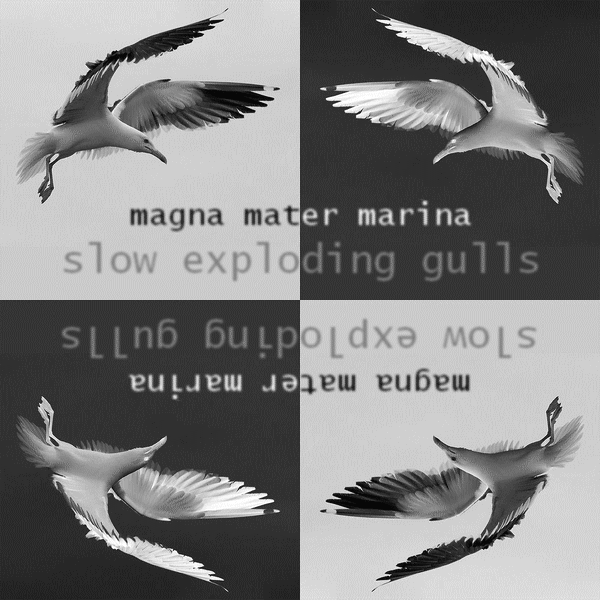
Cover of Magna Mater Marina by Slow Exploding Gulls (CD re-issue)

“Thalassa! Thalassa!” The chant that began the first song on the first side of the first S.E.G. album is still inspiring the group twenty-six years and eighteen albums later. Few fans will need reminding that it is ancient Greek for “The Sea! The Sea!”, as shouted in ecstasy by a mercenary army after a long and dangerous retreat across Asia Minor in 401 BC. Ecstasy is not so much an inspiration to the group as an aspiration. They try to use melody, rhythm and “drowned sound” to take their listeners out of the everyday and into the otherwhere, to sink them “full fathom five” in music as rich and mysterious as the sea. The S.E.G. story begins in 1987, when Joseph Corvin, the ever-present Kapitän und Kappellmeister, as he jokingly calls himself, was living in an old house in the ancient Celto-Roman town of Exeter on the southern English coast. When the sea-wind blew, his living quarters became lowing quarters: “an eerie wailing used to sound from the roof and there were all sorts of weird sound effects in the bathroom, because of air moving in the overflow pipe and the walls. I liked what I heard and I thought I could do something with it, musically speaking.”

Corvin recorded some of the wind-sounds, mixed them with gull-cries and underwater engine-noise, added vocals and electronically treated flute and drums, and put out the results on a cassette-only album called Magna Mater Marina (Latin for Great Marine Mother), under the odd but memorable moniker of Slow Exploding Gulls. The name was inspired by Corvin’s love of the surrealists Salvador Dalí and Max Ernst, but it would dog him and his cohorts for years to come, partly because it pigeon-holed the group as “Kraut-rock” and partly because it suggested cruelty to animals, which was not appreciated by some of his potential audience. Both assumptions were completely wrong: Corvin says, first, that, as a fan, he was then much more into The Cure, The Smiths and Siouxsie and the Banshees than anything electronic or experimental, and, second, that far from advocating cruelty to gulls, he was celebrating them:

Not for one moment was I suggesting any harm to anything with wings or feathers. Gulls are my favourite birds, highly potent symbols of freedom, grace and the life-force. The title was meant to be metaphorical, not literal, and it was partly a reference to the explosion of joy that sudden sight of a flying gull can waken in your heart. There’s something very Nietzschean about them and yeah, I will admit to a Friedrich-fixation in the 1980s, though the Kraut-rock label was an albatross around our necks, no pun intended, for most of the ’90s. It came mainly from a review in the N.M.E. [New Musical Express, one of Britain’s big “pop-papers”] claiming to detect similarities between us and Einstürzende Neubaten, which means “Collapsing New Buildings”. Well, I can’t say there wasn’t a subliminal influence, name-wise, but I’d heard very little by any of the German groups at the time and when I did hear more, I didn’t detect many similarities between their music and ours. We were and always will be inspired by sea-sounds, everything you can hear under and over the water of the British coast. The next label they tried to stick on us was “goth”, on the ground that we made gloomy music and always dressed in black. We didn’t: it was dark blue, it wasn’t all the time and there’s nothing gloomy about our music, if it’s listened to right. (Interview on the fan-site GullSegg, November, 2003)

Corvin’s protests were to no avail: S.E.G.’s next album, A Grey Mist (1989), was reviewed under titles like “Submarine Electro-Goths” and “Solipsistic Entrail-Gazing”. Again he says the press had got hold of the wrong end of the stick: “The title of the album comes from ‘Sea-Fever’, a very beautiful poem by John Masefield, and far from attempting to be gloomy or depressing, it was all about the joy of the sea, the cold in the early morning and the bite of the wind, ‘the white clouds flying’ and mist as a symbol of mystery and possibility, not as anything glum and gothic.” Happily, S.E.G. would outlive that early hostility and journalists’ insistence on labelling, rather than listening to, the music they created, but a lasting effect of both has been the playful name-switching they’ve indulged in since their early days. They’ve released albums under at least eight different names and performed gigs under all those and more, but every name has been based on the acronym S.E.G. and had a maritime theme. 1994’s Mew Upsilon Sigma, for example, came out under the name Swim with Elegant Gods, and 2003’s re-mixed Yr Wylan Ddu (Welsh for The Black Gull) under the name Seaside Excursion Guide. They’ve also recorded songs with titles like “Sunken Etruscan Gold”, “Sailing to Ecstatic Gnosis”, “Submersed in the Eternal Gulf” and “She’s an Exeter Girl” (a reference to Cathleen Orne, Joseph’s then girlfriend, now wife, who is indeed an Exeter girl).

Cover of Silica by Slow Exploding Gulls

This S.E.G. motif means that hardcore fans, of whom they’ve garnered and retained a flighty fair few down the decades, are generally referred to as SEGheads, while their biggest – and best – fan-site is GullSegg, where you can find the earliest and most accurate news on the group’s activities, plus detailed and reasonably objective reviews of every piece of music they’ve ever recorded. So can S.E.G. be described as Shadowy Exeter Goths? No, Soaring Elemental Gods is much closer the mark and I join many mental-marine-music fans in wishing them well in their ambition of recording music in every major sea-side town of the British Isles. Wexford on the eastern coast of Ireland is next, according to GullSegg, and Wassernyxe, album #19 (and German/Greek for “Mermaid-Night”), should be released before the end of the year. It’s unlikely it will sail new seas, or sound new depths, but after twenty-six years of mer-music-making who could expect it to? Yes, never mind the rowlocks! S.E.G.’s Saline Esoterica Gangs on – and gongs on – every time someone plays a classic album like Mew or Thalas/Socratic, their 1996 split-EP with their own whale-song side-project Schatten über Exeter Gruppe (German for “Shadow over Exeter Group”).


Elsewhere other-posted:

• More Musings on Music

Previously pre-posted (please peruse):

Stoch’! (In the Name of Dove)

Proviously post-posted (please peruse):

The Sound of Silex

Stoch’! (In the Name of Dove)

Stochasma, In Abysso (2012)

The Sueco-Georgian avant-gardists Stochasma were formed, in their own words, “to interrogate, eviscerate, and exterminate the ultimate experimental envelope of acoustic idiosyncrasy”. That’s “Sueco-” as in Sweden and “Georgian” as in the Eurasian nation, not the American state, by the way. Going one up on some bands from Wales, Ireland and Scotland, who issue their material bilingually, in English and one or another of the Celtic languages, Stochasma issue all their material tri-lingually, in English, Swedish, and Georgian. The strangeness and beauty of the Georgian script match and enhance the strangeness and (occasional) beauty of their music, but, unlike their last two releases, there’s no spoken English, Swedish or Georgian here: In Abysso is intended to be an “abhuman listen”.

Front cover of Stochasma's album In Abysso 

Believe me, it is! The title of the album is Latin for “In the Abyss” and the liner-notes extend thanks to H.P. Lovecraft, Clark Ashton Smith and Stanislaw Ulam for “infernal inspiration”. If the last name makes you think “Who?” (or “U?”), you must be new/nu to Stochasma, who draw inspiration not just from art and literature, but from mathematics too. Stanislaw Ulam (1909-84) was a Polish mathematician perhaps most famous for inventing the “Ulam spiral”, a graphical representation of the prime numbers that reveals mysterious patterns in this strange and fascinating set of integers. Ulam stumbled across the spiral while “doodling” during a boring lecture at a scientific meeting. That kind of serendipity has always been important to Stochasma, who explore the musical abyss/chasm partly through random, or stochastic, techniques. For the first track, “Pr1m4l Skr33m”, the five members of the band had electrodes attached to their nipples before being asked, at random, to indicate, with a nod or shake of the head, whether a randomly selected number between 1 and 10,000 was prime or composite (for example, 1,433 is prime, being divisible by no numbers but itself and 1; 1,434 is composite, being divisible by 2, 3 and 239). If they were wrong, they received a painful electric shock.

The resultant collection of grunts, gasps, and screams was electronically worked over in fully traditional Stochasma fashion to create “Pr1m4l Skr33m”, which sounds like a fully traditional Stochasma track: fucking weird and unsettling! Is the irregular chorus of voices in agony or ecstasy? Are the band being tortured in a hell run by sadists or pleasured in a heaven run for masochists? Or both? It’s hard to decide, and at times hard to listen, but as Stochasma themselves put it: “We’re queasy listening, not easy – easy listening is for cubes.”

Elsewhere, the band have used the ultra-sensitive microphones they first experimented with on 2003’s AnguisaquA (sic – it literally means “SnakewateR”). This time they’ve recorded the bloodflow of a dove and the movements of parasites in its feathers for “Täubchen”, which sounds even stranger than it reads. That and “Pr1m4l Skr33m” are the first two tracks: the next fifteen are entitled “Ignisigil I” to “Ignisigil XV”. Stochasma used a fire-proof microphone to record the sound of books being burned. They selected fifteen wildly different authors for this literally incendiary homage, from “J. Aldapuerta to J. Archer, from K. Marx to K. Minogue”, as they themselves put it. (That’s the über-trangressive Spanish horror-writer Jesús Aldapuerta and the über-cruddy British thriller-writer Jeffrey Archer, and the Anglo-German philosophaster Karl Marx and the Australian pop-pixie Kylie Minogue, for those unfamiliar with the names.) And the band insist, perhaps tongue-in-cheek, that the sonic textures of the recordings are dependent not just on the physical nature of the paper and ink being burnt, but also on the ideological and aesthetic nature of the burning text.

It’s hard to agree: the “Ignisigils” all sound pretty much alike to me, though that sound is uncharacteristically soothing and relaxing by Stochasma standards (on my first listen, I dropped off during “Ignisigil VIII” and didn’t wake up till “Ignisigil XI”). The album is rounded off with three of the strangest pieces of music I’ve heard this century: “Musgomorrah”, “Gradus ad Parnassum”, and “CoMoXoCoI”. The first sounds like a slowed recording of men in armour fighting in thick mud; the second like a choir of giant glass insects singing themselves to splinters; and the third like echoes chasing each another in a collapsing or burning maze. These three might grow on me or might not: for now, “Pr1m4l Skr33m”, “Täubchen”, and “Ignisigil IV” hit the sonic sweet’n’sour spot that Stochasma seem to have copyrighted. I don’t know why “IV” hits the spot and the rest of the Ignisigils don’t, but that’s often the way with Stochasma: you like the sounds they create and you haven’t a clue as to why. In company with a select band of other electronicognoscenti, I look forward to their seventh album, whenever it appears and whatever musical mélanges or macedoines it manages to mulch, mangle, and miscegenate.


Elsewhere other-engageable:

Musings on Music