
King Kompetition

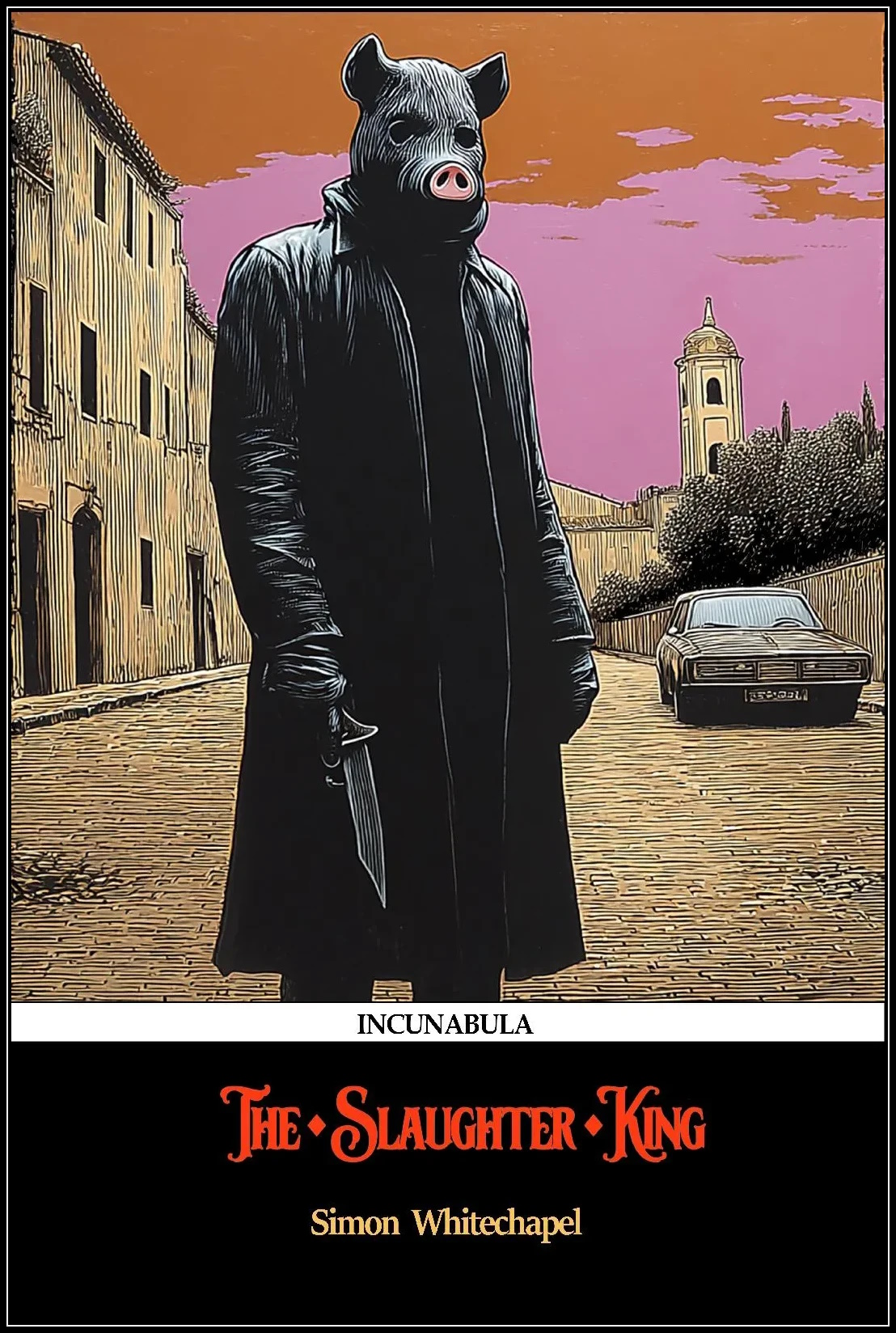
Incunabula have re-printed that core counter-cultural classic The Slaughter King, first published in 1996. To celebrate this auspicious occasion, here’s a competition to win a signed copy of the classic. To be in it with a chance to win it, please read the introduction to the new edition, then answer the questions and complete the tie-breaker.
Épilogue écrit trente ans après le roman

I hadn’t read or seen a copy of The Slaughter King for more than twenty years when Dave Mitchell contacted me and told me he wanted to re-publish it. I said no at first, but Dave is persuasive and so the Beast is Back, brand-new for the twenty-first century. I still don’t want to re-read it and, on balance, would prefer never to have written it.

Then again, I did get to know three fascinating people by writing it: a psychologically complex serial-killer fan called David Slater; a necrotropic gargoyle fan called David Kerekes; and (sorry to say this, but it’s true) an EngLit graduate called James Williamson. James ran Creation Books and was a crook, but also intelligent, imaginative and genuinely devoted to books and literature. The dysmorphic duo of deviant Davids were dim-but-devious adolescent voyeurs and genuinely devoted to scopophilia and slime-sniffing. They were the editors of the key counter-cultural journal Headpress and simul-scribes of the seminal snuff-study Killing for Culture.

I’ve never been interested in transgressive films or images myself and the deviant Daves did nothing to make me re-think my prejudices about those who are. Trying to hold an intelligent conversation with either Psicolo or Princess Dai was like trying to eat soup with chopsticks. Thin soup. And bendy chopsticks. However, I did learn two very interesting things about myself from Psicolo and Princess Dai: that I am homosexual and that I am a keyly committed core component of the coprophile community. Wow. Well, what was it thæt Teuto-Toxic Titan of Transgression said in Princess Dai’s book about his noxious necrophile narratives? Oh, yes: “Sorry to disappoint you”, lads, but you got it wrong. I am right, though, to say of Psicolo that he is, for some reason or other, very anxious to avoid attracting the attention of the police. I’m also right to say of Princess Dai that he has the soul of a lawyer, the mind of a cop, the intellect of a Daily-Mail reader and the psychology of a chav.

Not to mention the intellect and psychology of the late Diana Spencer, quondam Princess of Wales. Princess Di was “fascinated by the forbidden”, you know, and in between cuddling kiddies with cancer often visited a high-security hospital for the criminally insane called Broadmoor. She also liked transgressive images, spying and lashon hara (as we say up north). I can easily imagine her avidly watching some of the noxious necro-narratives deviantly dissected in Killing for Culture. In short, Princess Di was Headpressean, because Headpress and its edgily esoteric editors never provided an alternative to the voyeurism and other vices of the mainstream. Instead, they provided an exaggeration of mephitic mainstream maggot-culture. Dave Mitchell saw that instantly. Alas, it took me much longer.

And what about The Slaughter King? Is it Headpressean too? Is it “fascinated by the forbidden” à la Princess Di and Princess Dai and Psicolo? No, I hope it’s too literary and logophilic for that. And too intelligent. Dave Mitchell thinks it critiques mainstream maggot-culture rather than contributing to it. If he’s right, good. If he’s not, so it goes. Which reminds me to add: although Kurt Vonnegut wasn’t an influence on The Slaughter King, Ed McBain was. Oh, and “Épilogue écrit” etc is a pretentious and presumptuous reference to Huysmans’s À Rebours (1884), which is a very good book and also an influence on The Slaughter King.

Simon Whitechapel, Carlisle, 23×25.

The Slaughter King — Incunabula’s new edition


Kompetition Kwestchuns

1. What does “Psicolo” mean?
2. What is the point of using “thæt”?
3. What else do we say up north?

Tiebreaker

Please say why The Slaughter King is a core counter-cultural classic in 23 words or fewer.


N.B. Entries by any and all bigots, racists, sexists, transphobes, homophobes, lesbophobes, Islamophobes, neo-Nazis, palaeo-Nazis, and past, present or future members of the I.D.F. are especially welcome. Fans of Guns’n’Roses, otoh, are banned.

Performativizing Papyrocentricity #70

Papyrocentric Performativity Presents…

Fish, Not FrogDizionario Italiano: Dizionario della Lingua Contemporanea (Vallardi 2017)

Headstrong, Heroic and Hellbent on Glory – The Brigadier Gerard stories of Arthur Conan Doyle

Art of DarknessArt-Bandit: Interrogating the Outlaw Aesthetics of Über-Maverick Gay Atelierista John Coulthart, Dr Joan Jay Jefferson (Visceral Visions i.a.w. University of Salford Press 2022)

Fuller FrontalDeviant. Devious. Depraved.: The Sickening, Slimy and Sizzlingly Septic Story of Noxiously Nasty Necrophile Nonce David Fuller, David Kerekes, with an introduction by David Slater (Visceral Visions 2022)

Submarine SkinkUnderwater Adventure, Willard Price (1955)

Pair’s FairThe Dark Hours, Michael Connelly (2021)

Front Row for the Axl ShowNothin’ But a Good Time: The Spectacular Rise and Fall of Glam Metal, Justin Quirk (Unbound 2020)

Posturing ProctoglossistHumour, Terry Eagleton (Yale University Press 2019)


Or Read a Review at Random: RaRaR

Sime Time

I came across the writings of Simon Whitechapel a year ago after picking up the first twenty or so issues of Headpress, a 1990s ’zine that dealt with the relentlessly grim, the esoteric and prurient. His style was fascinating, coming across as intelligent and well-read and — at least from first reading — subtly ironic.

In fact he must have impressed some other people during this time too as Headpress’ Critical Vision imprint spun his collected articles together for publication under the title Intense Device: A Journey Through Lust, Murder and the Fires of Hell — they have all the typical interests that run through Whitechapel’s work — there is an obsession with numerology, with Whitehouse-style distortion music, with Hitler and de Sade. There are also articles on farting, on Jack Chick and novelisations of TV shows. They are fascinating, written in a scholarly way with footnotes aplenty but never difficult to understand. He also wrote two non-fiction works during the late 1990s and early 2000s that centred around sadism and the murder of women in South America. They are dark.

There are also the works of fiction. To say that Whitechapel is transgressive is an understatement. His writing bleeds. The ‘official’ work The Slaughter King is filled with the detailed descriptions of sadistic murder, beginning with a serial killer murdering a gay prostitute whilst listening to distortion-atrocity music. The plot is schlocky but serviceable, jumping around inconsistently but the images it creates are terrifying. A bourgeois dinner party straight out of Buñuel and Pasolini’s nightmares where guests are served poisons as if they were the finest consommés: they eat bees until their faces swell, dropping dead at the table, finishing with a trifle “made from the berries of the several varieties of belladonna, of cuckoo-pint, and of the flowers of monkshood”. It’s a sinister book, but nothing compared to his second work.

Whitechapel wrote The Eyes. This is clear just from a simple comparison between his texts, the fascination with language, with sadism, with de Sade. The thing is, The Eyes is supposedly written by some guy called Aldapuerta, Spanish apparently. ‘Aldapuerta’ can be written Alda Puerta — ‘at the gate’, a telling description of these short stories, which go past this point many, many times. The tale of ‘Aldapuerta’ himself is too exact to be believed: a young boy with an interest in de Sade, corrupted by the local pornographer, medical-school training that honed his knowledge, then a mysterious death (echoing shades of Pasolini’s own) and finishing with the “and he might be baaaack” closer. But this point isn’t really an issue and it’s understandable that Whitechapel would want to keep his name away from this work. It is also surrealistically brilliant at times: amongst the brutality, the images it creates are unforgettable.

Of course, Whitechapel is a fake name, redolent of Jack the Ripper, and even Simon was taken from elsewhere — a colleague perhaps? He disappeared during the 2000s, no longer writing for Headpress, a few self-published chapbooks pastiching Clark Ashton Smith… where did he go? There are the rumours of prison time — they are convincing to my mind, as they too revolve around different identities, around extremity and anonymity. I wonder though, if true, just how much this individual actually believed in them. His most recent writings, at his tricksy blog, hint at this, as well as make his ‘relationship’ with Aldapuerta clearer but it’s not in my ability to directly connect the personas.

If you want to be fascinated and repulsed, then the non-author Simon Whitechapel is for you.

Lancashire


Elsewhere other-posted:

It’s The Gweel Thing…Gweel & Other Alterities, Simon Whitechapel (Ideophasis Books, 2011)

Mi Is Mirror

I hope that nobody thinks I’m being racially prejudiced when I say that, much though I am fascinated by her, I do not find the Anglo-American academic Mikita Brottman physically attractive. It is her mind that has raised my longstanding interest, nothing more.

Honest.

This is because, for me, Ms B is like a mirror that reverses not left and right, but male and female.

Obviously, we’re different in a lot of ways: I don’t smoke and I don’t have any tattoos, for example.

But there are big similarities too.

We were born in the same year (1956) and we were both keyly core contributors to seminal early issues of the transgressive journal Headpress Journal.

And we have various other things in common, like our mutually shared passion for corpse’n’cannibal cinema, our Glaswegian accents and (at different times) our season tickets for Hull Kingston Rovers.

So it is that, looking at Ms B, I have the uncanny experience of seeing myself as I might have been, had I been born female.

But it’s not just uncanny.

It’s horrifying at times too.

Okay, I’m comfortable with the idea that, born female, I would have been less intelligent and more conformist. So I don’t mind that Ms B is a Guardianista. Not particularly. I can face the fact that I would quite likely have been one of them too, as a female.

But there are worse things than being a Guardianista, believe it or not.

Ms B has a PhD in EngLit.

A PhD!

In EngLit.

It’s not at all easy for me to face the fact that I might have had one too, as a female. It really isn’t. But how can I deny it? I might have. That despicable, deplorable, thoroughly disreputable subject might have attracted me. In fact, it would probably have attracted me.

<retch>

But it gets worse still.

Ms B is a psychoanalyst.

A psychoanalyst.

Ach du lieber Gott!

See what I mean by “horrifying”?

I mean, even if I’d been born female I wouldn’t have sunk to such depths, would I? Would I? No, I have to face facts: I might. But I don’t think so. I have a feeling that there’s more to Brotty’s interest in Freud than her gender statusicity and her key commitment to core componency of the counter-cultural community.

But I’d better say no more. Verb sap.