
Mavericks in a Metropolis of Millions…

Trump has won again.

I can’t believe I’ve just written those words.

I don’t wanna believe I’ve just written those words.

But I hafta.

’Coz they’re true.

Toxically, traumatizingly, tear-tappingly true.

So how’m I gonna respond to the toxic truth of tyrannical Trump’s triumph?

Welp… how better than by publishing some fiercely unbowed words of anti-fascist resistance from one of the core counter-cultural components at one of the world’s leading anti-racist publishing houses?

Yes indeedy, this Papyrocentric Performativizer is positively pulsating with pride and passion to present an exclusive antifa extract from arguably the best interview in Titans of Transgression: Incendiary Interviews with Eleven Ultra-Icons of Über-Extremity (TransVisceral Books 2024), which has just seen its third edition.

Please raise your revolutionary fists for Jay Guinness, Artistic Director and Ipsissimic Aesthetician at Manchester-locused Savoy Books, long hailed as England’s most transgressive publishing company…

Readers’ Advisory: Interview extract contains strong language and uncompromising counter-cultural contrarianism. Proceed at your own risk.

[…]

Miriam Stimbers: Manchester was in the headlines for all the wrong reasons in 2017 [editor’s note: Miriam is referring to the murder of twenty-two people by the homophobic and misogynist Islamist suicide-bomber Salman Abedi at the Manchester Arena].

Jay Guinness: It was, yes. Sadly it was.

Miriam Stimbers: How did you react at Savoy?

Jay Guinness: We in the Savoy community were badly affected. Clearly, we’ve engaged fictionally, artistically, aesthetically with issues around fascism, hatred, intolerance throughout our professional lives, but to have those issues strike on your own doorstep, as it were, strike for real, well, it’s something you could never be prepared for.

Miriam Stimbers: So you think what he did was fascism?

Jay Guinness: I think it was echt fascism, fascism pur sang. Pun not intended. Let’s not beat about the bush. It was fascism.

Miriam Stimbers: Much has been made of the fact that the terrorist––

Jay Guinness: I don’t think “terrorist” is the mot juste. Not at all. For me, he’s just a criminal with a diseased mind. And I don’t mean that as a compliment!
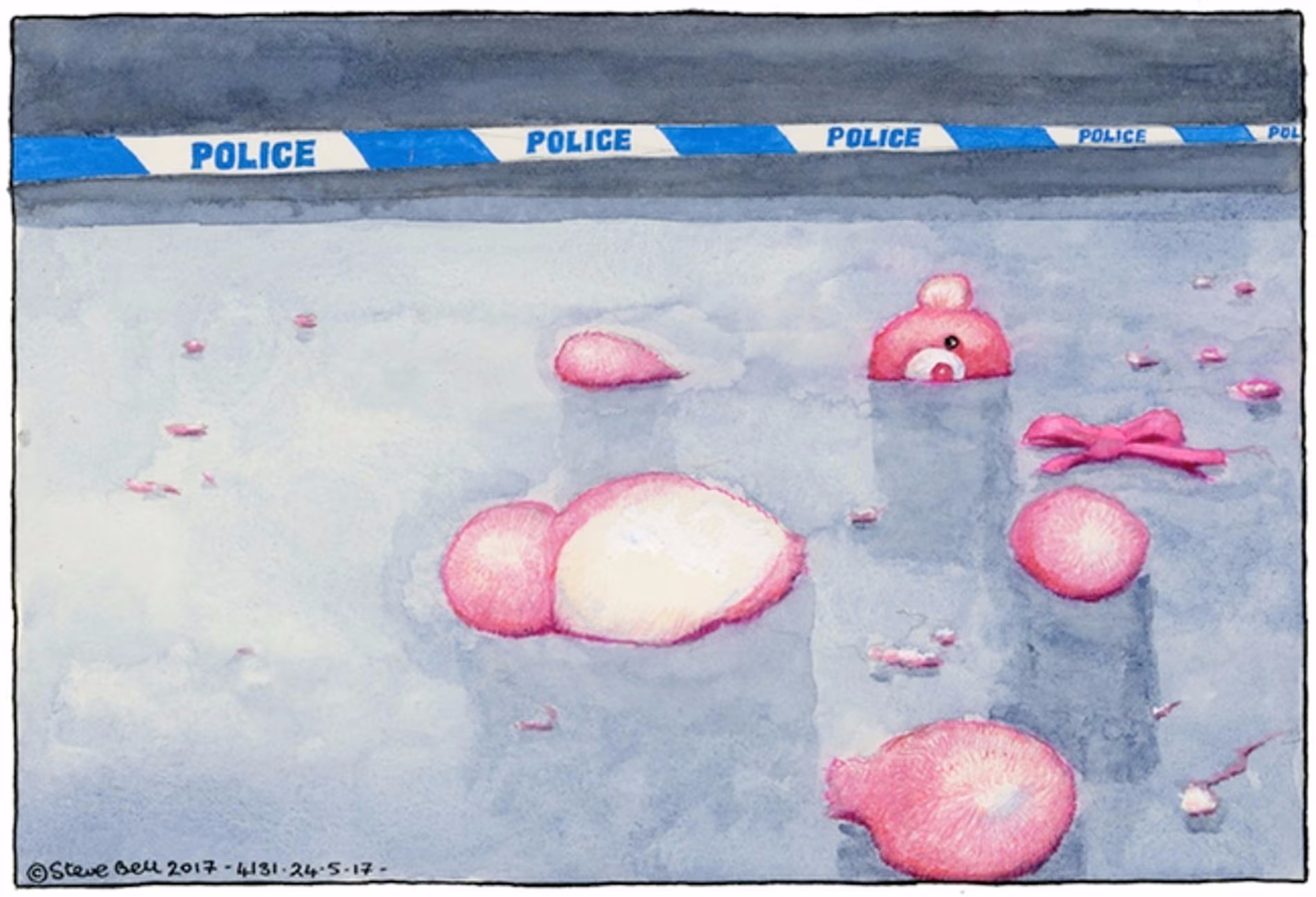
Steve Bell of The Guardian excoriates the Manchester Arena Bomber

Miriam Stimbers: Okay. Much has been made of the fact that the criminal was born and brought up in Manchester. Have you any thoughts on that?

Jay Guinness: You’re right, much has been made of it. But for me and my colleagues at Savoy what he did merely underlined the fact that Manchester is a state of mind far more than it is a physical and temporal Sitz im Leben. It’s about a locus of values, not about geography. I mean, I was born in Huddersfield myself, but I felt that I was Mancunian from the moment I first hung my hat here, because I subscribe to Mancunian values. People who were born here but don’t subscribe to those values aren’t part of the city. Not for me, not for the Savoy community, not ever. I think Dave [Britton] put it best when we were processing the news of what he’d done. Dave’s words have stayed with me: “He’s not a fucking Manc, he’s a fucking cunt. The fucker should be fucking strung up.”

Miriam Stimbers: Metaphorically speaking?

Jay Guinness: No, not metaphorically. Literally. We in the Savoy community are a pretty progressive bunch. We’re not instinctive supporters of the death penalty, to put it mildly. But if you took a vote at Savoy in terms of whether people who do things like that should be hanged, it would be a unanimous yes. No dissenters.

Miriam Stimbers: I’m taken aback. It seems a little extreme. A lot extreme, to be honest.

Jay Guinness: The Savoy community might be progressive, but we’re not bleeding-heart liberals. As Dave said, the fucker should be fucking strung up.

Miriam Stimbers: But what could you hope to achieve by it?

Jay Guinness: Well, for one thing it would be a deterrent to others. Just as importantly, it would ensure he doesn’t do it again.

Miriam Stimbers: But he won’t be doing it again. How could he?

Jay Guinness: Very easily. And he will do it again. We in the Savoy community are confident of that. Leopards don’t change their spots.

Miriam Stimbers: But how could he do it again? He’s dead.

Jay Guinness: I’m sorry, you’ve lost me. Who’s dead?

Miriam Stimbers: Salman Abedi, of course. The suicide-bomber at the Manchester Arena. Who else?
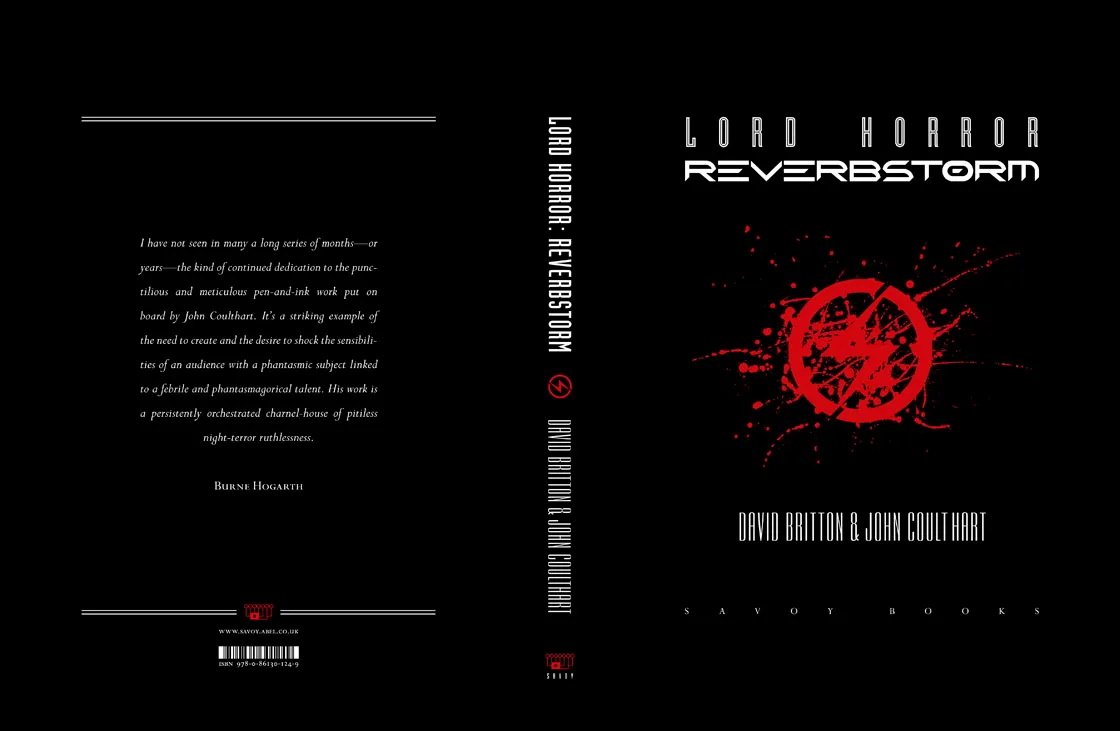
Much More Mucking Maverick Than You, Monkeyfunker!

Jay Guinness: Oh no, no, no, you’ve got entirely the wrong end of the stick. I wasn’t talking about that poor British-Muslim boy. He was quite possibly the biggest victim in that unfortunate business at the Arena.

Miriam Stimbers: Then who were you talking about?

Jay Guinness: That despicable creature Morrissey, of course. Those comments of his about immigration and Salman’s background were utterly unforgivable. Utterly. But no more than one would expect. As Dave went on to say: “That fucking crypto-fascist cunt’s just a fucking attention-seeker, always fucking has been, always fucking will be. String the fucker up!”

Miriam Stimbers: And you really think there’d be a majority at Savoy in favour of executing Morrissey?

Jay Guinness: I don’t think it, I know it. But it wouldn’t just be a majority, it would a unanimous vote, nem. con. What has Morrissey ever done but bring Manchester into disrepute with his dire music, his shitty fashion sense and his toxic racist agenda? As Michael Moorcock once said: “Fascism never sleeps and nor must the anti-fascist community.” In terms of saying it all, it does. Definitively.

[…]

Interview extract © Jay Guinness, Dr Miriam Stimbers, TransVisceral Books 2024


Jay Guinness is a Huddersfield-born artist and aesthetician, and the subject of Dr Joan Jay Jefferson’s incisive and exhaustive biography Art-Bandit: Interrogating the Outlaw Aesthetics of Über-Maverick Gay Atelierista Jay Guinness (University of Salford Press 2012). See reviews of Art-Bandit at: Pink News, The Guardian, London Review of Books, Quietus, and Huffington Post. Visit Jay’s website for news of his latest projects.

Miriam Stimbers is a Glasgow-born psychoanalyst, literary scholar and cultural commentatrix whose most recent book is the updated edition of Morbidly Miriam: The Mephitic Memoirs of Miriam B. Stimbers (TransVisceral Books 2023). See a review of Morbidly Miriam at Papyrocentric Performativity. Visit Miriam’s website for news of her latest projects.


Previously pre-posted on Papyrocentric Performativity…

Il Nano e il Necrofilo… – an earlier exclusive extract from Titans of Transgression

The Hurt Shocker – an even earlier exclusive extract from Titans of Transgression

Maximal Moz

Morrissey in Conversation: The Essential Interviews, ed. Paul A. Woods (Plexus 2016)

It’s very Mozzean that one of the most Mozzean things in this book is marginal. That is, it’s not in the interviews or anything Moz himself says: it’s in the mini-bios of the “Contributors” section at the end of the book. For example, Dave McCullough interviewed Moz for the long-defunct Sounds in 1983. And I thought it was a joke when McCullough’s mini-bio ended with “His current whereabouts are unknown.”

But it happened again for Shaun Philips, who interviewed Moz, again for Sounds, in 1988: “His
current whereabouts are unknown.” And again for Elissa Van Poznak, who interviewed Moz for The Face in 1984: “Her current whereabouts are unknown.” And that sentence is the last in the book, apart from the acknowledgements. What happened to these three journalists? They had lives and careers, friends and family. Their writing was once regularly read by many thousands or even millions of people. And then read again in this book. But “Their current whereabouts are unknown.” They’ve dropped out of sight, even maybe out of life, and the editor of the book, Paul A. Woods, hasn’t been able to find out what happened to them. Not even in this ultra-connected internet age.

That’s very Mozzean. You could even wonder whether they’ve succumbed to a belated form of the Curse of Moz, or the career-failure that strikes bands after Morrissey praises them or takes them on tour as support. Or you could wonder whether, like Morrissey himself for so long, they were struggling with depression and an urge-to-self-annihilation even as they achieved professional success. You’d certainly expect the first publication of this book in 2007 to have flushed them out. But it didn’t. Nor did the second publication in 2011. But perhaps the third publication did in 2016.

I don’t know and I’d rather not know. I like the Mozzeanism of three missing journalists. And I liked this book too. A lot. Obviously a lot of other people did too, or it wouldn’t have been printed three times. But I suspect it won’t be re-printed again. Why not? Coz of Moz on Muz. Guardian-readers were not pleased by Morrissey’s comments on Muslims and Muslim immigration after the Manchester bombing in 2017 or by his support for Brexit and the “far-right” For Britain party. You can get T-shirts now that say “Shut Up, Morrissey!” and there have been a string of anathemas and excommunications issued at Moz from woke bastions like the Quietus (where bad English goes to die). Guardian-readers feel deeply betrayed by Morrissey, who once said all the right things about economics, animal rights, vegetarianism, and the evilness of the Conservative and Republican parties – as you can read here.

But you’ll also read here about disturbing early signs – or sounds – that Moz wasn’t prepared to buzz with the hive-mind on everything. After he began his solo career in 1988 he released songs with titles like “The National Front Disco” and “Bengali in Platforms”, the latter of which opined “Life is hard enough when you belong here.” But there was enough ambiguity and authorial distance in the songs for him to deny plausibly that he was being racist or sympathizing with racism. And he still had a whole heap of good-will from the Smiths, so he survived the first campaign to cancel him and came back as strong as ever.

Well, the good-will has disappeared now. Moz has burned all his bridges to the Guardian and I don’t think there’s any chance of this book being re-re-re-printed. Indeed, I bet a lot of former fans have thrown out their copies or even ritually burned them. It’s their loss, because Morrissey is one of the wittiest, most interesting, and most intelligent interviewees who ever lived. As the back cover says of an earlier edition of Morrissey: In Conversation:

It’s proof, lest we forget, that in terms of great copy, Morrissey has rarely been anything other than interview gold. – Q magazine

But that quote itself needs trimming of its Guardianist fat: “It’s proof, lest we forget, that Morrissey has rarely been anything other than interview gold.” Moz himself is rarely guilty of saying more than he needs to. He’s both articulate and acute. It’s hard to believe that he came from a big working-class Irish family in Manchester and spent years on the dole after being shunted into a bad school by failing his eleven-plus. If he’d passed that selective exam he would have gone to a better school and most probably on to university. But I think university would have been bad for him. He probably wouldn’t have had a career in music and he certainly wouldn’t have become the Morrissey that millions of people either love or loathe.

But he would have become someone who habitually said “in terms of” and “prior to”. Alas, he does sometimes say “in terms of” in later interviews here, but it’s a minor blemish and I read everything in the book. Except – speak of “in terms of” and the windbag appears – Will Self’s “The King of Bedsit Angst Grows Up” from 1995. As usual with Self, I began losing the will to live half-a-paragraph in and gave up. If it had been a proper interview rather than Self blotivating on themes Mozzean, I might have persevered. But it wasn’t, so I didn’t.

Most of the other pieces were proper interviews, but either way I always persevered. You can read how Moz’s ideas and allegiances changed. And you can also see how Moz himself changed, because there are some good photos too. I bet some of the interviewers now regret their association with Morrissey and their appearance in this book, but that adds to its appeal for me. Moz has bitten the hands that typed about him and they’ll never forgive him for it. But they were warned:

Are you a bad man?

Only inwardly. (“The Importance of Being Morrissey”, Jennifer Nine for Melody Maker, August 1997)

And here’s more from the man himself:

What else could you do [besides perform]?

Nothing. I’m entirely talentless… it was all a great big accident – I just came out of the wrong lift. (“Mr Smith: All Mouth and Trousers”, Dylan Jones for i-D magazine, October 1987)


What does your music do to your fans?

Well, they wear heavy overcoats and stare at broken lightbulbs. That’s the way it’s always been for me! (“Wilde Child”, Paul Morley for Blitz, April 1988)

“I often pass a mirror,” he confides, loving the attention he’s getting, “and I glance into it slightly, and I don’t really recognize myself at all. You can look into a mirror and wonder – where have I seen that person before? And then you remember. It was at a neighbour’s funeral, and it was the corpse.” (“Wilde Child”)


What was it like playing live again when you appeared in Wolverhampton in December [1988]?

It was nice. I did enjoy it. It was nice to be fondled.

Was it good to be back on stage again?

No, it was just nice to be fondled. (“Playboy of the Western World”, Eleanor Levy, Q magazine, January 1989)


My perfect audience are skinheads in nail varnish. And I’m not trying to be funny, that really is the perfect audience for me. But I am incapable of racism, and the people who say I am racist are basically just the people who can’t stand the sight of my physical frame. I don’t think we should flatter them with our attention. (“Morrissey Comes Out (For a Drink)”, Stuart Maconie for New Musical Express, May 1991)


I would rather eat my own testicles than reform the Smiths – and that’s saying something for a vegetarian. (“The Last Temptation of Morrissey”, Paul Morley for Uncut, May 2006)


My best friend is myself. I look after myself very, very well. I can rely on myself never to let myself down. I’m the last person I want to see at night and the first in the morning. I am endlessly fascinating – at eight o’clock at night, at midnight, I’m fascinated. It’s a lifelong relationship and divorce will never come into it. That’s why, as I say, I feel privileged. And that is an honest reply. (“The man with the thorn in his side”, Lynn Barber for The Observer, September 2002)


Favourite shop?

Rymans, the stationers. To me it’s like a sweetshop. I go in there for hours, smelling the envelopes. As I grew up I used to love stationery and pens and booklets and binders. I can get incredibly erotic about blotting paper. So for me, going into Rymans is the most extreme sexual experience one could ever have. (“Morrissey Answers Twenty Questions”, Smash Hits Collection, 1985)