
Pooh Pooh-Poohed

A.A. Milne’s Winnie-the-Pooh (1926) is a core kiddy-culture classic. And I’ve always been a big fan. Especially of Eeyore. But it wasn’t till 2025 that I noticed a big bit of bad writing in the book. Or maybe it isn’t. Maybe the redundancy here is more natural English than the same passage with the redundancy removed. But I still think removing the redundancy makes it read better. See for yourself:

One day when he was out walking, he [Winnie-the-Pooh] came to an open place in the middle of the forest, and in the middle of this place was a large oak-tree, and, from the top of the tree, there came a loud buzzing-noise.

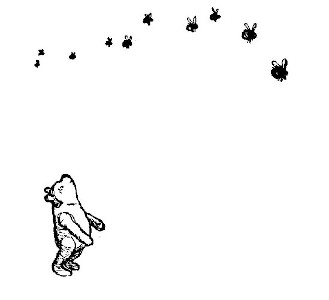
In this drawing, Winnie-the-Pooh is peering up. There are tiny things swarming around up there.

Winnie-the-Pooh sat down at the foot of the tree, put his head between his paws and began to think.

First of all he said to himself: “That buzzing-noise means something. You don’t get a buzzing-noise like that, just buzzing and buzzing, without its meaning something. If there’s a buzzing-noise, somebody’s making a buzzing-noise, and the only reason for making a buzzing-noise that I know of is because you’re a bee.”

Then he thought another long time, and said: “And the only reason for being a bee that I know of is making honey.”

And then he got up, and said: “And the only reason for making honey is so as I can eat it.” So he began to climb the tree. — Winnie-the-Pooh, chapter 1
REMOVING

REDUNDANCY

One day when he was out walking, he came to an open place in the middle of the forest, and in the middle of this place was a large oak-tree, and, from the top of the tree, there came a loud buzzing.

In this drawing, Winnie-the-Pooh is peering up. There are tiny things swarming around up there.

Winnie-the-Pooh sat down at the foot of the tree, put his head between his paws and began to think.

First of all he said to himself: “That buzzing means something. You don’t get a buzzing like that, just buzzing and buzzing, without its meaning something. If there’s a buzzing, somebody’s making a buzzing, and the only reason for making a buzzing that I know of is because you’re a bee.”

Then he thought another long time, and said: “And the only reason for being a bee that I know of is making honey.”

And then he got up, and said: “And the only reason for making honey is so as I can eat it.” So he began to climb the tree. — Winnie-the-Pooh, chapter 1


Elsewhere Other-Accessible…

Winnie-the-Pooh (1926) at Gutenberg

Previously Pre-Posted…

Noise Annoys — discussion of the redundancy of “noise”
Nice Noise — more discussion of the redundancy of “noise”

Squooh You

Here’s an interesting little puzzle:

Winnie-the-Pooh and Piglet set out to visit one another. They leave their houses at the same time and walk along the same road. But Piglet is absorbed in counting the birds overhead, and Winnie-the-Pooh is composing a new “hum,” so they pass one another without noticing. One minute after the meeting, Winnie-the-Pooh is at Piglet’s house, and 4 minutes after the meeting Piglet is at Winnie-the-Pooh’s. How long has each of them walked? — “A puzzle by S. Sefibekov” viâ Futility Closet

If you’re good at maths, you should see the answer in an intuitive instant. I’m not good at maths, so it took me much longer, because I didn’t understand what was going on. But I can explain the answer like this. Pooh is obviously walking faster than Piglet. Therefore, Pooh and Piglet can’t have met after one minute, because that would mean Pooh takes one minute to walk the distance walked by Piglet in one minute.

So let’s suppose Pooh and Piglet met after two minutes. If Pooh takes one minute to walk the distance walked by Piglet in two minutes, then Pooh is walking twice as fast as Piglet. Does that work? Yes, because Piglet walks Pooh’s distance in four minutes, which is twice as long as Pooh took. Therefore Piglet is walking twice as slowly as Pooh. It’s symmetrical and we can conclude that they did indeed meet after two minutes. Pooh then walks another minute, for three minutes in total, and Piglet walks another four minutes, for six minutes in total.

But guessing is not a good way to find the answer to the puzzle. Let’s try to reason it through properly. Suppose that Pooh and Piglet meet after one unit of time, during which Piglet has walked one unit of distance and Pooh has walked x units of distance, where x > 1. In other words, Pooh is walking x times faster than Piglet. The distances they walk before meeting are therefore in the ratio:

1 : x

Next, note that Pooh will cover the distance Piglet has already walked in 1 unit / x = 1 minute, while Piglet covers the distance Pooh has already walked in x / 1 = 4 minutes. The times they take are therefore in the ratio:

1 / x : x → 1 : x^2 → 1 : 4

And if 1 : x^2 is 1 : 4 (the ratio of the minutes they walk after meeting), then 1 : x (the ratio of the distances they walk before meeting) = 1 : √(x^2) = 1 : √4 = 1 : 2. Pooh is therefore walking 2x faster than Piglet and Piglet is walking 2x slower than Pooh. If Pooh covers Piglet’s distance in 1 minute, Piglet must have taken 2 minutes to walk that distance. And if Piglet covers Pooh’s distance in 4 minutes, Pooh must have taken 2 minutes to walk that distance.

Therefore, when they meet, each of them has been walking for 2 minutes. Pooh therefore walks 2 + 1 = 3 minutes in total and Piglet walks 2 + 4 = 6 minutes in total.

The result can be generalized for all relative speeds. Suppose that Pooh and Piglet meet after m1 minutes and that Pooh then takes m2 minutes to walk the distance Piglet walked in m1 minutes, while Piglet takes m3 minutes to walk the distance Pooh walked in m1 minutes. The time they walk before they meet, m1 minutes, is therefore supplied by this simple equation:

m1 = √(m3 / m2)

And you can call √(m3 / m2), the square root of m3 / m2, the squooh function:

m1 = √(m3 / m2) = squooh(m2,m3)

Now suppose the distance between Pooh’s and Piglet’s houses houses is 12 units of distance and that Piglet always walks at 1 unit a minute. If Pooh walks at the same speed as Piglet, i.e. 1 unit a minute, then:

After they meet, Pooh walks 6 more min = m2, Piglet walks 6 more min = m3.

How long do they walk before they meet?

m1 = m3 / m2 = 1, √1 * 6 = 6

They meet after 6 min.

Now suppose that after they meet, Pooh walks 2 more min, Piglet walks 8 more min.

Therefore, m3 / m2 = 4, √4 * 2 = 2 * 2 = 4 = m1

Therefore they walk for 4 min before they meet and Pooh walks 2x faster than Piglet.

After they meet, Pooh walks 1 more min, Piglet walks 9 more min (m3 / m2 = 9, √9 * 1 = 3)

Therefore they walk for 3 min before they meet and Pooh walks 3x faster than Piglet.

After they meet, Pooh walks 0·6 more min, Piglet walks 9·6 more min (m3 / m2 = 16, √16 * 0·6 = 4 * 0·6 = 2·4)

Therefore they walk for 2·4 min before they meet and Pooh walks 4x faster than Piglet:

After they meet, Pooh walks 0·4 more min, Piglet walks 10 more min (m3 / m2 = 25, √25 * 0·4 = 5 * 0·4 = 2)

Therefore they walk for 2 min before they meet and Pooh walks 5x faster than Piglet.

And so on.