Vibrancy and Vileness

Every so often you come across a news-story that isn’t just horrifying in itself but offers a sickening glimpse into the wilful neglect and toxicity of a so-called “civilized” state and its so-called “justice” system. Here’s a story like that from Scandinavia:

Rapist is sentenced to six-and-a-half years in prison

The Iraqi man (35) arrived in Norway in 2003. Now he has been convicted of sexual assault twice. The 35-year-old Iraqi has now been sentenced to six-and-a-half years in prison and ordered to pay NoK 300,000 [$52,000/£34,000] in damages after he was arrested for participating in a gang rape in Slottsparken [the park surrounding the Royal Palace in Oslo] in October 2011. The 35-year-old also committed a particularly degrading rape at Rådhusplassen [the town square] in November 2005. On that occasion he raped a 27-year-old woman behind some pallets with granite slabs. When the victim resisted, the man put his hand over her mouth and nose and told her that he would kill her.

The woman who was raped in Slottsparken told police that she was raped by several men and that she feared that she would be killed. She is unsure of how many men who raped her, but she knows that none of the rapists used condoms. As a result she was given HIV-prevention drugs and pregnancy-termination drugs. The relationship with her fiancé came to an end and she attempted to commit suicide after the ordeal. Today she is afraid to meet men who look foreign.

(Translation of Aftenpost story, “Seks og et halvt års fengsel for voldtektsmann”, 2nd April, 2013)

But “horrifying” is perhaps understating it. I’m left shaking my head in disgust and asking one urgent question: Why, in the name of decency and justice, was this obnoxious woman not prosecuted and punished severely for her blatant auto-incitement to racial hatred and xenophobia / allophobia? Her wilfully selfish attitude reeks of toxic white privilege and obdurate refusal to sensitively engage issues around the Other. Shame on you, Norway, for creating a society in which such corrosive and egocentric individuals can exist. To flush their hateful ideology from your so-called “nation”, I suggest that you immediately double immigration from Iraq – and go on doubling it for as long as it takes. And double immigration from Somalia, Haïti and the Congo too. Until you do that, you can count yourself a thoroughly failed state.


A Slap on the Wrist — original translation, which is adapted slightly above

Bones, Blinks, Books

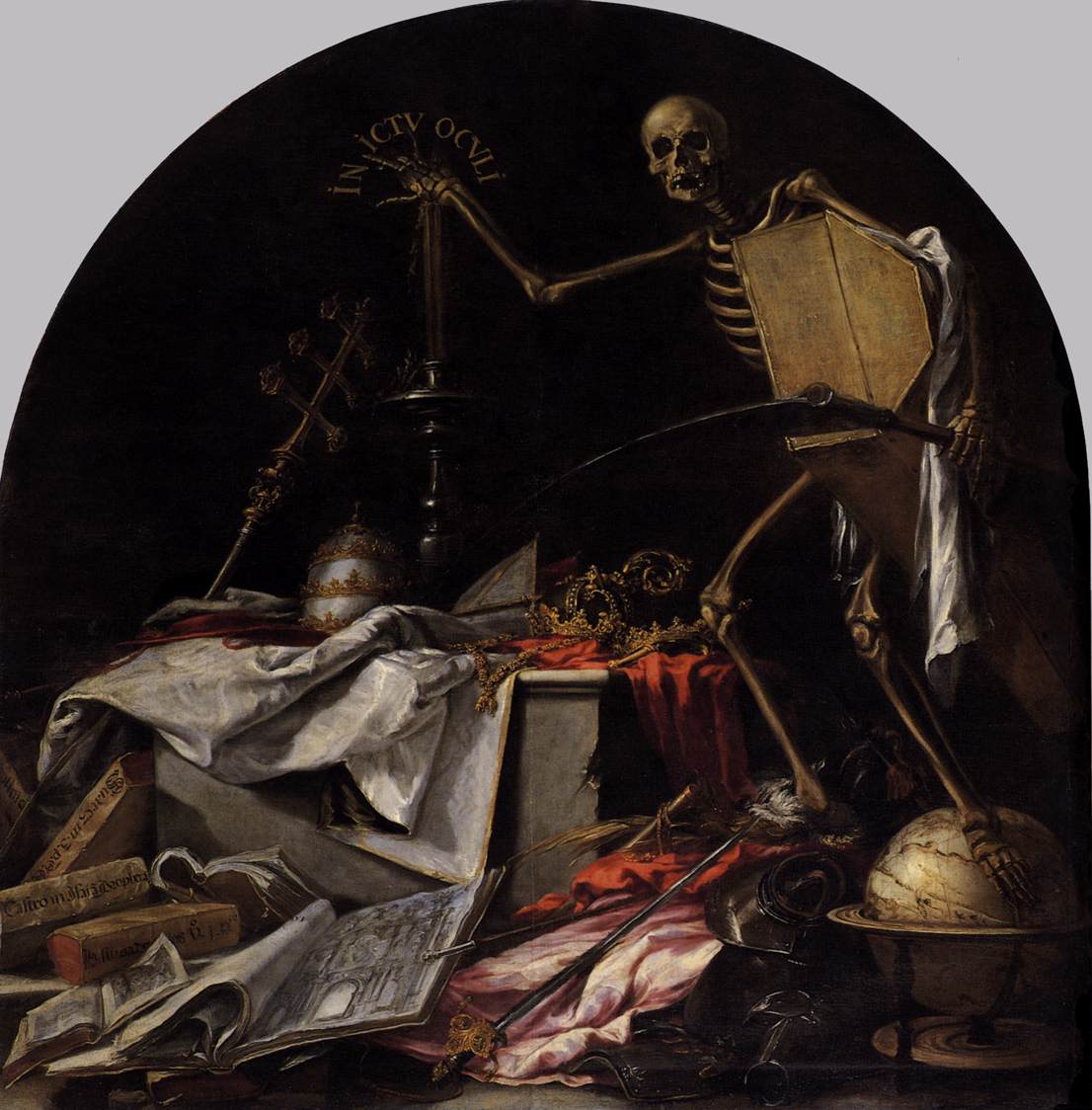
In Ictu Oculi by Juan de Valdés Leal (c. 1671)

In Ictu Oculi (In the Blink of an Eye) by Juan de Valdés Leal (c. 1671).

Mish’ Upon A Star

When Barack Obama first became famous in the United Kingdom, I concluded that he was a more intelligent, more histrionically skilled version of Tony Blair. But perhaps I was wrong. He may in fact be a less intelligent, more histrionically skilled version of Tony Blair. Otherwise the parallels between the two remain uncanny: the narcissism, the incompetence, the shallowness, the intellectual vacuity, the pathological dishonesty, the hatred of or indifference towards history and the historic nation. There are even the same rumours about past homosexuality, a similarly grotesque, Lady-Macbeth-like wife and a love of vapid, worthless celebrity culture shared with her. Michelle Obama’s recent Oscar-presentation stunt is the Cherie on the icing, though, to give Cherie Blair her due, she never gave me the impression that racial hatred was an even stronger element in her nature than egotism and desire for personal gain.

Michelle Obama presenting an Oscar at the White House

Mish’ Upon A Star — Michelle Obama presents an Oscar at the White House

Racial hatred may seem like one big difference between Obama and Blair, but their policies in terms of race, for reasons around which I won’t interrogate issues, have been more or less the same. Voting “conservative” in either nation wouldn’t have made any difference to that. It would also have made little difference to the speed with which each nation is being destroyed. But the Tories and Republicans couldn’t appeal to voters in the same way as their supposed rivals. Like Blair, Obama saw that the key to electoral success was to get people to vote not for him, but for themselves. That’s why so many Guardianistas in the UK so desperately wished they could “Vote O in ’8”. The narcissistic, self-righteous thrill would have been even greater than voting for Blair. Obama was black, after all. Black, for Mandela’s sake! Like Blair, Obama offered himself as a mirror for liberal narcissists; and like Blair, he’s disappointed more and more of those narcissists as the years have passed. But, by himself, he wouldn’t have destroyed my faith in democracy as comprehensively as Blair did. T.B. was an obvious fake and a bad con-man. B.O. is a better con-man and a less obvious fake. It isn’t as hard to understand how he fooled so many and got the chance to do so much harm.

A lot more harm, in fact, because the United States is a much bigger and much more important country than the UK. Historians will give its collapse much more attention in future, but I wonder how many of them will put the blame where it belongs: on one of the two great curses of modernity. The first great curse has been the car, the second has been television. Cars have destroyed our cities; TV has destroyed our culture. Blair and Obama are what TV hath wrought in politics: ultimate expressions of the ultimate abomination of liberalism. Après eux, le Déluge. “After them, the Flood.”

Roses Are Golden

Sir Lawrence Alma-Tadema’s painting The Roses of Heliogabalus (1888) is based on an apocryphal episode in the sybaritic life of the Roman Emperor Elagabalus (204-222 A.D.), who is said to have suffocated guests with flowers at one of his feasts. The painting is in a private collection, but I saw it for real in an Alma-Tadema exhibition at the Walker Art Gallery in Liverpool sometime during the late 1990s. I wasn’t disappointed: it was a memorable meeting with a painting I’d been interested in for years. Roses is impressively large and impressively skilful. Close-up, the brush-strokes are obvious, obtrusive and hard to interpret as people and objects. It isn’t till you step back, far beyond the distance at which Alma-Tadema was painting, that the almost photographic realism becomes apparent. But you get more of the many details at close range, like the Latin inscription on a bowl below and slightly to the right of that scowling water-mask. Alas, I forgot to take a note of what the inscription was, though perhaps the memory is still locked away somewhere in my subconscious.

The Roses of Heliogabalus (1888)

The Roses of Heliogabalus (1888)

Whatever it is, I feel sure it is significant, because Roses is rich with meaning. That’s a large part of why I’m interested in it. Yes, I like it a lot as art, but the women would have to be more attractive for it to be higher in the list of my favourite paintings. As it is, I think there are only four reasonably good-looking people in it: the man with the beard on the right; the flautist striding past the marble pillar on the left; the red-headed girl with a crown of white flowers; and Heliogabalus himself, crowned in roses and clutching a handful of grapes beside the overweight man who’s wearing a wreath and sardonically saluting one of the rose-pelted guests in the foreground. When I first wrote about Roses in a pub-zine whose name escapes me, I misidentified the overweight man as Heliogabalus himself, even though I noted that he seemed many years old than Heliogabalus, toppled as a teen tyrant, should have been. It was a bad mistake, but one that, with less knowledge and more excuse, many people must make when they look at Roses, because the overweight man and his sardonic salute are a natural focus for the eye. Once your eye has settled on and noted him, you naturally follow the direction of his gaze down to the man in the foreground, who’s gazing right back.

A comparison between Alma-Tadema's portrayal of Heliogabalus and a bust of Heliogabalus from the Musei Capitolini in Rome

Something Like the Sun

And by following that gaze, you’ve performed a little ratio-ritual, just as Alma-Tadema intended you to do. Yes, Roses is full of meaning and much of that meaning is mathematical. I think the angle of the gaze is one of many references in Roses to the golden ratio, or φ (phi), a number that is supposed to have special aesthetic importance and has certainly been used by many artists and musicians to guide their work. A rectangle with sides in the proportions 8:13, for example, approximates the golden ratio pretty closely, but φ itself is impossible to represent physically, because it’s an irrational number with infinitely many decimal digits, like π or √2, the square root of two. π represents the ratio of a circle’s circumference to its diameter and √2 the ratio of a square’s diagonal to its side, but no earthly circle and no earthly square can ever capture these numbers with infinite precision. Similarly, no earthly rectangle can capture φ, but the rectangle of Roses is a good attempt, because it measures 52″ x 84 1/8". That extra eighth of an inch was my first clue to the painting’s mathematical meaningfulness. And sure enough, 52/84·125 = 416/673 = 0·61812…, which is a good approximation to φ’s never-ending 0·6180339887498948482045868343656…*
A circle with radii at 0 and 222 degrees
That deliberate choice of dimensions for the canvas led me to look for more instances of φ in the painting, though one of the most important and obvious might be called a meta-presence. The Roses of Heliogabalus is dated 1888, or 1666 years after the death of Heliogabalus in 222 AD. A radius at 222º divides a circle in the golden ratio, because 222/360 = 0·616… It’s very hard to believe Alma-Tadema didn’t intend this reference and I also think there’s something significant in 1888 itself, which equals 2 x 2 x 2 x 2 x 2 x 59 = 25 x 59. Recall that 416 is the expanded short side of Roses. This equals 25 x 13, while 673, the expanded long side, is the first prime number after 666. As one of the most technically skilled painters who ever lived, Alma-Tadema was certainly an exceptional implicit mathematician. But he clearly had explicit mathematical knowledge too and this painting is a phi-pie cooked by a master matho-chef. In short, when Roses is read, Roses turns out to be golden.


*φ is more usually represented as 1·6180339887498948482045868343656…, but it has the pecularity that 1/φ = φ-1, so the decimal digits don’t change and 0·6180339887498948482045868343656… is also legitimate.

Appendix I

I’ve looked at more of Alma-Tadema’s paintings to see if their dimensions approximate φ, √2, √3 or π, or their reciprocals. These were the results (ε = error, i.e. the difference between the constant and the ratio of the dimensions).

The Roman Wine Tasters (1861), 50" x 69 2/3": 150/209 = 0·717… ≈ 1/√2 (ε=0·02)
A Roman Scribe (1865), 21 1/2" x 15 1/2": 43/31 = 1·387… ≈ √2 (ε=0·027)
A Picture Gallery (1866), 16 1/8" x 23": 129/184 = 0·701… ≈ 1/√2 (ε=0·012)
A Roman Dance (1866), 16 1/8" x 22 1/8": 43/59 = 0·728… ≈ 1/√2 (ε=0·042)
In the Peristyle (1866), 23" x 16": 23/16 = 1·437… ≈ √2 (ε=0·023)
Proclaiming Emperor Claudius (1867), 18 1/2" x 26 1/3": 111/158 = 0·702… ≈ 1/√2 (ε=0·009)
Phidias and the Frieze of the Parthenon Athens (1868), 29 2/3" x 42 1/3": 89/127 = 0·7… ≈ 1/√2 (ε=0·012)
The Education of Children of Clovis (1868), 50" x 69 2/3": 150/209 = 0·717… ≈ 1/√2 (ε=0·02)
An Egyptian Juggler (1870), 31" x 19 1/4": 124/77 = 1·61… ≈ φ (ε=0·007)
A Roman Art Lover (1870), 29" x 40": 29/40 = 0·725… ≈ 1/√2 (ε=0·034)
Good Friends (1873), 4 1/2" x 7 1/4": 18/29 = 0·62… ≈ φ (ε=0·006)
Pleading (1876), 8 1/2" x 12 3/8": 68/99 = 0·686… ≈ 1/√2 (ε=0·041)
An Oleander (1882), 36 1/2" x 25 1/2": 73/51 = 1·431… ≈ √2 (ε=0·017)
Dolce Far Niente (1882), 9 1/4" x 6 1/2": 37/26 = 1·423… ≈ √2 (ε=0·008)
Anthony and Cleopatra (1884), 25 3/4" x 36 1/3": 309/436 = 0·708… ≈ 1/√2 (ε=0·003)
Rose of All Roses (1885), 15 1/4" x 9 1/4": 61/37 = 1·648… ≈ φ (ε=0·03)
The Roses of Heliogabalus (1888), 52" x 84 1/8": 416/673 = 0·618… ≈ φ (ε<0.001)
The Kiss (1891), 18" x 24 3/4": 8/11 = 0·727… ≈ 1/√2 (ε=0·039)
Unconscious Rivals (1893), 17 3/4" x 24 3/4": 71/99 = 0·717… ≈ 1/√2 (ε=0·019)
A Coign of Vantage (1895), 25 1/4" x 17 1/2": 101/70 = 1·442… ≈ √2 (ε=0·028)
A Difference of Opinion (1896), 15" x 9": 5/3 = 1·666… ≈ φ (ε=0·048)
Whispering Noon (1896), 22" x 15 1/2": 44/31 = 1·419… ≈ √2 (ε=0·005)
Her Eyes Are With Her Thoughts And Her Thoughts Are Far Away (1897), 9" x 15": 3/5 = 0·6… ≈ φ (ε=0·048)
The Baths of Caracalla (1899), 60" x 37 1/2": 8/5 = 1·6… ≈ φ (ε=0·018)
The Year’s at the Spring, All’s Right with the World (1902), 13 1/2" x 9 1/2": 27/19 = 1·421… ≈ √2 (ε=0·006)
Ask Me No More (1906), 31 1/2" x 45 1/2": 9/13 = 0·692… ≈ 1/√2 (ε=0·03)

Appendix II

The Roses of Heliogabalus is based on this section from Aelius Lampridius’ pseudonymous and largely apocryphal Vita Heliogabali, or Life of Heliogabalus, in the Historia Augusta (late fourth century):

XXI. 1 Canes iecineribus anserum pavit. Habuit leones et leopardos exarmatos in deliciis, quos edoctos per mansuetarios subito ad secundam et tertiam mensam iubebat accumbere ignorantibus cunctis, quod exarmati essent, ad pavorem ridiculum excitandum. 2 Misit et uvas Apamenas in praesepia equis suis et psittacis atque fasianis leones pavit et alia animalia. 3 Exhibuit et sumina apruna per dies decem tricena cottidie cum suis vulvis, pisum cum aureis, lentem cum cerauniis, fabam cum electris, orizam cum albis exhibens. 4 Albas praeterea in vicem piperis piscibus et tuberibus conspersit. 5 Oppressit in tricliniis versatilibus parasitos suos violis et floribus, sic ut animam aliqui efflaverint, cum erepere ad summum non possent. 6 Condito piscinas et solia temperavit et rosato atque absentato…

Historia Augusta: Vita Heliogabali

XXI. 1 He fed his dogs on goose-livers. He had pet lions and leopards, which had been rendered harmless and trained by tamers, and these he would suddenly order during the dessert and the after-dessert to get on the couches, thereby causing laughter and panic, for none knew that they were harmless. 2 He sent grapes from Apamea to his stables for the horses, and he fed parrots and pheasants to his lions and other beasts. 3 For ten days in a row, moreover, he served wild sows’ udders with the matrices, at a rate of thirty a day, serving, besides, peas with gold-pieces, lentils with onyx, beans with amber, and rice with pearls; 4 and he also sprinkled pearls on fish and used truffles instead of pepper. 5 In a banqueting-room with a reversible ceiling he once buried his parasites in violets and other flowers, so that some were actually smothered to death, being unable to crawl out to the top. 6 He flavoured his swimming-pools and bath-tubs with essence of spices or of roses or wormwood…

Augustan History: Life of Heliogabalus

Hateful, Bestial, Demonic

Who is the world’s saintliest womun? I would say Hillary Clinton, but she’s white, alas, so I’ll go for Aung San Suu Kyi and/or Winnie Mundela instead. But who is the world’s evillest woman? (sic) I don’t know, but I do know someone who is trying damn hard for the title: the keyly committed hate-blogger called HBD-Chick, who engages issues around an über-misanthropic unter-movement called H.B.D. This stands for Human Bio-Diversity, i.e., the hateful, bestial and demonic notion that biological “differences” between groups of humun being can help explain social, cultural and political patterns. HBD-Chick, for example, tries to explain levels of “corruption” and democracy in “different” countries by looking at how “in-bred” their populations are.

’Cuse me while I throw up. Yes, HBD is not just evil, it’s so pseudo-scientific that it makes tea-leaf reading look like gamma-ray astronomy. As proper scientists like Stephen Jay Gould, Jared Diamond, Steven Rose, Richard Lewontin and Karl Marx have taught us, humun beings floated free of biology during the Pleistocene and are best regarded as disembodied social units that just happen (for the time being) to have a corporeal component. It follows from this proper science that all social, cultural and political dysfunction can be explained by racism, sexism, homophobia and other forms of hate-think invented by white male Europeans of Christian heritage. And, like cornered rats baring their yellowed fangs and squealing their defiance, this despicable demographic has created HBD in an attempt to over-turn the hard-won scientific insights of Gould et al. If you’re a good persun, you won’t be taken in by the HBDers’ lies, deceit and pseudo-science. HBD-Chick is plainly a bad person (sic), because she has been taken in. But, as a womun, she isn’t really to blame – here are some of the real vectors of this diseased and depraved ideology:

Steve Surfer – KKKalifornian krank who invented and popularized the term HBD

West Hunter – run by pseudo-scientists Greg Cochran and Henry Harpending, the former of who/whom is responsible for an unspeakably hateful theory about the origins of homosexuality

JayMan – mendaciously claims to have Community-of-Color heritage and has added more hate-think to Cochran’s hate-theory

Evo and Proud – White, Male and Evil, more like

Dienekes – so pseudo-scientific it makes aromatherapy look like quantum physics

Guitardämmerung

Cover of Nation of Ashes by Man Will Destroy HimselfMan Will Destroy Himself, Nation of Ashes (2007)

I’ve enjoyed this album a lot. It’s short, sharp and psycho-sonically stimulating. It could be called sonic-ironic too. Hardcore, in the guitar sense, is an accelerated and intensified form of punk that first appeared in the late 1980s. It was then an extreme, bleeding-edge – and bleeding-ear – form of music. But now it has three decades of tradition behind it. One of the men who first championed it, the BBC D.J. John Peel (1939-2004), would be seventy-four if he were still alive today. This is from Peel’s auto/biography, Margrave of the Marshes (2004), which was begun by him but completed by his wife Sheila after he died of a heart-attack in Peru:

William [one of Peel’s sons] and I [his wife writes] went regularly with John to gigs that Extreme Noise Terror and Napalm Death played together at the Caribbean Centre in Ipswich. They were grimy, chaotic affairs attended largely by crusties wearing layers of shredded denim and dreadlocks thick as rope. The moshpit was like an initiation ritual – if you could make it out of there in one piece, you knew you could survive anything life had to throw at you. People would stagger out with nosebleeds, clutching their heads, complaining of double vision, drenched in sweat. And yet a good-natured atmosphere prevailed somehow. William, who was around thirteen at the time, took one look at these crusties, who mostly shunned bathing or showering, and decided that this was the musical sub-genre to which he wanted to pledge undying allegiance. His karate teacher attended the reggae nights upstairs at the Caribbean Centre, and would say to William on the way out, “What are you doing listening to that?” (Op. cit., pg. 387-8)

That extract sums up the music well: hardcore is adolescent and part of its early appeal was its ability to shock your parents and conventional society. Okay, the adolescent William Peel was attending Extreme Noise Terror gigs actually with his parents, but then John Peel was a permanent adolescent and the music didn’t appeal to the karate teacher. Before long, William Peel probably did something his father never did, namely begin to grow up. He would then have lost interest in hardcore. Or grindcore, as Sheila Peel calls it. I don’t think E.N.T. were grindcore (and neither do they, apparently) and I don’t think Napalm Death belong with E.N.T. or with Man Will Destroy Himself. For one thing, Napalm Death are crap. For another, they are, or became, much more metal and lost the grimy authenticity of E.N.T. and M.W.D.H.

Grime is authentic, after all: you’re closer to reality when you’re dirty and smelly and living in a squat, far from the nine-to-five conformity of deluded mainstream society. Or are you? In fact, the crusties – named from the crustiness of their unwashed skin and hair – could not have existed without the generous benefit-systems of Western Europe. Crusties sneered at straights – and lived off the taxes of straights. They bemoaned the brutal military-industrial complex – and were kept safe by it from a communist system that would not have tolerated their rebellion for a second. And, of course, they were using electricity to create and record their music. Not to mention benefitting from the transport network for food, the sewage network for hygiene, and the generally law-abiding, relatively uncorrupt societies that surrounded them and without which their “lifestyle” would have been impossible or unsustainable. If crusty political ideas had been realized – or are realized, because they’re alive and well in the Occupy movement – even crusties might begin to see that Western society was rather more complex and benign than they recognized.

But recognizing the complexity and benignity would get in the way of the self-righteousness that is another and essential part of hardcore’s adolescent appeal. You have to strip down your music to get the exciting speed and you have to strip down your ideas to get the exciting sneer. The first track on this album, “Subdivide”, begins with a sample from the end of the film Planet of the Apes (1968), when Charlton Heston learns, in a particularly dramatic and memorable way, where he has been all the time and what man has done with his super-sized brain. “Goddamn you all to Hell!” he cries – and the music swells up and screams off in that exciting, but by now very familiar, hardcore way. It’s an effective opening, but it reminds me of the term used of art by Aldous Huxley in Brave New World (1931): “emotional engineering”. The sample relies for its power on listeners’ previous knowledge of the film. Man has indeed destroyed himself – but in a science-fiction universe. The sample is effective, but insincere. Heston is acting and so, I feel, are M.W.D.H. The theme of nuclear armageddon was very well-trodden well before the ’noughties, when this album was released: Planet of the Apes appeared in 1968 and is based on a book published in 1963. Extreme Noise Terror were railing against the arms-trade from the beginning and E.N.T. have been assaulting ears, offending noses, and straining their throats for a long time now. Which is sonic-ironic: M.W.D.H. could never shock E.N.T. with their music, even though E.N.T. are probably old enough to be their dads.

Global warming, the apocalyptic theme now occupying the progressive community, isn’t so much fun to scream about: it’s slower and less obviously an act of malevolent free-will. But what about the much bigger threats posed not by man but by Mother Nature, with things like asteroid-strikes and mega-volcanoes? Well, hardcore bands have never worked themselves into self-righteous frenzies about those. How can you be self-righteous about billions of people dying if no human agency is involved? If we’re wiped out by an asteroid or a mega-volcano, it will be, at worst, a sin of omission. We could have spent more money researching the threat and inventing ways to prevent or avoid it. We’ve not been wiped out like that yet, but the threats remain and I think we should spend more money watching the skies, for example. But it’s difficult to get emotional about it: there are no self-righteous thrills to be found in nearby asteroids. Nuclear arsenals are different: men made those and men may use them. So you can get emotional about the threat. The strong sensations of hardcore aren’t supplied by just the speed and volume: the self-righteousness and sanctimony are important too. That’s why M.W.D.H. use that sample from Planet of the Apes and put nuclear missiles on the front cover of this album.

I don’t know whether they scream about global warming too, because I can’t understand the lyrics and haven’t found them on the web yet. The final track, “M.O.A.B.”, is presumably about the mega-munition called the “Mother Of All Bombs” by the U.S. military. Whether or not that bomb is the subject, it’s surprising how quickly you reach “M.O.A.B.”: this album whirls by and can seem even shorter than its actual running-time of twenty minutes. Hardcore is headlong, like sheets and shards of metal being blown along by a hurricane. And metal is a word that comes to mind a lot as you listen to this album. The sounds are metallic in an almost literal sense: strong but flexible, meaty but malleable. Nation of Ashes sounds like a sonic factory taking the raw ore of volume and hammering, twisting, and rolling it into shape. That’s appropriate for a form of music that depends on an advanced technological civilization, though it’s sonic-ironic because the music is being used to criticize that civilization. But Nation of Ashes also sounds metallic in a more strictly musical sense. As I’ve said, M.W.D.H. and E.N.T. aren’t metal bands like Napalm Death, but heavy metal does influence the sound of hardcore. There are throbbing, thundering passages between the headlong charges on this album, but that variety increases the power of the music. And has been doing so on hundreds of albums for thousands of days. So, as M.W.D.H.’s music pounds, listeners can ponder things like authenticity and originality.

I’ve certainly pondered my own originality while writing this review. I’m pleased with the title of the review – “Guitardämmerung” – but I’ve found from a web-search that it’s been used before. Other minds have worked like mine, noting the similarity between “guitar” and Götter. The point of a pun is to distort language and create a new sensation from something familiar. That’s also what punk did to rock music, and what hardcore did to punk: they were distortions for new sensations. Sometimes musical distortion is inadvertent: new forms of music, like new forms of life, can arise when there’s a mistake in copying. Or when the technology of the art does undesigned and originally unwanted things, like causing feedback. An accidental thing like that can then become something pursued and valued in its own right. Hardcore is about distortion in lots of ways: it uses distorted guitars and voices to protest about the distortion of society and justice. But this album isn’t distorted in one way: it adheres faithfully to the hardcore recipe first laid down in the late 1980s. So that’s sonic-ironic again.

“Guitardämmerung” also blends ideas in the way that hardcore blends punk and heavy metal. Götterdämmerung means “Twilight of the Gods” and refers to the cataclysmic end of the world in Norse mythology. Man Will Destroy Himself use electric guitars to create music about cataclysm and apocalypse, but are we now in the final stages of guitar-based music? Will hardcore, heavy metal, and other forms of rock exist much longer? I don’t think they will. There are cataclysms of various kinds ahead: political, social, scientific, and technological. The political and social cataclysms probably won’t be those foreseen by the self-righteous and sanctimonious crusty community (crummunity?). And that community may realize that it’s been working for political and social cataclysm in a lot of ways, rather than against it. The scientific and technological cataclysms will be more powerful and long-lasting in their effects – assuming science and technology survive what is ahead in politics and sociology. I don’t think the Deus Ex Machina, the electronically enhanced superhuman now in preparation, will be interested in loud guitars. But I’m not superhuman, or properly grown-up, and I am still interested in loud guitars. Although the music is quite different, this album makes me nostalgic – or prostalgic – in a similar way to the mediaeval ballads on Music of the Crusades. That music was traditional, and so, sonic-ironically, is hardcore, three decades after it first appeared. Hardcore expresses ugly emotions in an ugly way, but it’s still human. And Man is indeed about to be Destroyed.

Nation of Ashes is available for free at Last.fm


Elsewhere other-engageable:

Musings on Music

Lauditor Temporis Acti

Music of the Crusades, David Munrow and the Early Music Consort of London (1991)

If a real mediæval audience could hear this magical and sometimes spine-tinglingly beautiful collection of mediæval ballads, I suspect they’d burst into roars of disbelieving laughter. It might sound like the real thing to us, but nobody knows what the real thing sounded like and this album must be getting something badly wrong. But it can’t be getting everything wrong and I think the spirit of the Middle Ages is here, or several spirits: some songs are wistful and yearning, some boisterous and playful, some pious and icily perfect. As was the medieval way, the artists and musicians did their work gratiâ Dei, for God’s sake, not their own, and most of the songs are attributed to a simple “Anonymous”. But one, “Ja nus hons pris” (“No Man Who’s Gaoled”), is attributed to a certain imprisoned “Richard Coeur-de-lion”. The best performances are by a tenor called James Bowman, who has a voice that would have made him famous across Europe back then; nowadays, when “early music” has to compete with thousands of other genres, it’s a treasure known only to a discerning few, rather like the languages – Latin and mediæval French – in which the songs are performed.

Music of the Crusades

You have to know both the Vulgate and mediæval history to appreciate titles like “Sede, Syon, in Pulvere” (“Seat Thyself, Zion, in the Dust”), but “Palästinalied”, or “Palestine-Song”, the only title in German, shows that the Middle Ages have never really gone away. Wars in the Middle East and the threat of militant Islam have been with us before, and though part of the joy of this album is the way it allows you to escape the modern world, there are some things you can’t escape and a dose of real mediæval life would cure many modern discontents and dissatisfactions. Still, as the human race enters its final days, some of us continue to look back and regret what we’re going to lose and what we’ve already lost. It’s a pleasing irony that a compact disc, product of the scientific hangman, can contain so much of both.

Death and the Midden

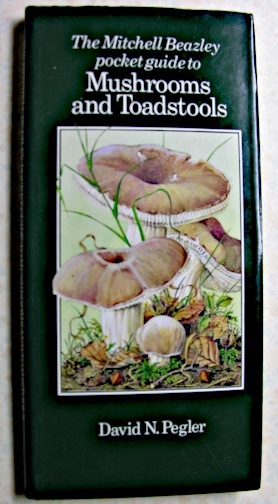
Front cover of The Mitchell Beazley Pocket Guide to Mushrooms and Toadstools by David N. PeglerThe Mitchell Beazley Pocket Guide to Mushrooms and Toadstools, David N. Pegler (1982)

A little gem of a book in a consistently excellent natural history series. Rather like its subject, it’s an example of something very rich and rewarding that’s growing quietly in a neglected niche. Representational art, banished from the academies and galleries over the past century, has survived in natural history illustration. When I think of contemporary art that’s moved or delighted me I often think of men like Richard Lewington, illustrator of Field Guide to the Dragonflies of Britain and Europe, and Ralph Thompson, who illustrated Gerald Durrell’s books about animal-collecting in Africa and South America. David N. Pegler’s art is more realistic and detailed than Thompson’s and he may be an even better draughtsman. But if you think he has less scope for quirkiness and humor, with non-animal, let alone non-mammalian, subjects, you’d be wrong. Each of the fungi illustrated here is a finely detailed, delicately tinted portrait in miniature and in situ, often accompanied by the dried leaves or bark or pine-needles of the spot in which Pegler presumably found it. And one of the pleasures of looking through the book is uncovering the unique and often witty touches Pelger has added to some of the portraits. For example, there’s the beetle crawling towards two specimens of Tricholoma portenosum – ‘so good to eat the French call it “Marvellous Tricholoma” (Tricholome merveilleux)’ – and the crumpled sweet-wrapper lying near three Agaricus xanthodermus, the Yellow-staining mushroom found in or on “Parks, roadsides and wasteland”.

But Pegler usually lets the fungi speak for themselves in their bewildering variety of voices from their startlingly wide range of habitats: there are fungi that specialize in sand, marsh, burnt ground, and dung, as well as the more familiar dead wood and leaf-litter. As so often, the English-speaking world still has a lot to learn from the French: where many Brits or Americans are familiar with two or three edible species, the French are familiar with dozens. The Italians, on the other hand, knew a lot about another kind of mushroom during the Renaissance: the poisonous varieties whose symbols – black-skull-on-white-background for “dangerous” and white-skull-on-black-background for “deadly” – add a regular macabre frisson to Pegler’s drawings.

Inner pages of Mushrooms and Toadstools

One of the deadliest fungi, the Destroying Angel (Amanita virosa), is one of the most beautiful too, like an evil young witch out of Grimms’ Fairy Tales: it’s pure white, slender-stemmed, and with lacy clinging veils, but it reveals its true nature by its “heavy soporific smell”. “Do not mistake for Agaricus silvicola”, Pegler warns (the Latin adjective silvicola, meaning “wood-dwelling”, only exists in the feminine form). One of the ways to avoid mistaking the two is that A. silvicola, the Wood mushroom, “smells of aniseed”. Fungi can delight, or revolt, the nose as well as the eye: there’s the Coconut-scented milk-cap (Lactarius glyciosmus) and the Geranium-scented russula (Russula fellea) on the delightful side, and the Nitrous mycena (Mycena leptocephala), “often smell[ing] of nitric acid”, and the Stinking parasol (Lepiota cristata), with its “unpleasant rubbery smell”, on the revolting.

Unless it can assist identification like that, Pegler doesn’t usually say much about any particular fungus, because he’s writing mainly for identification and has to cram hundreds of species into a pocket-sized space. But each species must have its own unique ecological story and Pegler has managed to make his drawings portraits from the wild and not just mycological mug-shots. And each is accompanied by an illustration of its spores, as a further aid to identification and further invitation for the browsing eye. Spores, like fungi themselves, come in many different shapes and sizes. All of which makes this book my favorite in the Mitchell Beazley series. Every book is worth owning or looking at, but the Pocket Guide to Butterflies, for example, has no artistic charm or whimsy. The butterflies are drawn strictly and severely for identification, with nothing accompanying them: no plants, no landscapes, and no jeux d’esprit. And European butterflies don’t come in many varieties or colors: although they often have hidden charms, most of them are frumpish and dowdy when set beside their glittering, gleaming, multi-spectacular cousins from the tropics.

That isn’t true of European fungi, as Pegler demonstrates: both they and their spores come in all shapes, sizes, and patterns. And all colors too. The Hygrocybe genus gleams with reds, yellows, and lilacs, and the species there look much more like magic mushrooms than the genuine article: the unassuming little Liberty Cap, Psilocybe semilanceata, which can open the doors of perception to a world of wonder. Fungi can drive you mad, kill you, or delight your palate, eye, and intellect, and this book captures their richness and variety better than any other I’ve come across. Art, natural history, and culinary guide: it’s all here and The Mitchell Beazley Pocket Guide to Mushrooms and Toadstools is, in its quiet way, a much greater example of European high culture than anything the modern Turner Prize has produced.

Damsels and Dragons

If I were asked to nominate a great work of 21st-century art, I would not choose anything by the likes of Damien Hirst or the architect Frank Gehry (responsible for the giant metal midden in Bilbao known as the Guggenheim Museum). Instead, I’d put forward something by Klaas-Douwe B. Dijkstra, Richard Lewington, and British Wildlife Publishing of Gillingham in Dorset. They’re not big names like Hirst and Gehry and they’re not earning big money or exercising big influence. And they’re unlike Hirst and Gehry in another way: they’ve created a genuinely beautiful and intellectually stimulating piece of art.

The art-work is called the Field Guide to the Dragonflies of Britain and Europe (2006). Dijkstra oversees the detailed, expert, and fascinating text, Lewington supplies the detailed, accurate, and beautiful drawings, complemented by photographs of dragonflies and damselflies in the wild. Lots of people don’t know the difference between these two suborders of the Odonata, but their common names reflect their appearance: the Zygoptera, or damselflies, are delicate and fold their wings at rest; the Anisoptera, or dragonflies, are robust and always hold their wings at right angles to their bodies. Both come in a huge variety of colours, pure and mixed, as their common names prove: damselflies include the Azure, the Goblet-Marked, the Orange White-legged, the Scarce Blue-Tailed and the Scarce Emerald; dragonflies include the Green and Mosaic Darners, the Banded, Red-Veined, Scarlet, Violet-marked and Yellow-winged Darters, the Orange-spotted Emerald, and the Four-spotted Skimmer. There’s also Somatochlora metallica, the Brilliant Emerald dragonfly, which looks as though it’s made of bright green metal or enamel.

These rich colours, with the complex venation of their wings, have made the Odonata a popular subject for artists and jewellers: for example, the art nouveau master René Lalique (1860-1945) made dragonfly mascots for cars. Unfortunately, the book doesn’t cover the Odonata in art: it’s a scientific text, a microcosm of the macrocosm of biology. Biology depends on accurate description and classification, so odonatology has a rich vocabulary: antehumeral stripes, arculus, carina, clypeus, diapause, discoidal cell, gynomorph, medial supplemental vein, pronotum, pseudopterostigma, siccation, and so on. Even the segments of the abdomen are numbered, from S1, just below the wings, to S9 and S10 at the tip of the tail, where the females have their almost clockwork genitalia. Males have theirs beneath S2, so mating in the Odonata is a complicated, almost tantric, business, as some of the photographs prove. Nomenclature in the Odonata is a complicated, almost incantatory business: Calopteryx splendens, virgo, xanthostoma; Enallagma cyathigerum; Pyrrhosoma nymphula; Anax parthenope, imperator; Ophiogomphus cecilia; Onychogomphus forcipatus; Libellula quadrimaculata; Sympetrum depressiusculum; Zygonyx torridus.

That nomenclature, and that sex-life, are two of the ways that the Odonata are CASean creatures; that is, their complexity, strangeness, and beauty remind me of the work of “the Emperor of Dreams”, the Californian writer Clark Ashton Smith (1893-1961). The obsessive, minutely detailed nature of the book is CASean too, and some of its subjects might literally be emperors in dreams: the common name of the Anax genus is the Emperors. One of these Emperors answered a CASean question I had as I leafed through the book: distribution tides washed back and forth across the little map of Europe that accompanied each specific description, submerging here Britain and Ireland, there France and Spain, here Germany and Scandinavia, there Greece and Turkey, and sometimes all of them at once.

But the strange, isolated island of Iceland, though included on every map, always seemed redundant, like a wall-flower at the Odonatan dance. “Was it a dragon- and damselfly desert?” I wondered. Then I came across Anax epihippiger, or the Vagrant Emperor: “A. epihippiger is the only dragonfly ever recorded on Iceland.” From the magnificent to the minute, from damselflies in the burning deserts of Morocco to dragonflies amid the frosty volcanoes of Iceland, it’s all here in a book that truly does deserve to represent European civilization in the twenty-first century. But doesn’t, alas.