Puro Lojo

Los Ojos

He was haunted by eyes. It had begun quite slowly, quite simply: a feeling that he was being watched whenever he went out, that hostile eyes were staring out at him, down on him, from the windows of the town, tracking his progress, feeding the nectar of data to the honeycombs of brains, for savouring later, when he had passed. He started to find quieter, gloomier streets, to stay indoors on sunny days, to keep his curtains drawn. He felt calmer when he knew he wasn’t overlooked, wasn’t being watched, couldn’t be. But then the calm began to evaporate, for he realized that there were eyes even in his house, even here, where he was cocooned in privacy.

The eyes of his books – indeed, the eyes of “books”, the two o’s, the two little eyes staring out between the “b” and the “k”. There were hundreds of eyes, thousands of them, in every book, ready to stare out at him, to watch him, whenever he opened a book and tried to read. Even “eyes” itself, with the twin e’s, seemed to peer at him, if not to stare. It had half-closed lids, ready to open on him, to glare its full. In Spanish, the word opened fully: ojo. The word reminded him of two eyes with a nose between them, with a bindi over the nose, the mystic dot of Hinduism, symbolizing the third eye. In Hindi, though, the word didn’t threaten him: आँख, ānkh. When he’d first started to worry about his books, about the eyes in his books, he’d gone to the public library and spent an hour searching through the dictionaries, making a list of the eye-words he did find threatening, as though he could trap them, confine them, on a single piece of paper.

The “oog” of Dutch. The “öga” of Swedish. The “øje” and “øye” of Danish and Norwegian, which reminded him of the razor-blade slicing the eye in Un Chien Andalou. The “oko” of Czech, Polish, and Russian. The “ojo” of Spanish, the “olho” of Portuguese, the “occhio” of Italian, all from the “oculus” of Latin (“oculo” in the ablative and dative). Then there was the “göz” of Turkish, entirely unrelated, but staring out at him like a cyclops. And what about the “ojú” of Yoruba? It was unrelated to Spanish, but disturbingly similar. Disturbing in a different way was the οφθαλμος, the “ophthalmos”, of ancient Greek. It was such a juicy, gelatinous word, like the juice and jelly of an eye itself, like a mechanism of chemicals and flesh from which the two o’s stared out at him, watching him, judging him, storing data about him for use in his trial, the secret trial that was being prepared for him.

He felt relieved, at first, that modern Greek had a less threatening μάτι, “mati”. But then he discovered that Malay had a word that was very similar, “mata”, though he knew that Malay and Greek were entirely unrelated. He felt his skin prickle as the first hint of a conspiracy trickled into his brain. The lower-case a’s of “matia”, the Greek plural, like the lower-case e’s of “eyes”, were like peering eyes, as though the words were beginning to take on the same form as “ojo” and “oko”, as though they would open fully one day too. He wondered if, one day, all the world’s languages would have eyes in their words for “eye”, would have twin o’s gazing out, glaring out at the reader. The biter bit. The reader read. Or what about a script, a font, a language, that was entirely ocular, entirely based on o’s, that read its readers as they read it? You could do that, could create one. There were enough forms of “o” in the alphabet, or the alphabets, the Latin and French and Czech and Yoruba and Vietnamese.

It was then he realized that he hadn’t looked at the Vietnamese dictionary, having missed it near the end of the shelf. He went to look at it, carrying his eye-list with him. He took the dictionary off the shelf and flicked to the right page. He nearly dropped the book when he saw the word staring up at him: mắt. Like Greek, like Malay. He would discover later, after more research, that the Vietnamese and Malay words probably had a common origin, something he’d half-suspected, after that moment of shock. The language families were spoken in neighbouring regions, after all. But for that moment of shock it had seemed a confirmation of something at work, something beneath the surface, or beneath the lid, peering out, ready to be fully exposed, fully opened, ready to stare its full, to drink his soul.

After his visit to the library, he found it more and more difficult to read English and Spanish, both with eye-like eye-words, both full of o’s. He was haunted by a line from Lovecraft, from “The Shadow over Innsmouth”: “I could not escape the sensation of being watched from ambush on every hand by sly, staring eyes that never shut.” But in English, in Spanish, they were not in ambush. They were there openly, eagerly, greedily. He sought refuge in French and German, whose eye-words were asymmetric, un-eye-like, and where “o” was blessedly far down the list of letter-frequencies. English ran e-t-a-o. All those to’s and of’s and not’s. Spanish was even worse: e-a-o. All those masculine endings, those past tenses, those no’s and lo’s. But French ran e-a-s-i-t-n-r-u-l-o. German was even better: e-n-i-s-t-r-a-d-h-u-g-m-c-l-b-o. He began to sellotape his English and Spanish books shut, as though each were an eye that he was closing by force, blinding so that its myriad inner eyes could not watch him. He felt much calmer reading French and German, much better able to cope when he came across a reference to eyes, and he even laughed aloud when, returning to À Rebours, he read of how the ancestral portraits of des Esseintes alarmaient avec leurs yeux fixes, “startled one with their fixed gaze”.

The disaster, when it came, came without warning. He picked up a French guide to butterflies one afternoon, meaning to browse through it before lunch, and almost at once came across a slip of paper handwritten on both sides. The writing was neat but small and he had to concentrate to read it. It was all part of the trap, he realized too late, to make him focus, to bite more deeply on the poison bait that had been dangled before him. Ice began to form around his viscera as he read, but he could not stop himself until he had finished:

Die einzelnen Worte schwammen um mich; sie gerannen zu Augen die mich anstarrten und in die ich wieder hineinstarren muß: Wirbel sind sie, in die hinabzusehen mich schwindelt, die sich unaufhaltsam drehen und durch die hindurch man ins Leere kommt.

With sick horror, he noted that the passage contained exactly two o’s, near the beginning and near the end, like the grotesque eyes of a distorted, teratomorphic face. Then he turned the slip over and found that the other side contained a translation in English, full of o’s, full of eyes, staring at him, eager to drink the emotion in his face, the realization that he had been trapped. Again, he could not prevent himself from reading to the end:

Single words floated round me; they congealed into eyes that stared at me and that I was forced to stare back into – whirlpools that gave me vertigo and, reeling ceaselessly, led into the void.

He let out an involuntary cry. Where had the slip come from? Who was the author of the German? Who had translated it? Who had written the two languages down, hidden the slip in the book? He looked again and realized that it was his own writing, slow, careful, half-disguised, but unmistakable, now that he looked. There was a conspiracy, yes, there was, and he was the author of it, spinning a web for himself, plotting his own destruction, with hidden motives, hidden hatred. He moaned. Things were moving in his head. The slip was a linguistic key, turning a lock in his subconscious, releasing a phrase that he himself had hidden there. Esse Est Percipi. Berkeley’s great dictum. “To Be Is To Be Perceived”. He knew the truth now. He could not escape, could find no refuge, draw no curtain, close no door, find no darkness to hide in. The universe itself was an eye all around him and he was its eternal focus, naked always, visible always, pierced through and through by a torturer’s gaze that created its own object of torture.

Vermilion Glands

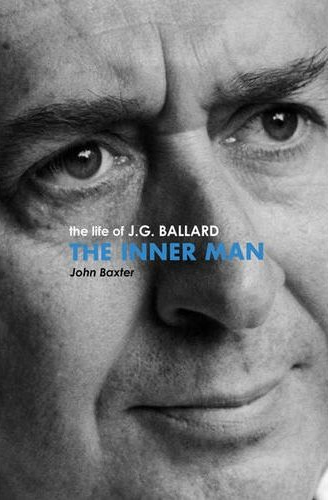
Front cover of The Inner Man The Life of J.G. Ballard by John BaxterReaders’ Advisory: Contains Self-abuse and reference to Mancas.

The Inner Man: The Life of J.G. Ballard, John Baxter (W&N 2011)

“B” is for Bataille, Burroughs, and Ballard. I’ve never read Bataille, I can’t stand Burroughs, I used to love Ballard. Nowadays I have strong doubts about him. Vermilion Sands, yes. Crash, no. Vermilion Sands is surreal, haunting, funny, endlessly inventive, and extravagantly intelligent. Crash, by contrast, is silly and sordid. The last time I tried to read it I quickly gave up. I couldn’t take it seriously any more. It’s a book for pretentious, wanna-be-intellectual adolescents of all ages who like Dark’n’Dangerous Sex’n’Violence. A book for Guardian-readers, in short – the sort of people who continually use and hear the phrase “in terms of”, who believe passionately in Equality, Justice, and the Fight against Hate, and who desperately, desperately, wished they’d been able to stimulate the largest erogenous zone in their bodies by voting for Barack Obama in 2008.

What is that erogenous zone? Well, though not all liberals are Guardianistas, all Guardianistas are liberals, so the largest erogenous zone in a Guardianista’s body is his-or-her narcissism. Guardianistas are also, alas, the sort of people who write biographies of J.G. Ballard. John Baxter is most definitely a committed component of the core community. As a big admirer of Mike Moorcock, Britain’s biggest bearded Burroughsian lit-twat, how could he not be? This is part of why I now have doubts about Ballard. I don’t like liking things that Guardianistas like and I don’t like the fact that Moorcock was mates (on and off) with Ballard. On the other hand, I do like the fact that Moorcock and the Guardian boosted Burroughs big-time back in the day and that the Guardian now bigs up Cormac McCarthy and his Dark’n’Dangerous Sex’n’Violence. Good, I think: they all deserve each other. Perhaps one day, in some drug-stoked, depravity-soaked über-orgy of trans-transgressive hyper-homoeroticism, they’ll all manage to climb up each other’s arseholes and disappear from history.

But Guardianistas don’t just like Burroughs and McCarthy: they like Ballard too. They write books about him. Fortunately, The Inner Man isn’t a good book. That would have been disturbing, believe me. The dedication is by far the best thing in it: “To the insane. I owe them everything.” And guess whose lines those are? After that, it’s mostly Baxter and mostly dull. When it’s not, you’ll usually have Ballard to thank:

Novels sent to him in hope of endorsement got short shrift. He enjoyed describing the satisfying thump of Salman Rushdie’s Midnight’s Children as it hit the bottom of the dustbin. (pg. 47) In September 1995, the Observer, for a piece about odd bequests, invited him to answer the question, “What would you leave to whom, and why?” Jim said, “I would leave Andrea Dworkin my testicles. She could have testicules flambés.” Anti-pornography campaigner Dworkin was a close friend of Mike and Linda Moorcock but a bête noire of Ballard’s. (pg. 308)

I think Ballard was right in his cod-bequest for Dworkin and bum’s-rush for Rushdie. And if Baxter had the same sense of humour and mischief, The Inner Man would have been a much better book. Okay, it’s not that bad, because I managed to finish it, but that was disappointing in its own way. I’d almost have preferred a boldly, flamboyantly pretentious Ballard bio full of solecisms and mixed metaphors to a plodding, mediocre one like this. I like sneering at and feeling sniffily superior to Guardianistas. And all I’ve got to go on here are occasional lines like these:

Like another diligent civil servant, he [Ballard] was Agent 00∞: licensed to chill… (pg. 3) But in surrealism, as in most things, Jim was drawn to the extremity, the dangerous edge, the abyss which, as H.G. Wells warned, will, if you stare into it long enough, stare back at you. (pg. 36)

It’s puzzling that Baxter misattributes such a famous quote and that his editors didn’t spot the misattribution. It’s also puzzling that Baxter doesn’t seem to like Ballard much, to be very interested in Ballard’s life, or to be very enthusiastic about Ballard’s writing. Born in Shanghai, incarcerated (and half-starved) under the Japanese during the war, trained as a doctor: Ballard had an unusual early life for a writer and one can only admire Baxter’s ability to keep the interest out of it. Baxter devotes much more attention to Ballard’s time in advertising and life in suburbia. Yes, the contrast between this apparently staid existence and the wildness of Ballard’s veridically visceral visions is interesting, but it’s obviously related to his early experiences in China. Baxter has got those out of the way within the first 26 pages of a 377-page book. When he himself takes visionary flight, he doesn’t do so to Ballard’s advantage. Why did Ballard turn down the chance to be published in “a series of de luxe limited editions of fantasy classics” by Manchester’s most maverick messiahs, “the radical publishing enterprise of Savoy Books”? Baxter conducts an interview with his own imagination and reports back with this:

He may have felt that involvement with Savoy and [David] Britton – who had already served two prison terms under the Obscene Publications and Dangerous Dogs Acts – risked once again placing him in hazard, as had been the case with “Why I Want to Fuck Ronald Reagan”. (pg. 321)

Eh? Yes, he “may”, but simpler explanations are to hand. Either way, Baxter says the rejection meant that “a sense of grievance” now “permeated his relationship with” the messianic Mancas. Again: Eh? The grievance would have been one-sided, there was never much of a relationship, and although Savoy “put a lot of effort” into persuading Fenella Fielding to record extracts from one of Ballard’s books (no prizes for guessing which), they put in the effort without first asking Ballard if he was interested. When the recordings were made and they did ask, he “refused to cooperate”. It was now that grievance began to permeate the relationship.

Reading about this important episode in Ballard’s career, I felt another feeling begin to permeate me. A familiar feeling. Yes, “S” is for Savoy (B), Sontag (S), and Self (W). All three turn up in this biography, variously offering to publish Ballard, heaping praise on him, and having dinner with him. All three are part of the Guardianista demographic in one way or another: Self nails his colours firmly to the gasbag when he speaks of a “scintilla” of an “affectation” that forms an “armature” (pg. 341). All three add to my doubts about Ballard. If people like that like him, should I like him too, like? I think if Ballard had been born ten or twenty years later, the question wouldn’t arise. A younger Ballard would have been sucked fully into the macroverse of Guardianista subversion, radicalism, and counter-cultural twattishness and I’d never have liked him at all. As it was, he was too big to entirely fit. Crash got sucked and does suck. Vermilion Sands didn’t and doesn’t.

And this biography? Well, it could have been much worse. Yes, it’s dull but that may be partly because Ballard himself is such an interesting and memorable writer. As I’ve pointed out elsewhere, the danger in literary biographies is that the biographee is likely to be a better writer than the biographer. The implicit comparison will always be there and Ballard’s autobiography, Miracles of Life (2008), is likely to remain better, and briefer, than anything a biographer ever turns out. But Baxter tells you about things that Ballard doesn’t, possibly because they’re not true. Like the air of menace Ballard could project and his occasional violence towards his girlfriend Claire Walsh, who “appeared at parties with facial bruises, usually hidden between sunglasses” (pg. 187).

And “girlfriend” is the word: Baxter reports that Ballard “always” and “anachronistically” used it of Walsh (pg. 171), rather than (he implies) the smarmy Guardianista “partner”. Good for Ballard. But bad for Ballard in terms of engagement with issues around the bruises, if true. As George Orwell said:

If Shakespeare returned to the earth to-morrow, and if it were found that his favourite recreation was raping little girls in railway carriages, we should not tell him to go ahead with it on the ground that he might write another King Lear. (“Benefit of Clergy: Some Notes on Salvador Dalí”, 1944)

It would have been better that Ballard hadn’t punched his girlfriend, just as it would have been better that Caravaggio hadn’t been a murderer. But if they hadn’t been violent men, with more than a touch of psychosis, they might not have produced such interesting art. I don’t think Ballard is as significant a figure in European art as Caravaggio, and even if he is, he and his art won’t have as much time to be significant in. One way or another, Europe is now entering its final days. We are about to reap the whirlwinds so diligently sown for us by the Guardianistas and their continental cousins. And science is busy measuring mankind for its coffin. Ballard saw and wrote about parts of this future, but I now prefer his surreal side to his sinister and his dreams to his depravity. It’s bad, v. bad, that Will Self hails Ballard as “My single most important mentor and influence.” But Self (thank Bog) didn’t write this biography. He didn’t write Vermilion Sands either. He couldn’t. Ballard could and did. He could and did write other good stuff. I don’t love him any more, but, despite the Guardian and the Guardianistas, I will continue to read him. Lucky Jim, eh?


Post-Performative Post-Scriptum…

In terms of all Savoy-fans and other non-conformist mavericks, keyly committed core components of the counter-cultural community et al having read this review prior to departing in terms of departure… please can you stop using “in terms of” and “prior to” and stuff? You wouldn’t allow bloated flesh to adversely impact your body, so why do you allow bloated phrases to negatively trajectorize your English?

Ex-term-in-ate! — more on “in terms of”
Prior Analytics — more on “prior to”

A Swirl of Shadows

I tell of the planet of Gdarrujh, far, very far, in space and time. There is a spot there, by a vanished sea, whereon, at certain times of the year, a swirl of shadows will appear on a broken floor of ancient marble. And these shadows are very strange, seeming those of living creatures, yet with likeness to none ever known on that world. Travellers who return from the spot compare the shadows to those of autumn leaves able to hover and flutter at will between sun and earth, shading the latter with their shape. Yet these shadows have heads and limbs, after a fashion, and certainly pertain to the animal, not the vegetable, and even to the human, as though the arms of Gdarrujh-folk were broad-bladed oars and men could row the very insubstantiality of air, ride there at will, though they remained solid flesh and sturdy bone.

And this shadow-swirl has nourished several schools of speculation on Gdarrujh. Some philosophoi say it is nothing real, being a mirage or trick of some long-dead, high-cunning’d mage, whose magick works on down the millennia, tempting the foolish to belief in nonsense and chimæras. But others say, nay, nay, the shadows are those of real creatures, past or to come, and are shown by design of the gods, that men might throw down their walls of dogma, topple their towers of certitude, and know that the Universe holds more than man sees or woman dreams. And a smaller school of the realitarians holds that the shadows are not of the past or future, but rather of the present, being cast somehow through a chink that separates known Gdarrujh from another Gdarrujh that exists in hidden parallel, where creatures dwell not only the land and sea, but also the air, being able to take to it, delight in it, partake there of the lightness of leaves and the grace of fish.

And the creatures of the shadow-swirl have mouths like knives, which gape as though they call, but, in repudiation of whose claims, in confirmation of whose, in relevation of what mysteries, no sound reaches the speculators of Gdarrujh.

Palace in Numberland

The Palace of Primes

“Cur ad uvas per Zeusim depictas accursabant volucres?” – Iordani Bruni Ars Memoriæ (1582).

“Why did birds flock to the grapes painted by Zeuxis?” – Giordano Bruno’s Art of Memory.

“To mnemonicize the primes is to partake of the mind of God, as though one dipped a shell into plumbless nectar and drank thereof.” So runs the saying in the Cult of Primes, wherein prodigious feats of memory are demanded even of the neophytes, who must enthrone in a memory-palace the initial 931 primes (from 2 to 7,307) ere they can begin climbing, rung by jaden rung, the ladder of the Hierarchy. The Cult has a number-system based on thirty: which is to say, where we, with a base of ten, have nine number-symbols and the cipher, they have twenty-nine ditto and ditto. To each symbol, in their mnemonics, they assign a beast, bird, and flower; a metal, gem, and wood; a fur, cloth, and silk; a food, drink, and condiment; a colour, scent, and sound. Thus, a hummingbird hovering above an emerald amid scent of vanilla symbolizes the prime 1,667; an eye upon a silver harp the prime 5,059; and a porphyry scarab upon a cheetah’s fur the prime 11,173.

When once the neophytes have mastered the system of mnemonics, each sets to constructing his Palatium Primorum, his Palace of Primes. Herein, each Prime has Its Room, wherein It sits on a Throne studded with symbols of its attributes, whilst courtiers feast and musicians play before It. And in the Left Wall of the Room are many doors symbolizing numbers from 1 to 31. If one is in the Throne-Room of 137, for example, and one steps through the Door of 13, one finds oneself in the Throne-Room of 199, the Prime 13 places higher in the List of Primes; and similarly, mutatis mutandis, for other numbers and other doors. And in the Right Wall are an increasing number of doors leading to Primes lower in the list. Thus, the Throne-Room of 2 has no doors on the right; and of 3 has one door; and of 5 two doors; and so till 131, the 32nd prime, whereat the Right Doors reach their maximum. And each priest of the Cult, from his neophycy on, will toil a lifetime bedecking, manning, and extending the Palace, till it seems to him more real than the World, vaster than the Universe, and dearer to him than his heart-beat.

Nor, if earthly misfortune overtakes him, does the Palace fail of consolation, for a priest can resort thither for surcease of pain, if upon the rack; for oblivion of want, if destitute or starving; and for foretaste of Paradise, if dying. Yea, Paradise is a Palace, in the teaching of the Cult, a Palatium Omnium Primorum, of All Primes, primes numberless as beats of a deathless heart, as sands of an endless shore, as stars of a boundless heaven. And Herein the Doors of the Left Wall are infinite and the Doors of the Right increase for ever.

Lulu Lunatic Luz

It’s disturbing what you can find online…

Tales of Silence & Sortilege, Simon Whitechapel, Paperback, 111 Pages

May 28, 2012

If you love weird fantasy, if you love the English language, even if you don’t love Clark Ashton Smith, you should read this book. The back cover describes it as “the darkest and most disturbing fantasy” of this millennium, but that’s either sarcastic or tragically optimistic, because what these stories really are is beautiful. The breath of snow-wolves is described as “harsh-spiced.” A mysterious gargoyle leaning from the heights of a great cathedral has “wings still glistening with the rime of interplanetary flight.” Hummingbirds are “gem-feathered… their glittering breasts dusted with the gold of a hundred pollens.” If you cannot appreciate such imagery, then perhaps you are dead to beauty, or simply dead. These tales are very short, but some of them have stayed with me for years, such as “The Treasure of the Temple,” in which a thief seems to lose the greatest fortune he could ever have found by stealing a king’s ransom in actual treasure. Most of the stories are brilliant, one or two is only good, but the masterpieces are “Master of the Pyramid” and “The Return of the Cryomancer.” The sense of loss and mystery evoked by these two companion stories is almost physically painful, it is so haunting. There is nothing like these stories being published today. Reading them, I feel the excitement and wonder that fans of Weird Tales magazine must have known long ago when new stories would appear by H.P. Lovecraft, Clark Ashton Smith, and Robert E. Howard. Simon Whitechapel doesn’t imitate these authors so much as apply their greatest lessons to new forms of fantasy. This is one of the cheapest books I own, but I accord it one of my most valuable. It is easily the best work of art you will find in any form on Lulu. I cannot recommend it highly enough.

The Roses of Hsūlag-Beiolă, Simon Whitechapel, Paperback, 154 Pages

Jun 8, 2012

This collection of weird fantasy is filled with mystery, wonder and a sense of the ineffable. Not every story is a mind-blowing masterpiece, but the best of them are absolutely spectacular. Even the worst are good and all are haunting in one way or another. My two favorites were: 1. “The Mercy of the Osmomancer,” wherein a knight on a mission to investigate the tower of a scent-wizard encounters demons made of smells and even learns the language of odors… 2. “The Swans,” in which a pawnbroker tracks down all the known paintings of a seemingly insane artist who paints his canvases entirely black, nothing but black, for reasons best and most poetically left to Simon Whitechapel to explain… Any fan of H.P. Lovecraft, Robert E. Howard, Clark Ashton Smith, Edgar Allan Poe, Comte de Lautréamont, Charles Baudelaire or William S. Burroughs will find something wonderful to love in here. I sure did.


Even more disturbing is the thought that this individual may be able to pass themself off as normal in real life: there are no spelling mistakes or solecisms. (Then again, perhaps I’m reviewing my own books in my sleep. (But I wouldn’t compare myself to B*rr**ghs, surely? (Unless it’s a bluff or double-bluff. (Disturbing, as I said. (I agree.)))))

Stoch’! (In the Name of Dove)

Stochasma, In Abysso (2012)

The Sueco-Georgian avant-gardists Stochasma were formed, in their own words, “to interrogate, eviscerate, and exterminate the ultimate experimental envelope of acoustic idiosyncrasy”. That’s “Sueco-” as in Sweden and “Georgian” as in the Eurasian nation, not the American state, by the way. Going one up on some bands from Wales, Ireland and Scotland, who issue their material bilingually, in English and one or another of the Celtic languages, Stochasma issue all their material tri-lingually, in English, Swedish, and Georgian. The strangeness and beauty of the Georgian script match and enhance the strangeness and (occasional) beauty of their music, but, unlike their last two releases, there’s no spoken English, Swedish or Georgian here: In Abysso is intended to be an “abhuman listen”.

Front cover of Stochasma's album In Abysso 

Believe me, it is! The title of the album is Latin for “In the Abyss” and the liner-notes extend thanks to H.P. Lovecraft, Clark Ashton Smith and Stanislaw Ulam for “infernal inspiration”. If the last name makes you think “Who?” (or “U?”), you must be new/nu to Stochasma, who draw inspiration not just from art and literature, but from mathematics too. Stanislaw Ulam (1909-84) was a Polish mathematician perhaps most famous for inventing the “Ulam spiral”, a graphical representation of the prime numbers that reveals mysterious patterns in this strange and fascinating set of integers. Ulam stumbled across the spiral while “doodling” during a boring lecture at a scientific meeting. That kind of serendipity has always been important to Stochasma, who explore the musical abyss/chasm partly through random, or stochastic, techniques. For the first track, “Pr1m4l Skr33m”, the five members of the band had electrodes attached to their nipples before being asked, at random, to indicate, with a nod or shake of the head, whether a randomly selected number between 1 and 10,000 was prime or composite (for example, 1,433 is prime, being divisible by no numbers but itself and 1; 1,434 is composite, being divisible by 2, 3 and 239). If they were wrong, they received a painful electric shock.

The resultant collection of grunts, gasps, and screams was electronically worked over in fully traditional Stochasma fashion to create “Pr1m4l Skr33m”, which sounds like a fully traditional Stochasma track: fucking weird and unsettling! Is the irregular chorus of voices in agony or ecstasy? Are the band being tortured in a hell run by sadists or pleasured in a heaven run for masochists? Or both? It’s hard to decide, and at times hard to listen, but as Stochasma themselves put it: “We’re queasy listening, not easy – easy listening is for cubes.”

Elsewhere, the band have used the ultra-sensitive microphones they first experimented with on 2003’s AnguisaquA (sic – it literally means “SnakewateR”). This time they’ve recorded the bloodflow of a dove and the movements of parasites in its feathers for “Täubchen”, which sounds even stranger than it reads. That and “Pr1m4l Skr33m” are the first two tracks: the next fifteen are entitled “Ignisigil I” to “Ignisigil XV”. Stochasma used a fire-proof microphone to record the sound of books being burned. They selected fifteen wildly different authors for this literally incendiary homage, from “J. Aldapuerta to J. Archer, from K. Marx to K. Minogue”, as they themselves put it. (That’s the über-trangressive Spanish horror-writer Jesús Aldapuerta and the über-cruddy British thriller-writer Jeffrey Archer, and the Anglo-German philosophaster Karl Marx and the Australian pop-pixie Kylie Minogue, for those unfamiliar with the names.) And the band insist, perhaps tongue-in-cheek, that the sonic textures of the recordings are dependent not just on the physical nature of the paper and ink being burnt, but also on the ideological and aesthetic nature of the burning text.

It’s hard to agree: the “Ignisigils” all sound pretty much alike to me, though that sound is uncharacteristically soothing and relaxing by Stochasma standards (on my first listen, I dropped off during “Ignisigil VIII” and didn’t wake up till “Ignisigil XI”). The album is rounded off with three of the strangest pieces of music I’ve heard this century: “Musgomorrah”, “Gradus ad Parnassum”, and “CoMoXoCoI”. The first sounds like a slowed recording of men in armour fighting in thick mud; the second like a choir of giant glass insects singing themselves to splinters; and the third like echoes chasing each another in a collapsing or burning maze. These three might grow on me or might not: for now, “Pr1m4l Skr33m”, “Täubchen”, and “Ignisigil IV” hit the sonic sweet’n’sour spot that Stochasma seem to have copyrighted. I don’t know why “IV” hits the spot and the rest of the Ignisigils don’t, but that’s often the way with Stochasma: you like the sounds they create and you haven’t a clue as to why. In company with a select band of other electronicognoscenti, I look forward to their seventh album, whenever it appears and whatever musical mélanges or macedoines it manages to mulch, mangle, and miscegenate.


Elsewhere other-engageable:

Musings on Music

Bat’s the Way to Do It!

I think Britain would be much better off without three things that start with “c”: cars, canines, and coos (sic (i.e., pigeons)). But perhaps I should add another c-word to the list: cats. I like cats, but there’s no doubt that, in terms of issues around negative components/aspects of conservation/bio-diversity issues vis-à-vis the feline community/demographic, they’re buggers for killing wildlife:

A recent survey by the Mammal Society was based on a sample of 1,000 cats, countrywide, over the summer of 1997. The results included only “what the cat brought in” and ignored what it ate or left outside. Leaving aside this substantial hidden kill, it still concluded that cats killed about 230,000 bats a year. This is equivalent to more than the entire population of any species other than the two most common pipistrelles. If these 1,000 cats are typical, and there is no reason to believe that they are not, cats kill many more bats than all natural predators combined. They are one of the biggest causes of bat mortality in Britain, perhaps the biggest. (Op. cit., chapter 6, “Conservation”, pg. 139)
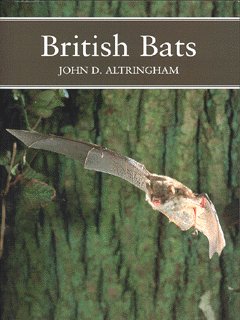
Cover of British Bats by John D. Altringham

That is the unhappy conclusion in John D. Altringham’s very interesting and educative book British Bats (HarperCollins, 2003). Accordingly, I’d rather have fewer cats and more bats. Anyone but a cat-fanatic – and cat-fanatics are found in one or two places – should feel the same, and even the fanatics might reconsider if they read this book. The cat family contains some of the most beautiful and athletic animals on earth; the bat family contains some of the strangest and most interesting. In fact, all bats are strange: they’re mammals capable of sustained powered flight. Little else unites them: in chapter two, Altringham describes the huge variety of bats around the world. They live in many places and live off many things. Some drink nectar, some drink blood; some eat fruit, some eat fish. Some roost in caves, some in trees. Some hibernate, some migrate. Some use echolocation and some don’t. Bats are much more varied than cats and scientifically speaking are much more interesting.

Although echolocation isn’t universal, it is the most interesting aspect of bats’ behaviour and it’s used by all the species found in Britain, from the big ones, like the noctule and greater horseshoe bat, Nyctalus noctula and Rhinolophus ferrumequinum, to the small ones, like the whiskered bat and the pipistrelles, Myotis mystacinum and Pipistrellus spp.[1] Two of the pipistrelles are in fact most easily distinguished by the frequencies they call at: the 45 kHz pipistrelle, Pipistrellus pipistrellus, and the 55 kHz pipistrelle, Pipistrellus pygmaeus. As their English names suggest, one calls at an average of 45 kilo-Herz, or 45,000 cycles a second, and the other at an average of 55. The two species weren’t recognized as separate until recently: they look almost identical, although the 55 kHz is “on average… very slightly smaller”, and they forage for food in the same places, although the 55 kHz is “more closely associated with riparian habitat” (that is, it feeds more over rivers and other bodies of water). But examine their calls on a spectrograph, an electronic instrument for visually representing sounds, and there’s a much more obvious difference. This is a good example of how much the scientific study of bats depends on technology. Human beings didn’t need science to know about and understand the ways a cat uses its senses, because they’re refinements of what we use ourselves. We might marvel at the acuity of a cat’s eyes or ears, as we might marvel at the acuity of a dog’s nose, but we know for ourselves what seeing, hearing, and smelling are like.

Echolocation is something different. Bats don’t just see with their ears, as it were: they illuminate with their mouths, pouring out sound to detect objects around them. And the sound has to be very loud: “The intensity of a pipistrelle’s call, measured 10 centimetres in front of it, is as much as 120 decibels: that is the equivalent of holding a domestic smoke alarm to your ear.”[2] The “inverse square law”, whereby the intensity of sound (or light) falls in ratio to the square of the distance it travels, means that the returning echoes are far, far fainter than the original call. It’s as though Motörhead, playing at full volume, could hear someone at the back of the crowd unwrapping a toffee. How do bats call very loudly and hear very acutely? How do they avoid deafening themselves and drowning their own echoes? These are some of the questions bat-researchers have investigated and Altringham gives a fascinating summary of the answers. For example, they avoid deafening themselves by switching off their ears as they call. They’ve had to solve many other tricky acoustic problems to perfect their powers of echolocation.

Or rather evolution has had to solve the problems. The DNA of bats has changed in many ways as they evolved from the common mammalian ancestor (which also gave rise to you, me, and the author of this book) and those changes in DNA represent changes in their neurology, anatomy, and appearance. It’s easy to see that hearing is important for bats, because their eyes are relatively small and their ears are often large and rigid and come in a great variety of shapes. What isn’t easy to see is what those ears are supplying: the bat-brain and its astonishing ability to process and classify sound-data as though it were light-data. Bats can create sound-pictures of their surroundings in complete darkness. Of course, the feline or human ability to create light-pictures is astonishing too, but we’re too familiar with it to remember that easily. Bats aren’t just marvels in themselves: they should encourage us to marvel at ourselves and what our own brains can do. The digestive system of a bat, cat, or human needs food; the nervous system of a bat, cat, or human needs data. That’s what our sense-organs are there for and in principle it doesn’t matter whether we create a picture of the world with our eyes or with our ears.
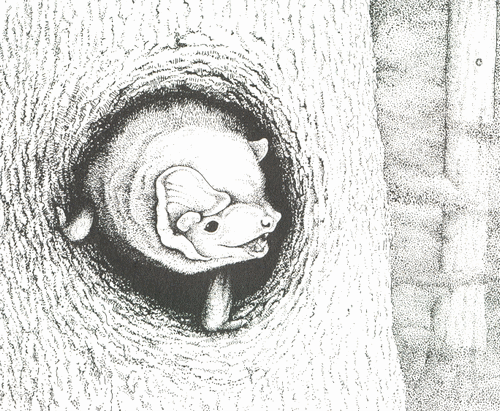
Male noctule (Nyctalus noctula) calling from tree-roost to attract mates

Male noctule calling from tree-roost

In practice, there are some very important differences between sound and light. Light works instantly and powerfully on a terrestrial scale; sound takes its time and is much more easily diluted or blocked. A hunting cat can scan an illuminated or unilluminated environment for free, because it doesn’t have to generate the light it sees by or the sound it hears by. Hunting bats have to pay when they scan their environment, because they’re using energy to create sound and induce echoes. Once they’ve got their data, both cats and bats have to pay to process it: it takes energy to run a brain. But bat-brains are solving more complicated problems than cat-brains: Altringham describes the questions a flying bat has to answer when it detects the echo of an insect:

How far away is the insect?… How big is it?… In which direction does it lie?… How fast is it flying and in what direction?… What is it?… (ch. 3, “The Biology of Temperate Bats”, pp. 42-3)

Like insect-eating birds, bats can answer all these questions in mid-flight, but what is relatively easy for birds, using their eyes, is a much greater computational problem for bats, using their ears. “Computational” is the key word: brains are mathematical mechanisms and process sense-data using algorithms that run on chemicals and electricity. Bats were intuitively using mathematical concepts like doppler shift and frequency modulation (as in FM radio) millions of years before man invented mathematics, but man-made mathematics is an essential tool in the study of echolocation. For example, the concept of wavelength, or the distance between one crest of a sound-wave and the next, is very important in understanding how bats perceive objects. Light has very short wavelengths, so humans and other visual animals can easily resolve small objects. Sound has much longer wavelengths, so bats find it hard to resolve small objects. But some find it harder than others: Daubenton’s bat, Myotis daubentonii, and other Myotis spp. “can resolve distances down to about 5 millimetres when given tasks to perform in the laboratory”. But horseshoe bats, Rhinolophus spp., “can do little better than 12 millimetres.”

Why this difference? You have to look at the nature of the sound being produced by the different species: the Myotis spp. use “high frequency FM calls”; the Rhinolophus use “predominantly CF [constant frequency] calls”. The mathematical nature of the call determines the bats’ powers of perception. Calls can also determine how easily a bat can identify an insect: “relatively long calls can have a ‘flutter detector’… If a call is 50 milliseconds long, then within one echo a bat can detect the full wingbeat of insects beating their wings at more than 50 Hz.”[3] So bats can tell one kind of insect from another, something like the way a blindfolded human can tell a bumblebee from a mosquito. But insects aren’t passive as prey and one of the most interesting sections of the book describes how they try to avoid being eaten. Some moths have “ultrasound detectors” and if a moth hears a calling bat, it “will either stop flying and drop toward the ground, or begin a series of rapid and unpredictable manoeuvres involving dives, loops and spirals”.[4] This kind of ecological interaction creates an “evolutionary arms race”: each side evolves to become better at capture or evasion.

The moth/bat air-battle is reminiscent of the air-battles of the Second World War, which involved radar trying to detect bombers and bombers trying to evade radar. One defensive technique was jamming, or attempts to interfere with radar signals or drown them in noise. Some moths may use this technique too. The tiger moths, the Arctiidae, don’t try to escape detection. Instead, they “emit their own, loud clicks”[5], perhaps to interfere with echolocation or startle a predatory bat. Alternatively, Altringham suggests, the clicks may be the aural equivalent of “bright warning colours and patterns”: the moths may be warning bats of their unpalatability. If so, it would be another example of the difference between the costs of sight and the costs of sound. An unpalatable insect in daylight doesn’t have to pay for its warning colours, after the initial investment of creating them, and doesn’t have to know when a predator is watching. An unpalatable insect in the dark, on the other, can’t send out a constant audible warning: it has to select its moment and know when a predator is nearby. Unless, that is, some insects use passive signals of unpalatability, like body modifications that create a distinctive echo.

Bat-researchers don’t know the full story: there is still a lot to learn about bats’ hunting techniques and the ways insects try to defeat them. But “cost” is a word that comes up again and again in this book, which is partly a study in bio-economics. Bats have to pay a lot for echolocation and flight, but flight is a more general phenomenon in the animal kingdom, so the economics of bat flight also illuminates (insonates?) bird and insect flight. Altringham points out a very important but not very obvious fact: that flight is expensive by the unit of time and cheap by the unit of distance. Movement on foot is the opposite: it’s expensive by the unit of distance and cheap by the unit of time. Bats, birds, and insects expend more energy per second in flight, but can travel further and faster in search of food or new habitats. However, bats don’t all fly in the same way: a bat expert can identify different species by their wings alone. The wings vary in “wing loading”, which is “simply the weight of the bat divided by the total area of its wings. Bats with a high wing loading are large and heavy in relation to their wing area, bats with small bodies and large wings have a low wing loading”.[6] Then there’s “aspect ratio”, the “ratio of wingspan to average wing width”, or, because “bats have such an irregular wing shape”, “wingspan squared divided by wing area.”

It’s mathematics again: there are no explicit numbers in a bat’s life, but everything it does, from echolocating to flying, from eating to mating, is subject to mathematical laws of physics, ecology, and economics. Bats have to invest time and energy and make a profit to survive and have offspring. As warm-blooded, fast-moving animals with high energy needs, they’re usually nearer famine than feast, which is one reason they migrate or hibernate to avoid or survive through cold weather and scarcity. They also vary their diet during the year, to take advantage of changes in the abundance of one insect species or another, and seek out specialized feeding niches. Daubenton’s bat, for example, “habitually feeds very low over water”, using echolocation to catch not just flying insects but floating ones too. That is why it needs smooth water to feed over: ponds, lakes, canals and placid streams and rivers. The floating insects are easier to echolocate on a smooth surface, rather like, for humans, a black spider on a white wall. Once spotted, they “are gaffed with the large feet or the tail mechanism and quickly transferred to the mouth as the bat continues its flight”.[7]
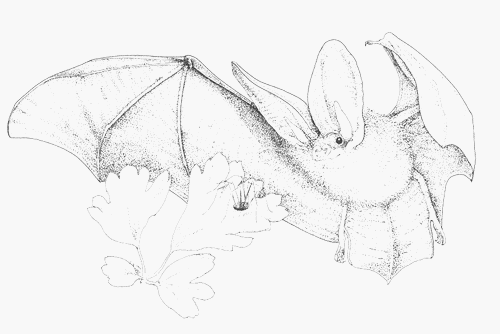
Long-eared bat (Plecotus auritus) gleaning harvestman

Long-eared bat gleaning harvestman

One of the photos in the colour section in the middle of the book shows a Daubenton’s bat mirrored in smooth water, having just scooped up prey from the surface. Other photos show other species roosting, perching, or in flight, but the book also has excellent black-and-white illustrations mixed with the text, hand-drawn using a speckled or pointillist technique that suits bats very well. I particularly like the drawings on pages 48, 67 and 101. The first shows a long-eared bat, Plecotus auritus, “gleaning”, or snapping up, a “harvestman” (a long-legged relation of the spiders) from a leaf (ch. 3); the second shows a “male noctule calling from his tree roost to attract mates” (ch. 3); and the third shows a tawny owl trying to catch another long-eared bat (ch. 4).

Owls could be called the avian equivalents of bats: they’re specialized nocturnal hunters with very sharp hearing, but I think they’re both less interesting and more attractive. Bats, with their leathery wings, sometimes huge ears, and oddly shaped noses, are strange rather than attractive and some people find them repulsive. But some people, or peoples, find them divine or lucky: the introduction describes the Mayan bat-god Zotz, with his leaf-shaped nose modelled on that of the phyllostomids, or vampire bats.[8] The Chinese use a ring of five bats to symbolize the “five great happinesses: health, wealth, good luck, long life and tranquillity.”[9] Altringham blames the less positive image of bats in European cultures partly on Bram Stoker’s Dracula, which was first published in 1897. Before then, he says, “bats were not linked with witches, vampires and the evil side of the supernatural in any significant way.”[10] Dracula may have done for bats what the novel Jaws (1974) and its cinematic offspring did for sharks: encouraged human beings to harm the animal fictionally and falsely depicted as villainous.
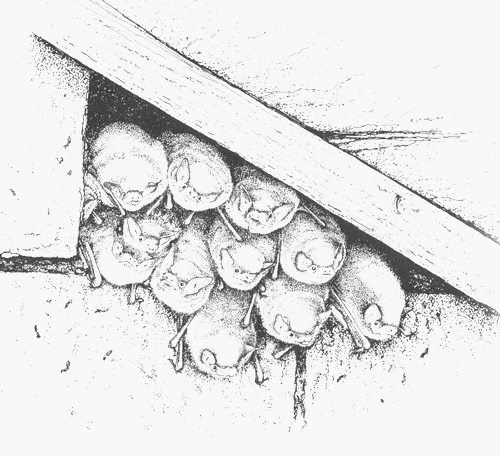
Daubenton's bats (Myotis daubentonii) in a summer roost

Roosting Daubenton’s bats

If so, British Bats is partly redressing the balance. You can learn a lot from this book about both biology in general and bat-biology in particular. It stimulates the mind, pleases the eye, describes the appearance, ecology, and range of all British species, and points the way to further reading and research. So let’s not hear it for John D. Altringham! Without specialized equipment, that is, but that equipment is getting cheaper and more widely available all the time: you don’t have to be a professional zoologist to record and analyse bat-calls any more. There is still a lot for zoologists, both amateur and professional, to learn about bats. Okay, some of the research – like fitting miniature radio-transmitters to wild bats – seems intrusive and smacks of Weber’s Entzauberung, or “disenchantment”, but the more we know about bats, the more we will be able to help conserve them and their habitats. Bats aren’t villains: cats are. I like both kinds of mammal, but I hope we can find some way in future to help stop the latter preying so heavily on the former. If this book helps publicize the problem, it will be valuable for bat-conservation just as it is already valuable for bat-science. In short, no more brick-bats for Brit-bats: we should control our cats better.

Reviewer’s note: Any scientific mistakes, misinterpretations or misunderstandings in this review are entirely your responsibility.

NOTES

1. sp = species, singular; spp = species, plural.

2. ch. 3, “The Biology of Temperate Bats”, pg. 40

3. Ibid., pg. 45

4. ch. 4, “An Ecological Synthesis”, pg. 98

5. Ibid., pg. 99

6. Ibid., pg. 71

7. ch. 5, “British Bats, Past and Present”, pg. 117

8. ch. 1, “Introduction”, pg. 10. “Phyllostomid” is scientific Greek for “leaf-mouthed clan”.

9. Ibid., pg. 11

10. Ibid., pg. 9

Prime Youver

The utilitarian philosopher Jeremy Bentham (1748-1832) thought that the notion of “natural rights” was “nonsense on stilts”. I’m inclined to agree with him, but I think the dismissal applies a fortiori to theology. In fact, I think theology is nonsense on stilts on roller-skates. It’s the pursuit of the unknowable, unprovable or impossible by the irrational, illogical or insane. The illiterate too, nowadays: at least Newman and C.S. Lewis are enjoyable to read, unlike most modern theologians. But there is a theological idea I’ve always found interesting: that you created the universe. And I did too. More than that: the idea says that you or I, or both of us, created God Him/Her/Itself. The idea works like this: if free will exists (I don’t think it does) and human beings can exercise it, every instance of free will must be an act ex nihilo, an act out of nothing, undetermined by what has gone before it, and not a necessary act, in the technical sense. But that act of free will can only take place because the actor exists in a universe. To put it another way: the necessary precondition of an unnecessitated act of free will is that the universe exist. One could conclude, then, that God is forced to create the universe in order to allow you, me and other human beings to exercise our free will: in other words, the primum movens, the prime mover or initial uncaused cause of the universe, is any act of free will by a human being. In short, you’re the prime youver and I’m the prime mever. But in order for God to create the universe, God has to exist. So an uncaused act of free will doesn’t just create creation, it creates the creator. The slightest freely chosen, undetermined act, from rubbing one’s nose to writing a postcard, brings about the Ultimate Whole and the Ultimate Holy. Whodunnit? Youdunnit! And I did too.

Okay, that’s nonsense on stilts on roller-skates on oily ice (in a hurricane) and undoubtedly blasphemous or sacrilegious by any normal theological standard. But it seems a sensical conclusion from nonsensical premises and it gives me the excuse for another piece of paronomasia.