The Mill to Power

Reading about Searle’s Chinese Room Argument at the Stanford Encyclopedia of Philosophy, I came across “Leibniz’s Mill” for the first time. At least, I think it was the first time:

It must be confessed, however, that perception, and that which depends upon it, are inexplicable by mechanical causes, that is to say, by figures and motions. Supposing that there were a machine whose structure produced thought, sensation, and perception, we could conceive of it as increased in size with the same proportions until one was able to enter into its interior, as he would into a mill. Now, on going into it he would find only pieces working upon one another, but never would he find anything to explain perception. It is accordingly in the simple substance, and not in the compound nor in a machine that the perception is to be sought. Furthermore, there is nothing besides perceptions and their changes to be found in the simple substance. And it is in these alone that all the internal activities of the simple substance can consist. (Monadology, 1714, section #17)

Andererseits muß man gestehen, daß die Vorstellungen, und Alles, was von ihnen abhängt, aus mechanischen Gründen, dergleichen körperliche Gestalten und Bewegungen sind, unmöglich erklärt werden können. Man stelle sich eine Maschine vor, deren Structur so eingerichtet sei, daß sie zu denken, zu fühlen und überhaupt vorzustellen vermöge und lasse sie unter Beibehaltung derselben Verhältnisse so anwachsen, daß man hinein, wie in das Gebäude einer Mühle eintreten kann. Dies vorausgesetzt, wird man bei Besichtigung des Innern nichts Anderes finden, als etliche Triebwerke, deren eins das andere bewegt, aber gar nichts, was hinreichen würde, den Grund irgend einer Vorstellung abzugeben. Die letztere gehört ausschließlich der einfachen Substanz an, nicht der zusammengesetzten, und dort, nicht hier, muß man sie suchen. Auch sind Vorstellungen und ihre Veränderungen zugleich das Einzige, was man in der einfachen Substanz antrifft. (Monadologie, 1714)

We can see that Leibniz’s argument applies to mechanism in general, not simply to the machines he could conceive in his own day. He’s claiming that consciousness isn’t corporeal. It can’t generated by interacting parts or particles. And intuitively, he seems to be right. How could a machine or mechanism, however complicated, be conscious? Intuition would say that it couldn’t. But is intuition correct? If we examine the brain, we see that consciousness begins with mechanism. Vision and the other senses are certainly electro-chemical processes in the beginning. Perhaps in the end too.

Some puzzles arise if we assume otherwise. If consciousness isn’t mechanistic, how does it interact with mechanism? If it’s immaterial, how does it interact with matter? But those questions go back much further, to Greek atomists like Democritus (c. 460-370 BC):

Δοκεῖ δὲ αὐτῶι τάδε· ἀρχὰς εἶναι τῶν ὅλων ἀτόμους καὶ κενόν, τὰ δ’ἀλλα πάντα νενομίσθαι.

He taught that the first principles of the universe are atoms and void; everything else is merely thought to exist.

Νόμωι (γάρ φησι) γλυκὺ καὶ νόμωι πικρόν, νόμωι θερμόν, νόμωι ψυχρόν, νόμωι χροιή, ἐτεῆι δὲ ἄτομα καὶ κενόν.

By convention sweet is sweet, bitter is bitter, hot is hot, cold is cold, color is color; but in truth there are only atoms and the void. (Democritus at Wikiquote)

Patterns of unconscious matter and energy influence consciousness and are perhaps entirely responsible for it. The patterns are tasteless, soundless, colourless, scentless, neither hot nor cold – in effect, units of information pouring through the circuits of reality. But are qualia computational? I think they are. I don’t think it’s possible to escape matter or mechanism and I certainly don’t think it’s possible to escape mathematics. But someone who thinks it’s possible to escape at least the first two is the Catholic philosopher Edward Feser. I wish I had come across his work a long time ago, because he raises some very interesting questions in a lucid way and confirms the doubts I’ve had for a long time about Richard Dawkins and other new atheists. His essay “Schrödinger, Democritus, and the paradox of materialism” (2009) is a good place to start.


Elsewhere other-posted:

Double Bubble
This Mortal Doyle
The Brain in Pain
The Brain in Train

Performativizing Papyrocentricity #30

Papyrocentric Performativity Presents:

Ai Luv YewThe Bonsai Bible: The Definitive Guide to Choosing and Growing Bonsai, Peter Chan (Hamlyn 2014)

Starway to HeavenGuide to the Pyramids of Egypt, Alberto Siliotti, preface by Zahi Hawass (White Star Publishers 2000)

Escape and EssenceThe Wooden Horse, Eric Williams (Pen & Sword 2013)

Aspects of the AnnihilatorSub-Machine Gun: The development of sub-machine guns and their ammunition from World War I to the present day, Maxim Popenker and Anthony G. Williams (Crowood Press 2011)

Northanger AbyssJane in Blood: Castration, Clitoridolatry and Communal Cannibalism in the Novels of Jane Austen, Dr Miriam B. Stimbers (University of Nebraska Press 2014)


Or Read a Review at Random: RaRaR

Performativizing Papyrocentricity #29

Papyrocentric Performativity Presents:

Sky StoryThe Cloud Book: How to Understand the Skies, Richard Hamblyn (David & Charles 2008)

Wine WordsThe Oxford Companion to Wine, ed. Janice Robinson (Oxford University Press 2006)

Nu WorldsNumericon, Marianne Freiberger and Rachel Thomas (Quercus Editions 2014)

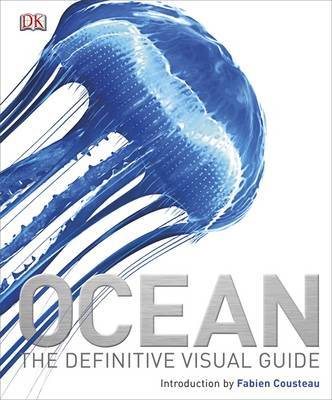
ThalassobiblionOcean: The Definitive Visual Guide, introduction by Fabien Cousteau (Dorling Kindersley 2014) (posted @ Overlord of the Über-Feral)


Or Read a Review at Random: RaRaR

Thalassobiblion

Ocean The Definitive Visual GuideOcean: The Definitive Visual Guide, introduction by Fabien Cousteau (Dorling Kindersley 2014)

A big book for a big subject: the sea. But “guide” isn’t the mot juste. “Encyclopaedia” is better, because the book covers all aspects of oceanography and marine life, drawing on physics, chemistry and biology to describe everything inorganic from waves and icebergs to whirlpools and underwater volcanoes, everything organic from a beautiful flower like beach morning-glory, Ipomoea imperati, to a grotesque fish like the Pacific blackdragon, Idiacanthus antrostomus. The flower is on the shore, the fish is in the abyss, but both of them descend from a single ancestor.

And that ancestor may have evolved in the sea. It certainly moved there before it gave rise to flowers and fish. This big subject is also a very important one: the sea is central to the evolution and continued existence of life on earth. Only the sun matters as much, but some marine life could potentially survive the disappearance of the sun:

Hydrothermal vents are similar to hot springs on land. Located near ocean ridges and rifts, at an average depth of 2,100m (7,000ft), they spew out mineral-rich, superheated seawater. Some have tall chimneys, formed from dissolved minerals that precipitate when the hot vent water meets cold, deep-ocean water. The mix of heat and chemicals supports animal communities around the vents – the first life known to exist entirely without the energy of sunlight. (pg. 188, “The Open Ocean and Ocean Floor”)

The deep ocean is a fascinating and little-known place: much nearer than the other side of the earth, but much harder to get to. Like climbing mountains, plumbing the abyss is difficult and dangerous. It’s interesting that both endeavours have been dominated by a particular group of human being: both the highest and lowest points on the planet were first reached by white males. Fabien Cousteau, who introduces this book, continues the tradition. He’s the grandson of Jacques Cousteau (1910-97), who popularized diving and marine biology for millions of people. Jacques saw huge advances in marine technology and science and his son and grandson have seen more. But the discoveries are still coming: as Fabien points out, it’s estimated that “over 90 per cent of the world’s biodiversity resides in its oceans”.

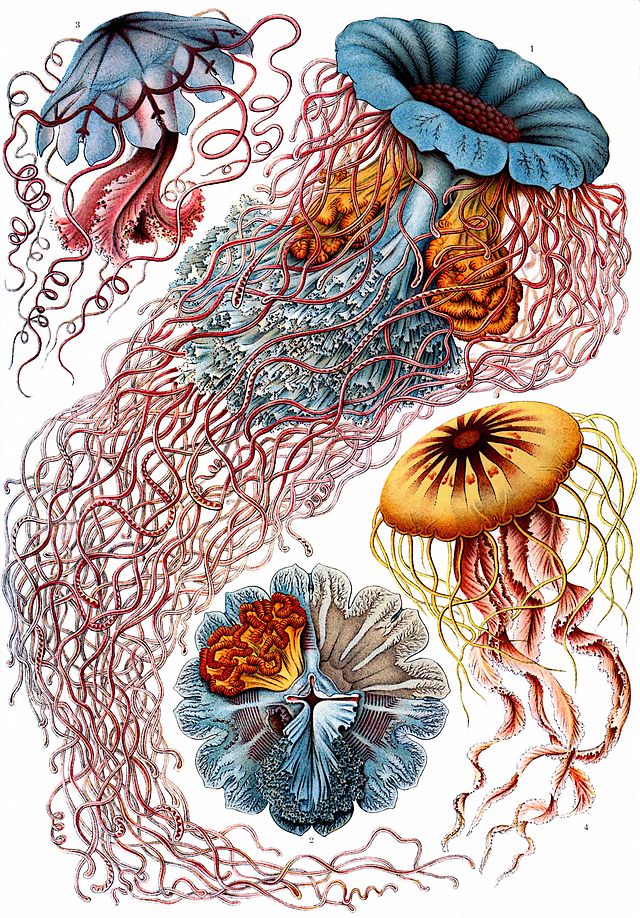
Discomedesae by Ernst Haeckel

Discomedusae by Ernst Haeckel

Some of that biodiversity left the water for the land and evolved new forms. Some of those new forms went back to the water, like the ceteceans and sea-snakes. Like human beings, they’re descended from fish, the most varied of all vertebrate groups. But some marine life never left its cradle. Where else can you find the beauty and strangeness of groups like the jellyfish? Radial symmetry is a marine speciality and when H.P. Lovecraft was inventing his aliens, he looked to under-space as much as outer:

But to give it a name at this stage was mere folly. It looked like a radiate, but was clearly something more. It was partly vegetable, but had three-fourths of the essentials of animal structure. That it was marine in origin, its symmetrical contour and certain other attributes clearly indicated; yet one could not be exact as to the limit of its later adaptations. The wings, after all, held a persistent suggestion of the aerial. How it could have undergone its tremendously complex evolution on a new-born earth in time to leave prints in Archaean rocks was so far beyond conception as to make Lake whimsically recall the primal myths about Great Old Ones who filtered down from the stars and concocted earth life as a joke or mistake; and the wild tales of cosmic hill things from outside told by a folklorist colleague in Miskatonic’s English department. (At the Mountains of Madness, 1931)

Lovecraft would have enjoyed Ocean as much as Jacques Cousteau. It closes with a detailed “Atlas of the Oceans”, with maps of the ocean floor all around the world. Before that, you can learn how the Corryvreckan whirlpool nearly killed George Orwell in 1947, where to find manganese nodules, why so many deep-sea creatures are red and what the narwhale’s horn really is. You can also feast your eyes on photography that records everything from microscopic plankton to swirling hurricanes hundreds of kilometres across. Big subject, big book. Beautiful subject and beautiful book too.

Hip-Hop Hermeneuticized

The Guardian undertakes a close hermeneutical analysis of some respected figures in the rap community and their complex and challenging lyrical interrogation of issues around neo-liberal capitalism:

In contemporary America, success in overcoming adversity (and often systemic racism) is most often represented in financial terms, and it’s a recurring theme in hip-hop. Consider Kanye West:

I treat the cash the way the government treats AIDS
I won’t be satisfied til all my niggas get it, get it?

Or Dr Dre:

Get your money right
Don’t be worried ’bout the next man – make sure your business tight
Get your money right
Go inside the safe, grab your stash that you copped tonight
Get your money right
Be an international player, don’t be scared to catch those red eye flights
You better get your money right
Cause when you out there on the streets, you gotta get it – get it

Or even TI himself:

Regardless what haters say I’m as real as they come
I’m chasin that paper baby however it come
I’m singin a song and movin yay by the ton
I bet you never seen a nigga gettin money so young.

Hip-Hop Hermeneuticized

Material Whirled

When we are conscious of being conscious, what are we consciousness-conscious with? If consciousness is a process in the brain, the process has become aware of itself, but how does it do so? And what purpose does consciousness-of-consciousness serve? Is it an artefact or an instrument? Is it an illusion? A sight or sound or smell is consciousness of a thing-in-itself, but that doesn’t apply here. We aren’t conscious of the thing-in-itself: the brain and its electro-chemistry. We’re conscious of the glitter on the swinging sword, but not the sword or the swing.

We can also be conscious of being conscious of being conscious, but beyond that my head begins to spin. Which brings me to an interesting reminder of how long the puzzle of consciousness has existed in its present form: how do we get from matter to mind? As far as I can see, science understands the material substrate of consciousness – the brain – in greater and greater detail, but is utterly unable to explain how objective matter becomes subjective consciousness. We have not moved an inch towards understanding how quanta become qualia since this was published in 1871:

Were our minds and senses so expanded, strengthened, and illuminated, as to enable us to see and feel the very molecules of the brain; were we capable of following all their motions, all their groupings, all their electric discharges, if such there be; and were we intimately acquainted with the corresponding states of thought and feeling, we should be as far as ever from the solution of the problem, “How are these physical processes connected with the facts of consciousness?” The chasm between the two classes of phenomena would still remain intellectually impassable.

Let the consciousness of love, for example, be associated with a right-handed spiral motion of the molecules of the brain, and the consciousness of hate with a left-handed spiral motion. We should then know, when we love, that the motion is in one direction, and, when we hate, that the motion is in the other; but the “Why?” would remain as unanswerable as before. — John Tyndall, Fragments of Science (1871), viâ Rational Buddhism.


Elsewhere other-posted:

Double Bubble
The Brain in Pain
The Brain in Train
This Mortal Doyle

Performativizing Papyrocentricity #25

Papyrocentric Performativity Presents:

Colouring the ChameleonOlivier, Philip Ziegler (MacLehose Press 2013)

Paper-DeepTreasure Island (1883) and Dr. Jekyll and Mr. Hyde (1885), Robert Louis Stevenson

Fins and FangsThe Fresh and Salt Water Fishes of the World, Edward C. Migdalski and George S. Fichter, illustrated by Norman Weaver (1977) (posted @ Overlord of the Über-Feral)


Or Read a Review at Random: RaRaR

Fins and Fangs

Fresh and Salt-Water Fishes of the World by Edward C. Migdalski and George S. Fichter illustrated by Norman WeaverThe Fresh and Salt Water Fishes of the World, Edward C. Migdalski and George S. Fichter, illustrated by Norman Weaver (1977)

A big book with a big subject: fish are the most numerous and varied of the vertebrates, from the bus-sized Rhincodon typus or whale shark, which feeds its vast bulk on plankton, to the little-finger-long Vandellia cirrhosa, the parasitic catfish that can give bathers a nasty surprise by swimming into their “uro-genitary openings” – “the pain is agonizing and the fish can be removed only by surgery”. The book is full of interesting asides like that, but I doubt that readers will read every page carefully. They’ll certainly look at every page carefully, to see Norman Weaver’s gorgeous drawings, which capture both the colour and the shine of fish’s bodies. Another aspect of the enormous variation of fish is not just their differences in size, shape and colouring, but their differences in aesthetic appeal. Some are among the most beautiful of living creatures, others among the most grotesque, like the Lovecraftian horrors that literally dwell in the abyss: inhabitants of the very deep ocean like Chauliodus macouni, the Pacific viperfish, whose teeth are too long and sharp for it to close its mouth.

The crushing pressure and freezing darkness in which these fish live are alien to human beings and so are the appearance and behaviour of the fish. But fish that live in shallow water, like the hammerhead shark and the electric eel, can seem alien too and some of the strangest fish of all, the horizontally flattened rays and mantas, can even fly briefly in the open air. Some of the piscine beauties, on the other hand, like Cheirodon axelrodi, the neon-bodied cardinal tetra, are routinely kept in aquariums, but then so is the very strange Anoptichthys jordani, the blind cavefish. There’s a blind torpedo ray too, Typhlonarke aysoni, “which has no functional eyes and ‘stumps’ along the bottom on its thick, leglike ventral fins”. But the appearance, behaviour and habitat of fish aren’t the only things man finds interesting about them. Some are good eating or offer good sport and the authors often discuss both cuisine and fishing in relation to a particular species or family. That raises the second of the two questions I keep asking myself when I look at this book. The first question is: “Why are some fish so beautiful and some so ugly?” The second is: “Are fish capable of suffering, and if they are, do they suffer much?”

I don’t know if the first question can be answered or is even sensible to ask; the second will, I hope, be answered by science in the negative. It’s not pleasant to think of what a positive answer would mean, because we’ve been hooking and hauling fish from fresh and salt water for countless generations. In the past, it was for food, but when we do it today it’s often for fun. I hope the fun isn’t at fish’s expense in more than the obvious sense: that it deprives them permanently of life or, for those returned to the water, temporarily of peaceful existence. I hope the deprivation is not painful in any strong sense. Either way, fish will continue to die at each other’s fangs and to serve as food for many species of mammal and bird. Nature is red in tooth and claw, after all, but it’s a lot more beside and this is one of the books that will show you how. From luminous sharks to uncannily accurate archerfish, from what men do to fish to what fish do to men: the 315 pages of the large and lavishly illustrated Fishes of the World can offer only a glimpse into a very rich and fascinating world, but a glimpse is dazzling.


Previously pre-posted (please peruse):

Slug is a DrugCollins Complete Guide to British Coastal Wildlife (2012)