
A perceived sphere (image from AnOpticalIllusion.com)

A perceived sphere (image from AnOpticalIllusion.com)
“My only drugs are silence and solitude.” — Frederick Forsyth in The Outsider: My Life in Intrigue (2015)

Silver Y Moth, Autographa gamma (Linnaeus 1758)
[I]t was hard to pierce Robert de Montesquiou’s carapace — and he wouldn’t have wanted you to. He was perhaps at heart a melancholic: he liked to say that his mother had “given me the sad present of life”. His restlessness and furious inquisitiveness might have been a response to this. He was vain without being especially self-reflective, one of those who, rather than look inside to discover who they are, prefer to see themselves in the reflections that come back from others. — Julian Barnes, The Man in the Red Coat (2019), pp. 192-3
Elsewhere Other-Accessible…
• Portait of a Peacock — Cornelia Otis Skinner’s essay on Montesquiou
• Le Paon dans les Pyrénées — review of Barnes’ The Man in the Red Coat

Some examples of impossible geometry (poster at Tarquin)
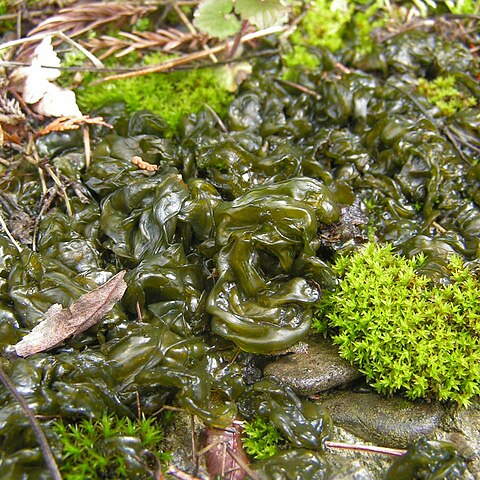
The colonial cyanobacterium Nostoc commune (image from Wikipedia)
Post-Performative Post-Scriptum…
The title of this incendiary intervention is a reference to the French phrase nostalgie de la boue, literally meaning “nostalgia for mud” and referring to a longing for social or sexual degradation.

When you stare at the cross for at least 30 seconds, you see three illusions:
• A gap running around the circle of lilac discs;
• A green disc running around the circle of lilac discs in place of the gap; and
• The green disc running around on the grey background, with the lilac discs having disappeared in sequence. — Lilac Chaser, Wikipedia
Elsewhere Other-Accessible…
• Troxler’s fading at Wikipedia
Pol. How say you by that? Still harping on my daughter: yet he knew me not at first; he said I was a Fishmonger: he is farre gone, farre gone: and truly in my youth, I suffred much extreamity for loue: very neere this. Ile speake to him againe. What do you read my Lord?
Ham. Words, words, words. — Hamlet (c. 1600), Act 2, Scene 2

Chimerical colors (from Wikipedia)
(click for larger)
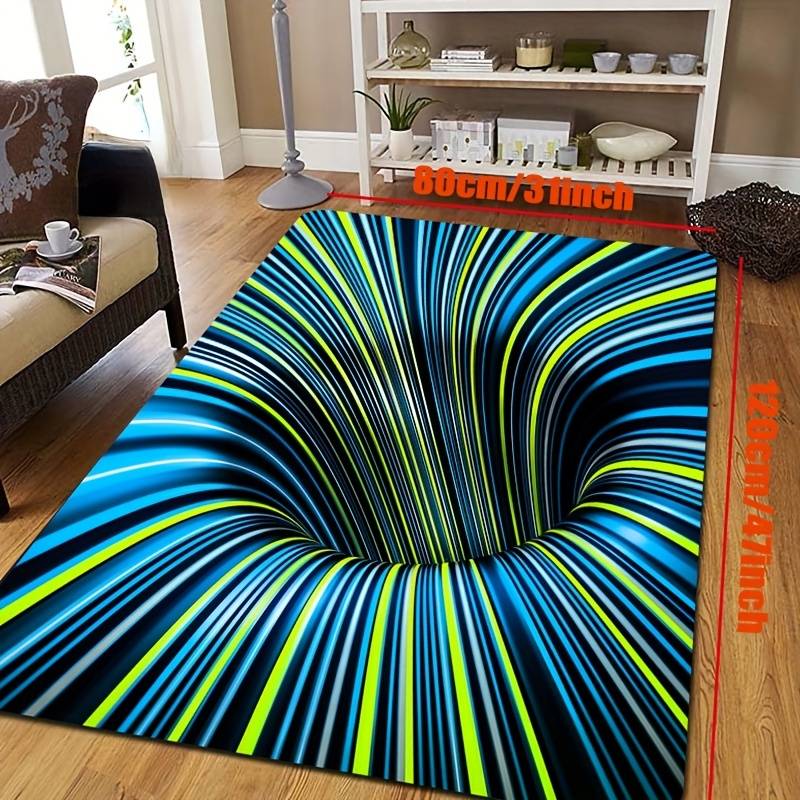
Abyss-illusion rug in blue and yellow (image from Temu)
 Overlord In Terms of Core Issues Around Maximal Engagement with Key Notions of the Über-Feral
