
You Sixy Beast

666 is the Number of the Beast. But it’s much more than that. After all, it’s a number, so it has mathematical properties (everything has mathematical properties, but it’s a sine-qua-non of numbers). For example, 666 is a palindromic number, reading the same forwards and backwards. And it’s a repdigit, consisting of a single repeated digit. Now try answering this question: how many pebbles are there in this triangle?


••
•••
••••
•••••
••••••
•••••••
••••••••
•••••••••
••••••••••
•••••••••••
••••••••••••
•••••••••••••
••••••••••••••
•••••••••••••••
••••••••••••••••
•••••••••••••••••
••••••••••••••••••
•••••••••••••••••••
••••••••••••••••••••
•••••••••••••••••••••
••••••••••••••••••••••
•••••••••••••••••••••••
••••••••••••••••••••••••
•••••••••••••••••••••••••
••••••••••••••••••••••••••
•••••••••••••••••••••••••••
••••••••••••••••••••••••••••
•••••••••••••••••••••••••••••
••••••••••••••••••••••••••••••
•••••••••••••••••••••••••••••••
••••••••••••••••••••••••••••••••
•••••••••••••••••••••••••••••••••
••••••••••••••••••••••••••••••••••
•••••••••••••••••••••••••••••••••••
••••••••••••••••••••••••••••••••••••


Counting the pebbles one by one would take a long time, but there’s a short-cut. Each line of the triangle after the first is one pebble longer than the previous line. There are 36 lines and therefore 36 pebbles in the final line. So the full number of pebbles = 1 + 2 + 3 + 4 + 5 + 6 + 7 + 8 + 9 + 10 + 11 + 12 + 13 + 14 + 15 + 16 + 17 + 18 + 19 + 20 + 21 + 22 + 23 + 24 + 25 + 26 + 27 + 28 + 29 + 30 + 31 + 32 + 33 + 34 + 35 + 36. And there’s an easy formula for that sum: (36^2 + 36) / 2 = (1296 + 36) / 2 = 1332 / 2 = 666.

So 666 is the 36th triangular number:


1 = 1
1+2 = 3
1+2+3 = 6
1+2+3+4 = 10
1+2+3+4+5 = 15
1+2+3+4+5+6 = 21
1+2+3+4+5+6+7 = 28
1+2+3+4+5+6+7+8 = 36
1+2+3+4+5+6+7+8+9 = 45
1+2+3+4+5+6+7+8+9+10 = 55
[...]
1+2+3+4+5+6+7+8+9+10+11+12+13+14+15+16+17+18+19+20+21+22+23+24+25+26+27+28+29+30+31+32+33+34+35+36 = 666

But what’s tri(666), the 666th triangular number? By the formula above, it equals (666^2 + 666) / 2 = (443556 + 666) / 2 = 444222 / 2 = 222111. But recall something else from above: tri(6) = 1+2+3+4+5+6 = 21. Is it a coincidence that tri(6) = 21 and tri(666) = 222111? No, it isn’t:


tri(6) = 21 = (6^2 + 6) / 2 = (36 + 6) / 2 = 42 / 2
tri(66) = 2211 = (66^2 + 66) / 2 = (4356 + 66) / 2 = 4422 / 2
tri(666) = 222111 = (666^2 + 666) / 2 = (443556 + 666) / 2 = 444222 / 2
tri(6666) = 22221111
tri(66666) = 2222211111
tri(666666) = 222222111111
tri(6666666) = 22222221111111
tri(66666666) = 2222222211111111
tri(666666666) = 222222222111111111
tri(6666666666) = 22222222221111111111
tri(66666666666) = 2222222222211111111111
tri(666666666666) = 222222222222111111111111
tri(6666666666666) = 22222222222221111111111111
tri(66666666666666) = 2222222222222211111111111111
tri(666666666666666) = 222222222222222111111111111111

So we’ve looked at tri(36) = 666 and tri(666) = 222111. Let’s go a step further: tri(222111) = 24666759216. So 666 appears again. And the sixiness carries on here:


tri(36) = 666
tri(3366) = 5666661
tri(333666) = 55666666611
tri(33336666) = 555666666666111
tri(3333366666) = 5555666666666661111
tri(333333666666) = 55555666666666666611111
tri(33333336666666) = 555555666666666666666111111
tri(3333333366666666) = 5555555666666666666666661111111
tri(333333333666666666) = 55555555666666666666666666611111111
tri(33333333336666666666) = 555555555666666666666666666666111111111
tri(3333333333366666666666) = 5555555555666666666666666666666661111111111
tri(333333333333666666666666) = 55555555555666666666666666666666666611111111111
tri(33333333333336666666666666) = 555555555555666666666666666666666666666111111111111
tri(3333333333333366666666666666) = 5555555555555666666666666666666666666666661111111111111
tri(333333333333333666666666666666) = 55555555555555666666666666666666666666666666611111111111111
Year and Square

The simplest and in some ways greatest magic square is this:

6 1 8
7 5 3
2 9 4 (Magic total = 15)

All rows and columns sum to 15 and so do both diagonals. Using other sets of numbers, you can create an infinite number of further 3×3 magic squares. Here’s one using only prime numbers and 1:

43 01 67
61 37 13
07 73 31 (Magic=111)

The magic total is 111, which is 3 x 37, just as 15 = 3 x 5. It’s an interesting but untaxing exercise to prove that, for all 3×3 magic squares, the magic total is three times the central number. So you can use only prime numbers in a 3×3 square, but you can’t have a prime number as the magic total (unless you use fractions and so on).

And guess what? 2019 = 3 x 667, the first prime number after 666. So I decided to see if I could find an all-prime magic squares whose magic total was 2019. I found nine of them (and 9 = 3 x 3).

1117 0019 0883
0439 0673 0907
0463 1327 0229 (Magic=2019)

1069 0067 0883
0487 0673 0859
0463 1279 0277 (Magic=2019)

1063 0229 0727
0337 0673 1009
0619 1117 0283 (Magic=2019)

0883 0313 0823
0613 0673 0733
0523 1033 0463 (Magic=2019)

0619 0337 1063
1117 0673 0229
0283 1009 0727 (Magic=2019)

0463 0439 1117
1327 0673 0019
0229 0907 0883 (Magic=2019)

0463 0487 1069
1279 0673 0067
0277 0859 0883 (Magic=2019)

0379 0607 1033
1327 0673 0019
0313 0739 0967 (Magic=2019)

0523 0613 0883
1033 0673 0313
0463 0733 0823 (Magic=2019)

Digital Disfunction

It’s fun when functions disfunc. The function digit-sum(n^p) takes a number, raises it to the power of p and sums its digits. If p = 1, n is unchanged. So digit-sum(1^1) = 1, digit-sum(11^1) = 2, digit-sum(2013^1) = 6. The following numbers set records for the digit-sum(n^1) from 1 to 1,000,000:

digit-sum(n^1): 1, 2, 3, 4, 5, 6, 7, 8, 9, 19, 29, 39, 49, 59, 69, 79, 89, 99, 199, 299, 399, 499, 599, 699, 799, 899, 999, 1999, 2999, 3999, 4999, 5999, 6999, 7999, 8999, 9999, 19999, 29999, 39999, 49999, 59999, 69999, 79999, 89999, 99999, 199999, 299999, 399999, 499999, 599999, 699999, 799999, 899999, 999999.

The pattern is easy to predict. But the function disfuncs when p = 2. Digit-sum(3^2) = 9, which is more than digit-sum(4^2) = 1 + 6 = 7 and digit-sum(5^2) = 2 + 5 = 7. These are the records from 1 to 1,000,000:

digit-sum(n^2): 1, 2, 3, 7, 13, 17, 43, 63, 83, 167, 264, 313, 707, 836, 1667, 2236, 3114, 4472, 6833, 8167, 8937, 16667, 21886, 29614, 32617, 37387, 39417, 42391, 44417, 60663, 63228, 89437, 141063, 221333, 659386, 791833, 976063, 987917.

Higher powers are similarly disfunctional:

digit-sum(n^3): 1, 2, 3, 4, 9, 13, 19, 53, 66, 76, 92, 132, 157, 353, 423, 559, 842, 927, 1192, 1966, 4289, 5826, 8782, 10092, 10192, 10275, 10285, 10593, 11548, 11595, 12383, 15599, 22893, 31679, 31862, 32129, 63927, 306842, 308113.

digit-sum(n^4): 1, 2, 3, 4, 6, 8, 13, 16, 18, 23, 26, 47, 66, 74, 118, 256, 268, 292, 308, 518, 659, 1434, 1558, 1768, 2104, 2868, 5396, 5722, 5759, 6381, 10106, 12406, 14482, 18792, 32536, 32776, 37781, 37842, 47042, 51376, 52536, 84632, 255948, 341156, 362358, 540518, 582477.

digit-sum(n^5): 1, 2, 3, 5, 6, 14, 15, 18, 37, 58, 78, 93, 118, 131, 139, 156, 179, 345, 368, 549, 756, 1355, 1379, 2139, 2759, 2779, 3965, 4119, 4189, 4476, 4956, 7348, 7989, 8769, 9746, 10566, 19199, 19799, 24748, 31696, 33208, 51856, 207198, 235846, 252699, 266989, 549248, 602555, 809097, 814308, 897778.

You can also look for narcissistic numbers with this function, like digit-sum(9^2) = 8 + 1 = 9 and digit-sum(8^3) = 5 + 1 + 2 = 8. 9^2 is the only narcissistic square in base ten, but 8^3 has these companions:

17^3 = 4913 → 4 + 9 + 1 + 3 = 17
18^3 = 5832 → 5 + 8 + 3 + 2 = 18
26^3 = 17576 → 1 + 7 + 5 + 7 + 6 = 26
27^3 = 19683 → 1 + 9 + 6 + 8 + 3 = 27

Twelfth powers are as unproductive as squares:

108^12 = 2518170116818978404827136 → 2 + 5 + 1 + 8 + 1 + 7 + 0 + 1 + 1 + 6 + 8 + 1 + 8 + 9 + 7 + 8 + 4 + 0 + 4 + 8 + 2 + 7 + 1 + 3 + 6 = 108

But thirteenth powers are fertile:

20 = digit-sum(20^13)
40 = digit-sum(40^13)
86 = digit-sum(86^13)
103 = digit-sum(103^13)
104 = digit-sum(104^13)
106 = digit-sum(106^13)
107 = digit-sum(107^13)
126 = digit-sum(126^13)
134 = digit-sum(134^13)
135 = digit-sum(135^13)
146 = digit-sum(146^13)

There are also numbers that are narcissistic with different powers, like 90:

90^19 = 1·350851717672992089 x 10^37 → 1 + 3 + 5 + 0 + 8 + 5 + 1 + 7 + 1 + 7 + 6 + 7 + 2 + 9 + 9 + 2 + 0 + 8 + 9 = 90
90^20 = 1·2157665459056928801 x 10^39 → 1 + 2 + 1 + 5 + 7 + 6 + 6 + 5 + 4 + 5 + 9 + 0 + 5 + 6 + 9 + 2 + 8 + 8 + 0 + 1 = 90
90^21 = 1·09418989131512359209 x 10^41 → 1 + 0 + 9 + 4 + 1 + 8 + 9 + 8 + 9 + 1 + 3 + 1 + 5 + 1 + 2 + 3 + 5 + 9 + 2 + 0 + 9 = 90
90^22 = 9·84770902183611232881 x 10^42 → 9 + 8 + 4 + 7 + 7 + 0 + 9 + 0 + 2 + 1 + 8 + 3 + 6 + 1 + 1 + 2 + 3 + 2 + 8 + 8 + 1 = 90
90^28 = 5·23347633027360537213511521 x 10^54 → 5 + 2 + 3 + 3 + 4 + 7 + 6 + 3 + 3 + 0 + 2 + 7 + 3 + 6 + 0 + 5 + 3 + 7 + 2 + 1 + 3 + 5 + 1 + 1 + 5 + 2 + 1 = 90

One of the world’s most famous numbers is also multi-narcissistic:

666 = digit-sum(666^47)
666 = digit-sum(666^51)

1423 isn’t multi-narcissistic, but I like the way it’s a prime that’s equal to the sum of the digits of its power to 101, which is also a prime:

1423^101 = 2,
976,424,759,070,864,888,448,625,568,610,774,713,351,233,339,
006,775,775,271,720,934,730,013,444,193,709,672,452,482,197,
898,160,621,507,330,824,007,863,598,230,100,270,989,373,401,
979,514,790,363,102,835,678,646,537,123,754,219,728,748,171,
764,802,617,086,504,534,229,621,770,717,299,909,463,416,760,
781,260,028,964,295,036,668,773,707,186,491,056,375,768,526,
306,341,717,666,810,190,220,650,285,746,057,099,312,179,689,
423 →

2 + 9 + 7 + 6 + 4 + 2 + 4 + 7 + 5 + 9 + 0 + 7 + 0 + 8 + 6 + 4 + 8 + 8 + 8 + 4 + 4 + 8 + 6 + 2 + 5 + 5 + 6 + 8 + 6 + 1 + 0 + 7 + 7 + 4 + 7 + 1 + 3 + 3 + 5 + 1 + 2 + 3 + 3 + 3 + 3 + 9 + 0 + 0 + 6 + 7 + 7 + 5 + 7 + 7 + 5 + 2 + 7 + 1 + 7 + 2 + 0 + 9 + 3 + 4 + 7 + 3 + 0 + 0 + 1 + 3 + 4 + 4 + 4 + 1 + 9 + 3 + 7 + 0 + 9 + 6 + 7 + 2 + 4 + 5 + 2 + 4 + 8 + 2 + 1 + 9 + 7 + 8 + 9 + 8 + 1 + 6 + 0 + 6 + 2 + 1 + 5 + 0 + 7 + 3 + 3 + 0 + 8 + 2 + 4 + 0 + 0 + 7 + 8 + 6 + 3 + 5 + 9 + 8 + 2 + 3 + 0 + 1 + 0 + 0 + 2 + 7 + 0 + 9 + 8 + 9 + 3 + 7 + 3 + 4 + 0 + 1 + 9 + 7 + 9 + 5 + 1 + 4 + 7 + 9 + 0 + 3 + 6 + 3 + 1 + 0 + 2 + 8 + 3 + 5 + 6 + 7 + 8 + 6 + 4 + 6 + 5 + 3 + 7 + 1 + 2 + 3 + 7 + 5 + 4 + 2 + 1 + 9 + 7 + 2 + 8 + 7 + 4 + 8 + 1 + 7 + 1 + 7 + 6 + 4 + 8 + 0 + 2 + 6 + 1 + 7 + 0 + 8 + 6 + 5 + 0 + 4 + 5 + 3 + 4 + 2 + 2 + 9 + 6 + 2 + 1 + 7 + 7 + 0 + 7 + 1 + 7 + 2 + 9 + 9 + 9 + 0 + 9 + 4 + 6 + 3 + 4 + 1 + 6 + 7 + 6 + 0 + 7 + 8 + 1 + 2 + 6 + 0 + 0 + 2 + 8 + 9 + 6 + 4 + 2 + 9 + 5 + 0 + 3 + 6 + 6 + 6 + 8 + 7 + 7 + 3 + 7 + 0 + 7 + 1 + 8 + 6 + 4 + 9 + 1 + 0 + 5 + 6 + 3 + 7 + 5 + 7 + 6 + 8 + 5 + 2 + 6 + 3 + 0 + 6 + 3 + 4 + 1 + 7 + 1 + 7 + 6 + 6 + 6 + 8 + 1 + 0 + 1 + 9 + 0 + 2 + 2 + 0 + 6 + 5 + 0 + 2 + 8 + 5 + 7 + 4 + 6 + 0 + 5 + 7 + 0 + 9 + 9 + 3 + 1 + 2 + 1 + 7 + 9 + 6 + 8 + 9 + 4 + 2 + 3 = 1423


Previously pre-posted (please peruse):

The Hill to Power
Narcissarithmetic #1
Narcissarithmetic #2

Sumbertime Views

Like 666 (see Revelation 13:18), 153 (see John 21:11) appears in the Bible. And perhaps for the same reason: because it is the sum of successive integers. 153 = 1+2+3+…+17 = Σ(17), just as 666 = Σ(36). So both numbers are sum-numbers or sumbers. But 153 has other interesting properties, including one that can’t have been known in Biblical times, because numbers weren’t represented in the right way. It’s also the sum of the cubes of its digits: 153 = 1^3 + 5^3 + 3^3 = 1 + 125 + 27. So 153 is a cube-sumber or 3-sumber. The other 3-sumbers are 370, 371 and 407. There are 4-sumbers too, like 1,634 = 1^4 + 6^4 + 3^4 + 4^4, and 5-sumbers, like 194,979 = 1^5 + 9^5 + 4^5 + 9^5 + 7^5 + 9^5, and 6-sumbers, like 548,834 = 5^6 + 4^6 + 8^6 + 8^6 + 3^6 + 4^6.

But there are no 2-sumbers, or numbers that are the sum of the squares of their digits. It doesn’t take long to confirm this, because numbers above a certain size can’t be 2-sumbers. 9^2 + 9^2 = 162, but 9^2 + 9^2 + 9^2 = 243. So 2-sumbers can’t exist above 99 and if you search that high you’ll find that they don’t exist at all. At least not in this house, but they do exist in the houses next door. Base 10 yields nothing, so what about base 9?

4^2 + 5^2 = 45[9] = 41[10]
5^2 + 5^2 = 55[9] = 50

And base 11?

5^2 + 6^2 = 56[11] = 61[10]
6^2 + 6^2 = 66[11] = 72

This happens because odd bases always yield a pair of 2-sumbers whose second digit is one more than half the base and whose first digit is the same or one less. See above (and the appendix). Such a pair is found among the 14 sumbers of base 47, which is the best total till base 157 and its 22 sumbers. Here are the 2-sumbers for base 47:

2^2 + 10^2 = 104
3^2 + 12^2 = 153
5^2 + 15^2 = 250
9^2 + 19^2 = 442
12^2 + 21^2 = 585
14^2 + 22^2 = 680
23^2 + 24^2 = 1,105
24^2 + 24^2 = 1,152
33^2 + 22^2 = 1,573
35^2 + 21^2 = 1,666
38^2 + 19^2 = 1,805
42^2 + 15^2 = 1,989
44^2 + 12^2 = 2,080
45^2 + 10^2 = 2,125

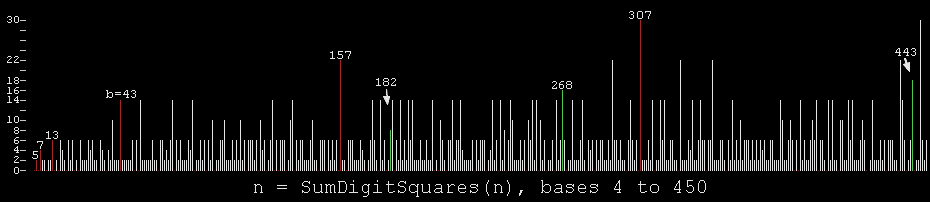
As the progressive records for 2-sumber-totals are set, subsequent bases seem to either match or surpass them, except in three cases below base 450:

2 in base 5
4 in base 7
6 in base 13
10 in base 43
14 in base 47
22 in base 157
8 in base 182*
16 in base 268*
30 in base 307
18 in base 443*

Totals for sums of squares in bases 4 to 450

Totals for sums-of–squares in bases 4 to 450 (click for larger image)

Appendix: Odd Bases and 2-sumbers

Take an even number and half of that even number: say 12 and 6. 12 x 6 = 11 x 6 + 6. Further, 12 x 6 = 2 x 6 x 6 = 2 x 6^2 = 6^2 + 6^2. Accordingly, 66[11] = 6 x 11 + 6 = 12 x 6 = 6^2 + 6^2. So 66 in base 11 is a 2-sumber. Similar reasoning applies to every other odd base except base-3 [update: wrong!]. Now, take 12 x 5 = 2 x 6 x 5 = 2 x (5×5 + 5) = 5^2+5 + 5^5+5 = 5^5 + 5^5+2×5. Further, 5^5+2×5 = (5+1)(5+1) – 1 = 6^2 – 1. Accordingly, 56[11] = 11×5 + 6 = 12×5 + 1 = 5^2 + 6^2. Again, similar reasoning applies to every other odd base except base-3 [update: no — 1^2 + 2^2 = 12[3] = 5; 2^2 + 2^2 = 22[3] = 8]. This means that every odd base b, except base-3, will supply a pair of 2-sumbers with digits [d-1][d] and [d][d], where d = (b + 1) / 2.