Spijit

The only two digits found in all standard bases are 1 and 0. But they behave quite differently. Suppose you take the integers 1 to 100 and compare the number of 1s and 0s in the representation of each integer, n, in bases 2 to n-1. For example, 10 would look like this:

1010 in base 2
101 in base 3
22 in base 4
20 in base 5
14 in base 6
13 in base 7
12 in base 8
11 in base 9

So there are nine 1s and four 0s. If you check 1 to 100 using this all-base function, the count of 1s goes like this:

1, 1, 2, 3, 5, 5, 8, 5, 9, 9, 11, 10, 15, 12, 14, 13, 15, 12, 17, 14, 20, 19, 20, 15, 23, 19, 22, 22, 25, 24, 31, 21, 25, 24, 24, 27, 33, 27, 31, 29, 34, 29, 36, 30, 34, 35, 34, 30, 40, 33, 36, 35, 38, 34, 42, 37, 43, 40, 41, 37, 48, 39, 42, 42, 44, 43, 48, 43, 47, 46, 51, 42, 53, 44, 48, 50, 51, 50, 55, 48, 59, 55, 55, 54, 64, 57, 57, 55, 60, 57, 68, 60, 64, 63, 64, 59, 68, 58, 61, 63.

And the count of 0s goes like this:

0, 1, 0, 2, 1, 2, 0, 4, 4, 4, 2, 5, 1, 2, 2, 7, 4, 8, 4, 7, 4, 3, 1, 8, 4, 4, 6, 8, 4, 7, 1, 10, 8, 7, 7, 12, 5, 6, 5, 10, 4, 8, 2, 6, 7, 4, 2, 12, 6, 9, 7, 8, 4, 11, 6, 10, 5, 4, 2, 12, 2, 3, 5, 14, 11, 13, 7, 10, 8, 11, 5, 17, 7, 8, 10, 10, 8, 10, 4, 13, 12, 10, 8, 16, 8, 7, 7, 12, 6, 14, 6, 8, 5, 4, 4, 16, 6, 10, 11, 15.

The bigger the numbers get, the bigger the discrepancies get. Sometimes the discrepancy is dramatic. For example, suppose you represented the prime 1014719 in bases 2 to 1014718. How 0s would there be? And how many 1s? There are exactly nine zeroes:

1014719 = 11110111101110111111 in base 2 = 1220112221012 in base 3 = 40B27B in base 12 = 1509CE in base 15 = 10[670] in base 1007.

But there are 507723 ones. The same procedure applied to the next integer, 1014720, yields 126 zeroes and 507713 ones. However, there is a way to see that 1s and 0s in the all-base representation are behaving in a similar way. To do this, imagine listing the individual digits of n in bases 2 to n-1 (or just base 2, if n <= 3). When the digits aren’t individual they look like this:

1 = 1 in base 2
2 = 10 in base 2
3 = 11 in base 2
4 = 100 in base 2; 11 in base 3
5 = 101 in base 2; 12 in base 3; 11 in base 4
6 = 110 in base 2; 20 in base 3; 12 in base 4; 11 in base 5
7 = 111 in base 2; 21 in base 3; 13 in base 4; 12 in base 5; 11 in base 6
8 = 1000 in base 2; 22 in base 3; 20 in base 4; 13 in base 5; 12 in base 6; 11 in base 7
9 = 1001 in base 2; 100 in base 3; 21 in base 4; 14 in base 5; 13 in base 6; 12 in base 7; 11 in base 8
10 = 1010 in base 2; 101 in base 3; 22 in base 4; 20 in base 5; 14 in base 6; 13 in base 7; 12 in base 8; 11 in base 9

So the list would look like this:

1, 1, 0, 1, 1, 1, 0, 0, 1, 1, 1, 0, 1, 1, 2, 1, 1, 1, 1, 0, 2, 0, 1, 2, 1, 1, 1, 1, 1, 2, 1, 1, 3, 1, 2, 1, 1, 1, 0, 0, 0, 2, 2, 2, 0, 1, 3, 1, 2, 1, 1, 1, 0, 0, 1, 1, 0, 0, 2, 1, 1, 4, 1, 3, 1, 2, 1, 1, 1, 0, 1, 0, 1, 0, 1, 2, 2, 2, 0, 1, 4, 1, 3, 1, 2, 1, 1

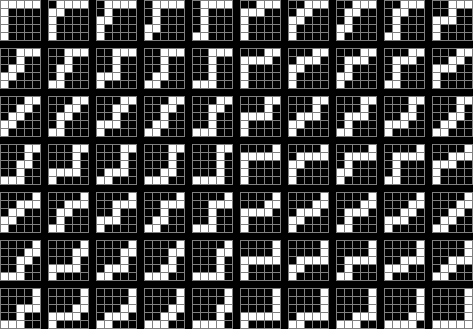
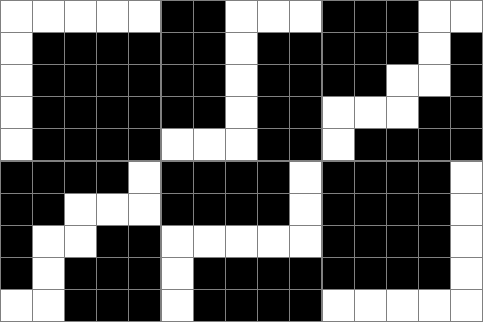
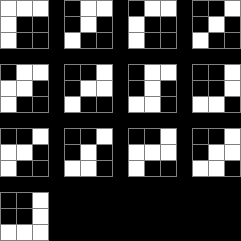
Suppose that these digits are compared against the squares of a counter-clockwise spiral on a rectangular grid. If the spiral digit is equal to 1, the square is filled in; if the spijit is not equal to 1, the square is left blank. The 1-spiral looks like this:
1spiral
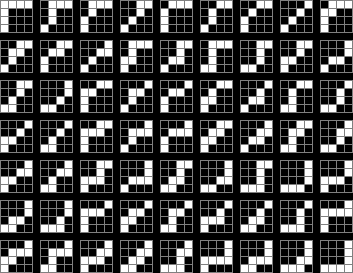
Now try zero. If the spijit is equal to 0, the square is filled in; if not, the square is left blank. The 0-spiral looks like this:
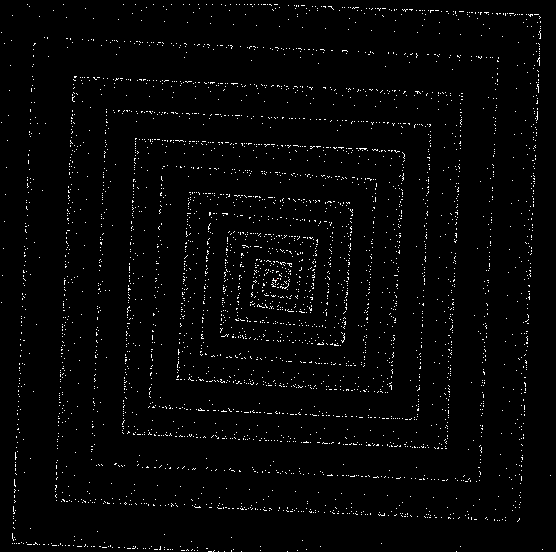
0spiral
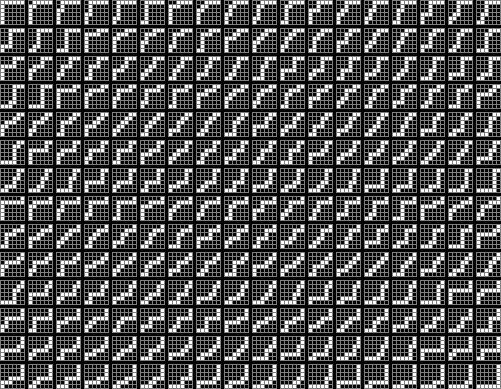
And here’s an animated gif of the n-spiral for n = 0..9:
animspiral

N-route

In maths, one thing leads to another. I wondered whether, in a spiral of integers, any number was equal to the digit-sum of the numbers on the route traced by moving to the origin first horizontally, then vertically. To illustrate the procedure, here is a 9×9 integer spiral containing 81 numbers:

| 65 | 64 | 63 | 62 | 61 | 60 | 59 | 58 | 57 |
| 66 | 37 | 36 | 35 | 34 | 33 | 32 | 31 | 56 |
| 67 | 38 | 17 | 16 | 15 | 14 | 13 | 30 | 55 |
| 68 | 39 | 18 | 05 | 04 | 03 | 12 | 29 | 54 |
| 69 | 40 | 19 | 06 | 01 | 02 | 11 | 28 | 53 |
| 70 | 41 | 20 | 07 | 08 | 09 | 10 | 27 | 52 |
| 71 | 42 | 21 | 22 | 23 | 24 | 25 | 26 | 51 |
| 72 | 43 | 44 | 45 | 46 | 47 | 48 | 49 | 50 |
| 73 | 74 | 75 | 76 | 77 | 78 | 79 | 80 | 81 |

Take the number 21, which is three places across and up from the bottom left corner of the spiral. The route to the origin contains the numbers 21, 22, 23, 8 and 1, because first you move right two places, then up two places. And 21 is what I call a route number, because 21 = 3 + 4 + 5 + 8 + 1 = digitsum(21) + digitsum(22) + digitsum(23) + digitsum(8) + digitsum(1). Beside the trivial case of 1, there are two more route numbers in the spiral:

58 = 13 + 14 + 6 + 7 + 7 + 6 + 4 + 1 = digitsum(58) + digitsum(59) + digitsum(60) + digitsum(61) + digitsum(34) + digitsum(15) + digitsum(4) + digitsum(1).

74 = 11 + 12 + 13 + 14 + 10 + 5 + 8 + 1 = digitsum(74) + digitsum(75) + digitsum(76) + digitsum(77) + digitsum(46) + digitsum(23) + digitsum(8) + digitsum(1).

Then I wondered about other possible routes to the origin. Think of the origin as one corner of a rectangle and the number being tested as the diagonal corner. Suppose that you always move away from the starting corner, that is, you always move up or right (or up and left, and so on, depending on where the corners lie). In a x by y rectangle, how many routes are there between the diagonal corners under those conditions?

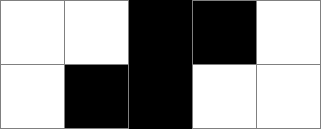
It’s an interesting question, but first I’ve looked at the simpler case of an n by n square. You can encode each route as a binary number, with 0 representing a vertical move and 1 representing a horizontal move. The problem then becomes equivalent to finding the number of distinct ways you can arrange equal numbers of 1s and 0s. If you use this method, you’ll discover that there are two routes across the 2×2 square, corresponding to the binary numbers 01 and 10:

2x2

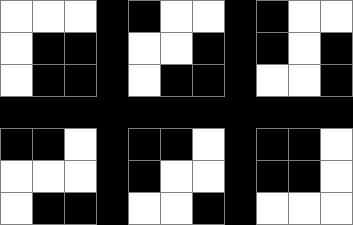
Across the 3×3 square, there are six routes, corresponding to the binary numbers 0011, 0101, 0110, 1001, 1010 and 1100:

3x3

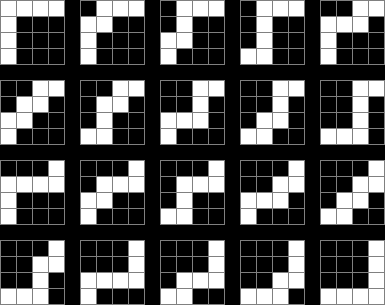
Across the 4×4 square, there are twenty routes:
4x4

(Please open in new window if it fails to animate)

(Please open in new window if it fails to animate)

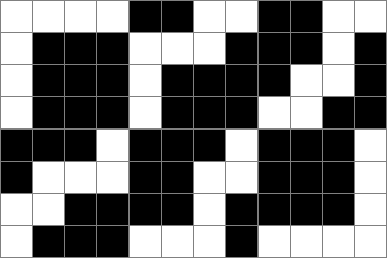
Across the 5×5 square, there are 70 routes:

5x5

(Please open in new window etc)

(Please open in new window etc)

Across the 6×6 and 7×7 squares, there are 252 and 924 routes:

6x6

7x7

After that, the routes quickly increase in number. This is the list for n = 1 to 14:

1, 2, 6, 20, 70, 252, 924, 3432, 12870, 48620, 184756, 705432, 2704156, 10400600… (see A000984 at the Online Encyclopedia of Integer Sequences)

After that you can vary the conditions. What if you can move not just vertically and horizontally, but diagonally, i.e. vertically and horizontally at the same time? Now you can encode the route with a ternary number, or number in base 3, with 0 representing a vertical move, 1 a horizontal move and 2 a diagonal move. As before, there is one route across a 1×1 square, but there are three across a 2×2, corresponding to the ternary numbers 01, 2 and 10:

3x3t

There are 13 routes across a 3×3 square, corresponding to the ternary numbers 0011, 201, 021, 22, 0101, 210, 1001, 120, 012, 102, 0110, 1010, 1100:

4x4t

And what about cubes, hypercubes and higher?

Talcum Power

If primes are like diamonds, powers of 2 are like talc. Primes don’t crumble under division, because they can’t be divided by any number but themselves and one. Powers of 2 crumble more than any other numbers. The contrast is particularly strong when the primes are Mersenne primes, or equal to a power of 2 minus 1:

3 = 4-1 = 2^2 – 1.
4, 2, 1.

7 = 8-1 = 2^3 – 1.
8, 4, 2, 1.

31 = 32-1 = 2^5 – 1.
32, 16, 8, 4, 2, 1.

127 = 2^7 – 1.
128, 64, 32, 16, 8, 4, 2, 1.

8191 = 2^13 – 1.
8192, 4096, 2048, 1024, 512, 256, 128, 64, 32, 16, 8, 4, 2, 1.

131071 = 2^17 – 1.
131072, 65536, 32768, 16384, 8192, 4096, 2048, 1024, 512, 256, 128, 64, 32, 16, 8, 4, 2, 1.

524287 = 2^19 – 1.
524288, 262144, 131072, 65536, 32768, 16384, 8192, 4096, 2048, 1024, 512, 256, 128, 64, 32, 16, 8, 4, 2, 1.

2147483647 = 2^31 – 1.
2147483648, 1073741824, 536870912, 268435456, 134217728, 67108864, 33554432, 16777216, 8388608, 4194304, 2097152, 1048576, 524288, 262144, 131072, 65536, 32768, 16384, 8192, 4096, 2048, 1024, 512, 256, 128, 64, 32, 16, 8, 4, 2, 1.

Are Mersenne primes infinite? If they are, then there will be just as many Mersenne primes as powers of 2, even though very few powers of 2 create a Mersenne prime. That’s one of the paradoxes of infinity: an infinite part is equal to an infinite whole.

But are they infinite? No-one knows, though some of the greatest mathematicians in history have tried to find a proof or disproof of the conjecture. A simpler question about powers of 2 is this: Does every integer appear as part of a power of 2? I can’t find one that doesn’t:

0 is in 1024 = 2^10.
1 is in 16 = 2^4.
2 is in 32 = 2^5.
3 is in 32 = 2^5.
4 = 2^2.
5 is in 256 = 2^8.
6 is in 16 = 2^4.
7 is in 32768 = 2^15.
8 = 2^3.
9 is in 4096 = 2^12.
10 is in 1024 = 2^10.
11 is in 1099511627776 = 2^40.
12 is in 128 = 2^7.
13 is in 131072 = 2^17.
14 is in 262144 = 2^18.
15 is in 2097152 = 2^21.
16 = 2^4.
17 is in 134217728 = 2^27.
18 is in 1073741824 = 2^30.
19 is in 8192 = 2^13.
20 is in 2048 = 2^11.

666 is in 182687704666362864775460604089535377456991567872 = 2^157.
1066 is in 43556142965880123323311949751266331066368 = 2^135.
1492 is in 356811923176489970264571492362373784095686656 = 2^148.
2014 is in 3705346855594118253554271520278013051304639509300498049262642688253220148477952 = 2^261.

I’ve tested much higher than that, but testing is no good: where’s a proof? I don’t have one, though I conjecture that all integers do appear as part or whole of a power of 2. Nor do I have a proof for another conjecture: that all integers appear infinitely often as part or whole of powers of 2. Or indeed, of powers of 3, 4, 5 or any other number except powers of 10.

I conjecture that this would apply in all bases too: In any base b all n appear infinitely often as part or whole of powers of any number except those equal to a power of b.

1 is in 11 = 2^2 in base 3.
2 is in 22 = 2^3 in base 3.
10 is in 1012 = 2^5 in base 3.
11 = 2^2 in base 3.
12 is in 121 = 2^4 in base 3.
20 is in 11202 = 2^7 in base 3.
21 is in 121 = 2^4 in base 3.
22 = 2^3 in base 3.
100 is in 100111 = 2^8 in base 3.
101 is in 1012 = 2^5 in base 3.
102 is in 2210212 = 2^11 in base 3.
110 is in 1101221 = 2^10 in base 3.
111 is in 100111 = 2^8 in base 3.
112 is in 11202 = 2^7 in base 3.
120 is in 11202 = 2^7 in base 3.
121 = 2^4 in base 3.
122 is in 1101221 = 2^10 in base 3.
200 is in 200222 = 2^9 in base 3.
201 is in 12121201 = 2^12 in base 3.
202 is in 11202 = 2^7 in base 3.

1 is in 13 = 2^3 in base 5.
2 is in 112 = 2^5 in base 5.
3 is in 13 = 2^3 in base 5.
4 = 2^2 in base 5.
10 is in 1003 = 2^7 in base 5.
11 is in 112 = 2^5 in base 5.
12 is in 112 = 2^5 in base 5.
13 = 2^3 in base 5.
14 is in 31143 = 2^11 in base 5.
20 is in 2011 = 2^8 in base 5.
21 is in 4044121 = 2^16 in base 5.
22 is in 224 = 2^6 in base 5.
23 is in 112341 = 2^12 in base 5.
24 is in 224 = 2^6 in base 5.
30 is in 13044 = 2^10 in base 5.
31 = 2^4 in base 5.
32 is in 230232 = 2^13 in base 5.
33 is in 2022033 = 2^15 in base 5.
34 is in 112341 = 2^12 in base 5.
40 is in 4022 = 2^9 in base 5.

1 is in 12 = 2^3 in base 6.
2 is in 12 = 2^3 in base 6.
3 is in 332 = 2^7 in base 6.
4 = 2^2 in base 6.
5 is in 52 = 2^5 in base 6.
10 is in 1104 = 2^8 in base 6.
11 is in 1104 = 2^8 in base 6.
12 = 2^3 in base 6.
13 is in 13252 = 2^11 in base 6.
14 is in 144 = 2^6 in base 6.
15 is in 101532 = 2^13 in base 6.
20 is in 203504 = 2^14 in base 6.
21 is in 2212 = 2^9 in base 6.
22 is in 2212 = 2^9 in base 6.
23 is in 1223224 = 2^16 in base 6.
24 = 2^4 in base 6.
25 is in 13252 = 2^11 in base 6.
30 is in 30544 = 2^12 in base 6.
31 is in 15123132 = 2^19 in base 6.
32 is in 332 = 2^7 in base 6.

1 is in 11 = 2^3 in base 7.
2 is in 22 = 2^4 in base 7.
3 is in 1331 = 2^9 in base 7.
4 = 2^2 in base 7.
5 is in 514 = 2^8 in base 7.
6 is in 2662 = 2^10 in base 7.
10 is in 1054064 = 2^17 in base 7.
11 = 2^3 in base 7.
12 is in 121 = 2^6 in base 7.
13 is in 1331 = 2^9 in base 7.
14 is in 514 = 2^8 in base 7.
15 is in 35415440431 = 2^30 in base 7.
16 is in 164351 = 2^15 in base 7.
20 is in 362032 = 2^16 in base 7.
21 is in 121 = 2^6 in base 7.
22 = 2^4 in base 7.
23 is in 4312352 = 2^19 in base 7.
24 is in 242 = 2^7 in base 7.
25 is in 11625034 = 2^20 in base 7.
26 is in 2662 = 2^10 in base 7.

1 is in 17 = 2^4 in base 9.
2 is in 152 = 2^7 in base 9.
3 is in 35 = 2^5 in base 9.
4 = 2^2 in base 9.
5 is in 35 = 2^5 in base 9.
6 is in 628 = 2^9 in base 9.
7 is in 17 = 2^4 in base 9.
8 = 2^3 in base 9.
10 is in 108807 = 2^16 in base 9.
11 is in 34511011 = 2^24 in base 9.
12 is in 12212 = 2^13 in base 9.
13 is in 1357 = 2^10 in base 9.
14 is in 314 = 2^8 in base 9.
15 is in 152 = 2^7 in base 9.
16 is in 878162 = 2^19 in base 9.
17 = 2^4 in base 9.
18 is in 218715 = 2^17 in base 9.
20 is in 70122022 = 2^25 in base 9.
21 is in 12212 = 2^13 in base 9.
22 is in 12212 = 2^13 in base 9.

Miss This

1,729,404 is seven digits long. If you drop one digit at a time, you can create seven more numbers from it, each six digits long. If you add these numbers, something special happens:

1,729,404 → 729404 (missing 1) + 129404 (missing 7) + 179404 (missing 2) + 172404 + 172904 + 172944 + 172940 = 1,729,404

So 1,729,404 is narcissistic, or equal to some manipulation of its own digits. Searching for numbers like this might seem like a big task, but you can cut the search-time considerably by noting that the final two digits determine whether a number is a suitable candidate for testing. For example, what if a seven-digit number ends in …38? Then the final digit of the missing-digit sum will equal (3 x 1 + 8 x 6) modulo 10 = (3 + 48) mod 10 = 51 mod 10 = 1. This means that you don’t need to check any seven-digit number ending in …38.

But what about seven-digit numbers ending in …57? Now the final digit of the sum will equal (5 x 1 + 7 x 6) modulo 10 = (5 + 42) mod 10 = 47 mod 10 = 7. So seven-digit numbers ending in …57 are possible missing-digit narcissistic sums. Then you can test numbers ending …157, …257, …357 and so on, to determine the last-but-one digit of the sum. Using this method, one quickly finds the only two seven-digit numbers of this form in base-10:

1,729,404 → 729404 + 129404 + 179404 + 172404 + 172904 + 172944 + 172940 = 1,729,404

1,800,000 → 800000 + 100000 + 180000 + 180000 + 180000 + 180000 + 180000 = 1,800,000

What about eight-digit numbers? Only those ending in these two digits need to be checked: …00, …23, …28, …41, …46, …64, …69, …82, …87. Here are the results:

• 13,758,846 → 3758846 + 1758846 + 1358846 + 1378846 + 1375846 + 1375846 + 1375886 + 1375884 = 13,758,846
• 13,800,000 → 3800000 + 1800000 + 1300000 + 1380000 + 1380000 + 1380000 + 1380000 + 1380000 = 13,800,000
• 14,358,846 → 4358846 + 1358846 + 1458846 + 1438846 + 1435846 + 1435846 + 1435886 + 1435884 = 14,358,846
• 14,400,000 → 4400000 + 1400000 + 1400000 + 1440000 + 1440000 + 1440000 + 1440000 + 1440000 = 14,400,000
• 15,000,000 → 5000000 + 1000000 + 1500000 + 1500000 + 1500000 + 1500000 + 1500000 + 1500000 = 15,000,000
• 28,758,846 → 8758846 + 2758846 + 2858846 + 2878846 + 2875846 + 2875846 + 2875886 + 2875884 = 28,758,846
• 28,800,000 → 8800000 + 2800000 + 2800000 + 2880000 + 2880000 + 2880000 + 2880000 + 2880000 = 28,800,000
• 29,358,846 → 9358846 + 2358846 + 2958846 + 2938846 + 2935846 + 2935846 + 2935886 + 2935884 = 29,358,846
• 29,400,000 → 9400000 + 2400000 + 2900000 + 2940000 + 2940000 + 2940000 + 2940000 + 2940000 = 29,400,000

But there are no nine-digit sumbers, or nine-digit numbers that supply missing-digit narcissistic sums. What about ten-digit sumbers? There are twenty-one:

1,107,488,889; 1,107,489,042; 1,111,088,889; 1,111,089,042; 3,277,800,000; 3,281,400,000; 4,388,888,889; 4,388,889,042; 4,392,488,889; 4,392,489,042; 4,500,000,000; 5,607,488,889; 5,607,489,042; 5,611,088,889; 5,611,089,042; 7,777,800,000; 7,781,400,000; 8,888,888,889; 8,888,889,042; 8,892,488,889; 8,892,489,042 (21 numbers)

Finally, the nine eleven-digit sumbers all take this form:

30,000,000,000 → 0000000000 + 3000000000 + 3000000000 + 3000000000 + 3000000000 + 3000000000 + 3000000000 + 3000000000 + 3000000000 + 3000000000 + 3000000000 = 30,000,000,000

So that’s forty-one narcissistic sumbers in base-10. Not all of them are listed in Sequence A131639 at the Encyclopedia of Integer Sequences, but I think I’ve got my program working right. Other bases show similar patterns. Here are some missing-digit narcissistic sumbers in base-5:

• 1,243 → 243 + 143 + 123 + 124 = 1,243 (b=5) = 198 (b=10)
• 1,324 → 324 + 124 + 134 + 132 = 1,324 (b=5) = 214 (b=10)
• 1,331 → 331 + 131 + 131 + 133 = 1,331 (b=5) = 216 (b=10)
• 1,412 → 412 + 112 + 142 + 141 = 1,412 (b=5) = 232 (b=10)

• 100,000 → 00000 + 10000 + 10000 + 10000 + 10000 + 10000 = 100,000 (b=5) = 3,125 (b=10)
• 200,000 → 00000 + 20000 + 20000 + 20000 + 20000 + 20000 = 200,000 (b=5) = 6,250 (b=10)
• 300,000 → 00000 + 30000 + 30000 + 30000 + 30000 + 30000 = 300,000 (b=5) = 9,375 (b=10)
• 400,000 → 00000 + 40000 + 40000 + 40000 + 40000 + 40000 = 400,000 (b=5) = 12,500 (b=10)

And here are some sumbers in base-16:

5,4CD,111,0EE,EF0,542 = 4CD1110EEEF0542 + 5CD1110EEEF0542 + 54D1110EEEF0542 + 54C1110EEEF0542 + 54CD110EEEF0542 + 54CD110EEEF0542 + 54CD110EEEF0542 + 54CD111EEEF0542 + 54CD1110EEF0542 + 54CD1110EEF0542 + 54CD1110EEF0542 + 54CD1110EEE0542 + 54CD1110EEEF542 + 54CD1110EEEF042 + 54CD1110EEEF052 + 54CD1110EEEF054 (b=16) = 6,110,559,033,837,421,890 (b=10)

6,5DD,E13,CEE,EF0,542 = 5DDE13CEEEF0542 + 6DDE13CEEEF0542 + 65DE13CEEEF0542 + 65DE13CEEEF0542 + 65DD13CEEEF0542 + 65DDE3CEEEF0542 + 65DDE1CEEEF0542 + 65DDE13EEEF0542 + 65DDE13CEEF0542 + 65DDE13CEEF0542 + 65DDE13CEEF0542 + 65DDE13CEEE0542 + 65DDE13CEEEF542 + 65DDE13CEEEF042 + 65DDE13CEEEF052 + 65DDE13CEEEF054 (b=16) = 7,340,270,619,506,705,730 (b=10)

10,000,000,000,000,000 → 0000000000000000 + 1000000000000000 + 1000000000000000 + 1000000000000000 + 1000000000000000 + 1000000000000000 + 1000000000000000 + 1000000000000000 + 1000000000000000 + 1000000000000000 + 1000000000000000 + 1000000000000000 + 1000000000000000 + 1000000000000000 + 1000000000000000 + 1000000000000000 + 1000000000000000 = 10,000,000,000,000,000 (b=16) = 18,446,744,073,709,551,616 (b=10)

F0,000,000,000,000,000 → 0000000000000000 + F000000000000000 + F000000000000000 + F000000000000000 + F000000000000000 + F000000000000000 + F000000000000000 + F000000000000000 + F000000000000000 + F000000000000000 + F000000000000000 + F000000000000000 + F000000000000000 + F000000000000000 + F000000000000000 + F000000000000000 + F000000000000000 = F0,000,000,000,000,000 (b=16) = 276,701,161,105,643,274,240 (b=10)

Next I’d like to investigate sumbers created by missing two, three and more digits at a time. Here’s a taster:

1,043,101 → 43101 (missing 1 and 0) + 03101 (missing 1 and 4) + 04101 (missing 1 and 3) + 04301 + 04311 + 04310 + 13101 + 14101 + 14301 + 14311 + 14310 + 10101 + 10301 + 10311 + 10310 + 10401 + 10411 + 10410 + 10431 + 10430 + 10431 = 1,043,101 (b=5) = 18,526 (b=10)