Playing the Double Base

Here’s some mathematical nonsense:

10 > 12
100 > 122
1000 > 1222

How can 1000 > 1222? Well, it makes perfect sense in what you might call a double base. In this base, every number is identified by a unique string of digits, but the strings don’t behave as they do in a standard base.

To see how this double base works, first look at 9 in standard base 2. To generate the binary digits from right to left, you follow the procedure x mod 2 and x = x div 2, where (x mod 2) returns the remainder when x is divided by 2 and (x div 2) divides x by 2 and discards the remainder:

9 mod 2 = 1 → ...1
9 div 2 = 4
4 mod 2 = 0 → ..01
4 div 2 = 2
2 mod 2 = 0 → .001
2 div 2 = 1
1 mod 2 = 1 → 1001

So 9[b=10] = 1001[b=2]. To adapt the procedure to base 3, simply use x mod 3 and x = x div 3:

32 mod 3 = 2 → ...2
32 div 3 = 10
10 mod 3 = 1 → ..12
10 div 3 = 3
3 mod 3 = 0 → .012
3 div 3 = 1
1 mod 3 = 1 → 1012

So 32[b=10] = 1012[b=3].

But what happens if you mix bases and use (x mod 3) and (x div 2), like this?:

2 mod 3 = 2 → .2
2 div 2 = 1
1 mod 3 = 1 → 12

3 mod 3 = 0 → .0
3 div 2 = 1
1 mod 3 = 1 → 10

So 10 > 12, i.e. 10[b=3,2] > 12[b=3,2].

5 mod 3 = 2 → ..2
5 div 2 = 2
2 mod 3 = 2 → .22
2 div 2 = 1
1 mod 3 = 1 → 122

6 mod 3 = 0 → ..0
6 div 2 = 3
3 mod 3 = 0 → .00
3 div 2 = 1
1 mod 3 = 1 → 100

So 100 > 122.

11 mod 3 = 2 → ...2
11 div 2 = 5
5 mod 3 = 2 → ..22
5 div 2 = 2
2 mod 3 = 2 → .222
2 div 2 = 1
1 mod 3 = 1 → 1222

12 mod 3 = 0 → …0
12 div 2 = 6
6 mod 3 = 0 → ..00
6 div 2 = 3
3 mod 3 = 0 → .000
3 div 2 = 1
1 mod 3 = 1 → 1000

And 1000 > 1222. Here are numbers 1 to 32 in this double base:

1 = 1
12 = 2
10 = 3
121 = 4
122 = 5
100 = 6
101 = 7
1212 = 8
1210 = 9
1221 = 10
1222 = 11
1000 = 12
1001 = 13
1012 = 14
1010 = 15
12121 = 16
12122 = 17
12100 = 18
12101 = 19
12212 = 20
12210 = 21
12221 = 22
12222 = 23
10000 = 24
10001 = 25
10012 = 26
10010 = 27
10121 = 28
10122 = 29
10100 = 30
10101 = 31
121212 = 32

Given a number represented in this mixed base, how do you extract the underlying n? Suppose the number takes the form n = (digit[1]..digit[di]), where digit[1] is the first and leftmost digit and digit[di] the final and rightmost digit. Then this algorithm will extract n:

n = 1
for i = 2 to di
..n = n * 2
..while n mod 3 ≠ digit[i]
....n = n + 1
..endwhile
next i
print n

For example, suppose n = 12212[b=3,2]. Then di = 5 and the algorithm will work like this:

n = 1
n = n * 2 = 2.
2 mod 3 = 2 = digit[2]
2 * 2 = 4
4 mod 3 = 1 ≠ digit[3]
5 mod 3 = 2 = digit[3]
5 * 2 = 10
10 mod 3 = 1 = digit[4]
10 * 2 = 20
20 mod 3 = 2 = digit[5]

Therefore 12212[b=3,2] = 20[b=10].

Now try some more mathematical nonsense:

21 > 100
111 > 1,000
1,001 > 10,000
10,001 > 100,000

How can numbers with d digits be greater than numbers with d+1 digits? Easily. In this incremental base, the base adjusts itself as the digits are generated, like this:

5 mod 2 = 1 → .1
5 div 2 = 2
2 mod (2 + 1) = 2 mod 3 = 2 → 21

The first digit generated is 1, so the base increases to (2 + 1) = 3 for the second digit. Compare the procedure when n = 4:

4 mod 2 = 0 → ..0
4 div 2 = 2
2 mod 2 = 0 → .00
2 div 2 = 1
1 mod 2 = 1 → 100

So 21 > 100, because 4 is a power of 2 and all the digits generated by (x mod 2) are 0 except the final and leftmost. 2 + 0 = 2. Now try n = 33:

33 mod 2 = 1 → ...1
33 div 2 = 16
16 mod (2+1) = 16 mod 3 = 1 → ..11
16 div 3 = 5
5 mod (3+1) = 5 mod 4 = 1 → .111
5 div 4 = 1
1 mod (4+1) = 1 mod 5 = 1.

33[b=10] = 1111[b=2,3,4,5].

Here are numbers 1 to 60 in this incremental base (note how 21 > 100, 111 > 1000, 1001 > 10000 and 10001 > 100000):

1 = 1
10 = 2
11 = 3
100 = 4*
21 = 5*
110 = 6
101 = 7
1000 = 8*
111 = 9*
210 = 10
121 = 11
1100 = 12
201 = 13
1010 = 14
211 = 15
10000 = 16*
221 = 17
1110 = 18
1001 = 19*
2100 = 20
311 = 21
1210 = 22
321 = 23
11000 = 24
1101 = 25
2010 = 26
1011 = 27
10100 = 28
421 = 29
2110 = 30
1201 = 31
100000 = 32*
1111 = 33
2210 = 34
1021 = 35
11100 = 36
2001 = 37
10010 = 38
1211 = 39
21000 = 40
1121 = 41
3110 = 42
2101 = 43
12100 = 44
1311 = 45
3210 = 46
1221 = 47
110000 = 48
2201 = 49
11010 = 50
2011 = 51
20100 = 52
1321 = 53
10110 = 54
10001 = 55*
101000 = 56
2111 = 57
4210 = 58
1421 = 59
21100 = 60

And here are numbers 256 to 270 (Note how 8,421 > 202,100 > 100,000,000):

100000000 = 256*
11221 = 257
101110 = 258
32101 = 259
202100 = 260*
13311 = 261
41210 = 262
10321 = 263
1111000 = 264
24201 = 265
131010 = 266
23011 = 267
320100 = 268
8421 = 269*
52110 = 270

Extracting n from a number represented in this incremental base is trickier than for the double base using (x mod 3) and (x div 2). To see how to do it, examine 11221[b=incremental]. The fifth and rightmost digit is 1, so the base increases to (2 + 1) = 3 for the fourth digit, which is 2. The base increases to (3 + 2) = 5 for the third digit, which is 2 again. The base increases to (5 + 2) = 7 for the second digit, 1. But the first and rightmost digit, 1, represents (x div 7) mod (7 + 1 = 8). So n can be extracted like this:

digit[1] * 7 = 1 * 7 = 7
7 mod 7 = 0 ≠ digit[2]
8 mod 7 = 1 = digit[2]
8 * 5 = 40
40 mod 5 = 0 ≠ digit[3]
41 mod 5 = 1 ≠ digit[3]
42 mod 5 = 2 = digit[3]
42 * 3 = 126
126 mod 3 = 0 ≠ digit[4]
127 mod 3 = 1 ≠ digit[4]
128 mod 3 = 2 = digit[4]
128 * 2 = 256
256 mod 2 = 0 ≠ digit[5]
257 mod 2 = 1 = digit[5]

So 11221[b=8,7,5,3,2] = 257[b=10].

Now try 8421[b=incremental]. The fourth and rightmost digit is 1, so the base increases to (2 + 1) = 3 for the third digit, which is 2. The base increases to (3 + 2) = 5 for the second digit, 4. But the first and rightmost digit, 8, represents (x div 5) mod (5 + 4 = 9). So n can be extracted like this:

digit[1] * 5 = 8 * 5 = 40
40 mod 5 = 0 ≠ digit[2]
41 mod 5 = 1 ≠ digit[2]
42 mod 5 = 2 ≠ digit[2]
43 mod 5 = 3 ≠ digit[2]
44 mod 5 = 4 = digit[2]
44 * 3 = 132
132 mod 3 = 0 ≠ digit[3]
133 mod 3 = 1 ≠ digit[3]
134 mod 3 = 2 = digit[3]
134 * 2 = 268
268 mod 2 = 0 ≠ digit[4]
269 mod 2 = 1 = digit[4]

So 8421[b=9,5,3,2] = 269[b=10].

Narcischism

What have bits to do with splits? A lot. Suppose you take the digits 12345, split them in all possible ways, then sum the results, like this:

12345 → (1234 + 5) + (123 + 45) + (123 + 4 + 5) + (12 + 345) + (12 + 34 + 5) + (12 + 3 + 45) + (12 + 3 + 4 + 5) + (1 + 2345) + (1 + 234 + 5) + (1 + 23 + 45) + (1 + 23 + 4 + 5) + (1 + 2 + 345) + (1 + 2 + 34 + 5) + (1 + 2 + 3 + 45) + (1 + 2 + 3 + 4 + 5) = 5175.

That’s a sum in base 10, but base 2 is at work below the surface, because each set of numbers is the answer to a series of binary questions: split or not? There are four possible places to split the digits 12345: after the 1, after the 2, after the 3 and after the 4. In (1 + 2 + 3 + 4 + 5), the binary question “Split or not?” is answered SPLIT every time. In (1234 + 5) and (1 + 2345) it’s answered SPLIT only once.

So the splits are governed by a four-digit binary number ranging from 0001 to 1111. When the binary digit is 1, split; when the binary digit is 0, don’t split. In binary, 0001 to 1111 = 01 to 15 in base 10 = 2^4-1. That’s for a five-digit number, so the four-digit 1234 will have 2^3-1 = 7 sets of sums:

1234 → (123 + 4) + (12 + 34) + (12 + 3 + 4) + (1 + 234) + (1 + 23 + 4) + 110 (1 + 2 + 34) + (1 + 2 + 3 + 4) = 502.

And the six-digit number 123456 will have 2^5-1 = 31 sets of sums. By now, an exciting question may have occurred to some readers. Does any number in base 10 equal the sum of all possible numbers formed by splitting its digits?

The exciting answer is: 0. In other words: No. To see why not, examine a quick way of summing the split-bits of 123,456,789, with nine digits. The long way is to find all possible sets of split-bits. There are 2^8-1 = 255 of them. The quick way is to sum these equations:

1 * 128 + 10 * 64 + 100 * 32 + 1000 * 16 + 10000 * 8 + 100000 * 4 + 1000000 * 2 + 10000000 * 1
2 * 128 + 20 * 64 + 200 * 32 + 2000 * 16 + 20000 * 8 + 200000 * 4 + 2000000 * 2 + 20000000 * 1
3 * 128 + 30 * 64 + 300 * 32 + 3000 * 16 + 30000 * 8 + 300000 * 4 + 3000000 * 3
4 * 128 + 40 * 64 + 400 * 32 + 4000 * 16 + 40000 * 8 + 400000 * 7
5 * 128 + 50 * 64 + 500 * 32 + 5000 * 16 + 50000 * 15
6 * 128 + 60 * 64 + 600 * 32 + 6000 * 31
7 * 128 + 70 * 64 + 700 * 63
8 * 128 + 80 * 127
9 * 255

Sum = 52,322,283.

52,322,283 has eight digits. If you use the same formula for the nine-digit number 999,999,999, the sum is 265,621,761, which has nine digits but is far smaller than 999,999,999. If you adapt the formula for the twenty-digit 19,999,999,999,999,999,999 (starting with 1), the split-bit sum is 16,562,499,999,987,400,705. In base 10, as far as I can see, numbers increase too fast and digit-lengths too slowly for the binary governing the split-sums to keep up. That’s also true in base 9 and base 8:

Num = 18,888,888,888,888,888,888 (b=9)
Sum = 16,714,201,578,038,328,760

Num = 17,777,777,777,777,777,777 (b=8)
Sum = 17,070,707,070,625,000,001

So what about base 7? Do the numbers increase slowly enough and the digit-lengths fast enough for the binary to keep up? The answer is: 1. In base 7, this twenty-digit number is actually smaller than its split-bit sum:

Num = 16,666,666,666,666,666,666 (b=7)
Sum = 20,363,036,303,404,141,363

And if you search below that, you can find a number that is equal to its split-bit sum:

166512 → (1 + 6 + 6 + 5 + 1 + 2) + (16 + 6 + 5 + 1 + 2) + (1 + 66 + 5 + 1 + 2) + (166 + 5 + 1 + 2) + (1 + 6 + 65 + 1 + 2) + (16 + 65 + 1 + 2) + (1 + 665 + 1 + 2) + (1665 + 1 + 2) + (1 + 6 + 6 + 51 + 2) + (16 + 6 + 51 + 2) + (1 + 66 + 51 + 2) + (166 + 51 + 2) + (1 + 6 + 651 + 2) + (16 + 651 + 2) + (1 + 6651 + 2) + (16651 + 2) + (1 + 6 + 6 + 5 + 12) + (16 + 6 + 5 + 12) + (1 + 66 + 5 + 12) + (166 + 5 + 12) + (1 + 6 + 65 + 12) + (16 + 65 + 12) + (1 + 665 + 12) + (1665 + 12) + (1 + 6 + 6 + 512) + (16 + 6 + 512) + (1 + 66 + 512) + (166 + 512) + (1 + 6 + 6512) + (16 + 6512) + (1 + 66512) = 166512[b=7] = 33525[b=10].

So 33525 in base 7 is what might be called a narcischist: it can gaze into the split-bits of its own digits and see itself gazing back. In base 6, 1940 is a narcischist:

12552 → (1 + 2 + 5 + 5 + 2) + (12 + 5 + 5 + 2) + (1 + 25 + 5 + 2) + (125 + 5 + 2) + (1 + 2 + 55 + 2) + (12 + 55 + 2) + (1 + 255 + 2) + (1255 + 2) + (1 + 2 + 5+ 52) + (12 + 5 + 52) + (1 + 25 + 52) + (125 + 52) + (1 + 2 + 552) + (12 + 552) + (1 + 2552) = 12552[b=6] = 1940[b=10].

In base 5, 4074 is a narcischist:

112244 → (1 + 1 + 2 + 2 + 4 + 4) + (11 + 2 + 2 + 4 + 4) + (1 + 12 + 2 + 4 + 4) + (112 + 2 + 4 + 4) + (1 + 1 + 22 + 4 + 4) + (11 + 22 + 4 + 4) + (1 + 122 + 4 + 4) + (1122 + 4 + 4) + (1 + 1 + 2 + 24 + 4) + (11 + 2 + 24 + 4) + (1 + 12 + 24 + 4) + (112 + 24 + 4) + (1 + 1 + 224 + 4) + (11 + 224 + 4) + (1 + 1224 + 4) + (11224 + 4) + (1 + 1 + 2 + 2 + 44) + (11 + 2 + 2 + 44) + (1 + 12 + 2 + 44) + (112 + 2 + 44) + (1 + 1 + 22 + 44) + (11 + 22 + 44) + (1 + 122 + 44) + (1122 + 44) + (1 + 1 + 2 + 244) + (11 + 2 + 244) + (1 + 12 + 244) + (112 + 244) + (1 + 1 + 2244) + (11 + 2244) + (1 + 12244) = 112244[b=5] = 4074.

And in base 4, 27 is:

123 → (1 + 2 + 3) + (12 + 3) + (1 + 23) = 123[b=4] = 27.

And in base 3, 13 and 26 are:

111 → (1 + 1 + 1) + (11 + 1) + (1 + 11) = 111[b=3] = 13.

222 → (2 + 2 + 2) + (22 + 2) + (2 + 22) = 222[b=3] = 26.

There are many more narcischists in all these bases, even if you exclude numbers with zeroes in them, like these in base 4:

1022 → (1 + 0 + 2 + 2) + (10 + 2 + 2) + (1 + 02 + 2) + (102 + 2) + (1 + 0 + 22) + (10 + 22) + (1 + 022) = 1022[b=4] = 74.

1030 → (1 + 0 + 3 + 0) + (10 + 3 + 0) + (1 + 03 + 0) + (103 + 0) + (1 + 0 + 30) + (10 + 30) + (1 + 030) = 1030[b=4] = 76.

1120 → (1 + 1 + 2 + 0) + (11 + 2 + 0) + (1 + 12 + 0) + (112 + 0) + (1 + 1 + 20) + (11 + 20) + (1 + 120) = 1120[b=4] = 88.

Magistra Rules the Waves

One of my favourite integer sequences has the simple formula n(i) = n(i-1) + digitsum(n(i-1)). If it’s seeded with 1, its first few terms go like this:

n(1) = 1
n(2) = n(1) + digitsum(n(1)) = 1 + digitsum(1) = 2
n(3) = 2 + digitsum(2) = 4
n(4) = 4 + digitsum(4) = 8
n(5) = 8 + digitsum(8) = 16
n(6) = 16 + digitsum(16) = 16 + 1+6 = 16 + 7 = 23
n(7) = 23 + digitsum(23) = 23 + 2+3 = 23 + 5 = 28
n(8) = 28 + digitsum(28) = 28 + 2+8 = 28 + 10 = 38

As a sequence, it looks like this:

1, 2, 4, 8, 16, 23, 28, 38, 49, 62, 70, 77, 91, 101, 103, 107, 115, 122, 127, 137, 148, 161, 169, 185, 199, 218, 229, 242, 250, 257, 271, 281, 292, 305, 313, 320, 325, 335, 346, 359, 376, 392, 406, 416, 427, 440, 448, 464, 478, 497, 517, 530, 538, 554, 568, 587, 607, 620, 628, 644, 658, 677, 697, 719, 736, 752, 766, 785, 805, 818, 835, 851, 865, 884, 904, 917, 934, 950, 964, 983, 1003…

Given a number at random, is there a quick way to say whether it appears in the sequence seeded with 1? Not that I know, with one exception. If the number is divisible by 3, it doesn’t appear, at least in base 10. In base 2, that rule doesn’t apply:

n(1) = 1
n(2) = 1 + digitsum(1) = 10 = 1 + 1 = 2
n(3) = 10 + digitsum(10) = 10 + 1 = 11 = 2 + 1 = 3
n(4) = 11 + digitsum(11) = 11 + 1+1 = 101 = 3 + 2 = 5
n(5) = 101 + digitsum(101) = 101 + 1+0+1 = 111 = 5 + 2 = 7
n(6) = 111 + digitsum(111) = 111 + 11 = 1010 = 7 + 3 = 10
n(7) = 1010 + digitsum(1010) = 1010 + 10 = 1100 = 10 + 2 = 12
n(8) = 1100 + digitsum(1100) = 1100 + 10 = 1110 = 12 + 2 = 14

1, 2, 3, 5, 7, 10, 12, 14, 17, 19, 22, 25, 28, 31, 36, 38, 41, 44, 47, 52, 55, 60, 64, 65, 67, 70, 73, 76, 79, 84, 87, 92, 96, 98, 101, 105, 109, 114, 118, 123, 129, 131, 134, 137, 140, 143, 148, 151, 156, 160, 162, 165, 169, 173, 178, 182, 187, 193, 196, 199, 204, 208, 211, 216, 220, 225, 229, 234, 239, 246, 252, 258, 260, 262, 265, 268, 271, 276, 279, 284, 288, 290, 293, 297, 301, 306, 310, 315, 321, 324, 327, 332, 336, 339, 344, 348, 353, 357, 362, 367, 374…

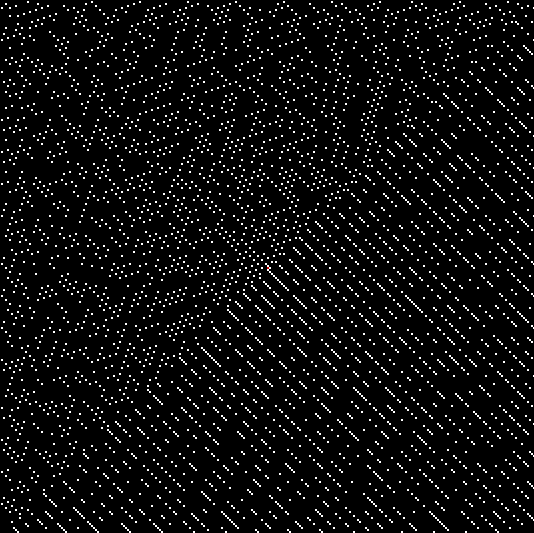
What patterns are there in these sequences? It’s easier to check when they’re represented graphically, so I converted them into patterns à la the Ulam spiral, where n is represented as a dot on a spiral of integers. This is the spiral for base 10:

ulambase10Base 10


And these are the spirals for bases 2 and 3:

ulambase2

Base 2


ulambase3

Base 3


These sequences look fairly random to me: there are no obvious patterns in the jumps from n(i) to n(i+1), i.e. in the values for digitsum(n(i)). Now try the spirals for bases 9 and 33:

ulambase9

Base 9


ulambase33

Base 33


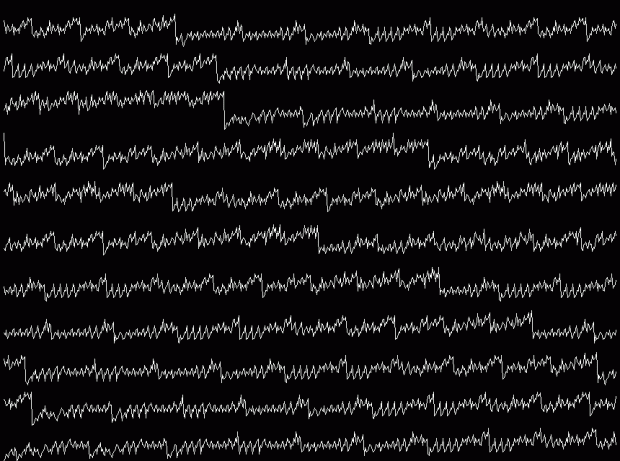
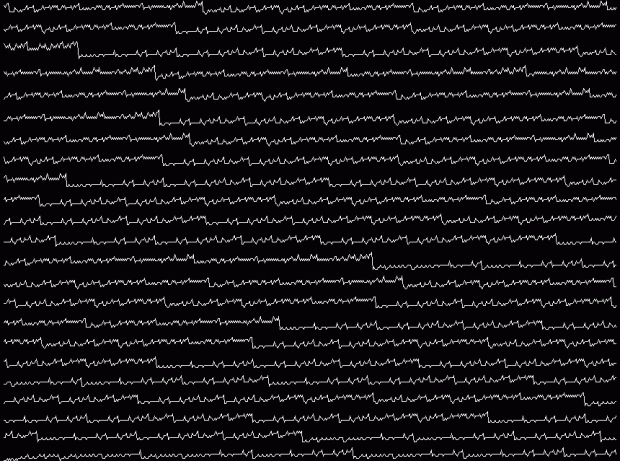
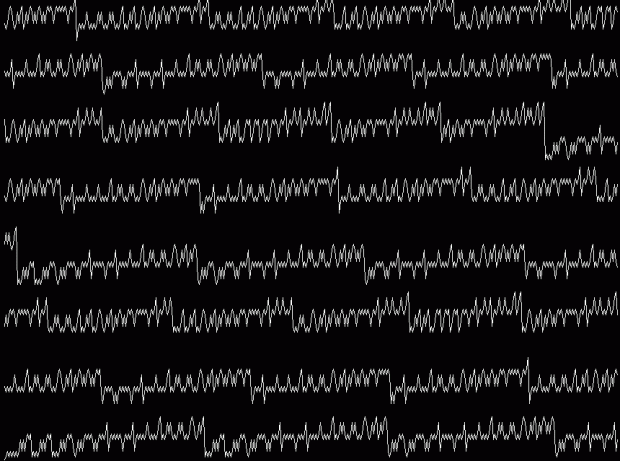
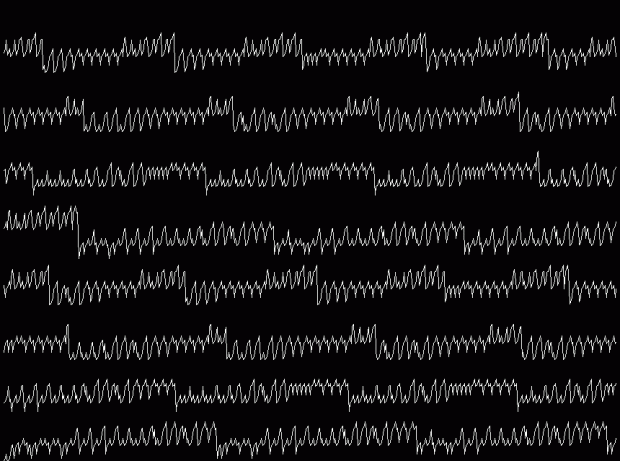
Patterns have appeared: there is some regularity in the jumps. You can see these regularities more clearly if you represent digitsum(n(i)) as a graph, with n(i) on the x axis and digitsum(n(i)) on the y axis. If the graph starts with n(i) = 1 on the lower left and proceeds left-right, left-right up the screen, it looks like this in base 10:

base10

Base 10 (click to enlarge)


Here are bases 2 and 3:

base2

Base 2


base3

Base 3


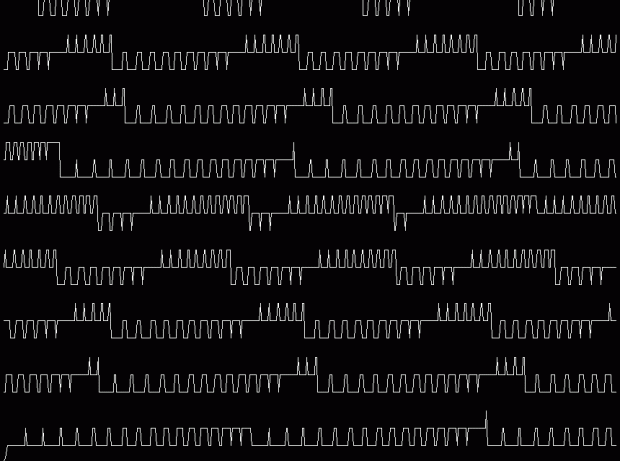
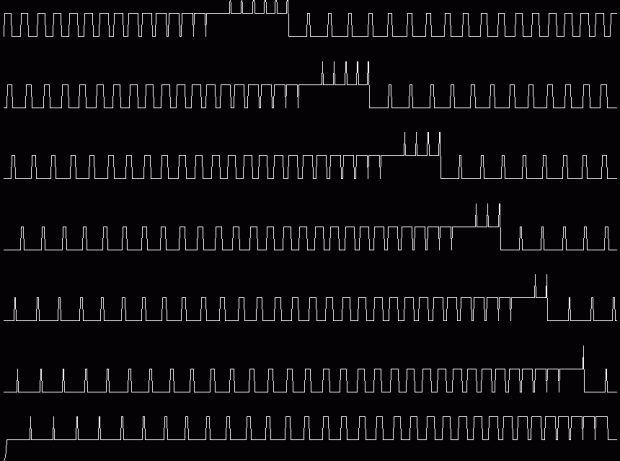
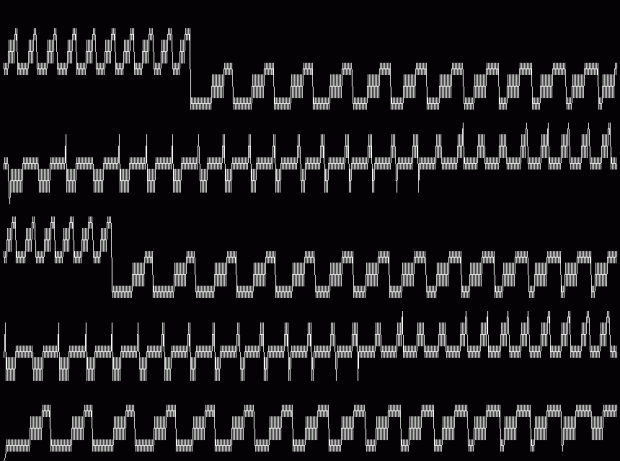
The jumps seem fairly random. Now try bases 9, 13, 16, 17, 25, 33 and 49:

base9

Base 9


base13

Base 13


base16

Base 16


base17

Base 17


base25

Base 25


base33

Base 33


base49

Base 49


In some bases, the formula n(i) = n(i-1) + digitsum(n(i-1)) generates mild randomness. In others, it generates strong regularity, like waves rolling ashore under a steady wind. I don’t understand why, but regularity seems to occur in bases that are one more than a power of 2 and also in some bases that are primes or squares.


Elsewhere other-posted:

Mathematica Magistra Mundi
8200_idf_insignia

Dig Sum Fib

The Fibonacci sequence is an infinitely rich sequence based on a very simple rule: add the previous two numbers. If the first two numbers are 1 and 1, the sequence begins like this:

1, 1, 2, 3, 5, 8, 13, 21, 34, 55, 89, 144, 233, 377, 610, 987, 1597, 2584, 4181, 6765, 10946, 17711, 28657, 46368, 75025…

Plainly, the numbers increase for ever. The hundredth Fibonacci number is 354,224,848,179,261,915,075, for example, and the two-hundredth is 280,571,172,992,510,140,037,611,932,413,038,677,189,525. But there are variants on the Fibonacci sequence that don’t increase for ever. The standard rule is n(i) = n(i-2) + n(i-1). What if the rule becomes n(i) = digitsum(n(i-2)) + digitsum(n(i-1))? Now the sequence falls into a loop, like this:

1, 1, 2, 3, 5, 8, 13, 12, 7, 10, 8, 9, 17, 17, 16, 15, 13, 10, 5, 6, 11, 8, 10, 9, 10, 10, 2, 3… (length=28)

But that’s in base 10. Here are the previous bases:

1, 1, 2, 2, 2… (base=2) (length=5)
1, 1, 2, 3, 3, 2, 3… (b=3) (l=7)
1, 1, 2, 3, 5, 5, 4, 3, 4, 4, 2, 3… (b=4) (l=12)
1, 1, 2, 3, 5, 4, 5, 5, 2, 3… (b=5) (l=10)
1, 1, 2, 3, 5, 8, 8, 6, 4, 5, 9, 9, 8, 7, 5, 7, 7, 4, 6, 5, 6, 6, 2, 3… (b=6) (l=24)
1, 1, 2, 3, 5, 8, 7, 3, 4, 7, 5, 6, 11, 11, 10, 9, 7, 4, 5, 9, 8, 5, 7, 6, 7, 7, 2, 3… (b=7) (l=28)
1, 1, 2, 3, 5, 8, 6, 7, 13, 13, 12, 11, 9, 6, 8, 7, 8, 8, 2, 3… (b=8) (l=20)
1, 1, 2, 3, 5, 8, 13, 13, 10, 7, 9, 8, 9, 9, 2, 3… (b=9) (l=16)

Apart from base 2, all the bases repeat with (2, 3), which is set up in each case by (base, base) = (10, 10) in that base, equivalent to (1, 1). All bases > 2 appear to repeat with (2, 3), but I don’t understand why. The length of the sequence varies widely. Here it is in bases 29, 30 and 31:

1, 1, 2, 3, 5, 8, 13, 21, 34, 27, 33, 32, 9, 13, 22, 35, 29, 8, 9, 17, 26, 43, 41, 28, 41, 41, 26, 39, 37, 20, 29, 21, 22, 43, 37, 24, 33, 29, 6, 7, 13, 20, 33, 25, 30, 27, 29, 28, 29, 29, 2, 3… (b=29) (l=52)

1, 1, 2, 3, 5, 8, 13, 21, 34, 26, 31, 28, 30, 29, 30, 30, 2, 3 (b=30) (l=18)

1, 1, 2, 3, 5, 8, 13, 21, 34, 25, 29, 54, 53, 47, 40, 27, 37, 34, 11, 15, 26, 41, 37, 18, 25, 43, 38, 21, 29, 50, 49, 39, 28, 37, 35, 12, 17, 29, 46, 45, 31, 16, 17, 33, 20, 23, 43, 36, 19, 25, 44, 39, 23, 32, 25, 27, 52, 49, 41, 30, 41, 41, 22, 33, 25, 28, 53, 51, 44, 35, 19, 24, 43, 37, 20, 27, 47, 44, 31, 15, 16, 31, 17, 18, 35, 23, 28, 51, 49, 40, 29, 39, 38, 17, 25, 42, 37, 19, 26, 45, 41, 26, 37, 33, 10, 13, 23, 36, 29, 35, 34, 9, 13, 22, 35, 27, 32, 29, 31, 30, 31, 31, 2, 3 (b=31) (l=124)

The sequence for base 77 is short like that for base 30:

1, 1, 2, 3, 5, 8, 13, 21, 34, 55, 89, 68, 81, 73, 78, 75, 77, 76, 77, 77, 2, 3 (b=77) (l=22)

But the sequence for base 51 is this:

1, 1, 2, 3, 5, 8, 13, 21, 34, 55, 39, 44, 83, 77, 60, 37, 47, 84, 81, 65, 46, 61, 57, 18, 25, 43, 68, 61, 29, 40, 69, 59, 28, 37, 65, 52, 17, 19, 36, 55, 41, 46, 87, 83, 70, 53, 23, 26, 49, 75, 74, 49, 73, 72, 45, 67, 62, 29, 41, 70, 61, 31, 42, 73, 65, 38, 53, 41, 44, 85, 79, 64, 43, 57, 50, 57, 57, 14, 21, 35, 56, 41, 47, 88, 85, 73, 58, 31, 39, 70, 59, 29, 38, 67, 55, 22, 27, 49, 76, 75, 51, 26, 27, 53, 30, 33, 63, 46, 59, 55, 14, 19, 33, 52, 35, 37, 72, 59, 31, 40, 71, 61, 32, 43, 75, 68, 43, 61, 54, 15, 19, 34, 53, 37, 40, 77, 67, 44, 61, 55, 16, 21, 37, 58, 45, 53, 48, 51, 49, 50, 99, 99, 98, 97, 95, 92, 87, 79, 66, 45, 61, 56, 17, 23, 40, 63, 53, 16, 19, 35, 54, 39, 43, 82, 75, 57, 32, 39, 71, 60, 31, 41, 72, 63, 35, 48, 83, 81, 64, 45, 59, 54, 13, 17, 30, 47, 77, 74, 51, 25, 26, 51, 27, 28, 55, 33, 38, 71, 59, 30, 39, 69, 58, 27, 35, 62, 47, 59, 56, 15, 21, 36, 57, 43, 50, 93, 93, 86, 79, 65, 44, 59, 53, 12, 15, 27, 42, 69, 61, 30, 41, 71, 62, 33, 45, 78, 73, 51, 24, 25, 49, 74, 73, 47, 70, 67, 37, 54, 41, 45, 86, 81, 67, 48, 65, 63, 28, 41, 69, 60, 29, 39, 68, 57, 25, 32, 57, 39, 46, 85, 81, 66, 47, 63, 60, 23, 33, 56, 39, 45, 84, 79, 63, 42, 55, 47, 52, 49, 51, 50, 51, 51, 2, 3… (b=51) (l=304)

Summer Set Sequence

I wondered what would happen if you added to a set of numbers, (a, b, c), the first number that wasn’t equal to the sum of any subset of the numbers: a + b, a + c, c + b, a + b + c. If the set begins with 1, the first number not equal to any subset of (1) is 2. So the set becomes (1, 2). 3 = 1 + 2, so 3 is not added. But 4 is added, making the set (1, 2, 4). The sequence of additions goes like this:

1, 2, 4, 8, 16, 32, 64, 128, 256, 512, 1024, 2048, 4096, 8192, 16384, 32768, 65536…

It’s the powers of 2, because some subset of the powers of 2 < 2^p will equal any number from 1 to (2^p)-1, therefore the first addition will be 2^p = the cumulative sum + 1:

1 (cumulative sum=1), 2 (cs=3), 4 (cs=7), 8 (cs=15), 16 (cs=31), 32 (cs=63), 64 (cs=127), 128 (cs=255), 256 (cs=511), 512 (cs=1023), 1024 (cs=2047), 2048 (cs=4095), 4096 (cs=8191), 8192 (cs=16383), 16384 (cs=32767), 32768 (cs=65535)…

If you seed the sequence with the set (2), the first addition is 3, but after that the powers of 2 re-appear:

2, 3, 4, 8, 16, 32, 64, 128, 256, 512, 1024, 2048, 4096, 8192, 16384, 32768, 65536…

It becomes more complicated if the sequence is seeded with the set (3):

3, 4, 5, 6, 16, 17, 49, 50, 148, 149, 445, 446, 1336, 1337, 4009, 4010, 12028, 12029, 36085, 36086…

You can predict the pattern by looking at the cumulative sums again:

3, 4, 5, 6 (cumulative sum=18), 16, 17 (cs=51), 49, 50 (cs=150), 148, 149 (cs=447), 445, 446 (cs=1338), 1336, 1337 (cs=4011), 4009, 4010 (cs=12030), 12028, 12029 (cs=36087), 36085, 36086 (cs=108258)…

The sequence begins with a block of four consecutive numbers, followed by separate blocks of two consecutive numbers. The first number in each 2-block is predicted by the cumulative sum of the last number in the previous block, according to the formula n = cumulative sum – seed + 1. When the seed is 3, n = cs-3+1.

If the seed is 4, the sequences goes like this:

4, 5, 6, 7, 8, 27, 28, 29, 111, 112, 113, 447, 448, 449, 1791, 1792, 1793, 7167, 7168, 7169…

Now the sequence begins with a block of five consecutive numbers, followed by separate blocks of three consecutive numbers. The formula is n = cs-4+1:

4, 5, 6, 7, 8 (cumulative sum=30), 27, 28, 29 (cs=114), 111, 112, 113 (cs=450), 447, 448, 449 (cs=1794), 1791, 1792, 1793 (cs=7170), 7167, 7168, 7169 (cs=28674)…

And here’s the sequence seeded with (5):

5, 6, 7, 8, 9, 10, 41, 42, 43, 44, 211, 212, 213, 214, 1061, 1062, 1063, 1064, 5311, 5312, 5313, 5314…

5, 6, 7, 8, 9, 10 (cs=45), 41, 42, 43, 44 (cs=215), 211, 212, 213, 214 (cs=1065), 1061, 1062, 1063, 1064 (cs=5315), 5311, 5312, 5313, 5314 (cs=26565)…

The Rite of Sling

Duels are interesting things. Flashman made his name in one and earnt an impressive scar in another. Maupassant explored their psychology and so did his imitator Maugham. Game theory might be a good guide on how to fight one, but I’d like to look at something simpler: the concept of duelling numbers.

How would two numbers fight? One way is to use digit-sums. Find the digit-sum of each number, then take it away from the other number. Repeat until one or both numbers <= 0, like this:

function duel(n1,n2){
print(n1," <-> ",n2);
do{
s1=digitsum(n1);
s2=digitsum(n2);
n1 -= s2;
n2 -= s1;
print(” -> ",n1," <-> ",n2);
}while(n1>0 && n2>0);
}

Suppose n1 = 23 and n2 = 22. At the first step, s1 = digitsum(23) = 5 and s2 = digitsum(22) = 4. So n1 = 23 – 4 = 19 and n2 = 22 – 5 = 17. And what happens in the end?

23 ↔ 22 ➔ 19 ↔ 17 ➔ 11 ↔ 7 ➔ 4 ↔ 5 ➔ -1 ↔ 1

So 23 loses the duel with 22. Now try 23 vs 24:

23 ↔ 24 ➔ 17 ↔ 19 ➔ 7 ↔ 11 ➔ 5 ↔ 4 ➔ 1 ↔ -1

23 wins the duel with 24. The gap can be bigger. For example, 85 and 100 are what might be called David and Goliath numbers, because the David of 85 beats the Goliath of 100:

85 ↔ 100 ➔ 84 ↔ 87 ➔ 69 ↔ 75 ➔ 57 ↔ 60 ➔ 51 ↔ 48 ➔ 39 ↔ 42 ➔ 33 ↔ 30 ➔ 30 ↔ 24 ➔ 24 ↔ 21 ➔ 21 ↔ 15 ➔ 15 ↔ 12 ➔ 12 ↔ 6 ➔ 6 ↔ 3 ➔ 3 ↔ -3

999 and 1130 are also David and Goliath numbers:

999 ↔ 1130 ➔ 994 ↔ 1103 ➔ 989 ↔ 1081 ➔ 979 ↔ 1055 ➔ 968 ↔ 1030 ➔ 964 ↔ 1007 ➔ 956 ↔ 988 ➔ 931 ↔ 968 ➔ 908 ↔ 955 ➔ 889 ↔ 938 ➔ 869 ↔ 913 ➔ 856 ↔ 890 ➔ 839 ↔ 871 ➔ 823 ↔ 851 ➔ 809 ↔ 838 ➔ 790 ↔ 821 ➔ 779 ↔ 805 ➔ 766 ↔ 782 ➔ 749 ↔ 763 ➔ 733 ↔ 743 ➔ 719 ↔ 730 ➔ 709 ↔ 713 ➔ 698 ↔ 697 ➔ 676 ↔ 674 ➔ 659 ↔ 655 ➔ 643 ↔ 635 ➔ 629 ↔ 622 ➔ 619 ↔ 605 ➔ 608 ↔ 589 ➔ 586 ↔ 575 ➔ 569 ↔ 556 ➔ 553 ↔ 536 ➔ 539 ↔ 523 ➔ 529 ↔ 506 ➔ 518 ↔ 490 ➔ 505 ↔ 476 ➔ 488 ↔ 466 ➔ 472 ↔ 446 ➔ 458 ↔ 433 ➔ 448 ↔ 416 ➔ 437 ↔ 400 ➔ 433 ↔ 386 ➔ 416 ↔ 376 ➔ 400 ↔ 365 ➔ 386 ↔ 361 ➔ 376 ↔ 344 ➔ 365 ↔ 328 ➔ 352 ↔ 314 ➔ 344 ↔ 304 ➔ 337 ↔ 293 ➔ 323 ↔ 280 ➔ 313 ↔ 272 ➔ 302 ↔ 265 ➔ 289 ↔ 260 ➔ 281 ↔ 241 ➔ 274 ↔ 230 ➔ 269 ↔ 217 ➔ 259 ↔ 200 ➔ 257 ↔ 184 ➔ 244 ↔ 170 ➔ 236 ↔ 160 ➔ 229 ↔ 149 ➔ 215 ↔ 136 ➔ 205 ↔ 128 ➔ 194 ↔ 121 ➔ 190 ↔ 107 ➔ 182 ↔ 97 ➔ 166 ↔ 86 ➔ 152 ↔ 73 ➔ 142 ↔ 65 ➔ 131 ↔ 58 ➔ 118 ↔ 53 ➔ 110 ↔ 43 ➔ 103 ↔ 41 ➔ 98 ↔ 37 ➔ 88 ↔ 20 ➔ 86 ↔ 4 ➔ 82 ↔ -10

You can look in the other direction and find bully numbers, or numbers that beat all numbers smaller than themselves. In base 10, the numbers 2 to 9 obviously do. So do these:

35, 36, 37, 38, 39, 47, 48, 49, 58, 59, 64, 65, 66, 67, 68, 69, 76, 77, 78, 79, 189

In other bases, bullies are sometimes common, sometimes rare. Sometimes they don’t exist at all for n > b. Here are bully numbers for bases 2 to 30:

base=2: 3, 5, 7, 13, 15, 21, 27, 29, 31, 37, 43, 45, 47, 54, 59
b=3: 4, 5, 7, 8, 14
b=4: 5, 6, 7, 9, 10, 11, 14, 15, 27, 63
b=5: 12, 13, 14, 18, 19, 23, 24
b=6: 15, 16, 17, 22, 23, 26, 27, 28, 29, 32, 33, 34, 35, 65, 71, 101
b=7: 17, 18, 19, 20, 24, 25, 26, 27, 32, 33, 34, 40, 41, 45, 46, 47, 48, 76
b=8: 37, 38, 39, 46, 47, 59, 60, 61, 62, 63, 95, 103, 111, 119
b=9: 42, 43, 44, 52, 53, 61, 62
b=10: 35, 36, 37, 38, 39, 47, 48, 49, 58, 59, 64, 65, 66, 67, 68, 69, 76, 77, 78, 79, 189
b=11: 38, 39, 40, 41, 42, 43, 49, 50, 51, 52, 53, 54, 62, 63, 64, 65, 73, 74, 75, 76, 85, 86, 87
b=12: 57, 58, 59
b=13: 58, 59, 60, 61, 62, 63, 64, 74, 75, 76, 77, 87, 88, 89, 90, 101, 102, 103, 115, 116, 127, 128, 129
b=14: none (except 2 to 13)
b=15: 116, 117, 118, 119, 130, 131, 132, 133, 134, 147, 148, 149
b=16: 122, 123, 124, 125, 126, 127, 140, 141, 142, 143, 156, 157, 158, 159, 173, 174, 175, 190, 191, 222, 223
b=17: 151, 152, 168, 169, 185, 186
b=18: 85, 86, 87, 88, 89, 191, 192, 193, 194, 195, 196, 197, 212, 213, 214, 215
b=19: 242, 243, 244, 245, 246
b=20: none
b=21: 136, 137, 138, 139, 140, 141, 142, 143, 144, 145, 146, 162, 163, 164, 165, 166, 167, 183, 184, 185, 186, 187, 188, 206, 207, 208, 209, 227, 228, 229, 230, 248, 249, 250, 251, 270, 271, 272
b=22: 477, 478, 479, 480, 481, 482, 483
b=23: none
b=24: none
b=25: 271, 272, 273, 274, 296, 297, 298, 299, 322, 323, 324, 348, 349, 372, 373, 374
b=26: none
b=27: none
b=28: none
b=29: 431, 432, 433, 434, 459, 460, 461, 462, 463, 490, 491, 492, 546, 547, 548, 549, 550
b=30: none

Summus

I’m interested in digit-sums and in palindromic numbers. Looking at one, I found the other. It started like this: 9^2 = 81 and 9 = 8 + 1, so digitsum(9^1) = digitsum(9^2). I wondered how long such a sequence of powers could be (excluding powers of 10). I quickly found that the digit-sum of 468 is equal to the digit-sum of its square and cube:

digsum(468) = digsum(219024) = digsum(102503232)

But I couldn’t find any longer sequence, although plenty of other numbers are similar to 468:

digsum(585) = digsum(342225) = digsum(200201625)
digsum(4680) = digsum(21902400) = digsum(102503232000)
digsum(5850) = digsum(34222500) = digsum(200201625000)
digsum(5851) = digsum(34234201) = digsum(200304310051)
digsum(5868) = digsum(34433424) = digsum(202055332032)
digsum(28845) = digsum(832034025) = digsum(24000021451125) […]
digsum(589680) = digsum(347722502400) = digsum(205045005215232000)

What about other bases? First came this sequence:

digsum(2) = digsum(11) (base = 3) (highest power = 2)

Then these:

digsum(4) = digsum(22) = digsum(121) (b=7) (highest power = 3)
digsum(8) = digsum(44) = digsum(242) = digsum(1331) (b=15) (hp=4)
digsum([16]) = digsum(88) = digsum(484) = digsum(2662) = digsum(14641) (b=31) (hp=5)

The pattern continues (a number between square brackets represents a single digit in the base):

digsum([32]) = digsum([16][16]) = digsum(8[16]8) = digsum(4[12][12]4) = digsum(28[12]82) = digsum(15[10][10]51) (b=63) (hp=6)
digsum([64]) = digsum([32][32]) = digsum([16][32][16]) = digsum(8[24][24]8) = digsum(4[16][24][16]4) = digsum(2[10][20][20][10]2) = digsum(16[15][20][15]61) (b=127) (hp=7)
digsum([128]) = digsum([64][64]) = digsum([32][64][32]) = digsum([16][48][48][16]) = digsum(8[32][48][32]8) = digsum(4[20][40][40][20]4) = digsum(2[12][30][40][30][12]2) = digsum(17[21][35][35][21]71) (b=255) (hp=8)
digsum([256]) = digsum([128][128]) = digsum([64][128][64]) = digsum([32][96][96][32]) = digsum([16][64][96][64][16]) = digsum(8[40][80][80][40]8) = digsum(4[24][60][80][60][24]4) = digsum(2[14][42][70][70][42][14]2) = digsum(18[28][56][70][56][28]81) (b=511) (hp=9)

After this, I looked at sequences in which n(i) = n(i-1) + digitsum(n(i-1)). How long could digitsum(n(i)) be greater than or equal to digitsum(n(i-1))? In base 10, I found these sequences:

1 (digitsum=1) → 2 → 4 → 8 → 16 (sum=7) (count=4) (base=10)
9 → 18 (sum=9) → 27 (s=9) → 36 (s=9) → 45 (s=9) → 54 (s=9) → 63 (s=9) → 72 (s=9) → 81 (s=9) → 90 (s=9) → 99 (s=18) → 117 (s=9) (c=11) (b=10)
801 (s=9) → 810 (s=9) → 819 (s=18) → 837 (s=18) → 855 (s=18) → 873 (s=18) → 891 (s=18) → 909 (s=18) → 927 (s=18) → 945 (s=18) → 963 (s=18) → 981 (s=18) → 999 (s=27) → 1026 (s=9) (c=13)

Base 2 does better:

1 → 10 (s=1) → 11 (s=2) → 101 (s=2) → 111 (s=3) → 1010 (s=2) (c=5) (b=2)
16 = 10000 (s=1) → 10001 (s=2) → 10011 (s=3) → 10110 (s=3) → 11001 (s=3) → 11100 (s=3) → 11111 (s=5) → 100100 (s=2) (c=7) (b=2)
962 = 1111000010 (s=5) → 1111000111 (s=7) → 1111001110 (s=7) → 1111010101 (s=7) → 1111011100 (s=7) → 1111100011 (s=7) → 1111101010 (s=7) → 1111110001 (s=7) → 1111111000 (s=7) → 1111111111 (s=10) → 10000001001 (s=3) (c=10) (b=2)
524047 = 1111111111100001111 (s=15) → 1111111111100011110 (s=15) → 1111111111100101101 (s=15) → 1111111111100111100 (s=15) → 1111111111101001011 (s=15) → 1111111111101011010 (s=15) → 1111111111101101001(s=15) → 1111111111101111000 (s=15) → 1111111111110000111 (s=15) → 1111111111110010110 (s=15) → 1111111111110100101 (s=15) → 1111111111110110100 (s=15) → 1111111111111000011 (s=15) → 1111111111111010010 (s=15) → 1111111111111100001 (s=15) → 1111111111111110000 (s=15) → 1111111111111111111 (s=19) → 10000000000000010010 (s=3) (c=17) (b=2)

The best sequence I found in base 3 is shorter than in base 10, but there are more sequences:

1 → 2 → 11 (s=2) → 20 (s=2) → 22 (s=4) → 110 (s=2) (c=5) (b=3)
31 = 1011 (s=3) → 1021 (s=4) → 1102 (s=4) → 1120 (s=4) → 1201 (s=4) → 1212 (s=6) → 2002 (s=4) (c=6) (b=3)
54 = 2000 (s=2) → 2002 (s=4) → 2020 (s=4) → 2101 (s=4) → 2112 (s=6) → 2202 (s=6) → 2222 (s=8) → 10021(s=4) (c=7) (b=3)
432 = 121000 (s=4) → 121011 (s=6) → 121101 (s=6) → 121121 (s=8) → 121220 (s=8) → 122012 (s=8) → 122111 (s=8) → 122210 (s=8) → 200002 (s=4) (c=8) (b=3)
648 = 220000 (s=4) → 220011 (s=6) → 220101 (s=6) → 220121 (s=8) → 220220 (s=8) → 221012 (s=8) → 221111 (s=8) → 221210 (s=8) → 222002 (s=8) → 222101 (s=8) → 222200 (s=8) → 222222 (s=12) → 1000102 (s=4) (c=12) (b=3)

And what about sequences in which digitsum(n(i)) is always greater than digitsum(n(i-1))? Base 10 is disappointing:

1 → 2 → 4 → 8 → 16 (sum=7) (count=4) (base=10)
50 (s=5) → 55 (s=10) → 65 (s=11) → 76 (s=13) → 89 (s=17) → 106 (s=7) (c=5) (b=10)

Some other bases do better:

2 = 10 (s=1) → 11 (s=2) → 101 (s=2) (c=2) (b=2)
4 = 100 (s=1) → 101 (s=2) → 111 (s=3) → 1010 (s=2) (c=3) (b=2)
240 = 11110000 (s=4) → 11110100 (s=5) → 11111001 (s=6) → 11111111 (s=8) → 100000111 (s=4) (c=4) (b=2)

1 → 2 → 11 (s=2) (c=2) (b=3)
19 = 201 (s=3) → 211 (s=4) → 222 (s=6) → 1012 (s=4) (c=3) (b=3)
58999 = 2222221011 (s=15) → 2222221201 (s=16) → 2222222022 (s=18) → 2222222222 (s=20) → 10000000201 (s=4) (c=4) (b=3)

1 → 2 → 10 (s=1) (c=2) (b=4)
4 = 10 (s=1) → 11 (s=2) → 13 (s=4) → 23 (s=5) → 100 (s=1) (c=4) (b=4)
977 = 33101 (s=8) → 33121 (s=10) → 33203 (s=11) → 33232 (s=13) → 33323 (s=14) → 100021 (s=4) (c=5) (b=4)

1 → 2 → 4 → 13 (s=4) (c=3) (b=5)
105 = 410 (s=5) → 420 (s=6) → 431 (s=8) → 444 (s=12) → 1021 (s=4) (c=4) (b=5)

1 → 2 → 4 → 12 (s=3) (c=3) (b=6)
13 = 21 (s=3) → 24 (s=6) → 34 (s=7) → 45 (s=9) → 102 (s=3) (c=4) (b=6)
396 = 1500 (s=6) → 1510 (s=7) → 1521 (s=9) → 1534 (s=13) → 1555 (s=16) → 2023 (s=7) (c=5) (b=6)

1 → 2 → 4 → 11 (s=2) (c=3) (b=7)
121 = 232 (s=7) → 242 (s=8) → 253 (s=10) → 266 (s=14) → 316 (s=10) (c=4) (b=7)
205 = 412 (s=7) → 422 (s=8) → 433 (s=10) → 446 (s=14) → 466 (s=16) → 521 (s=8) (c=5) (b=7)

1 → 2 → 4 → 10 (s=1) (c=3) (b=8)
8 = 10 (s=1) → 11 (s=2) → 13 (s=4) → 17 (s=8) → 27 (s=9) → 40 (s=4) (c=5) (b=8)
323 = 503 (s=8) → 513 (s=9) → 524 (s=11) → 537 (s=15) → 556 (s=16) → 576 (s=18) → 620 (s=8) (c=6) (b=8)

1 → 2 → 4 → 8 → 17 (s=8) (c=4) (b=9)
6481 = 8801 (s=17) → 8820 (s=18) → 8840 (s=20) → 8862 (s=24) → 8888 (s=32) → 10034 (s=8) (c=5) (b=9)

1 → 2 → 4 → 8 → 16 (s=7) (c=4) (b=10)
50 (s=5) → 55 (s=10) → 65 (s=11) → 76 (s=13) → 89 (s=17) → 106 (s=7) (c=5) (b=10)

1 → 2 → 4 → 8 → 15 (s=6) (c=4) (b=11)
1013 = 841 (s=13) → 853 (s=16) → 868 (s=22) → 888 (s=24) → 8[10][10] (s=28) → 925 (s=16) (c=5) (b=11)

1 → 2 → 4 → 8 → 14 (s=5) (c=4) (b=12)
25 = 21 (s=3) → 24 (s=6) → 2[10] (s=12) → 3[10] (s=13) → 4[11] (s=15) → 62 (s=8) (c=5) (b=12)
1191 = 833 (s=14) → 845 (s=17) → 85[10] (s=23) → 879 (s=24) → 899 (s=26) → 8[11][11] (s=30) → 925 (s=16) (c=6) (b=12)

1 → 2 → 4 → 8 → 13 (s=4) (c=4) (b=13)
781 = 481 (s=13) → 491 (s=14) → 4[10]2 (s=16) → 4[11]5 (s=20) → 4[12][12] (s=28) → 521 (s=8) (c=5) (b=13)
19621 = 8[12]14 (s=25) → 8[12]33 (s=26) → 8[12]53 (s=28) → 8[12]75 (s=32) → 8[12]9[11] (s=40) → 8[12][12][12] (s=44) → 9034 (s=16) (c=6) (b=13)

1 → 2 → 4 → 8 → 12 (s=3) (c=4) (b=14)
72 = 52 (s=7) → 59 (s=14) → 69 (s=15) → 7[10] (s=17) → 8[13] (s=21) → [10]6 (s=16) (c=5) (b=14)
1275 = 671 (s=14) → 681 (s=15) → 692 (s=17) → 6[10]5 (s=21) → 6[11][12] (s=29) → 6[13][13] (s=32) → 723 (s=12) (c=6) (b=14)
19026 = 6[13]10 (s=20) → 6[13]26 (s=27) → 6[13]45 (s=28) → 6[13]65 (s=30) → 6[13]87 (s=34) → 6[13][10][13] (s=42) → 6[13][13][13] (s=45) → 7032 (s=12) (c=7) (b=14)

1 → 2 → 4 → 8 → 11 (s=2) (c=4) (b=15)
603 = 2[10]3 (s=15) → 2[11]3 (s=16) → 2[12]4 (s=18) → 2[13]7 (s=22) → 2[14][14] (s=30) → 31[14] (s=18) (c=5) (b=15)
1023 = 483 (s=15) → 493 (s=16) → 4[10]4 (s=18) → 4[11]7 (s=22) → 4[12][14] (s=30) → 4[14][14] (s=32) → 521 (s=8) (c=6) (b=15)
1891 = 861 (s=15) → 871 (s=16) → 882 (s=18) → 895 (s=22) → 8[10][12] (s=30) → 8[12][12] (s=32) → 8[14][14] (s=36) → 925 (s=16) (c=7) (b=15)

1 → 2 → 4 → 8 → 10 (s=1) (c=4) (b=16)
16 = 10 (s=1) → 11 (s=2) → 13 (s=4) → 17 (s=8) → 1[15] (s=16) → 2[15] (s=17) → 40 (s=4) (c=6) (b=16)
1396 = 574 (s=16) → 584 (s=17) → 595 (s=19) → 5[10]8 (s=23) → 5[11][15] (s=31) → 5[13][14] (s=32) → 5[15][14] (s=34) → 620 (s=8) (c=7) (b=16)
2131 = 853 (s=16) → 863 (s=17) → 874 (s=19) → 887 (s=23) → 89[14] (s=31) → 8[11][13] (s=32) → 8[13][13] (s=34) → 8[15][15] (s=38) → 925 (s=16) (c=8) (b=16)

1 → 2 → 4 → 8 → [16] (s=16) → 1[15] (s=16) (c=5) (b=17)

1 → 2 → 4 → 8 → [16] (s=16) → 1[14] (s=15) (c=5) (b=18)
5330 = [16]82 (s=26) → [16]9[10] (s=35) → [16][11]9 (s=36) → [16][13]9 (s=38) → [16][15][11] (s=42) → [16][17][17] (s=50) → [17]2[13] (s=32) (c=6) (b=18)

1 → 2 → 4 → 8 → [16] (s=16) → 1[13] (s=14) (c=5) (b=19)
116339 = [16][18]52 (s=41) → [16][18]75 (s=46) → [16][18]9[13] (s=56) → [16][18][12][12] (s=58) → [16][18][15][13] (s=62) → [16][18][18][18] (s=70) → [17]03[12] (s=32) (c=6) (b=19)

1 → 2 → 4 → 8 → [16] (s=16) → 1[12] (s=13) (c=5) (b=20)
100 = 50 (s=5) → 55 (s=10) → 5[15] (s=20) → 6[15] (s=21) → 7[16] (s=23) → 8[19] (s=27) → [10]6 (s=16) (c=6) (b=20)
135665 = [16][19]35 (s=43) → [16][19]58 (s=48) → [16][19]7[16] (s=58) → [16][19][10][14] (s=59) → [16][19][13][13] (s=61) → [16][19][16][14] (s=65) → [16][19][19][19] (s=73) → [17]03[12] (s=32) (c=7) (b=20)

Spijit

The only two digits found in all standard bases are 1 and 0. But they behave quite differently. Suppose you take the integers 1 to 100 and compare the number of 1s and 0s in the representation of each integer, n, in bases 2 to n-1. For example, 10 would look like this:

1010 in base 2
101 in base 3
22 in base 4
20 in base 5
14 in base 6
13 in base 7
12 in base 8
11 in base 9

So there are nine 1s and four 0s. If you check 1 to 100 using this all-base function, the count of 1s goes like this:

1, 1, 2, 3, 5, 5, 8, 5, 9, 9, 11, 10, 15, 12, 14, 13, 15, 12, 17, 14, 20, 19, 20, 15, 23, 19, 22, 22, 25, 24, 31, 21, 25, 24, 24, 27, 33, 27, 31, 29, 34, 29, 36, 30, 34, 35, 34, 30, 40, 33, 36, 35, 38, 34, 42, 37, 43, 40, 41, 37, 48, 39, 42, 42, 44, 43, 48, 43, 47, 46, 51, 42, 53, 44, 48, 50, 51, 50, 55, 48, 59, 55, 55, 54, 64, 57, 57, 55, 60, 57, 68, 60, 64, 63, 64, 59, 68, 58, 61, 63.

And the count of 0s goes like this:

0, 1, 0, 2, 1, 2, 0, 4, 4, 4, 2, 5, 1, 2, 2, 7, 4, 8, 4, 7, 4, 3, 1, 8, 4, 4, 6, 8, 4, 7, 1, 10, 8, 7, 7, 12, 5, 6, 5, 10, 4, 8, 2, 6, 7, 4, 2, 12, 6, 9, 7, 8, 4, 11, 6, 10, 5, 4, 2, 12, 2, 3, 5, 14, 11, 13, 7, 10, 8, 11, 5, 17, 7, 8, 10, 10, 8, 10, 4, 13, 12, 10, 8, 16, 8, 7, 7, 12, 6, 14, 6, 8, 5, 4, 4, 16, 6, 10, 11, 15.

The bigger the numbers get, the bigger the discrepancies get. Sometimes the discrepancy is dramatic. For example, suppose you represented the prime 1014719 in bases 2 to 1014718. How 0s would there be? And how many 1s? There are exactly nine zeroes:

1014719 = 11110111101110111111 in base 2 = 1220112221012 in base 3 = 40B27B in base 12 = 1509CE in base 15 = 10[670] in base 1007.

But there are 507723 ones. The same procedure applied to the next integer, 1014720, yields 126 zeroes and 507713 ones. However, there is a way to see that 1s and 0s in the all-base representation are behaving in a similar way. To do this, imagine listing the individual digits of n in bases 2 to n-1 (or just base 2, if n <= 3). When the digits aren’t individual they look like this:

1 = 1 in base 2
2 = 10 in base 2
3 = 11 in base 2
4 = 100 in base 2; 11 in base 3
5 = 101 in base 2; 12 in base 3; 11 in base 4
6 = 110 in base 2; 20 in base 3; 12 in base 4; 11 in base 5
7 = 111 in base 2; 21 in base 3; 13 in base 4; 12 in base 5; 11 in base 6
8 = 1000 in base 2; 22 in base 3; 20 in base 4; 13 in base 5; 12 in base 6; 11 in base 7
9 = 1001 in base 2; 100 in base 3; 21 in base 4; 14 in base 5; 13 in base 6; 12 in base 7; 11 in base 8
10 = 1010 in base 2; 101 in base 3; 22 in base 4; 20 in base 5; 14 in base 6; 13 in base 7; 12 in base 8; 11 in base 9

So the list would look like this:

1, 1, 0, 1, 1, 1, 0, 0, 1, 1, 1, 0, 1, 1, 2, 1, 1, 1, 1, 0, 2, 0, 1, 2, 1, 1, 1, 1, 1, 2, 1, 1, 3, 1, 2, 1, 1, 1, 0, 0, 0, 2, 2, 2, 0, 1, 3, 1, 2, 1, 1, 1, 0, 0, 1, 1, 0, 0, 2, 1, 1, 4, 1, 3, 1, 2, 1, 1, 1, 0, 1, 0, 1, 0, 1, 2, 2, 2, 0, 1, 4, 1, 3, 1, 2, 1, 1

Suppose that these digits are compared against the squares of a counter-clockwise spiral on a rectangular grid. If the spiral digit is equal to 1, the square is filled in; if the spijit is not equal to 1, the square is left blank. The 1-spiral looks like this:
1spiral
Now try zero. If the spijit is equal to 0, the square is filled in; if not, the square is left blank. The 0-spiral looks like this:
0spiral
And here’s an animated gif of the n-spiral for n = 0..9:
animspiral

N-route

In maths, one thing leads to another. I wondered whether, in a spiral of integers, any number was equal to the digit-sum of the numbers on the route traced by moving to the origin first horizontally, then vertically. To illustrate the procedure, here is a 9×9 integer spiral containing 81 numbers:

| 65 | 64 | 63 | 62 | 61 | 60 | 59 | 58 | 57 |
| 66 | 37 | 36 | 35 | 34 | 33 | 32 | 31 | 56 |
| 67 | 38 | 17 | 16 | 15 | 14 | 13 | 30 | 55 |
| 68 | 39 | 18 | 05 | 04 | 03 | 12 | 29 | 54 |
| 69 | 40 | 19 | 06 | 01 | 02 | 11 | 28 | 53 |
| 70 | 41 | 20 | 07 | 08 | 09 | 10 | 27 | 52 |
| 71 | 42 | 21 | 22 | 23 | 24 | 25 | 26 | 51 |
| 72 | 43 | 44 | 45 | 46 | 47 | 48 | 49 | 50 |
| 73 | 74 | 75 | 76 | 77 | 78 | 79 | 80 | 81 |

Take the number 21, which is three places across and up from the bottom left corner of the spiral. The route to the origin contains the numbers 21, 22, 23, 8 and 1, because first you move right two places, then up two places. And 21 is what I call a route number, because 21 = 3 + 4 + 5 + 8 + 1 = digitsum(21) + digitsum(22) + digitsum(23) + digitsum(8) + digitsum(1). Beside the trivial case of 1, there are two more route numbers in the spiral:

58 = 13 + 14 + 6 + 7 + 7 + 6 + 4 + 1 = digitsum(58) + digitsum(59) + digitsum(60) + digitsum(61) + digitsum(34) + digitsum(15) + digitsum(4) + digitsum(1).

74 = 11 + 12 + 13 + 14 + 10 + 5 + 8 + 1 = digitsum(74) + digitsum(75) + digitsum(76) + digitsum(77) + digitsum(46) + digitsum(23) + digitsum(8) + digitsum(1).

Then I wondered about other possible routes to the origin. Think of the origin as one corner of a rectangle and the number being tested as the diagonal corner. Suppose that you always move away from the starting corner, that is, you always move up or right (or up and left, and so on, depending on where the corners lie). In a x by y rectangle, how many routes are there between the diagonal corners under those conditions?

It’s an interesting question, but first I’ve looked at the simpler case of an n by n square. You can encode each route as a binary number, with 0 representing a vertical move and 1 representing a horizontal move. The problem then becomes equivalent to finding the number of distinct ways you can arrange equal numbers of 1s and 0s. If you use this method, you’ll discover that there are two routes across the 2×2 square, corresponding to the binary numbers 01 and 10:

2x2

Across the 3×3 square, there are six routes, corresponding to the binary numbers 0011, 0101, 0110, 1001, 1010 and 1100:

3x3

Across the 4×4 square, there are twenty routes:
4x4

(Please open in new window if it fails to animate)

(Please open in new window if it fails to animate)

Across the 5×5 square, there are 70 routes:

5x5

(Please open in new window etc)

(Please open in new window etc)

Across the 6×6 and 7×7 squares, there are 252 and 924 routes:

6x6

7x7

After that, the routes quickly increase in number. This is the list for n = 1 to 14:

1, 2, 6, 20, 70, 252, 924, 3432, 12870, 48620, 184756, 705432, 2704156, 10400600… (see A000984 at the Online Encyclopedia of Integer Sequences)

After that you can vary the conditions. What if you can move not just vertically and horizontally, but diagonally, i.e. vertically and horizontally at the same time? Now you can encode the route with a ternary number, or number in base 3, with 0 representing a vertical move, 1 a horizontal move and 2 a diagonal move. As before, there is one route across a 1×1 square, but there are three across a 2×2, corresponding to the ternary numbers 01, 2 and 10:

3x3t

There are 13 routes across a 3×3 square, corresponding to the ternary numbers 0011, 201, 021, 22, 0101, 210, 1001, 120, 012, 102, 0110, 1010, 1100:

4x4t

And what about cubes, hypercubes and higher?

Lat’s That

In a magic square of numbers, all rows, columns and diagonals have the same sum, or magic total. Here is an example:

1*5*9
8*3*4
6*7*2

(mt=15)

Here’s another:

06*07*11*10
15*02*14*03
04*13*01*16
09*12*08*05

(mt=34)

And another:

04*25*20*10*06
01*13*11*21*19
23*09*07*08*18
15*16*03*14*17
22*02*24*12*05

(mt=65)

And another:

35*15*10*18*11*22
05*25*33*12*07*29
34*30*04*14*21*08
02*16*27*17*23*26
03*24*09*19*36*20
32*01*28*31*13*06

(mt=111)

In all those magic squares, the magic total is fixed: the sum of all numbers from 1 to 36 is 666, so any individual line in a 6×6 magic square has to equal 666 / 6 or 111. In other kinds of magic figure, this rule doesn’t apply:

2*7*3
4***8
6*5*1

(mt=12)

6*3*4
2***8
5*7*1

(mt=13)

8*5*1
2***6
4*3*7

(mt=14)

8*1*6
4***2
3*5*7

(mt=15)

Continue reading Lat’s That