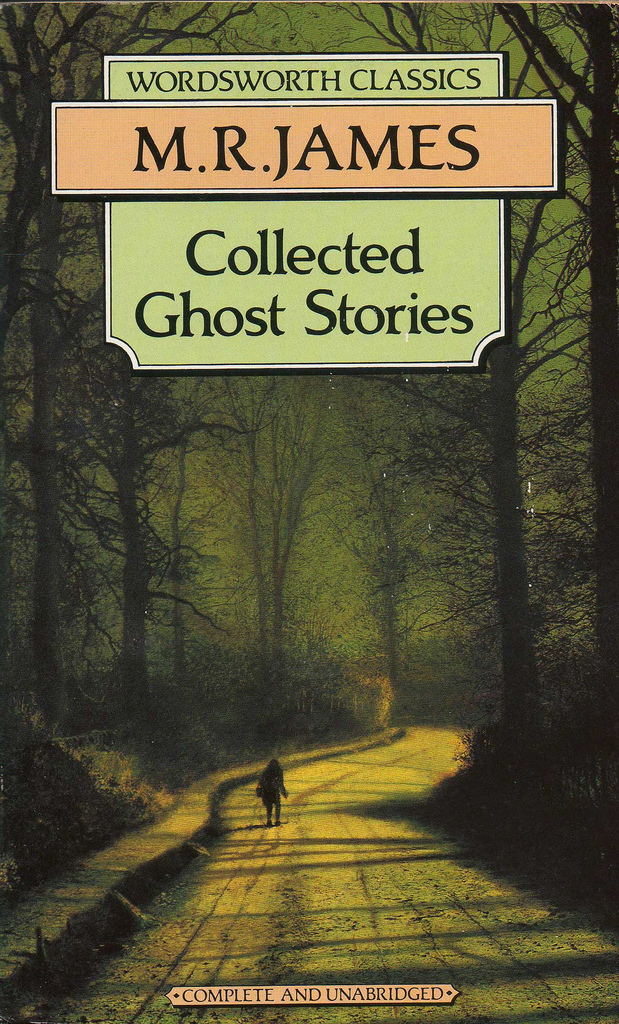
Moonlight Walk by John Atkinson Grimshaw (1836-93)

Moonlight Walk by John Atkinson Grimshaw (1836-93)

John Atkinson Grimshaw (1836-93), Autumn Morning.
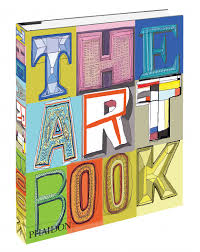 The Art Book, Phaidon (Second edition 2012)
An A to Z of artists, mostly painters, occasionally sculptors, installers and performers, with a few photographers and video-makers too. You can trace the development, culmination and corruption of high art all the way from Giotto and Fra Angelico through Van Eyck and Caravaggio to Auerbach and Twombly. But the modernist dreck heightens the power of the pre-modernist delights. A few pages after Pieter Claesz’s remarkable A Vanitas Still Life of 1645 there’s Joseph Cornell’s “Untitled” of 1950. One is a skull, watch and overturned glass, skilfully lit, minutely detailed, richly symbolic; the other is a wooden box containing a “frugal assortment of stamps, newspaper cuttings and other objects with no particular relevance to each other”. From the sublime to the slapdash. Over the page from Eleazar Lissitzky’s Composition of 1941 there’s Stefan Lochner’s The Virgin and Child in a Rose Arbour of 1442. One is like a child’s doodle, the other like a jewel. From the slapdash to the sublime.
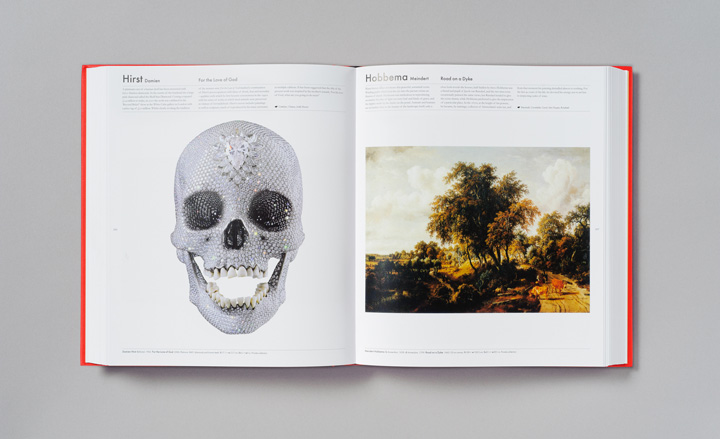
And so it goes on throughout the book, with beautiful art by great artists following or preceding ugly art by poseurs and charlatans. But some of the modern art is attractive or interesting, like Bridget Riley’s eye-alive Cataract 3 (1961) and Damien Hirst’s diamond-encrusted skull For the Love of God (2006). Riley and Hirst aren’t great and Hirst at least is more like an entrepreneur than an artist, but their art here is something that rewards the eye. So is Riley’s art elsewhere, as newcomers to her work might guess from the single example here. That is one of the purposes of a guide like this: to invite – or discourage – further investigation. I vaguely remember seeing the beautiful still-life of a boiled lobster, drinking horn and peeled lemon on page 283 before, but I wouldn’t have recognized the name of the Dutch artist: Willem Kalf (1619-93).
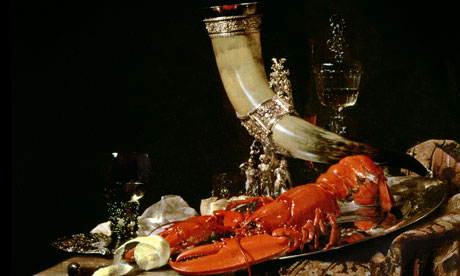
Willem Kalf, Still Life (c. 1653)
Finding Grimshaw here made a good guide even better. The short texts above each art-work pack in a surprising amount of information and anecdote too. What you learn from the texts raises some interesting questions. For example: Why has one small nation contributed so much to the world’s treasury of art? From Van Eyck to Van Gogh by way of Hieronymus Bosch and Jan Vermeer, Holland is comparable to Italy in its importance. But only in painting, not sculpture or architecture. There aren’t just patterns of pigment, texture and geometry in this book: there are patterns of DNA, culture and evolution too. Brilliant, beautiful and banal; skilful, subtle and slapdash: The Art Book has all that and more. It puts jewels inside your skull.
Elsewhere other-posted:
• Ai Wei to Hell — How to Read Contemporary Art, Michael Wilson
• Eyck’s Eyes — Van Eyck, Simone Ferrari
• Face Paint — A Face to the World: On Self-Portraits, Laura Cumming
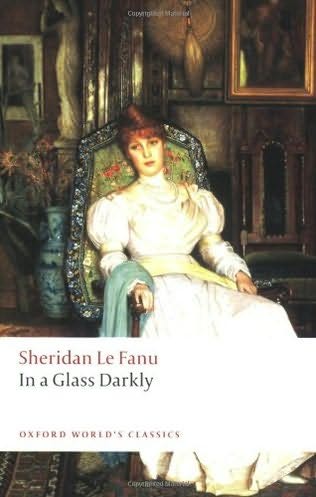 In A Glass Darkly, Sheridan Le Fanu
Far less known than his great admirer M.R. James, the Dubliner Sheridan Le Fanu (1814-73) may be an even better and more haunting writer. And yet he doesn’t rely much on the supernatural. Some of his stories seem to be more about neurological disease than about ghostly visitation. That kind of disease was much more common in his Georgian and Victorian day, when the toxicity of many chemicals wasn’t understood properly and people could be poisoned by arsenic in their wallpaper. But the horrors conjured by a diseased brain can be both stronger and more mysterious than a ghost or demon, because they’re more intimate and less easy to escape.
Le Fanu is intimate in another way: he has Robert Aickman’s ability to start currents swirling in your subconscious. You can feel yourself being drawn down into the abysses that wait there, dark and mysterious with sex, death and primal instinct. “Carmilla”, his classic tale of adolescent lesbian vampirism, is a good example. It also reveals his wider sympathy with humanity. M.R. James would not have written about women or about that kind of sex. Homosexuality and necrophilia seem to inform James’ stories; Le Fanu’s have the richness and bittersweetness of a man with wider sexual interests. Like Frankenstein or Sherlock Holmes, “Carmilla” may be more famous than its author is. It still appears in horror anthologies, partly because of its theme, partly because it’s probably his best work.
It’s also written more simply than, say, “The Familiar”. You often have to pay attention when you read Le Fanu’s prose:
The mind thus turned in upon itself, and constantly occupied with a haunting anxiety which it dared not reveal, or confide to any human breast, became daily more excited, and, of course, more vividly impressible, by a system of attack which operated through the nervous system; and in this state he was destined to sustain, with increasing frequency, the stealthy visitations of that apparition, which from the first had seemed to possess so unearthly and terrible a hold upon his imagination. (“The Watcher”)
If you don’t concentrate as Le Fanu throws you the words, you drop them and can’t juggle the whirl of metaphor and concept he wants you to experience. The effort required to read his stories is no doubt part of why he isn’t as well-known as he should be. But what you invest is repaid with interest and this collection, in Oxford’s World Classics series, is well represented by the painting on the cover: a detail from the great John Atkinson Grimshaw’s Dulce Domum (1885), with a melancholy-dreaming young woman sitting in a house rich with detail, from peacock feathers to Chinese vases.
 Overlord In Terms of Core Issues Around Maximal Engagement with Key Notions of the Über-Feral
