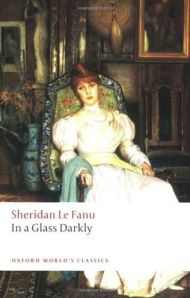
 In A Glass Darkly, Sheridan Le Fanu
Far less known than his great admirer M.R. James, the Dubliner Sheridan Le Fanu (1814-73) may be an even better and more haunting writer. And yet he doesn’t rely much on the supernatural. Some of his stories seem to be more about neurological disease than about ghostly visitation. That kind of disease was much more common in his Georgian and Victorian day, when the toxicity of many chemicals wasn’t understood properly and people could be poisoned by arsenic in their wallpaper. But the horrors conjured by a diseased brain can be both stronger and more mysterious than a ghost or demon, because they’re more intimate and less easy to escape.
Le Fanu is intimate in another way: he has Robert Aickman’s ability to start currents swirling in your subconscious. You can feel yourself being drawn down into the abysses that wait there, dark and mysterious with sex, death and primal instinct. “Carmilla”, his classic tale of adolescent lesbian vampirism, is a good example. It also reveals his wider sympathy with humanity. M.R. James would not have written about women or about that kind of sex. Homosexuality and necrophilia seem to inform James’ stories; Le Fanu’s have the richness and bittersweetness of a man with wider sexual interests. Like Frankenstein or Sherlock Holmes, “Carmilla” may be more famous than its author is. It still appears in horror anthologies, partly because of its theme, partly because it’s probably his best work.
It’s also written more simply than, say, “The Familiar”. You often have to pay attention when you read Le Fanu’s prose:
The mind thus turned in upon itself, and constantly occupied with a haunting anxiety which it dared not reveal, or confide to any human breast, became daily more excited, and, of course, more vividly impressible, by a system of attack which operated through the nervous system; and in this state he was destined to sustain, with increasing frequency, the stealthy visitations of that apparition, which from the first had seemed to possess so unearthly and terrible a hold upon his imagination. (“The Watcher”)
If you don’t concentrate as Le Fanu throws you the words, you drop them and can’t juggle the whirl of metaphor and concept he wants you to experience. The effort required to read his stories is no doubt part of why he isn’t as well-known as he should be. But what you invest is repaid with interest and this collection, in Oxford’s World Classics series, is well represented by the painting on the cover: a detail from the great John Atkinson Grimshaw’s Dulce Domum (1885), with a melancholy-dreaming young woman sitting in a house rich with detail, from peacock feathers to Chinese vases.