
The ’rror

The Haunted Mirrors

Ego non sum…

     Evangelium secundum Ioannem XVII, xiv.

The old palace had a thousand corridors, ten thousand mirrors, squares, ovals, and diamonds, which remained bright and clear for all the dust and cobwebs that surrounded them, specking not with the autumn rain that fell through rents in the roof, cracking not in the fierce frosts of midwinter, ever fascinating, ever fearful to the youths and maidens of the villages therearound. For no mirror reflected faithfully, or so ’twas said, having always some sorcerous taint or anomaly, whereby, on early corridors, the faces reflected were not quite those of him or her who stood before them, being distinct in some particular of eye or mouth or cheek, of hair or tint or scarring, as though a brother or sister looked out, not a twin; and on later the faces reflected began to alter more strongly, more unsettlingly, seeming to partake of different nation and race; and on last of all, seen by very few, the faces reflected began to depart the bounds of humanity, borrowing form and feature from beasts, birds, and fish.

But horrider than these, found here and there in the palace, were mirrors wherein viewers saw themselves become giant insects, myriad-eyed, with nodding antennæ, finger-like jaws or coiled proboscis, or else arachnids, crustaceans, or worms, whereat some fled in horror or fainted where they stood, and few indeed could watch the transformations for long. Kinder mirrors might stand a stride or two away, natheless, wherein faces became now flowers, great and glorious, now crystals of many and gorgeous facets or polyhedra of polished metal, reflective themselves within a reflection. But these mirrors too could trouble the brain and linger in dreams, being sorcerous equally with the rest, nor did it seem right that fragrance should leak from the flowers and notes chime from the crystals and polyhedra. Wherefor no mirror in the old palace could be viewed with impunity, save by the dullest-witted, the stupidest, and these too feared to come before one or another of two mirrors said to be horriblest of all.

In one of these, the viewer would see himself seemingly true at first, then note that months were passing in the mirror for moments before it, whereby one aged before one’s very eyes, skin wrinkling, nose expanding, jaw collapsing. And if one watched unwisely long, one saw death possess the face and a haze of maggots eat it to bare and grinning bone.

In the other of these mirrors, the viewer saw somewhat more disturbing still, save to a rarest few: namely, naught at all where a face should have looked back, as though one existed not and the world flowed on unaffected.
Absolutely Sabulous

Smooth between sea and land
Is laid the yellow sand,
And here through summer days
The seed of Adam plays.

Here the child comes to found
His unremaining mound,
And the grown lad to score
Two names upon the shore.

Here, on the level sand,
Between the sea and land,
What shall I build or write
Against the fall of night?

Tell me of runes to grave
That hold the bursting wave,
Or bastions to design
For longer date than mine.

Shall it be Troy or Rome
I fence against the foam,
Or my own name, to stay
When I depart for aye?

Nothing: too near at hand,
Planing the figure sand,
Effacing clean and fast
Cities not built to last
And charms devised in vain,
Pours the confounding main. — A.E. Housman, “XLV” of More Poems (1936)

HMortuis

“The Garden of Prosperpine”

By Algernon Charles Swinburne


Here, where the world is quiet;
         Here, where all trouble seems
Dead winds’ and spent waves’ riot
         In doubtful dreams of dreams;
I watch the green field growing
For reaping folk and sowing,
For harvest-time and mowing,
         A sleepy world of streams.

I am tired of tears and laughter,
         And men that laugh and weep;
Of what may come hereafter
         For men that sow to reap:
I am weary of days and hours,
Blown buds of barren flowers,
Desires and dreams and powers
         And everything but sleep.

Here life has death for neighbour,
         And far from eye or ear
Wan waves and wet winds labour,
         Weak ships and spirits steer;
They drive adrift, and whither
They wot not who make thither;
But no such winds blow hither,
         And no such things grow here.

No growth of moor or coppice,
         No heather-flower or vine,
But bloomless buds of poppies,
         Green grapes of Proserpine,
Pale beds of blowing rushes
Where no leaf blooms or blushes
Save this whereout she crushes
         For dead men deadly wine.

Pale, without name or number,
         In fruitless fields of corn,
They bow themselves and slumber
         All night till light is born;
And like a soul belated,
In hell and heaven unmated,
By cloud and mist abated
         Comes out of darkness morn.

Though one were strong as seven,
         He too with death shall dwell,
Nor wake with wings in heaven,
         Nor weep for pains in hell;
Though one were fair as roses,
His beauty clouds and closes;
And well though love reposes,
         In the end it is not well.

Pale, beyond porch and portal,
         Crowned with calm leaves, she stands
Who gathers all things mortal
         With cold immortal hands;
Her languid lips are sweeter
Than love’s who fears to greet her
To men that mix and meet her
         From many times and lands.

She waits for each and other,
         She waits for all men born;
Forgets the earth her mother,
            The life of fruits and corn;
And spring and seed and swallow
Take wing for her and follow
Where summer song rings hollow
         And flowers are put to scorn.

There go the loves that wither,
         The old loves with wearier wings;
And all dead years draw thither,
         And all disastrous things;
Dead dreams of days forsaken,
Blind buds that snows have shaken,
Wild leaves that winds have taken,
         Red strays of ruined springs.

We are not sure of sorrow,
         And joy was never sure;
To-day will die to-morrow;
         Time stoops to no man’s lure;
And love, grown faint and fretful,
With lips but half regretful
Sighs, and with eyes forgetful
         Weeps that no loves endure.

From too much love of living,
         From hope and fear set free,
We thank with brief thanksgiving
         Whatever gods may be
That no life lives for ever;
That dead men rise up never;
That even the weariest river
         Winds somewhere safe to sea.

Then star nor sun shall waken,
         Nor any change of light:
Nor sound of waters shaken,
         Nor any sound or sight:
Nor wintry leaves nor vernal,
Nor days nor things diurnal;
Only the sleep eternal
         In an eternal night.

Bones, Blinks, Books

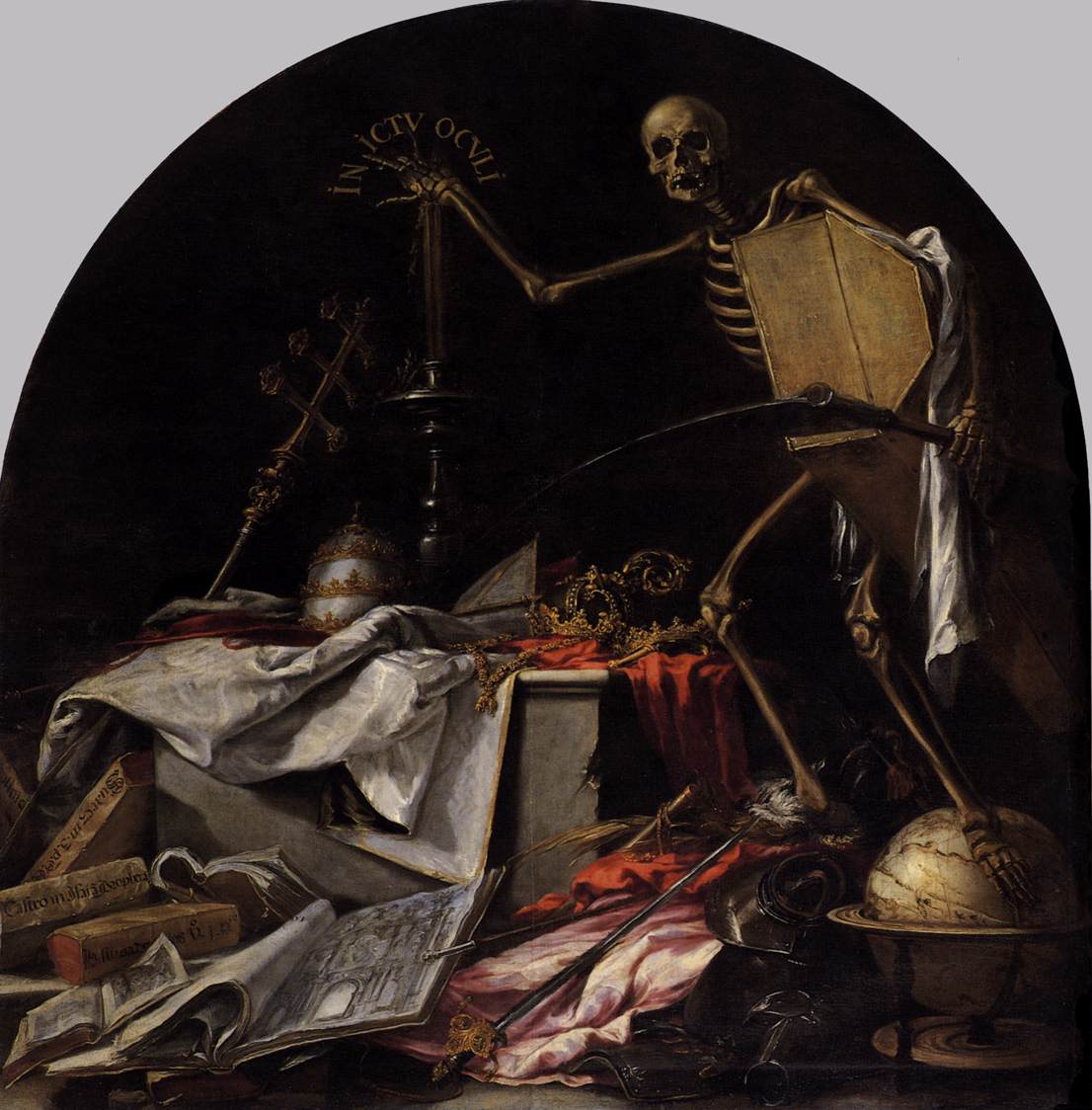
In Ictu Oculi by Juan de Valdés Leal (c. 1671)

In Ictu Oculi (In the Blink of an Eye) by Juan de Valdés Leal (c. 1671).