Primal Pellicles

Numbers have thin skins. And they’re easily replaced. Take 71624133. Here it is permuting its pellicles:

71624133 in base 10 = 100010001001110010111000101 in base 2 = 11222202212211200 in b3 = 10101032113011 in b4 = 121313433013 in b5 = 11035053113 in b6 = 1526536500 in b7 = 421162705 in b8 = 158685750 in b9 = 374802A9 in b11 = 1BBA1199 in b12 = 11AB9B59 in b13 = 9726137 in b14 = 644BE73 in b15 = F3855B7 in b16

But if digits are the skin of 71624133, what are its bones? Well, you could say the skeleton of a number, something that doesn’t change from base to base, is its prime factorization:

71624133 = 32 × 72 × 162413

But the primes themselves are numbers, so they’re wearing pellicles too. And it turns out that, in base 10, the pellicles of the prime factors of 71624133 match the pellicle of 71624133 itself:

71624133 = 32.72.162413

Here’s a list of primal pellicles in base 10:

735 = 3.5.72
3792 = 24.3.79
1341275 = 52.13.4127
13115375 = 53.7.13.1153
22940075 = 52.229.4007
29373375 = 3.53.29.37.73
71624133 = 32.72.162413
311997175 = 52.7.172.31.199
319953792 = 27.3.53.79.199
1019127375 = 32.53.7.127.1019
1147983375 = 3.53.7.11.83.479
1734009275 = 52.173.400927
5581625072 = 24.5581.62507
7350032375 = 53.7.23.73.5003
17370159615 = 34.5.17.59.61.701
33061224492 = 22.33.306122449
103375535837 = 72.37.103.553583
171167303912 = 23.11.172.6730391
319383665913 = 3.133.19.383.6659
533671737975 = 34.52.17.53.367.797
2118067737975 = 32.52.7.79.211.80677
3111368374257 = 3.112.132.683.74257
3216177757191 = 3.73.191.757.21617
3740437158475 = 52.37.4043715847
3977292332775 = 3.52.292.233.277.977
4417149692375 = 53.7.23.4969.44171
7459655393232 = 24.32.72.23.45965539
7699132721175 = 3.52.72.27211.76991
7973529228735 = 3.5.7.972.2287.3529
10771673522535 = 34.5.67.71.107.52253

You can find them at the Online Encyclopedia of Integer Sequences under A121342, “Composite numbers that are a concatenation of their distinct prime divisors in some order.” But what about pairs of primal pellicles, that is, pairs of numbers where the prime factors of each form the pellicle of the other?

35 = 5.775 = 3.52
1275 = 3.52.173175 = 52.127
131715 = 32.5.2927329275 = 52.13171
3199767 = 3.359.297135932971 = 3.19.67.972
14931092 = 22.11.61.5563116155632 = 24.3.109.1492

And here are a few primal pellicles I’ve found in other bases:

Primal Pellicles in Base 2

1111011011110 = 10.1110.110110111 in b2 = 7902 = 2.32.439 in b10
1110001100110111 = 1110.10111.100011001 in b2 = 58167 = 32.23.281 in b10
1111011011011110 = 10.1110.110110110111 in b2 = 63198 = 2.32.3511 in b10
11101001100001101 = 1110.101.101001100001 in b2 = 119565 = 32.5.2657 in b10
1111011011011011110 = 10.1110.110110110110111 in b2 = 505566 = 2.32.28087 in b10
1111011111101111011 = 1110.1011.10111.11011111 in b2 = 507771 = 32.11.23.223 in b10


Primal Pellicles in Base 3

121022 = 210.12.102 in b3 = 440 = 23.5.11 in b10
212212 = 22.21.212 in b3 = 644 = 22.7.23 in b10
20110112 = 210.201.1011 in b3 = 4712 = 23.19.31 in b10
21110110 = 10.212.1101 in b3 = 5439 = 3.72.37 in b10
121111101 = 122.111.1101 in b3 = 12025 = 52.13.37 in b10
222112121 = 22.21.221121 in b3 = 19348 = 22.7.691 in b10
2202122021 = 22.2021.22021 in b3 = 54412 = 22.61.223 in b10
120212201221 = 2.122.21.201.1202 in b3 = 312550 = 2.52.7.19.47 in b10


Primal Pellicles in Base 7

2525 = 2.52.25 in b7 = 950 = 2.52.19 in b10
3210 = 2.34.10 in b7 = 1134 = 2.34.7 in b10
5252 = 2.52.52 in b7 = 1850 = 2.52.37 in b10
332616 = 33.16.326 in b7 = 58617 = 33.13.167 in b10
336045 = 32.5.3604 in b7 = 59715 = 32.5.1327 in b10
2251635 = 22.3.5.16.252 in b7 = 281580 = 22.3.5.13.192 in b10


Primal Pellicles in Base 11

253 = 22.3.52 in b11 = 300 = 22.3.52 in b10
732 = 2.32.72 in b11 = 882 = 2.32.72 in b10
2123 = 23.33.12 in b11 = 2808 = 23.33.13 in b10
3432 = 25.3.43 in b11 = 4512 = 25.3.47 in b10
3710 = 32.72.10 in b11 = 4851 = 32.72.11 in b10
72252 = 23.72.225 in b11 = 105448 = 23.72.269 in b10


Primal Pellicles in Base 15

275 = 24.5.7 in b15 = 560 = 24.5.7 in b10
2D5 = 2.52.D in b15 = 650 = 2.52.13 in b10
2CD5 = 2.52.CD in b15 = 9650 = 2.52.193 in b10
7BE3 = 3.72.BE in b15 = 26313 = 3.72.179 in b10
21285 = 24.52.128 in b15 = 105200 = 24.52.263 in b10

The Fatal Factory

I can’t remember where I came across this clever little puzzle and what precise form it took, but here’s my version of it:

A famously eccentric inventor and recreational mathematician has invited you to tour the factory where his company manufactures locks, keys, safes, cash-boxes and so on. At the end of the tour he brings you to a conference room, pours you a glass of wine, and invites you to test your wits against a puzzle. He points out that a hundred numbered boxes have been set out on two long tables in the room. You sip your wine as you listen to him explain that each box is locked and contains a slip of paper bearing a number between 0 and 9. If you accept the challenge, the inventor will order a hundred workers to walk in turn past the boxes, using a master-key to unlock or lock the boxes like this:

The first worker will use the key on every box (boxes #1,2,3…), the second worker will use the key on every second box (boxes #2,4,6…), the third worker the key on every third box (boxes #3,6,9…), and so on.

Now, you can’t tell by simply looking at a box whether it’s unlocked or not, but it’s obvious that the first box will be unlocked when all that is over. Box #1 is originally locked and the master-key will be used on it just once. But how many other boxes will be unlocked? If you can choose nothing but the unlocked boxes, you get to keep the contents. Otherwise you get nothing. That is, if you choose one or more locked boxes, you get nothing.

And what good are the contents of the unlocked boxes? Well, if you take the numbered slips of paper they contain in order, they will give you the combination of a locked safe the inventor now points out in the wall behind you. The safe contains the antidote for the deadly but slow-acting poison he secretly slipped into the wine you have been sipping as you listened to him explain the details of the puzzle. So you have to choose all and only the unlocked boxes to save your life. Can you do it?


Solution

I’m sure there’s a simpler explanation of which boxes will be unlocked, but here’s my complicated one:

Whether box #n is locked or unlocked in the end depends on how many divisors the number n has. If it has an even number of divisors, it will be locked; if it has an odd number of divisors, it will be unlocked. Take box #12. The number 12 has six divisors: 1, 2, 3, 4, 6 and 12. So workers #1, #3 and #6 will unlock it with the master-key, but workers #2, #4 and #12 will lock it again. Worker #12 will be the final worker to use the master-key on the box, so it will be locked.

Now take box #16. The number #16 has five divisors: 1, 2, 4, 8 and 16. So workers #1, #4 and #16 will unlock the box with the master-key, while workers #2 and #8 will lock it. Worker #16 will be the final worker to use the master-key on the box, so it will be unlocked.

In other words, the puzzle reduces to this: Which numbers from 1 to 100 have an odd number of divisors? To work out the number of divisors n has, you add 1 to the exponent of each of its prime factors and multiply the results. For example, 24 has eight divisors thus:

• 24 = 2^3 * 3^1 → (3+1) * (1+1) = 4 * 2 = 8, so 24 has eight divisors: 1, 2, 3, 4, 6, 8, 12, 24

But 36 has nine divisors thus:

• 36 = 2^2 * 3^2 → (2+1) * (2+1) = 3 * 3 = 9, so 36 has nine divisors: 1, 2, 3, 4, 6, 9, 12, 18, 36

36 demonstrates that a number has to have only even exponents on its prime factors to have an odd number of divisors (the only number without prime factors is 1, which has one divisor, namely itself). Numbers with only even exponents on their prime factors are square numbers:

• 4 = 2^2 → (2+1) = 3, so 4 has three divisors: 1, 2, 4
• 9 = 3^2 → (2+1) = 3, so 9 has three divisors: 1, 3, 9
• 16 = 2^4 → (4+1) = 5, so 16 has five divisors: 1, 2, 4, 8, 16
• 25 = 5^2 → (2+1) = 3, so 25 has divisors: 1, 5, 25
• 36 = 2^2 * 3^2 → (2+1) * (2+1) = 3 * 3 = 9, so 36 has nine divisors: 1, 2, 3, 4, 6, 9, 12, 18, 36
• 49 = 7^2 → (2+1) = 3, so 49 has three divisors: 1, 7, 49
• 64 = 2^6 → (6+1) = 7, so 64 has seven divisors: 1, 2, 4, 8, 16, 32, 64
• 81 = 3^4 → (4+1) = 5, so 81 has five divisors: 1, 3, 9, 27, 81
• 100 = 2^2 * 5^2 → (2+1) * (2+1) = 3 * 3 = 9, so 100 has nine divisors: 1, 2, 4, 5, 10, 20, 25, 50, 100

So if you choose boxes #1, #4, #9, #16, #25, #36, #49, #64, #81 and #100, you’ll get the combination for the safe and save your life.


Appendix

Here’s the full description of what happens to the boxes:

• box #1 is unlocked by worker #1 and locked by no-one, therefore it’s unlocked
• box #2 is unlocked by worker #1 and locked by worker #2, therefore it’s locked
• box #3 is unlocked by worker #1 and locked by worker #3, therefore it’s locked
• box #4 is unlocked by workers #1 and #4, and locked by worker #2, therefore it’s unlocked
• box #5 is unlocked by worker #1 and locked by worker #5, therefore it’s locked
• box #6 is unlocked by workers #1 and #3, and locked by workers #2 and #6, therefore it’s locked
• box #7 is unlocked by worker #1 and locked by worker #7, therefore it’s locked
• box #8 is unlocked by workers #1 and #4, and locked by workers #2 and #8, therefore it’s locked
• box #9 is unlocked by workers #1 and #9, and locked by worker #3, therefore it’s unlocked
• box #10 is unlocked by workers #1 and #5, and locked by workers #2 and #10, therefore it’s locked
• box #11 is unlocked by worker #1 and locked by worker #11, therefore it’s locked
• box #12 is unlocked by workers #1, #3 and #6, and locked by workers #2, #4 and #12, therefore it’s locked
• box #13 is unlocked by worker #1 and locked by worker #13, therefore it’s locked
• box #14 is unlocked by workers #1 and #7, and locked by workers #2 and #14, therefore it’s locked
• box #15 is unlocked by workers #1 and #5, and locked by workers #3 and #15, therefore it’s locked
• box #16 is unlocked by workers #1, #4 and #16, and locked by workers #2 and #8, therefore it’s unlocked
• box #17 is unlocked by worker #1 and locked by worker #17, therefore it’s locked
• box #18 is unlocked by workers #1, #3 and #9, and locked by workers #2, #6 and #18, therefore it’s locked
• box #19 is unlocked by worker #1 and locked by worker #19, therefore it’s locked
• box #20 is unlocked by workers #1, #4 and #10, and locked by workers #2, #5 and #20, therefore it’s locked
• box #21 is unlocked by workers #1 and #7, and locked by workers #3 and #21, therefore it’s locked
• box #22 is unlocked by workers #1 and #11, and locked by workers #2 and #22, therefore it’s locked
• box #23 is unlocked by worker #1 and locked by worker #23, therefore it’s locked
• box #24 is unlocked by workers #1, #3, #6 and #12, and locked by workers #2, #4, #8 and #24, therefore it’s locked
• box #25 is unlocked by workers #1 and #25, and locked by worker #5, therefore it’s unlocked
• box #26 is unlocked by workers #1 and #13, and locked by workers #2 and #26, therefore it’s locked
• box #27 is unlocked by workers #1 and #9, and locked by workers #3 and #27, therefore it’s locked
• box #28 is unlocked by workers #1, #4 and #14, and locked by workers #2, #7 and #28, therefore it’s locked
• box #29 is unlocked by worker #1 and locked by worker #29, therefore it’s locked
• box #30 is unlocked by workers #1, #3, #6 and #15, and locked by workers #2, #5, #10 and #30, therefore it’s locked
• box #31 is unlocked by worker #1 and locked by worker #31, therefore it’s locked
• box #32 is unlocked by workers #1, #4 and #16, and locked by workers #2, #8 and #32, therefore it’s locked
• box #33 is unlocked by workers #1 and #11, and locked by workers #3 and #33, therefore it’s locked
• box #34 is unlocked by workers #1 and #17, and locked by workers #2 and #34, therefore it’s locked
• box #35 is unlocked by workers #1 and #7, and locked by workers #5 and #35, therefore it’s locked
• box #36 is unlocked by workers #1, #3, #6, #12 and #36, and locked by workers #2, #4, #9 and #18, therefore it’s unlocked
• box #37 is unlocked by worker #1 and locked by worker #37, therefore it’s locked
• box #38 is unlocked by workers #1 and #19, and locked by workers #2 and #38, therefore it’s locked
• box #39 is unlocked by workers #1 and #13, and locked by workers #3 and #39, therefore it’s locked
• box #40 is unlocked by workers #1, #4, #8 and #20, and locked by workers #2, #5, #10 and #40, therefore it’s locked
• box #41 is unlocked by worker #1 and locked by worker #41, therefore it’s locked
• box #42 is unlocked by workers #1, #3, #7 and #21, and locked by workers #2, #6, #14 and #42, therefore it’s locked
• box #43 is unlocked by worker #1 and locked by worker #43, therefore it’s locked
• box #44 is unlocked by workers #1, #4 and #22, and locked by workers #2, #11 and #44, therefore it’s locked
• box #45 is unlocked by workers #1, #5 and #15, and locked by workers #3, #9 and #45, therefore it’s locked
• box #46 is unlocked by workers #1 and #23, and locked by workers #2 and #46, therefore it’s locked
• box #47 is unlocked by worker #1 and locked by worker #47, therefore it’s locked
• box #48 is unlocked by workers #1, #3, #6, #12 and #24, and locked by workers #2, #4, #8, #16 and #48, therefore it’s locked
• box #49 is unlocked by workers #1 and #49, and locked by worker #7, therefore it’s unlocked
• box #50 is unlocked by workers #1, #5 and #25, and locked by workers #2, #10 and #50, therefore it’s locked
• box #51 is unlocked by workers #1 and #17, and locked by workers #3 and #51, therefore it’s locked
• box #52 is unlocked by workers #1, #4 and #26, and locked by workers #2, #13 and #52, therefore it’s locked
• box #53 is unlocked by worker #1 and locked by worker #53, therefore it’s locked
• box #54 is unlocked by workers #1, #3, #9 and #27, and locked by workers #2, #6, #18 and #54, therefore it’s locked
• box #55 is unlocked by workers #1 and #11, and locked by workers #5 and #55, therefore it’s locked
• box #56 is unlocked by workers #1, #4, #8 and #28, and locked by workers #2, #7, #14 and #56, therefore it’s locked
• box #57 is unlocked by workers #1 and #19, and locked by workers #3 and #57, therefore it’s locked
• box #58 is unlocked by workers #1 and #29, and locked by workers #2 and #58, therefore it’s locked
• box #59 is unlocked by worker #1 and locked by worker #59, therefore it’s locked
• box #60 is unlocked by workers #1, #3, #5, #10, #15 and #30, and locked by workers #2, #4, #6, #12, #20 and #60, therefore it’s locked
• box #61 is unlocked by worker #1 and locked by worker #61, therefore it’s locked
• box #62 is unlocked by workers #1 and #31, and locked by workers #2 and #62, therefore it’s locked
• box #63 is unlocked by workers #1, #7 and #21, and locked by workers #3, #9 and #63, therefore it’s locked
• box #64 is unlocked by workers #1, #4, #16 and #64, and locked by workers #2, #8 and #32, therefore it’s unlocked
• box #65 is unlocked by workers #1 and #13, and locked by workers #5 and #65, therefore it’s locked
• box #66 is unlocked by workers #1, #3, #11 and #33, and locked by workers #2, #6, #22 and #66, therefore it’s locked
• box #67 is unlocked by worker #1 and locked by worker #67, therefore it’s locked
• box #68 is unlocked by workers #1, #4 and #34, and locked by workers #2, #17 and #68, therefore it’s locked
• box #69 is unlocked by workers #1 and #23, and locked by workers #3 and #69, therefore it’s locked
• box #70 is unlocked by workers #1, #5, #10 and #35, and locked by workers #2, #7, #14 and #70, therefore it’s locked
• box #71 is unlocked by worker #1 and locked by worker #71, therefore it’s locked
• box #72 is unlocked by workers #1, #3, #6, #9, #18 and #36, and locked by workers #2, #4, #8, #12, #24 and #72, therefore it’s locked
• box #73 is unlocked by worker #1 and locked by worker #73, therefore it’s locked
• box #74 is unlocked by workers #1 and #37, and locked by workers #2 and #74, therefore it’s locked
• box #75 is unlocked by workers #1, #5 and #25, and locked by workers #3, #15 and #75, therefore it’s locked
• box #76 is unlocked by workers #1, #4 and #38, and locked by workers #2, #19 and #76, therefore it’s locked
• box #77 is unlocked by workers #1 and #11, and locked by workers #7 and #77, therefore it’s locked
• box #78 is unlocked by workers #1, #3, #13 and #39, and locked by workers #2, #6, #26 and #78, therefore it’s locked
• box #79 is unlocked by worker #1 and locked by worker #79, therefore it’s locked
• box #80 is unlocked by workers #1, #4, #8, #16 and #40, and locked by workers #2, #5, #10, #20 and #80, therefore it’s locked
• box #81 is unlocked by workers #1, #9 and #81, and locked by workers #3 and #27, therefore it’s unlocked
• box #82 is unlocked by workers #1 and #41, and locked by workers #2 and #82, therefore it’s locked
• box #83 is unlocked by worker #1 and locked by worker #83, therefore it’s locked
• box #84 is unlocked by workers #1, #3, #6, #12, #21 and #42, and locked by workers #2, #4, #7, #14, #28 and #84, therefore it’s locked
• box #85 is unlocked by workers #1 and #17, and locked by workers #5 and #85, therefore it’s locked
• box #86 is unlocked by workers #1 and #43, and locked by workers #2 and #86, therefore it’s locked
• box #87 is unlocked by workers #1 and #29, and locked by workers #3 and #87, therefore it’s locked
• box #88 is unlocked by workers #1, #4, #11 and #44, and locked by workers #2, #8, #22 and #88, therefore it’s locked
• box #89 is unlocked by worker #1 and locked by worker #89, therefore it’s locked
• box #90 is unlocked by workers #1, #3, #6, #10, #18 and #45, and locked by workers #2, #5, #9, #15, #30 and #90, therefore it’s locked
• box #91 is unlocked by workers #1 and #13, and locked by workers #7 and #91, therefore it’s locked
• box #92 is unlocked by workers #1, #4 and #46, and locked by workers #2, #23 and #92, therefore it’s locked
• box #93 is unlocked by workers #1 and #31, and locked by workers #3 and #93, therefore it’s locked
• box #94 is unlocked by workers #1 and #47, and locked by workers #2 and #94, therefore it’s locked
• box #95 is unlocked by workers #1 and #19, and locked by workers #5 and #95, therefore it’s locked
• box #96 is unlocked by workers #1, #3, #6, #12, #24 and #48, and locked by workers #2, #4, #8, #16, #32 and #96, therefore it’s locked
• box #97 is unlocked by worker #1 and locked by worker #97, therefore it’s locked
• box #98 is unlocked by workers #1, #7 and #49, and locked by workers #2, #14 and #98, therefore it’s locked
• box #99 is unlocked by workers #1, #9 and #33, and locked by workers #3, #11 and #99, therefore it’s locked
• box #100 is unlocked by workers #1, #4, #10, #25 and #100, and locked by workers #2, #5, #20 and #50, therefore it’s unlocked

Power Flip

12 is an interesting number in a lot of ways. Here’s one way I haven’t seen mentioned before:
12 = 3^1 * 2^2


The digits of 12 represent the powers of the primes in its factorization, if primes are represented from right-to-left, like this: …7, 5, 3, 2. But I couldn’t find any more numbers like that in base 10, so I tried a power flip, from right-left to left-right. If the digits from left-to-right represent the primes in the order 2, 3, 5, 7…, then this number is has prime-power digits too:
81312000 = 2^8 * 3^1 * 5^3 * 7^1 * 11^2 * 13^0 * 17^0 * 19^0


Or, more simply, given that n^0 = 1:

81312000 = 2^8 * 3^1 * 5^3 * 7^1 * 11^2


I haven’t found any more left-to-right prime-power digital numbers in base 10, but there are more in other bases. Base 5 yields at least three (I’ve ignored numbers with just two digits in a particular base):

110 in b2 = 2^1 * 3^1 (n=6)
130 in b6 = 2^1 * 3^3 (n=54)
1010 in b2 = 2^1 * 3^0 * 5^1 (n=10)
101 in b3 = 2^1 * 3^0 * 5^1 (n=10)
202 in b7 = 2^2 * 3^0 * 5^2 (n=100)
3020 in b4 = 2^3 * 3^0 * 5^2 (n=200)
330 in b8 = 2^3 * 3^3 (n=216)
13310 in b14 = 2^1 * 3^3 * 5^3 * 7^1 (n=47250)
3032000 in b5 = 2^3 * 3^0 * 5^3 * 7^2 (n=49000)
21302000 in b5 = 2^2 * 3^1 * 5^3 * 7^0 * 11^2 (n=181500)
7810000 in b9 = 2^7 * 3^8 * 5^1 (n=4199040)
81312000 in b10 = 2^8 * 3^1 * 5^3 * 7^1 * 11^2


Post-Performative Post-Scriptum

When I searched for 81312000 at the Online Encyclopedia of Integer Sequences, I discovered that these are Meertens numbers, defined at A246532 as the “base n Godel encoding of x [namely,] 2^d(1) * 3^d(2) * … * prime(k)^d(k), where d(1)d(2)…d(k) is the base n representation of x.”

Fract-Hills

The Farey sequence is a fascinating sequence of fractions that divides the interval between 0/1 and 1/1 into smaller and smaller parts. To find the Farey fraction a[i] / b[i], you simply find the mediant of the Farey fractions on either side:

• a[i] / b[i] = (a[i-1] + a[i+1]) / (b[i-1] + b[i+1])

Then, if necessary, you reduce the numerator and denominator to their simplest possible terms. So the sequence starts like this:

• 0/1, 1/1

To create the next stage, find the mediant of the two fractions above: (0+1) / (1+1) = 1/2

• 0/1, 1/2, 1/1

For the next stage, there are two mediants to find: (0+1) / (1+2) = 1/3, (1+1) / (2+3) = 2/3

• 0/1, 1/3, 1/2, 2/3, 1/1

Note that 1/2 is the mediant of 1/3 and 2/3, that is, 1/2 = (1+2) / (3+3) = 3/6 = 1/2. The next stage is this:

• 0/1, 1/4, 1/3, 2/5, 1/2, 3/5, 2/3, 3/4, 1/1

Now 1/2 is the mediant of 2/5 and 3/5, that is, 1/2 = (2+3) / (5+5) = 5/10 = 1/2. Further stages go like this:

• 0/1, 1/5, 1/4, 2/7, 1/3, 3/8, 2/5, 3/7, 1/2, 4/7, 3/5, 5/8, 2/3, 5/7, 3/4, 4/5, 1/1

• 0/1, 1/6, 1/5, 2/9, 1/4, 3/11, 2/7, 3/10, 1/3, 4/11, 3/8, 5/13, 2/5, 5/12, 3/7, 4/9, 1/2, 5/9, 4/7, 7/12, 3/5, 8/13, 5/8, 7/11, 2/3, 7/10, 5/7, 8/11, 3/4, 7/9, 4/5, 5/6, 1/1

• 0/1, 1/7, 1/6, 2/11, 1/5, 3/14, 2/9, 3/13, 1/4, 4/15, 3/11, 5/18, 2/7, 5/17, 3/10, 4/13, 1/3, 5/14, 4/11, 7/19, 3/8, 8/21, 5/13, 7/18, 2/5, 7/17, 5/12, 8/19, 3/7, 7/16, 4/9, 5/11, 1/2, 6/11, 5/9, 9/16, 4/7, 11/19, 7/12, 10/17, 3/5, 11/18, 8/13, 13/21, 5/8, 12/19, 7/11, 9/14, 2/3, 9/13, 7/10, 12/17, 5/7, 13/18, 8/11, 11/15, 3/4, 10/13, 7/9, 11/14, 4/5, 9/11, 5/6, 6/7, 1/1

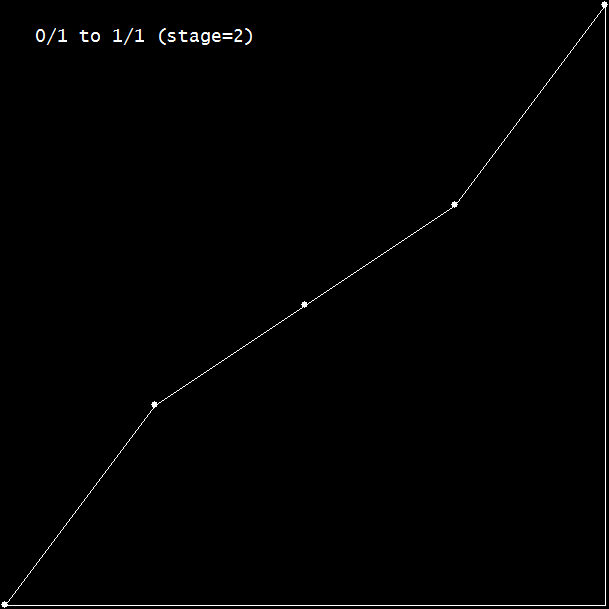
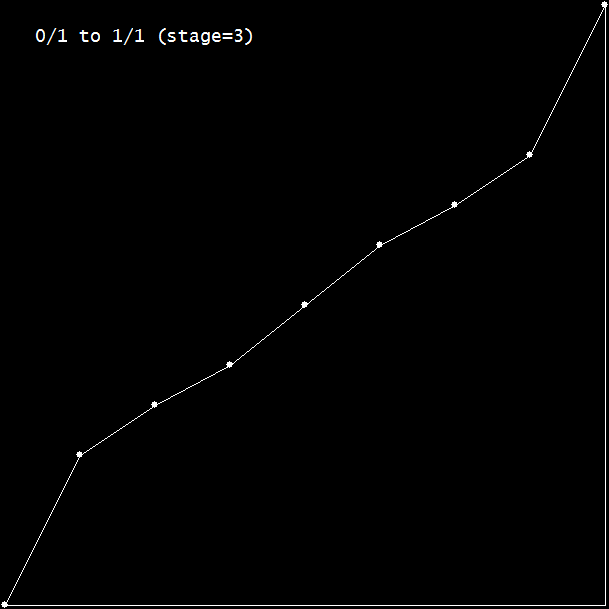
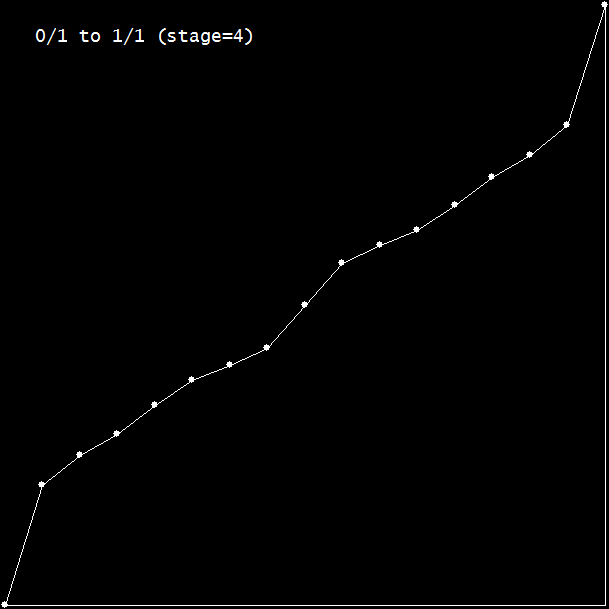
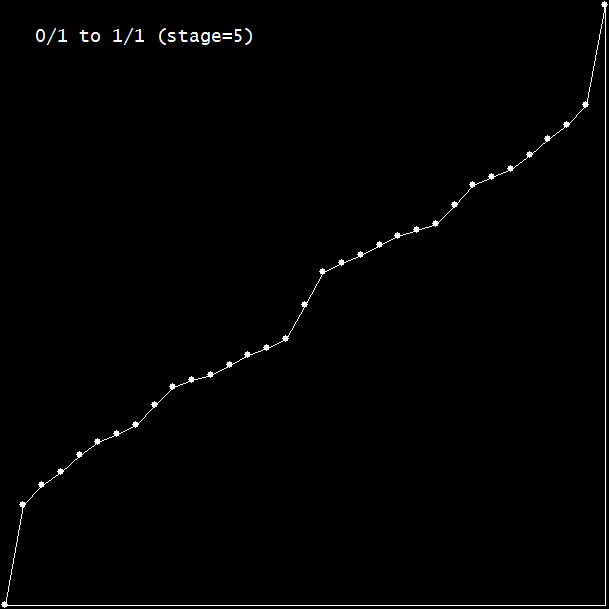
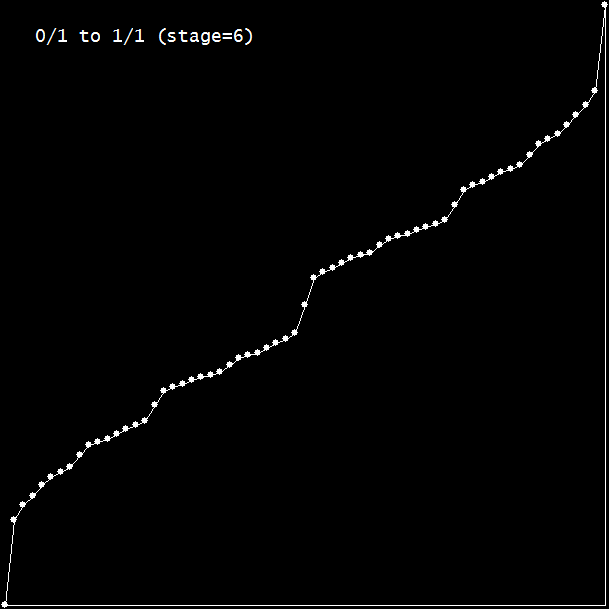
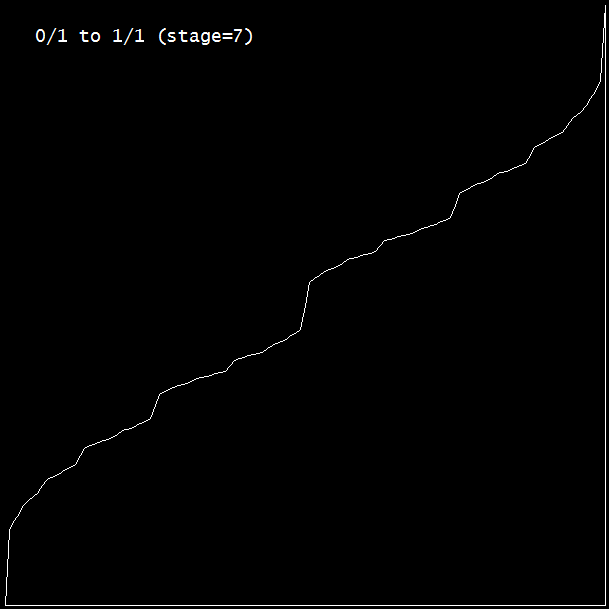
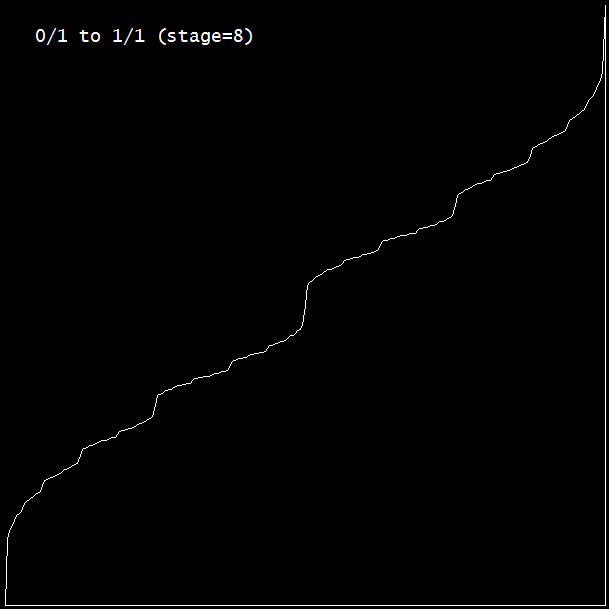
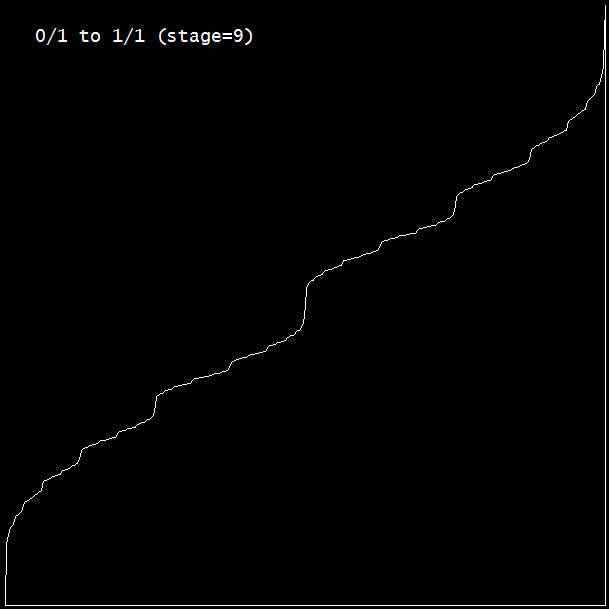
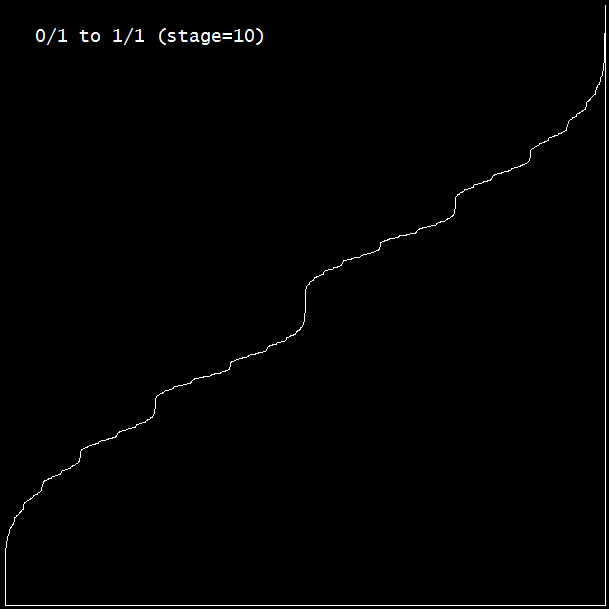
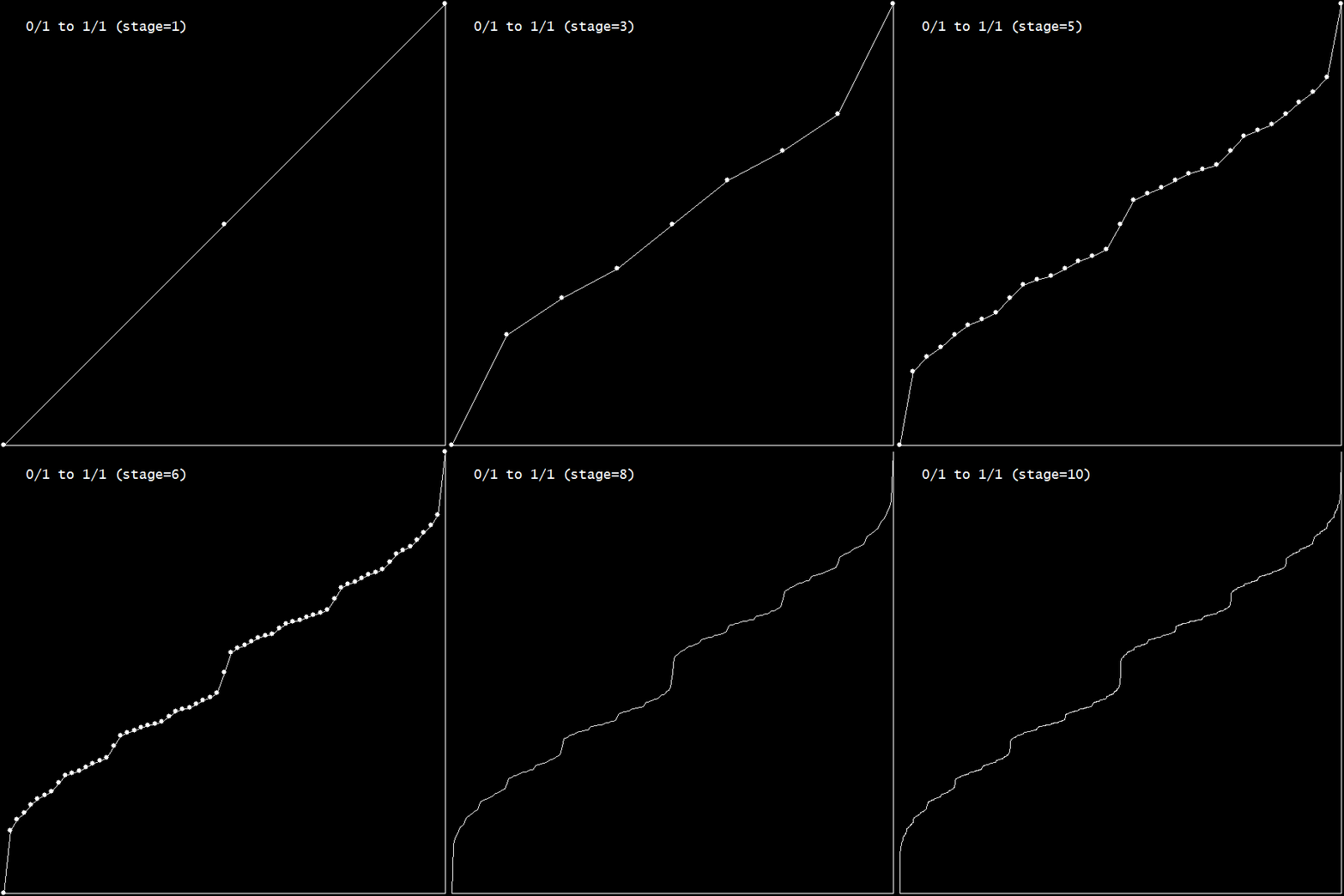
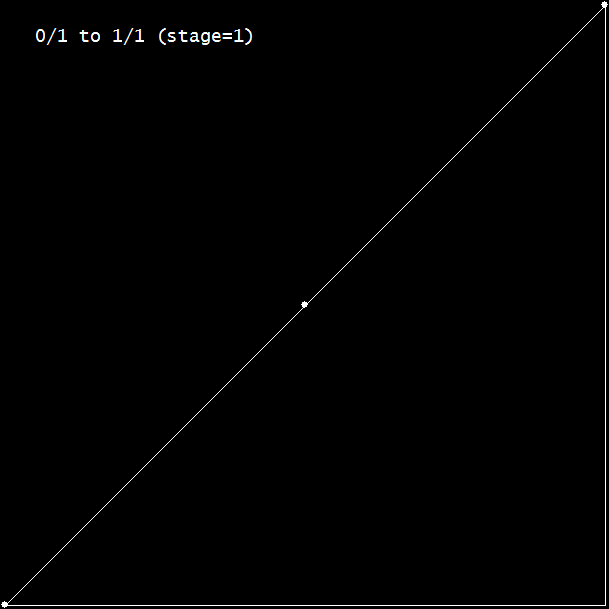
The Farey sequence is actually a fractal, as you can see more easily when it’s represented as an image:

Farey fractal stage #1, representing 0/1, 1/2, 1/1

Farey fractal stage #2, representing 0/1, 1/3, 1/2, 2/3, 1/1

Farey fractal stage #3, representing 0/1, 1/4, 1/3, 2/5, 1/2, 3/5, 2/3, 3/4, 1/1

Farey fractal stage #4, representing 0/1, 1/5, 1/4, 2/7, 1/3, 3/8, 2/5, 3/7, 1/2, 4/7, 3/5, 5/8, 2/3, 5/7, 3/4, 4/5, 1/1

Farey fractal stage #5

Farey fractal stage #6

Farey fractal stage #7

Farey fractal stage #8

Farey fractal stage #9

Farey fractal stage #10

Farey fractal (animated)

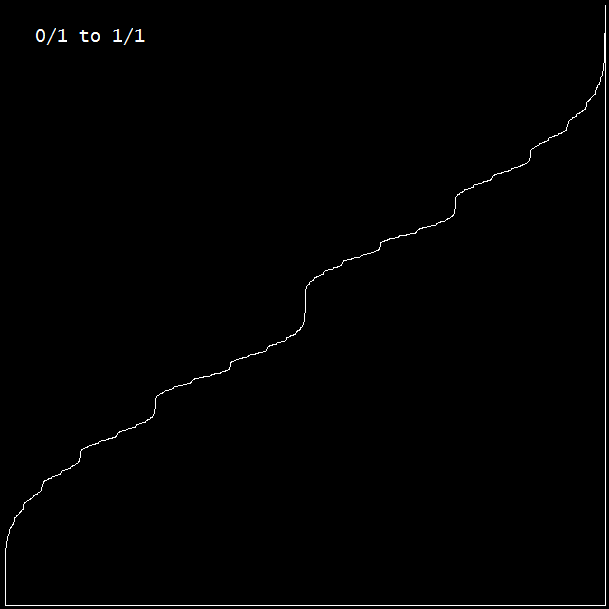
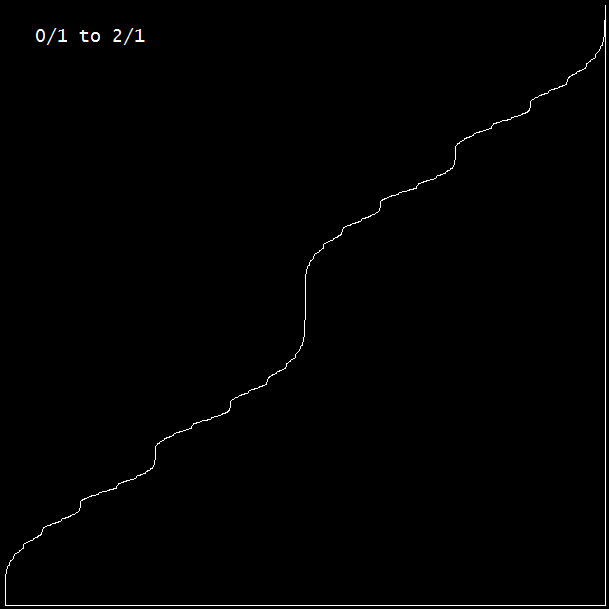
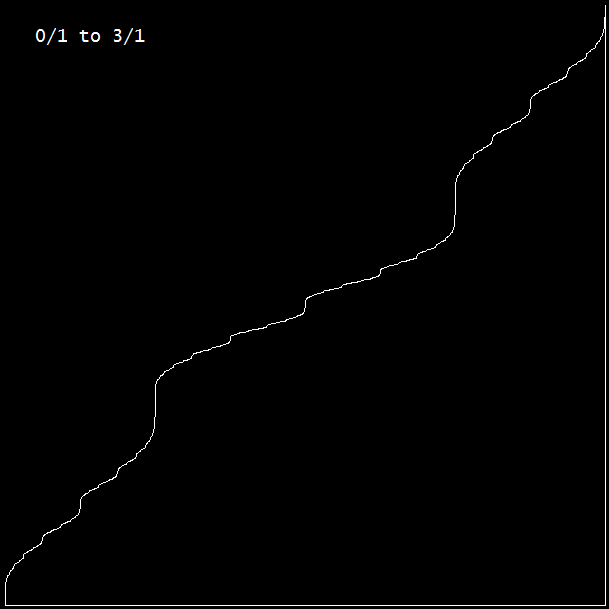
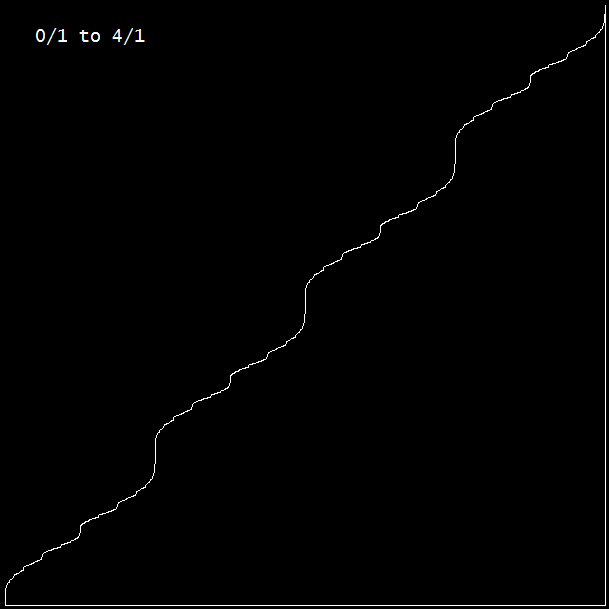
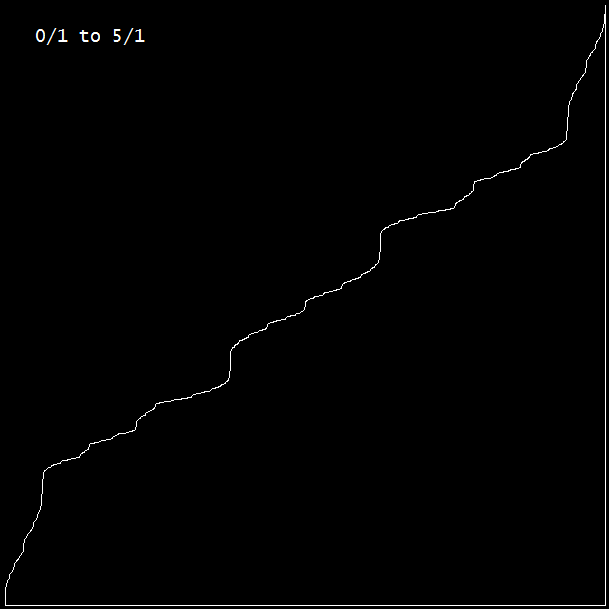
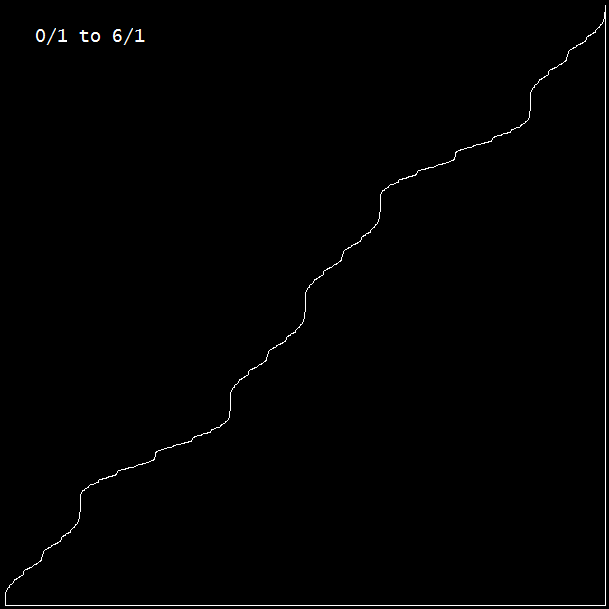
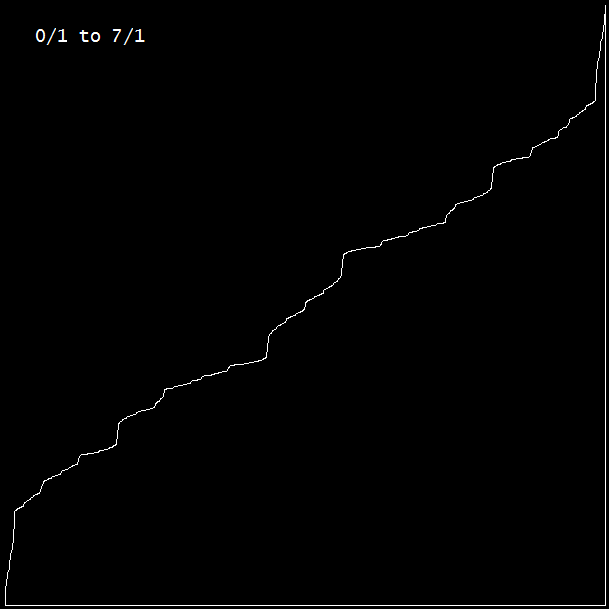
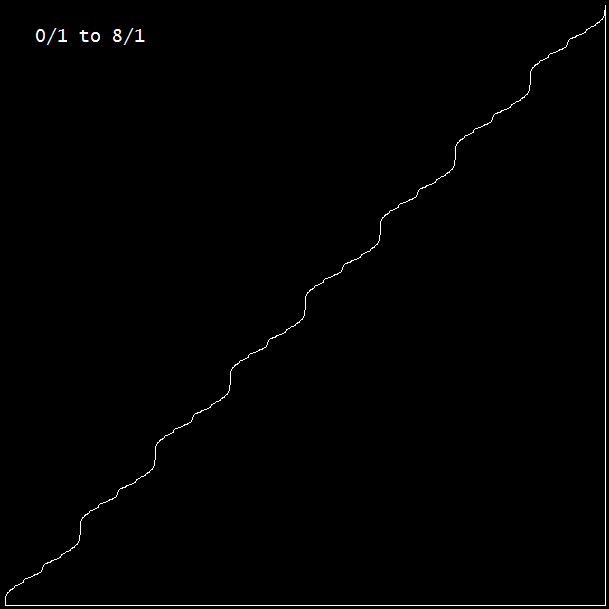
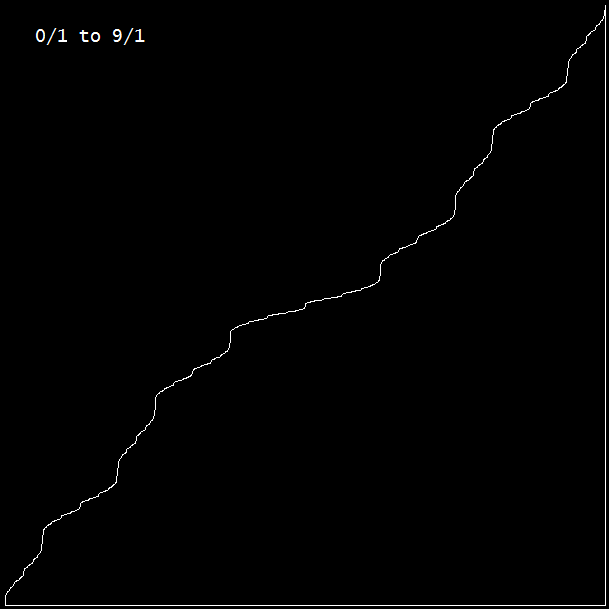
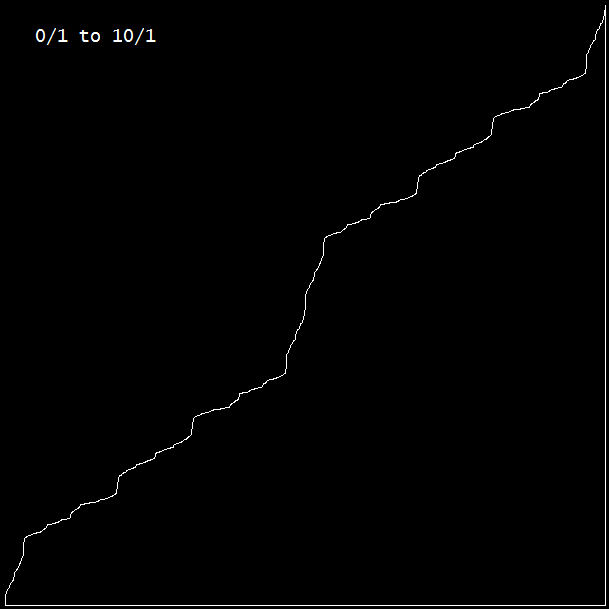
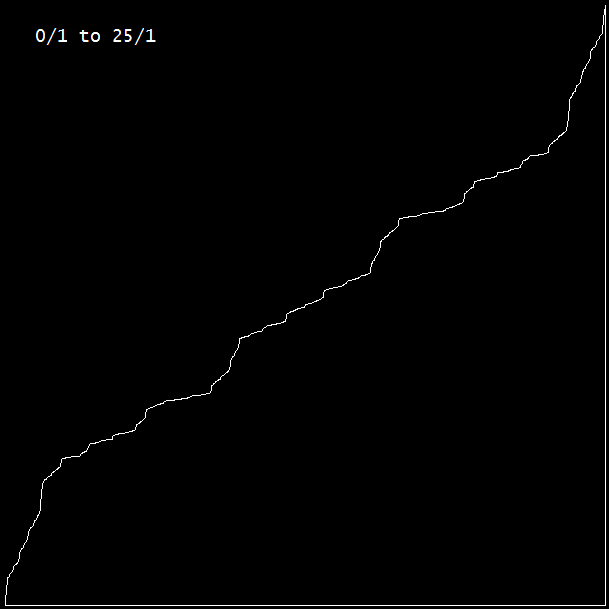
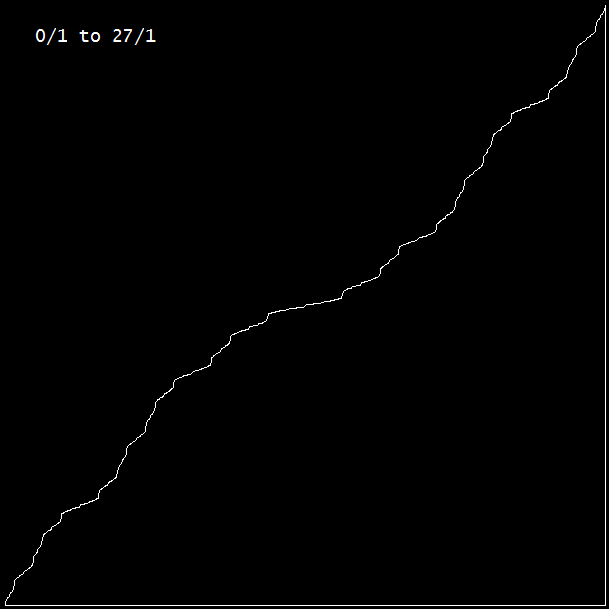
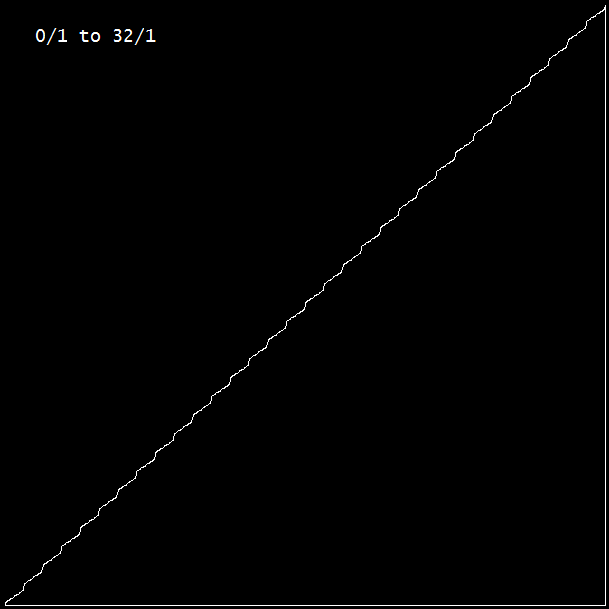
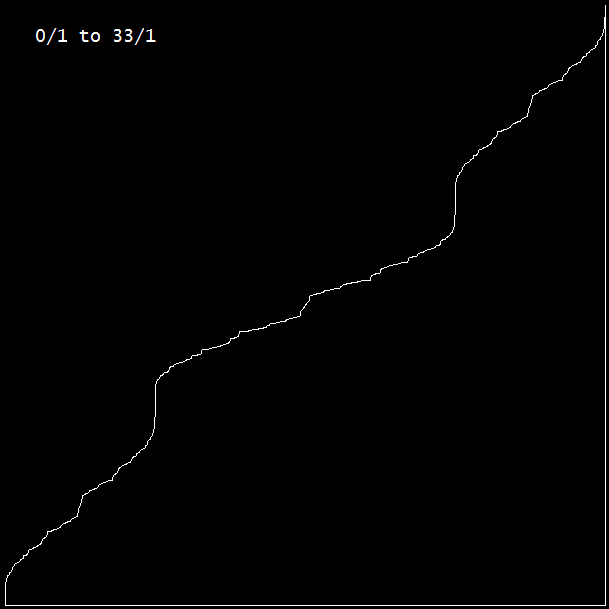
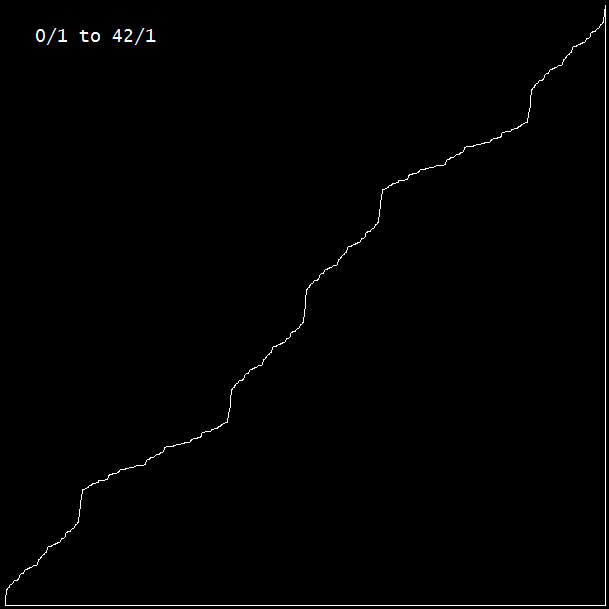
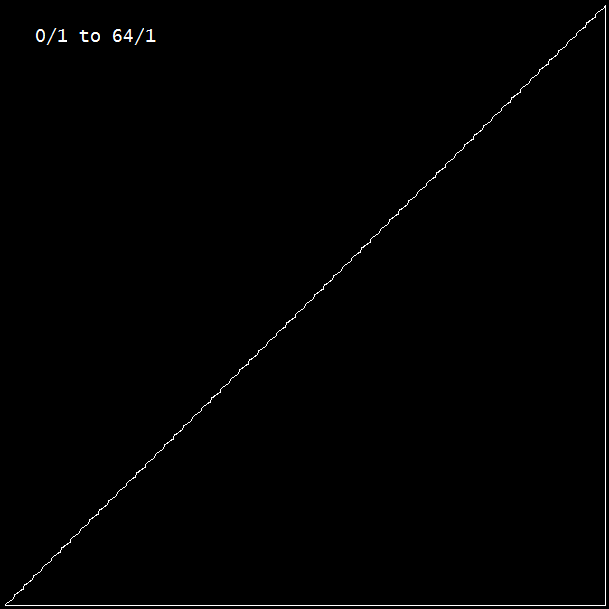
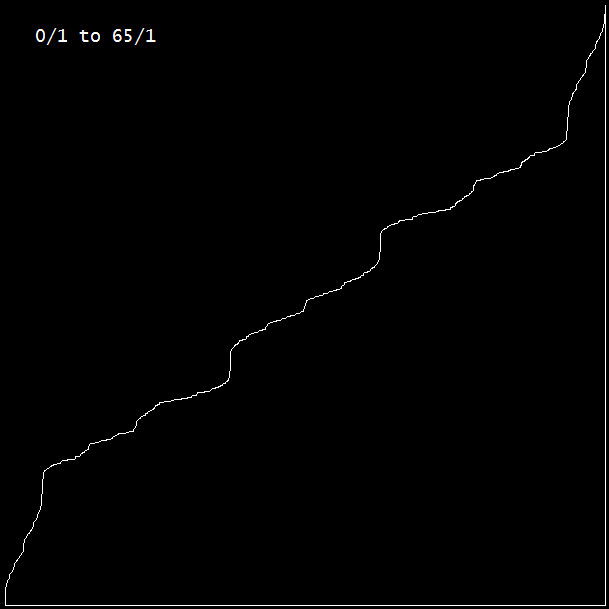
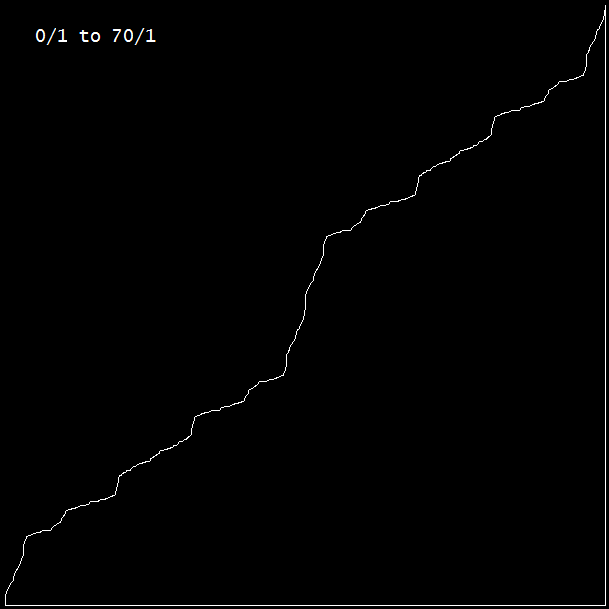
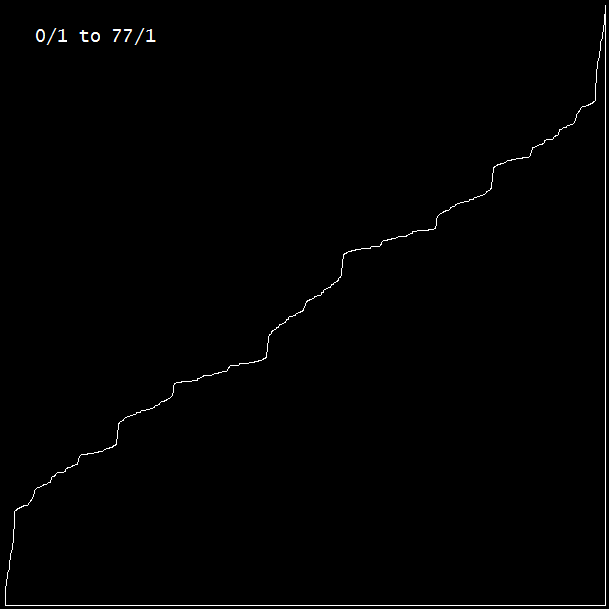
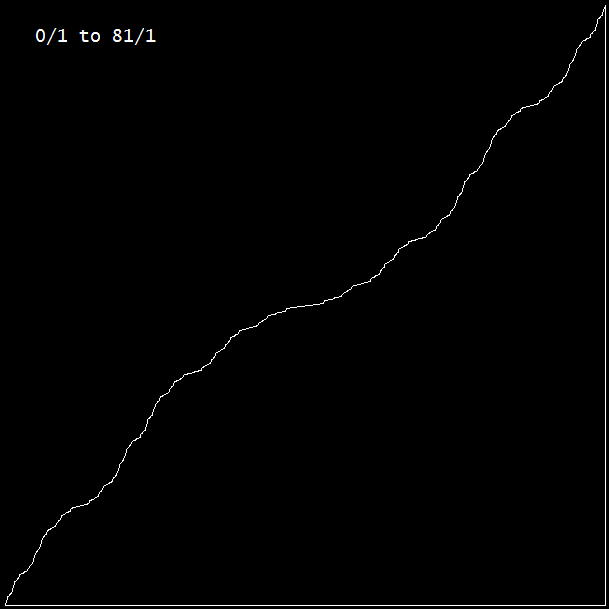
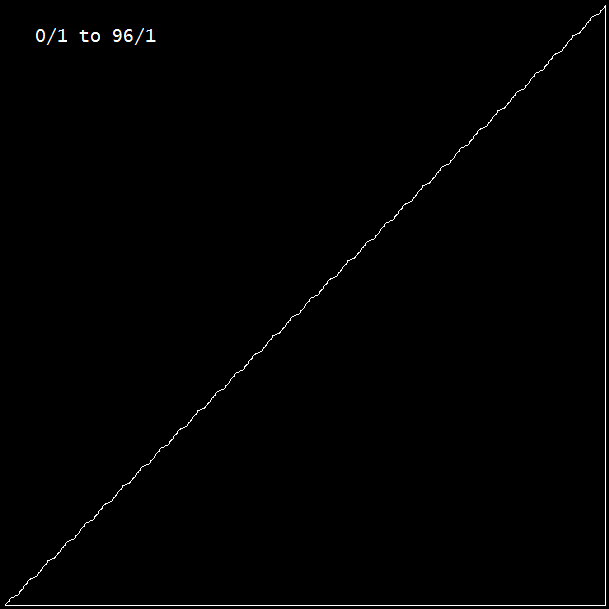
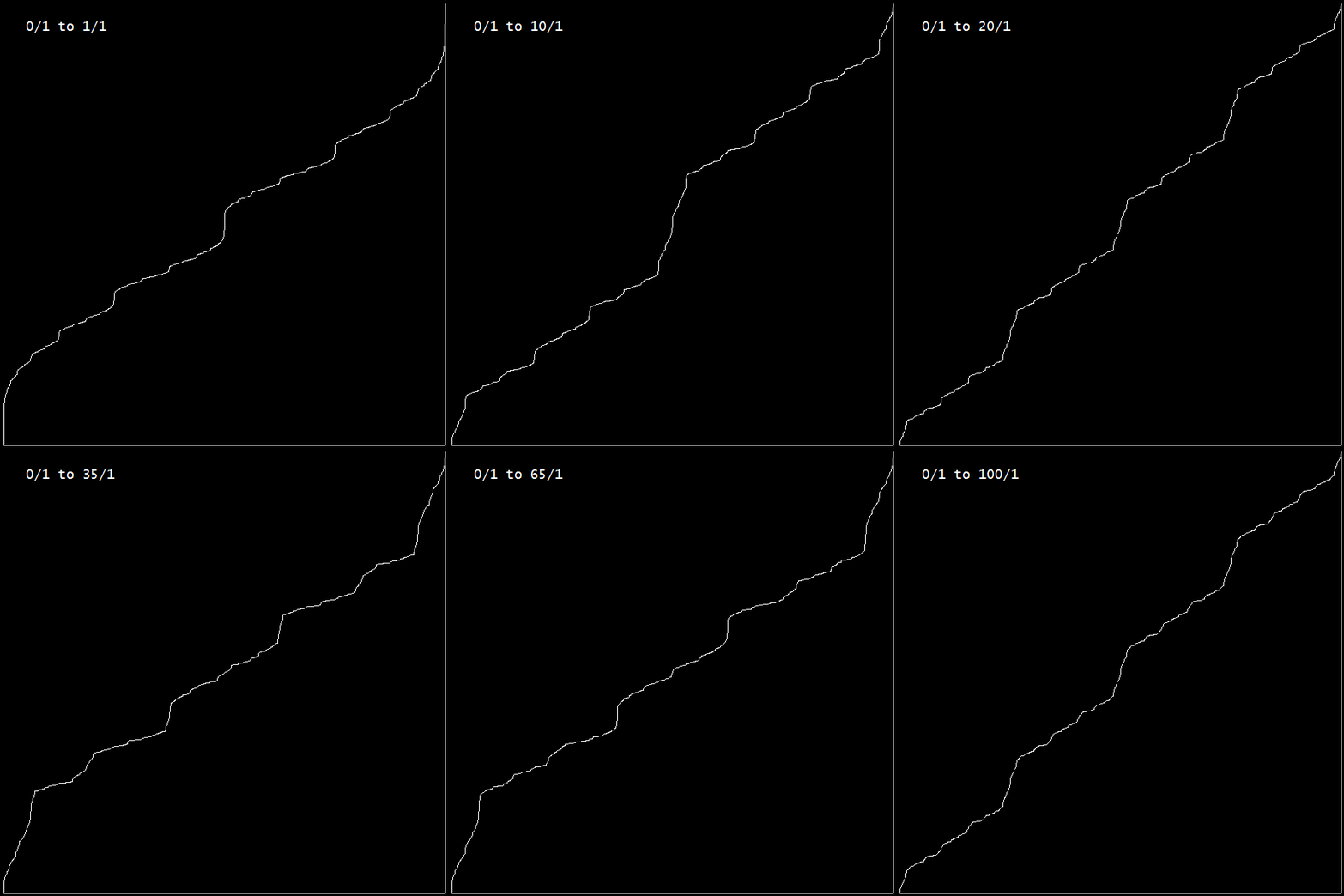
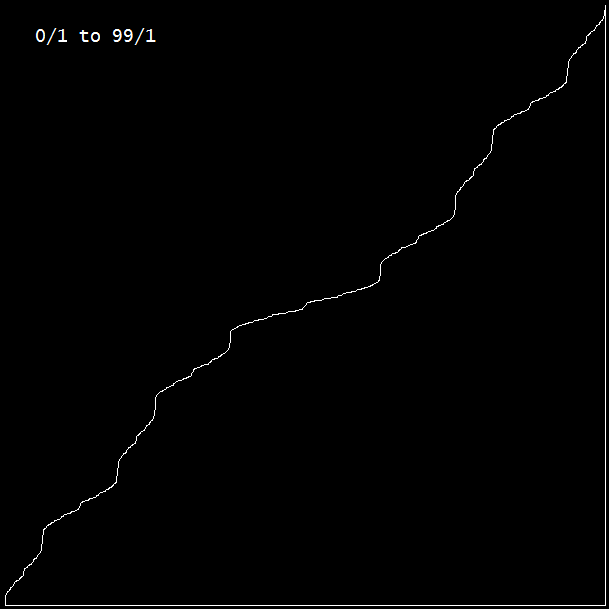
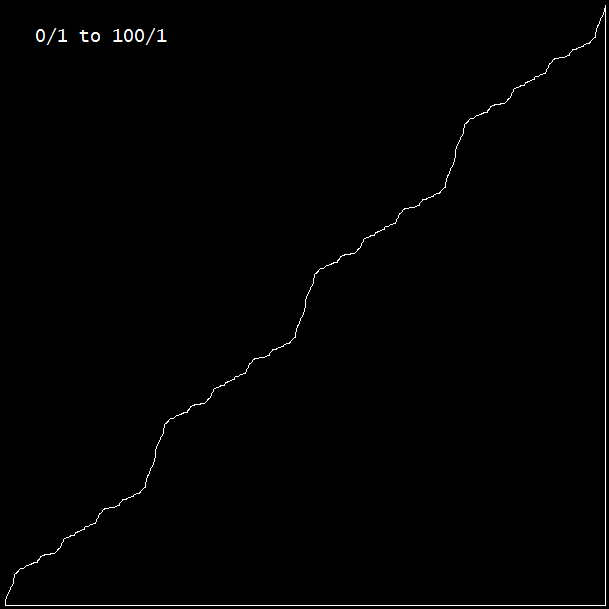
That looks like the slope of a hill to me, so you could call it a Farey fract-hill. But Farey fract-hills or Farey fractals aren’t confined to the unit interval, 0/1 to 1/1. Here are Farey fractals for the intervals 0/1 to n/1, n = 1..10:

Farey fractal for interval 0/1 to 1/1

Farey fractal for interval 0/1 to 2/1, beginning 0/1, 1/4, 1/3, 2/5, 1/2, 3/5, 2/3, 3/4, 1/1, 5/4, 4/3, 7/5, 3/2, 8/5, 5/3, 7/4, 2/1

Farey fractal for interval 0/1 to 3/1, beginning 0/1, 1/3, 1/2, 2/3, 1/1, 5/4, 4/3, 7/5, 3/2, 8/5, 5/3, 7/4, 2/1, 7/3, 5/2, 8/3, 3/1

Farey fractal for interval 0/1 to 4/1, beginning
0/1, 1/3, 1/2, 2/3, 1/1, 4/3, 3/2, 5/3, 2/1, 7/3, 5/2, 8/3, 3/1, 10/3, 7/2, 11/3, 4/1

Farey fractal for interval 0/1 to 5/1, beginning 0/1, 1/1, 5/4, 10/7, 5/3, 7/4, 2/1, 7/3, 5/2, 8/3, 3/1, 13/4, 10/3, 25/7, 15/4, 4/1, 5/1

Farey fractal for interval 0/1 to 6/1, beginning 0/1, 1/2, 1/1, 4/3, 3/2, 5/3, 2/1, 5/2, 3/1, 7/2, 4/1, 13/3, 9/2, 14/3, 5/1, 11/2, 6/1

Farey fractal for interval 0/1 to 7/1, beginning 0/1, 7/5, 7/4, 2/1, 7/3, 21/8, 14/5, 3/1, 7/2, 4/1, 21/5, 35/8, 14/3, 5/1, 21/4, 28/5, 7/1

Farey fractal for interval 0/1 to 8/1, beginning 0/1, 1/2, 1/1, 3/2, 2/1, 5/2, 3/1, 7/2, 4/1, 9/2, 5/1, 11/2, 6/1, 13/2, 7/1, 15/2, 8/1

Farey fractal for interval 0/1 to 9/1, beginning 0/1, 1/1, 3/2, 2/1, 3/1, 7/2, 4/1, 13/3, 9/2, 14/3, 5/1, 11/2, 6/1, 7/1, 15/2, 8/1, 9/1

Farey fractal for interval 0/1 to 10/1, beginning 0/1, 5/4, 5/3, 2/1, 5/2, 3/1, 10/3, 15/4, 5/1, 25/4, 20/3, 7/1, 15/2, 8/1, 25/3, 35/4, 10/1

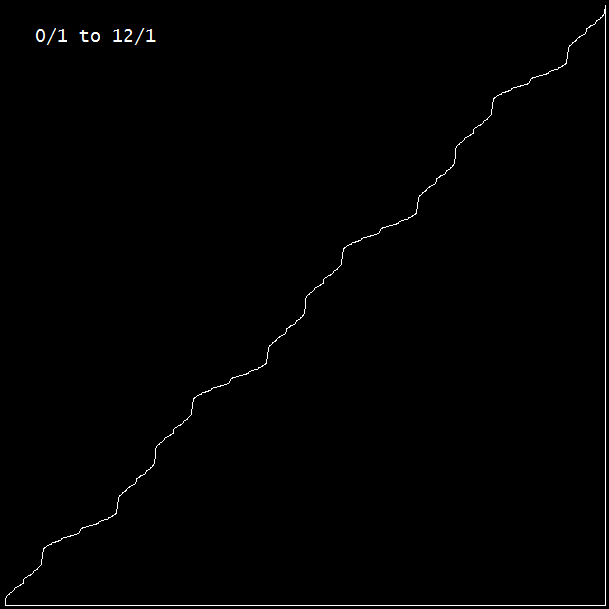
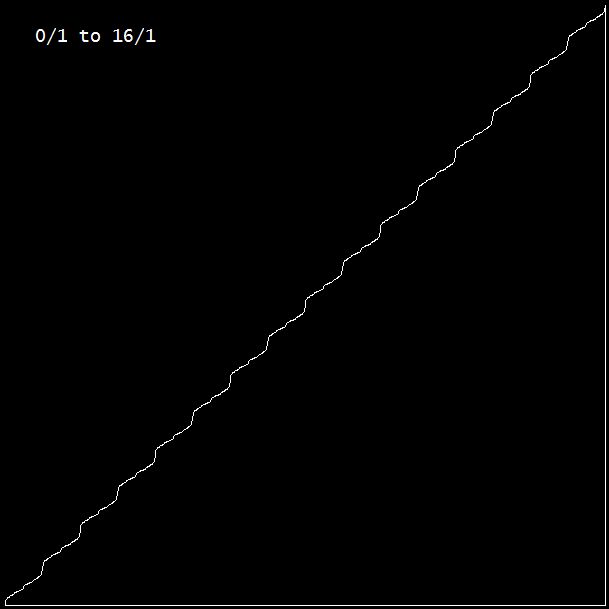
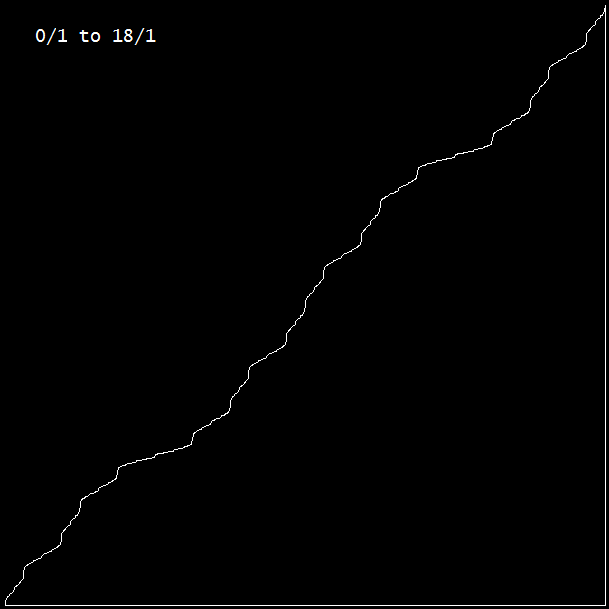
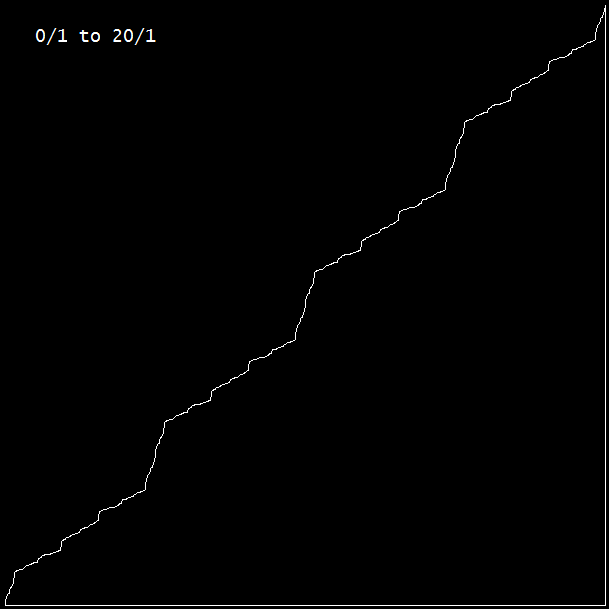
The shape of the slope is determined by the factorization of n:

n = 12 = 2^2 * 3

n = 16 = 2^4

n = 18 = 2 * 3^2

n = 20 = 2^2 * 5

n = 25 = 5^2

n = 27 = 3^3

n = 32 = 2^5

n = 33 = 3 * 11

n = 42 = 2 * 3 * 7

n = 64 = 2^6

n = 65 = 5 * 13

n = 70 = 2 * 5 * 7

n = 77 = 7 * 11

n = 81 = 3^4

n = 96 = 2^5 * 3

n = 99 = 3^2 * 11

n = 100 = 2^2 * 5^2

Farey fractal-hills, n = various

Poulet’s Propeller

The Penguin Dictionary of Curious and Interesting Numbers (1986) is one of my favourite books. It’s a fascinating mixture of math, mathecdote and math-joke:

2·618 0333…

The square of φ, the golden ratio, and the only positive number such that √n = n-1. (pg. 45)


6

Kepler discussed the 6-fold symmetry of snowflakes, and attempted to explain it by considering the close packing of spheres in a hexagonal array. (pg. 69)


39

This appears to be the first uninteresting number, which of course makes it an especially interesting number, because it is the smallest number to have the property of being uninteresting.

It is therefore also the first number to be simultaneously interesting and uninteresting. (pg. 120)

David Wells, who wrote the Dictionary, “had the rare distinction of being a Cambridge scholar in mathematics and failing his degree”. He must be the mathematical equivalent of the astronomer Patrick Moore: a popularizer responsible for opening many minds and inspiring many careers. He’s also written books on geometry and mathematical puzzles. But not everyone appreciates his efforts. This is a sideswipe in a review of William Hartston’s The Book of Numbers:

Thankfully, this book is more concerned with facts than mathematics. Anyone wanting to learn more about [π] or the Fibonacci sequence should turn to the Penguin Dictionary of Curious and Interesting Numbers, a volume which none but propeller-heads will find either curious or interesting. (Review in The Independent, 18th December 1997)


Continue reading: Poulet’s Propeller

Factory Records

The factors of n are those numbers that divide n without remainder. So the factors of 6 are 1, 2, 3 and 6. If the function s(n) is defined as “the sum of the factors of n, excluding n, then s(6) = 1 + 2 + 3 = 6. This makes 6 a perfect number: its factors re-create it. 28 is another perfect number. The factors of 28 are 1, 2, 4, 7, 14 and 28, so s(28) = 1 + 2 + 4 + 7 + 14 = 28. Other perfect numbers are 496 and 8128. And they’re perfect in any base.

Amicable numbers are amicable in any base too. The factors of an amicable number sum to a second number whose factors sum to the first number. So s(220) = 284, s(284) = 220. That pair may have been known to Pythagoras (c.570-c.495 BC), but s(1184) = 1210, s(1210) = 1184 was discovered by an Italian schoolboy called Nicolò Paganini in 1866. There are also sociable chains, in which s(n), s(s(n)), s(s(s(n))) create a chain of numbers that leads back to n, like this:

12496 → 14288 → 15472 → 14536 → 14264 → 12496 (c=5)

Or this:

14316 → 19116 → 31704 → 47616 → 83328 → 177792 → 295488 → 629072 → 589786 → 294896 → 358336 → 418904 → 366556 → 274924 → 275444 → 243760 → 376736 → 381028 → 285778 → 152990 → 122410 → 97946 → 48976 → 45946 → 22976 → 22744 → 19916 → 17716 → 14316 (c=28)

Those sociable chains were discovered (and christened) in 1918 by the Belgian mathematician Paul Poulet (1887-1946). Other factor-sum patterns are dependant on the base they’re expressed in. For example, s(333) = 161. So both n and s(n) are palindromes in base-10. Here are more examples — the numbers in brackets are the prime factors of n and s(n):

333 (3^2, 37) → 161 (7, 23)
646 (2, 17, 19) → 434 (2, 7, 31)
656 (2^4, 41) → 646 (2, 17, 19)
979 (11, 89) → 101 (prime)
1001 (7, 11, 13) → 343 (7^3)
3553 (11, 17, 19) → 767 (13, 59)
10801 (7, 1543) → 1551 (3, 11, 47)
11111 (41, 271) → 313 (prime)
18581 (17, 1093) → 1111 (11, 101)
31713 (3, 11, 31^2) → 15951 (3, 13, 409)
34943 (83, 421) → 505 (5, 101)
48484 (2^2, 17, 23, 31) → 48284 (2^2, 12071)
57375 (3^3, 5^3, 17) → 54945 (3^3, 5, 11, 37)
95259 (3, 113, 281) → 33333 (3, 41, 271)
99099 (3^2, 7, 11^2, 13) → 94549 (7, 13, 1039)
158851 (7, 11, 2063) → 39293 (prime)
262262 (2, 7, 11, 13, 131) → 269962 (2, 7, 11, 1753)
569965 (5, 11, 43, 241) → 196691 (11, 17881)
1173711 (3, 7, 11, 5081) → 777777 (3, 7^2, 11, 13, 37)

Note how s(656) = 646 and s(646) = 434. There’s an even longer sequence in base-495:

33 → 55 → 77 → 99 → [17][17] → [19][19] → [21][21] → [43][43] → [45][45] → [111][111] → [193][193] → [195][195] → [477][477] (b=495) (c=13)
1488 (2^4, 3, 31) → 2480 (2^4, 5, 31) → 3472 (2^4, 7, 31) → 4464 (2^4, 3^2, 31) → 8432 (2^4, 17, 31) → 9424 (2^4, 19, 31) → 10416 (2^4, 3, 7, 31) → 21328 (2^4, 31, 43) → 22320 (2^4, 3^2, 5, 31) → 55056 (2^4, 3, 31, 37) → 95728 (2^4, 31, 193) → 96720 (2^4, 3, 5, 13, 31) → 236592 (2^4, 3^2, 31, 53)

I also tried looking for n whose s(n) mirrors n. But they’re hard to find in base-10. The first example is this:

498906 (2, 3^3, 9239) → 609894 (2, 3^2, 31, 1093)

498906 mirrors 609894, because the digits of each run in reverse to the digits of the other. Base-9 does better for mirror-sums, clocking up four in the same range of integers:

42 → 24 (base=9)
38 (2, 19) → 22 (2, 11)
402 → 204 (base=9)
326 (2, 163) → 166 (2, 83)
4002 → 2004 (base=9)
2918 (2, 1459) → 1462 (2, 17, 43)
5544 → 4455 (base=9)
4090 (2, 5, 409) → 3290 (2, 5, 7, 47)

Base-11 does better still, clocking up eight in the same range:

42 → 24 (base=11)
46 (2, 23) → 26 (2, 13)
2927 → 7292 (base=11)
3780 (2^2, 3^3, 5, 7) → 9660 (2^2, 3, 5, 7, 23)
4002 → 2004 (base=11)
5326 (2, 2663) → 2666 (2, 31, 43)
13772 → 27731 (base=11)
19560 (2^3, 3, 5, 163) → 39480 (2^3, 3, 5, 7, 47)
4[10]7[10]9 → 9[10]7[10]4 (base=11)
72840 (2^3, 3, 5, 607) → 146040 (2^3, 3, 5, 1217)
6929[10] → [10]9296 (base=11)
100176 (2^4, 3, 2087) → 158736 (2^4, 3, 3307)
171623 → 326171 (base=11)
265620 (2^2, 3, 5, 19, 233) → 520620 (2^2, 3, 5, 8677)
263702 → 207362 (base=11)
414790 (2, 5, 41479) → 331850 (2, 5^2, 6637)

Note that 42 mirrors its factor-sum in both base-9 and base-11. But s(42) = 24 in infinitely many bases, because when 42 = 2 x prime, s(42) = 1 + 2 + prime. So (prime-1) / 2 will give the base in which 24 = s(42). For example, 2 x 11 = 22 and 22 = 42 in base (11-1) / 2 or base-5. So s(42) = 1 + 2 + 11 = 14 = 2 x 5 + 4 = 24[b=5]. There are infinitely many primes, so infinitely many bases in which s(42) = 24.

Base-10 does better for mirror-sums when s(n) is re-defined to include n itself. So s(69) = 1 + 3 + 23 + 69 = 96. Here are the first examples of all-factor mirror-sums in base-10:

69 (3, 23) → 96 (2^5, 3)
276 (2^2, 3, 23) → 672 (2^5, 3, 7)
639 (3^2, 71) → 936 (2^3, 3^2, 13)
2556 (2^2, 3^2, 71) → 6552 (2^3, 3^2, 7, 13)

In the same range, base-9 now produces one mirror-sum, 13 → 31 = 12 (2^2, 3) → 28 (2^2, 7). Base-11 produces no mirror-sums in the same range. Base behaviour is eccentric, but that’s what makes it interesting.

Back to Bases

(N.B. I am not a mathematician and often make stupid mistakes in my recreational maths. Caveat lector.)

101 isn’t a number, it’s a label for a number. In fact, it’s a label for infinitely many numbers. In base 2, 1012 = 5; in base 3, 1013 = 10; 1014 = 17; 1015 = 26; and so on, for ever. In some bases, like 2 and 4, the number labelled 101 is prime. In other bases, it isn’t. But it is always a palindrome: that is, it’s the same read forward and back. But 101, the number itself, is a palindrome in only two bases: base 10 and base 100.1 Note that 100 = 101-1: with the exception of 2, all integers, or whole numbers, are palindromic in at least one base, the base that is one less than the integer itself. So 3 = 112; 4 = 113; 5 = 114; 101 = 11100; and so on.

Less trivial is the question of which integers set progressive records for palindromicity, or for the number of palindromes they create in bases less than the integers themselves. You might guess that the bigger the integer, the more palindromes it will create, but it isn’t as simple as that. Here is 10 represented in bases 2 through 9:

10102 | 1013* | 224* | 205 | 146 | 137 | 128 | 119*

10 is a palindrome in bases 3, 4, and 9. Now here is 30 represented in bases 2 through 29 (note that a number between square brackets represents a single digit in that base):2

111102 | 10103 | 1324 | 1105 | 506 | 427 | 368 | 339* | 30 | 2811 | 2612 | 2413 | 2214* | 2015 | 1[14]16 | 1[13]17 | 1[12]18 | 1[11]19 | 1[10]20 | 1921 | 1822 | 1723 | 1624 | 1525 | 1426 | 1327 | 1228
| 1129*

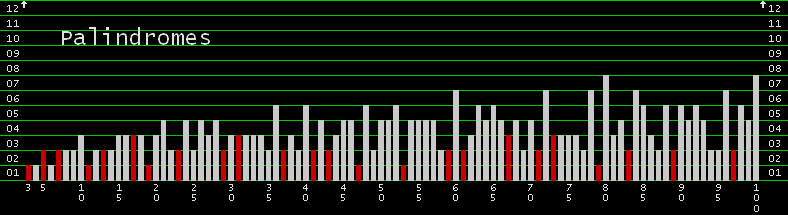
30, despite being three times bigger than 10, creates only three palindromes too: in bases 9, 14, and 29. Here is a graph showing the number of palindromes for each number from 3 to 100 (prime numbers are in red):

Graph of palindromes in various bases for n=3 to 100

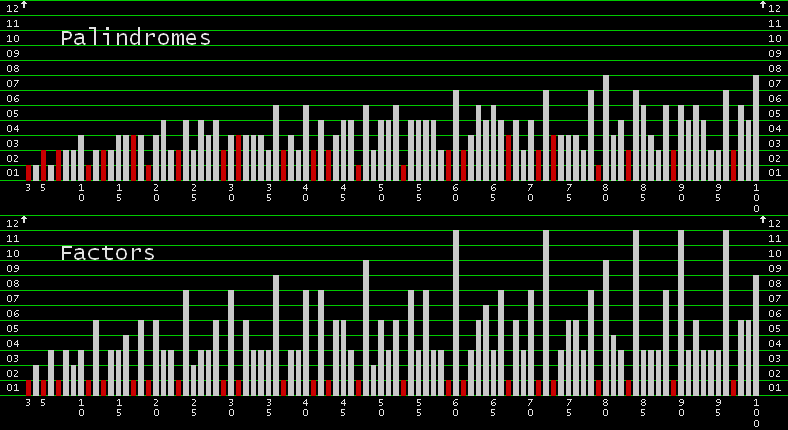
The number of palindromes a number has is related to the number of factors, or divisors, it has. A prime number has only one factor,  itself (and 1), so primes tend to be less palindromic than composite numbers. Even large primes can have only one palindrome, in the base b=n-1 (55,440 has 119 factors and 61 palindromes; 65,381 has one factor and one palindrome, 1165380). Here is a graph showing the number of factors for each number from 3 to 100:

Graph of number of factors for n = 3 to 100

And here is an animated gif combining the two previous images:

Animated gif of number of palindromes and factors, n=3 to 100

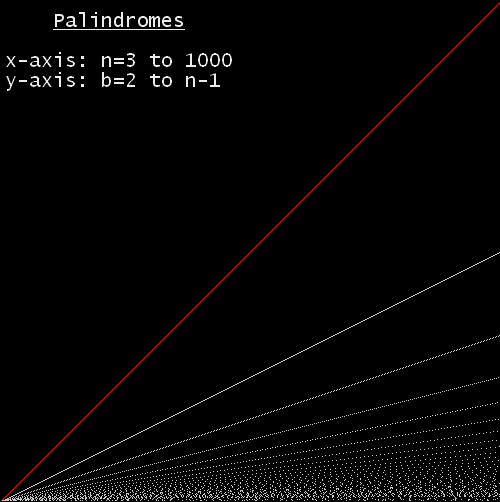
Here is a graph indicating where palindromes appear when n, along the x-axis, is represented in the bases b=2 to n-1, along the y-axis:

Graph showing where palindromes occur in various bases for n = 3 to 1000

The red line are the palindromes in base b=n-1, which is “11” for every n>2. The lines below it arise because every sufficiently large n with divisor d can be represented in the form d·n1 + d. For example, 8 = 2·3 + 2, so 8 in base 3 = 223; 18 = 3·5 + 3, so 18 = 335; 32 = 4.7 + 4, so 32 = 447; 391 = 17·22 + 17, so 391 = [17][17]22.

And here, finally, is a table showing integers that set progressive records for palindromicity (p = number of palindromes, f = total number of factors, prime and non-prime):

n Prime Factors p f    n Prime Factors p f
3 3 1 1    2,520 23·32·5·7 25 47
5 5 2 1    3,600 24·32·52 26 44
10 2·5 3 3    5,040 24·32·5·7 30 59
21 3·7 4 3    7,560 23·33·5·7 32 63
36 22·32 5 8    9,240 23·3·5·7·11 35 63
60 22·3·5 6 11    10,080 25·32·5·7 36 71
80 24·5 7 9    12,600 23·32·52·7 38 71
120 23·3·5 8 15    15,120 24·33·5·7 40 79
180 22·32·5 9 17    18,480 24·3·5·7·11 43 79
252 22·32·7 11 17    25,200 24·32·52·7 47 89
300 22·3·52 13 17    27,720 23·32·5·7·11 49 95
720 24·32·5 16 29    36,960 25·3·5·7·11 50 95
1,080 23·33·5 17 31    41,580 22·33·5·7·11 51 95
1,440 25·32·5 18 35    45,360 24·34·5·7 52 99
1,680 24·3·5·7 20 39    50,400 25·32·52·7 54 107
2,160 24·33·5 21 39    55,440 24·32·5·7·11 61 119

Notes

1. That is, it’s only a palindrome in two bases less than 101. In higher bases, “101” is a single digit, so is trivially a palindrome (as the numbers 1 through 9 are in base 10).

2. In base b, there are b digits, including 0. So base 2 has two digits, 0 and 1; base 10 has ten digits, 0-9; base 16 has sixteen digits: 0, 1, 2, 3, 4, 5, 6, 7, 8, 9, A, B, C, D, E, F.