
Pigmental Paradox

From Raymond Smullyan’s Logical Labyrinths (2009):

We now visit another knight/knave island on which, like on the first one, all knights tell the truth and all knaves lie. But now there is another complication! For some reason, the natives refuse to speak to strangers, but they are willing to answer yes/no questions using a secret sign language that works like this:

Each native carries two cards on his person; one is red and the other is black. One of them means yes and the other means no, but you are not told which color means what. If you ask a yes/no question, the native will flash one of the two cards, but unfortunately, you will not know whether the card means yes or no!

Problem 3.1. Abercrombie, who knew the rules of this island, decided to pay it a visit. He met a native and asked him: “Does a red card signify yes?” The native then showed him a red card.

From this, is it possible to deduce what a red card signifies? Is it possible to deduce whether the native was a knight or a knave?

Problem 3.2. Suppose one wishes to find out whether it is a red card or a black card that signifies yes. What simple yes/no question should one ask?
Think Ink

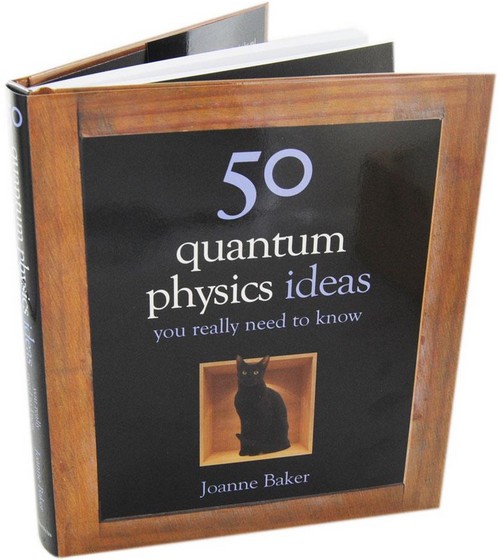
Front cover of 50 Quantum Physics Ideas You Really Need to Know by Joanne Baker50 Quantum Physics Ideas You Really Need to Know, Joanne Baker (Quercus 2013)

A very good introduction to a very difficult subject. A very superficial introduction too, because it doesn’t use proper mathematics. If it did, I’d be lost: like most people’s, my maths is far too weak for me to understand quantum physics. Here’s one of the side-quotes that help make this book such an interesting read: “We must be clear that when it comes to atoms, language can be used only as in poetry.”

That’s by the Jewish-Danish physicist Niels Bohr (1885-1962). It applies to quantum physics in general. Without the full maths, you’re peering through a frost-covered window into a sweetshop, you’re not inside sampling the wares. But even without the full maths, the concepts and ideas in this book are still difficult and challenging, from the early puzzles thrown up by the ultra-violet catastrophe to the ingenious experiments that have proved particle-wave duality and action at a distance.

But there’s a paradox here.

Continue reading: Think Ink

Neuclid on the Block

How many blows does it take to demolish a wall with a hammer? It depends on the wall and the hammer, of course. If the wall is reality and the hammer is mathematics, you can do it in three blows, like this:

α’. Σημεῖόν ἐστιν, οὗ μέρος οὐθέν.
β’. Γραμμὴ δὲ μῆκος ἀπλατές.
γ’. Γραμμῆς δὲ πέρατα σημεῖα.

1. A point is that of which there is no part.
2. A line is a length without breadth.
3. The extremities of a line are points.

That is the astonishing, world-shattering opening in one of the strangest – and sanest – books ever written. It’s twenty-three centuries old, was written by an Alexandrian mathematician called Euclid (fl. 300 B.C.), and has been pored over by everyone from Abraham Lincoln to Bertrand Russell by way of Edna St. Vincent Millay. Its title is highly appropriate: Στοιχεῖα, or Elements. Physical reality is composed of chemical elements; mathematical reality is composed of logical elements. The second reality is much bigger – infinitely bigger, in fact. In his Elements, Euclid slipped the bonds of time, space and matter by demolishing the walls of reality with a mathematical hammer and escaping into a world of pure abstraction.

• Continue reading Neuclid on the Block

Bones, Blinks, Books

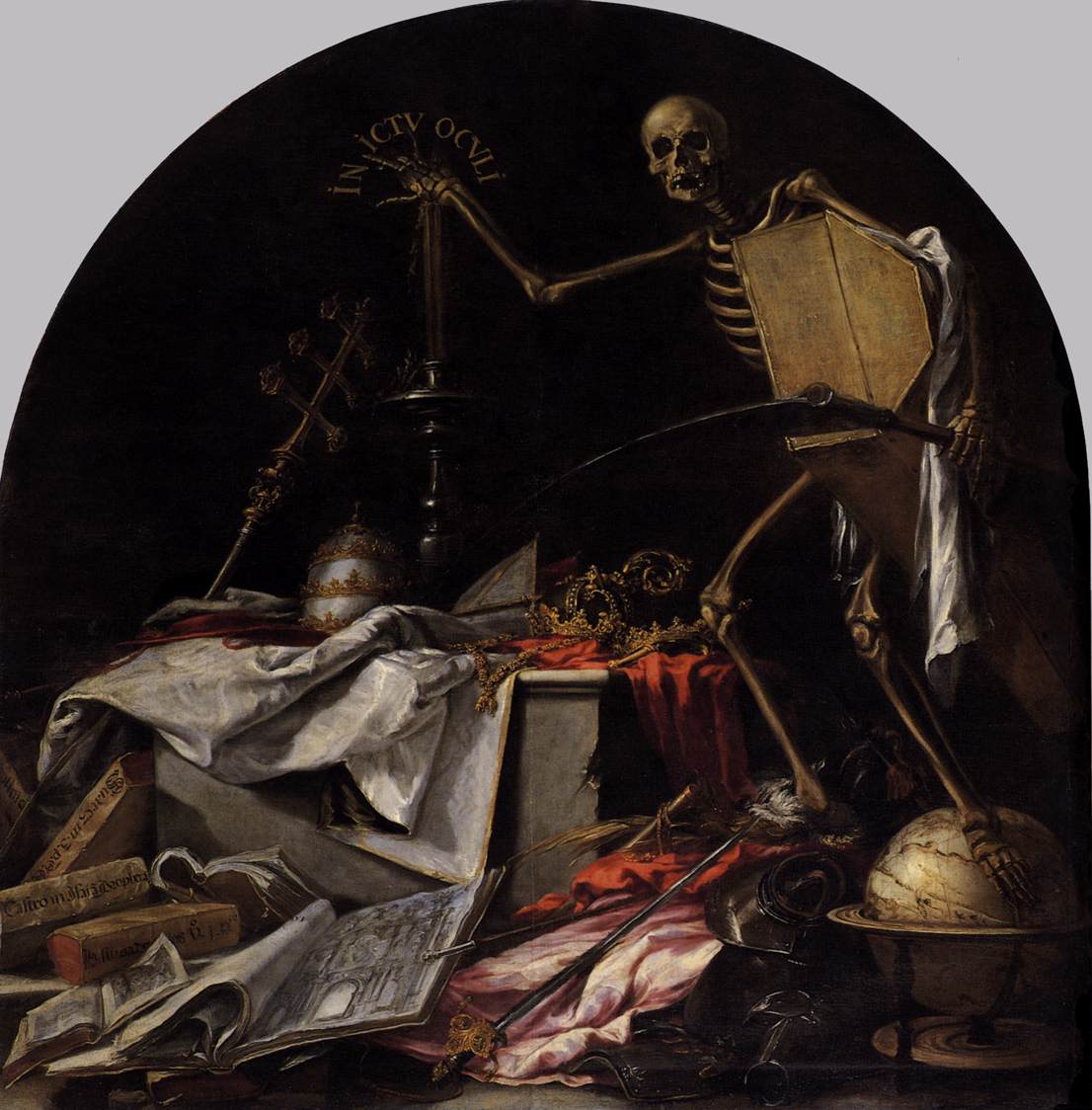
In Ictu Oculi by Juan de Valdés Leal (c. 1671)

In Ictu Oculi (In the Blink of an Eye) by Juan de Valdés Leal (c. 1671).