 Aldous Huxley (1894-1963), the author of Brave New World (1932) and After Many A Summer (1939), is a bad but interesting writer. One of his bad but interesting books is The Doors of Perception (1954), in which he discusses mescalin and mysticism. I like this comment a lot:
In a world where education is predominantly verbal, highly educated people find it all but impossible to pay serious attention to anything but words and notions. There is always money for, there are always doctorates in, the learned foolery of research into what, for scholars, is the all-important question: Who influenced whom to say what when? (Op. cit., pg. 61 of the 1985 Panther paperback)
It’s an insightful and entertaining point. There are analogous questions in biology: what genes influence what and where do they come from? But biologists can answer questions like that much more precisely, because genes are physical entities, susceptible to precise chemical analysis. They can be easily mathematized, turned into statistics, tested for correlations and other patterns. We can’t yet do that to “words and notions” and get the same precise answers. That’s why it’s sometimes easier to answer questions about human prehistory over hundreds of millennia than about human history over decades. For example, we now know that ancient human beings migrating from Africa picked up genes from Neanderthals and a lesser-known group called the Denisovans, while those human beings that stayed behind in Africa picked up genes from other archaic hominids.
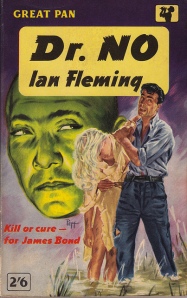
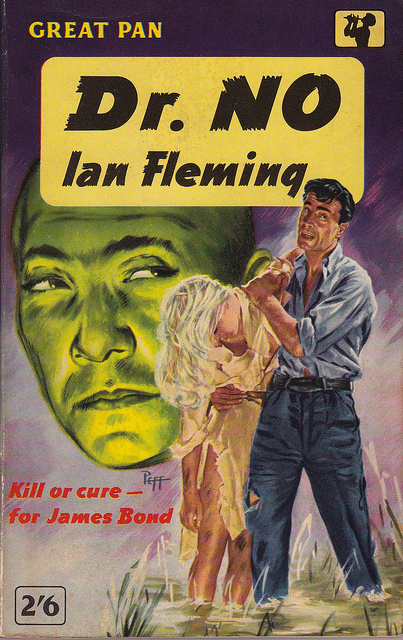
But we don’t know whether the Californian author Clark Ashton Smith (1894-1961) influenced the British author Ian Fleming (1908-64). At least, I don’t know, because I think I am the first person to raise the possibility. After all, they aren’t obvious literary associates: Smith wrote highly ornate fantasy set on a quasi-mediaeval far future earth; Fleming wrote vice-and-violence spy-thrillers set in contemporary Europe, America and Japan. And in the Caribbean, which is why the question of CAS’s influence occurred to me. Fleming was the creator of James Bond and one of his Bond adventures, published in 1958, is called Dr. No. It is named after its anti-hero, a Chinese-German megalomaniac called Doctor Julius No who lives on the mountainous island of Crab Key near Jamaica. He is conducting research into the human capacity for suffering:
“Silence!” Doctor No’s voice was the crack of a whip. “Enough of this foolery. Of course it will hurt. I am interested in pain. I am also interested in finding out how much the human body can endure. From time to time I make experiments on those of my people who have to be punished. And on trespassers like yourselves. You have both put me to a great deal of trouble. In exchange I intend to put you to a great deal of pain. I shall record the length of your endurance. The facts will be noted. One day my findings will be given to the world. Your deaths will have served the purposes of science.” (Op. cit., ch. XVI, “Horizons of Agony”)

He is talking to James Bond and Bond’s companion, the beautiful blonde Honeychile Rider. Bond will have to run an “obstacle race, an assault course against death”, which is designed to be unbeatable. Meanwhile, Honeychile will be “pegged out” on the mountain-side as part of another experiment. With sadistic relish, Doctor No reveals what will happen to her:
“This island is called Crab Key. It is called by that name because it is infested with crabs, land crabs — what they call in Jamaica ‘black crabs’. You know them. They weigh about a pound each and they are as big as saucers. At this time of year they come up in thousands from their holes near the shore and climb up towards the mountain. … The crabs devour what they find in their path. … And tonight, in the middle of their path, they are going to find the naked body of a woman pegged out — a banquet spread for them — and they will feel the warm body with their feeding pincers, and one will make the first incision with his fighting claws and then… and then…”
And then Honeychile faints. But, like all the best super-villains, Doctor No mixes sensibility with his sadism. This is what Bond and Honeychile first see when they step from a lift into the heart of Doctor No’s underground lair:
It was a high-ceilinged room about sixty feet long, lined on three sides with books to the ceiling. At first glance, the fourth wall seemed to be made of solid blue-black glass. … Bond’s eye caught a swirl of movement in the dark glass. He walked across the room. A silvery spray of small fish with a bigger fish in pursuit fled across the dark blue. … What was this? An aquarium? Bond looked upwards. A yard below the ceiling, small waves were lapping at the glass. Above the waves was a strip of greyer blue-black, dotted with sparks of light. The outlines of Orion were the clue. This was not an aquarium. This was the sea itself and the night sky. The whole of one side of the room was made of armoured glass. They were under the sea, looking straight into its heart, twenty feet down.
Bond and the girl stood transfixed. As they watched, there was the glimpse of two great goggling orbs. A golden sheen of head and deep flank showed for an instant and was gone. A big grouper? A silver swarm of anchovies stopped and hovered and sped away. The twenty-foot tendrils of a Portuguese man-o’-war drifted slowly across the window, glinting violet as they caught the light. Up above there was the dark mass of its underbelly and the outline of its inflated bladder, steering with the breeze.
Bond walked along the wall, fascinated by the idea of living with this slow, endlessly changing moving picture. A big tulip shell was progressing slowly up the window from the floor level, a frisk of demoiselles and angel fish and a ruby-red moonlight snapper were nudging and rubbing themselves against a corner of the glass and a sea centipede quested along, nibbling at the minute algae that must grow every day on the outside of the window. (Op. cit., ch. XIV, “Come Into My Parlour”)
Yes, the sea-window is a fascinating idea, but where does the idea come from? Here is another literary character, King Fulbra, in the underground domain of another sadist:
After descending many stairs, they came to a ponderous door of bronze; and the door was unlocked by one of the guards, and Fulbra was compelled to enter; and the door clanged dolorously behind him. The chamber into which he had been thrust was walled on three sides with the dark stone of the island, and was walled on the fourth with heavy, unbreakable glass. Beyond the glass he saw the blue-green, glimmering waters of the undersea, lit by the hanging cressets of the chamber; and in the waters were great devil-fish whose tentacles writhed along the wall; and huge pythonomorphs with fabulous golden coils receding in the gloom; and the floating corpses of men that stared in upon him with eyeballs from which the lids had been excised.
That is from Clark Ashton Smith’s short story “The Isle of the Torturers” (1933), which was originally published in the pulp magazine Weird Tales. Like the evil King Ildrac of Smith’s story, Doctor No lives on an island, tortures people and has a glass wall set onto the undersea. But that is not all they have in common. Here is Fleming’s description of Doctor No:
He stood looking at them benignly, with a thin smile on his lips. … (Bond was to get used to that thin smile) … Bond’s first impression was of thinness and erectness and height. Doctor No was at least six inches taller than Bond, but the straight immovable poise of his body made him seem still taller. The head also was elongated and tapered from a round, completely bald skull down to a sharp chin so that the impression was of a reversed raindrop — or rather oildrop, for the skin was of a deep almost translucent yellow.
It was impossible to tell Doctor No’s age: as far as Bond could see, there were no lines on the face. It was odd to see a forehead as smooth as the top of the polished skull. Even the cavernous indrawn cheeks below the prominent cheekbones looked as smooth as fine ivory. There was something Dali-esque about the eyebrows, which were fine and black, and sharply upswept as if they had been painted on as makeup for a conjurer. Below them, slanting jet black eyes stared out of the skull. They were without eyelashes. (ch. XIV, “Come Into My Parlour”)
When King Fulbra is shipwrecked on Uccastrog, the Isle of the Torturers, this is his first sight of its inhabitants:
The people drew near, thronging about the barge and the galley. They wore fantastic turbans of blood-red, and were clad in closely fitting robes of vulturine black. Their faces and hands were yellow as saffron; their small and slaty eyes were set obliquely beneath lashless lids; and their thin lips, which smiled eternally, were crooked as the blades of scimitars. (“The Isle of the Torturers”)
Fulbra surrenders to them with misgivings and is taken to the throne-room of his fellow king, where his misgivings grow:
Soon he came into the presence of Ildrac, who sat on a lofty brazen chair in a vast hall of the palace. Ildrac was taller by half a head than any of his followers; and his features were like a mask of evil wrought from some pale, gilded metal; and he was clad in vestments of a strange hue, like sea-purple brightened with fresh-flowing blood. About him were many guardsmen, armed with terrible scythe-like weapons; and the sullen, slant-eyed girls of the palace, in skirts of vermilion and breast-cups of lazuli, went to and fro among huge basaltic columns. About the hall stood numerous engineries of wood and stone and metal such as Fulbra had never beheld, and having a formidable aspect with their heavy chains, their beds of iron teeth and their cords and pulleys of fish-skin. (Op. cit.)
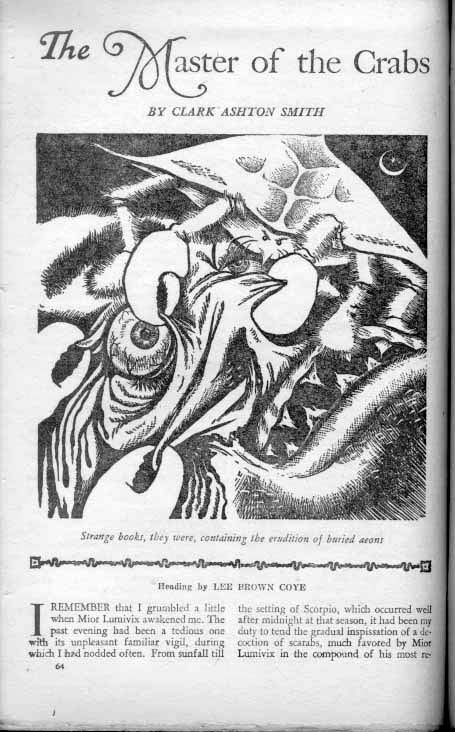
 The similarities between Doctor No and “The Isle of the Torturers” are obvious. But how likely is it that Fleming had read Smith’s story and then incorporated elements of it into his novel, consciously or unconsciously? Smith wrote of a tall, slant-eyed, yellow-skinned king who ruled an island and oversaw ingenious tortures. Fleming wrote of a tall, slant-eyed, yellow-skinned scientist who ruled an island and oversaw ingenious tortures. The scientist also used crabs as weapons, like the wizard Sarcand in Smith’s story “The Master of the Crabs” (1948):
So saying, he raised his hand and described a peculiar sign with the index finger, on which the ring flashed like a circling orb. The double column of crabs suspended their crawling for a moment. Then, moved as if by a single impulse, they began to scuttle toward us, while others appeared from the cavern’s entrance and from its inner recesses to swell their rapidly growing numbers. They surged upon us with a speed beyond belief, assailing our ankles and shins with their knife-sharp pincers as if animated by demons. I stooped over, striking and thrusting with my arthame; but the few that I crushed in this manner were replaced by scores; while others, catching the hem of my cloak, began to climb it from behind and weigh it down. Thus encumbered, I lost my footing on the slippery ground and fell backward amid the scuttling multitude. (“The Master of the Crabs”)
And that doesn’t exhaust the parallels between Smith’s stories and Fleming’s novel. Here is more of Doctor No’s appearance:
The bizarre, gliding figure looked like a giant venomous worm wrapped in grey tin-foil, and Bond would not have been surprised to see the rest of it trailing slimily along the carpet behind. (ch. XIV, “Come Into My Parlour”)
This is from Smith’s story “The Coming of the White Worm” (1941):
At sight of this entity, the pulses of Evagh were stilled for an instant by terror; and, following quickly upon the terror, his gorge rose within him through excess of loathing. In all the world there was naught that could be likened for its foulness to Rlim Shaikorth. Something he had of the semblance of a fat white worm; but his bulk was beyond that of the sea-elephant. His half-coiled tail was thick as the middle folds of his body; and his front reared upward from the dais in the form of a white round disk, and upon it were imprinted vaguely the lineaments of a visage belonging neither to beast of the earth nor ocean-creature. (“The Coming of the White Worm”)
I can’t claim that it’s probable that Fleming had read Smith or even a strong possibility that he did so, but the shared elements are suggestive. The fact that Doctor No and King Ildrac are both tall could easily, on its own, be a coincidence: size is an obvious and widely used marker of importance and dominance. But each additional similarity reduces the possibility that Fleming was inventing Doctor No ex nihilo. He was certainly familiar with American popular culture and the cheap publications in which Smith’s work appeared. Here are descriptions from two more Bond novels:
There were two or three all-night diners to choose from and they [Bond and a girl called Solitaire] pushed through the door that announced “Good Eats” in the brightest neon. It was the usual sleazy food-machine — two tired waitresses behind a zinc counter loaded with cigarettes and candy and paper-backs and comics. (Live and Let Die, 1954, Chapter XII, “The Everglades”)
At 12.30 they [Bond and his companion Felix Leiter] stopped for lunch at The Chicken in the Basket, a log-built Frontier-style road-house with standard equipment — a tall counter covered with the best-known proprietary brands of chocolates and candies, cigarettes, cigars, magazines and paperbacks, a juke box blazing with chromium and coloured lights that looked like something out of science fiction … (Diamonds Are For Ever, 1956, Chapter 10, “Studillac to Saratoga”)
Smith’s themes – death, pain and suffering – would certainly have appealed to Fleming, who practised sado-masochism with his wife Ann and returned again and again to those themes in his Bond books. This is from You Only Live Twice (1964):
“That is so. You are indeed a genius, lieber Ernst. You have already established this place as a shrine to death for evermore. People read about such fantasies in the works of Poe, Lautréamont, de Sade, but no one has ever created such a fantasy in real life. It is as if one of the great fairy tales has come to life. A sort of Disneyland of Death. But of course,” she hastened to add, “on an altogether grander, more poetic scale.” (Op. cit., Part 2, ch. 17, “Something Evil Comes This Way”)
So it seems that Fleming had read and appreciated Poe and Lautréamont. If he had come across Smith’s work during his trips to America, I suggest that he would not have dismissed it. And it may indeed have influenced his novel Dr. No. Perhaps literary forensics will be able to confirm or reject the hypothesis in future by analysing patterns in Smith’s and Fleming’s work.
At present, the influence of the obscure Californian Smith on the world-famous Briton Fleming remains just that: a hypothesis. But I think there is a stronger case for another influence, this time flowing in the opposite direction: from world-famous Briton to obscure Californian. I quoted above from “The Master of the Crabs”. Here is some more:
Even as we veered landward through the crystalline calm, there was a sudden seething and riffling about us, as if some monster had risen beneath. The boat began to shoot with plummet-like speed toward the cliffs, the sea foaming and streaming all around as though some kraken were dragging us to its caverned lair. Borne like a leaf on a cataract, we toiled vainly with straining oars against the ineluctable current.
Heaving higher momentarily, the cliffs seemed to shear the heavens above us, unscalable, without ledge or foothold. Then, in the sheer wall, appeared the low, broad arch of a cavern-mouth that we had not discerned heretofore, toward which the boat was drawn with dreadful swiftness.
“It is the entrance!” cried the Master. “But some wizard tide has flooded it.”
We shipped our useless oars and crouched down behind the thwarts as we neared the opening: for it seemed that the lowness of the arch would afford bare passage to our high-built prow. There was no time to unstep the mast, which broke instantly like a reed as we raced on without slackening into blind torrential darkness. (“The Master of the Crabs”)
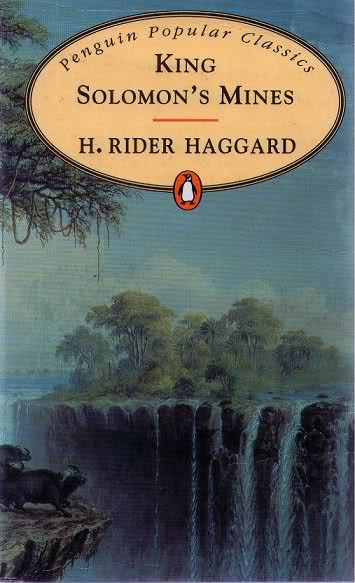
N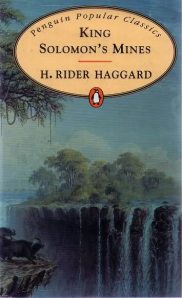 ext comes the encounter with giant crabs quoted previously. So Smith’s short story describes a boat drawn by an irresistible current beneath a low entrance to an encounter with giant crabs. Now try H. Rider Haggard’s Allan Quatermain (1887), a sequel to King Solomon’s Mines (1885). Haggard’s adventurers are hunting wildfowl on a lake when they are caught in a strong current:
We realized our danger now and rowed, or rather paddled, furiously in our attempt to get out of the vortex. In vain; in another second we were flying straight for the arch like an arrow, and I thought that we were lost. Luckily I retained sufficient presence of mind to shout out, instantly setting the example by throwing myself into the bottom of the canoe, “Down on your faces — down!” and the others had the sense to take the hint. In another instant there was a grinding noise, and the boat was pushed down till the water began to trickle over the sides, and I thought that we were gone. But no, suddenly the grinding ceased, and we could again feel the canoe flying along [on an underground river]. … (Allan Quatermain, Chapter IX, “Into the Unknown”)
By the river’s edge was a little shore formed of round fragments of rock washed into this shape by the constant action of water, and giving the place the appearance of being strewn with thousands of fossil cannon balls. … And here … we determined to land, in order to rest ourselves a little after all that we had gone through … It was a dreadful place, but it would give an hour’s respite from the terrors of the river, and also allow of our repacking and arranging the canoe. Accordingly we selected what looked like a favourable spot, and with some little difficulty managed to beach the canoe and scramble out on to the round, inhospitable pebbles. … The gloom was so intense that we could scarcely see the way to cut our food and convey it to our mouths. Still we got on pretty well, till I happened to look behind me — my attention being attracted by a noise of something crawling over the stones, and perceived sitting upon a rock in my immediate rear a huge species of black freshwater crab, only it was five times the size of any crab I ever saw. This hideous and loathsome-looking animal had projecting eyes that seemed to glare at one, very long and flexible antennae or feelers, and gigantic claws. Nor was I especially favoured with its company. From every quarter dozens of these horrid brutes were creeping up, drawn, I suppose, by the smell of the food, from between the round stones and out of holes in the precipice. (Allan Quatermain, Chapter X, “The Rose of Fire”)
The similarities between Allan Quatermain and “The Master of the Crabs” seem stronger and clearer than those between “The Isle of the Torturers” and Dr. No. Haggard is widely read even today, in the twenty-first century, and was hugely popular in Smith’s lifetime. It is very difficult to believe that Smith was not familiar with most or all of his work. But if he borrowed ideas from Allan Quatermain, he transformed what he borrowed and produced a better and subtler story. He was, in fact, a much better writer than his probable influence H. Rider Haggard and his putative influencee Ian Fleming. That is part of why he achieved little of their success: he wrote too well, transcending his genre but not the ghetto of his genre.
That’s my opinion, at least, but I can’t prove it, any more than I prove that Smith influenced Fleming or Haggard influenced Smith. Nevertheless, I would argue that the quality of a literary work is a mathematical phenomenon, dependant for its power on the way it manipulates the implicit mathematics of the language faculty in a reader’s brain. Given this, I think that it will some day be possible to analyse two texts mathematically and give objective reasons for preferring one to another. If that happens, I think Smith will be shown to be a literary equivalent of Mozart or Bach, far above the entertaining but crude pop or rock’n’roll of Haggard and Fleming.
It’s already apparent that the patterns of literature are akin to the patterns of music: like poetry, prose has rhythms, melodies, motifs and so on. Words are equivalent to notes, or rather to chords. A word has both a sound and a meaning, or layers of meaning. On the page or screen it has a shape too, but how important word-shapes are in good writing is a difficult question. Shape may be most important in onomastics, or naming systems. Compare two names: Katherine-with-a-K and Catherine-with-a-C. The letter C is more attractive than the letter K and I think the second spelling of the name is more attractive too. So would Smith’s Isle of Torture “Uccastrog”, with a double-c, be more effective as “Ukkastrog”, with a double-k? Or does the guttural sound clash effectively with the elegant double-c?
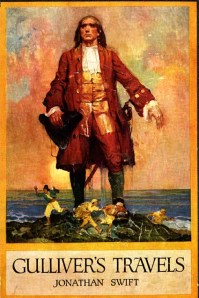
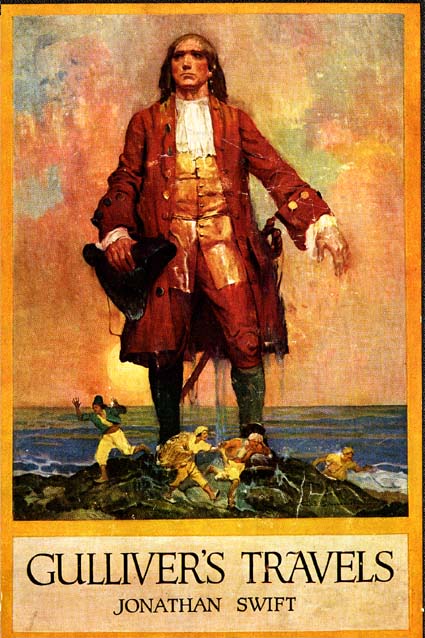
I think the latter and I think “Uccastrog” is an example of Smith’s onomastic skill. But the name has echoes of Gulliver’s Travels (1726), which describes the “great prophet Lustrog” (pt. 1, ch. IV) and the islands Luggnagg and Glubbdubdrib (pt. III). Smith certainly read Gulliver’s Travels and certainly shared Swift’s sardonic and satirical tastes. But how much did Swift shape those tastes, rather than merely chime with them? As we saw at the beginning, Aldous Huxley playfully reduced literary scholarship to a game of “Who influenced whom to say what when?” But it’s also a case of “What influenced whom to be influenced by whom?” Did Swift shape Smith, or merely chime with what was already there? If Clark Ashton Smith and his Isle of Torture did not influence Ian Fleming and Dr. No, how we do explain the shared elements? The shared personality of Smith and Fleming? Their shared genetics? Their shared reading of yet another text of which I am not aware? The questions can unwind for ever. But as we wait for science to answer them, the texts and their dark pleasures remain.




 Overlord In Terms of Core Issues Around Maximal Engagement with Key Notions of the Über-Feral