Prime Climb Time

The third prime is equal to the sum of the first and second primes: 2 + 3 = 5. After that, for obvious reasons, the prime-sum climbs much more rapidly than the primes themselves:

2, 3, 05, 07, 11, 13, 17, 19, 023, 029...
2, 5, 10, 17, 28, 41, 58, 77, 100, 129...

But what if you use digit-sum(p1..pn), i.e., the sum of the digits of the primes from the first to the nth? For example, the digit-sum(p1..p5) = 2 + 3 + 5 + 7 + 1+1 = 19, whereas the sum(p1..p5) = 2 + 3 + 5 + 7 + 11 = 28. Using the digit-sums of the primes, the comparison now looks like this:

2, 3, 05, 07, 11, 13, 17, 19, 23, 29...
2, 5, 10, 17, 19, 23, 31, 41, 46, 57...

The sum climbs more slowly, but still too fast. So what about a different base? In base-2, the digit-sum(p1..p3) = (1+0) + (1+1) + (1+0+1) = 1 + 2 + 2 = 5. The comparison looks like this:

2, 3, 05, 07, 11, 13, 17, 19, 23, 29...
1, 3, 05, 08, 11, 14, 16, 19, 23, 27...

For primes 3, 5, 11, 19, and 23, p = digit-sum(primes <= p) in base-2. But the cumulative digit-sum soon begins to climb too slowly:

2, 3, 5, 7, 11, 13, 17, 19, 23, 29, 31, 37, 41, 43, 47, 53, 59, 61, 67, 71, 73, 79, 83, 89, 97, 101, 103, 107, 109, 113, 127, 131, 137, 139, 149, 151, 157, 163, 167, 173, 179, 181, 191, 193, 197, 199, 211, 223, 227, 229, 233, 239, 241, 251, 257, 263, 269, 271...

1, 3, 5, 8, 11, 14, 16, 19, 23, 27, 32, 35, 38, 42, 47, 51, 56, 61, 64, 68, 71, 76, 80, 84, 87, 091, 096, 101, 106, 110, 117, 120, 123, 127, 131, 136, 141, 145, 150, 155, 160, 165, 172, 175, 179, 184, 189, 196, 201, 206, 211, 218, 223, 230, 232, 236, 240, 245...

So what about base-3?

2, 3, 5, 7, 11, 13, 17, 19, 23, 29, 31, 37, 41, 43, 47, 53, 59...
2, 3, 6, 9, 12, 15, 20, 23, 28, 31, 34, 37, 42, 47, 52, 59, 64...

In base-3, for p = 2, 3 and 37, p = digit-sum(primes <= p), while for p = 23, 31, 47 and 59, p = digit-sum(primes < p), like this:

2 = 2.
3 = 2 + (1+0).
37 = 2 + (1+0) + (1+2) + (2+1) + (1+0+2) + (1+1+1) + (1+2+2) + (2+0+1) + (2+1+2) + (1+0+0+2) + (1+0+1+1) + (1+1+0+1) = 2 + 1 + 3 + 3 + 3 + 3 + 5 + 3 + 5 + 3 + 3 + 3.

23 = 2 + (1+0) + (1+2) + (2+1) + (1+0+2) + (1+1+1) + (1+2+2) + (2+0+1) = 2 + 1 + 3 + 3 + 3 + 3 + 5 + 3.
31 = 2 + (1+0) + (1+2) + (2+1) + (1+0+2) + (1+1+1) + (1+2+2) + (2+0+1) + (2+1+2) + (1+0+0+2) = 2 + 1 + 3 + 3 + 3 + 3 + 5 + 3 + 5 + 3.
47 = 2 + (1+0) + (1+2) + (2+1) + (1+0+2) + (1+1+1) + (1+2+2) + (2+0+1) + (2+1+2) + (1+0+0+2) + (1+0+1+1) + (1+1+0+1) + (1+1+1+2) + (1+1+2+1) = 2 + 1 + 3 + 3 + 3 + 3 + 5 + 3 + 5 + 3 + 3 + 3 + 5 + 5.
59 = 2 + (1+0) + (1+2) + (2+1) + (1+0+2) + (1+1+1) + (1+2+2) + (2+0+1) + (2+1+2) + (1+0+0+2) + (1+0+1+1) + (1+1+0+1) + (1+1+1+2) + (1+1+2+1) + (1+2+0+2) + (1+2+2+2) = 2 + 1 + 3 + 3 + 3 + 3 + 5 + 3 + 5 + 3 + 3 + 3 + 5 + 5 + 5 + 7.

This carries on for a long time. For these primes, p = digit-sum(primes < p):

23, 31, 47, 59, 695689, 698471, 883517, 992609, 992737, 993037, 1314239, 1324361, 1324571, 1326511, 1327289, 1766291, 3174029

And for these primes, p = digit-sum(primes <= p):

3, 37, 695663, 695881, 1308731, 1308757, 1313153, 1314301, 1326097, 1766227, 3204779, 14328191

Now try the cumulative digit-sum in base-4:

2, 3, 5, 07, 11, 13, 17, 19, 23, 29, 31, 37, 41, 43, 47, 53, 59...
2, 5, 7, 11, 16, 20, 22, 26, 31, 36, 43, 47, 52, 59, 67, 72, 80... 

The sum of digits climbs too fast. Base-3 is the Goldilocks base, climbing neither too slowly, like base-2, nor too fast, like all bases greater than 3.
Prime Time #2

“2n2 + 29 is prime for all values of n for 1 to 28.” — The Penguin Dictionary of Curious and Interesting Numbers, David Wells (1986).

• 31, 37, 47, 61, 79, 101, 127, 157, 191, 229, 271, 317, 367, 421, 479, 541, 607, 677, 751, 829, 911, 997, 1087, 1181, 1279, 1381, 1487, 1597.


Elsewhere other-posted:

Prime Time #1
Poulet’s Propellor — Musings on Math and Mathculinity
La Spirale è Mobile

Lat’s That

In a magic square of numbers, all rows, columns and diagonals have the same sum, or magic total. Here is an example:

1*5*9
8*3*4
6*7*2

(mt=15)

Here’s another:

06*07*11*10
15*02*14*03
04*13*01*16
09*12*08*05

(mt=34)

And another:

04*25*20*10*06
01*13*11*21*19
23*09*07*08*18
15*16*03*14*17
22*02*24*12*05

(mt=65)

And another:

35*15*10*18*11*22
05*25*33*12*07*29
34*30*04*14*21*08
02*16*27*17*23*26
03*24*09*19*36*20
32*01*28*31*13*06

(mt=111)

In all those magic squares, the magic total is fixed: the sum of all numbers from 1 to 36 is 666, so any individual line in a 6×6 magic square has to equal 666 / 6 or 111. In other kinds of magic figure, this rule doesn’t apply:

2*7*3
4***8
6*5*1

(mt=12)

6*3*4
2***8
5*7*1

(mt=13)

8*5*1
2***6
4*3*7

(mt=14)

8*1*6
4***2
3*5*7

(mt=15)

Continue reading Lat’s That

Priamonds and Pearls

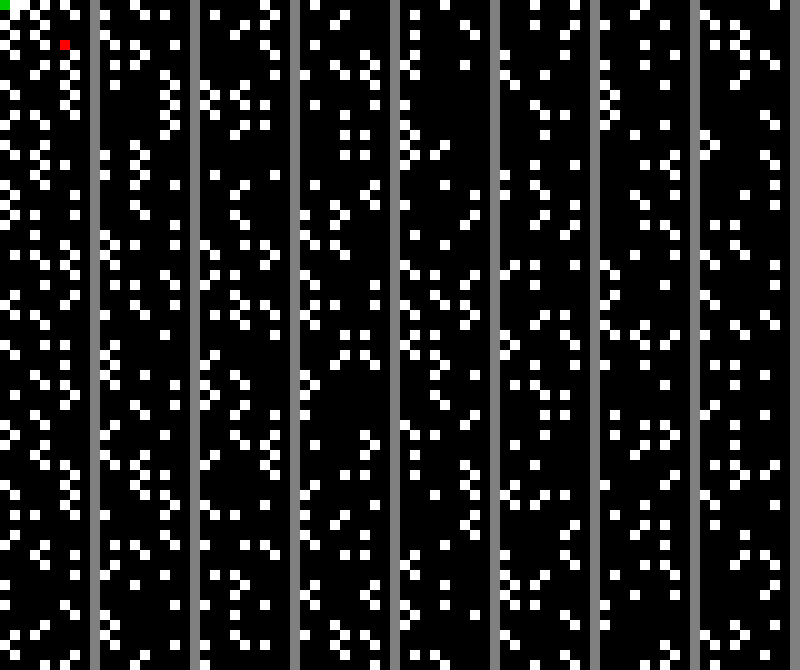
Interesting patterns emerge when primes are represented as white blocks in a series of n-width left-right lines laid vertically, one atop the other. When the line is five blocks wide, the patterns look like this (the first green block is 1, followed by primes 2, 3 and 5, then 7 in the next line):
5line

(Click for larger version)

Right at the bottom of the first column is an isolated prime diamond, or priamond (marked with a green block). It consists of the four primes 307-311-313-317, where the three latter primes equal 307 + 4 and 6 and 10, or 307 + 5-1, 5+1 and 5×2 (the last prime in the first column is 331 and the first prime in the second is 337). About a third of the way down the first column is a double priamond, consisting of 97, 101, 103, 107, 109 and 113. For a given n, then, a priamond is a set of primes, p1, p2, p3 and p4, such that p2 = p1 + n-1, p3 = p + n+1 and p4 = p1 + 2n.

There are also fragments of pearl-necklace in the columns. One is above the isolated priamond. It consists of four prime-blocks slanting from left to right: 251-257-263-269, or 251 + 6, 12 and 18. A prearl-necklace, then, is a set of primes, p1, p2, p3…, such that p2 = p1 + n+i, p3 = p + 2(n+i)…, where i = +/-1. Now here are the 7-line and 9-line:

7line

Above: 7-line for primes

9line

Above: 9-line for primes

In the 9-line, you can see a prime-ladder marked with a red block. It consists of the primes 43-53-61-71-79-89-97-107, in alternate increments of 10 and 8, or 9+1 and 9-1. A prime-ladder, then, is a set of primes, p1, p2, p3, p4…, such that p2 = p1 + n+1, p3 = p + 2n, p3 = p + 3n+1…

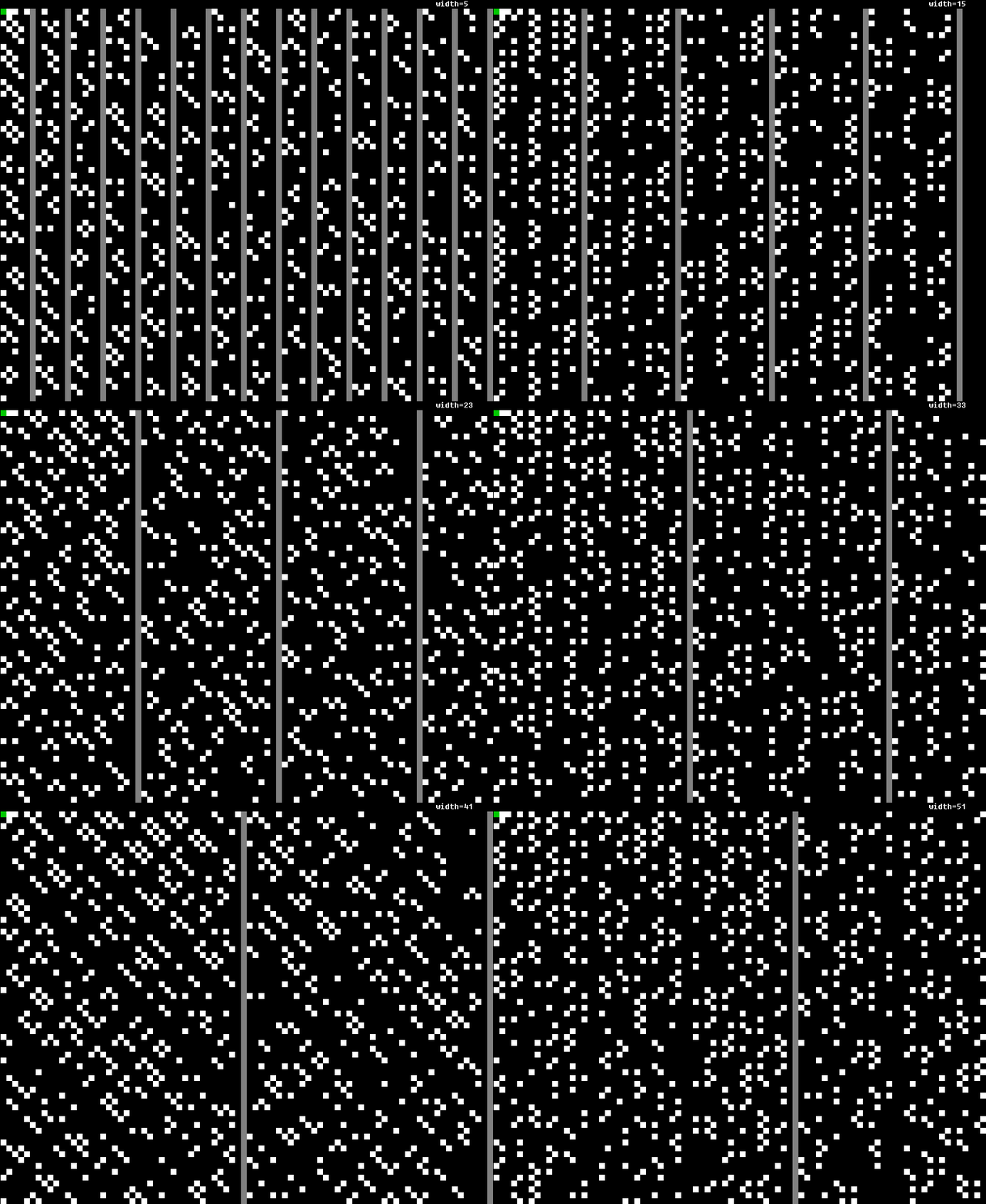
And here is an animated gif of lines 5 through 51:

lines5to51

(Click or open in new window for larger version or if file fails to animate)

Prime Time

1/29[b=2] = 0·0000100011010011110111001011… (l=28)
1/29[b=3] = 0·0002210102011122200121202111… (l=28)
1/29[b=5] = 0·00412334403211… (l=14)
1/29[b=7] = 0·0145536… (l=7)
1/29[b=11] = 0·04199534608387[10]69115764[10]2723… (l=28)
1/29[b=13] = 0·05[10]9[11]28[12]7231[10]4… (l=14)
1/29[b=17] = 0·09[16]7… (l=4)
1/29[b=19] = 0·0[12]89[15][13][14]7[16]73[17][13]1[18]6[10]9354[11]2[11][15]15[17]… (l=28)
1/29[b=23] = 0·0[18]5[12][15][19][19]… (l=7)
1/29[b=29] = 0·1 (l=1)
1/29[b=31] = 0·1248[17]36[12][25][20]9[19]7[14][29][28][26][22][13][27][24][18]5[10][21][11][23][16]… (l=28)
1/29[b=37] = 0·1[10]7[24]8[34][16][21][25][19]53[30][22][35][26][29][12][28]2[20][15][11][17][31][33]6[14]… (l=28)
1/29[b=41] = 0·1[16][39][24]… (l=4)
1/29[b=43] = 0·1[20][32][26][29][28]7[17][34]4[19][11][37]2[41][22][10][16][13][14][35][25]8[38][23][31]5[40]… (l=28)
1/29[b=47] = 0·1[29]84[40][24][14][27][25][43][35][30][37][12][45][17][38][42]6[22][32][19][21]3[11][16]9[34]… (l=28)
1/29[b=53] = 0·1[43][45][36][29][12][42]… (l=7)
1/29[b=59] = 0·2… (l=1)
1/29[b=61] = 0·26[18][56][48][23]8[25][14][44][10][31][33][39][58][54][42]4[12][37][52][35][46][16][50][29][27][21]… (l=28)
1/29[b=67] = 0·2[20][53]9[16][11][36][64][46][13][57][50][55][30]… (l=14)
1/29[b=71] = 0·2[31][58][53][61][14][48][68][39][12][17]9[56][22]… (l=14)
1/29[b=73] = 0·2[37][55][27][50][25][12][42][57][65][32][52][62][67][70][35][17][45][22][47][60][30][15]7[40][20][10]5… (l=28)
1/29[b=79] = 0·2[57][16][27][19]5[35][32][54][38][10][70][65][29][76][21][62][51][59][73][43][46][24][40][68]8[13][49]… (l=28)
1/29[b=83] = 0·2[71][45][65][68][57][20]… (l=7)
1/29[b=89] = 0·36[12][24][49]9[18][36][73][58][27][55][21][42][85][82][76][64][39][79][70][52][15][30][61][33][67][46]… (l=28)
1/29[b=97] = 0·3[33][43][46][80][26][73][56][83][60][20]6[66][86][93][63][53][50][16][70][23][40][13][36][76][90][30][10]… (l=28)

More Narcissisum

The number 23 is special, inter alia, because it’s prime, divisible by only itself and 1. It’s also special because its reciprocal has maximum period. That is, the digits of 1/23 come in repeated blocks of 22, like this:

1/23 = 0·0434782608695652173913  0434782608695652173913  0434782608695652173913…

But 1/23 fails to be special in another way: you can’t sum its digits and get 23:

0 + 4 + 3 + 4 + 7 = 18
0 + 4 + 3 + 4 + 7 + 8 = 26
0 + 4 + 3 + 4 + 7 + 8 + 2 + 6 + 0 + 8 + 6 + 9 + 5 + 6 + 5 + 2 + 1 + 7 + 3 + 9 + 1 + 3 = 99

1/7 is different:

1/7 = 0·142857… → 1 + 4 + 2 = 7

This means that 7 is narcissistic: it reflects itself by manipulation of the digits of 1/7. But that’s in base ten. If you try base eight, 23 becomes narcissistic too (note that 23 = 2 x 8 + 7, so 23 in base eight is 27):

1/27 = 0·02620544131… → 0 + 2 + 6 + 2 + 0 + 5 + 4 + 4 = 27 (base=8)

Here are more narcissistic reciprocals in base ten:

1/3 = 0·3… → 3 = 3
1/7 = 0·142857… → 1 + 4 + 2 = 7
1/8 = 0·125 → 1 + 2 + 5 = 8
1/13 = 0·076923… → 0 + 7 + 6 = 13
1/14 = 0·0714285… → 0 + 7 + 1 + 4 + 2 = 14
1/34 = 0·02941176470588235… → 0 + 2 + 9 + 4 + 1 + 1 + 7 + 6 + 4 = 34
1/43 = 0·023255813953488372093… → 0 + 2 + 3 + 2 + 5 + 5 + 8 + 1 + 3 + 9 + 5 = 43
1/49 = 0·020408163265306122448979591836734693877551… → 0 + 2 + 0 + 4 + 0 + 8 + 1 + 6 + 3 + 2 + 6 + 5 + 3 + 0 + 6 + 1 + 2 = 49
1/51 = 0·0196078431372549… → 0 + 1 + 9 + 6 + 0 + 7 + 8 + 4 + 3 + 1 + 3 + 7 + 2 = 51
1/76 = 0·01315789473684210526… → 0 + 1 + 3 + 1 + 5 + 7 + 8 + 9 + 4 + 7 + 3 + 6 + 8 + 4 + 2 + 1 + 0 + 5 + 2 = 76
1/83 = 0·01204819277108433734939759036144578313253… → 0 + 1 + 2 + 0 + 4 + 8 + 1 + 9 + 2 + 7 + 7 + 1 + 0 + 8 + 4 + 3 + 3 + 7 + 3 + 4 + 9 = 83
1/92 = 0·010869565217391304347826… → 0 + 1 + 0 + 8 + 6 + 9 + 5 + 6 + 5 + 2 + 1 + 7 + 3 + 9 + 1 + 3 + 0 + 4 + 3 + 4 + 7 + 8 = 92
1/94 = 0·01063829787234042553191489361702127659574468085… → 0 + 1 + 0 + 6 + 3 + 8 + 2 + 9 + 7 + 8 + 7 + 2 + 3 + 4 + 0 + 4 + 2 + 5 + 5 + 3 + 1 + 9 + 1 + 4 = 94
1/98 = 0·0102040816326530612244897959183673469387755… → 0 + 1 + 0 + 2 + 0 + 4 + 0 + 8 + 1 + 6 + 3 + 2 + 6 + 5 + 3 + 0 + 6 + 1 + 2 + 2 + 4 + 4 + 8 + 9 + 7 + 9 + 5 = 98


Previously pre-posted (please peruse):

Digital Disfunction
The Hill to Power
Narcissarithmetic #1
Narcissarithmetic #2

Poulet’s Propeller

The Penguin Dictionary of Curious and Interesting Numbers (1986) is one of my favourite books. It’s a fascinating mixture of math, mathecdote and math-joke:

2·618 0333…

The square of φ, the golden ratio, and the only positive number such that √n = n-1. (pg. 45)


6

Kepler discussed the 6-fold symmetry of snowflakes, and attempted to explain it by considering the close packing of spheres in a hexagonal array. (pg. 69)


39

This appears to be the first uninteresting number, which of course makes it an especially interesting number, because it is the smallest number to have the property of being uninteresting.

It is therefore also the first number to be simultaneously interesting and uninteresting. (pg. 120)

David Wells, who wrote the Dictionary, “had the rare distinction of being a Cambridge scholar in mathematics and failing his degree”. He must be the mathematical equivalent of the astronomer Patrick Moore: a popularizer responsible for opening many minds and inspiring many careers. He’s also written books on geometry and mathematical puzzles. But not everyone appreciates his efforts. This is a sideswipe in a review of William Hartston’s The Book of Numbers:

Thankfully, this book is more concerned with facts than mathematics. Anyone wanting to learn more about [π] or the Fibonacci sequence should turn to the Penguin Dictionary of Curious and Interesting Numbers, a volume which none but propeller-heads will find either curious or interesting. (Review in The Independent, 18th December 1997)


Continue reading: Poulet’s Propeller

In Perms Of

13 is a prime number, divisible only by itself and 1. Perm 13 and you get 31, which is also a prime number. The same is true of 17, 37 and 79. There are only two possible permutations – 2 x 1 – of a two-digit number, so base-10 is terminally permal for two-digit primes:

13, 31
17, 71
37, 73
79, 97

What about three-digit primes? Now there are six possible permutations: 3 x 2 x 1. But base-10 is not terminally permal for three-digit primes. This is the best it does:

149, 419, 491, 941
179, 197, 719, 971
379, 397, 739, 937

Fortunately, we aren’t restricted to base-10. Take a step up and you’ll find that base-11 is terminally permal for three-digit primes (139 in base-11 = 1 x 11^2 + 3 x 11 + 9 = 163 in base-10):

139, 193, 319, 391, 913, 931 (6 primes) (base=11)

163, 223, 383, 463, 1103, 1123 (base=10)

Four-digit primes have twenty-four possible permutations – 4 x 3 x 2 x 1 – and base-10 again falls short:

1237, 1327, 1723, 2137, 2371, 
2713, 2731, 3217, 3271, 7213,
7321 (11 primes)

1279, 1297, 2179, 2719, 2791,
2917, 2971, 7129, 7219, 9127,
9721

For four-digit primes, the most permal base I’ve discovered so far is base-13 (where B represents [11]):

134B, 13B4, 14B3, 1B34, 1B43,
314B, 31B4, 34B1, 3B14, 413B,
41B3, 431B, 43B1, 4B13, 4B31,
B134, B143, B314, B413 (19 primes) (base=13)

2767, 2851, 3019, 4099, 4111,
6823, 6907, 7411, 8467, 9007,
9103, 9319, 9439, 10663, 10687,
24379, 24391, 24691, 24859 (base=10)

Is there a base in which all permutations of some four-digit number are prime? I think so, but I haven’t found it yet. Is there always some base, b, in which all permutations of some d-digit number are prime? Is there an infinity of bases in which all permutations of some d-digit number are prime? Easy to ask, difficult to answer. For me, anyway.

Factory Records

The factors of n are those numbers that divide n without remainder. So the factors of 6 are 1, 2, 3 and 6. If the function s(n) is defined as “the sum of the factors of n, excluding n, then s(6) = 1 + 2 + 3 = 6. This makes 6 a perfect number: its factors re-create it. 28 is another perfect number. The factors of 28 are 1, 2, 4, 7, 14 and 28, so s(28) = 1 + 2 + 4 + 7 + 14 = 28. Other perfect numbers are 496 and 8128. And they’re perfect in any base.

Amicable numbers are amicable in any base too. The factors of an amicable number sum to a second number whose factors sum to the first number. So s(220) = 284, s(284) = 220. That pair may have been known to Pythagoras (c.570-c.495 BC), but s(1184) = 1210, s(1210) = 1184 was discovered by an Italian schoolboy called Nicolò Paganini in 1866. There are also sociable chains, in which s(n), s(s(n)), s(s(s(n))) create a chain of numbers that leads back to n, like this:

12496 → 14288 → 15472 → 14536 → 14264 → 12496 (c=5)

Or this:

14316 → 19116 → 31704 → 47616 → 83328 → 177792 → 295488 → 629072 → 589786 → 294896 → 358336 → 418904 → 366556 → 274924 → 275444 → 243760 → 376736 → 381028 → 285778 → 152990 → 122410 → 97946 → 48976 → 45946 → 22976 → 22744 → 19916 → 17716 → 14316 (c=28)

Those sociable chains were discovered (and christened) in 1918 by the Belgian mathematician Paul Poulet (1887-1946). Other factor-sum patterns are dependant on the base they’re expressed in. For example, s(333) = 161. So both n and s(n) are palindromes in base-10. Here are more examples — the numbers in brackets are the prime factors of n and s(n):

333 (3^2, 37) → 161 (7, 23)
646 (2, 17, 19) → 434 (2, 7, 31)
656 (2^4, 41) → 646 (2, 17, 19)
979 (11, 89) → 101 (prime)
1001 (7, 11, 13) → 343 (7^3)
3553 (11, 17, 19) → 767 (13, 59)
10801 (7, 1543) → 1551 (3, 11, 47)
11111 (41, 271) → 313 (prime)
18581 (17, 1093) → 1111 (11, 101)
31713 (3, 11, 31^2) → 15951 (3, 13, 409)
34943 (83, 421) → 505 (5, 101)
48484 (2^2, 17, 23, 31) → 48284 (2^2, 12071)
57375 (3^3, 5^3, 17) → 54945 (3^3, 5, 11, 37)
95259 (3, 113, 281) → 33333 (3, 41, 271)
99099 (3^2, 7, 11^2, 13) → 94549 (7, 13, 1039)
158851 (7, 11, 2063) → 39293 (prime)
262262 (2, 7, 11, 13, 131) → 269962 (2, 7, 11, 1753)
569965 (5, 11, 43, 241) → 196691 (11, 17881)
1173711 (3, 7, 11, 5081) → 777777 (3, 7^2, 11, 13, 37)

Note how s(656) = 646 and s(646) = 434. There’s an even longer sequence in base-495:

33 → 55 → 77 → 99 → [17][17] → [19][19] → [21][21] → [43][43] → [45][45] → [111][111] → [193][193] → [195][195] → [477][477] (b=495) (c=13)
1488 (2^4, 3, 31) → 2480 (2^4, 5, 31) → 3472 (2^4, 7, 31) → 4464 (2^4, 3^2, 31) → 8432 (2^4, 17, 31) → 9424 (2^4, 19, 31) → 10416 (2^4, 3, 7, 31) → 21328 (2^4, 31, 43) → 22320 (2^4, 3^2, 5, 31) → 55056 (2^4, 3, 31, 37) → 95728 (2^4, 31, 193) → 96720 (2^4, 3, 5, 13, 31) → 236592 (2^4, 3^2, 31, 53)

I also tried looking for n whose s(n) mirrors n. But they’re hard to find in base-10. The first example is this:

498906 (2, 3^3, 9239) → 609894 (2, 3^2, 31, 1093)

498906 mirrors 609894, because the digits of each run in reverse to the digits of the other. Base-9 does better for mirror-sums, clocking up four in the same range of integers:

42 → 24 (base=9)
38 (2, 19) → 22 (2, 11)
402 → 204 (base=9)
326 (2, 163) → 166 (2, 83)
4002 → 2004 (base=9)
2918 (2, 1459) → 1462 (2, 17, 43)
5544 → 4455 (base=9)
4090 (2, 5, 409) → 3290 (2, 5, 7, 47)

Base-11 does better still, clocking up eight in the same range:

42 → 24 (base=11)
46 (2, 23) → 26 (2, 13)
2927 → 7292 (base=11)
3780 (2^2, 3^3, 5, 7) → 9660 (2^2, 3, 5, 7, 23)
4002 → 2004 (base=11)
5326 (2, 2663) → 2666 (2, 31, 43)
13772 → 27731 (base=11)
19560 (2^3, 3, 5, 163) → 39480 (2^3, 3, 5, 7, 47)
4[10]7[10]9 → 9[10]7[10]4 (base=11)
72840 (2^3, 3, 5, 607) → 146040 (2^3, 3, 5, 1217)
6929[10] → [10]9296 (base=11)
100176 (2^4, 3, 2087) → 158736 (2^4, 3, 3307)
171623 → 326171 (base=11)
265620 (2^2, 3, 5, 19, 233) → 520620 (2^2, 3, 5, 8677)
263702 → 207362 (base=11)
414790 (2, 5, 41479) → 331850 (2, 5^2, 6637)

Note that 42 mirrors its factor-sum in both base-9 and base-11. But s(42) = 24 in infinitely many bases, because when 42 = 2 x prime, s(42) = 1 + 2 + prime. So (prime-1) / 2 will give the base in which 24 = s(42). For example, 2 x 11 = 22 and 22 = 42 in base (11-1) / 2 or base-5. So s(42) = 1 + 2 + 11 = 14 = 2 x 5 + 4 = 24[b=5]. There are infinitely many primes, so infinitely many bases in which s(42) = 24.

Base-10 does better for mirror-sums when s(n) is re-defined to include n itself. So s(69) = 1 + 3 + 23 + 69 = 96. Here are the first examples of all-factor mirror-sums in base-10:

69 (3, 23) → 96 (2^5, 3)
276 (2^2, 3, 23) → 672 (2^5, 3, 7)
639 (3^2, 71) → 936 (2^3, 3^2, 13)
2556 (2^2, 3^2, 71) → 6552 (2^3, 3^2, 7, 13)

In the same range, base-9 now produces one mirror-sum, 13 → 31 = 12 (2^2, 3) → 28 (2^2, 7). Base-11 produces no mirror-sums in the same range. Base behaviour is eccentric, but that’s what makes it interesting.

Multi-Magic

A magic square is a square of numbers in which all rows, all columns and both diagonals add to the same number, or magic total. The simplest magic square using distinct numbers is this:

6 1 8
7 5 3
2 9 4

It’s easy to prove that the magic total of a 3×3 magic square must be three times the central number. Accordingly, if the central number is 37, the magic total must be 111. There are lots of ways to create a magic square with 37 at its heart, but this is my favourite:

43 | 01 | 67
61 | 37 | 13
07 | 73 | 31

The square is special because all the numbers are prime, or divisible by only themselves and 1 (though 1 itself is not usually defined as prime in modern mathematics). I like the 37-square even more now that I’ve discovered it can be found inside another all-prime magic square:

0619 = 0006[37] | 0097 = 00000010 | 1123 = [11][56]
1117 = [11][50] | 0613 = 0006[31] | 0109 = 0001[12]
0103 = 00000016 | 1129 = [11][62] | 0607 = 0006[25]

Magic total = 1839

The square is shown in both base-10 and base-97. If the digit-sums of the base-97 square are calculated, this is the result (e.g., the digit-sum of 6[37][b=97] = 6 + 37 = 43):

43 | 01 | 67
61 | 37 | 13
07 | 73 | 31

This makes me wonder whether the 613-square might nest in another all-prime square, and so on, perhaps ad infinitum [Update: yes, the 613-square is a nestling]. There are certainly many nested all-prime squares. Here is square-631 in base-187:

661 = 003[100] | 379 = 00000025 | 853 = 004[105]
823 = 004[075] | 631 = 003[070] | 439 = 002[065]
409 = 002[035] | 883 = 004[135] | 601 = 003[040]

Magic total = 1893

Digit-sums:

103 | 007 | 109
079 | 073 | 067
037 | 139 | 043

Magic total = 219

There are also all-prime magic squares that have two kinds of nestlings inside them: digit-sum magic squares and digit-product magic squares. The digit-product of a number is calculated by multiplying its digits (except 0): digit-product(37) = 3 x 7 = 21, digit-product(103) = 1 x 3 = 3, and so on. In base-331, this all-prime magic square yields both a digit-sum square and a digit-product square:

503 = 1[172] | 359 = 1[028] | 521 = 1[190]
479 = 1[148] | 461 = 1[130] | 443 = 1[112]
401 = 1[070] | 563 = 1[232] | 419 = 1[088]

Magic total = 1383

Digit-sums:

173 | 029 | 191
149 | 131 | 113
071 | 233 | 089

Magic total = 393

Digit-products:

172 | 028 | 190
148 | 130 | 112
070 | 232 | 088

Magic total = 390

Here are two more twin-bearing all-prime magic squares:

Square-719 in base-451:

761 = 1[310] | 557 = 1[106] | 839 = 1[388]
797 = 1[346] | 719 = 1[268] | 641 = 1[190]
599 = 1[148] | 881 = 1[430] | 677 = 1[226]

Magic total = 2157

Digit-sums:

311 | 107 | 389
347 | 269 | 191
149 | 431 | 227

Magic total = 807

Digit-products:

310 | 106 | 388
346 | 268 | 190
148 | 430 | 226

Magic total = 804

Square-853 in base-344:

883 = 2[195] | 709 = 2[021] | 967 = 2[279]
937 = 2[249] | 853 = 2[165] | 769 = 2[081]
739 = 2[051] | 997 = 2[309] | 823 = 2[135]

Magic total = 2559

Digit-sums:

197 | 023 | 281
251 | 167 | 083
053 | 311 | 137

Magic total = 501

Digit-products:

390 | 042 | 558
498 | 330 | 162
102 | 618 | 270

Magic total = 990

Proviously Post-Posted (please peruse):

More Multi-Magic