S’éteignent, S’encroûtent, S’allument…

« Des soleils s’éteignent & s’encroûtent, des planètes périssent & se dispersent dans les plaines des airs ; d’autres soleils s’allument, de nouvelles planètes se forment pour faire leurs révolutions ou pour décrire de nouvelles routes, & l’homme, portion infiniment petite d’un globe, qui n’est lui-même qu’un point imperceptible dans l’immensité, croit que c’est pour lui que l’univers est fait, s’imagine qu’il doit être le confident de la nature, se flatte d’être éternel, se dit le roi de l’univers ! » — Baron d’Holbach, Système de la nature (1770), Partie 1, Chapitre 6

“Suns are extinguished or become corrupted, planets perish and scatter across the wastes of the sky; other suns are kindled, new planets formed to make their revolutions or describe new orbits, and man, an infinitely minute part of a globe which itself is only an imperceptible point in the immense whole, believes that the universe is made for himself, flatters himself that he is eternal, calls himself king of the universe!”


Post-Performative Post-Scriptum…

Mais… Mens Major Est Quam Materia…

RanDOOM Numbers

In my story “The Web of Nemilloth”, I wrote about a wizard, Vmirr-Psumm, who sought to escape the web of necessity spun over all matter in the universe by the spider-goddess Nemilloth. Vmirr-Psumm knew the legend of a fore-wizard, Tšenn-Gilë, who had sought the same escape and had cast a giant spell to tear the entire planet of Pmimmb from Nemilloth’s web. Alas, the legend ran, Tšenn-Gilë had made an error in his working and Pmimmb had exploded, broadcasting fragments of itself throughout the universe in the form of a seemingly worthless black mineral called sorraim.

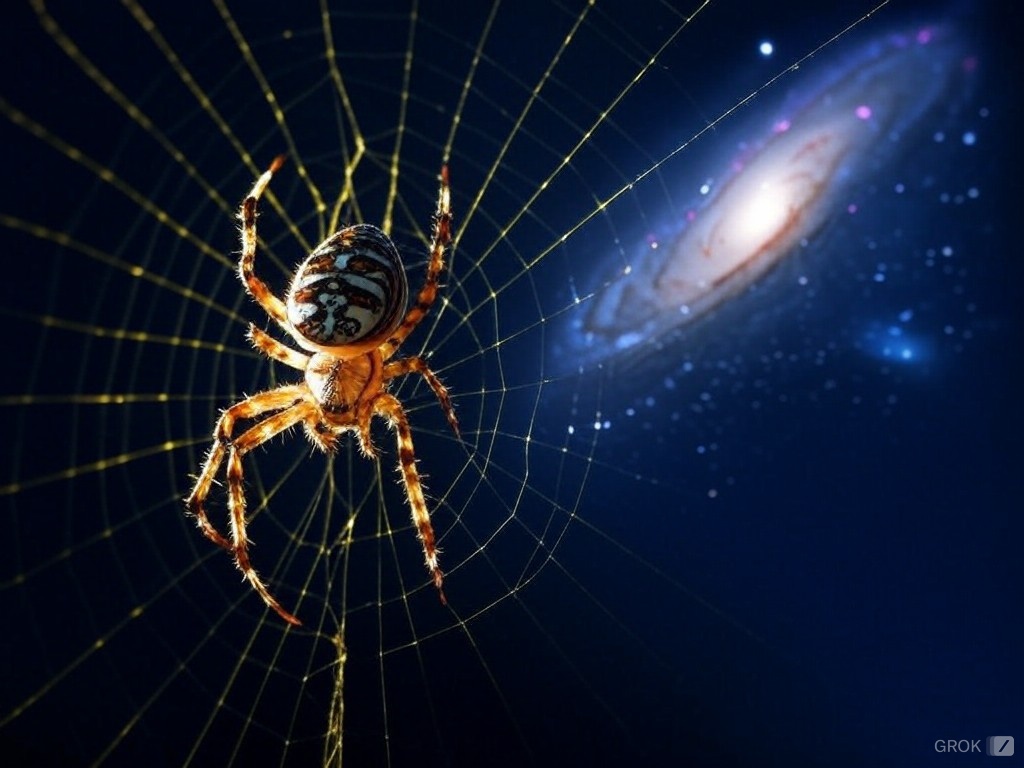
The spider-goddess Nemilloth binds the Universe in Her web (AI-rtist’s impression)

Pieces of sorraim were found on Vmirr-Psumm’s own planet and he reasoned that, were the legend true, he could lift Nemilloth’s web from his own brain by carving and throwing a die of the mineral, wherein the virtue of Tšenn-Gilë’s spell still lingered. A die of any ordinary material would be within the web and therefore bound by necessity, generating only pseudo-random numbers in its throws. But a die of sorraim, being outside the web, would generate veri-random numbers that would alter the working of his brain, inspire thoughts unbound by Nemilloth, and grant him true freedom from Her tyranny.

Unfortunately for Vmirr-Psumm, he did not realize that “he who loosens the web of Nemilloth in rebellion grants matter itself leave to rebel.” A fragment of sorraim was small enough to remain outside the web and survive, but anything larger, from a planet to a human brain, would be destroyed. And that is why, absorbing the veri-random throws of the sorraim die, Vmirr-Psumm’s brain exploded with the power of an atom bomb at the end of the story, “succumbing, on its vastly smaller scale, to the same forces that had torn apart the planet of Pmimmb.”

Reflections on ranDOOM

Thinking about “The Web of Nemilloth” again at the end of 2024, I’ve realized that it raises some interesting questions. If a truly random sequence of numbers could cause a brain to explode, how long would the sequence have to be? I conjecture that a single number, and single throw of Vmirr-Psumm’s deadly die, would suffice, because it would be truly random in a way no number generated in any normal way could be. After all, if the brain of the die-thrower didn’t explode after one throw, why should it explode after two or three or any other finite number of throws? If the true randomness of the sequence is not established after one throw, then (one might reason) it could be established only after infinite throws. But Vmirr-Psumm did not throw the die infinitely often. Therefore, I conjecture, he must have rolled it only once, seen but one uppermost face of his dodecahedral die of sorraim, and die-d on that instant, as his brain absorbed the first veri-random number and exploded.

But why should sorraim need to be carved into a die to be deadly? If the mineral were truly outside the web of Nemilloth, then would not merely seeing or touching sorraim introduce unnecessitated sense-data into the brain of the beholder or betoucher and provoke an explosion? And why would the influence of the sorraim need to be on a conscious brain? If it’s insentient matter itself that rebels when outside the web, then ordinary matter influenced by sorraim would explode. And that explosion itself would be unnecessitated and thereby provoke further explosion in all the ordinary matter that it influenced.

And the influence of such an explosion would propagate at the speed of light, because the photons it created would be unnecessitated and therefore explosive in their influence. One could conclude, then, that the fore-wizard’s spell would have destroyed not only the planet of Pmimmb whereon it was worked but, in time, the entire universe, as the photons bearing the news of the initial explosion sped outward and triggered further explosions in all the ordinary matter they effected in some way. Vmirr-Psumm could never have found his sorraim and carved his die, because photons from Pmimmb would have reached his planet far before fragments of sorraim ever did. And it seems illogical or arbitrary to suppose that sorraim could exist anyway. Would not all matter be destroyed – turn into electro-magnetic radiation – if outside the web or if influenced by unnecessitated fundamental particles?

Psychopaths and Stoics

Still, let’s suppose that my story doesn’t succumb to this explosive logic, that sorraim could exist and be carved into a die, and that a single truly random number could cause a brain to explode. What a method of assassination or murder that would be! But it would be like the head of Medusa: you would have to emulate Perseus and avoid beholding your own weapon. If sorraim really existed and you could carve a die from it, you’d have to set up an automatic mechanism to roll that die, record the number first generated, then transmit that number to your target in some way. But to use such a weapon you’d have to have a psychopathic indifference to collateral damage: when your target’s brain absorbed the single veri-random number and exploded, this would destroy any city that your target happened to be present in at the time. But suppose you were indeed a psychopath and wanted to destroy a city or a nation or a continent or the entire world. Then you’d simply arrange for your single truly random number to be seen by the requisite number of people.

A final thought: I have a recollection that the Stoics believed necessity rules the universe and true randomness is therefore impossible, because it would trigger destruction in the necessitated material order of the universe. But I can’t remember where (or if) I read this and am pretty sure I read it only after I’d written “The Web of Nemilloth”.


Post-Performative Post-Scriptum

• “The Web of Nemilloth” appears in the CAS-inspired collection Tales of Silence and Sortilege, re-published by Incunabula Books in 2023.

Astronomy Dominie

• ἐπαινῶ: παντὶ γάρ μοι δοκεῖ δῆλον ὅτι αὕτη γε ἀναγκάζει ψυχὴν εἰς τὸ ἄνω ὁρᾶν καὶ ἀπὸ τῶν ἐνθένδε ἐκεῖσε ἄγει. — Πολιτεία τοῦ Πλᾰ́τωνος

• • For every one, as I think, must see that astronomy compels the soul to look upwards and leads us from this world to another. — Plato’s Republic (c. 375 BC), Book 7, line 529a

Perplexing Purple

We have three sets of cones (or colour sensors) in our retinas, each of which is sensitive to a different part of the colour spectrum; the brain then constructs the rest of the spectrum by extrapolating from the relative strength of these three. In the case of purple, which occurs when the red and blue sensors but not the green ones are triggered, the brain creates a colour to fill the gap. If your brain were more objective, rather than showing you purple, it would display a patch of flickering grey with the words “system error” on it. — Rory Sutherland in Alchemy: The Surprising Power of Ideas That Don’t Make Sense (2019), section 6.2

Guat Da Fack?!

From Intellectual Impostures (1998) by Alan Sokal and Jean Bricmont:

To conclude, let us quote a brief excerpt from the book Chaosmosis, written by Guattari alone. This passage contains the most brilliant melange of scientific, pseudo-scientific, and philosophical jargon that we have ever encountered; only a genius could have written it.

We can clearly see that there is no bi-univocal correspondence between linear signifying links or archi-writing, depending on the author, and this multireferential, multidimensional machinic catalysis. The symmetry of scale, the transversality, the pathic non-discursive character of their expansion: all these dimensions remove us from the logic of the excluded middle and reinforce us in our dismissal of the ontological binarism we criticised previously. A machinic assemblage, through its diverse components, extracts its consistency by crossing ontological thresholds, non-linear thresholds of irreversibility, ontological and phylogenetic thresholds, creative thresholds of heterogenesis and autopoiesis. The notion of scale needs to be expanded to consider fractal symmetries in ontological terms.

What fractal machines traverse are substantial scales. They traverse them in engendering them. But, and this should be noted, the existential ordinates that they “invent” were always already there. How can this paradox be sustained? It’s because everything becomes possible (including the recessive smoothing of time, evoked by Rene Thom) the moment one allows the assemblage to escape from energetico-spatiotemporal coordinates. And, here again, we need to rediscover a manner of being of Being — before, after, here and everywhere else — without being, however, identical to itself; a processual, polyphonic Being singularisable by infinitely complexifiable textures, according to the infinite speeds which animate its virtual compositions.

The ontological relativity advocated here is inseparable from an enunciative relativity. Knowledge of a Universe (in an astrophysical or axiological sense) is only possible through the mediation of autopoietic machines. A zone of self-belonging needs to exist somewhere for the coming into cognitive existence of any being or any modality of being. Outside of this machine/Universe coupling, beings only have the pure status of a virtual entity. And it is the same for their enunciative coordinates. The biosphere and mecanosphere, coupled on this planet, focus a point of view of space, time and energy. They trace an angle of the constitution of our galaxy. Outside of this particularised point of view, the rest of the Universe exists (in the sense that we understand existence here-below) only through the virtual existence of other autopoietic machines at the heart of other bio-mecanospheres scattered throughout the cosmos. The relativity of points of view of space, time and energy do not, for all that, absorb the real into the dream. The category of Time dissolves into cosmological reflections on the Big Bang even as the category of irreversibility is affirmed. Residual objectivity is what resists scanning by the infinite variation of points of view constitutable upon it. Imagine an autopoietic entity whose particles are constructed from galaxies. Or, conversely, a cognitivity constituted on the scale of quarks. A different panorama, another ontological consistency. The mecanosphere draws out and actualises configurations which exist amongst an infinity of others in fields of virtuality. Existential machines are at the same level as being in its intrinsic multiplicity. They are not mediated by transcendent signifiers and subsumed by a univocal ontological foundation. They are to themselves their own material of semiotic expression. Existence, as a process of deterritorialisation, is a specific inter-machinic operation which superimposes itself on the promotion of singularised existential intensities. And, I repeat, there is no generalised syntax for these deterritorialisations. Existence is not dialectical, not representable. It is hardly livable! (Félix Guattari 1995, pp. 50-52)

Knostrils

• εἰ πάντα τὰ ὄντα καπνὸς γένοιτο, ῥῖνες ἂν διαγνοῖεν. — Ἡράκλειτος ὁ Ἐφέσιος

• • Si toutes choses devenaient fumée, on connaîtrait par les narines. — Héraclite d’Ephèse

• • • If all things were turned to smoke, the nostrils would tell them apart. — Heraclitus of Ephesos, quoted in Aristotle’s De sensu, 5, 443a 23

A Ladd Inane

“I once received a letter from an eminent logician, Mrs. Christine Ladd-Franklin, saying that she was a solipsist, and was surprised that there were no others.” — Bertrand Russell, Human Knowledge: Its Scope and Limits (1948)


Peri-Performative Post-Scriptum

The title of this post is, of course, a radical reference to core Jethro Tull album Aladdin Sane (1973).

Jonglietzsche


Post-Performative Post-Scriptum

“Jonglietzsche” is a portmanteau of German Jongleur / jonglieren, “juggler, juggling”, and the surname of core counter-cultural philosopher Friedrich Nietzsche (1844-1900). Jongleur is pronounced something like “zhawngloer”, as in French.

Stu’s Views

“Consciousness is a fascinating but elusive phenomenon; it is impossible to specify what it is, what it does, or why it evolved. Nothing worth reading has been written on it.” — Stuart Sutherland (1927-98), in The International Dictionary of Psychology (1995), entry on “Consciousness”