He Say, He Sigh, He Sow #9 and #10

“One of mighty union-smashing Maggie’s few big mistakes – along with increasing comprehensive education, letting third-world immigration and enforced multiculturalism rip, leaving the NHS and BBC ‘safe in our hands’, smashing the fisheries, selling out the Northern Irish Protestants, increasing welfarism, ending academic freedom and trying to push through the Poll Tax – was to be unfriendly to German reunification.” — Chris Brand, gFactor.


“Homosexual men are nature’s Petri dishes.” — Greg Cochran, West Hunter.

Flesh and Binary

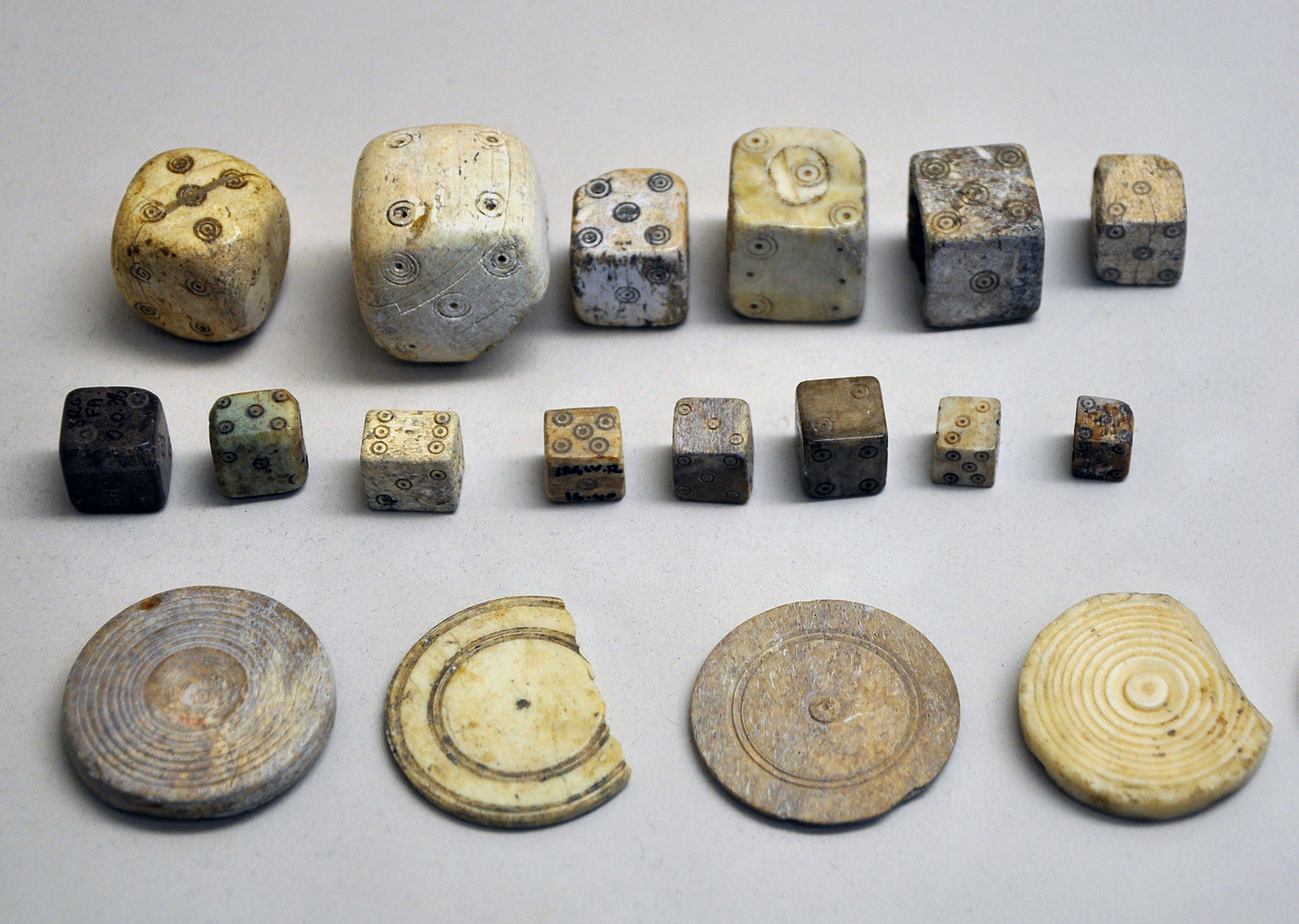
It’s odd that probability theory is so counter-intuitive to human beings and so late-flowering in mathematics. Men have been gambling for thousands of years, but didn’t develop a good understanding of what happens when dice are rolled or coins are tossed until a few centuries ago. And an intuitive grasp of probability would have been useful long before gambling was invented. Our genes automatically equip us to speak, to walk and to throw, but they don’t equip us to understand by instinct why five-tails-in-a-row makes heads no more likely on the sixth coin-toss than it was on the first.

Dice from ancient Rome

Dice and gambling tokens from ancient Rome

Or to understand why five-boys-in-a-row makes the birth of a girl next time no more likely than it was during the first pregnancy (at least in theory). Boy/girl, like heads/tails, is a binary choice, so binary numbers are useful for understanding the probabilities of birth or coin-tossing. Questions like these are often asked to test knowledge of elementary probability:

1. Suppose a family have two children and the elder is a boy. What is the probability that both are boys?

2. Suppose a family have two children and at least one is a boy. What is the probability that both are boys?

People sometimes assume that the two questions are equivalent, but binary makes it clear that they’re not. If 1 represents a boy, 0 represents a girl and digit-order represents birth-order, the first question covers these possibilities: 10, 11. So the chance of both children being boys is 1/2 or 50%. The second question covers these possibilities: 10, 01, 11. So the chance of both children being boys is 1/3 = 33·3%. But now examine this question:

3. Suppose a family have two children and only one is called John. What is the probability that both children are boys?

That might seem the equivalent of question 2, but it isn’t. The name “John” doesn’t just identify the child as a boy, it identifies him as a unique boy, distinct from any brother he happens to have. Binary isn’t sufficient any more. So, while boy = 1, John = 2. The possibilities are: 20, 21, 02, 12. The chance of both children being boys is then 1/2 = 50%.

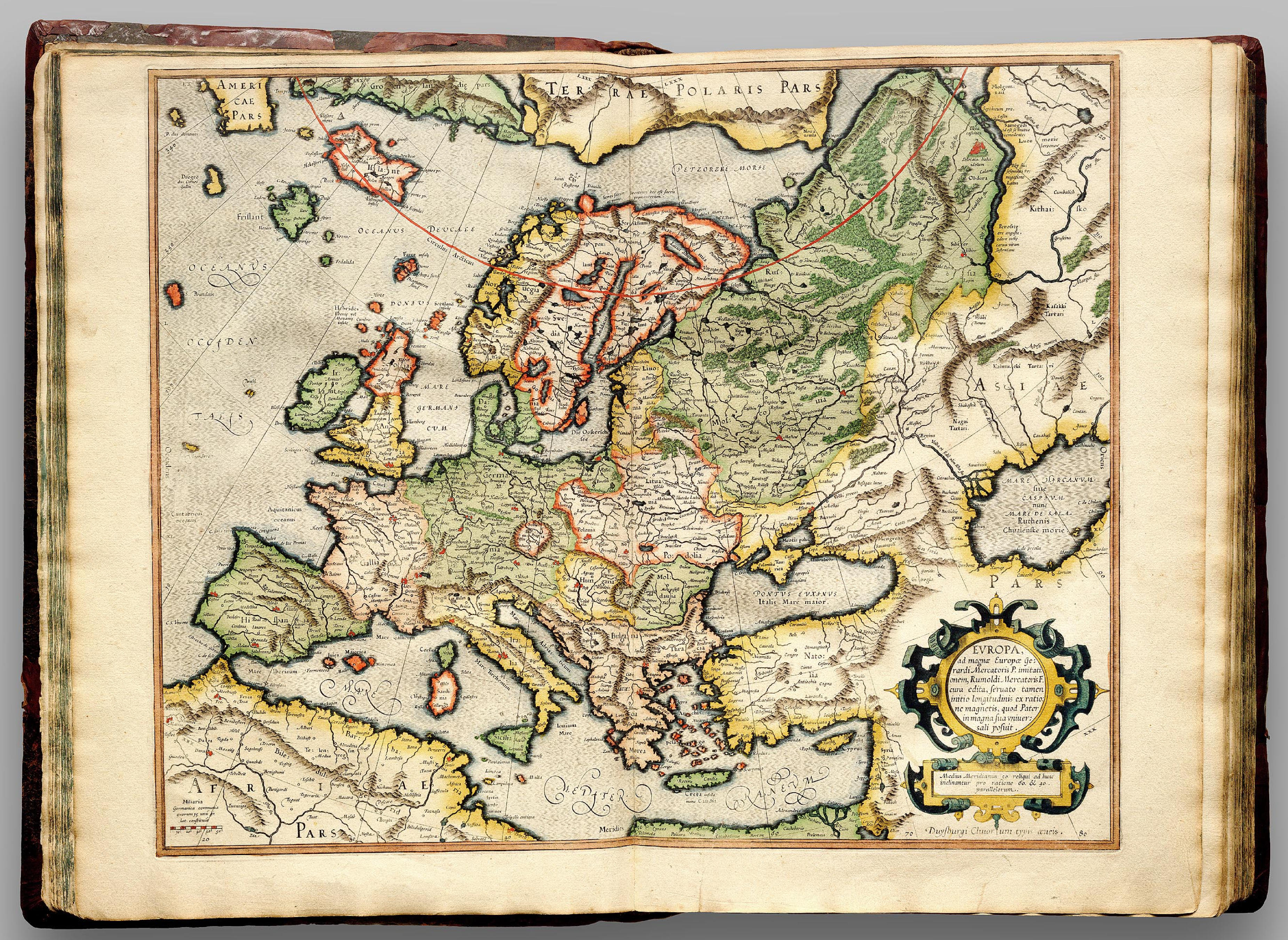
The three questions above are very simple, but I don’t think Archimedes or Euclid ever addressed the mathematics behind them. Perhaps they would have made mistakes if they had. I hope I haven’t, more than two millennia later. Perhaps the difficulty of understanding probability relates to the fact that it involves movement and change. The Greeks developed a highly sophisticated mathematics of static geometry, but did not understand projectiles or falling objects. When mathematicians began understood those in Renaissance Italy, they also began to understand the behaviour of dice, coins and cards. Ideas were on the move then and this new mathematics was obviously related to the rise of science: Galileo (1564-1642) is an important figure in both fields. But the maths and science can be linked with apparently distinct phenomena like Protestantism and classical music. All of these things began to develop in a “band of genius” identified by the American researcher Charles Murray. It runs roughly from Italy through France and Germany to Scotland: from Galileo through Beethoven and Descartes to David Hume.

Map of Europe from Mercator's Atlas Cosmographicae (1596)

Map of Europe from Mercator’s Atlas Cosmographicae (1596)

But how far is geography also biology? Having children is a form of gambling: the dice of DNA, shaken in testicle- and ovary-cups, are rolled in a casino run by Mother Nature. Or rather, in a series of casinos where different rules apply: the genetic bets placed in Africa or Europe or Asia haven’t paid off in the same way. In other words, what wins in one place may lose in another. Different environments have favoured different sets of genes with different effects on both bodies and brains. All human beings have many things in common, but saying that we all belong to the same race, the human race, is like saying that we all speak the same language, the human language. It’s a ludicrous and anti-scientific idea, however widely it may be accepted (and enforced) in the modern West.

Languages have fuzzy boundaries. So do races. Languages have dialects and accents, and so, in a sense, do races. The genius that unites Galileo, Beethoven and Hume may have been a particular genetic dialect spoken, as it were, in a particular area of Europe. Or perhaps it’s better to see European genius as a series of overlapping dialects. Testing that idea will involve mathematics and probability theory, and the computers that crunch the data about flesh will run on binary. Apparently disparate things are united by mathematics, but maths unites everything partly because it is everything. Understanding the behaviour of dice in the sixteenth century leads to understanding the behaviour of DNA in the twenty-first.

The next step will be to control the DNA-dice as they roll. China has already begun trying to do that using science first developed in the West. But the West itself is still in the thrall of crypto-religious ideas about equality and environment. These differences have biological causes: the way different races think about genetics, or persuade other races to think about genetics, is related to their genetics. You can’t escape genes any more than you can escape maths. But the latter is a ladder that allows us to see over the old genetic wall and glimpse the possibilities beyond it. The Chinese are trying to climb over the wall using super-computers; the West is still insisting that there’s nothing on the other side. Interesting times are ahead for both flesh and binary.

Appendix

1. Suppose a family have three children and the eldest is a girl. What is the probability that all three are girls?

2. Suppose a family have three children and at least one is a girl. What is the probability that all three are girls?

3. Suppose a family have three children and only one is called Joan. What is the probability that all three are girls?

The possibilities in the first case are: 000, 001, 010, 011. So the chance of three girls is 1/4 = 25%.

The possibilities in the second case are: 000, 001, 010, 011, 100, 101, 110. So the chance of three girls is 1/7 = 14·28%.

The possibilities in the third case are: 200, 201, 210, 211, 020, 021, 120, 121, 002, 012, 102, 112. So the chance of three girls is 3/12 = 1/4 = 25%.

Cat out of Bel

The Belgian symbolist Fernand Khnopff (1858-1921) is one of my favourite artists; Caresses (1896) is one of his most famous paintings. I like it a lot, though I find it more interesting than attractive. It’s a good example of Khnopff’s art in that the symbols are detached from clear meaning and float mysteriously in a world of their own. As Khnopff used to say: On n’a que soi “One has only oneself.” But he was clearly inspired by the story of Oedipus and the Sphinx, which is thousands of years old. Indeed, an alternate title for the painting is The Sphinx.

Caresses by Fernand Khnopff (click for larger image)

Caresses (1896) by Fernand Khnopff (click for larger image)

Even older than the Oedipus story is another link to the incestuous themes constantly explored by Khnopff, who was obsessed with his sister Marguerite and portrayed her again and again in his art. That’s her heavy-jawed face rubbing against the heavy-jawed face of the oddly nippled man, but Khnopff has given her the body of a large spotted felid. Many people misidentify it as a leopard, Panthera pardus. It’s actually a stranger and rarer felid: a cheetah, Acinonyx jubatus, which occupies a genus of its own among the great cats. And A. jubatus, unlike P. pardus, is an incestuous animal par excellence:

Cheetahs are very inbred. They are so inbred that genetically they are almost identical. The current theory is that they became inbred when a “natural” disaster dropped their total world population down to less than seven individual cheetahs – probably about 10,000 years ago. They went through a “Genetic Bottleneck”, and their genetic diversity plummeted. They survived only through brother-to-sister or parent-to-child mating. (Cheetah Extinction)

It must have been a large disaster. Perhaps cheetahs barely survived the inferno of a strike by a giant meteor, which would make them a cat out of hell. In 1896, they became a cat out of Bel too when Khnopff unveiled Caresses. Back then, biologists could not analyse DNA and discover the ancient history of a species like that. So how did Khnopff know the cheetah would add extra symbolism to his painting? Presumably he didn’t, though he must have recognized the cheetah as unique in other ways. All the same, I like to think that perhaps he had extra-rational access to scientific knowledge from the future. As he dove into the subconscious, Khnopff used symbols like weights to drag himself and his art deeper and darker. So perhaps far down, in the mysterious black, where time and space lose their meaning, he encountered a current of telepathy bearing the news of the cheetah’s incestuous nature. And that’s why he chose to give his sphinx-sister a cheetah’s body.

Guise and Molls

Front cover of Octopus: The Ocean’s Intelligent Invertebrate: A Natural History, by Jennifer A. Mather et al
Octopus: The Ocean’s Intelligent Invertebrate: A Natural History, Jennifer A. Mather, Roland C. Anderson and James B. Wood (Timber Press, 2010)

Who knows humanity who only human knows? We understand ourselves better by looking at other animals, but most other animals are not as remarkable as the octopus. These eight-armed invertebrates are much more closely related to oysters, limpets and ship-worms than they are to fish, let alone to mammals, but they lead fully active lives and seem fully conscious creatures of strong and even unsettling intelligence. Octopuses are molluscs, or “soft ones” (the same Latin root is found in “mollify”), with no internal skeleton and no rigid structure. Unlike some of their relatives, however, they do have brains. And more than one brain apiece, in a sense, because their arms are semi-autonomous. They don’t really have bodies, though, which is why they belong to the class known as Cephalopoda, or “head-foots”. Squid and cuttlefish, which are also covered in this book, are in the same class but do have more definite bodies, because they swim in open water rather than, like octopuses, living on the sea-floor. Another difference between the groups is that octopuses don’t have tentacles. Their limbs are too adaptable for that:

Because the arms are lined with suckers along the underside, octopuses can grasp anything. And since the animal has no skeleton, it can flex its arms and move them in any direction. The arms aren’t tentacles: tentacles are used for prey capture in squid, and these arms, with their flexibility, are used for many different actions. (“Introduction: Meet the Octopus”, pg. 15)

Octopuses would be interesting even if we humans knew ourselves perfectly. But one of the interesting things is whether they could be us, given time and opportunity. That is, could they become a tool-making, culture-forming, language-using species like us? After all, unlike most animals, they don’t use their limbs simply for locomotion or aggression: octopuses can manipulate objects with reasonably good precision. I used to think that one obstacle to their use of tools was their inability to make fine discriminations between shapes, because I remembered reading in the Oxford Book of the Mind (2004) that they couldn’t tell cubes from spheres. The explanation there was that their arms are too flexible and can’t, like rigid human arms and fingers, be used as fixed references to judge a manipulated object against. But this book says otherwise:

[The British researcher J.M.] Wells found that common octopuses can learn by touch and can tell a smooth cylinder from a grooved one or a cube from a sphere. They had much more trouble, though, telling a cube with smoothed-off corners from a sphere… They couldn’t learn to distinguish a heavy cylinder from a lighter one with the same surface texture. (ch. 9, “Intelligence”, pg. 130)

The problem isn’t simply that their arms are too flexible: their arms are also too independent:

Maybe the common octopus could not use information about the amount of sucker bending to send to the brain and calculate what an object’s shape would be, or calculate how much the arm bent to figure out weight. Octopuses have a lot of local control of arm movement: there are chains of ganglia [nerve-centres] down the arm and even sucker ganglia to control their individual actions. If local information is processed as reflexes in these ganglia, most touch and position information might not go to the brain and then couldn’t used in associative learning. (Ibid., pg. 130-1)

Or in manipulating an object with high precision and accuracy. An octopus can use rocks to make the entrance to its den narrower and less accessible to predators, but that’s a long way from being able to build a den. It is a start, however, and if man and other apes left the scene, octopuses would be a candidate to occupy his vacant throne one day. But I would give better odds to squirrels and to corvids (crow-like birds) than to cephalopods. Living in the sea may be a big obstacle to developing full, language-using, world-manipulating intelligence. The brevity of that life in the sea is definitely an obstacle: one deep-sea species of octopus may live over ten years, which would be “the longest for any octopus” (ch. 1, “In the Egg”). In shallower, warmer water, the Giant Pacific Octopus, Enteroctopus dofleini, is senescent at three or four years; some other species are senescent at a year or less. Males die after fertilizing the females, females die after guarding their eggs to hatching. In such an active, enquiring animal, senescence is an odd and unsettling process. A male octopus will stop eating, lose weight and start behaving in unnatural ways:

Senescent male giant Pacific octopuses and red octopuses are found crawling out of the water onto the beach [which is] likely to lead to attacks by gulls, crows, foxes, river otters or other animals… Senescent males have even been found in river mouths, going upstream to their eventual death from the low salinity of the fresh water. (ch. 10, “Sex at Last”, pg. 148)

Female octopuses stop eating and lose weight, but can’t behave unnaturally like that, because they have eggs to guard. Evolution keeps them on duty, because females that abandoned their eggs would leave fewer offspring. Meanwhile, males can become what might be called demob-demented: once they’ve mated, their behaviour doesn’t affect their offspring. In the deep sea, longer-lived species follow the same pattern of maturing, mating and senescing, but aren’t so much living longer as living slower. These short, or slow, lives wouldn’t allow octopuses to learn in the way human beings do. The most important part of human learning is, of course, central to this book and this review: language. Cephalopods don’t have good hearing, but they do have excellent sight and the ability to change the colour and patterning of their skin. So Arthur C. Clarke (1917-2008) suggested in his short-story “The Shining Ones” (1962) that they could become autodermatographers, or “self-skin-writers”, speaking with their skin. The fine control necessary for language is already there:

Within the outer layers of octopus skin are many chromatophores – sacs that contain yellow, red or brown pigment within an elastic container. When a set of muscles pulls a chromatophore sac out to make it bigger, its color is allowed to show. When the muscles relax, the elastic cover shrinks the sac and the color seems to vanish. A nerve connects to each set of chromatophore muscles, so that nervous signals from the brain can cause an overall change in color in less than 100 milliseconds at any point in the body… When chromatophores are contracted, there is another color-producing layer beneath them. A layer of reflecting cells, white leucophores or green iridophores depending on the area of the body, produces color in a different way: Like a hummingbird’s feathers, which only reflect color at a specific angle, these cells have no pigment themselves but reflect all or some of the colors in the environment back to the observer… (ch. 6, “Appearances”, pg. 89)

“Observer” is the operative word: changes in skin-colour, -texture and -shape are a way to fool the eyes and brains of predators. The molluscan octopus can adopt many guises: it can look like rocks, sand or seaweed. But the champion changer is Thaumoctopus mimicus, which lives in shallow waters off Indonesia. Its generic name means “marvel-octopus” and its specific name means “mimicking”. And its modes of mimicry are indeed marvellous:

This octopus can flatten its body and move across the sand, using its jet for propulsion and trailing its arms, with the same undulating motion as a flounder or sole. It can swim above the mud with its striped arms outspread, looking like a venomous lionfish or jellyfish. It can narrow the width of its combined slender body and arms to look like a striped sea-snake. And it may be able to carry out other mimicries we have yet to see. Particularly impressive about the mimic octopus is that not only can it take on the appearance of another animal but it can also assume the behaviour of that animal. (ch. 7, “Not Getting Eaten”, pg. 109)

But octopuses also change their skin to fool the eyes and brains of prey. The “Passing Cloud” may sound like a martial arts technique, but it’s actually a molluscan hunting technique. And it’s produced entirely within the skin, as the authors of this book observed after videotaping octopuses “in an outdoor saltwater pond on Coconut Island”, Hawaii:

Back in the lab and replaying the video frame by frame, we found how complex the Passing Cloud display is. The Passing Cloud formed on the posterior mantle, flowed forward past the head and became more of a bar in shape, then condensed into a small blob below the head. The shape then enlarged and moved out onto the outstretched mantle, flowing off the anterior mantle and disappearing. (ch. 6, “Appearances”, pg. 93)

It’s apparently used to startle crabs that have frozen and are hard to see. When the crab moves in response to the Passing Cloud, the octopus can grab it and bite it to death with its “parrotlike beak”. They “also use venom from the posterior salivary gland that can paralyze prey and start digestion” (ch. 3, “Making a Living”, pg. 62). But a bite from an octopus can kill much bigger things than crabs:

Blue-ringed octopuses, the four species that are members of the genus Hapalochlaena, display stunning coloration. Like other spectacular forms of marine and terrestrial life, they have vivid color patterns as a warning signal. These small octopuses pose a serious threat to humans. They pack a potent venomous bite that makes them among the most dangerous creatures on Earth. Their venom, the neurotoxin tetrodotoxin (TTX) described by Scheumack et al in 1978, is among the few cephalopod venoms that can affect humans. A variety of marine and terrestrial animals produce TTX [including] poisonous arrow frogs [untrue, according to Wikipedia, which refers to “toads of the genus Atelopus” instead], newts, and salamanders… but the classic example, and what the compound is named after, is the tetraodon puffer fish. The puffers are what the Japanese delicacy fufu is made from. If the fish is prepared correctly, extremely small amounts of TTX cause only a tingling or numbing sensation. But if it is prepared incorrectly, the substance kills by blocking sodium channels on the surface of nerve membranes. A single milligram, 1/2500 of the weight of a penny, will kill an adult human… Even in the minuscule doses delivered by a blue-ringed octopus’s nearly unnoticeable bite, TTX can shut down the nervous system of a large person in just minutes; the risk of death is very high. (“Postscript: Keeping a Captive Octopus”, pg. 170)

It’s interesting to see how often toxicity has evolved among animals. Puffer-fish and blue-ringed octopuses may get their toxin from bacteria or algae, while poison-arrow frogs get the even more potent batrachotoxin from eating beetles, as do certain species of bird on New Guinea. Accordingly, toxicity is found in animals with no legs, two legs, four legs, six legs, eight legs and ten legs (if squid have a poisonous bite too). Evolution has found similar solutions to similar problems in unrelated groups, because evolution is a way of exploring space: that of possibility. And it is all, in one way or another, chemical possibility. Blue-ringed octopuses have found a chemical solution to hunting and evading predators. Other cephalopods have found a chemical solution to staying afloat:

Another substance used to keep plankton buoyant is ammonia, again lighter than water. Ammonia is primarily used by the large squid species, including the giant squid (Architeuthis dux), in their tissues, although the glass squid (Cranchia scabra) concentrates ammonia inside a special organ. The ammonia in the tissues of these squid makes the living or dead animal smell pungent. Dead or dying squid on the ocean’s surface smell particularly foul. The ammonia in these giant squid also makes them inedible – there will be no giant squid calamari. (ch. 2, “Drifting and Settling”)

Other deep-sea solutions from chemical possibility-space include bioluminescence. This is used by a cephalopod that was little-known until it was used as a metaphor for the greedy behaviour of Goldman-Sachs and other bankers:

…although they do not have an ink-sac, vampire squid have a bioluminescent mucus that they can jet out, presumably at the approach of a potential predator, likely distracting it in the same way as a black ink jet for a shallow-water octopus or squid. Second, they have a pair of light organs at the base of the fins with a moveable flap that can be used as a shutter. These could act as a searchlight, turning a beam of light onto a potential prey species that tactile sensing from the [tentacle-like] filaments has picked up. And third, they have a huge number of tiny photophores all over the body and arms. These could work two ways: they might give a general dim lighting as a visual counter-shading. With even a little light from above, a dark animal would stand out in silhouette from below. With low-level light giving just enough illumination, it could blend in. And the second function of these lights has been seen by ROV [remotely operated underwater vehicle] viewers: a disturbed vampire squid threw its arms back over its body and flashed the lights on the arms, which should startle any creature. (ch. 11, “The Rest of the Group”, pg. 161)

I was surprised to learn that vampire squid can be prey, but in fact their scientific name – Vampyroteuthis infernalis – is almost as big as they are: “for those imagining that vampire squid are monsters of the deep, they are tiny – only up to 5 in. (13 cm) long” (ibid., pg. 162). Even less-studied, even deeper-living, and even longer-named is Vulcanoctopus hydrothermalis, the “specialized deep-sea vent octopus”, which is “found, as its name suggests, near deep-sea hydrothermal vents way down at 6000 ft. (2000 m)” (“Introduction: Meet the Octopus”, pg. 15). Life around hydrothermal vents, or mini-volcanoes on the ocean floor, is actually independent of the sun, because the food-pyramid there is based on bacteria that live on the enriched water flowing from the vents. So an asteroid strike or mega-volcano that clouded the skies and stopped photosynthesis wouldn’t directly affect that underwater economy. But vents sometimes go extinct and Vulcanoctopus hydrothermalis must lead a precarious existence.

I’d like to know more about the species, but it’s one interesting octopus among many. This book is an excellent introduction to this eight-limbed group and cousins like the ten-limbed squid and the sometimes ninety-limbed nautiluses. It will guide you through all aspects of their lives and behaviour, from chromatophores, detachable arms and jet propulsion to siphuncles, glue-glands and the hectocotylus, the “modified mating arm” of male cephalopods that was once thought to be a parasitic worm. That mystery has been solved, but lots more remain. Octopus: The Ocean’s Intelligent Invertebrate should appeal to any thalassophile who shares the enthusiasm of H.P. Lovecraft or Arthur C. Clarke for a group that has evolved high intelligence without ever leaving the ocean.

Yew and Me

The Pocket Guide to The Trees of Britain and Northern Europe, Alan Mitchell, illustrated by David More (1990)

Leafing through this book after I first bought it, I suddenly grabbed at it, because I thought one of the illustrations was real and that a leaf was about to slide off the page and drop to the floor. It was an easy mistake to make, because David More is a good artist. That isn’t surprising: good artists are often attracted to trees. I think it’s a mathemattraction. Trees are one of the clearest and commonest examples of natural fractals, or shapes that mirror themselves on smaller and smaller scales. In trees, trunks divide into branches into branchlets into twigs into twiglets, where the leaves, well distributed in space, wait to eat the sun.

When deciduous, or leaf-dropping, trees go hungry during the winter, this fractal structure is laid bare. And when you look at a bare tree, you’re looking at yourself, because humans are fractals too. Our torsos sprout arms sprout hands sprout fingers. Our veins become veinlets become capillaries. Ditto our lungs and nervous systems. We start big and get small, mirroring ourselves on smaller and smaller scales. Fractals make maximum and most efficient use of space and what’s found in me or thee is also found in a tree, both above and below ground. The roots of a tree are also fractals. But one big difference between trees and people is that trees are much freer to vary their general shape. Trees aren’t mirror-symmetrical like animals and that’s another thing that attracts human eyes and human artists. Each tree is unique, shaped by the chance of its seeding and setting, though each species has its characteristic silhouette. David More occasionally shows that bare winter silhouette, but usually draws the trees in full leaf, disposed to eat the sun. Trees can also be identified by their leaves alone and leaves too are fractals. The veins of a leaf divide and sub-divide, carrying the raw materials and the finished products of photosynthesis to and from the trunk and roots. Trees are giants that work on a microscopic scale, manufacturing themselves from photons and molecules of water and carbon dioxide.

We eat or sculpt what they manufacture, as Alan Mitchell describes in the text of this book:

The name “Walnut” comes from the Anglo-Saxon for “foreign nut” and was in use before the Norman Conquest, probably dating from Roman times. It may refer to the fruit rather than the tree but the Common Walnut, Juglans regia, has been grown in Britain for a very long time. The Romans associated their god Jupiter (Jove) with this tree, hence the Latin name juglans, “Jove’s acorn (glans) or nut”… The wood [of Black Walnut, Juglans nigra] is like that of Common Walnut and both are unsurpassed for use as gunstocks because, once seasoned and worked, neither moves at all and they withstand shock particularly well. They are also valued in furniture for their good colour and their ability to take a high polish. (entry for “Walnuts”, pg. 18)

That’s from the first and longer section, devoted to “Broadleaved Trees and Palms”; in the second section, “Conifers”, devoted to pines and their relatives, maths appears in a new form. Pine-cones embody the Fibonacci sequence, one of the most famous of all number sequences or series. Start with 1 and 1, then add the pair and go on adding pairs: 1, 1, 2, 3, 5, 8, 13, 21, 34, 55, 89, 144… That’s the Fibonacci sequence, named after the Italian mathematician Leonardo Fibonacci (c.1170-c.1245). And if you examine the two spirals created by the scales of a pine-cone, clockwise and counter-clockwise, you’ll find that there are, say, five spirals in one direction and eight in another, or eight and thirteen. The scales of a pineapple and petals of many flowers behave in a similar way. These patterns aren’t fractals like branches and leaves, but they’re also about distributing living matter efficiently through space. Mitchell doesn’t discuss any of this mathematics, but it’s there implicitly in the illustrations and underlies his text. Even the toxicity of the yew is ultimately mathematical, because the effect of toxins is determined by their chemical shape and its interaction with the chemicals in our bodies. Micro-geometry can be noxious. Or nourishing:

The Yews are a group of conifers, much more primitive than those which bear cones. Each berry-like fruit has a single large seed, partially enclosed in a succulent red aril which grows up around it. The seed is, like the foliage, very poisonous to people and many animals, but deer and rabbits eat the leaves without harm. Yew has extremely strong and durable wood [and the] Common Yew, Taxus baccata, is nearly immortal, resistant to almost every pest and disease of importance, and immune to stress from exposure, drought and cold. It is by a long way the longest-living tree we have and many in country churchyards are certainly much older than the churches, often thousands of years old. Since the yews pre-date the churches, the sites may have been holy sites and the yews sacred trees, possibly symbols of immortality, under which the Elders met. (entry for “Yews”, pg. 92)

This isn’t a big book, but there’s a lot to look at and read. I’d like a doubtful etymology to be true: some say “book” is related to “beech”, because beech-bark or beech-leaves were used for writing on. Bark is another way of identifying a tree and another aspect of their dendro-mathematics, in its texture, colours and patterns. But trees can please the ear as well as the eye: the dendrophile A.E. Housman (1859-1936) recorded how “…overhead the aspen heaves / Its rainy-sounding silver leaves” (A Shropshire Lad, XXVI). There’s maths there too. An Aspen sounds like rain in part because its many leaves, which tremble even in the lightest breeze, are acting like many rain-drops. That trembling is reflected in the tree’s scientific name: Populus tremula, “trembling poplar”. Housman, a Latin professor as well as an English poet, could have explained how tree-nouns in Latin are masculine in form: Alnus, Pinus, Ulmus; but feminine in gender: A. glutinosa, P. contorta, U. glabra (Common Alder, Lodgepole Pine, Wych-Elm). He also sums up why trees please in these simple and ancient words of English:

Give me a land of boughs in leaf,
A land of trees that stand;
Where trees are fallen, there is grief;
I love no leafless land.

More Poems, VIII.

Chicks, Dicks and H.B.D.

Britain has recently been entertained by a cat-fight conducted at Twitter, The Observer and other loci of liberalism. Or perhaps “cat-and-castrated-tom-fight” is a better way of putting it. In the cat corner: a pair of self-righteous feminist egomaniacs called Julie Burchill and Suzanne Moore. In the castrato corner: lots of self-righteous transsexual egomaniacs and their supporters. It’s been one of those fights you wish both sides could lose, but it’s also been interesting from a hateful, bestial and demonic point of view. That is, from an HBD POV. HBD stands for human bio-diversity and is about looking at how human biology influences social, cultural and political patterns. Transsexuality is obviously a biological phenomenon, but I think feminism and female writers are too. Read on, if you’re man enough, and I’ll explain how.

The fight started when Suzanne Moore wrote an essay about “female anger” for an anthology published by the booksellers Waterstones. I don’t know or care what the anthology was about, but Moore’s essay included these lines:

The cliché is that female anger is always turned inwards rather than outwards into despair. We are angry with ourselves for not being happier, not being loved properly and not having the ideal body shape – that of a Brazilian transsexual. (Moore article)

Moore was then politely challenged on Twitter by a transphilic woman who detected a hint of transphobia in her remark. Moore refused to retract it and was even sarcastic about the notion of “intersectionality”, i.e., the multiple oppressions suffered by, say, black homosexuals with bad legs, who will suffer not just from racism, homophobia or disabledism, but from all three. Finally, pushed too far, Moore announced that:

People can just fuck off really. Cut their dicks off and be more feminist than me. Good for them. (Transphobic tweeting)

Moore then left Twitter because of the “bullying” she was experiencing. Her friend Julie Burchill came to her defence in The Observer (i.e. The Guardian-on-Sunday) in an article that began like this:

Hey trannies, cut it out

Where do dicks in terrible wigs get off lecturing us natural-born women about not being quite feministic enough? (Burchill article)

Burchill went on to excoriate “dicks in chick’s clothing” and “bed-wetters in bad wigs” who have had their “nuts taken off”. Further uproar ensued, the “transsexual community” complained long and loudly, and The Observer withdrew the article and apologized for the offence it had caused. All this has been entertaining but also, I think, an example of the poisoning of politics described by Britain’s Chief Rabbi, Jonathan Sacks:

Sacks: Multiculturalism threatens democracy

Multiculturalism promotes segregation, stifles free speech and threatens liberal democracy, Britain’s top Jewish official warned in extracts from his book The Home We Build Together: Recreating Society… [Jonathan] Sacks said Britain’s politics had been poisoned by the rise of identity politics, as minorities and aggrieved groups jockeyed first for rights, then for special treatment. The process, he said, began with Jews, before being taken up by blacks, women and gays. He said the effect had been “inexorably divisive. A culture of victimhood sets group against group, each claiming that its pain, injury, oppression, humiliation is greater than that of others.” (Multiculturalism threatens democracy, The Jerusalem Post)

By claiming “pain, injury, oppression” and so on, transsexuals want to make themselves immune from criticism. Saints could be trusted to behave well when immune from criticism, but saints wouldn’t demand to be so. Transsexuals are, I think it’s safe to say, no more saintly than Jews, blacks, women or gays. All the same, I also think Moore and Burchill have shown bigotry – in the proper, rather than politically correct, sense – towards transsexuals. This transphobic twosome obviously don’t like their feminist franchise being challenged by transsexuals, i.e., people who were born in men’s bodies, but think they’re really women and have had surgery to prove it. From my own bigoted, biocentric point of view, I am happy to accept that bodies do not always match brains and that someone with a female mind can be born in a male body. Or vice versa. It’s an interesting phenomenon, scientifically speaking, but it must also sometimes be a distressing phenomenon, psycho-socially speaking. Burchill’s sneers about “phantom limbs” and “bed-wetters in bad wigs” don’t show much female solidarity, let alone imaginative sympathy. But then she doesn’t seem to accept that a real woman can be born in a male body:

Shims, shemales, whatever you’re calling yourselves these days – don’t threaten or bully we [sic] lowly natural-born women, I warn you. We may not have as many lovely big swinging PhDs as you, but we’ve experienced a lifetime of PMT and sexual harassment, and many of us are now staring HRT and the menopause straight in the face – and still not flinching. Trust me, you ain’t seen nothing yet. You really won’t like us when we’re angry.

That is echt essentialism – indeed, physio-fascism. Burchill seems to believe that you can’t be a real woman unless you’re born in a female body. The bit about “lovely big swinging PhDs” is a sneer too, but a funny one: Burchill is an entertaining writer who combines masculine vigour with feminine illogic. Look at her reasoning here, for example:

…their lot [i.e., transsexuals] describe born women as “cis” – sounds like syph, cyst, cistern; all nasty stuff…

If “cis” is nasty because it sounds a bit like “cistern”, presumably “sister” would be even worse. Like Burchill, Suzanne Moore has no time for the nasty male invention of logic; unlike Burchill, she isn’t an entertaining or amusing writer. I’d never read anything by her before this cat-fight and I don’t intend to read anything again. The fight itself seems a good example of narcisso-sisters playing tyranny-trumps and poisoning politics, as the Chief Rabbi warned. Burchill and Moore themselves seem good examples of testotero-sisters: they’re masculinized in both psychology and physiognomy. It’s not just their aggression and coarseness: take a look at their faces:

Suzanne Moore and Julie Burchill

Suzanne Moore and Julie Burchill

I suggest that Moore and Burchill, despite their female bodies, are less psychologically female than some transsexuals who were born in male bodies. Both of them are left-wing and opponents of biological determinism, but they are cruder in their bio-determinism than the supposedly right-wing psychologist Hans Eysenck (1916–97), who was writing about HBD before HBD existed under its present name. In his book Sex, Violence and the Media (1978), Eysenck discussed that idea that “there is a strong biological determinant which predisposes individuals in the direction of greater or lesser ‘maleness’”:

Some of the strongest evidence for this point of view comes from the work of Dr Wilhart Schlegel, a Hamburg physician who made an exhaustive study of the shape of the pelvis in men and women. In men, typically, the pelvis is shaped like a funnel, tapering down to a narrow outlet; in women, the pelvis is shaped more like a tube, with a broad outlet. There is much variety within each sex; thus there are men with tube-shaped pelvis outlet structures, and women with funnel-shaped ones. What made Schlegel interested in the pelvic outlet is that its shape is apparently determined at the foetal stage by precisely the kind of hormonal burst [determining masculinity or femininity] already described; if such androgenic material is supplied, the pelvic shape will be masculine; if not, feminine. This led Schlegel to study in detail the social and sexual behaviour of men and women having typical and atypical pelvic shapes, using over a thousand men and women in his researches. (Op. cit., H.J. Eysenck and D.K.B. Nias, Maurice Temple Smith, London, 1978, pg. 230-1)

Schlegel discovered a strong correlation between pelvic shape and behaviour:

A masculine-type pelvis correlated with leadership, an active sexual role, dominance and a preference for a younger sexual partner, in men and women alike. A feminine-type pelvis correlated with empathy, suggestibility, and compliance. In other words, behaviour in both sexes seemed to be determined by the same hormonal factors which originally produced skeletal features of the pelvis, namely androgen secretion at the foetal stage.

Faces, like pelvises, are shaped by hormonal factors and I suggest that Moore and Burchill have masculinized faces. I also suggest that, as female writers, they are not unique in this. Another example of a masculinized female writer seems to be Hilary Mantel, winner of last year’s Man-Booker Prize for her novel Bring Out the Bodies. Mantel has been placed under scientific analysis by Eysenck’s protegé Chris Brand at his g-Factor blog:

Hilary Mantel

Hilary Mantel

Incomprehensible bug-eyed leftist old bag authoress Hilary Mantel was welcomed by the London Review of Books to put in her two pennorth slagging off the gracious, cheerful and pregnant Duchess of Cornwall… Broad-beamed Mantelpiece was a leftie born and bred – a matter which her publishers had contrived to conceal for several years. Of Irish parentage, she was raised a Catholic by parents who separated (she never saw her father after age eleven). She gave up Christianity at twelve and progressed to full-blown socialism, as was readily compatible with her studies at the London School of Economics and the University of Sheffield. Her own lack of husband and family was perhaps traceable to gynaecological problems so serious that she had been treated by doctors for psychosis during her twenties. (IQ & PC – By Chris Brand, Monday, February 25, 2013)

Mantel’s unusually broad features seem to occur elsewhere among female writers:

L-R: Jane Austen, Harriet Beecher Stowe, Pearl S. Buck, Iris Murdoch

L-R: Jane Austen, Harriet Beecher Stowe, Pearl S. Buck, Iris Murdoch

L-R: Joyce Carol Oates, Maya Angelou, Alice Walker, Arundhati Roy

L-R: Joyce Carol Oates, Maya Angelou, Alice Walker, Arundhati Roy

I suggest that the particular genre in which a writer works would also be reflected in her – or his – biology, but female writers are a small, self-selected group and don’t seem typical of women in general. This also appears to be true of female politicians. I first began to notice their unusual features in the 1990s among women like Hillary Clinton and Madeleine Albright:

Hillary Clinton and Madelaine Albright

Hillary Clinton and Madelaine Albright

Like Moore and Burchill, Clinton and Albright are left-wing and opponents of biological determinism. But the reality may be that a rejection of biological determinism is itself, in part, biologically determined. The subjective self-confidence and aggression of a masculinized woman may lead her to deny any influence of biology on politics, even though there is more and more evidence that such influence exists:

The GOP has a feminine face, UCLA study finds

At least when it comes to female politicians, perhaps you can judge a book by its cover, suggest two UCLA researchers who looked at facial features and political stances in the U.S. House of Representatives. “Female politicians with stereotypically feminine facial features are more likely to be Republican than Democrat, and the correlation increases the more conservative the lawmaker’s voting record,” said lead author Colleen M. Carpinella, a UCLA graduate student in psychology.

The researchers also found the opposite to be true: Female politicians with less stereotypically feminine facial features were more likely to be Democrats, and the more liberal their voting record, the greater the distance the politician’s appearance strayed from stereotypical gender norms. In fact, the relationship is so strong that politically uninformed undergraduates were able to determine the political affiliation of the representatives with an overall accuracy rate that exceeded chance, and the accuracy of those predications increased in direct relation to the lawmaker’s proximity to feminine norms. (“The GOP has a feminine face, UCLA study finds”, Meg Sullivan, September 27, 2012)

Faces and pelvises are indirect guides to brains and it would be very interesting to have more direct data about the brains of female politicians, whether left- or right-wing. It would also be interesting to know how many children they have and the sex-ratio of those children, because that is also influenced by hormonal factors. Like Burchill and Moore, Hilary Mantel and Hillary Clinton would no doubt dismiss HBD as hateful, but all of them are biological entities and none of them can escape HBD. Neither can I or you or any other human being, but the more we know about ourselves the better we may be able to understand politics and culture. And the more we know about human biology, the more we may also understand that some forms of politics are far less caring and compassionate than they claim to be.

Vigor Mortis

Front cover of The Best of Black Sabbath
In the Christian religion, the resurrection follows the virgin birth. In the rock-graves at Heysham, the virgin birth follows the resurrection. Or rather: the virgin-births follow the resurrections. There are many of both. The rock-graves at Heysham* are carved in solid rock near the remains of St Patrick’s chapel, an ancient ruin overlooking Morecambe Bay on the coast of Lancashire in England. You may have seen them before, because they appear on the cover of a compilation album by the heavy-metal band Black Sabbath, where they’re filled with ice and look suitably dark and sinister. But the graves are sometimes full of life and activity. In spring, as the rainwater filling them begins to warm, there are resurrections – dozens of them. Tiny crustaceans (a group of animals that includes crabs, shrimps and woodlice) hatch from eggs that have over-wintered in the sediment on the floors of the graves. Some of the crustaceans are called water-fleas, others are called seed-shrimps. Water-fleas, whose scientific name is Daphnia, hop through the water with jerks of their antennae, sieving it for fresh-water plankton. Seed-shrimps, or ostracods, are enclosed in tiny double-sided shells through which their legs protrude. They trundle over the stone sides of the graves, scraping off algae and catching even smaller and simpler animals like rotifers and protozoa.

The rock graves at Heysham (c. 11th century A.D.)

Rock graves at Heysham, Lancs. (c. 1000s)

Water-fleas are famous for parthenogenesis, or their ability to produce offspring without sex. Those that hatch first in spring are female and give birth without mating with any males. A single water-flea in a jar of stagnant water soon becomes a swarm. It’s only later in the year that males are born and the water-fleas mate to produce winter eggs, which sink to the floor of the graves and lie there through the cold weather. The eggs of water-fleas and ostracods can also survive desiccation, or drying-up, and can be blown on the wind to new sites. That is probably how these crustaceans arrived in the rock-graves, which they must have occupied for centuries, through the coldest winters and the hottest summers, dying and being reborn again and again. When a human being or large animal dies, chemical changes in the body make the muscles rigid and wood-like. The scientific term for this is rigor mortis, or the “stiffness of death”. Rigor mortis wears off in time and the body begins to rot. The rock-graves at Heysham are an example of vigor mortis, or the “vigour of death”. Medieval human beings created the graves to bury their dead, but the bodies that were once there have been lost to history. The water-fleas and the seed-shrimps remain, tiny, overlooked and fascinating.

A seed-shrimp or ostracod

A seed-shrimp

A water-flea, Daphnia pulex

A water-flea


*Heysham is pronounced HEE-shum and is an old coastal village near the city of Lancaster, after which Lancashire is named.

Hateful, Bestial, Demonic

Who is the world’s saintliest womun? I would say Hillary Clinton, but she’s white, alas, so I’ll go for Aung San Suu Kyi and/or Winnie Mundela instead. But who is the world’s evillest woman? (sic) I don’t know, but I do know someone who is trying damn hard for the title: the keyly committed hate-blogger called HBD-Chick, who engages issues around an über-misanthropic unter-movement called H.B.D. This stands for Human Bio-Diversity, i.e., the hateful, bestial and demonic notion that biological “differences” between groups of humun being can help explain social, cultural and political patterns. HBD-Chick, for example, tries to explain levels of “corruption” and democracy in “different” countries by looking at how “in-bred” their populations are.

’Cuse me while I throw up. Yes, HBD is not just evil, it’s so pseudo-scientific that it makes tea-leaf reading look like gamma-ray astronomy. As proper scientists like Stephen Jay Gould, Jared Diamond, Steven Rose, Richard Lewontin and Karl Marx have taught us, humun beings floated free of biology during the Pleistocene and are best regarded as disembodied social units that just happen (for the time being) to have a corporeal component. It follows from this proper science that all social, cultural and political dysfunction can be explained by racism, sexism, homophobia and other forms of hate-think invented by white male Europeans of Christian heritage. And, like cornered rats baring their yellowed fangs and squealing their defiance, this despicable demographic has created HBD in an attempt to over-turn the hard-won scientific insights of Gould et al. If you’re a good persun, you won’t be taken in by the HBDers’ lies, deceit and pseudo-science. HBD-Chick is plainly a bad person (sic), because she has been taken in. But, as a womun, she isn’t really to blame – here are some of the real vectors of this diseased and depraved ideology:

Steve Surfer – KKKalifornian krank who invented and popularized the term HBD

West Hunter – run by pseudo-scientists Greg Cochran and Henry Harpending, the former of who/whom is responsible for an unspeakably hateful theory about the origins of homosexuality

JayMan – mendaciously claims to have Community-of-Color heritage and has added more hate-think to Cochran’s hate-theory

Evo and Proud – White, Male and Evil, more like

Dienekes – so pseudo-scientific it makes aromatherapy look like quantum physics

Cultic Fringe

Grasses, Ferns, Mosses & Lichens by Roger PhillipsGrasses, Ferns, Mosses and Lichens of Great Britain and Ireland, Roger Phillips (1980)

Language doesn’t create the world, but it can manipulate the way we see it or can focus our attention on things we were overlooking. When I read a book on architecture and learnt about the three classic forms of column – Doric, Ionic, and Corinthian – I started to see them everywhere in towns and cities. Something similar happened to me because of this book. After leafing through its colour photos, I suddenly started noticing moss much more. And it’s worth noticing, both scientifically and aesthetically. It’s a humble but fascinating plant and has a surprising beauty and variety: Thuidium tamariscinum, common tamarisk-moss, for example, looks as though it should be with the ferns, because it has a similar branching structure. Lichens aren’t beautiful in their own right like mosses, but they can create beautiful patterns and colours on rock and stonework. And like mosses, they’re something humble that should make us humble: they’ve been around for much longer than we have and may be around long after we’re gone.

The same is true of ferns and grasses, though I have to admit that I still find it hard to see much interest in grasses. I know that interest is there, but they still seem dull. Ferns don’t, despite being a simpler plant. But they have a romance that grasses lack. You could call them the Celts of the vegetable kingdom: pushed to the fringes by later invaders. Where once they ruled the world, now they’re confined to specialized habitats. Damp ones. Meeting ferns at home can be refreshing in all sorts of ways: the air is cool and moist and their green is easy on the eye. I like their fractal structure too and there’s even a fern that refreshes the nose: mountain fern, Oreopteris limbosperma, which has a “strong almost citron scent released by brushing past or rubbing the leaves”. The scientific names are fascinating too and books like this are spiritually refreshing in our increasingly soulless, mechanized and electronic world. Leafing through Grasses, Ferns, Mosses and Lichens is like taking a walk through woods and mountains without leaving your chair. Lots of people like flowers and trees, and lots of places host them. These botanical groups are much more specialized and easy to overlook, confined to the fringes of our world, and have a cult-appeal that reminds me of obscure forms of music or art.

Pre-previously posted (please peruse):

Mushrooms, Roger Phillips