Ave Aves!

Front cover of Collins Bird Guide by Lars SvenssonCollins Bird Guide: The Most Complete Guide to the Birds of Britain and Europe (second edition), text and maps by Lars Svensson, illustrations and captions by Killian Mullarney and Dan Zetterström, with a significant contribution by Peter J. Grant, translated by David Christie and Lars Svensson (HarperCollins, 2009)

A literate musician can read a score and hear a symphony in his head. I wonder whether the mega-minds of the future will be able to do something similar with genomes: read a DNA recipe and see the animal or plant cooked from it. The mega-minds will need to know about the oven, that is, the womb, egg or seed, but then musicians need to know about instruments, not just notes. The code can’t exist in isolation: it needs a world to be realized in and a musician’s mind can mimic that world.

But mega-minds aren’t here yet for genetics, so we have to use books like this to see the product of DNA-recipes. Collins Bird Guide is effectively a genetic cook-book or genomic score, but we don’t see the naked genes, just the dish or symphony cooked or played from them. Lars Svensson describes thousands of birds of all shapes, sizes, colours, diets and habitats, from the huge golden eagle, Aquila chrysaetos, which can carry off a lamb, to the tiny goldcrest, Regulus regulus, which isn’t much bigger than a bumblebee. But these two, like all other birds, have a common ancestor: when you see a bird sitting in a tree, it is also, metaphorically speaking, sitting in a genetic tree whose twigs, branches and boughs spring from a single trunk. One DNA-recipe has turned into many under the influence of natural and sexual selection.

Birds, which often come in very distinct male and female forms, offer lots of good examples of sexual selection. One of the most spectacular examples isn’t native to the region covered by the book, but it has been introduced here. And so there are pleasant surprises in store for some European ornithophiles. I once came across a wild-living golden pheasant, Chrysolophus pictus, early one morning in a park in northern England. I thought for a moment that I was hallucinating: the bird has a crest of spun gold, a scarlet breast and belly, and an orange/black “nuchal cape”, or neck-feathers, that “can be raised like a fan when displaying” (“Partridges & Pheasants”, pg. 59). It also has yellow legs, blue wings and a long, attractively patterned tail. “Unmistakable!” notes the book.

That’s true of the ♂, at least. The ♀, whose eyes and brain are responsible for the spectacular appearance of the ♂, is undistinguished and similar to the ♀ of Lady Amherst’s pheasant, Chrysolophus amherstiae, whose ♂ is again “Unmistakable!”, thanks to the sexual selection of its ♀. These closely related species are native to eastern Asia and “occasionally hybridize” in Britain (pg. 59). In other words, their common ancestor was fairly recent and their DNA recipes can still work together. But these hybridizations may also be a function of small populations and restricted habitat in Britain. “Function” is the operative word: birds, like all other forms of life, are mechanisms with inputs, throughputs and outputs. For a pheasant, some of the input is sense-data. The throughput is the processing of sense-data in the brain. The output is behaviour: for example, mating with a less-than-ideal partner under the restricted conditions of Britain.

All this can be modelled mathematically, but in the widest and deepest sense it already is mathematical: the human invention of mathematics, with a small “m”, is a symbolic representation of Mathematics with a big “M”. Mathematical symbols represent entities and operations and are manipulated according to logical rules. This mimics the inter-play of entities in the real world, which are subject to the rules of logic implicit in physics and chemistry. Human mathematics is fallible, albeit self-correcting. The mathematics underlying reality realizes the pipe-dreams of the papacy and is infallible, in the sense that it never disobeys the rules by which it is governed.

But this infallible mathematics can fail the entities for whom it operates: birds can die young and fail to reproduce or have fewer offspring than their competitors. But this is the fuel of a larger mechanism: evolution, which is a mathematical process. Genes mutate and vary in frequency under the influence of natural and sexual selection, inter alia. Birds offer more good examples of the effects, because they have wings, beaks and feet. These are mathematical mechanisms, shaped by and for the physics of a particular environment: wings have input from the air and provide the output of flight. Or the output of swimming: some wings are adapted for movement underwater, as in the cormorants, or Phalacrocoracidae, whose beaks are adapted for seizing fish and feet for paddling.

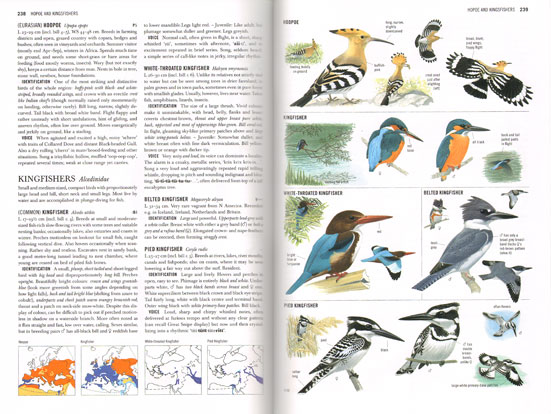
Sample page from Collins Bird Guide by Lars Svensson

You can look through this book and survey the varying geometry of wings, beaks and feet, from gliding gulls to hovering warblers, from seed-cracking finches to flesh-tearing owls, from tiny-toed swifts to wading egrets. The tool-kit of the common ancestor has become many tool-kits and evolution has been morally neutral as it has worked its multiplicative magic. The feet of the odd and endearing wallcreeper, Tichodroma muraria, are adapted to clinging onto vertical rock; the feet of eagles and owls are adapted to puncturing nerve-filled flesh. And presumably each species enjoys using its adaptation. A distinct psychology will accompany each distinct wing, beak and foot, because no organ can change in isolation: it is evolving within the environment of the body, influencing and influenced by other organs, in particular the brain.

But changes in the brain aren’t easily visible. If they were, some parts of evolution would be much less controversial: racial differences in human intelligence, for example. But races differ in other ways: in their attitudes to animals, for example. One generalization is that northern Europeans like listening to songbirds and southern Europeans like shooting them. So it’s not surprising that this book was originally published in Swedish as Fågelguiden, Europas och Medelhavsområdets fåglar i fält (1999). It would also be interesting to see the statistics of ornithological publishing in Europe. Those statistics will reflect genetic differences in the white European race, and so will readers’ reactions to the book.

My interest is partly aesthetic and mathematical, for example, and I quail at the thought of learning the differences between what bird-watchers call “little brown jobs”: the various kinds of warbler are hard enough to tell apart in pictures, let alone in the wild. But things can get even worse at night: Lars Svensson notes of Savi’s warbler, Locustella luscinioides, that “A possible confusion risk at distance and at night in S and C Europe is the mole-cricket” (“Warblers”, pg. 318). Birdsong and bird-cries are another aspect of ornitho-mathematics, but it’s hard to represent them in print: “kru-kih karra-kru-kih chivi trü chivi chih” (clamorous reed warbler, Acrocephalus stentoreus, pg. 322), “glipp-glipp-glipp” (common crossbill, Loxia curvirostra, pg. 386), “trrsh, trre-trre-trre-rrerrerre” (sand martin, Riparia riparia, pg. 258), “pyük…popopo…” (pygmy owl, Glaucidium passerinum, pg. 226), “brrreep, bip bip bip” (red phalarope, Phalaropus fulicarius, pg. 162), and so on.

In an electronic manual of ornithology, you’d be able to hear the songs, rather than imagine them, but electronic manuals, by offering more, in some ways offer less. Because the book has so many species to cover, it can’t describe any species in detail. So there are occasional fleeting comments like this:

Asian Desert Warbler, Sylvia nana V*** [= rare vagrant in northern Europe]… has the peculiar habit of sometimes “tailing” the Desert Wheatear [Oenanthe deserti] (“Warblers”, pg. 310-1)

The accompanying illustration shows a desert warbler standing under a small bush and peering out at a nearby wheatear. It’s anthropomorphic and anthropocentric to be amused by the behaviour, but ornithology is a human invention and humans don’t have to be purely scientific. I get a boy-racer thrill from another “V***” bird, the white-throated needletail, Hirundapus caudacutus:

Big, with heavy compact body, neckless, stub-tailed (shape somewhere between fat cigar and “flying barrel”). Flight impressively fast, the bird seems to draw easily away from other swifts (though these are still fast flyers!). (“Vagrants”, pg. 415)

That I would like to see. In the meantime, I have this book and the multiplex mutational mathematics it captures in pictures and words.

Flesh and Fear

Understanding Owls by Jemima Parry-JonesUnderstanding Owls: Biology, Management, Breeding, Training, Jemima Parry-Jones (David & Charles, 1998)

We come into the world ready for the world. And in more ways than one. We aren’t just born with sense-organs and a brain designed to use them: we’re born with instinctive likes and dislikes. That’s where phobias come from. The common ones, about heights or contamination or potentially dangerous animals, are based on things that we’ve been facing and surviving for millions of years. Or failing to survive, because we didn’t pay them sufficient attention or respect. Those who did pay sufficient attention and respect were those who had more offspring and passed down the relevant, phobogenic genes.

How precisely those genes encode fear is an interesting question. Are spiders and snakes written into our brains in some sense? Monkeys are instinctively afraid of snakes, for example, and though that fear has to be triggered by example, it is obviously there to be triggered. A mother-monkey apparently reacting with fear to a flower will not induce a fear of flowers in her offspring. But if she reacts with fear to a snake, she will induce a fear of snakes. Monkeys also have special warning-calls for birds of prey. Human beings have been too big for too long to be easily afraid of birds, but we were small enough once to be their prey and genetic memories may linger. That might help explain our fascination with birds of prey. But I don’t think owls are written into our brains the way spiders and snakes probably are.

They do trigger other instincts, however: their uncanny stare, their nocturnal lives, their loud calls and the silence of their flight all help explain why they’re psychologically special to human beings and part of myth and legend around the world. This book is a practical introduction to keeping owls as pets, not general guide, but it has lots of owls in it, so it has lots of uncanny and unblinking eyes too. And a lot of beauty: owls don’t often have elegant shapes, but they often have beautiful feathers. They’re also intelligent birds and can be trained to the hand rather like eagles and falcons. Unlike eagles and falcons, however, they generally hunt small ground-animals and at night, so “Hunting with Owls” is unrewarding and Jemima Parry-Jones gives it only two pages, one of which is mostly taken up by a photo of an eagle owl (Bubo sp.). But it’s an interesting addition to a short but interesting book, with lots of attractive pictures and practical advice.

Neuclid on the Block

How many blows does it take to demolish a wall with a hammer? It depends on the wall and the hammer, of course. If the wall is reality and the hammer is mathematics, you can do it in three blows, like this:

α’. Σημεῖόν ἐστιν, οὗ μέρος οὐθέν.
β’. Γραμμὴ δὲ μῆκος ἀπλατές.
γ’. Γραμμῆς δὲ πέρατα σημεῖα.

1. A point is that of which there is no part.
2. A line is a length without breadth.
3. The extremities of a line are points.

That is the astonishing, world-shattering opening in one of the strangest – and sanest – books ever written. It’s twenty-three centuries old, was written by an Alexandrian mathematician called Euclid (fl. 300 B.C.), and has been pored over by everyone from Abraham Lincoln to Bertrand Russell by way of Edna St. Vincent Millay. Its title is highly appropriate: Στοιχεῖα, or Elements. Physical reality is composed of chemical elements; mathematical reality is composed of logical elements. The second reality is much bigger – infinitely bigger, in fact. In his Elements, Euclid slipped the bonds of time, space and matter by demolishing the walls of reality with a mathematical hammer and escaping into a world of pure abstraction.

• Continue reading Neuclid on the Block

Paradigm Lost

Genius schmenius — genetics is sooooo 1950s:

But Paul Martin, a sociologist at the University of Sheffield, UK, is surprised that geneticists are still pursuing this line of research. “I think most people would say that’s the wrong paradigm, when most educational research suggests that social factors are incredibly important,” he says. “Strategically, this seems like something of a throwback.”

Chinese project probes the genetics of genius

See? Sense and decency. That’s because sociology is a proper science. Nearly as proper as psychoanalysis or astrology, in fact.

He Say, He Sigh, He Sow #9 and #10

“One of mighty union-smashing Maggie’s few big mistakes – along with increasing comprehensive education, letting third-world immigration and enforced multiculturalism rip, leaving the NHS and BBC ‘safe in our hands’, smashing the fisheries, selling out the Northern Irish Protestants, increasing welfarism, ending academic freedom and trying to push through the Poll Tax – was to be unfriendly to German reunification.” — Chris Brand, gFactor.


“Homosexual men are nature’s Petri dishes.” — Greg Cochran, West Hunter.

Flesh and Binary

It’s odd that probability theory is so counter-intuitive to human beings and so late-flowering in mathematics. Men have been gambling for thousands of years, but didn’t develop a good understanding of what happens when dice are rolled or coins are tossed until a few centuries ago. And an intuitive grasp of probability would have been useful long before gambling was invented. Our genes automatically equip us to speak, to walk and to throw, but they don’t equip us to understand by instinct why five-tails-in-a-row makes heads no more likely on the sixth coin-toss than it was on the first.

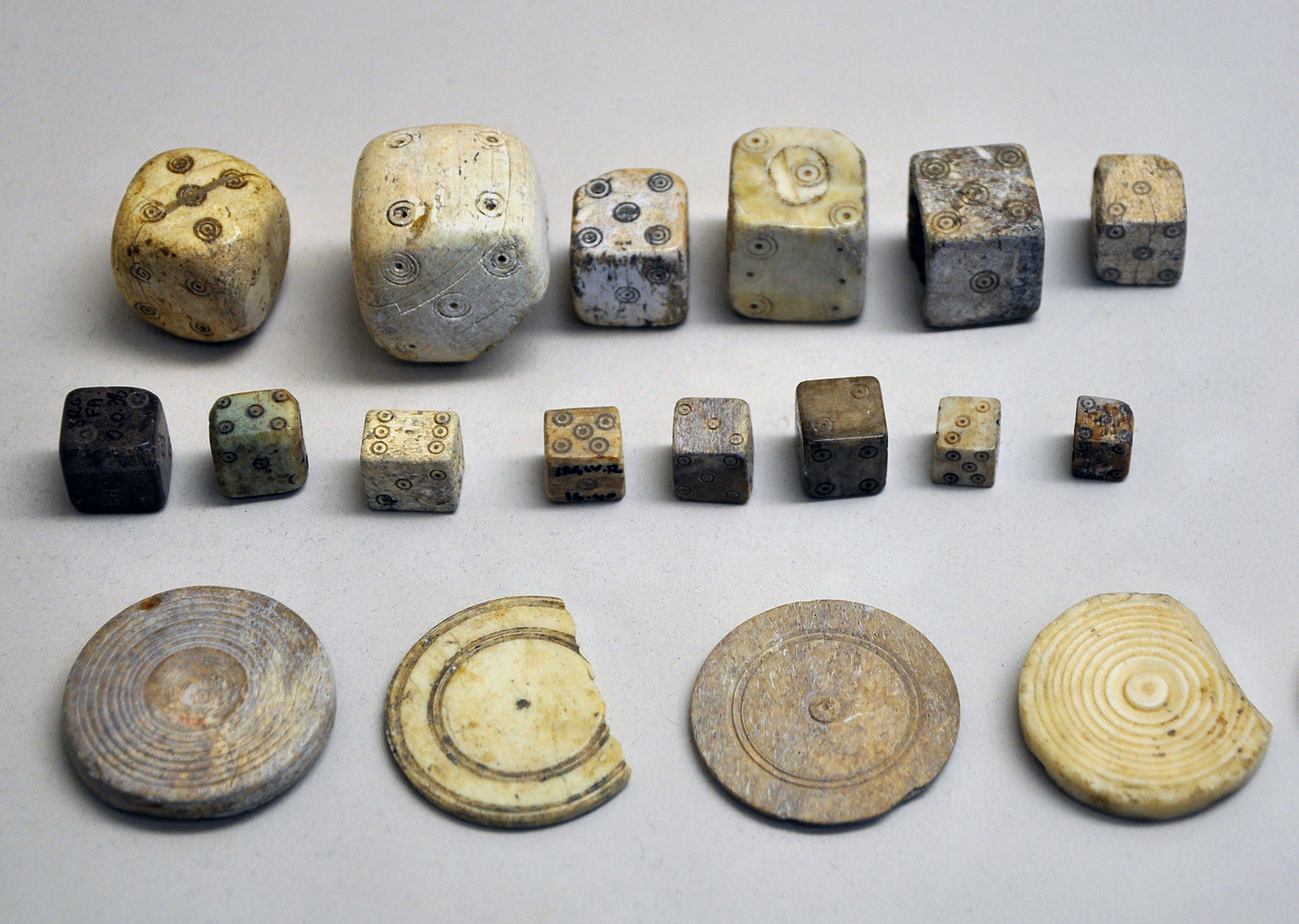
Dice from ancient Rome

Dice and gambling tokens from ancient Rome

Or to understand why five-boys-in-a-row makes the birth of a girl next time no more likely than it was during the first pregnancy (at least in theory). Boy/girl, like heads/tails, is a binary choice, so binary numbers are useful for understanding the probabilities of birth or coin-tossing. Questions like these are often asked to test knowledge of elementary probability:

1. Suppose a family have two children and the elder is a boy. What is the probability that both are boys?

2. Suppose a family have two children and at least one is a boy. What is the probability that both are boys?

People sometimes assume that the two questions are equivalent, but binary makes it clear that they’re not. If 1 represents a boy, 0 represents a girl and digit-order represents birth-order, the first question covers these possibilities: 10, 11. So the chance of both children being boys is 1/2 or 50%. The second question covers these possibilities: 10, 01, 11. So the chance of both children being boys is 1/3 = 33·3%. But now examine this question:

3. Suppose a family have two children and only one is called John. What is the probability that both children are boys?

That might seem the equivalent of question 2, but it isn’t. The name “John” doesn’t just identify the child as a boy, it identifies him as a unique boy, distinct from any brother he happens to have. Binary isn’t sufficient any more. So, while boy = 1, John = 2. The possibilities are: 20, 21, 02, 12. The chance of both children being boys is then 1/2 = 50%.

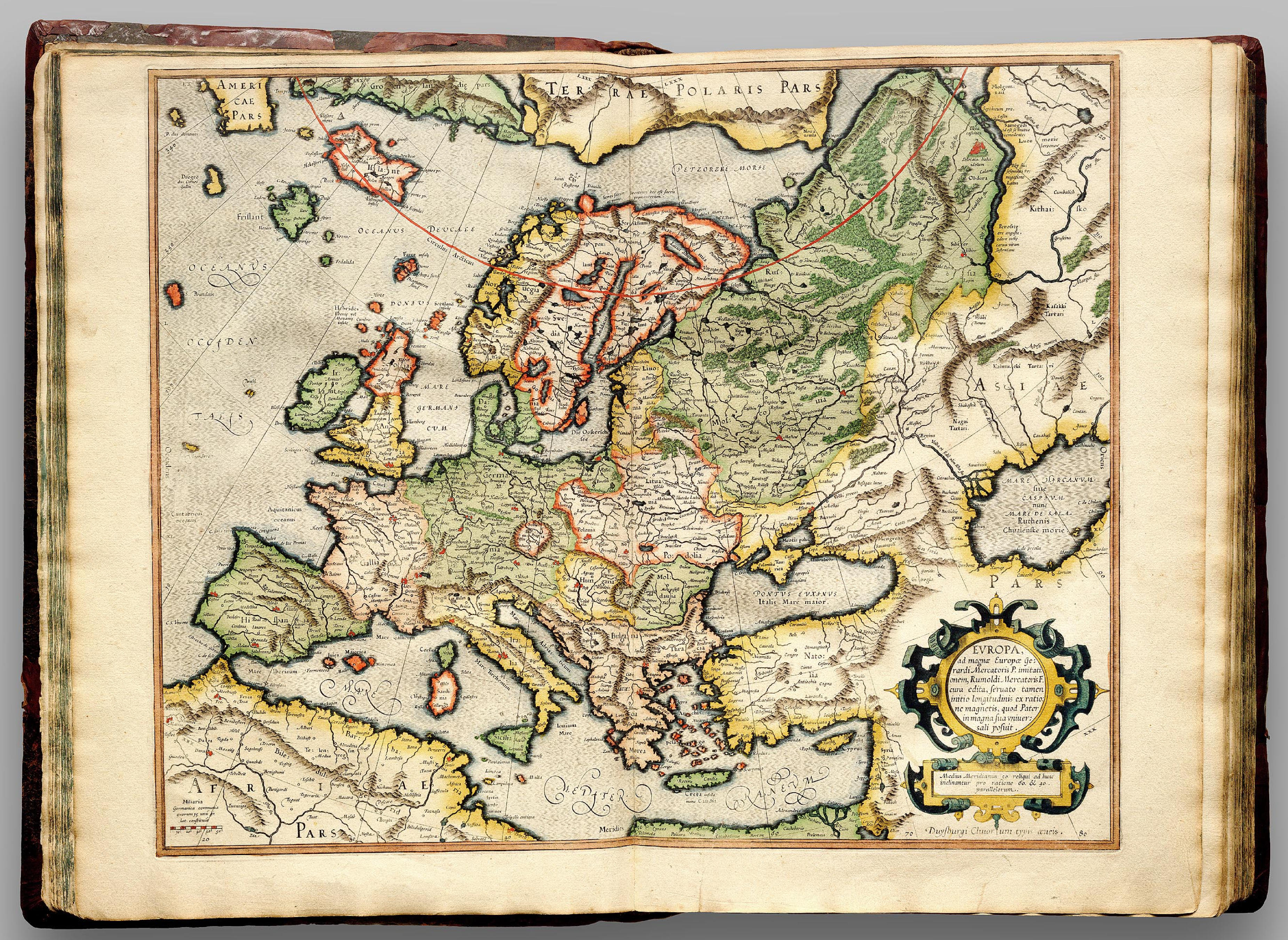
The three questions above are very simple, but I don’t think Archimedes or Euclid ever addressed the mathematics behind them. Perhaps they would have made mistakes if they had. I hope I haven’t, more than two millennia later. Perhaps the difficulty of understanding probability relates to the fact that it involves movement and change. The Greeks developed a highly sophisticated mathematics of static geometry, but did not understand projectiles or falling objects. When mathematicians began understood those in Renaissance Italy, they also began to understand the behaviour of dice, coins and cards. Ideas were on the move then and this new mathematics was obviously related to the rise of science: Galileo (1564-1642) is an important figure in both fields. But the maths and science can be linked with apparently distinct phenomena like Protestantism and classical music. All of these things began to develop in a “band of genius” identified by the American researcher Charles Murray. It runs roughly from Italy through France and Germany to Scotland: from Galileo through Beethoven and Descartes to David Hume.

Map of Europe from Mercator's Atlas Cosmographicae (1596)

Map of Europe from Mercator’s Atlas Cosmographicae (1596)

But how far is geography also biology? Having children is a form of gambling: the dice of DNA, shaken in testicle- and ovary-cups, are rolled in a casino run by Mother Nature. Or rather, in a series of casinos where different rules apply: the genetic bets placed in Africa or Europe or Asia haven’t paid off in the same way. In other words, what wins in one place may lose in another. Different environments have favoured different sets of genes with different effects on both bodies and brains. All human beings have many things in common, but saying that we all belong to the same race, the human race, is like saying that we all speak the same language, the human language. It’s a ludicrous and anti-scientific idea, however widely it may be accepted (and enforced) in the modern West.

Languages have fuzzy boundaries. So do races. Languages have dialects and accents, and so, in a sense, do races. The genius that unites Galileo, Beethoven and Hume may have been a particular genetic dialect spoken, as it were, in a particular area of Europe. Or perhaps it’s better to see European genius as a series of overlapping dialects. Testing that idea will involve mathematics and probability theory, and the computers that crunch the data about flesh will run on binary. Apparently disparate things are united by mathematics, but maths unites everything partly because it is everything. Understanding the behaviour of dice in the sixteenth century leads to understanding the behaviour of DNA in the twenty-first.

The next step will be to control the DNA-dice as they roll. China has already begun trying to do that using science first developed in the West. But the West itself is still in the thrall of crypto-religious ideas about equality and environment. These differences have biological causes: the way different races think about genetics, or persuade other races to think about genetics, is related to their genetics. You can’t escape genes any more than you can escape maths. But the latter is a ladder that allows us to see over the old genetic wall and glimpse the possibilities beyond it. The Chinese are trying to climb over the wall using super-computers; the West is still insisting that there’s nothing on the other side. Interesting times are ahead for both flesh and binary.

Appendix

1. Suppose a family have three children and the eldest is a girl. What is the probability that all three are girls?

2. Suppose a family have three children and at least one is a girl. What is the probability that all three are girls?

3. Suppose a family have three children and only one is called Joan. What is the probability that all three are girls?

The possibilities in the first case are: 000, 001, 010, 011. So the chance of three girls is 1/4 = 25%.

The possibilities in the second case are: 000, 001, 010, 011, 100, 101, 110. So the chance of three girls is 1/7 = 14·28%.

The possibilities in the third case are: 200, 201, 210, 211, 020, 021, 120, 121, 002, 012, 102, 112. So the chance of three girls is 3/12 = 1/4 = 25%.

Cat out of Bel

The Belgian symbolist Fernand Khnopff (1858-1921) is one of my favourite artists; Caresses (1896) is one of his most famous paintings. I like it a lot, though I find it more interesting than attractive. It’s a good example of Khnopff’s art in that the symbols are detached from clear meaning and float mysteriously in a world of their own. As Khnopff used to say: On n’a que soi “One has only oneself.” But he was clearly inspired by the story of Oedipus and the Sphinx, which is thousands of years old. Indeed, an alternate title for the painting is The Sphinx.

Caresses by Fernand Khnopff (click for larger image)

Caresses (1896) by Fernand Khnopff (click for larger image)

Even older than the Oedipus story is another link to the incestuous themes constantly explored by Khnopff, who was obsessed with his sister Marguerite and portrayed her again and again in his art. That’s her heavy-jawed face rubbing against the heavy-jawed face of the oddly nippled man, but Khnopff has given her the body of a large spotted felid. Many people misidentify it as a leopard, Panthera pardus. It’s actually a stranger and rarer felid: a cheetah, Acinonyx jubatus, which occupies a genus of its own among the great cats. And A. jubatus, unlike P. pardus, is an incestuous animal par excellence:

Cheetahs are very inbred. They are so inbred that genetically they are almost identical. The current theory is that they became inbred when a “natural” disaster dropped their total world population down to less than seven individual cheetahs – probably about 10,000 years ago. They went through a “Genetic Bottleneck”, and their genetic diversity plummeted. They survived only through brother-to-sister or parent-to-child mating. (Cheetah Extinction)

It must have been a large disaster. Perhaps cheetahs barely survived the inferno of a strike by a giant meteor, which would make them a cat out of hell. In 1896, they became a cat out of Bel too when Khnopff unveiled Caresses. Back then, biologists could not analyse DNA and discover the ancient history of a species like that. So how did Khnopff know the cheetah would add extra symbolism to his painting? Presumably he didn’t, though he must have recognized the cheetah as unique in other ways. All the same, I like to think that perhaps he had extra-rational access to scientific knowledge from the future. As he dove into the subconscious, Khnopff used symbols like weights to drag himself and his art deeper and darker. So perhaps far down, in the mysterious black, where time and space lose their meaning, he encountered a current of telepathy bearing the news of the cheetah’s incestuous nature. And that’s why he chose to give his sphinx-sister a cheetah’s body.

Guise and Molls

Front cover of Octopus: The Ocean’s Intelligent Invertebrate: A Natural History, by Jennifer A. Mather et al
Octopus: The Ocean’s Intelligent Invertebrate: A Natural History, Jennifer A. Mather, Roland C. Anderson and James B. Wood (Timber Press, 2010)

Who knows humanity who only human knows? We understand ourselves better by looking at other animals, but most other animals are not as remarkable as the octopus. These eight-armed invertebrates are much more closely related to oysters, limpets and ship-worms than they are to fish, let alone to mammals, but they lead fully active lives and seem fully conscious creatures of strong and even unsettling intelligence. Octopuses are molluscs, or “soft ones” (the same Latin root is found in “mollify”), with no internal skeleton and no rigid structure. Unlike some of their relatives, however, they do have brains. And more than one brain apiece, in a sense, because their arms are semi-autonomous. They don’t really have bodies, though, which is why they belong to the class known as Cephalopoda, or “head-foots”. Squid and cuttlefish, which are also covered in this book, are in the same class but do have more definite bodies, because they swim in open water rather than, like octopuses, living on the sea-floor. Another difference between the groups is that octopuses don’t have tentacles. Their limbs are too adaptable for that:

Because the arms are lined with suckers along the underside, octopuses can grasp anything. And since the animal has no skeleton, it can flex its arms and move them in any direction. The arms aren’t tentacles: tentacles are used for prey capture in squid, and these arms, with their flexibility, are used for many different actions. (“Introduction: Meet the Octopus”, pg. 15)

Octopuses would be interesting even if we humans knew ourselves perfectly. But one of the interesting things is whether they could be us, given time and opportunity. That is, could they become a tool-making, culture-forming, language-using species like us? After all, unlike most animals, they don’t use their limbs simply for locomotion or aggression: octopuses can manipulate objects with reasonably good precision. I used to think that one obstacle to their use of tools was their inability to make fine discriminations between shapes, because I remembered reading in the Oxford Book of the Mind (2004) that they couldn’t tell cubes from spheres. The explanation there was that their arms are too flexible and can’t, like rigid human arms and fingers, be used as fixed references to judge a manipulated object against. But this book says otherwise:

[The British researcher J.M.] Wells found that common octopuses can learn by touch and can tell a smooth cylinder from a grooved one or a cube from a sphere. They had much more trouble, though, telling a cube with smoothed-off corners from a sphere… They couldn’t learn to distinguish a heavy cylinder from a lighter one with the same surface texture. (ch. 9, “Intelligence”, pg. 130)

The problem isn’t simply that their arms are too flexible: their arms are also too independent:

Maybe the common octopus could not use information about the amount of sucker bending to send to the brain and calculate what an object’s shape would be, or calculate how much the arm bent to figure out weight. Octopuses have a lot of local control of arm movement: there are chains of ganglia [nerve-centres] down the arm and even sucker ganglia to control their individual actions. If local information is processed as reflexes in these ganglia, most touch and position information might not go to the brain and then couldn’t used in associative learning. (Ibid., pg. 130-1)

Or in manipulating an object with high precision and accuracy. An octopus can use rocks to make the entrance to its den narrower and less accessible to predators, but that’s a long way from being able to build a den. It is a start, however, and if man and other apes left the scene, octopuses would be a candidate to occupy his vacant throne one day. But I would give better odds to squirrels and to corvids (crow-like birds) than to cephalopods. Living in the sea may be a big obstacle to developing full, language-using, world-manipulating intelligence. The brevity of that life in the sea is definitely an obstacle: one deep-sea species of octopus may live over ten years, which would be “the longest for any octopus” (ch. 1, “In the Egg”). In shallower, warmer water, the Giant Pacific Octopus, Enteroctopus dofleini, is senescent at three or four years; some other species are senescent at a year or less. Males die after fertilizing the females, females die after guarding their eggs to hatching. In such an active, enquiring animal, senescence is an odd and unsettling process. A male octopus will stop eating, lose weight and start behaving in unnatural ways:

Senescent male giant Pacific octopuses and red octopuses are found crawling out of the water onto the beach [which is] likely to lead to attacks by gulls, crows, foxes, river otters or other animals… Senescent males have even been found in river mouths, going upstream to their eventual death from the low salinity of the fresh water. (ch. 10, “Sex at Last”, pg. 148)

Female octopuses stop eating and lose weight, but can’t behave unnaturally like that, because they have eggs to guard. Evolution keeps them on duty, because females that abandoned their eggs would leave fewer offspring. Meanwhile, males can become what might be called demob-demented: once they’ve mated, their behaviour doesn’t affect their offspring. In the deep sea, longer-lived species follow the same pattern of maturing, mating and senescing, but aren’t so much living longer as living slower. These short, or slow, lives wouldn’t allow octopuses to learn in the way human beings do. The most important part of human learning is, of course, central to this book and this review: language. Cephalopods don’t have good hearing, but they do have excellent sight and the ability to change the colour and patterning of their skin. So Arthur C. Clarke (1917-2008) suggested in his short-story “The Shining Ones” (1962) that they could become autodermatographers, or “self-skin-writers”, speaking with their skin. The fine control necessary for language is already there:

Within the outer layers of octopus skin are many chromatophores – sacs that contain yellow, red or brown pigment within an elastic container. When a set of muscles pulls a chromatophore sac out to make it bigger, its color is allowed to show. When the muscles relax, the elastic cover shrinks the sac and the color seems to vanish. A nerve connects to each set of chromatophore muscles, so that nervous signals from the brain can cause an overall change in color in less than 100 milliseconds at any point in the body… When chromatophores are contracted, there is another color-producing layer beneath them. A layer of reflecting cells, white leucophores or green iridophores depending on the area of the body, produces color in a different way: Like a hummingbird’s feathers, which only reflect color at a specific angle, these cells have no pigment themselves but reflect all or some of the colors in the environment back to the observer… (ch. 6, “Appearances”, pg. 89)

“Observer” is the operative word: changes in skin-colour, -texture and -shape are a way to fool the eyes and brains of predators. The molluscan octopus can adopt many guises: it can look like rocks, sand or seaweed. But the champion changer is Thaumoctopus mimicus, which lives in shallow waters off Indonesia. Its generic name means “marvel-octopus” and its specific name means “mimicking”. And its modes of mimicry are indeed marvellous:

This octopus can flatten its body and move across the sand, using its jet for propulsion and trailing its arms, with the same undulating motion as a flounder or sole. It can swim above the mud with its striped arms outspread, looking like a venomous lionfish or jellyfish. It can narrow the width of its combined slender body and arms to look like a striped sea-snake. And it may be able to carry out other mimicries we have yet to see. Particularly impressive about the mimic octopus is that not only can it take on the appearance of another animal but it can also assume the behaviour of that animal. (ch. 7, “Not Getting Eaten”, pg. 109)

But octopuses also change their skin to fool the eyes and brains of prey. The “Passing Cloud” may sound like a martial arts technique, but it’s actually a molluscan hunting technique. And it’s produced entirely within the skin, as the authors of this book observed after videotaping octopuses “in an outdoor saltwater pond on Coconut Island”, Hawaii:

Back in the lab and replaying the video frame by frame, we found how complex the Passing Cloud display is. The Passing Cloud formed on the posterior mantle, flowed forward past the head and became more of a bar in shape, then condensed into a small blob below the head. The shape then enlarged and moved out onto the outstretched mantle, flowing off the anterior mantle and disappearing. (ch. 6, “Appearances”, pg. 93)

It’s apparently used to startle crabs that have frozen and are hard to see. When the crab moves in response to the Passing Cloud, the octopus can grab it and bite it to death with its “parrotlike beak”. They “also use venom from the posterior salivary gland that can paralyze prey and start digestion” (ch. 3, “Making a Living”, pg. 62). But a bite from an octopus can kill much bigger things than crabs:

Blue-ringed octopuses, the four species that are members of the genus Hapalochlaena, display stunning coloration. Like other spectacular forms of marine and terrestrial life, they have vivid color patterns as a warning signal. These small octopuses pose a serious threat to humans. They pack a potent venomous bite that makes them among the most dangerous creatures on Earth. Their venom, the neurotoxin tetrodotoxin (TTX) described by Scheumack et al in 1978, is among the few cephalopod venoms that can affect humans. A variety of marine and terrestrial animals produce TTX [including] poisonous arrow frogs [untrue, according to Wikipedia, which refers to “toads of the genus Atelopus” instead], newts, and salamanders… but the classic example, and what the compound is named after, is the tetraodon puffer fish. The puffers are what the Japanese delicacy fufu is made from. If the fish is prepared correctly, extremely small amounts of TTX cause only a tingling or numbing sensation. But if it is prepared incorrectly, the substance kills by blocking sodium channels on the surface of nerve membranes. A single milligram, 1/2500 of the weight of a penny, will kill an adult human… Even in the minuscule doses delivered by a blue-ringed octopus’s nearly unnoticeable bite, TTX can shut down the nervous system of a large person in just minutes; the risk of death is very high. (“Postscript: Keeping a Captive Octopus”, pg. 170)

It’s interesting to see how often toxicity has evolved among animals. Puffer-fish and blue-ringed octopuses may get their toxin from bacteria or algae, while poison-arrow frogs get the even more potent batrachotoxin from eating beetles, as do certain species of bird on New Guinea. Accordingly, toxicity is found in animals with no legs, two legs, four legs, six legs, eight legs and ten legs (if squid have a poisonous bite too). Evolution has found similar solutions to similar problems in unrelated groups, because evolution is a way of exploring space: that of possibility. And it is all, in one way or another, chemical possibility. Blue-ringed octopuses have found a chemical solution to hunting and evading predators. Other cephalopods have found a chemical solution to staying afloat:

Another substance used to keep plankton buoyant is ammonia, again lighter than water. Ammonia is primarily used by the large squid species, including the giant squid (Architeuthis dux), in their tissues, although the glass squid (Cranchia scabra) concentrates ammonia inside a special organ. The ammonia in the tissues of these squid makes the living or dead animal smell pungent. Dead or dying squid on the ocean’s surface smell particularly foul. The ammonia in these giant squid also makes them inedible – there will be no giant squid calamari. (ch. 2, “Drifting and Settling”)

Other deep-sea solutions from chemical possibility-space include bioluminescence. This is used by a cephalopod that was little-known until it was used as a metaphor for the greedy behaviour of Goldman-Sachs and other bankers:

…although they do not have an ink-sac, vampire squid have a bioluminescent mucus that they can jet out, presumably at the approach of a potential predator, likely distracting it in the same way as a black ink jet for a shallow-water octopus or squid. Second, they have a pair of light organs at the base of the fins with a moveable flap that can be used as a shutter. These could act as a searchlight, turning a beam of light onto a potential prey species that tactile sensing from the [tentacle-like] filaments has picked up. And third, they have a huge number of tiny photophores all over the body and arms. These could work two ways: they might give a general dim lighting as a visual counter-shading. With even a little light from above, a dark animal would stand out in silhouette from below. With low-level light giving just enough illumination, it could blend in. And the second function of these lights has been seen by ROV [remotely operated underwater vehicle] viewers: a disturbed vampire squid threw its arms back over its body and flashed the lights on the arms, which should startle any creature. (ch. 11, “The Rest of the Group”, pg. 161)

I was surprised to learn that vampire squid can be prey, but in fact their scientific name – Vampyroteuthis infernalis – is almost as big as they are: “for those imagining that vampire squid are monsters of the deep, they are tiny – only up to 5 in. (13 cm) long” (ibid., pg. 162). Even less-studied, even deeper-living, and even longer-named is Vulcanoctopus hydrothermalis, the “specialized deep-sea vent octopus”, which is “found, as its name suggests, near deep-sea hydrothermal vents way down at 6000 ft. (2000 m)” (“Introduction: Meet the Octopus”, pg. 15). Life around hydrothermal vents, or mini-volcanoes on the ocean floor, is actually independent of the sun, because the food-pyramid there is based on bacteria that live on the enriched water flowing from the vents. So an asteroid strike or mega-volcano that clouded the skies and stopped photosynthesis wouldn’t directly affect that underwater economy. But vents sometimes go extinct and Vulcanoctopus hydrothermalis must lead a precarious existence.

I’d like to know more about the species, but it’s one interesting octopus among many. This book is an excellent introduction to this eight-limbed group and cousins like the ten-limbed squid and the sometimes ninety-limbed nautiluses. It will guide you through all aspects of their lives and behaviour, from chromatophores, detachable arms and jet propulsion to siphuncles, glue-glands and the hectocotylus, the “modified mating arm” of male cephalopods that was once thought to be a parasitic worm. That mystery has been solved, but lots more remain. Octopus: The Ocean’s Intelligent Invertebrate should appeal to any thalassophile who shares the enthusiasm of H.P. Lovecraft or Arthur C. Clarke for a group that has evolved high intelligence without ever leaving the ocean.