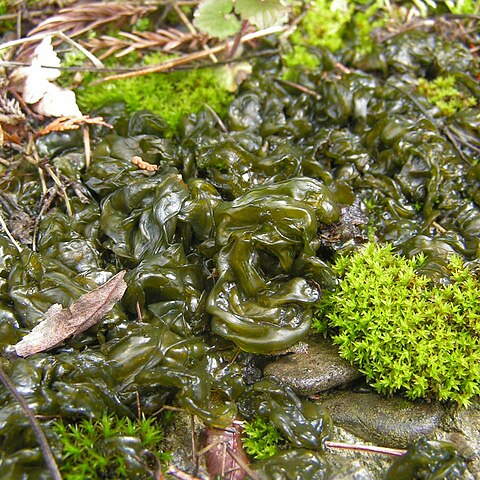
Nostocalgie de la Boue

The colonial cyanobacterium Nostoc commune (image from Wikipedia)


Post-Performative Post-Scriptum…

The title of this incendiary intervention is a reference to the French phrase nostalgie de la boue, literally meaning “nostalgia for mud” and referring to a longing for social or sexual degradation.

Green Seen


When you stare at the cross for at least 30 seconds, you see three illusions:

• A gap running around the circle of lilac discs;
• A green disc running around the circle of lilac discs in place of the gap; and
• The green disc running around on the grey background, with the lilac discs having disappeared in sequence. — Lilac Chaser, Wikipedia


Elsewhere Other-Accessible…

Troxler’s fading at Wikipedia

Bored Bard

Pol. How say you by that? Still harping on my daughter: yet he knew me not at first; he said I was a Fishmonger: he is farre gone, farre gone: and truly in my youth, I suffred much extreamity for loue: very neere this. Ile speake to him againe. What do you read my Lord?

Ham. Words, words, words. — Hamlet (c. 1600), Act 2, Scene 2

Vulgar Tongue

Viper’s bugloss, Echium vulgare (L 1753)


Also known as: blue devil, blue thistle, blueweed, snake flower; Gewöhnlicher Natternkopf, Blaue Natternkopf; vipérine commune, vipérine vulgaire, serpentine; viperina azzurra; viborera, viperina; gwiberlys; żmijowiec zwyczajny; naderles; ლურჯი ძირწითელა; 蓝蓟; синяк обыкновенный; etc.

Pards Paired

Two leopards at the Central Kalahari Game Reserve, Botswana

(viâ The In-Terms-Inator)


Post-Performative Post-Scriptum…

pard, n.¹ A panther, a leopard; (also) an animal resembling these. Now archaic.
pard, n.² A partner, esp. a male partner; a comrade, a mate.

Oxford English Dictionary

Floral Hex

I knew what the Sempervivum plant looked like:

Sempervivum × giuseppii (from Wikipedia)


But I’d never seen the flowers until a few days ago:

Sempervivum flowers (from Gardener’s Path)


They remind me of Clark Ashton Smith’s “The Demon of the Flower”:

Not as the plants and flowers of Earth, growing peacefully beneath a simple sun, were the blossoms of the planet Lophai. Coiling and uncoiling in double dawns; tossing tumultuously under vast suns of jade green and balas-ruby orange; swaying and weltering in rich twilights, in aurora-curtained nights, they resembled fields of rooted serpents that dance eternally to an other-worldly music. — “The Demon of the Flower”, Astounding Stories, Dec 1933