
“The IAE [International Art English] of the French press release is almost too perfect: It is written, we can only imagine, by French interns imitating American interns imitating American academics imitating French academics.” — “International Art English”, Alix Rule and David Levine
Clock around the Rock
If you like minimalism, you should like binary. There is unsurpassable simplicity and elegance in the idea that any number can be reduced to a series of 1’s and 0’s. It’s unsurpassable because you can’t get any simpler: unless you use finger-counting, two symbols are the minimum possible. But with those two – a stark 1 and 0, true and false, yin and yang, sun and moon, black and white – you can conquer any number you please. 2 = 10[2]. 5 = 101. 100 = 1100100. 666 = 1010011010. 2013 = 11111011101. 9^9 = 387420489 = 10111000101111001000101001001. You can also perform any mathematics you please, from counting sheep to modelling the evolution of the universe.

1 + 0 = ∞
But one disadvantage of binary, from the human point of view, is that numbers get long quickly: every doubling in size adds an extra digit. You can overcome that disadvantage using octal or hexadecimal, which compress blocks of binary into single digits, but those number systems need more symbols: eight and sixteen, as their names suggest. There’s an elegance there too, but binary goes masked, hiding its minimalist appeal beneath apparent complexity. It doesn’t need to wear a mask for computers, but human beings can appreciate bare binary too, even with our weak memories and easily tiring nervous systems. I especially like minimalist binary when it’s put to work on those most maximalist of numbers: the primes. You can compare integers, or whole numbers, to minerals. Some are like mica or shale, breaking readily into smaller parts, but primes are like granite or some other ultra-hard, resistant rock. In other words, some integers are easy to divide by other integers and some, like the primes, are not. Compare 256 with 257. 256 = 2^8, so it’s divisible by 128, 64, 32, 16, 8, 4, 2 and 1. 257 is a prime, so it’s divisible by nothing but itself and 1. Powers of two are easy to calculate and, in binary, very easy to represent:
2^0 = 1 = 1
2^1 = 2 = 10[2]
2^2 = 4 = 100
2^3 = 8 = 1000
2^4 = 16 = 10000
2^5 = 32 = 100000
2^6 = 64 = 1000000
2^7 = 128 = 10000000
2^8 = 256 = 100000000
Primes are the opposite: hard to calculate and usually hard to represent, whatever the base:
02 = 000010[2]
03 = 000011
05 = 000101
07 = 000111
11 = 001011
13 = 001101
17 = 010001
19 = 010011
23 = 010111
29 = 011101
31 = 011111
37 = 100101
41 = 101001
43 = 101011
Maximalist numbers, minimalist base: it’s a potent combination. But “brimes”, or binary primes, nearly all have one thing in common. Apart from 2, a special case, each brime must begin and end with 1. For the digits in-between, the God of Mathematics seems to be tossing a coin, putting 1 for heads, 0 for tails. But sometimes the coin will come up all heads or all tails: 127 = 1111111[2] and 257 = 100000001, for example. Brimes like that have a stark simplicity amid the jumble of 83 = 1010011[2], 113 = 1110001, 239 = 11101111, 251 = 11111011, 277 = 100010101, and so on. Brimes like 127 and 257 are also palindromes, or the same reading in both directions. But less simple brimes can be palindromes too:
73 = 1001001
107 = 1101011
313 = 100111001
443 = 110111011
1193 = 10010101001
1453 = 10110101101
1571 = 11000100011
1619 = 11001010011
1787 = 11011111011
1831 = 11100100111
1879 = 11101010111
But, whether they’re palindromes or not, all brimes except 2 begin and end with 1, so they can be represented as rings, like this:
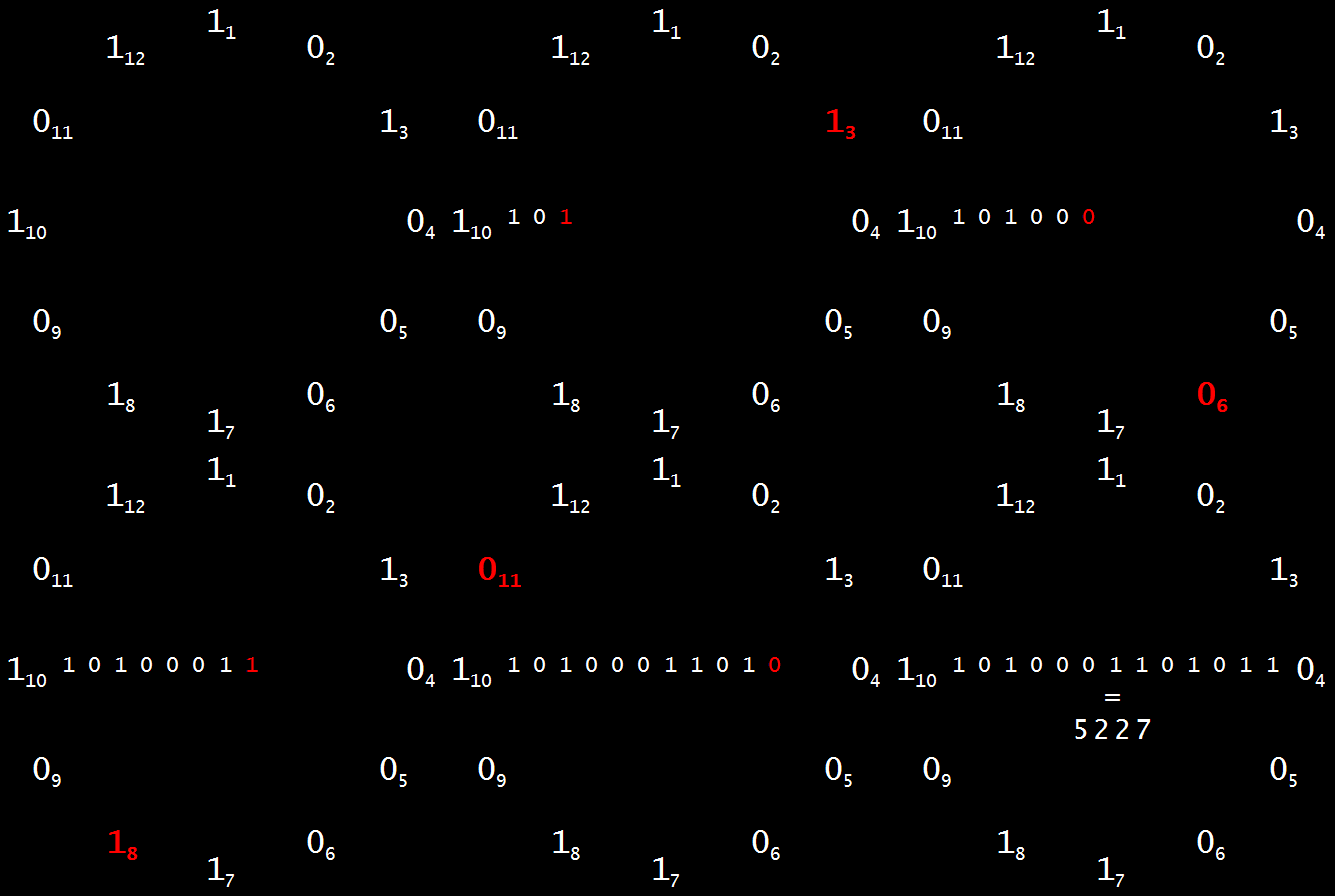
Those twelve bits, or binary digits, actually represent the thirteen bits of 5227 = 1,010,001,101,011. Start at twelve o’clock (digit 1 of the prime) and count clockwise, adding 1’s and 0’s till you reach 12 o’clock again and add the final 1. Then you’ve clocked around the rock and created the granite of 5227, which can’t be divided by any integers but itself and 1. Another way to see the brime-ring is as an Ouroboros (pronounced “or-ROB-or-us”), a serpent or dragon biting its own tail, like this:
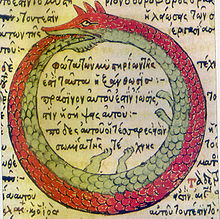
Alchemical Ouroboros (1478)
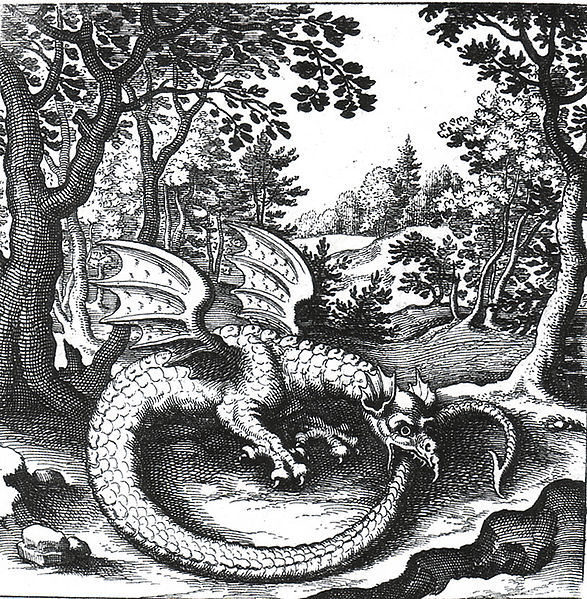
Another alchemical Ouroboros (1599)
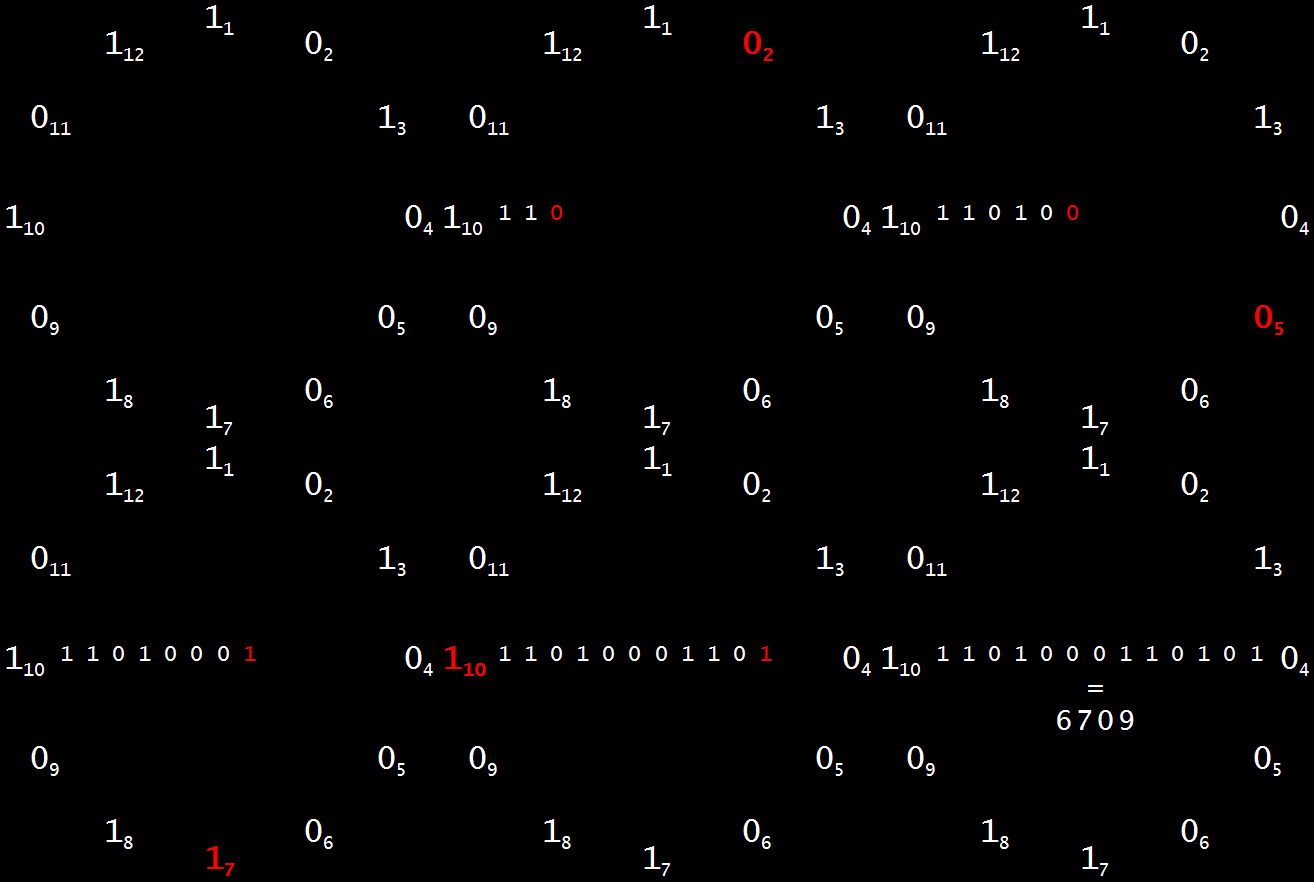
But you don’t have to start clocking around the rock at midday or midnight. Take the Ouroboprime of 5227 and start at eleven o’clock (digit 12 of the prime), adding 1’s and 0’s as you move clockwise. When you’ve clocked around the rock, you’ll have created the granite of 6709, another prime:
Other Ouroboprimes produce brimes both clockwise and anti-clockwise, like 47 = 101,111.
Clockwise
101,111 = 47
111,011 = 59
111,101 = 61
Anti-Clockwise
111,101 = 61
111,011 = 59
101,111 = 47
If you demand the clock-rocked brime produce distinct primes, you sometimes get more in one direction than the other. Here is 151 = 10,010,111:
Clockwise
10,010,111 = 151
11,100,101 = 229
Anti-Clockwise
11,101,001 = 233
11,010,011 = 211
10,100,111 = 167
10,011,101 = 157
The most productive brime I’ve discovered so far is 2,326,439 = 1,000,110,111,111,110,100,111[2], which produces fifteen distinct primes:
Clockwise (7 brimes)
1,000,110,111,111,110,100,111 = 2326439
1,100,011,011,111,111,010,011 = 3260371
1,110,100,111,000,110,111,111 = 3830207
1,111,101,001,110,001,101,111 = 4103279
1,111,110,100,111,000,110,111 = 4148791
1,111,111,010,011,100,011,011 = 4171547
1,101,111,111,101,001,110,001 = 3668593
Anti-Clockwise (8 brimes)
1,110,010,111,111,110,110,001 = 3768241
1,100,101,111,111,101,100,011 = 3342179
1,111,111,011,000,111,001,011 = 4174283
1,111,110,110,001,110,010,111 = 4154263
1,111,101,100,011,100,101,111 = 4114223
1,111,011,000,111,001,011,111 = 4034143
1,110,110,001,110,010,111,111 = 3873983
1,000,111,001,011,111,111,011 = 2332667
Appendix: Deciminimalist Primes
Some primes in base ten use only the two most basic symbols too. That is, primes like 11[10], 101[10], 10111[10] and 1011001[10] are composed of only 1’s and 0’s. Furthermore, when these numbers are read as binary instead, they are still prime: 11[2] = 3, 101[2] = 5, 10111[2] = 23 and 1011001[2] = 89. Here is an incomplete list of these deciminimalist primes:
11[10] = 1,011[2]; 11[2] = 3[10] is also prime.
101[10] = 1,100,101[2]; 101[2] = 5[10] is also prime.
10,111[10] = 10,011,101,111,111[2]; 10,111[2] = 23[10] is also prime.
101,111[10] = 11,000,101,011,110,111[2]; 101,111[2] = 47[10] is also prime.
1,011,001[10] = 11,110,110,110,100,111,001[2]; 1,011,001[2] = 89[10] is also prime.
1,100,101[10] = 100,001,100,100,101,000,101[2]; 1,100,101[2] = 101[10] is also prime.
10,010,101[10] = 100,110,001,011,110,111,110,101[2]; 10,010,101[2] = 149[10] is also prime.
10,011,101[10] = 100,110,001,100,000,111,011,101[2]; 10,011,101[2] = 157[10] is also prime.
10,100,011[10] = 100,110,100,001,110,100,101,011[2]; 10,100,011[2] = 163[10] is also prime.
10,101,101[10] = 100,110,100,010,000,101,101,101[2]; 10,101,101[2] = 173[10] is also prime.
10,110,011[10] = 100,110,100,100,010,000,111,011[2]; 10,110,011[2] = 179[10] is also prime.
10,111,001[10] = 100,110,100,100,100,000,011,001[2].
11,000,111[10] = 101,001,111,101,100,100,101,111[2]; 11,000,111[2] = 199[10] is also prime.
11,100,101[10] = 101,010,010,101,111,111,000,101[2]; 11,100,101[2] = 229[10] is also prime.
11,110,111[10] = 101,010,011,000,011,011,011,111[2].
11,111,101[10] = 101,010,011,000,101,010,111,101[2].
100,011,001[10] = 101,111,101,100,000,101,111,111,001[2]; 100,011,001[2] = 281[10] is also prime.
100,100,111[10] = 101,111,101,110,110,100,000,001,111[2].
100,111,001[10] = 101,111,101,111,001,001,010,011,001[2]; 100,111,001[2] = 313[10] is also prime.
101,001,001[10] = 110,000,001,010,010,011,100,101,001[2].
101,001,011[10] = 110,000,001,010,010,011,100,110,011[2]; 101,001,011[2] = 331[10] is also prime.
101,001,101[10] = 110,000,001,010,010,011,110,001,101[2].
101,100,011[10] = 110,000,001,101,010,100,111,101,011[2].
101,101,001[10] = 110,000,001,101,010,110,111,001,001[2].
101,101,111[10] = 110,000,001,101,010,111,000,110,111[2]; 101,101,111[2] = 367[10] is also prime.
101,110,111[10] = 110,000,001,101,101,000,101,011,111[2].
101,111,011[10] = 110,000,001,101,101,010,011,100,011[2]; 101,111,011[2] = 379[10] is also prime.
101,111,111[10] = 110,000,001,101,101,010,101,000,111[2]; 101,111,111[2] = 383[10] is also prime.
110,010,101[10] = 110,100,011,101,001,111,011,110,101[2].
110,100,101[10] = 110,100,011,111,111,111,010,000,101[2]; 110,100,101[2] = 421[10] is also prime.
110,101,001[10] = 110,100,100,000,000,001,000,001,001[2].
110,110,001[10] = 110,100,100,000,010,010,100,110,001[2]; 110,110,001[2] = 433[10] is also prime.
110,111,011[10] = 110,100,100,000,010,100,100,100,011[2]; 110,111,011[2] = 443[10] is also prime.
I Say, I Sigh, I Sow #6
Saying “I don’t like maths” is like saying “I don’t eat carbon.”
Flesh and Binary
It’s odd that probability theory is so counter-intuitive to human beings and so late-flowering in mathematics. Men have been gambling for thousands of years, but didn’t develop a good understanding of what happens when dice are rolled or coins are tossed until a few centuries ago. And an intuitive grasp of probability would have been useful long before gambling was invented. Our genes automatically equip us to speak, to walk and to throw, but they don’t equip us to understand by instinct why five-tails-in-a-row makes heads no more likely on the sixth coin-toss than it was on the first.
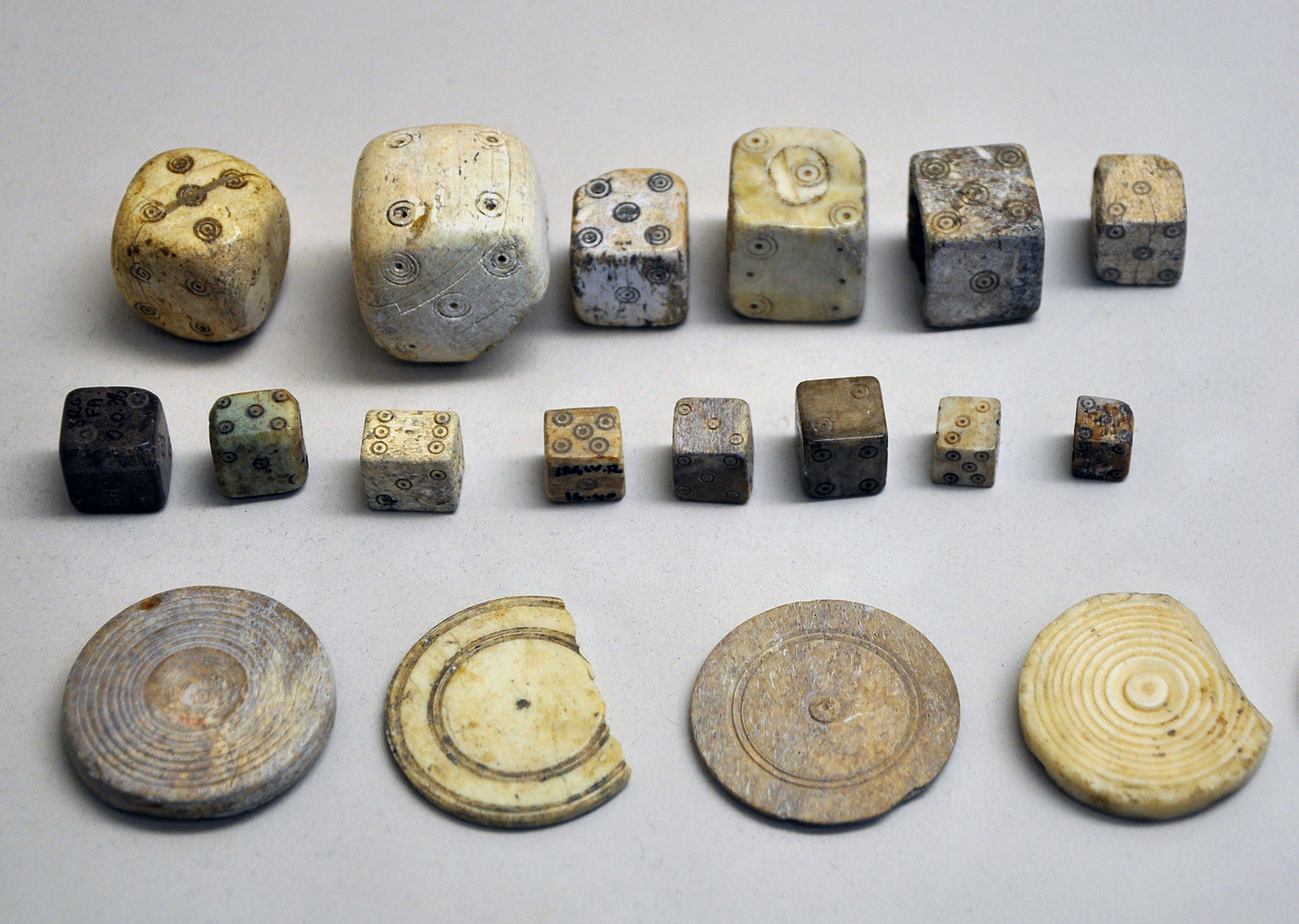
Dice and gambling tokens from ancient Rome
Or to understand why five-boys-in-a-row makes the birth of a girl next time no more likely than it was during the first pregnancy (at least in theory). Boy/girl, like heads/tails, is a binary choice, so binary numbers are useful for understanding the probabilities of birth or coin-tossing. Questions like these are often asked to test knowledge of elementary probability:
1. Suppose a family have two children and the elder is a boy. What is the probability that both are boys?
2. Suppose a family have two children and at least one is a boy. What is the probability that both are boys?
People sometimes assume that the two questions are equivalent, but binary makes it clear that they’re not. If 1 represents a boy, 0 represents a girl and digit-order represents birth-order, the first question covers these possibilities: 10, 11. So the chance of both children being boys is 1/2 or 50%. The second question covers these possibilities: 10, 01, 11. So the chance of both children being boys is 1/3 = 33·3%. But now examine this question:
3. Suppose a family have two children and only one is called John. What is the probability that both children are boys?
That might seem the equivalent of question 2, but it isn’t. The name “John” doesn’t just identify the child as a boy, it identifies him as a unique boy, distinct from any brother he happens to have. Binary isn’t sufficient any more. So, while boy = 1, John = 2. The possibilities are: 20, 21, 02, 12. The chance of both children being boys is then 1/2 = 50%.
The three questions above are very simple, but I don’t think Archimedes or Euclid ever addressed the mathematics behind them. Perhaps they would have made mistakes if they had. I hope I haven’t, more than two millennia later. Perhaps the difficulty of understanding probability relates to the fact that it involves movement and change. The Greeks developed a highly sophisticated mathematics of static geometry, but did not understand projectiles or falling objects. When mathematicians began understood those in Renaissance Italy, they also began to understand the behaviour of dice, coins and cards. Ideas were on the move then and this new mathematics was obviously related to the rise of science: Galileo (1564-1642) is an important figure in both fields. But the maths and science can be linked with apparently distinct phenomena like Protestantism and classical music. All of these things began to develop in a “band of genius” identified by the American researcher Charles Murray. It runs roughly from Italy through France and Germany to Scotland: from Galileo through Beethoven and Descartes to David Hume.
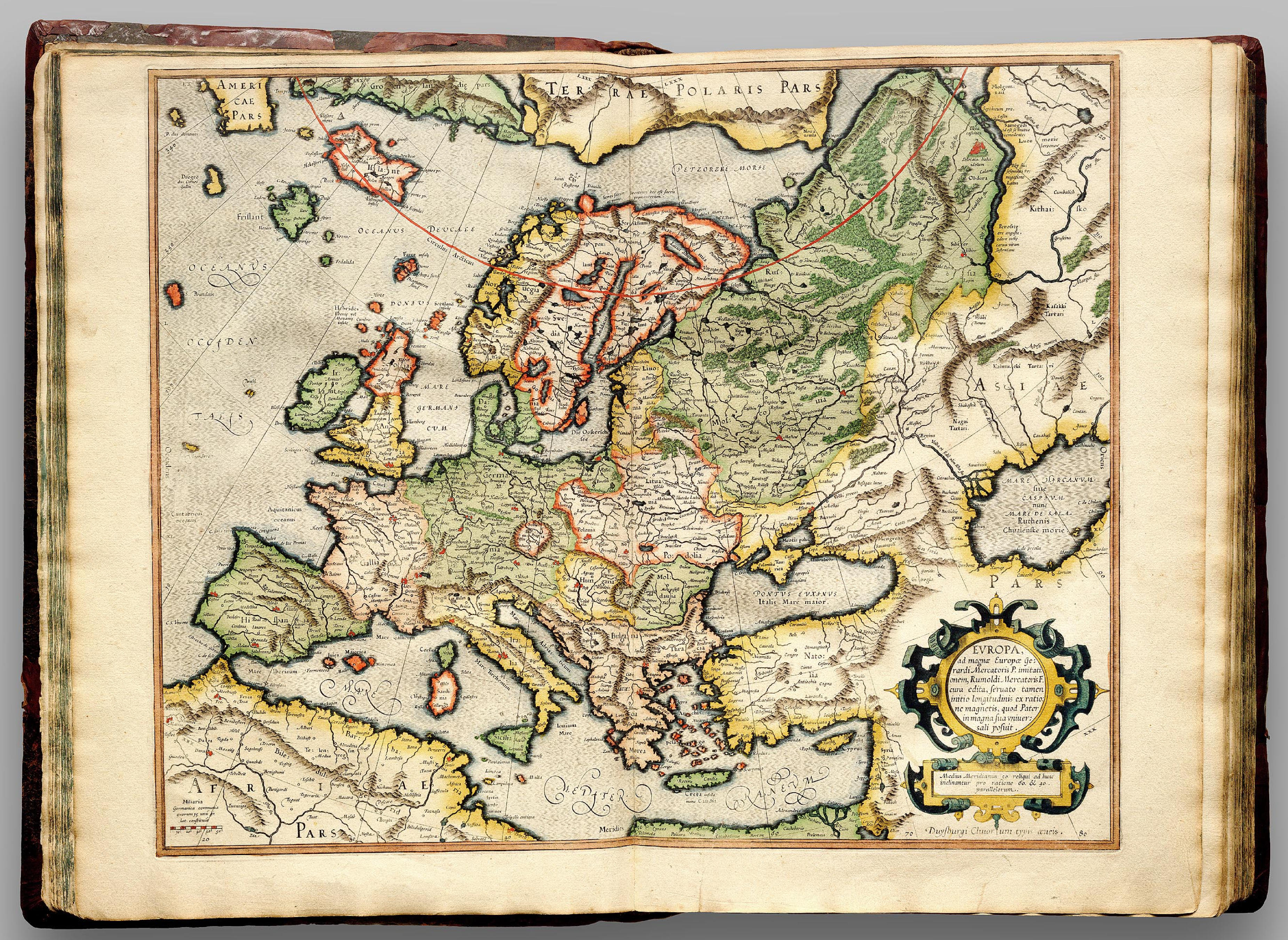
Map of Europe from Mercator’s Atlas Cosmographicae (1596)
But how far is geography also biology? Having children is a form of gambling: the dice of DNA, shaken in testicle- and ovary-cups, are rolled in a casino run by Mother Nature. Or rather, in a series of casinos where different rules apply: the genetic bets placed in Africa or Europe or Asia haven’t paid off in the same way. In other words, what wins in one place may lose in another. Different environments have favoured different sets of genes with different effects on both bodies and brains. All human beings have many things in common, but saying that we all belong to the same race, the human race, is like saying that we all speak the same language, the human language. It’s a ludicrous and anti-scientific idea, however widely it may be accepted (and enforced) in the modern West.
Languages have fuzzy boundaries. So do races. Languages have dialects and accents, and so, in a sense, do races. The genius that unites Galileo, Beethoven and Hume may have been a particular genetic dialect spoken, as it were, in a particular area of Europe. Or perhaps it’s better to see European genius as a series of overlapping dialects. Testing that idea will involve mathematics and probability theory, and the computers that crunch the data about flesh will run on binary. Apparently disparate things are united by mathematics, but maths unites everything partly because it is everything. Understanding the behaviour of dice in the sixteenth century leads to understanding the behaviour of DNA in the twenty-first.
The next step will be to control the DNA-dice as they roll. China has already begun trying to do that using science first developed in the West. But the West itself is still in the thrall of crypto-religious ideas about equality and environment. These differences have biological causes: the way different races think about genetics, or persuade other races to think about genetics, is related to their genetics. You can’t escape genes any more than you can escape maths. But the latter is a ladder that allows us to see over the old genetic wall and glimpse the possibilities beyond it. The Chinese are trying to climb over the wall using super-computers; the West is still insisting that there’s nothing on the other side. Interesting times are ahead for both flesh and binary.
Appendix
1. Suppose a family have three children and the eldest is a girl. What is the probability that all three are girls?
2. Suppose a family have three children and at least one is a girl. What is the probability that all three are girls?
3. Suppose a family have three children and only one is called Joan. What is the probability that all three are girls?
The possibilities in the first case are: 000, 001, 010, 011. So the chance of three girls is 1/4 = 25%.
The possibilities in the second case are: 000, 001, 010, 011, 100, 101, 110. So the chance of three girls is 1/7 = 14·28%.
The possibilities in the third case are: 200, 201, 210, 211, 020, 021, 120, 121, 002, 012, 102, 112. So the chance of three girls is 3/12 = 1/4 = 25%.
Performativizing Papyrocentricity #9
Papyrocentric Performativity Presents:
Booty and the Beasts — For Your Eyes Only, Ian Fleming (1960)
Flowering on Fumes — Collecting Cigarette & Trade Cards, Gordon Howsden (New Cavendish Books, 1995)
Passion for Parts — Dear Popsy: Collected Postcards of a Private Schoolboy to His Father, E. Bishop-Potter, illustrated by Paul Cox (Penguin, 1985)
Yes, We Can Shit — Why Your Five-Year-Old Could Not Have Done That: Modern Art Explained, Susie Hodge (Thames and Hudson, 2012)
Or Read a Review at Random: RaRaR
Vibrancy and Vileness
Every so often you come across a news-story that isn’t just horrifying in itself but offers a sickening glimpse into the wilful neglect and toxicity of a so-called “civilized” state and its so-called “justice” system. Here’s a story like that from Scandinavia:
Rapist is sentenced to six-and-a-half years in prison
The Iraqi man (35) arrived in Norway in 2003. Now he has been convicted of sexual assault twice. The 35-year-old Iraqi has now been sentenced to six-and-a-half years in prison and ordered to pay NoK 300,000 [$52,000/£34,000] in damages after he was arrested for participating in a gang rape in Slottsparken [the park surrounding the Royal Palace in Oslo] in October 2011. The 35-year-old also committed a particularly degrading rape at Rådhusplassen [the town square] in November 2005. On that occasion he raped a 27-year-old woman behind some pallets with granite slabs. When the victim resisted, the man put his hand over her mouth and nose and told her that he would kill her.
The woman who was raped in Slottsparken told police that she was raped by several men and that she feared that she would be killed. She is unsure of how many men who raped her, but she knows that none of the rapists used condoms. As a result she was given HIV-prevention drugs and pregnancy-termination drugs. The relationship with her fiancé came to an end and she attempted to commit suicide after the ordeal. Today she is afraid to meet men who look foreign.
(Translation of Aftenpost story, “Seks og et halvt års fengsel for voldtektsmann”, 2nd April, 2013)
But “horrifying” is perhaps understating it. I’m left shaking my head in disgust and asking one urgent question: Why, in the name of decency and justice, was this obnoxious woman not prosecuted and punished severely for her blatant auto-incitement to racial hatred and xenophobia / allophobia? Her wilfully selfish attitude reeks of toxic white privilege and obdurate refusal to sensitively engage issues around the Other. Shame on you, Norway, for creating a society in which such corrosive and egocentric individuals can exist. To flush their hateful ideology from your so-called “nation”, I suggest that you immediately double immigration from Iraq – and go on doubling it for as long as it takes. And double immigration from Somalia, Haïti and the Congo too. Until you do that, you can count yourself a thoroughly failed state.
A Slap on the Wrist — original translation, which is adapted slightly above
Methods of Mutagenesis
“However, many of the methods neuroscientists use to alter gene expression are not used by parasites (e.g. X-ray mutagenesis).” — a funny line in an interesting article: “Parasites: evolution’s neurobiologists” (2012).
Sumbertime Views
Like 666 (see Revelation 13:18), 153 (see John 21:11) appears in the Bible. And perhaps for the same reason: because it is the sum of successive integers. 153 = 1+2+3+…+17 = Σ(17), just as 666 = Σ(36). So both numbers are sum-numbers or sumbers. But 153 has other interesting properties, including one that can’t have been known in Biblical times, because numbers weren’t represented in the right way. It’s also the sum of the cubes of its digits: 153 = 1^3 + 5^3 + 3^3 = 1 + 125 + 27. So 153 is a cube-sumber or 3-sumber. The other 3-sumbers are 370, 371 and 407. There are 4-sumbers too, like 1,634 = 1^4 + 6^4 + 3^4 + 4^4, and 5-sumbers, like 194,979 = 1^5 + 9^5 + 4^5 + 9^5 + 7^5 + 9^5, and 6-sumbers, like 548,834 = 5^6 + 4^6 + 8^6 + 8^6 + 3^6 + 4^6.
But there are no 2-sumbers, or numbers that are the sum of the squares of their digits. It doesn’t take long to confirm this, because numbers above a certain size can’t be 2-sumbers. 9^2 + 9^2 = 162, but 9^2 + 9^2 + 9^2 = 243. So 2-sumbers can’t exist above 99 and if you search that high you’ll find that they don’t exist at all. At least not in this house, but they do exist in the houses next door. Base 10 yields nothing, so what about base 9?
4^2 + 5^2 = 45[9] = 41[10]
5^2 + 5^2 = 55[9] = 50
And base 11?
5^2 + 6^2 = 56[11] = 61[10]
6^2 + 6^2 = 66[11] = 72
This happens because odd bases always yield a pair of 2-sumbers whose second digit is one more than half the base and whose first digit is the same or one less. See above (and the appendix). Such a pair is found among the 14 sumbers of base 47, which is the best total till base 157 and its 22 sumbers. Here are the 2-sumbers for base 47:
2^2 + 10^2 = 104
3^2 + 12^2 = 153
5^2 + 15^2 = 250
9^2 + 19^2 = 442
12^2 + 21^2 = 585
14^2 + 22^2 = 680
23^2 + 24^2 = 1,105
24^2 + 24^2 = 1,152
33^2 + 22^2 = 1,573
35^2 + 21^2 = 1,666
38^2 + 19^2 = 1,805
42^2 + 15^2 = 1,989
44^2 + 12^2 = 2,080
45^2 + 10^2 = 2,125
As the progressive records for 2-sumber-totals are set, subsequent bases seem to either match or surpass them, except in three cases below base 450:
2 in base 5
4 in base 7
6 in base 13
10 in base 43
14 in base 47
22 in base 157
8 in base 182*
16 in base 268*
30 in base 307
18 in base 443*
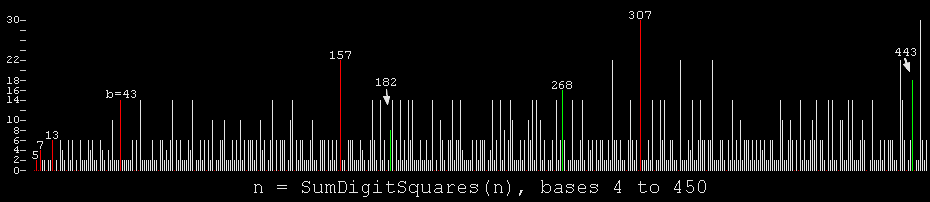
Totals for sums-of–squares in bases 4 to 450 (click for larger image)
Appendix: Odd Bases and 2-sumbers
Take an even number and half of that even number: say 12 and 6. 12 x 6 = 11 x 6 + 6. Further, 12 x 6 = 2 x 6 x 6 = 2 x 6^2 = 6^2 + 6^2. Accordingly, 66[11] = 6 x 11 + 6 = 12 x 6 = 6^2 + 6^2. So 66 in base 11 is a 2-sumber. Similar reasoning applies to every other odd base except base-3 [update: wrong!]. Now, take 12 x 5 = 2 x 6 x 5 = 2 x (5×5 + 5) = 5^2+5 + 5^5+5 = 5^5 + 5^5+2×5. Further, 5^5+2×5 = (5+1)(5+1) – 1 = 6^2 – 1. Accordingly, 56[11] = 11×5 + 6 = 12×5 + 1 = 5^2 + 6^2. Again, similar reasoning applies to every other odd base except base-3 [update: no — 1^2 + 2^2 = 12[3] = 5; 2^2 + 2^2 = 22[3] = 8]. This means that every odd base b, except base-3, will supply a pair of 2-sumbers with digits [d-1][d] and [d][d], where d = (b + 1) / 2.
He Say, He Sigh, He Sow #8
« Seul le silence est grand; tout le reste est faiblesse. » — Alfred de Vigny (1797-1863).
“Silence alone is great; all else is weakness.” — Alfred de Vigny.
Cat out of Bel
The Belgian symbolist Fernand Khnopff (1858-1921) is one of my favourite artists; Caresses (1896) is one of his most famous paintings. I like it a lot, though I find it more interesting than attractive. It’s a good example of Khnopff’s art in that the symbols are detached from clear meaning and float mysteriously in a world of their own. As Khnopff used to say: On n’a que soi – “One has only oneself.” But he was clearly inspired by the story of Oedipus and the Sphinx, which is thousands of years old. Indeed, an alternate title for the painting is The Sphinx.
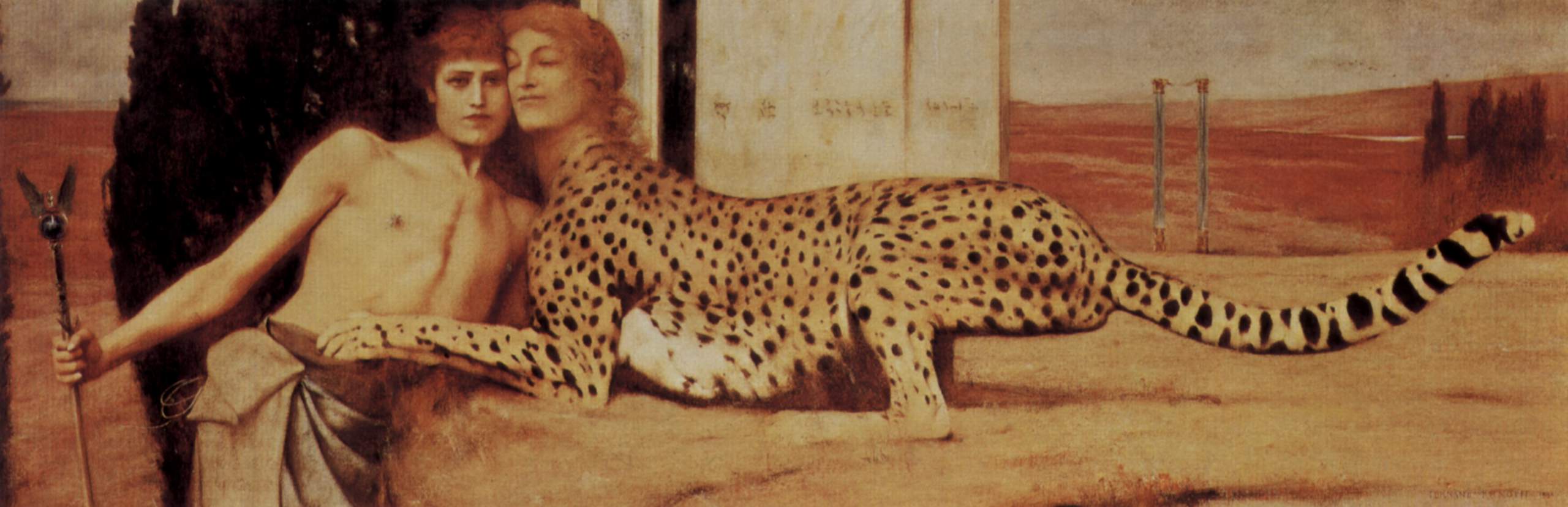
Caresses (1896) by Fernand Khnopff (click for larger image)
Even older than the Oedipus story is another link to the incestuous themes constantly explored by Khnopff, who was obsessed with his sister Marguerite and portrayed her again and again in his art. That’s her heavy-jawed face rubbing against the heavy-jawed face of the oddly nippled man, but Khnopff has given her the body of a large spotted felid. Many people misidentify it as a leopard, Panthera pardus. It’s actually a stranger and rarer felid: a cheetah, Acinonyx jubatus, which occupies a genus of its own among the great cats. And A. jubatus, unlike P. pardus, is an incestuous animal par excellence:
Cheetahs are very inbred. They are so inbred that genetically they are almost identical. The current theory is that they became inbred when a “natural” disaster dropped their total world population down to less than seven individual cheetahs – probably about 10,000 years ago. They went through a “Genetic Bottleneck”, and their genetic diversity plummeted. They survived only through brother-to-sister or parent-to-child mating. (Cheetah Extinction)
It must have been a large disaster. Perhaps cheetahs barely survived the inferno of a strike by a giant meteor, which would make them a cat out of hell. In 1896, they became a cat out of Bel too when Khnopff unveiled Caresses. Back then, biologists could not analyse DNA and discover the ancient history of a species like that. So how did Khnopff know the cheetah would add extra symbolism to his painting? Presumably he didn’t, though he must have recognized the cheetah as unique in other ways. All the same, I like to think that perhaps he had extra-rational access to scientific knowledge from the future. As he dove into the subconscious, Khnopff used symbols like weights to drag himself and his art deeper and darker. So perhaps far down, in the mysterious black, where time and space lose their meaning, he encountered a current of telepathy bearing the news of the cheetah’s incestuous nature. And that’s why he chose to give his sphinx-sister a cheetah’s body.
 Overlord In Terms of Core Issues Around Maximal Engagement with Key Notions of the Über-Feral