Mexican morning-glory, Ipomoea tricolor
(click for larger image)

Mexican morning-glory, Ipomoea tricolor
(click for larger image)
I wake from dreams and turning
My vision on the height
I scan the beacons burning
About the fields of night.
Each in its steadfast station
Inflaming heaven they flare;
They sign with conflagration
The empty moors of air.
The signal-fires of warning
They blaze, but none regard;
And on through night to morning
The world runs ruinward. — A.E. Housman in More Poems (1936)
There was a young fellow named Bright
Who travelled much faster than light.
He set off one day,
In a relative way
And came back the previous night. — Anonymous

Members of doom-stoner Russian band Fuzzthrone (image from Encyclopedia Metallum)
Elsewhere Other-Engageable…
• Temple of the Fuzz (2021) — Fuzzthrone’s debut album at Youtube
Binary is beautiful — both simple and subtle. What could be simpler than using only two digits to count with?
0, 1, 10, 11, 100, 101, 110, 111, 1000, 1001, 1010, 1011, 1100, 1101, 1110, 1111, 10000, 10001, 10010, 10011, 10100, 10101, 10110, 10111, 11000, 11001, 11010, 11011, 11100, 11101, 11110, 11111, 100000, 100001, 100010, 100011, 100100, 100101, 100110, 100111, 101000, 101001, 101010, 101011, 101100, 101101, 101110, 101111, 110000, 110001, 110010, 110011, 110100, 110101, 110110, 110111, 111000, 111001, 111010, 111011, 111100, 111101, 111110, 111111, 1000000...
But the simple patterns in the two digits of binary involve two of the most important numbers in mathematics: π and e (aka Euler’s number):
π = 3.141592653589793238462643383...
e = 2.718281828459045235360287471...
It’s easy to write π and e in binary:
π = 11.00100 10000 11111 10110 10101 00010...
e = 10.10110 11111 10000 10101 00010 11000...
But how do π and e appear in the patterns of binary 1 and 0? Well, suppose you use the digits of binary to generate the sums of distinct integers. For example, here are the sums of distinct integers you can generate with four digits of binary, if you count the digits from right to left (so the rightmost digit is 1, the the next-to-rightmost digit is 2, the next-to-leftmost digit is 3, and the leftmost digit is 4):
0000 → 0*4 + 0*3 + 0*2 + 0*1 = 0
0001 → 0*4 + 0*3 + 0*2 + 1*1 = 1*1 = 1
0010 → 0*4 + 0*3 + 1*2 + 0*1 = 1*2 = 2
0011 → 0*4 + 0*3 + 1*2 + 1*1 = 1*2 + 1*1 = 3
0100 → 1*3 = 3
0101 → 1*3 + 1*1 = 4
0110 → 3 + 2 = 5
0111 → 3 + 2 + 1 = 6
1000 → 4
1001 → 4 + 1 = 5
1010 → 4 + 2 = 6
1011 → 4 + 2 + 1 = 7
1100 → 4 + 3 = 7
1101 → 4 + 3 + 1 = 8
1110 → 4 + 3 + 2 = 9
1111 → 4 + 3 + 2 + 1 = 10
There are 16 sums (16 = 2^4) generating 11 integers, 0 to 10. But some integers involve more than one sum:
3 = 2 + 1 ← 0011
3 = 3 ← 01004 = 3 + 1 ← 0101
4 = 4 ← 10005 = 3 + 2 ← 0110
5 = 4 + 1 ← 10016 = 3 + 2 + 1 ← 0111
6 = 4 + 2 ← 10107 = 4 + 2 + 1 ← 1011
7 = 4 + 3 ← 1100
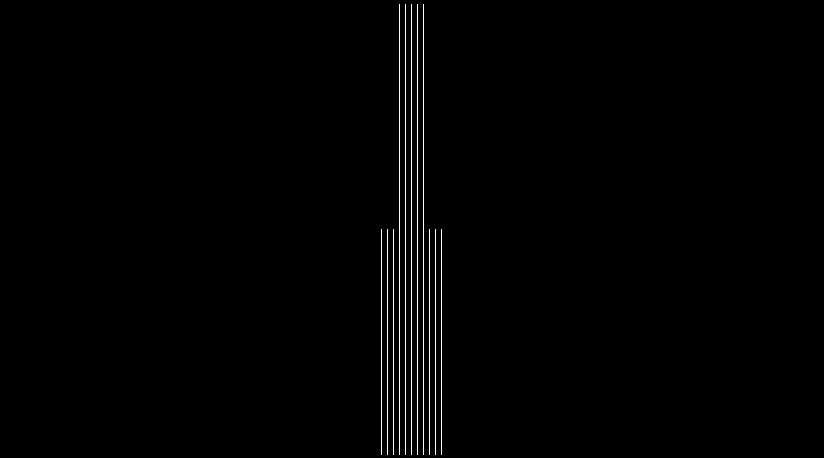
Note the symmetry of the sums: the binary number 0011, yielding 3, is the mirror of 1100, yielding 7; the binary number 0100, yielding 3 again, is the mirror of 1011, yielding 7 again. In each pair of mirror-sums, the two numbers, 3 and 7, are related by the formula 10-3 = 7 and 10-7 = 3. This also applies to 4 and 6, where 10-4 = 6 and 10-6 = 4, and to 5, which is its own mirror (because 10-5 = 5). Now, try mapping the number of distinct sums for 0 to 10 as a graph:
Graph for distinct sums of the integers 0 to 4
The graph show how 0, 1 and 2 have one sum each, 3, 4, 5, 6 and 7 have two sums each, and 8, 9 and 10 have one sum each. Now look at the graph for sums derived from three digits of binary:

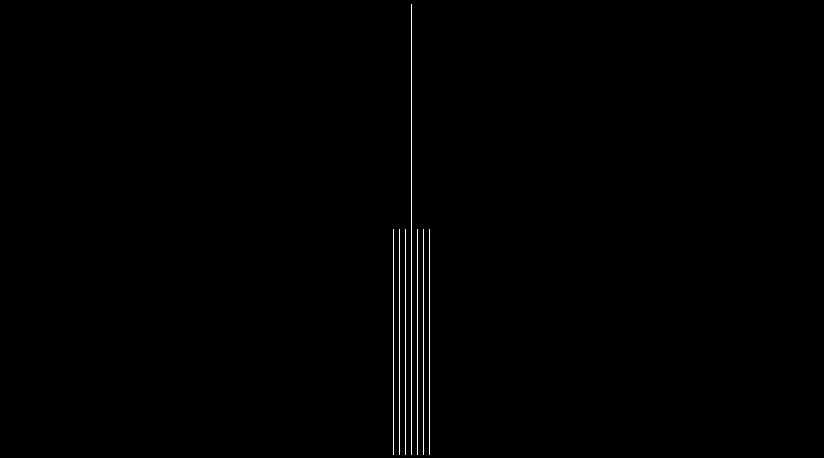
Graph for distinct sums of the integers 0 to 3
The single taller line of the seven lines represents the two sums of 3, because three digits of binary yield only one sum for 0, 1, 2, 4, 5 and 6:
000 → 0
001 → 1
010 → 2
011 → 2 + 1 = 3
100 → 3
101 → 3 + 1 = 4
110 → 3 + 2 = 5
111 → 3 + 2 + 1 = 6
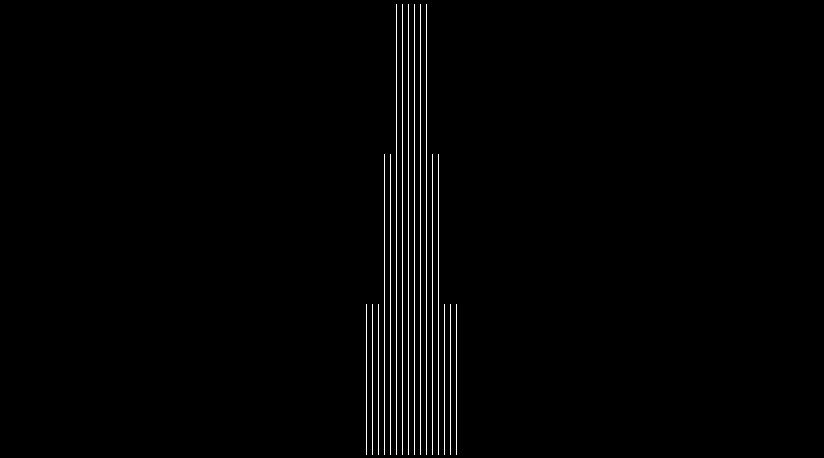
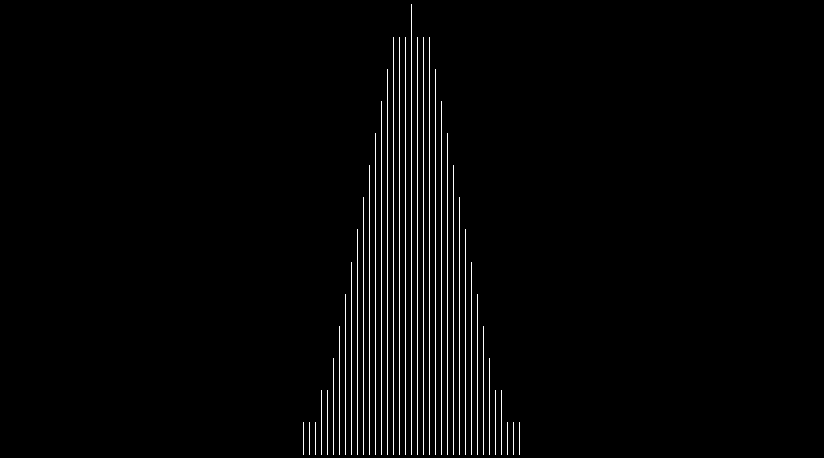
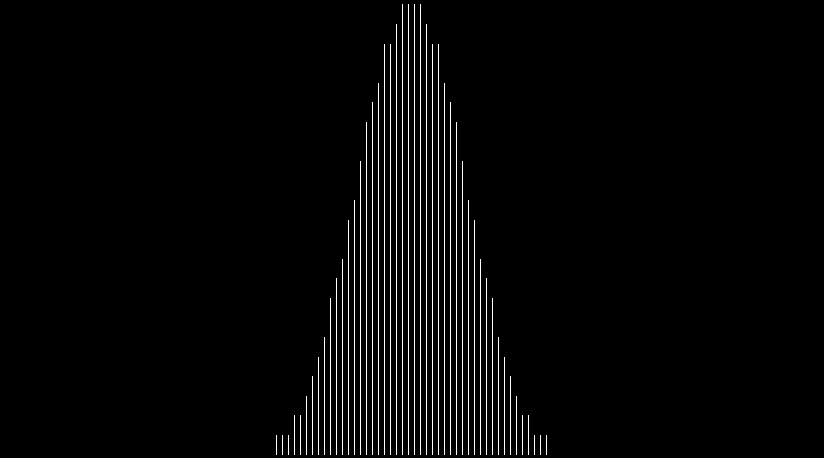
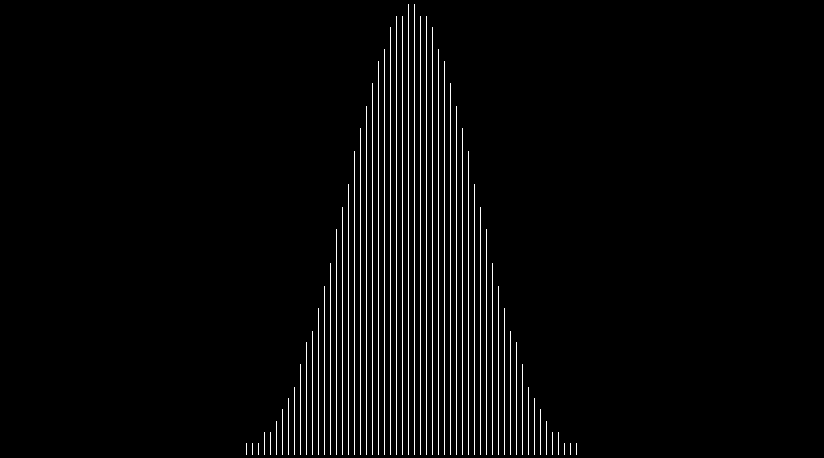
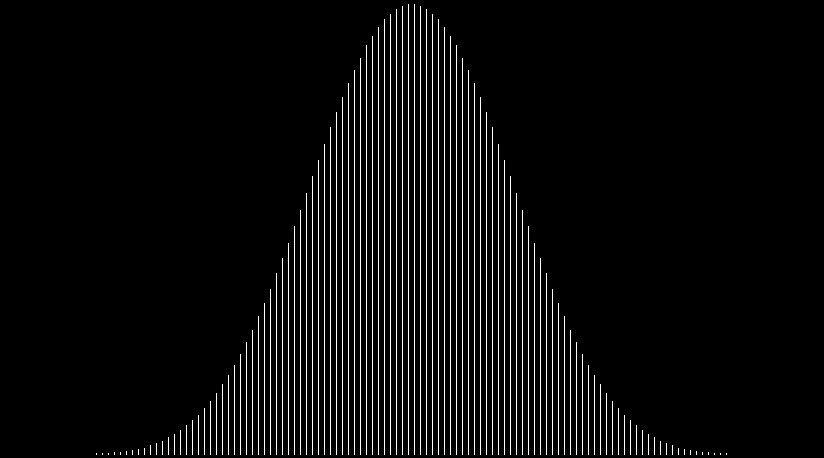
Next, look at graphs for sums derived from one to sixteen binary digits and note how the symmetry of the lines begins to create a beautiful curve (the y axis is normalized, so that the highest number of sums reaches the same height in each graph):

Graph for sums from 1 binary digit

Graph for sums from 2 binary digits
Graph for sums from 3 binary digits
Graph for sums from 4 binary digits
Graph for sums from 5 binary digits
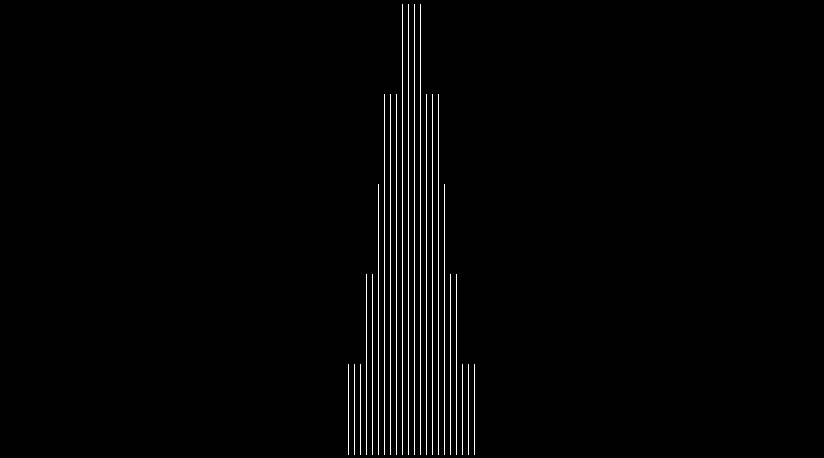
Graph for sums from 6 binary digits
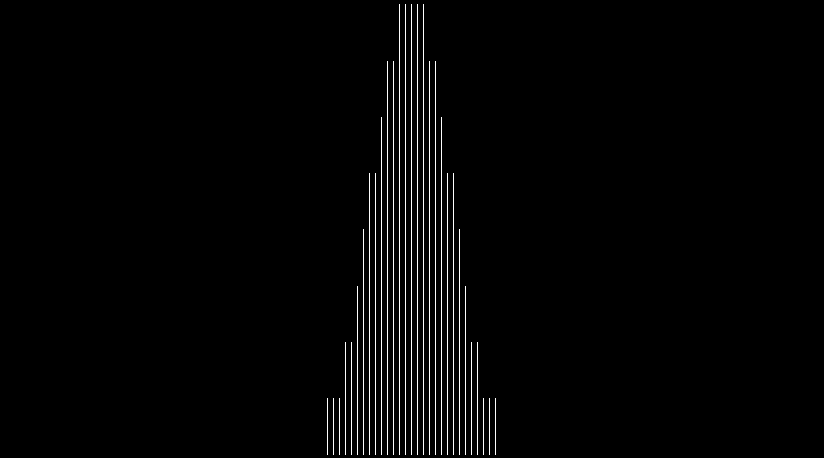
Graph for sums from 7 binary digits
Graph for sums from 8 binary digits
Graph for sums from 9 binary digits
Graph for sums from 10 binary digits
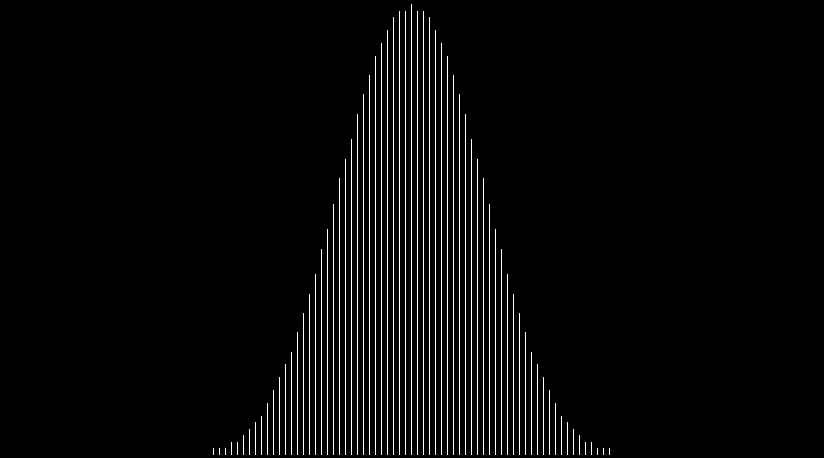
Graph for sums from 11 binary digits
Graph for sums from 12 binary digits
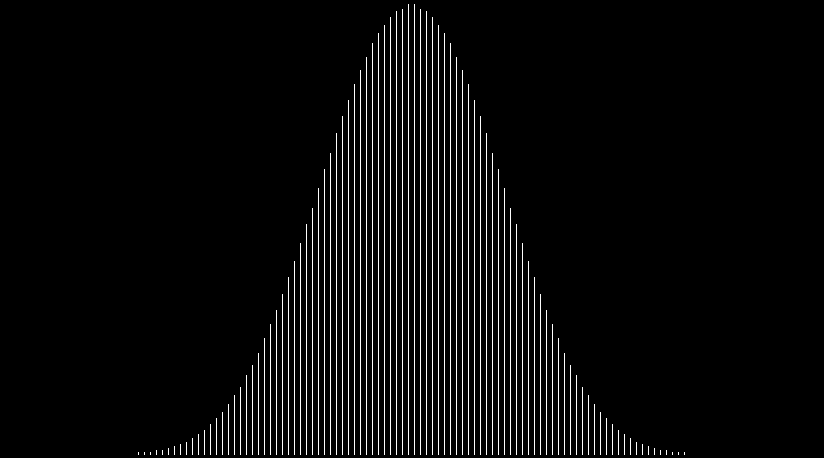
Graph for sums from 13 binary digits
Graph for sums from 14 binary digits
Graph for sums from 15 binary digits
Graph for sums from 16 binary digits

Graphs for 1 to 16 binary digits (animated)
You may recognize the shape emerging above as the bell curve, whose formula is this:
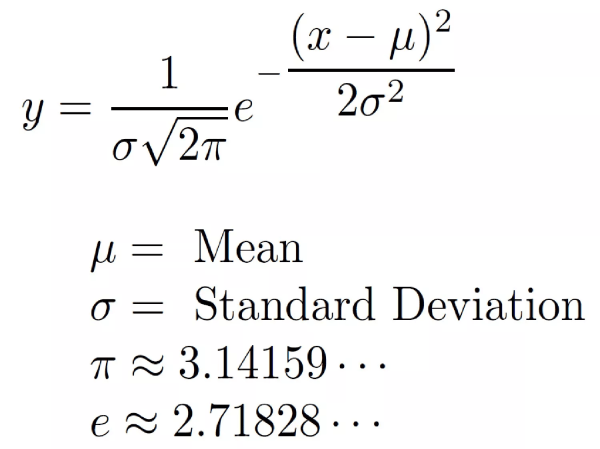
Formula for the normal distribution or bell curve (image from ThoughtCo)
And that’s how you can find pi in the bi, or π in the binary digits of 0, 1, 10, 11, 100, 101, 110, 111, 1000, 1001, 1010, 1011, 1100, 1101…
(And how you find e too, as promised above.)
Post-Performative Post-Scriptum
I asked this question above: What could be simpler than using only two digits? Well, using only one digit is simpler still:
1, 11, 111, 1111, 11111, 111111, 1111111, 11111111, 111111111, 1111111111...
But I don’t see an easy way to find π and e in numbers like that.

Midnight, one more night without sleeping.
Watching ’til that morning comes creeping.
Green Door: what’s that secret you’re keeping?There’s an old piano and they play it hot behind the green door!
Don’t know what they’re doing but they laugh a lot behind the green door.
Wish they’d let me in so I could find out what’s behind the green door.Knocked once, tried to tell ’em I’d been there.
Door slammed — hospitality’s thin there.
Wondering just what’s going on in there.Saw an eyeball peepin’ through a smoky cloud behind the green door.
When I said “Joe sent me” someone laughed out loud behind the green door.
All I want to do is join the happy crowd behind the green door.
Otra noche mas que no duermo.
Otra noche mas que se pierde.
¿Que habrá tras esa puerta verde?
Suena alegremente un piano viejo
tras la puerta verde.Todos ríen y no se que pasa
tras la puerta verde
No descansaré hasta saber que hay
tras la puerta verde.Toqué, y cuando contestaron
dije ¡Ah! que a mí me llamaron.
Risas, y enseguida me echaron.Sólo pude ver que mucha gente allí se divertía,
y entre tanto humo todo allí se confundía.
Yo quisiera estar al otro lado de la puerta verde.Otra noche mas que no duermo.
Otra noche mas que se pierde.
¿Que habrá tras esa puerta verde?
¿Que habrá?
Elsewhere Other-Accessible…
• “The Green Door” (1956), music by Bob “Hutch” Davie and lyrics by Marvin J. Moore
It’s obvious when you think about: an even number can never be the sum of two consecutive integers. Conversely, an odd number (except 1) is always the sum of two consecutive integers: 3 = 1 + 2; 5 = 2 + 3; 7 = 3 + 4; 9 = 4 + 5; and so on. The sum of three consecutive integers can be either odd or even: 6 = 1 + 2 + 3; 9 = 2 + 3 + 4. The sum of four consecutive integers must always be even: 1 + 2 + 3 + 4 = 10; 2 + 3 + 4 + 5 = 14. And so on.
But notice that 9 is the sum of consecutive integers in two different ways: 9 = 4 + 5 = 2 + 3 + 4. Having spotted that, I decided to look for numbers that were the sums of consecutive integers in the most different ways. These are the first few:
3 = 1 + 2 (number of sums = 1)
9 = 2 + 3 + 4 = 4 + 5 (s = 2)
15 = 1 + 2 + 3 + 4 + 5 = 4 + 5 + 6 = 8 + 7 = (s = 3)
45 (s = 5)
105 (s = 7)
225 (s = 8)
315 (s = 11)
945 (s = 15)
1575 (s = 17)
2835 (s = 19)
3465 (s = 23)
10395 (s = 31)
It was interesting that the number of different consecutive-integer sums for n was most often a prime number. Next I looked for the sequence at the Online Encyclopedia of Integer Sequences and discovered something that I hadn’t suspected:
A053624 Highly composite odd numbers: where d(n) increases to a record.
1, 3, 9, 15, 45, 105, 225, 315, 945, 1575, 2835, 3465, 10395, 17325, 31185, 45045, 121275, 135135, 225225, 405405, 675675, 1576575, 2027025, 2297295, 3828825, 6891885, 11486475, 26801775, 34459425, 43648605, 72747675, 130945815 — A053624 at OEIS
The notes add that the sequence is “Also least number k such that the number of partitions of k into consecutive integers is a record. For example, 45 = 22+23 = 14+15+16 = 7+8+9+10+11 = 5+6+7+8+9+10 = 1+2+3+4+5+6+7+8+9, six such partitions, but all smaller terms have fewer such partitions (15 has four).” When you don’t count the number n itself as a partition of n, you get 3 partitions for 15, i.e. consecutive integers sum to 15 in 3 different ways, so s = 3. I looked at more values for s and found that the stream of primes continued to flow:
3 → s = 1
9 = 3^2 → s = 2 (prime)
15 = 3 * 5 → s = 3 (prime)
45 = 3^2 * 5 → s = 5 (prime)
105 = 3 * 5 * 7 → s = 7 (prime)
225 = 3^2 * 5^2 → s = 8 = 2^3
315 = 3^2 * 5 * 7 → s = 11 (prime)
945 = 3^3 * 5 * 7 → s = 15 = 3 * 5
1575 = 3^2 * 5^2 * 7 → s = 17 (prime)
2835 = 3^4 * 5 * 7 → s = 19 (prime)
3465 = 3^2 * 5 * 7 * 11 → s = 23 (prime)
10395 = 3^3 * 5 * 7 * 11 → s = 31 (prime)
17325 = 3^2 * 5^2 * 7 * 11 → s = 35 = 5 * 7
31185 = 3^4 * 5 * 7 * 11 → s = 39 = 3 * 13
45045 = 3^2 * 5 * 7 * 11 * 13 → s = 47 (prime)
121275 = 3^2 * 5^2 * 7^2 * 11 → s = 53 (prime)
135135 = 3^3 * 5 * 7 * 11 * 13 → s = 63 = 3^2 * 7
225225 = 3^2 * 5^2 * 7 * 11 * 13 → s = 71 (prime)
405405 = 3^4 * 5 * 7 * 11 * 13 → s = 79 (prime)
675675 = 3^3 * 5^2 * 7 * 11 * 13 → s = 95 = 5 * 19
1576575 = 3^2 * 5^2 * 7^2 * 11 * 13 → s = 107 (prime)
2027025 = 3^4 * 5^2 * 7 * 11 * 13 → s = 119 = 7 * 17
2297295 = 3^3 * 5 * 7 * 11 * 13 * 17 → s = 127 (prime)
3828825 = 3^2 * 5^2 * 7 * 11 * 13 * 17 → s = 143 = 11 * 13
6891885 = 3^4 * 5 * 7 * 11 * 13 * 17 → s = 159 = 3 * 53
11486475 = 3^3 * 5^2 * 7 * 11 * 13 * 17 → s = 191 (prime)
26801775 = 3^2 * 5^2 * 7^2 * 11 * 13 * 17 → s = 215 = 5 * 43
34459425 = 3^4 * 5^2 * 7 * 11 * 13 * 17 → s = 239 (prime)
43648605 = 3^3 * 5 * 7 * 11 * 13 * 17 * 19 → s = 255 = 3 * 5 * 17
72747675 = 3^2 * 5^2 * 7 * 11 * 13 * 17 * 19 → s = 287 = 7 * 41
130945815 = 3^4 * 5 * 7 * 11 * 13 * 17 * 19 → s = 319 = 11 * 29
I can’t spot any way of predicting when n will yield a primal s, but I like the way that a simple question took an unexpected turn. When a number sets a record for the number of different ways it can be the sum of consecutive integers, that number will also be a highly composite odd number.
Troculus, a fractal Lovecraftian entity created by dividing-and-discarding parts of a triangle
Troculus converted into a circle
Troculus switching between forms (animated gif)
Elsewhere Other-Accessible…
• Circus Trix — how to create Troculus & Co.
Papyrocentric Performativity Presents…
• A Big Book about Books – The Penguin Classics Book, Henry Eliot (Penguin 2018)
• Wrecks & Drugs & Rock & Roll – Bodies: Life and Death in Music, Ian Winwood (Faber 2022)
• In the Bland of the Blind – An Unexplained Death: The True Story of a Body at the Belvedere, Mikita Brottman (Canongate 2018)
• Hu Thru Mu – The Musical Human: A History of Life on Earth, Michael Spitzer (Bloomsbury 2021)
• A Bit of EngLit – The Power of Delight: A Lifetime in Literature: Essays 1962-2002, John Bayley (Duckworth 2005)
• Chrome Tome – The Secret Lives of Colour, Kassia St Clair (John Murray 2018)
• Cannonball Corpse – AC/DC: The Story of the Original Monsters of Rock, Jerry Ewing (Carlton Books 2015)
• Chimpathy for the Devil? — Oasis: Supersonic: The Complete, Authorised and Uncut Interviews, curated by Simon Halfon (Nemperor 2021)
• D for Deviant, K for Korpse… — Doktor Deviant’s Diary of Depravity: Kandid Konfessions of a Kompulsive Korpse-Kopulator, ed. Dr David Kerekes and Samuel P. Salatta (Visceral Visions 2022)
Or Read a Review at Random: RaRaR

Shock-diamonds in the exhaust of a Lockheed SR71 Blackbird at 85,000 ft (from MechStuff.com)
(click for larger)

Иван Шишкин, Зима (1890) / Ivan Shishkin, Winter (1890)
(click for larger)
• nix, nivis f., snow — Latin vocab