Will Two Power?

It’s such a simple thing: repeatedly doubling a number: 1, 2, 4, 8, 16, 32, 61, 128… And yet it yields such riches, reminiscent of DNA or a literary text:

2^0 = 1
2^1 = 2
2^2 = 4
2^3 = 8
2^4 = 16
2^5 = 32
2^6 = 64
2^7 = 128
2^8 = 256
2^9 = 512
2^10 = 1024
2^20 = 1048576
2^30 = 1073741824
2^40 = 1099511627776
2^50 = 1125899906842624
2^60 = 1152921504606846976
2^70 = 1180591620717411303424
2^80 = 1208925819614629174706176
2^90 = 1237940039285380274899124224
2^100 = 1267650600228229401496703205376
2^200 = 1606938044258990275541962092341162602522202993782792835301376

Although, by Benford’s law*, 1 is the commonest leading digit, do all numbers eventually appear as the leading digits of some power of 2? I conjecture that they do. indeed, I conjecture that they do infinitely often. If the function first(n) returns the power of 2 whose leading digits are the same as the digits of n, then:

first(1) = 2^0 = 1
first(2) = 2^1 = 2
first(3) = 2^5 = 32
first(4) = 2^2 = 4
first(5) = 2^9 = 512
first(6) = 2^6 = 64
first(7) = 2^46 = 70368744177664
first(8) = 2^3 = 8
first(9) = 2^53 = 9007199254740992
first(10) = 2^10 = 1024

And I conjecture that this is true of all bases except bases that are powers of 2, like 2, 4, 8, 16 and so on. A related question is whether the leading digits of any 2^n are the same as the digits of n. Yes:

2^6 = 64
2^10 = 1024
2^1542 = 1.54259995… * 10^464
2^77075 = 7.70754024… * 10^23201
2^113939 = 1.13939932… * 10^34299
2^1122772 = 1.12277217… * 10^337988

That looks like a look of calculation, but there’s a simple way to cut it down: restrict the leading digits. Eventually they will lose accuracy, because the missing digits are generating carries. With four leading digits, this happens:

1: 0001
2: 0002
4: 0004
8: 0008
16: 0016
32: 0032
64: 0064
128: 0128
256: 0256
512: 0512
1024: 1024
2048: 2048
4096: 4096
8192: 8192
16384: 1638…
32768: 3276…
65536: 6552…

But working with only fifteen leading digits, you can find that 1122772 = the leading digits of 2^1122772, which has 337989 digits when calculated in full.


Previously pre-posted (please peruse):

Talcum Power


*Not Zipf’s law, as I originally said.

Talcum Power

If primes are like diamonds, powers of 2 are like talc. Primes don’t crumble under division, because they can’t be divided by any number but themselves and one. Powers of 2 crumble more than any other numbers. The contrast is particularly strong when the primes are Mersenne primes, or equal to a power of 2 minus 1:

3 = 4-1 = 2^2 – 1.
4, 2, 1.

7 = 8-1 = 2^3 – 1.
8, 4, 2, 1.

31 = 32-1 = 2^5 – 1.
32, 16, 8, 4, 2, 1.

127 = 2^7 – 1.
128, 64, 32, 16, 8, 4, 2, 1.

8191 = 2^13 – 1.
8192, 4096, 2048, 1024, 512, 256, 128, 64, 32, 16, 8, 4, 2, 1.

131071 = 2^17 – 1.
131072, 65536, 32768, 16384, 8192, 4096, 2048, 1024, 512, 256, 128, 64, 32, 16, 8, 4, 2, 1.

524287 = 2^19 – 1.
524288, 262144, 131072, 65536, 32768, 16384, 8192, 4096, 2048, 1024, 512, 256, 128, 64, 32, 16, 8, 4, 2, 1.

2147483647 = 2^31 – 1.
2147483648, 1073741824, 536870912, 268435456, 134217728, 67108864, 33554432, 16777216, 8388608, 4194304, 2097152, 1048576, 524288, 262144, 131072, 65536, 32768, 16384, 8192, 4096, 2048, 1024, 512, 256, 128, 64, 32, 16, 8, 4, 2, 1.

Are Mersenne primes infinite? If they are, then there will be just as many Mersenne primes as powers of 2, even though very few powers of 2 create a Mersenne prime. That’s one of the paradoxes of infinity: an infinite part is equal to an infinite whole.

But are they infinite? No-one knows, though some of the greatest mathematicians in history have tried to find a proof or disproof of the conjecture. A simpler question about powers of 2 is this: Does every integer appear as part of a power of 2? I can’t find one that doesn’t:

0 is in 1024 = 2^10.
1 is in 16 = 2^4.
2 is in 32 = 2^5.
3 is in 32 = 2^5.
4 = 2^2.
5 is in 256 = 2^8.
6 is in 16 = 2^4.
7 is in 32768 = 2^15.
8 = 2^3.
9 is in 4096 = 2^12.
10 is in 1024 = 2^10.
11 is in 1099511627776 = 2^40.
12 is in 128 = 2^7.
13 is in 131072 = 2^17.
14 is in 262144 = 2^18.
15 is in 2097152 = 2^21.
16 = 2^4.
17 is in 134217728 = 2^27.
18 is in 1073741824 = 2^30.
19 is in 8192 = 2^13.
20 is in 2048 = 2^11.

666 is in 182687704666362864775460604089535377456991567872 = 2^157.
1066 is in 43556142965880123323311949751266331066368 = 2^135.
1492 is in 356811923176489970264571492362373784095686656 = 2^148.
2014 is in 3705346855594118253554271520278013051304639509300498049262642688253220148477952 = 2^261.

I’ve tested much higher than that, but testing is no good: where’s a proof? I don’t have one, though I conjecture that all integers do appear as part or whole of a power of 2. Nor do I have a proof for another conjecture: that all integers appear infinitely often as part or whole of powers of 2. Or indeed, of powers of 3, 4, 5 or any other number except powers of 10.

I conjecture that this would apply in all bases too: In any base b all n appear infinitely often as part or whole of powers of any number except those equal to a power of b.

1 is in 11 = 2^2 in base 3.
2 is in 22 = 2^3 in base 3.
10 is in 1012 = 2^5 in base 3.
11 = 2^2 in base 3.
12 is in 121 = 2^4 in base 3.
20 is in 11202 = 2^7 in base 3.
21 is in 121 = 2^4 in base 3.
22 = 2^3 in base 3.
100 is in 100111 = 2^8 in base 3.
101 is in 1012 = 2^5 in base 3.
102 is in 2210212 = 2^11 in base 3.
110 is in 1101221 = 2^10 in base 3.
111 is in 100111 = 2^8 in base 3.
112 is in 11202 = 2^7 in base 3.
120 is in 11202 = 2^7 in base 3.
121 = 2^4 in base 3.
122 is in 1101221 = 2^10 in base 3.
200 is in 200222 = 2^9 in base 3.
201 is in 12121201 = 2^12 in base 3.
202 is in 11202 = 2^7 in base 3.

1 is in 13 = 2^3 in base 5.
2 is in 112 = 2^5 in base 5.
3 is in 13 = 2^3 in base 5.
4 = 2^2 in base 5.
10 is in 1003 = 2^7 in base 5.
11 is in 112 = 2^5 in base 5.
12 is in 112 = 2^5 in base 5.
13 = 2^3 in base 5.
14 is in 31143 = 2^11 in base 5.
20 is in 2011 = 2^8 in base 5.
21 is in 4044121 = 2^16 in base 5.
22 is in 224 = 2^6 in base 5.
23 is in 112341 = 2^12 in base 5.
24 is in 224 = 2^6 in base 5.
30 is in 13044 = 2^10 in base 5.
31 = 2^4 in base 5.
32 is in 230232 = 2^13 in base 5.
33 is in 2022033 = 2^15 in base 5.
34 is in 112341 = 2^12 in base 5.
40 is in 4022 = 2^9 in base 5.

1 is in 12 = 2^3 in base 6.
2 is in 12 = 2^3 in base 6.
3 is in 332 = 2^7 in base 6.
4 = 2^2 in base 6.
5 is in 52 = 2^5 in base 6.
10 is in 1104 = 2^8 in base 6.
11 is in 1104 = 2^8 in base 6.
12 = 2^3 in base 6.
13 is in 13252 = 2^11 in base 6.
14 is in 144 = 2^6 in base 6.
15 is in 101532 = 2^13 in base 6.
20 is in 203504 = 2^14 in base 6.
21 is in 2212 = 2^9 in base 6.
22 is in 2212 = 2^9 in base 6.
23 is in 1223224 = 2^16 in base 6.
24 = 2^4 in base 6.
25 is in 13252 = 2^11 in base 6.
30 is in 30544 = 2^12 in base 6.
31 is in 15123132 = 2^19 in base 6.
32 is in 332 = 2^7 in base 6.

1 is in 11 = 2^3 in base 7.
2 is in 22 = 2^4 in base 7.
3 is in 1331 = 2^9 in base 7.
4 = 2^2 in base 7.
5 is in 514 = 2^8 in base 7.
6 is in 2662 = 2^10 in base 7.
10 is in 1054064 = 2^17 in base 7.
11 = 2^3 in base 7.
12 is in 121 = 2^6 in base 7.
13 is in 1331 = 2^9 in base 7.
14 is in 514 = 2^8 in base 7.
15 is in 35415440431 = 2^30 in base 7.
16 is in 164351 = 2^15 in base 7.
20 is in 362032 = 2^16 in base 7.
21 is in 121 = 2^6 in base 7.
22 = 2^4 in base 7.
23 is in 4312352 = 2^19 in base 7.
24 is in 242 = 2^7 in base 7.
25 is in 11625034 = 2^20 in base 7.
26 is in 2662 = 2^10 in base 7.

1 is in 17 = 2^4 in base 9.
2 is in 152 = 2^7 in base 9.
3 is in 35 = 2^5 in base 9.
4 = 2^2 in base 9.
5 is in 35 = 2^5 in base 9.
6 is in 628 = 2^9 in base 9.
7 is in 17 = 2^4 in base 9.
8 = 2^3 in base 9.
10 is in 108807 = 2^16 in base 9.
11 is in 34511011 = 2^24 in base 9.
12 is in 12212 = 2^13 in base 9.
13 is in 1357 = 2^10 in base 9.
14 is in 314 = 2^8 in base 9.
15 is in 152 = 2^7 in base 9.
16 is in 878162 = 2^19 in base 9.
17 = 2^4 in base 9.
18 is in 218715 = 2^17 in base 9.
20 is in 70122022 = 2^25 in base 9.
21 is in 12212 = 2^13 in base 9.
22 is in 12212 = 2^13 in base 9.

Prime Climb Time

The third prime is equal to the sum of the first and second primes: 2 + 3 = 5. After that, for obvious reasons, the prime-sum climbs much more rapidly than the primes themselves:

2, 3, 05, 07, 11, 13, 17, 19, 023, 029...
2, 5, 10, 17, 28, 41, 58, 77, 100, 129...

But what if you use digit-sum(p1..pn), i.e., the sum of the digits of the primes from the first to the nth? For example, the digit-sum(p1..p5) = 2 + 3 + 5 + 7 + 1+1 = 19, whereas the sum(p1..p5) = 2 + 3 + 5 + 7 + 11 = 28. Using the digit-sums of the primes, the comparison now looks like this:

2, 3, 05, 07, 11, 13, 17, 19, 23, 29...
2, 5, 10, 17, 19, 23, 31, 41, 46, 57...

The sum climbs more slowly, but still too fast. So what about a different base? In base-2, the digit-sum(p1..p3) = (1+0) + (1+1) + (1+0+1) = 1 + 2 + 2 = 5. The comparison looks like this:

2, 3, 05, 07, 11, 13, 17, 19, 23, 29...
1, 3, 05, 08, 11, 14, 16, 19, 23, 27...

For primes 3, 5, 11, 19, and 23, p = digit-sum(primes <= p) in base-2. But the cumulative digit-sum soon begins to climb too slowly:

2, 3, 5, 7, 11, 13, 17, 19, 23, 29, 31, 37, 41, 43, 47, 53, 59, 61, 67, 71, 73, 79, 83, 89, 97, 101, 103, 107, 109, 113, 127, 131, 137, 139, 149, 151, 157, 163, 167, 173, 179, 181, 191, 193, 197, 199, 211, 223, 227, 229, 233, 239, 241, 251, 257, 263, 269, 271...

1, 3, 5, 8, 11, 14, 16, 19, 23, 27, 32, 35, 38, 42, 47, 51, 56, 61, 64, 68, 71, 76, 80, 84, 87, 091, 096, 101, 106, 110, 117, 120, 123, 127, 131, 136, 141, 145, 150, 155, 160, 165, 172, 175, 179, 184, 189, 196, 201, 206, 211, 218, 223, 230, 232, 236, 240, 245...

So what about base-3?

2, 3, 5, 7, 11, 13, 17, 19, 23, 29, 31, 37, 41, 43, 47, 53, 59...
2, 3, 6, 9, 12, 15, 20, 23, 28, 31, 34, 37, 42, 47, 52, 59, 64...

In base-3, for p = 2, 3 and 37, p = digit-sum(primes <= p), while for p = 23, 31, 47 and 59, p = digit-sum(primes < p), like this:

2 = 2.
3 = 2 + (1+0).
37 = 2 + (1+0) + (1+2) + (2+1) + (1+0+2) + (1+1+1) + (1+2+2) + (2+0+1) + (2+1+2) + (1+0+0+2) + (1+0+1+1) + (1+1+0+1) = 2 + 1 + 3 + 3 + 3 + 3 + 5 + 3 + 5 + 3 + 3 + 3.

23 = 2 + (1+0) + (1+2) + (2+1) + (1+0+2) + (1+1+1) + (1+2+2) + (2+0+1) = 2 + 1 + 3 + 3 + 3 + 3 + 5 + 3.
31 = 2 + (1+0) + (1+2) + (2+1) + (1+0+2) + (1+1+1) + (1+2+2) + (2+0+1) + (2+1+2) + (1+0+0+2) = 2 + 1 + 3 + 3 + 3 + 3 + 5 + 3 + 5 + 3.
47 = 2 + (1+0) + (1+2) + (2+1) + (1+0+2) + (1+1+1) + (1+2+2) + (2+0+1) + (2+1+2) + (1+0+0+2) + (1+0+1+1) + (1+1+0+1) + (1+1+1+2) + (1+1+2+1) = 2 + 1 + 3 + 3 + 3 + 3 + 5 + 3 + 5 + 3 + 3 + 3 + 5 + 5.
59 = 2 + (1+0) + (1+2) + (2+1) + (1+0+2) + (1+1+1) + (1+2+2) + (2+0+1) + (2+1+2) + (1+0+0+2) + (1+0+1+1) + (1+1+0+1) + (1+1+1+2) + (1+1+2+1) + (1+2+0+2) + (1+2+2+2) = 2 + 1 + 3 + 3 + 3 + 3 + 5 + 3 + 5 + 3 + 3 + 3 + 5 + 5 + 5 + 7.

This carries on for a long time. For these primes, p = digit-sum(primes < p):

23, 31, 47, 59, 695689, 698471, 883517, 992609, 992737, 993037, 1314239, 1324361, 1324571, 1326511, 1327289, 1766291, 3174029

And for these primes, p = digit-sum(primes <= p):

3, 37, 695663, 695881, 1308731, 1308757, 1313153, 1314301, 1326097, 1766227, 3204779, 14328191

Now try the cumulative digit-sum in base-4:

2, 3, 5, 07, 11, 13, 17, 19, 23, 29, 31, 37, 41, 43, 47, 53, 59...
2, 5, 7, 11, 16, 20, 22, 26, 31, 36, 43, 47, 52, 59, 67, 72, 80... 

The sum of digits climbs too fast. Base-3 is the Goldilocks base, climbing neither too slowly, like base-2, nor too fast, like all bases greater than 3.

Prime Time #2

“2n2 + 29 is prime for all values of n for 1 to 28.” — The Penguin Dictionary of Curious and Interesting Numbers, David Wells (1986).

• 31, 37, 47, 61, 79, 101, 127, 157, 191, 229, 271, 317, 367, 421, 479, 541, 607, 677, 751, 829, 911, 997, 1087, 1181, 1279, 1381, 1487, 1597.


Elsewhere other-posted:

Prime Time #1
Poulet’s Propellor — Musings on Math and Mathculinity
La Spirale è Mobile

Lat’s That

In a magic square of numbers, all rows, columns and diagonals have the same sum, or magic total. Here is an example:

1*5*9
8*3*4
6*7*2

(mt=15)

Here’s another:

06*07*11*10
15*02*14*03
04*13*01*16
09*12*08*05

(mt=34)

And another:

04*25*20*10*06
01*13*11*21*19
23*09*07*08*18
15*16*03*14*17
22*02*24*12*05

(mt=65)

And another:

35*15*10*18*11*22
05*25*33*12*07*29
34*30*04*14*21*08
02*16*27*17*23*26
03*24*09*19*36*20
32*01*28*31*13*06

(mt=111)

In all those magic squares, the magic total is fixed: the sum of all numbers from 1 to 36 is 666, so any individual line in a 6×6 magic square has to equal 666 / 6 or 111. In other kinds of magic figure, this rule doesn’t apply:

2*7*3
4***8
6*5*1

(mt=12)

6*3*4
2***8
5*7*1

(mt=13)

8*5*1
2***6
4*3*7

(mt=14)

8*1*6
4***2
3*5*7

(mt=15)

Continue reading Lat’s That

Priamonds and Pearls

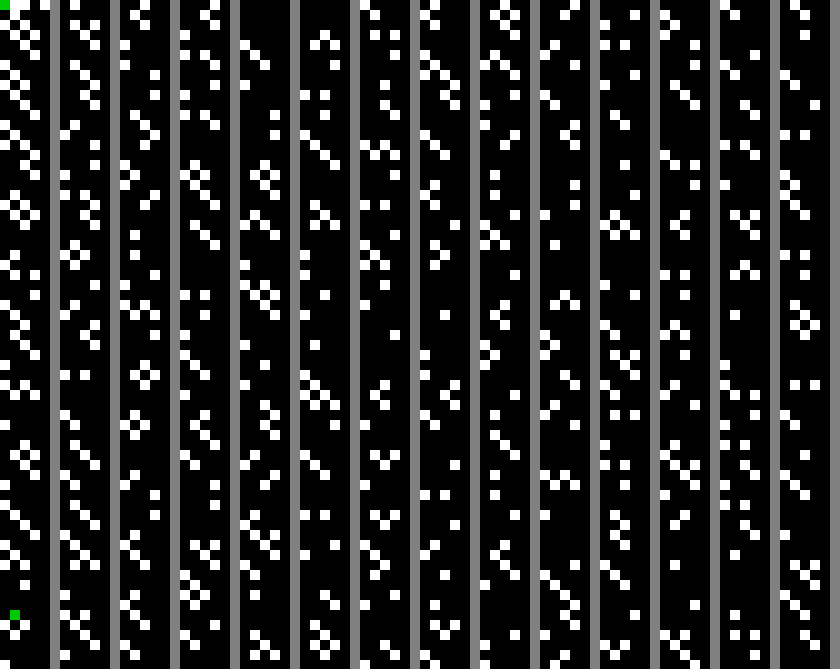
Interesting patterns emerge when primes are represented as white blocks in a series of n-width left-right lines laid vertically, one atop the other. When the line is five blocks wide, the patterns look like this (the first green block is 1, followed by primes 2, 3 and 5, then 7 in the next line):
5line

(Click for larger version)

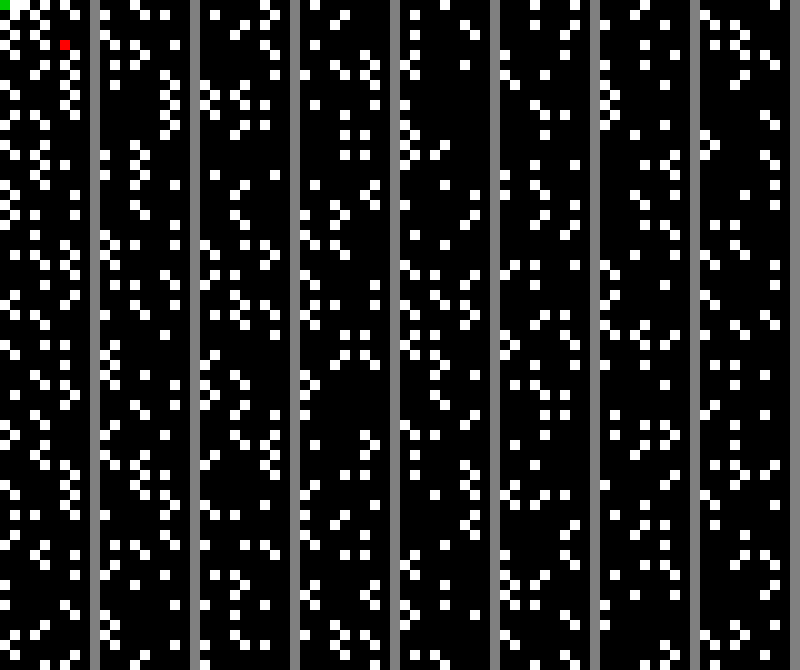
Right at the bottom of the first column is an isolated prime diamond, or priamond (marked with a green block). It consists of the four primes 307-311-313-317, where the three latter primes equal 307 + 4 and 6 and 10, or 307 + 5-1, 5+1 and 5×2 (the last prime in the first column is 331 and the first prime in the second is 337). About a third of the way down the first column is a double priamond, consisting of 97, 101, 103, 107, 109 and 113. For a given n, then, a priamond is a set of primes, p1, p2, p3 and p4, such that p2 = p1 + n-1, p3 = p + n+1 and p4 = p1 + 2n.

There are also fragments of pearl-necklace in the columns. One is above the isolated priamond. It consists of four prime-blocks slanting from left to right: 251-257-263-269, or 251 + 6, 12 and 18. A prearl-necklace, then, is a set of primes, p1, p2, p3…, such that p2 = p1 + n+i, p3 = p + 2(n+i)…, where i = +/-1. Now here are the 7-line and 9-line:

7line

Above: 7-line for primes

9line

Above: 9-line for primes

In the 9-line, you can see a prime-ladder marked with a red block. It consists of the primes 43-53-61-71-79-89-97-107, in alternate increments of 10 and 8, or 9+1 and 9-1. A prime-ladder, then, is a set of primes, p1, p2, p3, p4…, such that p2 = p1 + n+1, p3 = p + 2n, p3 = p + 3n+1…

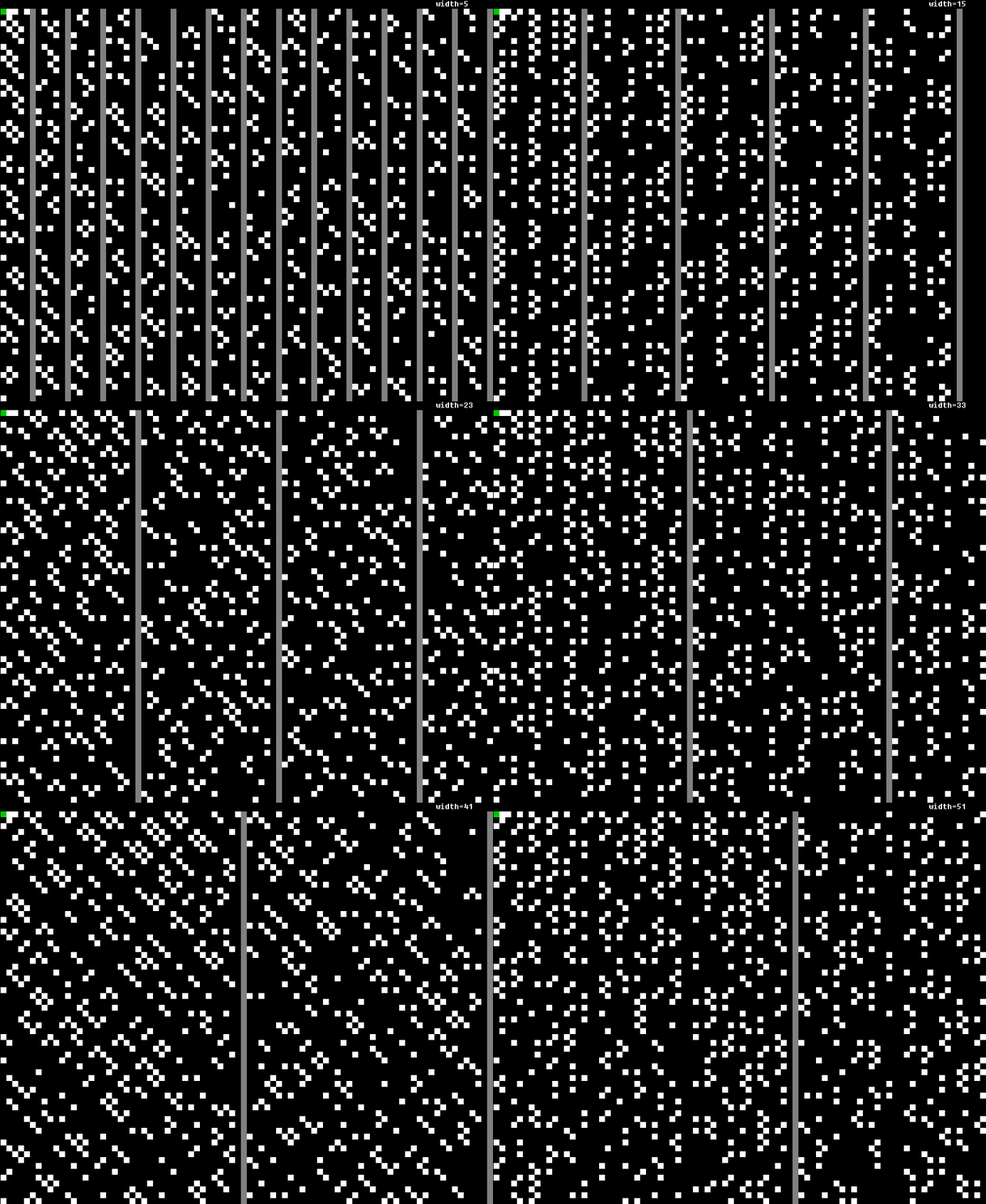
And here is an animated gif of lines 5 through 51:

lines5to51

(Click or open in new window for larger version or if file fails to animate)

Miss This

1,729,404 is seven digits long. If you drop one digit at a time, you can create seven more numbers from it, each six digits long. If you add these numbers, something special happens:

1,729,404 → 729404 (missing 1) + 129404 (missing 7) + 179404 (missing 2) + 172404 + 172904 + 172944 + 172940 = 1,729,404

So 1,729,404 is narcissistic, or equal to some manipulation of its own digits. Searching for numbers like this might seem like a big task, but you can cut the search-time considerably by noting that the final two digits determine whether a number is a suitable candidate for testing. For example, what if a seven-digit number ends in …38? Then the final digit of the missing-digit sum will equal (3 x 1 + 8 x 6) modulo 10 = (3 + 48) mod 10 = 51 mod 10 = 1. This means that you don’t need to check any seven-digit number ending in …38.

But what about seven-digit numbers ending in …57? Now the final digit of the sum will equal (5 x 1 + 7 x 6) modulo 10 = (5 + 42) mod 10 = 47 mod 10 = 7. So seven-digit numbers ending in …57 are possible missing-digit narcissistic sums. Then you can test numbers ending …157, …257, …357 and so on, to determine the last-but-one digit of the sum. Using this method, one quickly finds the only two seven-digit numbers of this form in base-10:

1,729,404 → 729404 + 129404 + 179404 + 172404 + 172904 + 172944 + 172940 = 1,729,404

1,800,000 → 800000 + 100000 + 180000 + 180000 + 180000 + 180000 + 180000 = 1,800,000

What about eight-digit numbers? Only those ending in these two digits need to be checked: …00, …23, …28, …41, …46, …64, …69, …82, …87. Here are the results:

• 13,758,846 → 3758846 + 1758846 + 1358846 + 1378846 + 1375846 + 1375846 + 1375886 + 1375884 = 13,758,846
• 13,800,000 → 3800000 + 1800000 + 1300000 + 1380000 + 1380000 + 1380000 + 1380000 + 1380000 = 13,800,000
• 14,358,846 → 4358846 + 1358846 + 1458846 + 1438846 + 1435846 + 1435846 + 1435886 + 1435884 = 14,358,846
• 14,400,000 → 4400000 + 1400000 + 1400000 + 1440000 + 1440000 + 1440000 + 1440000 + 1440000 = 14,400,000
• 15,000,000 → 5000000 + 1000000 + 1500000 + 1500000 + 1500000 + 1500000 + 1500000 + 1500000 = 15,000,000
• 28,758,846 → 8758846 + 2758846 + 2858846 + 2878846 + 2875846 + 2875846 + 2875886 + 2875884 = 28,758,846
• 28,800,000 → 8800000 + 2800000 + 2800000 + 2880000 + 2880000 + 2880000 + 2880000 + 2880000 = 28,800,000
• 29,358,846 → 9358846 + 2358846 + 2958846 + 2938846 + 2935846 + 2935846 + 2935886 + 2935884 = 29,358,846
• 29,400,000 → 9400000 + 2400000 + 2900000 + 2940000 + 2940000 + 2940000 + 2940000 + 2940000 = 29,400,000

But there are no nine-digit sumbers, or nine-digit numbers that supply missing-digit narcissistic sums. What about ten-digit sumbers? There are twenty-one:

1,107,488,889; 1,107,489,042; 1,111,088,889; 1,111,089,042; 3,277,800,000; 3,281,400,000; 4,388,888,889; 4,388,889,042; 4,392,488,889; 4,392,489,042; 4,500,000,000; 5,607,488,889; 5,607,489,042; 5,611,088,889; 5,611,089,042; 7,777,800,000; 7,781,400,000; 8,888,888,889; 8,888,889,042; 8,892,488,889; 8,892,489,042 (21 numbers)

Finally, the nine eleven-digit sumbers all take this form:

30,000,000,000 → 0000000000 + 3000000000 + 3000000000 + 3000000000 + 3000000000 + 3000000000 + 3000000000 + 3000000000 + 3000000000 + 3000000000 + 3000000000 = 30,000,000,000

So that’s forty-one narcissistic sumbers in base-10. Not all of them are listed in Sequence A131639 at the Encyclopedia of Integer Sequences, but I think I’ve got my program working right. Other bases show similar patterns. Here are some missing-digit narcissistic sumbers in base-5:

• 1,243 → 243 + 143 + 123 + 124 = 1,243 (b=5) = 198 (b=10)
• 1,324 → 324 + 124 + 134 + 132 = 1,324 (b=5) = 214 (b=10)
• 1,331 → 331 + 131 + 131 + 133 = 1,331 (b=5) = 216 (b=10)
• 1,412 → 412 + 112 + 142 + 141 = 1,412 (b=5) = 232 (b=10)

• 100,000 → 00000 + 10000 + 10000 + 10000 + 10000 + 10000 = 100,000 (b=5) = 3,125 (b=10)
• 200,000 → 00000 + 20000 + 20000 + 20000 + 20000 + 20000 = 200,000 (b=5) = 6,250 (b=10)
• 300,000 → 00000 + 30000 + 30000 + 30000 + 30000 + 30000 = 300,000 (b=5) = 9,375 (b=10)
• 400,000 → 00000 + 40000 + 40000 + 40000 + 40000 + 40000 = 400,000 (b=5) = 12,500 (b=10)

And here are some sumbers in base-16:

5,4CD,111,0EE,EF0,542 = 4CD1110EEEF0542 + 5CD1110EEEF0542 + 54D1110EEEF0542 + 54C1110EEEF0542 + 54CD110EEEF0542 + 54CD110EEEF0542 + 54CD110EEEF0542 + 54CD111EEEF0542 + 54CD1110EEF0542 + 54CD1110EEF0542 + 54CD1110EEF0542 + 54CD1110EEE0542 + 54CD1110EEEF542 + 54CD1110EEEF042 + 54CD1110EEEF052 + 54CD1110EEEF054 (b=16) = 6,110,559,033,837,421,890 (b=10)

6,5DD,E13,CEE,EF0,542 = 5DDE13CEEEF0542 + 6DDE13CEEEF0542 + 65DE13CEEEF0542 + 65DE13CEEEF0542 + 65DD13CEEEF0542 + 65DDE3CEEEF0542 + 65DDE1CEEEF0542 + 65DDE13EEEF0542 + 65DDE13CEEF0542 + 65DDE13CEEF0542 + 65DDE13CEEF0542 + 65DDE13CEEE0542 + 65DDE13CEEEF542 + 65DDE13CEEEF042 + 65DDE13CEEEF052 + 65DDE13CEEEF054 (b=16) = 7,340,270,619,506,705,730 (b=10)

10,000,000,000,000,000 → 0000000000000000 + 1000000000000000 + 1000000000000000 + 1000000000000000 + 1000000000000000 + 1000000000000000 + 1000000000000000 + 1000000000000000 + 1000000000000000 + 1000000000000000 + 1000000000000000 + 1000000000000000 + 1000000000000000 + 1000000000000000 + 1000000000000000 + 1000000000000000 + 1000000000000000 = 10,000,000,000,000,000 (b=16) = 18,446,744,073,709,551,616 (b=10)

F0,000,000,000,000,000 → 0000000000000000 + F000000000000000 + F000000000000000 + F000000000000000 + F000000000000000 + F000000000000000 + F000000000000000 + F000000000000000 + F000000000000000 + F000000000000000 + F000000000000000 + F000000000000000 + F000000000000000 + F000000000000000 + F000000000000000 + F000000000000000 + F000000000000000 = F0,000,000,000,000,000 (b=16) = 276,701,161,105,643,274,240 (b=10)

Next I’d like to investigate sumbers created by missing two, three and more digits at a time. Here’s a taster:

1,043,101 → 43101 (missing 1 and 0) + 03101 (missing 1 and 4) + 04101 (missing 1 and 3) + 04301 + 04311 + 04310 + 13101 + 14101 + 14301 + 14311 + 14310 + 10101 + 10301 + 10311 + 10310 + 10401 + 10411 + 10410 + 10431 + 10430 + 10431 = 1,043,101 (b=5) = 18,526 (b=10)

Reverssum

Here’s a simple sequence. What’s the next number?

1, 2, 4, 8, 16, 68, 100, ?

The rule I’m using is this: Reverse the number, then add the sum of the digits. So 1 doubles till it becomes 16. Then 16 becomes 61 + 6 + 1 = 68. Then 68 becomes 86 + 8 + 6 = 100. Then 100 becomes 001 + 1 = 2. And the sequence falls into a loop.

Reversing the number means that small numbers can get big and big numbers can get small, but the second tendency is stronger for the first few seeds:

• 1 → 2 → 4 → 8 → 16 → 68 → 100 → 2
• 2 → 4 → 8 → 16 → 68 → 100 → 2
• 3 → 6 → 12 → 24 → 48 → 96 → 84 → 60 → 12
• 4 → 8 → 16 → 68 → 100 → 2 → 4
• 5 → 10 → 2 → 4 → 8 → 16 → 68 → 100 → 2
• 6 → 12 → 24 → 48 → 96 → 84 → 60 → 12
• 7 → 14 → 46 → 74 → 58 → 98 → 106 → 608 → 820 → 38 → 94 → 62 → 34 → 50 → 10 → 2 → 4 → 8 → 16 → 68 → 100 → 2
• 8 → 16 → 68 → 100 → 2 → 4 → 8
• 9 → 18 → 90 → 18
• 10 → 2 → 4 → 8 → 16 → 68 → 100 → 2

An 11-seed is a little more interesting:

11 → 13 → 35 → 61 → 23 → 37 → 83 → 49 → 107 → 709 → 923 → 343 → 353 → 364 → 476 → 691 → 212 → 217 → 722 → 238 → 845 → 565 → 581 → 199 → 1010 → 103 → 305 → 511 → 122 → 226 → 632 → 247 → 755 → 574 → 491 → 208 → 812 → 229 → 935 → 556 → 671 → 190 → 101 → 103 (11 leads to an 18-loop from 103 at step 26; total steps = 44)

Now try some higher bases:

• 1 → 2 → 4 → 8 → 15 → 57 → 86 → 80 → 15 (base=11)
• 1 → 2 → 4 → 8 → 14 → 46 → 72 → 34 → 4A → B6 → 84 → 58 → 96 → 80 → 14 (base=12)
• 1 → 2 → 4 → 8 → 13 → 35 → 5B → C8 → A6 → 80 → 13 (base=13)
• 1 → 2 → 4 → 8 → 12 → 24 → 48 → 92 → 36 → 6C → DA → C8 → A4 → 5A → B6 → 80 → 12 (base=14)
• 1 → 2 → 4 → 8 → 11 → 13 → 35 → 5B → C6 → 80 → 11 (base=15)
• 1 → 2 → 4 → 8 → 10 → 2 (base=16)

Does the 1-seed always create a short sequence? No, it gets pretty long in base-19 and base-20:

• 1 → 2 → 4 → 8 → [16] → 1D → DF → [17]3 → 4[18] → 107 → 709 → 914 → 424 → 42E → E35 → 54[17] → [17]5C → C7D → D96 → 6B3 → 3C7 → 7D6 → 6EE → E[16]2 → 2[18]8 → 90B → B1A → A2E → E3[17] → [17]5A → A7B → B90 → AC→ DD → F1 → 2C → C[16] → [18]2 → 40 → 8 (base=19)
• 1 → 2 → 4 → 8 → [16] → 1C → CE → F[18] → 108 → 80A → A16 → 627 → 731 → 13[18] → [18]43 → 363 → 36F → F77 → 794 → 4A7 → 7B5 → 5CA → ADC → CF5 → 5[17]4 → 4[18]B → B[19][17] → [18]1[18] → [18]3F → F5E → E79 → 994 → 4AB → BB9 → 9D2 → 2ED → DFB → B[17]C → C[19]B → C1E → E2[19] → [19]49 → 96B → B7F → F94 → 4B3 → 3C2 → 2D0 → D[17] → [19]3 → 51 → 1B → BD → EF → [17]3 → 4[17] → [18]5 → 71 → 1F → F[17] → [19]7 → 95 → 63 → 3F → [16]1 → 2D → D[17] (base=20)

Then it settles down again:

• 1 → 2 → 4 → 8 → [16] → 1B → BD → EE → [16]0 → 1B (base=21)
• 1 → 2 → 4 → 8 → [16] → 1A → AC → DA → BE → FE → [16]0 → 1A (base=22)
• 1 → 2 → 4 → 8 → [16] → 19 → 9B → C6 → 77 → 7[21] → [22]C → EA → BF → [16]E → [16]0 → 19 (base=23)

Base-33 is also short:

1 → 2 → 4 → 8 → [16] → [32] → 1[31] → [32]0 → 1[31] (base=33)

And so is base-35:

1 → 2 → 4 → 8 → [16] → [32] → 1[29] → [29][31] → [33][19] → [21]F → [16][22] → [23][19] → [20][30] → [32]0 → 1[29] (base=35)

So what about base-34?

1 → 2 → 4 → 8 → [16] → [32] → 1[30] → [30][32] → 10[24] → [24]0[26] → [26]26 → 63[26] → [26]47 → 75[29] → [29]6E → E8A → A9C → CA7 → 7B7 → 7B[32] → [32]C[23] → [23]E[31] → [31][16][23] → [23][18][33] → [33][20][29] → [29][23]D → D[25][26] → [26][27]9 → 9[29][20] → [20][30][33] → [33][33]1 → 21[32] → [32]23 → 341 → 14B → B4[17] → [17]59 → 96E → E74 → 485 → 58[21] → [21]95 → 5A[22] → [22]B8 → 8C[29] → [29]D[23] → [23]F[26] → [26][17][19] → [19][19][20] → [20][21]9 → 9[23]2 → 2[24]9 → 9[25]3 → 3[26]C → C[27]A → A[28][27] → [27][30]7 → 7[32][23] → [24]01 → 11F → F1[18] → [18]2F → F3[19] → [19]4[18] → [18]5[26] → [26]6[33] → [33]8[23] → [23]A[29] → [29]C[17] → [17]E[19] → [19]F[33] → [33][17][18] → [18][19][33] → [33][21][20] → [20][24]5 → 5[26]1 → 1[27]3 → 3[27][32] → [32][28][31] → [31][31][21] → [22]0C → C1[22] → [22]2D → D3[25] → [25]4[20] → [20]66 → 67[18] → [18]83 → 39D → D9[28] → [28]A[29] → [29]C[27] → [27]E[29] → [29][16][29] → [29][19]1 → 1[21]A → A[21][33] → [33][23]6 → 6[25][27] → [27][26][30] → [30][29]8 → 8[31][29] → [29][33]8 → 91[31] → [31]2[16] → [16]4C → C5E → E69 → 979 → 980 → 8[26] → [27]8 → 9[28] → [29]C → E2 → 2[30] → [31]0 → 1[28] → [28][30] → [32][18] → [20]E → F[20] → [21][16] → [17][24] → [25][24] → [26]6 → 7[24] → [25]4 → 5[20] → [20][30] → [32]2 → 3[32] → [33]4 → 62 → 2E → E[18] → [19]C → D[16] → [17]8 → 98 → 8[26] (1 leads to a 30-loop from 8[26] / 298 in base-34 at step 111; total steps = 141)

An alternative rule is to add the digit-sum first and then reverse the result. Now 8 becomes 8 + 8 = 16 and 16 becomes 61. Then 61 becomes 61 + 6 + 1 = 68 and 68 becomes 86. Then 86 becomes 86 + 8 + 6 = 100 and 100 becomes 001 = 1:

• 1 → 2 → 4 → 8 → 61 → 86 → 1
• 2 → 4 → 8 → 61 → 86 → 1 → 2
• 3 → 6 → 21 → 42 → 84 → 69 → 48 → 6
• 4 → 8 → 61 → 86 → 1 → 2 → 4
• 5 → 1 → 2 → 4 → 8 → 62 → 7 → 48 → 6 → 27 → 63 → 27
• 6 → 21 → 42 → 84 → 69 → 48 → 6
• 7 → 41 → 64 → 47 → 85 → 89 → 601 → 806 → 28 → 83 → 49 → 26 → 43 → 5 → 6 → 27 → 63 → 27
• 8 → 61 → 86 → 1 → 2 → 4 → 8
• 9 → 81 → 9
• 10 → 11 → 31 → 53 → 16 → 32 → 73 → 38 → 94 → 701 → 907 → 329 → 343 → 353 → 463 → 674 → 196 → 212 → 712 → 227 → 832 → 548 → 565 → 185 → 991 → 101 → 301 → 503 → 115 → 221 → 622 → 236 → 742 → 557 → 475 → 194→ 802 → 218 → 922 → 539 → 655 → 176 → 91 → 102 → 501 → 705 → 717 → 237 → 942 → 759 → 87 → 208 → 812 → 328 → 143 → 151 → 851 → 568 → 785 → 508 → 125 → 331 → 833 → 748 → 767 → 787 → 908 → 529 → 545 → 955 → 479 → 994 → 6102 → 1116 → 5211 → 225 → 432 → 144 → 351 → 63 → 27 → 63

Block and Goal

123456789. How many ways are there to insert + and – between the numbers and create a formula for 100? With pen and ink it takes a long time to answer. With programming, the answer will flash up in an instant:

01. 1 + 2 + 3 - 4 + 5 + 6 + 78 + 9 = 100
02. 1 + 2 + 34 - 5 + 67 - 8 + 9 = 100
03. 1 + 23 - 4 + 5 + 6 + 78 - 9 = 100
04. 1 + 23 - 4 + 56 + 7 + 8 + 9 = 100
05. 12 - 3 - 4 + 5 - 6 + 7 + 89 = 100
06. 12 + 3 + 4 + 5 - 6 - 7 + 89 = 100
07. 12 + 3 - 4 + 5 + 67 + 8 + 9 = 100
08. 123 - 4 - 5 - 6 - 7 + 8 - 9 = 100
09. 123 + 4 - 5 + 67 - 89 = 100
10. 123 + 45 - 67 + 8 - 9 = 100
11. 123 - 45 - 67 + 89 = 100

And the beauty of programming is that you can easily generalize the problem to other bases. In base b, how many ways are there to insert + and – in the block [12345…b-1] to create a formula for b^2? When b = 10, the answer is 11. When b = 11, it’s 42. Here are two of those formulae in base-11:

123 - 45 + 6 + 7 - 8 + 9 + A = 100[b=11]
146 - 49 + 6 + 7 - 8 + 9 + 10 = 121

123 + 45 + 6 + 7 - 89 + A = 100[b=11]
146 + 49 + 6 + 7 - 97 + 10 = 121

When b = 12, it’s 51. Here are two of the formulae:

123 + 4 + 5 + 67 - 8 - 9A + B = 100[b=12]
171 + 4 + 5 + 79 - 8 - 118 + 11 = 144

123 + 4 + 56 + 7 - 89 - A + B = 100[b=12]
171 + 4 + 66 + 7 - 105 - 10 + 11 = 144

So that’s 11 formulae in base-10, 42 in base-11 and 51 in base-12. So what about base-13? The answer may be surprising: in base-13, there are no +/- formulae for 13^2 = 169 using the numbers 1 to 12. Nor are there any formulae in base-9 for 9^2 = 81 using the numbers 1 to 8. If you reverse the block, 987654321, the same thing happens. Base-10 has 15 formulae, base-11 has 54 and base-12 has 42. Here are some examples:

9 - 8 + 7 + 65 - 4 + 32 - 1 = 100
98 - 76 + 54 + 3 + 21 = 100

A9 + 87 - 65 + 4 - 3 - 21 = 100[b=11]
119 + 95 - 71 + 4 - 3 - 23 = 121

BA - 98 + 76 - 5 - 4 + 32 - 1 = 100[b=12]
142 - 116 + 90 - 5 - 4 + 38 - 1 = 144

But base-9 and base-13 again have no formulae. What’s going on? Is it a coincidence that 9 and 13 are each one more than a multiple of 4? No. Base-17 also has no formulae for b^2 = 13^2 = 169. Here is the list of formulae for bases-7 thru 17:

1, 2, 0, 11, 42, 51, 0, 292, 1344, 1571, 0 (block = 12345...)
3, 2, 0, 15, 54, 42, 0, 317, 1430, 1499, 0 (block = ...54321)

To understand what’s going on, consider any sequence of consecutive integers starting at 1. The number of odd integers in the sequence must always be greater than or equal to the number of even integers:

1, 2 (1 odd : 1 even)
1, 2, 3 (2 odds : 1 even)
1, 2, 3, 4 (2 : 2)
1, 2, 3, 4, 5 (3 : 2)
1, 2, 3, 4, 5, 6 (3 : 3)
1, 2, 3, 4, 5, 6, 7 (4 : 3)
1, 2, 3, 4, 5, 6, 7, 8 (4 : 4)

The odd numbers in a sequence determine the parity of the sum, that is, whether it is odd or even. For example:

1 + 2 = 3 (1 odd number)
1 + 2 + 3 = 6 (2 odd numbers)
1 + 2 + 3 + 4 = 10 (2 odd numbers)
1 + 2 + 3 + 4 + 5 = 15 (3 odd numbers)
1 + 2 + 3 + 4 + 5 + 6 = 21 (3 odd numbers)
1 + 2 + 3 + 4 + 5 + 6 + 7 = 28 (4 odd numbers)

If there is an even number of odd numbers, the sum will be even; if there is an odd number, the sum will be odd. Consider sequences that end in a multiple of 4:

1, 2, 3, 4 → 2 odds : 2 evens
1, 2, 3, 4, 5, 6, 7, 8 → 4 : 4
1, 2, 3, 4, 5, 6, 7, 8, 9, 10, 11, 12 → 6 : 6

Such sequences always contain an even number of odd numbers. Now, consider these formulae in base-10:

1. 12 + 3 + 4 + 56 + 7 + 8 + 9 = 99
2. 123 - 45 - 67 + 89 = 100
3. 123 + 4 + 56 + 7 - 89 = 101

They can be re-written like this:

1. 1×10^1 + 2×10^0 + 3×10^0 + 4×10^0 + 5×10^1 + 6×10^0 + 7×10^0 + 8×10^0 + 9×10^0 = 99

2. 1×10^2 + 2×10^1 + 3×10^0 – 4×10^1 – 5×10^0 – 6×10^1 – 7×10^0 + 8×10^1 + 9×10^0 = 100

3. 1×10^2 + 2×10^1 + 3×10^0 + 4×10^0 + 5×10^1 + 6×10^1 + 7×10^0 – 8×10^1 – 9×10^0 = 101

In general, the base-10 formulae will take this form:

1×10^a +/- 2×10^b +/- 3×10^c +/– 4×10^d +/– 5×10^e +/– 6×10^f +/– 7×10^g +/– 8×10^h +/– 9×10^i = 100

It’s important to note that the exponent of 10, or the power to which it is raised, determines whether an odd number remains odd or becomes even. For example, 3×10^0 = 3×1 = 3, whereas 3×10^1 = 3×10 = 30 and 3×10^2 = 3×100 = 300. Therefore the number of odd numbers in a base-10 formula can vary and so can the parity of the sum. Now consider base-9. When you’re trying to find a block-formula for 9^2 = 81, the formula will have to take this form:

1×9^a +/- 2×9^b +/- 3×9^c +/- 4×9^d +/- 5×9^e +/- 6×9^f +/- 7×9^g +/- 8×9^h = 81

But no such formula exists for 81 (with standard exponents). It’s now possible to see why this is so. Unlike base-10, the odd numbers in the formula will remain odd what the power of 9. For example, 3×9^0 = 3×1 = 3, 3×9^1 = 3×9 = 27 and 3×9^2 = 3×81 = 243. Therefore base-9 formulae will always contain four odd numbers and will always produce an even number. Odd numbers in base-2 always end in 1, even numbers always end in 0. Therefore, to determine the parity of a sum of integers, convert the integers to base-2, discard all but the final digit of each integer, then sum the 1s. In a base-9 formula, these are the four possible results:

1 + 1 + 1 + 1 = 4
1 + 1 + 1 - 1 = 2
1 + 1 - 1 - 1 = 0
1 - 1 - 1 - 1 = -2

The sum represents the parity of the answer, which is always even. Similar reasoning applies to base-13, base-17 and all other base-[b=4n+1].

Persist List

Multiplicative persistence is a complex term but a simple concept. Take a number, multiply its digits, repeat. Sooner or later the result is a single digit:

25 → 2 x 5 = 10 → 1 x 0 = 0 (mp=2)
39 → 3 x 9 = 27 → 2 x 7 = 14 → 1 x 4 = 4 (mp=3)

So 25 has a multiplicative persistence of 2 and 39 a multiplicative persistence of 3. Each is the smallest number with that m.p. in base-10. Further records are set by these numbers:

77 → 49 → 36 → 18 → 8 (mp=4)
679 → 378 → 168 → 48 → 32 → 6 (mp=5)
6788 → 2688 → 768 → 336 → 54 → 20 → 0 (mp=6)
68889 → 27648 → 2688 → 768 → 336 → 54 → 20 → 0 (mp=7)
2677889 → 338688 → 27648 → 2688 → 768 → 336 → 54 → 20 → 0 (mp=8)
26888999 → 4478976 → 338688 → 27648 → 2688 → 768 → 336 → 54 → 20 → 0 (mp=9)
3778888999 → 438939648 → 4478976 → 338688 → 27648 → 2688 → 768 → 336 → 54 → 20 → 0 (mp=10)

Now here’s base-9:

25[b=9] → 11 → 1 (mp=2)
38[b=9] → 26 → 13 → 3 (mp=3)
57[b=9] → 38 → 26 → 13 → 3 (mp=4)
477[b=9] → 237 → 46 → 26 → 13 → 3 (mp=5)
45788[b=9] → 13255 → 176 → 46 → 26 → 13 → 3 (mp=6)
2577777[b=9] → 275484 → 13255 → 176 → 46 → 26 → 13 → 3 (mp=7)

And base-11:

26[b=11] → 11 → 1 (mp=2)
3A[b=11] → 28 → 15 → 5 (mp=3)
69[b=11] → 4A → 37 → 1A → A (=10b=10) (mp=4)
269[b=11] → 99 → 74 → 26 → 11 → 1 (mp=5)
3579[b=11] → 78A → 46A → 1A9 → 82 → 15 → 5 (mp=6)
26778[b=11] → 3597 → 78A → 46A → 1A9 → 82 → 15 → 5 (mp=7)
47788A[b=11] → 86277 → 3597 → 78A → 46A → 1A9 → 82 → 15 → 5 (mp=8)
67899AAA[b=11] → 143A9869 → 299596 → 2A954 → 2783 → 286 → 88 → 59 → 41 → 4 (mp=9)
77777889999[b=11] → 2AA174996A → 143A9869 → 299596 → 2A954 → 2783 → 286 → 88 → 59 → 41 → 4 (mp=10)

I was also interested in the narcissism of multiplicative persistence. That is, are any numbers equal to the sum of the numbers created while calculating their multiplicative persistence? Yes:

86 = (8 x 6 = 48) + (4 x 8 = 32) + (3 x 2 = 6)

I haven’t found any more in base-10 (apart from the trivial 0 to 9) and can’t prove that this is the only one. Base-9 offers this:

78[b=9] = 62 + 13 + 3

I can’t find any at all in base-11, but here are base-12 and base-27:

57[b=12] = 2B + 1A + A
A8[b=12] = 68 + 40 + 0

4[23][b=27] = 3B + 16 + 6
7[24][b=27] = 66 + 19 + 9
A[18][b=27] = 6[18] + 40 + 0
[26][24][b=27] = [23]3 + 2F + 13 + 3
[26][23][26][b=27] = [21]8[23] + 583 + 4C + 1[21] + [21]

But the richest base I’ve found so far is base-108, with fourteen narcissistic multiplicative-persistence sums:

4[92][b=108] = 3[44] + 1[24] + [24]
5[63][b=108] = 2[99] + 1[90] + [90]
7[96][b=108] = 6[24] + 1[36] + [36]
A[72][b=108] = 6[72] + 40 + 0
[19][81][b=108] = E[27] + 3[54] + 1[54] + [54]
[26][96][b=108] = [23]C + 2[60] + 1C + C
[35][81][b=108] = [26][27] + 6[54] + 30 + 0
[37][55][b=108] = [18][91] + F[18] + 2[54] + 10 + 0
[73][60][b=108] = [40][60] + [22][24] + 4[96] + 3[60] + 1[72] + [72]
[107][66][b=108] = [65][42] + [25][30] + 6[102] + 5[72] + 3[36] + 10 + 0
[71][84][b=108] = [55][24] + C[24] + 2[72] + 1[36] + [36]
[107][99][b=108] = [98]9 + 8[18] + 1[36] + [36]
5[92][96][b=108] = 3[84][96] + 280 + 0
8[107][100][b=108] = 7[36][64] + 1[41][36] + D[72] + 8[72] + 5[36] + 1[72] + [72]


Update (10/ii/14): The best now is base-180 with eighteen multiplicative-persistence sums.

5[105][b=180] = 2[165] + 1[150] + [150]
7[118][b=180] = 4[106] + 2[64] + [128]
7[160][b=180] = 6[40] + 1[60] + [60]
8[108][b=180] = 4[144] + 3[36] + [108]
A[120][b=180] = 6[120] + 40 + 0 (s=5)
[19][135][b=180] = E[45] + 3[90] + 1[90] + [90]
[21][108][b=180] = C[108] + 7[36] + 1[72] + [72]
[26][160][b=180] = [23][20] + 2[100] + 1[20] + [20]
[31][98][b=180] = [16][158] + E8 + [112]
[35][135][b=180] = [26][45] + 6[90] + 30 + 0 (s=10)
[44][96][b=180] = [23][84] + A[132] + 7[60] + 2[60] + [120]
[71][140][b=180] = [55][40] + C[40] + 2[120] + 1[60] + [60]
[73][100][b=180] = [40][100] + [22][40] + 4[160] + 3[100] + 1[120] + [120]
[107][110][b=180] = [65][70] + [25][50] + 6[170] + 5[120] + 3[60] + 10 + 0
[107][165][b=180] = [98]F + 8[30] + 1[60] + [60] (s=15)
[172][132][b=180] = [126][24] + [16][144] + C[144] + 9[108] + 5[72] + 20 + 0
5[173][145][b=180] = 3[156][145] + 2[17]0 + 0
E[170][120][b=180] = 8[146][120] + 4[58][120] + [154][120] + [102][120] + [68]0 + 0