Yew and Me

The Pocket Guide to The Trees of Britain and Northern Europe, Alan Mitchell, illustrated by David More (1990)

Leafing through this book after I first bought it, I suddenly grabbed at it, because I thought one of the illustrations was real and that a leaf was about to slide off the page and drop to the floor. It was an easy mistake to make, because David More is a good artist. That isn’t surprising: good artists are often attracted to trees. I think it’s a mathemattraction. Trees are one of the clearest and commonest examples of natural fractals, or shapes that mirror themselves on smaller and smaller scales. In trees, trunks divide into branches into branchlets into twigs into twiglets, where the leaves, well distributed in space, wait to eat the sun.

When deciduous, or leaf-dropping, trees go hungry during the winter, this fractal structure is laid bare. And when you look at a bare tree, you’re looking at yourself, because humans are fractals too. Our torsos sprout arms sprout hands sprout fingers. Our veins become veinlets become capillaries. Ditto our lungs and nervous systems. We start big and get small, mirroring ourselves on smaller and smaller scales. Fractals make maximum and most efficient use of space and what’s found in me or thee is also found in a tree, both above and below ground. The roots of a tree are also fractals. But one big difference between trees and people is that trees are much freer to vary their general shape. Trees aren’t mirror-symmetrical like animals and that’s another thing that attracts human eyes and human artists. Each tree is unique, shaped by the chance of its seeding and setting, though each species has its characteristic silhouette. David More occasionally shows that bare winter silhouette, but usually draws the trees in full leaf, disposed to eat the sun. Trees can also be identified by their leaves alone and leaves too are fractals. The veins of a leaf divide and sub-divide, carrying the raw materials and the finished products of photosynthesis to and from the trunk and roots. Trees are giants that work on a microscopic scale, manufacturing themselves from photons and molecules of water and carbon dioxide.

We eat or sculpt what they manufacture, as Alan Mitchell describes in the text of this book:

The name “Walnut” comes from the Anglo-Saxon for “foreign nut” and was in use before the Norman Conquest, probably dating from Roman times. It may refer to the fruit rather than the tree but the Common Walnut, Juglans regia, has been grown in Britain for a very long time. The Romans associated their god Jupiter (Jove) with this tree, hence the Latin name juglans, “Jove’s acorn (glans) or nut”… The wood [of Black Walnut, Juglans nigra] is like that of Common Walnut and both are unsurpassed for use as gunstocks because, once seasoned and worked, neither moves at all and they withstand shock particularly well. They are also valued in furniture for their good colour and their ability to take a high polish. (entry for “Walnuts”, pg. 18)

That’s from the first and longer section, devoted to “Broadleaved Trees and Palms”; in the second section, “Conifers”, devoted to pines and their relatives, maths appears in a new form. Pine-cones embody the Fibonacci sequence, one of the most famous of all number sequences or series. Start with 1 and 1, then add the pair and go on adding pairs: 1, 1, 2, 3, 5, 8, 13, 21, 34, 55, 89, 144… That’s the Fibonacci sequence, named after the Italian mathematician Leonardo Fibonacci (c.1170-c.1245). And if you examine the two spirals created by the scales of a pine-cone, clockwise and counter-clockwise, you’ll find that there are, say, five spirals in one direction and eight in another, or eight and thirteen. The scales of a pineapple and petals of many flowers behave in a similar way. These patterns aren’t fractals like branches and leaves, but they’re also about distributing living matter efficiently through space. Mitchell doesn’t discuss any of this mathematics, but it’s there implicitly in the illustrations and underlies his text. Even the toxicity of the yew is ultimately mathematical, because the effect of toxins is determined by their chemical shape and its interaction with the chemicals in our bodies. Micro-geometry can be noxious. Or nourishing:

The Yews are a group of conifers, much more primitive than those which bear cones. Each berry-like fruit has a single large seed, partially enclosed in a succulent red aril which grows up around it. The seed is, like the foliage, very poisonous to people and many animals, but deer and rabbits eat the leaves without harm. Yew has extremely strong and durable wood [and the] Common Yew, Taxus baccata, is nearly immortal, resistant to almost every pest and disease of importance, and immune to stress from exposure, drought and cold. It is by a long way the longest-living tree we have and many in country churchyards are certainly much older than the churches, often thousands of years old. Since the yews pre-date the churches, the sites may have been holy sites and the yews sacred trees, possibly symbols of immortality, under which the Elders met. (entry for “Yews”, pg. 92)

This isn’t a big book, but there’s a lot to look at and read. I’d like a doubtful etymology to be true: some say “book” is related to “beech”, because beech-bark or beech-leaves were used for writing on. Bark is another way of identifying a tree and another aspect of their dendro-mathematics, in its texture, colours and patterns. But trees can please the ear as well as the eye: the dendrophile A.E. Housman (1859-1936) recorded how “…overhead the aspen heaves / Its rainy-sounding silver leaves” (A Shropshire Lad, XXVI). There’s maths there too. An Aspen sounds like rain in part because its many leaves, which tremble even in the lightest breeze, are acting like many rain-drops. That trembling is reflected in the tree’s scientific name: Populus tremula, “trembling poplar”. Housman, a Latin professor as well as an English poet, could have explained how tree-nouns in Latin are masculine in form: Alnus, Pinus, Ulmus; but feminine in gender: A. glutinosa, P. contorta, U. glabra (Common Alder, Lodgepole Pine, Wych-Elm). He also sums up why trees please in these simple and ancient words of English:

Give me a land of boughs in leaf,
A land of trees that stand;
Where trees are fallen, there is grief;
I love no leafless land.

More Poems, VIII.

Performativizing Papyrocentricity #7

Papyrocentric Performativity Presents:

Gábor, Gábor, Hej!Paradoxes in Probability Theory and Mathematical Statistics, Gábor J. Székely (1986)

Hit and MistThe Lost World and Other Stories, Arthur Conan Doyle (various dates)

Pride and PrecipiceThe Monk, Matthew Lewis (1796)

Mocking ManningEminent Victorians, Lytton Strachey (1918)

Mind the GapLytton Strachey: A Biography, Michael Holroyd (1967)

H8-FactoryRe-Light My Führer: Nausea, Noxiousness and Neo-Nazism in the Music(k) of Take That, 1988-2007, Dr Miriam B. Stimbers (2013)


Or Read a Review at Random: RaRaR

Performativizing Papyrocentricity #6

Papyrocentric Performativity Presents:

Camus Up for BlairGeorge Orwell: A Life in Letters, selected and annotated by Peter Davison, (Penguin 2011)

God-FingerThe Satan Bug (1962) / The Way to Dusty Death (1973), Alistair MacLean

Mum, Bum and CaravaggioOutsider: Always Almost, Never Quite: An Autobiography, Brian Sewell (2011)

Eyes Wide OpiumHow to Read a Photograph: Understanding, Interpreting and Enjoying the Great Photographers, Ian Jeffrey (2008)

Beard TalesThe Devotee of Ennui #1: Hymn to Hermaphrodite, Alan Moore with Kegsey Keegan (Polypogonic Press, 2013)


Or Read a Review at Random: RaRaR

Standing on the Sky

Field Guide to Meteors and Meteorites
Field Guide to Meteors and Meteorites, O. Richard Norton and Lawrence A. Chitwood (2008)

If you want to touch something from outer space, simply form one of your hands into a fist. You will then be touching star-stuff, because every atom in every human was once heavenly. We eat star-cinders, breathe star-fumes and stand on the sky, because all terrestrial matter was once extra-terrestrial. This is because the fusional furnace of a star, unlike an ordinary furnace, creates complexity out of simplicity. Simple atoms like hydrogen and helium go in, complex atoms like oxygen and iron come out. I think that’s one of the important messages to take from this book: Up There is down here and always has been. O. Richard Norton is writing about stones that are special because they fall from the sky, but sometimes those stones are very hard to tell from ordinary stones, as the section called “Meteorwrongs” explains next to a photo of two very similar rocks:

One of these rocks is a meteorite. Note the rounded knobbly shapes in both that look like clusters of grapes. Mundrabilla (right) is an Australian iron meteorite. The knuckle-like knobs are large, randomly orientated iron-nickel crystals of taenite that stand out due to weathering. A pair of Moqui marbles (left) are concretions weathered out of Navajo Sandstone in the southwestern United States. The sand is glued together by the iron oxides, hematite and goethite. They are a terrestrial analogue to the hematite-cemented Martian blueberries seen from the Martian rover Opportunity in 2004. (“A Gallery of Meteorwrongs”, pg. 178)

Unless you’re an expert, distinguishing special sky-stones from ordinary earth-stones can be difficult. But are any stones really ordinary? I don’t think so. They all come ultimately from the belly of a star and they all raise this fascinating question: what is matter? The ultimate answer to that may be: Matter is mathematics. But maths is always present when you study matter and its behaviour, so there is a lot of maths in this book. In fact, the whole book is mathematical, because it’s all about chemistry, geology, petrography and various forms of physics: orbital mechanics, thermodynamics, optics and even acoustics:

The sound of a fireball is an altogether different experience. It is an eerie experience when a fireball begins its rapid journey across the sky. Trees and tall buildings cast long moving shadows… Seconds go by and not a sound is heard. Suddenly, without warning, the fireball explodes, scattering myriads of fragments that briefly maintain their courses among the stars. All of this happens in absolute silence. Seconds and minutes go by. The fireball vanishes. Still, silence. Then, when you least expect it, a tremendous series of explosions rock the silence. The fireball’s shock wave has finally arrived, announcing its presence by a series of ground-shaking sonic booms. These sounds are caused by pressure waves generated in the atmosphere by the hypersonic flight of the fireball. (chapter 3, “Meteoroids to Meteors: Lessons in Survival”, pg. 45)

Fireballs are rare, but meteors fall constantly and many people watch for them and photograph them, so this book is also about sky-stones you can see falling, not just about sky-stones you can pick up or stand on. After all, some never reach the ground. Huge numbers of meteors fall individually and unpredictably, but there are also periodic meteor-showers named after the constellations they seem to fall from, like the Aquarids, Leonids and Taurids, and associated with the debris-trail of comets. These can also be tracked using radar:

In the 1940s military radar operators noticed that meteors caused interruptions in high-frequency broadcasting reception, taking the form of whistles that rapidly dropped in pitch. Most individual meteoroids are too small to reflect radar waves back to the ground. Instead, radar waves sent from the ground were detected as they reflected off much larger targets, in this case, columns of ionized gas left in the wake of a meteor, formed when the particles evaporated passing through the Earth’s upper atmosphere. (ch. 1, “Interplanetary Dust and Meteors”, pg. 19)

In a way, radar was detecting the death-cries of the “Ancient Fragments of the Solar System” described in part one of this book: the asteroidal and cometary grit in the cosmic clockwork of the sun and planets. Bits of that grit have been falling to earth throughout man’s existence, but some sceptics, inspired by Newton’s apparent conquest of the heavens, decided it wasn’t there after all. When two scientists from Connecticut reported a meteorite fall in 1807, Thomas Jefferson famously said: “I would sooner believe that two Yankee professors would lie than that stones would fall from heaven.” He wasn’t just wrong, he was unimaginative too. Two hundred years later, we know better, but some knew better more than two millennia ago:

Diogenites are named for the fifth century B.C. Greek philosopher, Diogenes of Apollonia, considered to be the first person to suggest that meteorites actually came from beyond the Earth. They are called Plutonic since their origin appears to be plutonic rocks deep below the eucrite crust of the asteroid 4 Vesta. (ch. 5, “Primitive and Differentiated Meteorites: Asteroidal Achondrites”, pg. 122)

So fragments of asteroid existed on the earth before astronomers discovered the existence of asteroids. Fragments of Mars and the moon have been found on earth too, as Norton describes: big meteoric impacts there have blasted Mars- and moon-stuff free and some of it has fallen here. But Diogenes’ ancient insight about the origin of sky-stones didn’t influence their name: meteors are so-called because they were thought to be atmospheric phenomena. That is, a shooting star, or meteor, was seen as part of meteorology, not astronomy. When science learnt better, it created two more terms: meteoroid, meaning the physical object in space, and meteorite, meaning the physical object once it’s landed on the earth. You may have meteorites on your windowsills, because some of them are very small: IDPs, or Interplanetary/Interstellar Dust Particles, like the ones that stream from the tail of a comet as it approaches the sun. These drift to earth rather than drop, but they’re hard to tell from terrestrial dust. To study them more easily, scientists had to get away from the surface of the earth and Richard Norton describes how the “University of Washington’s Interplanetary Dust Laboratory” began to use “high flying aircraft” in the 1970s to collect this cometary dandruff (ch. 1, “Interplanetary Dust and Meteors”, pg. 9). Since then, the Stardust probe has actually collected samples from “the periodic Comet Wild 2 (pronounced ‘Vilt’)” and returned them to earth.

This is one part of astronomy that isn’t reliant on the ephemerality of photons, but photons can still tell us a lot about the chemistry of comets and asteroids, because light is influenced by the nature of the matter it bounces off or shines from:

In 1970, T.B. McCord and his coworkers at the Institute of Geophysics and Planetology, University of Hawaii, made astronomical history when they were the first to recognize similar characteristics between the spectra of 4 Vesta and a specific meteorite type. They compared the reflection spectra of the Nuevo Laredo achondrite with the reflection spectra of 4 Vesta. (ch. 2, “Meteorites: Fragments of Asteroids”, pg. 33)

Photons are important in other ways, as you’ll find in chapter 11, “From Hand Lens to Microscope”. Here astronomy meets petrography, or the study of patterns and colours in slices of rock under high magnification. The photographs in this chapter are some of the strangest and most beautiful in the book: “A calcium-rich clinopyroxene glows with bright second order interference colors” (pg. 218). But meteorites can be beautiful to the naked eye too, though sometimes they have to be cut open to become so. There’s gold and silver on page 171, for example, where you’ll see photographs of meteorites like:

Esquel, a main group pallasite. It was found in Argentina 1951 by a farmer while digging for a water tank. The meteorite shows beautiful yellowish green olivine (peridot) crystals… The Glorieta Mountain meteorite. When cut into a thin slab, polished and lighted from behind, this becomes one of the world’s most beautiful pallasites. (ch. 8, “Differentiated Meteorites: Stony-Irons”)

Pallasites aren’t named after the asteroid Pallas, but after the “German naturalist and explorer, Peter Simon Pallas”, who collected samples of a “1,600 lb meteorite found in 1749 near Krasnojarsk, Siberia” (pg. 168). Nearly two hundred years later, the Sikhote-Alin mountains in Siberia experienced a much bigger meteorite, seen as an “enormous fire-ball” on February 12, 1947, then collected as “thousands of beautifully sculpted iron meteorites… Today, Sikhote-Alin meteorites are highly prized in public and private collections throughout the world” (pg. 47). They’re black, not colourful, but the “flow-patterns” and regmaglypts – depressions like thumb-prints – caused by heat make them like attractive modernist sculpture. That Siberian fireball is described in in chapter 3, “Meteoroids to Meteors: Lessons in Survival”, which is about what happens to meteoroids as they plunge through the atmosphere. They heat up and sometimes break up, but they aren’t always sizzling when they hit the ground:

The temperature at 50,000-ft [15-km] altitude is about -50°F [-45°C]. This low temperature aids in rapidly chilling the falling rock. Long before hitting the ground the meteorite’s surface temperature has been reduced to between lukewarm and stone cold. The meteorite may even be coated with a thin layer of ice. In fact, some meteorites have been found minutes after landing, resting on top of a snow bank – without melting the snow. (pg. 45)

But sometimes meteorites are found millennia after landing, so the effects of water and weather are an important topic for meteorite-hunters. So are the effects of magnetism: you can use metal-detectors to hunt for meteorites, as Norton describes in chapter 10, “In the Field”. This is a field-guide, after all, but “field” can mean African desert, Swedish pine-forest and Arctic or Antarctic ice-sheet:

In the continental United States, the best hunting ground is in the southwestern part of the Mojave desert of southern California, where vegetation is relatively sparse and the climate is dry. Look for an old surface, one that has been exposed for a long time. Old dry lakes can be a good place to search. Many meteorites have been found in Rosamond, Muroc, and Lucerne dry lakes. (pg. 183)

The American meteorite-hunter Steve Arnold found his record-breaking “1,400 lb Brenham orientated pallasite” another way: “he dug it up from a depth of seven-and-a-half feet, locating it with the help of a high-tech metal detector” in 2005 (pg. 187). “Brenham orientated” is a reference to the way the meteorite was shaped by “ablation”, or the “removal and loss of… material by heating and vaporization” during its fall to earth (“Glossary”, pg. 267). But meteoroids aren’t just shaped by their encounter with the earth: they can also shape the earth, both geologically and biologically. The earth bears the scars of many past impacts, some of them cataclysmic in scale and epoch-making in their effects. Would man the mammal now rule the earth and watch the sky if it hadn’t been for the asteroid that wiped out the dinosaurs 65 million years ago? Or would an advanced, intelligent species of reptile be collecting and analysing meteorites now?

Questions like that aren’t just of historic interest: stones that fall from the sky are of huge practical importance, because big ones can wipe out not just cities and civilizations, but entire species, including Homo sapiens. The sky gave birth to all life on earth, because without the chemicals created there, life wouldn’t exist here. Life may even have begun there, but the sky has regularly committed infanticide too and man’s name is definitely on the hit-list. Sooner or later another giant sky-stone will hit the earth and cause megadeaths or worse, unless we spot it en route and stop it. That’s another message to take from this book: some meteoroids are beauties and some are beasts. All of them are interesting. This book explains how, what, where, and why, all the way from aphelia and bolides to xenoliths and the Zodiacal light.

Eyes-Cream

Another reprehensible review of this teraticly toxic tomelet:

The Eyes by Jesús Ignacio Aldapuerta

As per the opening kayfabe, The Eyes was written by a deceased madman called Jesús Ignacio Aldapuerta who fashioned sex-toys from the bones of children.

I don’t want to be the guy who says there’s no Santa Claus, but this wouldn’t be the first time someone ghost-wrote an “alternative” book under the name of an imaginary lunatic. The true author of The Eyes is apt to be alive, sane, and well, and has likely done no more than give himself a backrub with the bones of children, if even that.

But that’s neither here nor there. The Eyes is disgusting, unforgettable, hard to read, harder to stop reading. I have read only a few books like it. One of them is Satanskin by James Havoc, another hoax author. He died in 1999… and was so dead that he reappeared in 2009 and started writing books again. Anyway, like Satanskin, The Eyes contains short stories meant to give you an inside view of hell. Some stories offer but a peek. Others give you the grand tour.

Pedophilia, cannibalism, it’s all here. Some stories (“Armful”) are so ugly that a summary would sound hyperbolic no matter what words I use. Generally, the tales in The Eyes provoke one of two reactions. The first is a horrified “WHAT?!” The second is like what you feel immediately after stepping on a nail. You don’t feel much pain, not at first, but there’s the sense that you’ve done yourself severe trauma.

Aldapuerta is one hell of a writer. James Havoc has a tendency to pile on the purple and overwrite beyond the point of self-parody, but The Eyes is lean and to the point. It’s not without a poetic edge. Aldapuerta’s forte is the quickfire mot juste. “Her hot little leaf of a hand.”… “the pale leaping tongues of his semen”…etc. Neat.

“Ikarus” is the most terrible creation in The Eyes, not a story but a black detonation of horror. A man explores the hull of a B-17 bomber, and discovers something that never will be explained, never could be explained, and never should be explained. “Ikarus” is almost a net liability to the book, as the other stories come up short next to it.

As it nears the end (its end, not yours), The Eyes gets increasingly strange. As the nostalgic schoolmaster’s fantasy of “Upright” ends, “The Winnowing” begins, which largely consists of a Czech man filling out a form. The final sentence… what am I supposed to take from that? That he was being sterilised? The book finishes with “Pornoglossia”, a list of words the author has invented for use in your own Marquis-de-Sade ripoff. The verb “Raí”, for example, means using an empty eye-socket as a sexual orifice. These words are in little danger of making their way into Merriam-Websters’ in the near future.

There may not be a hell, but Aldapuerta (or Whitechapel, or whoever wrote this) have proven that it is possible to create one on the page. The Eyes is genuinely amazing. Hopefully some day Aldapuerta will return to life, pick up his child-femur pen, and write a new collection of stories.

Original review


Jesús say: S… I…. M… E…. G…. U… S… T… A…. | M… A… Y… B… E…. I…. C… O… M… E….. H… A… U… N… T…. R… E… V… I… E…. W… E… R…. I… N… L… I… T… T… L… E…. B… I… T….

Performativizing Papyrocentricity #5

Papyrocentric Performativity Presents:

Sherlock’s ShadowThe Conan Doyle Stories, Arthur Conan Doyle (Blitz Editions, 1990)

Dahl “M” for Murder — Alfred Hitchcock Presents Stories to be Read with the Lights On, ed. Harold Q. Masur (1973)

Best-Laid StansUkridge, P.G. Wodehouse (Everyman, 2000)

Light at Night

The Sky at Night: Answers to Questions from Across the Universe, Patrick Moore and Chris North (BBC Books, 2012)

Astronomy, one of the most successful and far-reaching of all sciences, has been largely based on almost nothing. Human beings have pushed their knowledge of the physical universe out over huge stretches of space and time without using anything physical, in the everyday sense of the word. This is because astronomy is largely based on the collection and analysis of tiny, weightless particles known as photons, which can’t be touched, tasted, smelt, or heard, only seen. And sometimes not seen either: visible light is only a small part of the electro-magnetic spectrum occupied by photons at different wavelengths and energies. Move a little in one direction and you meet invisible ultra-violet; move a little in the other direction and you meet invisible infra-red. Move further and you’ll meet radio-waves and gamma-rays. To make all those visible, we need technology, but we also need technology to collect the visible light of dim or distant celestial objects.

That technology is called the telescope and without it modern astronomy wouldn’t exist. The telescope opened a door in the attic of the universe just as the microscope opened a door in the cellar. But astronomy was an advanced subject well before the telescope was invented, in part because it is an essentially simple subject. Unlike human beings and animals, planets and stars behave in relatively stereotyped, predictable ways. That’s why their behaviour is so easily expressed and analysed using mathematics. Thousands of years ago, men could create mathematical models of the universe and accurately predict celestial behaviour in detail. But they couldn’t create mathematical models of animal or human behaviour and make accurate predictions. We still can’t do that, but we’ve getting better and better at applying mathematics to the photons we collect from the sky. Patrick Moore (1923-2012) was the eccentric BBC presenter of a series called The Sky at Night and devoted his life to those photons, particularly the ones that bounced off the surface of the moon. He wasn’t a professional astronomer or an advanced mathematician, but he could recognize the importance of mathematics and the devices that run on it:

What single technological advance over the past 53 years has facilitated the greatest increase in our knowledge and understanding of the cosmos?

Tony Davies (Shoreham-by-Sea, West Sussex)

I think we’ve got to say here the development of electronics in astronomy. Old-fashioned photography has gone out, and electronic devices have taken over. They have led to amazing advances, in all branches of science, not just astronomy. Coupled with the advances in electronic computing, they have allowed discoveries astronomers could only dream of even as recently as a decade ago. So I must say the advent of the Electronic Age. (“Patrick Moore and the Sky at Night”, pg. 424)

I can almost hear Patrick Moore’s slightly clipped, almost stuttering tones as I read that answer. He was an odd character, but I think he led a worthwhile life and odd characters are attracted to subjects like astronomy. It’s on the philatelic side of science and this description by George Orwell of his job in a bookshop might also apply to astronomy:

Like most second-hand bookshops we had various sidelines. We sold second-hand typewriters, for instance, and also stamps — used stamps, I mean. Stamp-collectors are a strange, silent, fish-like breed, of all ages, but only of the male sex; women, apparently, fail to see the peculiar charm of gumming bits of coloured paper into albums. (“Bookshop Memories”, 1936)

Women also mostly fail to see the peculiar charm of astronomy. One of the reasons I like it is that it contains a lot of big ideas and tantalizing possibilities, from the lingering birth-bawl in the Cosmic Microwave Background to the prospect of life beneath the ice-cap of Jupiter’s moon Europa, by way of T.L.P., or Transient Lunar Phenomena, the mysterious fleeting changes that occasionally occur on the moon. This book covers all of those and much more. Another reason I like astronomy is that, so far, it hasn’t often involved killing things and cutting them up. Or worse, not killing them and still cutting them up. H.G. Wells couldn’t have written The Island of Dr Moreau (1896) about an astronomer and part of H.P. Lovecraft’s genius was to combine the grandeurs and glories of astronomy with the intimacy and viscerality of biology. Lovecraft would certainly have liked this book. This sounds like a giant cosmic conspiracy right out of a story like “Dreams in the Witch House” (1932):

…our Galaxy is moving relative… to the Universe… at a speed of around 600 km/s… The cause of the motion, enigmatically known as the “Great Attractor”, was a mystery for several decades, partly because whatever is causing it is hidden behind the material in the disc of our Galaxy. The source of the motion is now thought to be a massive cluster of galaxies in the constellation of Norma, which is attracting not just our Galaxy and its immediate neighbours, but also the much larger Virgo cluster. (“Cosmology: The Expansion of the Universe”, pg. 208)

It’s a large and complicated universe out there and it’s amazing that we’ve managed to learn so much about it from our own tiny corner, using mostly nothing but light and working mostly nowhere but the earth itself. But that is the power of mathematics: Archimedes said of levers that, given a place to stand, he could move the world. Using the lever of mathematics, men can move the universe standing only in their own heads. The co-author of this book, Dr Chris North of the School of Physics and Astronomy at Cardiff University, is one of those men. He does the heavy intellectual lifting here, answering the most advanced questions, but I’m sure that he would acknowledge that Patrick Moore was one of the world’s greatest popularizers of astronomy. The questions themselves range from the naïve to the nuanced, the elementary to the exoplanetary. But I was surprised, given that this is a book issued by the Bolshevik Broadcasting Corporation, that almost all of them seemed to be asked by white males, sometimes from hideously unvibrant parts of Britain like County Durham. Was there no edict to invent some astrophile Ayeshas and Iqbals from Bradford and some budding Afro-physicists from Brixton?

Perhaps there was, but Moore ignored it. He was an old-fashioned character with old-fashioned views, after all, and he says here that he was introduced to astronomy by a book, G.F. Chambers’ The Story of the Solar System, that was published in 1898 (pg. 409). So his astronomy touched three centuries. He also met three very important men: Orville Wright, the first man to fly properly; Yuri Gagarin, the first man into space; and Neil Armstrong, the first man on the moon. Those were three steps towards our permanent occupation of space. To understand what attracts men there and the questions they hope to answer, this book is a good place to start.

Cultic Fringe

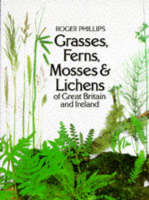
Grasses, Ferns, Mosses & Lichens by Roger PhillipsGrasses, Ferns, Mosses and Lichens of Great Britain and Ireland, Roger Phillips (1980)

Language doesn’t create the world, but it can manipulate the way we see it or can focus our attention on things we were overlooking. When I read a book on architecture and learnt about the three classic forms of column – Doric, Ionic, and Corinthian – I started to see them everywhere in towns and cities. Something similar happened to me because of this book. After leafing through its colour photos, I suddenly started noticing moss much more. And it’s worth noticing, both scientifically and aesthetically. It’s a humble but fascinating plant and has a surprising beauty and variety: Thuidium tamariscinum, common tamarisk-moss, for example, looks as though it should be with the ferns, because it has a similar branching structure. Lichens aren’t beautiful in their own right like mosses, but they can create beautiful patterns and colours on rock and stonework. And like mosses, they’re something humble that should make us humble: they’ve been around for much longer than we have and may be around long after we’re gone.

The same is true of ferns and grasses, though I have to admit that I still find it hard to see much interest in grasses. I know that interest is there, but they still seem dull. Ferns don’t, despite being a simpler plant. But they have a romance that grasses lack. You could call them the Celts of the vegetable kingdom: pushed to the fringes by later invaders. Where once they ruled the world, now they’re confined to specialized habitats. Damp ones. Meeting ferns at home can be refreshing in all sorts of ways: the air is cool and moist and their green is easy on the eye. I like their fractal structure too and there’s even a fern that refreshes the nose: mountain fern, Oreopteris limbosperma, which has a “strong almost citron scent released by brushing past or rubbing the leaves”. The scientific names are fascinating too and books like this are spiritually refreshing in our increasingly soulless, mechanized and electronic world. Leafing through Grasses, Ferns, Mosses and Lichens is like taking a walk through woods and mountains without leaving your chair. Lots of people like flowers and trees, and lots of places host them. These botanical groups are much more specialized and easy to overlook, confined to the fringes of our world, and have a cult-appeal that reminds me of obscure forms of music or art.

Pre-previously posted (please peruse):

Mushrooms, Roger Phillips

Get Your Locks Off

Led Zeppelin, Ray Tedman (Titan Books, 2011)

Front cover of Led Zeppelin by Ray Tedman

The most important thing in this big book of photographs is, of course, Robert Plant’s hair, which often looks remarkably like mine in both its colour and its curliness. There’s also little to choose between me and Robert Plant in the sex-god stakes, so I’ve often wondered precisely whose gigs my mother was attending in her youth (related rumours circulate, muso mutato et mama mutata, about at least one other keyly committed core component of the counter-cultural community). These aren’t unusual thoughts for me when I look at a book about Led Zeppelin: their hair interests me more than their harmonics. I usually get bored well before songs like “Whole Lotta Love” and “Stairway to Heaven” are over and I would much rather listen to the Beatles or Black Sabbath, even at their worst, than to Led Zeppelin, even at their best.

But, at their best, before their locks were shorn as the 1970s ended, Led Zeppelin did look much more like rock-gods than either the Beatles or Black Sabbath. One thing all three bands have in common is their classic quadrivalency: there are four men in each filling the four standard rock roles. I’ve outlined my humorous theory of the classic guitar-bass-drums-vocals line-up elsewhere, so all I’ll say here is that Led Zeppelin fit the theory well. Each member has a distinct personality as he plays a distinct instrument. Each is also distinct in appearance: Jimmy Page is rake-thin, Robert Plant well-built, John Paul Jones average, and Bonzo stocky. Bonzo always had facial hair too, which must say something about his psychology. The colour of his hair certainly says something about his psychology. Like skin-colour and eye-colour, hair-colour is a chemical phenomenon: different colours signal different chemicals or different levels of chemical in the body, and so in the brain. Lighter hair, like lighter skin and eyes, tends to go with a more introverted, less aggressive personality and it may be significant that Robert Plant and John Paul Jones, with lighter hair, are said to have been the two best-behaved members of Led Zeppelin. Black-haired Bonzo was notoriously bestial and also the heaviest drinker. Jimmy Page wasn’t violent, despite having black hair, but his somatype, or body-shape, doesn’t predict violence.

His face may predict high intelligence and high artistic achievement, however: he has always been a good-looking man. Good looks are related to symmetry, and symmetry is related to intelligence and coordination. Again, this isn’t an absolute rule: good-looking people can be stupid and bad at music, just as ugly people can be intelligent and good at music, and strange things can sometimes happen at the extremes of the bell-curve. But biology is about averages and tendencies, not absolutes, and biology is central to understanding human beings and their behaviour. That’s one of the things I find interesting about looking through this book, but there’s much more than individual biology at work here. Led Zeppelin followed fashions as well as setting them and faithfully reflected the look of the three decades in which they existed: the ’60s, the ’70s, and the ’80s.

Or first year of the ’80s, anyway: Bonzo died on 25th September 1980 and the band broke up. The book then follows Plant and Page into their solo careers and their occasional re-unions with Jones, but nobody looks as good as he did in the band’s mid-’70s prime, when their locks were longest and their testosterone levels highest. Endocrinology, or the science of hormones, is another essential part of understanding human behaviour and rock music at its loudest may influence hormones with more than its rhythms and melodies. High volume affects the entire body, not just the ears, and Led Zep were loud and proud, a band who shook the glands of their fans in more ways than one. As I’ve said, I’m not a big fan of Led Zeppelin myself, but if you are I can recommend this book. The photos range from the casual to the candid, the rampant to the risible, the phallocratic to the fan-worshipped, and there are regular biographical pages to guide you through the Led Zeppelin story. Oh, and there’s an index too, which books like this often lack.


Light and Shade: Conversations with Jimmy Page, Brad Tolkinski (Virgin Books, 2012)
Front cover of Light and Shade Conversations with Jimmy Page by Brad Tolinski
I’ve seen too many bad bios about big beasts of the rock jungle to expect much when I pick up a new one, but I was pleasantly surprised by Light and Shade. It does descend into rock-journalese from time to time – Cream and Jimi Hendrix adopted “a new, heavily riff-driven mode of expression” in 1967, apparently – but the conversations with Page are interesting, intelligent, and even impish, as when Page reveals he can mock himself:

On your 1973 tour you started using your own private plane, the Starship. Was that a good thing, or did it just guarantee that the party could continue and you’d never have a moment of rest?

No, it was a good thing. It was a place where you could bring your music and books and create some semblance of continuity as you travelled from city to city. However, [our former tour manager] Richard Cole ran into one of the air hostesses on the Starship recently and she told him, “You know we made a lot of money off you guys,” and Cole asked her how. “Well,” she explained, “when people on the plane used to sniff cocaine, they’d roll up hundred-dollar bills to use as straws. Then after they were high or passed out, they’d forget about the money. So we would go around and grab all the money that was laying around.” That might’ve been true, but I’ll tell you one thing: They never got any of my money! [laughs]

(Ch. 7, “The tours were exercises in pure hedonism…”, pg. 172)

And now you know, if you didn’t already, why Page has the nickname “Led Wallet”: he has always been canny with his cash. But don’t be misled by the coke reference or the chapter-title: this isn’t Hammer of the Gods, the most notorious of the Zeppographies, so the sex’n’drugs side of Page’s rock’n’roll story doesn’t get anywhere near as much attention as his music, his metaphysics, and his mutating fashions. There aren’t many photos, but they’re all well-chosen and you can trace the evolution of Page’s looks, locks, and collaborations right from the 1960s to the present day. There are also contributions from John Paul Jones, Jack White of the White Stripes, publicists, guitar experts and fashionistas, so you do get a well-rounded portrait of an interesting and highly influential musician. I’m not a big Led Zeppelin fan and I still liked this book. And regretted the absence of an index. So it’s a shade light there. Otherwise, it should provide many pages of pleasure for Page-o-philes.

Vapor Tales

Frogs: Inside Their Remarkable World, Ellin Beltz (2005)

Everyone say “eye”. Because I think that is one of the most important reasons that frogs and toads are so endearing. Their large eyes and their large mouths make them seem full of character and full of interest in the world. Their four limbs and plumpness are important too, I think, and I suspect that looking at them activates some of the same regions of the brain as looking at a baby does. All that would certainly help explain why we like them. The Californian herpetologist Ellin Beltz doesn’t spend long examining the roots of the human affection for and interest in the batrachians, as frogs and toads are called. “Is it perhaps that frogs look and act rather like people?” she asks and then gets on with the science. But she herself is obviously a dedicated batrachophile and she’s written an interesting and exhaustive introduction to what is indeed a remarkable world. There are frogs smaller than a human fingernail, like Psyllophryne didactyla, the gold frog of southeastern Brazil, and frogs larger than a human head. Or one species larger than some heads, anyway: Conraua goliath, the goliath frog of Cameroon. There are also frogs, the Malaysian Rhacophorus spp.,* that fly, or glide, at least, on the extended webbing between their toes, and frogs that literally stick around for sex: “males of the genus Breviceps from southern Africa” have very “short front legs” and “use special skin secretions to glue themselves onto the females” (pg. 149). Elsewhere, the Australian desert spadefoot toad, Notaden nichollsi, uses a “smelly skin secretion” to ward off predators (pg. 58).

(*Sp. = species, singular; spp. = species, plural.)

Front cover of Frogs by Ellin Beltz

That species isn’t very dangerous, but the much smaller poison-arrow frogs of South America definitely are: “the golden dart frog, Phyllobates terribilis, is credited with producing ‘the most toxic naturally occurring substance’ ” (pg. 147). In captivity, deprived of the wild food from which they manufacture their toxins, the poison-arrow frogs are harmless, but their remarkable colours remain: they look like harlequins in all shades of the rainbow. Whether these rainbow frogs are also raines beaux, or “beautiful frogs”, as they might be called in French, is a matter of taste, but some frogs definitely are beautiful. So are some toads: the male golden toad, Bufo periglenes, is a vivid golden-orange. Or rather, was: it was once a tourist attraction as it swarmed “out to mate in great congregations” in the Monteverde Cloud Forest Reserve in Costa Rica, but “photographs seem to be all that remains of this exquisite amphibian” (pg. 43). Yes, the ugliness in this book isn’t supplied only by the villainous-looking cane toad, Bufo marinus, which has been munching and poisoning its way through Australia’s native wildlife since it was foolishly introduced there in 1935. There’s also ugliness in the story of what is happening to the world’s amphibians. They’ve been disappearing everywhere and most of chapter four, “Environment & Adaptation”, is given over to the threats they face from pollution, bacteria, viruses, and various fungi, including the chytrid fungus responsible for “chytridiomycosis, a fatal fungus disease that leads to thickening and sloughing of the skin and death by unknown causes” (pg. 118).

African clawed frogs, Xenopus spp., are “asymptomatic carriers” of chytrid fungus. Because they were once used in pregnancy tests, they have been introduced all over the world and may have helped the fungus spread. However, the ever-growing human population is perhaps the greatest threat to the survival of wild amphibia, as it is to fauna and flora in general. More people mean more roads and more cars, for example:

Roadkill numbers are immense. Frogs don’t even have to be hit by a vehicle; the force of its passing can literally suck them inside out. Hundreds of flattened and inverted corpses lie roadways on rainy nights. (pg. 121)

Some species may be disappearing without ever being recorded. Perhaps the strangest and unfroggy-est frog in this book is Nakisakabatrachus sahyadrensis, the Kerala purple frog of southern India, which has tiny eyes and dark, leathery skin. It lives underground most of the year and was only described by scientists in 2003. Its tiny eyes are part of its adaptation to underground life. Eyes are a guide to ecology in other ways: a batrachian’s angle of vision is a clue to its edibility. Frogs, whose eyes are usually positioned so they can see both ahead and behind, are edible and fear predators. Toads, which usually can’t see behind themselves, are inedible and don’t fear predators. I can remember once picking up a tiny toadlet, or juvenile toad, and feeling my fingers sting from the secretions it released. Among Beltz’ personal anecdotes in this book is one about what happened when she and a colleague found a Couch’s spadefoot toad, Scaphiopus couchii, on the U.S.-Mexico border:

It was drizzling, and I brought the toad into the car for a good identification. We were paging through the field guide and put on the defoggers to clear the windows when we were overcome by a wave of noxious vapor emitted by the toad. It was like teargas and we exploded out of the car, put the toad into a ditch and tried to air out the car. Whatever toxin the toad let loose that night, I was down for 24 hours, sleeping with runny eyes and all the symptoms of a major cold. My colleague was similarly affected. Other reports of noxious fumes from southwestern toads have been [made]. (“Frog Miscellany”, pg. 149)

Stories like that are part of what makes this such an enjoyable book and although, at 175 pages with lots of large photos, it’s too brief to explore thoroughly all the biological topics it raises, there are pointers to some interesting aspects of evolution – and mathematics. Try this description of the Eastern spadefoot, Scaphiopus holbrookii, and plains spadefoot, Spea bombifrons, which live in deserts in North America:

When the rains fall, they congregate at temporary pools to breed. It takes the eggs two weeks to hatch into tadpoles. At this point, more rain is needed; otherwise the pools dry up and the plant-eating tadpoles die. Some tadpoles become cannibalistic under these harsh conditions, permitting some individuals to survive long enough to transform into frogs by eating the bodies of their herbivorous relatives. (ch. 2, “Frog Families”, pg. 37)

Consider the evolutionary mathematics of this cannibalism. It’s easy to understand genes instructing an individual to eat. Less easy to understand are genes that might instruct an individual to let itself be eaten. But the tadpoles in a temporary pool can be seen as a kind of super-organism. The super-organism initially has many mouths to turn algae and so on into tadpole-flesh. Then, as the pool shrinks, the super-organism begins to eat itself, having exploited the resources of the pool with maximum efficiency. It’s possible there is even a class of tadpole that exists to put on flesh fast and then be eaten by its siblings. It would never breed, but evolutionarily speaking that behaviour would be no more paradoxical than the sterile workers among ants, bees and wasps. Or the juvenile birds that let themselves starve to death in an over-crowded, underfed nest. The apparently suicidal genes of a cannibalized tadpole or sterile worker or starved nestling do not survive in that non-breeding individual, but they promote behaviour that enables unactivated copies of themselves to survive better in other individuals – as Richard Dawkins explains in The Blind Watchmaker (1986).

Swimming in another kind of pool is responsible for other evolved features in batrachians: their sometimes vivid colours or cunning camouflage. For millions of years, images of batrachians have been created in the chemical sludge of predators’ brains. And so, like snakes and wasps, batrachians signal their toxicity with colour. Or use colour to disguise their outlines or blend into the background. But batrachians are also like octopuses and other cephalopods: they can change their colour using special structures in their skin called chromatophores. One of the briefest but most interesting sections in this book discusses this shade-shifting and the cells responsible for it: the melanophores (responsible for black and brown colouration), xanthophores (yellow), erythrophores (red and orange), and iridophores (responsible for iridescence in the poison-arrow frogs). But what is briefly mentioned is extensively illustrated: almost every page has one or more colourful photographs of frogs and toads, usually in what appears to be their natural habitat.

There are also diagrams of batrachian anatomy and evolutionary relationships and pictures of art and sculpture in chapter five, “Frogs in Myth and Culture”. You’ll learn in the evolutionary discussions that toads aren’t a distinct group, because they don’t have a single common ancestor distinguishing them from frogs. But they look different to us and chapter five says that they were sacred to Heqet, the Egyptian goddess of childbirth and fertility. She’s depicted with an almost scientifically precise green toad, or Bufo viridis, on an ivory obstetric wand found near Thebes and dating from “around 2000 to 1700 BCE” (pg. 131). That “BCE”, like the “humanmade objects” mentioned on page 47, is a reminder that Ellin Beltz is a modern, and politically correct, American, unlike a Californian born in the Victorian era whose absence can’t, alas, be called a flaw in this book. The Auburn writer Clark Ashton Smith (1893-1961) and his interplanetary toad-god Tsathoggua and man-slaying toad-witch Mère “Mother of Toads” Antoinette aren’t famous and Beltz may never have heard of them. Instead, she discusses Shakespeare and the three toad-toxin-brewing witches of Macbeth (1611), Mark Twain and “The Celebrated Jumping Frog of Calaveras County” (1867), and Kenneth Graham and Toad of Toad Hall from Wind in the Willows (1908).

In short, she covers all the batrachian bases, from biology to books by way of batrachophagous bats and a bee-eating Bufo japonicus. The batrachophage, or frog-eater, is the fringe-lipped bat, Trachops cirrhosus of Central America, which tracks its prey by homing in on their calls. And here’s another acoustic anecdote to end on, demonstrating that Hollywood’s hegemony is partly herpetological:

Chorus frogs, Pseudacris spp., include the Pacific treefrog, Pseudacris regilla, the “ribbet frog” known to every movie fan. At some time in the early days of talkies, someone recorded frogs in a pond, probably near the famous Hollywood sign. The same audio loop is used over and over again in movies, leading to hysteria among amphibian researchers who hear “ribbet” in darkest Africa, South America and Australia… The Pacific treefrog is actually restricted to the western edge of North America. (ch. 2, “Frog Families”, pg. 49)