Maven of Mixcegenation

The obfuscating and intentional doublespeak swirling around the emotive cauldron ingredients of “immigration”, “illegal immigration” and “small boats” has been intentionally leveraged into mainstream political and media jargon by Reform UK, big tech algorithms, and thence into the baying mob. […] We are daily enriched by, and should feel deeply indebted to, the many people of colour in this and other sectors of our society. — “This capitulation to racist rhetoric will not end well for Labour or Britain”, letter by Quentin Cowen of Laxfield, Suffolk in The Guardian, 18xi25


Post-Performative Post-Scriptum

“The obfuscating and intentional doublespeak swirling around the emotive cauldron of…” woulda bin even betterer. If the ingredients aren’t bubbling away in the emotive cauldron, why would doublespeak bother to swirl around them? It certainly wouldn’t swirl around them as much, one would’ve thought. And does “emotive cauldron ingredients” mean “emotive-cauldron ingredients” or “emotive cauldron-ingredients”? Maybe it’s both. I’m also struck by the implications of “intentionally leveraged”. Is it possible to “unintentionally leverage” something? Not in this context, one would have thought. And if doublespeak is swirling, that is, if it’s fluid, it’s hard to see how one could exert leverage on it.

Etc, etc. Like all the best Guardianese, this passage is passionately pregnant with interrogation-inducing imagery in a way that is very difficult to achieve by conscious effort. Perhaps Quentin has been smoking some wacky baccy or other psychoactive stimulant supplied by one of the many Persons of Colour enriching his life and fighting da power in da extensive hoodz of Laxfield, Suffolk.

Apostrophizing Andy

If you get it, you’ll laugh. If you don’t, you won’t:

Eee, I know what you mean. Shine’s gone off this government faster than gravy off chips, as we say up here in the North, where I authentically am. What t’party needs is a leader who’s reet proper connected with t’working man. In terms of names, we’ll see to that when dog’s in t’barn, as Northerners like me say up here in the North. — “Mandelson: Let’s chat about Keir…”, 29ix25

Well, I laughed anyway. That’s Robert Hutton in The Critic joking about the prime-ministerial ambitions of Andy Burnham, the mayor of Manchester. And I’m wondering about the “In terms of names…” I think it’s there for deliberate contrast. As I’ve endlessly adumbrated in terms of Overlord-of-theÜber-Feral, “in terms of” is an ugly, pretentious piece of bureaucratese that’s keyly characteristic of politicians, lawyers, academics in the humanities, and other core communities of windbags. In short, it’s highly bourgeois.

And I reckon that’s why Hutton put it into his mockery of Burnham, who’s pretending to be reet down-to-earth but can’t help letting his true nature coom through. Whatever his roots, he’s a bourgeois bureaucrat now. If I’m right, then Hutton recognizes the rebarbativity of “in terms of”. Good on ya, Bob. But bad on ya for getting the northern accent wrong. The apostrophe’s in the wrong place: “t’party” and “t’working man” should be “’t party” and “’t working man”, because that northern form of the definite article doesn’t represent thet’ but that’t (in Old English þæt was the neuter form of the definite article, while the masculine and feminine forms were and sēo). You can hear the truth in the glottal stop, which is sometimes all that’s left of the original “that”. In fact, that’s what “t’” is generally a bad transcription of — a glottal stop, “ʔ” in phonetic transcription. But in some dialects of northern English, the glottal stop disappears too, so there’s no definite article and English weirdly seems like Latin or Russian or some other language that doesn’t use definite articles.

You can see Mancunian English moving towards no-definite-article with “Shine’s gone off this government…” But the most natural way to read that line is with a glottal stop: “ʔShine’s gone off this government…” If Hutton meant it to be read like that, he’s implicitly recognizing that “t’” is a bad transcription. “T’shine’s gone off…” would sound like “Chine’s gone off…” But no Mancunian would say it like that. Something else that no Mancunian would say is that the Fat Slags are from Newcastle. But that’s a story for another day.


Peri-Performative Post-Scriptum

As is usual with sociology or biology, the story of the northern definite article is much more complicated than a short discussion can cover. And I can’t remember where I read about its true origins and can’t find anything online at the moment. But this supports what I’m saying:

The phenomenon of Definite Article Reduction (DAR) is the realization of the definite article in northern British English dialects in a range of vowel-less forms, usually written t’ in literature. The origin of DAR is assumed to be the assimilation of the initial fricative of the Middle English definite article þe to produce a te form, a sound change recorded for many dialects of Middle English. This article examines the validity of this hypothesis by analysing the distribution of fricative allomorphs in the modern dialects in comparison with the details of the Middle English change. The predicted distribution of fricative forms is not found at most localities, indicating that the development hypothesis is incorrect, but the available data are too scanty to suggest an alternative model. — “The origin of Definite Article Reduction in northern English dialects: evidence from dialect allomorphy, Mark J. Jones in English Language and Linguistics, November 2002


Pooh Pooh-Poohed

A.A. Milne’s Winnie-the-Pooh (1926) is a core kiddy-culture classic. And I’ve always been a big fan. Especially of Eeyore. But it wasn’t till 2025 that I noticed a big bit of bad writing in the book. Or maybe it isn’t. Maybe the redundancy here is more natural English than the same passage with the redundancy removed. But I still think removing the redundancy makes it read better. See for yourself:

One day when he was out walking, he [Winnie-the-Pooh] came to an open place in the middle of the forest, and in the middle of this place was a large oak-tree, and, from the top of the tree, there came a loud buzzing-noise.

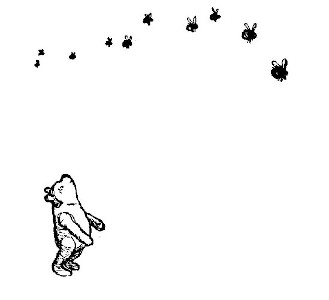
In this drawing, Winnie-the-Pooh is peering up. There are tiny things swarming around up there.

Winnie-the-Pooh sat down at the foot of the tree, put his head between his paws and began to think.

First of all he said to himself: “That buzzing-noise means something. You don’t get a buzzing-noise like that, just buzzing and buzzing, without its meaning something. If there’s a buzzing-noise, somebody’s making a buzzing-noise, and the only reason for making a buzzing-noise that I know of is because you’re a bee.”

Then he thought another long time, and said: “And the only reason for being a bee that I know of is making honey.”

And then he got up, and said: “And the only reason for making honey is so as I can eat it.” So he began to climb the tree. — Winnie-the-Pooh, chapter 1

REMOVING

REDUNDANCY

One day when he was out walking, he came to an open place in the middle of the forest, and in the middle of this place was a large oak-tree, and, from the top of the tree, there came a loud buzzing.

In this drawing, Winnie-the-Pooh is peering up. There are tiny things swarming around up there.

Winnie-the-Pooh sat down at the foot of the tree, put his head between his paws and began to think.

First of all he said to himself: “That buzzing means something. You don’t get a buzzing like that, just buzzing and buzzing, without its meaning something. If there’s a buzzing, somebody’s making a buzzing, and the only reason for making a buzzing that I know of is because you’re a bee.”

Then he thought another long time, and said: “And the only reason for being a bee that I know of is making honey.”

And then he got up, and said: “And the only reason for making honey is so as I can eat it.” So he began to climb the tree. — Winnie-the-Pooh, chapter 1


Elsewhere Other-Accessible…

Winnie-the-Pooh (1926) at Gutenberg

Previously Pre-Posted…

Noise Annoys — discussion of the redundancy of “noise”
Nice Noise — more discussion of the redundancy of “noise”

Kore. Kounter-Kultural. Kommandments.

One thing I’ve noticed about in terms of the hardcore heretics and mentally magnipotent mega-mavericks who corely comprise the counter-cultural community… is that… some of them can get very upset… if you don’t think in exactly the same way as… they do and/or you criticize and/or… question anything they like, like…

With this in mind, I’ve drawn up some key counter-cultural commandments for anyone who wants to gain and/or retain popularity and/or influence among in terms of the hardcore heretics and mentally magnipotent mega-mavericks who corely comprise the counter-cultural community…

• Thou shalt NOT mock The Guardian and/or Guardian-adjacent media outlets…
• Thou shalt NOT exhibit sniffy superiority towards vis à vis folk with EngLit and/or Film Studies and/or EngLit-and/or-Film-Studies-adjacent degrees…
• Thou shalt NOT pyogenically problematize use of italics or trailing dots
• Thou shalt NOT teratically toxicize “in terms of”, “prior to”, “core”, “key” or “toxicity”…
• Thou shalt NOT atrabiliously aspersicize the 2SLGBTQ+ Community
• Thou shalt NOT even hint that American English and/or usage [CENSORED]
• Thou shalt NOT say Cormac was Crap
• Thou shalt NOT refer to reference Mike Moorcock as “Britain’s biggest bearded Burroughsian lit-twat”…

But above all

• Thou shalt NOT suggest that crisps are a key component of core counter-culturalicity (wow)…

So. Now. You. Know.

[Parallel-Posted at Papyrocentric Performativity]

Penny’s Petrified Parade

“Without political agitation, sex can always be co-opted, calcifying gender revolution into another weary parade of saleable binary stereotypes.” — Laurie Penny, Meat Market: Female Flesh Under Capitalism (2011)

Viler Smiler

Less is more. It’s a principle for good writing, not an unalterable law. And one of the best expositions of the principle was given by A.E. Housman in his lecture “The Name and Nature of Poetry” (1933):

Dryden’s translation [of The Canterbury Tales] shows Dryden in the maturity of his power and accomplishment, and much of it can be honestly and soberly admired. Nor was he insensible to all the peculiar excellence of Chaucer: he had the wit to keep unchanged such lines as ‘Up rose the sun and up rose Emily’ or ‘The slayer of himself yet saw I there’; he understood that neither he nor anyone else could better them. But much too often in a like case he would try to improve, because he thought that he could. He believed, as he says himself, that he was ‘turning some of the Canterbury Tales into our language, as it is now refined’; ‘the words’ he says again ‘are given up as a post not to be defended in our poet, because he wanted the modern art of fortifying’; ‘in some places’ he tells us ‘I have added somewhat of my own where I thought my author was deficient, and had not given his thoughts their true lustre, for want of words in the beginning of our language’.

Let us look at the consequences. Chaucer’s vivid and memorable line

The smiler with the knife under the cloke

becomes these three:

Next stood Hypocrisy, with holy leer,
Soft smiling and demurely looking down,
But hid the dagger underneath the gown.

Again:

Alas, quod he, that day that I was bore.

So Chaucer, for want of words in the beginning of our language. Dryden comes to his assistance and gives his thoughts their true lustre thus:

Cursed be the day when first I did appear;
Let it be blotted from the calendar,
Lest it pollute the month and poison all the year.

Or yet again:

The queen anon for very womanhead
Gan for to weep, and so did Emily
And all the ladies in the company.

If Homer or Dante had the same thing to say, would he wish to say it otherwise? But to Dryden Chaucer wanted the modern art of fortifying, which he thus applies:

He said; dumb sorrow seized the standers-by.
The queen, above the rest, by nature good
(The pattern formed of perfect womanhood)
For tender pity wept: when she began
Through the bright quire the infectious virtue ran.
All dropped their tears, even the contended maid.


• “The Name and Nature of Poetry” (1933) by A.E. Housman — more of “less is more”

So, In Terms of Transgenderism…

Beth Rigby, Sky News: This is an image we’ve seen a lot of recently, it’s a podium with a trans woman coming first and a biological women coming second and third. Do you think that’s fair, Ian?

Ian Anderson of Stonewall: So, sport by sport, people are looking at this. On elite sport, what you’re finding is that sporting body by sporting body is looking at this issue.

BR: Let me put it another way, how would you feel if you were number two and three in that scenario? Do you think that was fair?

IA: Well, I’m absolutely rubbish at sport.

BR: You know what I mean. How do you think this woman, this woman might feel about that?

IA: Yeah, so, I mean, everybody, we’re working our way through on this, this is, I mean, this is, I mean, how trans folk take part in elite sport.

BR: But this is a problem, isn’t it? Do you see this as a problem?

IA: So, I think it’s a problem in terms of the perception of the conversation.

[etc]

• “The Idiocy of Stonewall”, Julie Bindel

Give It Some Pivot

Hydrology, geology, acoustics and more combine in one magnificently muddled mixed metaphor:

When [Emily] Pankhurst ordered her followers to stop bombing the British state and start helping to arm it for the war effort [after 1914], it left some of the most radicalized to fall into “a feminist-fascist estuary formed in the crater generated by Mrs Pankhurst’s pivot from law-breaking insurgency to conformist cheerleading”. — ‘It’s a scary time’: Sophie Lewis on the ‘enemy feminisms’ that enable the far right, The Guardian, 21ii25

Among the baffling questions raised by the metaphor is this: Why “estuary”? It would make sense to say “[fall into] a stagnant and stinking feminist-fascist pool formed in the crater…” But estuaries aren’t stagnant and craters don’t create estuaries anyway. Rivers do when they flow into a sea or lake. What would the river and sea represent?

I’ve no idea. And I would find it very difficult to match that mixed metaphor without making it seemed contrived or confected. Mixed metaphors are a zen thing: for best effect, they’ve got to flow from the fingertips or float off the tongue without effort, welling up from a bottomless crater of bollocks like a meth-smoking bull in a china-shop riding a feral tsunami of unhinged imagery and clashing comparativization.

Miximal Metaphors

“Each of Robyn’s three Honey-era Later performances featured a moment. Towards the end of ‘Missing U’, she finally stared down the camera, having avoided eye contact for fear of emotional collapse, while during ‘Honey’ she did away with the mic stand to make room for supple dance moves. With ‘Every Heartbeat’, meanwhile, peaked when she punctured the highwire emotional blood-letting with a cheeky wink.” — “The 100 greatest BBC music performances – ranked!”, The Guardian, 6×22


Post-Performative Post-Scriptum…

If you think it’s easy to mix so many metaphors in so few words, all I can say is: Try it for yourself!