
Un moine au milieu de la messe
S’eleva et cria en détresse:
« La vie religieuse,
C’est sale et affreuse! »
Et se poignarda dans les fesses. — Edward Gorey (1925-2000)
Category Archives: Literature
Home of the Gits
“They’re not misanthropic, they’re just rude.” — drummer Justin Greaves on his former bandmates in Electric Wizard, as reported in Dan Franklin’s Heavy: How Metal Changes the Way We See the World (2020)
Double-Gweeling

My short-story collection Gweel & Other Alterities has very kindly been re-published by D.M. Mitchell at Incunabula:
• Gweel & Other Alterities – Incunabula’s new edition
• Once More (With Gweeling) – my short review of the new edition
• Incunabula Media — wildness and weirdness in words and more

(click for larger image)
Sprung from the Tongue
• Quot linguas calles, tot homines vales. — attributed to the polyglot Holy Roman Emperor Charles V
• • You’re worth as many people as the languages you speak.
• • The more languages you speak, the more people you are.
• • Speak a new language, be a new person.
• • New language, new person.
• • New tongue, new man.
Lux Legibilis
I wake from dreams and turning
My vision on the height
I scan the beacons burning
About the fields of night.
Each in its steadfast station
Inflaming heaven they flare;
They sign with conflagration
The empty moors of air.
The signal-fires of warning
They blaze, but none regard;
And on through night to morning
The world runs ruinward. — A.E. Housman in More Poems (1936)
There was a young fellow named Bright
Who travelled much faster than light.
He set off one day,
In a relative way
And came back the previous night. — Anonymous
Lord, What Fuels These Portals Be!
Midnight, one more night without sleeping.
Watching ’til that morning comes creeping.
Green Door: what’s that secret you’re keeping?There’s an old piano and they play it hot behind the green door!
Don’t know what they’re doing but they laugh a lot behind the green door.
Wish they’d let me in so I could find out what’s behind the green door.Knocked once, tried to tell ’em I’d been there.
Door slammed — hospitality’s thin there.
Wondering just what’s going on in there.Saw an eyeball peepin’ through a smoky cloud behind the green door.
When I said “Joe sent me” someone laughed out loud behind the green door.
All I want to do is join the happy crowd behind the green door.
Otra noche mas que no duermo.
Otra noche mas que se pierde.
¿Que habrá tras esa puerta verde?
Suena alegremente un piano viejo
tras la puerta verde.Todos ríen y no se que pasa
tras la puerta verde
No descansaré hasta saber que hay
tras la puerta verde.Toqué, y cuando contestaron
dije ¡Ah! que a mí me llamaron.
Risas, y enseguida me echaron.Sólo pude ver que mucha gente allí se divertía,
y entre tanto humo todo allí se confundía.
Yo quisiera estar al otro lado de la puerta verde.Otra noche mas que no duermo.
Otra noche mas que se pierde.
¿Que habrá tras esa puerta verde?
¿Que habrá tras esa puerta verde?
¿Que habrá?
Elsewhere Other-Accessible…
• “The Green Door” (1956), music by Bob “Hutch” Davie and lyrics by Marvin J. Moore
Tête avec Texte
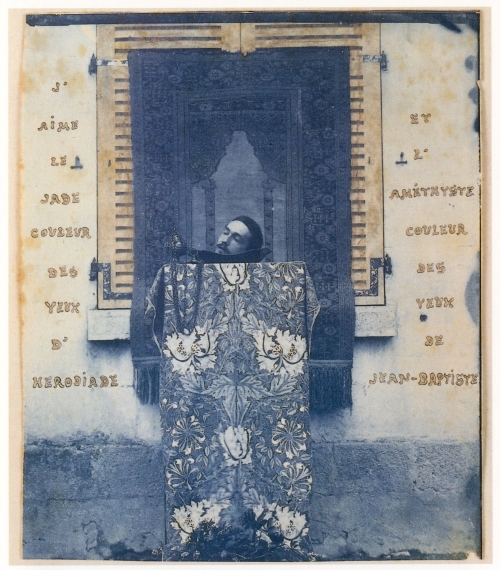
Above you can see the Peacock on a Platter, or Robert de Montesquiou posing as the severed head of John the Baptist and flanked by relevant lines of his own poetry. But there’s a better version of the poetry, as you can see by comparing the photo with this:
J’aime le jade,
Couleur des yeux
D’HérodiadeEt l’améthyste,
Couleur du sang
De Jean-Baptiste. — from “Robert de Montesquiou: The Magnificent Dandy” (1962) by Cornelia Otis Skinner
I love jade,
Color of the eyes
Of HerodiasAnd amethyst,
Color of the blood
Of John the Baptist.
Elsewhere Other-Accessible…
• Portrait of a Peacock — Cornelia Otis Skinner’s excellent essay on Montesquiou
• Le Paon dans les Pyrénées — review of Julian Barnes’ not-so-good book partly about Montesquiou
Moz on Mogz
“The basic fascination I have with cats is nothing unusual. I find them very intelligent and very superior. And I feel entranced by them. If I see one in the street I feel immediately drawn to the cat. I have a friend, Chrissie Hynde [the singer with The Pretenders], she’s exactly the same. You can be walking with her along the street, she sees a cat, she walks away. You continue to walk on, talking to no one. You look around and she’s crouched down with a cat in a hedge. I’m exactly the same way. I’m fascinated by them.” — “Morrissey on… privacy, the Queen and The Smiths”, The Daily Telegraph, 17vi11
Hymn to Heresy
Hymn to Proserpine
After the Proclamation in Rome
of the Christian Faith
by ALGERNON CHARLES SWINBURNE
Vicisti, Galilæe.
I have lived long enough, having seen one thing, that love hath an end;
Goddess and maiden and queen, be near me now and befriend.
Thou art more than the day or the morrow, the seasons that laugh or that weep;
For these give joy and sorrow; but thou, Proserpina, sleep.
Sweet is the treading of wine, and sweet the feet of the dove;
But a goodlier gift is thine than foam of the grapes or love.
Yea, is not even Apollo, with hair and harpstring of gold,
A bitter God to follow, a beautiful God to behold?
I am sick of singing; the bays burn deep and chafe: I am fain
To rest a little from praise and grievous pleasure and pain.
For the Gods we know not of, who give us our daily breath,
We know they are cruel as love or life, and lovely as death.
O Gods dethroned and deceased, cast forth, wiped out in a day!
From your wrath is the world released, redeemed from your chains, men say.
New Gods are crowned in the city; their flowers have broken your rods;
They are merciful, clothed with pity, the young compassionate Gods.
But for me their new device is barren, the days are bare;
Things long past over suffice, and men forgotten that were.
Time and the Gods are at strife; ye dwell in the midst thereof,
Draining a little life from the barren breasts of love.
I say to you, cease, take rest; yea, I say to you all, be at peace,
Till the bitter milk of her breast and the barren bosom shall cease.
Wilt thou yet take all, Galilean? but these thou shalt not take,
The laurel, the palms and the pæan, the breasts of the nymphs in the brake;
Breasts more soft than a dove’s, that tremble with tenderer breath;
And all the wings of the Loves, and all the joy before death;
All the feet of the hours that sound as a single lyre,
Dropped and deep in the flowers, with strings that flicker like fire.
More than these wilt thou give, things fairer than all these things?
Nay, for a little we live, and life hath mutable wings.
A little while and we die; shall life not thrive as it may?
For no man under the sky lives twice, outliving his day.
And grief is a grievous thing, and a man hath enough of his tears:
Why should he labour, and bring fresh grief to blacken his years?
Thou hast conquered, O pale Galilean; the world has grown grey from thy breath;
We have drunken of things Lethean, and fed on the fullness of death.
Laurel is green for a season, and love is sweet for a day;
But love grows bitter with treason, and laurel outlives not May.
Sleep, shall we sleep after all? for the world is not sweet in the end;
For the old faiths loosen and fall, the new years ruin and rend.
Fate is a sea without shore, and the soul is a rock that abides;
But her ears are vexed with the roar and her face with the foam of the tides.
O lips that the live blood faints in, the leavings of racks and rods!
O ghastly glories of saints, dead limbs of gibbeted Gods!
Though all men abase them before you in spirit, and all knees bend,
I kneel not neither adore you, but standing, look to the end.
All delicate days and pleasant, all spirits and sorrows are cast
Far out with the foam of the present that sweeps to the surf of the past:
Where beyond the extreme sea-wall, and between the remote sea-gates,
Waste water washes, and tall ships founder, and deep death waits:
Where, mighty with deepening sides, clad about with the seas as with wings,
And impelled of invisible tides, and fulfilled of unspeakable things,
White-eyed and poisonous-finned, shark-toothed and serpentine-curled,
Rolls, under the whitening wind of the future, the wave of the world.
The depths stand naked in sunder behind it, the storms flee away;
In the hollow before it the thunder is taken and snared as a prey;
In its sides is the north-wind bound; and its salt is of all men’s tears;
With light of ruin, and sound of changes, and pulse of years:
With travail of day after day, and with trouble of hour upon hour;
And bitter as blood is the spray; and the crests are as fangs that devour:
And its vapour and storm of its steam as the sighing of spirits to be;
And its noise as the noise in a dream; and its depth as the roots of the sea:
And the height of its heads as the height of the utmost stars of the air:
And the ends of the earth at the might thereof tremble, and time is made bare.
Will ye bridle the deep sea with reins, will ye chasten the high sea with rods?
Will ye take her to chain her with chains, who is older than all ye Gods?
All ye as a wind shall go by, as a fire shall ye pass and be past;
Ye are Gods, and behold, ye shall die, and the waves be upon you at last.
In the darkness of time, in the deeps of the years, in the changes of things,
Ye shall sleep as a slain man sleeps, and the world shall forget you for kings.
Though the feet of thine high priests tread where thy lords and our forefathers trod,
Though these that were Gods are dead, and thou being dead art a God,
Though before thee the throned Cytherean be fallen, and hidden her head,
Yet thy kingdom shall pass, Galilean, thy dead shall go down to thee dead.
Of the maiden thy mother men sing as a goddess with grace clad around;
Thou art throned where another was king; where another was queen she is crowned.
Yea, once we had sight of another: but now she is queen, say these.
Not as thine, not as thine was our mother, a blossom of flowering seas,
Clothed round with the world’s desire as with raiment, and fair as the foam,
And fleeter than kindled fire, and a goddess, and mother of Rome.
For thine came pale and a maiden, and sister to sorrow; but ours,
Her deep hair heavily laden with odour and colour of flowers,
White rose of the rose-white water, a silver splendour, a flame,
Bent down unto us that besought her, and earth grew sweet with her name.
For thine came weeping, a slave among slaves, and rejected; but she
Came flushed from the full-flushed wave, and imperial, her foot on the sea.
And the wonderful waters knew her, the winds and the viewless ways,
And the roses grew rosier, and bluer the sea-blue stream of the bays.
Ye are fallen, our lords, by what token? we wise that ye should not fall.
Ye were all so fair that are broken; and one more fair than ye all.
But I turn to her still, having seen she shall surely abide in the end;
Goddess and maiden and queen, be near me now and befriend.
O daughter of earth, of my mother, her crown and blossom of birth,
I am also, I also, thy brother; I go as I came unto earth.
In the night where thine eyes are as moons are in heaven, the night where thou art,
Where the silence is more than all tunes, where sleep overflows from the heart,
Where the poppies are sweet as the rose in our world, and the red rose is white,
And the wind falls faint as it blows with the fume of the flowers of the night,
And the murmur of spirits that sleep in the shadow of Gods from afar
Grows dim in thine ears and deep as the deep dim soul of a star,
In the sweet low light of thy face, under heavens untrod by the sun,
Let my soul with their souls find place, and forget what is done and undone.
Thou art more than the Gods who number the days of our temporal breath;
Let these give labour and slumber; but thou, Proserpina, death.
Therefore now at thy feet I abide for a season in silence. I know
I shall die as my fathers died, and sleep as they sleep; even so.
For the glass of the years is brittle wherein we gaze for a span;
A little soul for a little bears up this corpse which is man.
So long I endure, no longer; and laugh not again, neither weep.
For there is no God found stronger than death; and death is a sleep.
So long I endure, no longer; and laugh not again, neither weep.
For there is no God found stronger than death; and death is a sleep.
Elsewhere Other-Accessible…
• “Hymn to Proserpine” (1866) at Wikipedia
Cosa Globosa
• Il calcio è la cosa più importante delle cose meno importanti — Arrigo Sacchi
• • “Football is the most important of the unimportant things in life.” — Arrigo Sacchi
 Overlord In Terms of Core Issues Around Maximal Engagement with Key Notions of the Über-Feral