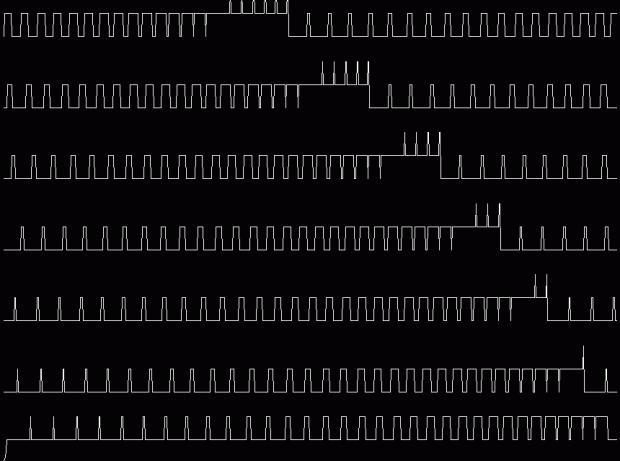
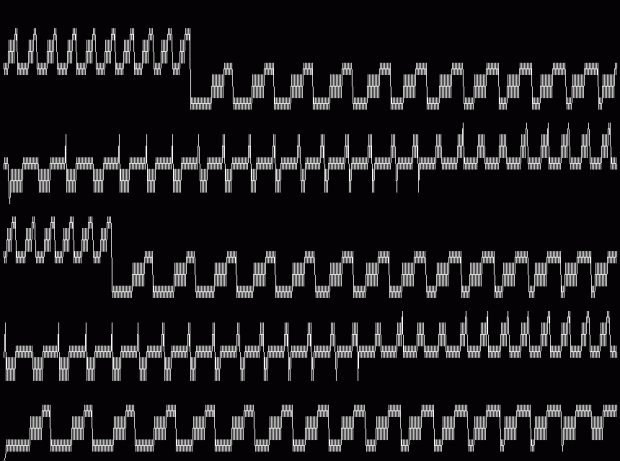
What a difference a digit makes. Suppose you take all representations of n in bases b <= n. When n = 3, the bases are 2 and 3, so 3 = 11 and 10, respectively. Next, count the occurrences of the digit 1:
digitcount(3, digit=1, n=11, 10) = 3
Add this digit-count to 3:
3 + digitcount(3, digit=1, n=11, 10) = 3 + 3 = 6.
Now apply the same procedure to 6. The bases will be 2 to 6:
6 + digitcount(6, digit=1, n=110, 20, 12, 11, 10) = 6 + 6 = 12
The procedure, n = n + digitcount(n,digit=1,base=2..n), continues like this:
12 + digcount(12,dig=1,n=1100, 110, 30, 22, 20, 15, 14, 13, 12, 11, 10) = 12 + 11 = 23
23 + digcount(23,dig=1,n=10111, 212, 113, 43, 35, 32, 27, 25, 23, 21, 1B, 1A, 19, 18, 17, 16, 15, 14, 13, 12, 11, 10) = 23 + 21 = 44
44 + digcount(44,dig=1,n=101100, 1122, 230, 134, 112, 62, 54, 48, 44, 40, 38, 35, 32, 2E, 2C, 2A, 28, 26, 24, 22, 20, 1L, 1K, 1J, 1I, 1H, 1G, 1F, 1E, 1D, 1C, 1B, 1A, 19, 18, 17, 16, 15, 14, 13, 12, 11, 10) = 44 + 31 = 75
And the sequence develops like this:
3, 6, 12, 23, 44, 75, 124, 202, 319, 503, 780, 1196, 1824, 2766, 4191, 6338, 9546, 14383, 21656, 32562, 48930, 73494, 110361, 165714, 248733, 373303, 560214, 840602, 1261237, 1892269, 2838926, 4258966, 6389157, 9584585, 14377879…
Now try the same procedure using the digit 0: n = n + digcount(n,dig=0,base=2..n). The first step is this:
3 + digcount(3,digit=0,n=11, 10) = 3 + 1 = 4
Next come these:
4 + digcount(4,dig=0,n=100, 11, 10) = 4 + 3 = 7
7 + digcount(7,dig=0,n=111, 21, 13, 12, 11, 10) = 7 + 1 = 8
8 + digcount(8,dig=0,n=1000, 22, 20, 13, 12, 11, 10) = 8 + 5 = 13
13 + digcount(13,dig=0,n=1101, 111, 31, 23, 21, 16, 15, 14, 13, 12, 11, 10) = 13 + 2 = 15
15 + digcount(15,dig=0,n=1111, 120, 33, 30, 23, 21, 17, 16, 15, 14, 13, 12, 11, 10) = 15 + 3 = 18
18 + digcount(18,dig=0,n=10010, 200, 102, 33, 30, 24, 22, 20, 18, 17, 16, 15, 14, 13, 12, 11, 10) = 18 + 9 = 27
27 + digcount(27,dig=0,n=11011, 1000, 123, 102, 43, 36, 33, 30, 27, 25, 23, 21, 1D, 1C, 1B, 1A, 19, 18, 17, 16, 15, 14, 13, 12, 11, 10) = 27 + 7 = 34
34 + digcount(34,dig=0,n=100010, 1021, 202, 114, 54, 46, 42, 37, 34, 31, 2A, 28, 26, 24, 22, 20, 1G, 1F, 1E, 1D, 1C, 1B, 1A, 19, 18, 17, 16, 15, 14, 13, 12, 11, 10) = 34 + 8 = 42
42 + digcount(42,dig=0,n=101010, 1120, 222, 132, 110, 60, 52, 46, 42, 39, 36, 33, 30, 2C, 2A, 28, 26, 24, 22, 20, 1K, 1J, 1I, 1H, 1G, 1F, 1E, 1D, 1C, 1B, 1A, 19, 18, 17, 16, 15, 14, 13, 12, 11, 10) = 42 + 9 = 51
The sequence develops like this:
3, 4, 7, 8, 13, 15, 18, 27, 34, 42, 51, 59, 62, 66, 80, 94, 99, 111, 117, 125, 132, 151, 158, 163, 173, 180, 204, 222, 232, 244, 258, 279, 292, 307, 317, 324, 351, 364, 382, 389, 400, 425, 437, 447, 454, 466, 475, 483, 494, 509, 517, 536, 553, 566, 576, 612, 637, 649, 669, 679, 693, 712, 728, 753, 768, 801, 822, 835, 849, 862, 869, 883, 895, 906, 923, 932, 943, 949, 957, 967, 975, 999, 1011…
If you compare it with the sequence for digit=1, it appears that digcount(n,dig=1,b=2..n) is always larger than digcount(n,dig=0,b=2..n). That is in fact the case, with one exception, when n = 2:
digcount(2,dig=1,n=10) = 1
digcount(2,dig=0,n=10) = 1
When n = 10 (in base ten), there are twice as many ones as zeros:
digcount(10,dig=1,n=1010, 101, 22, 20, 14, 13, 12, 11, 10) = 10
digcount(10,dig=0,n=1010, 101, 22, 20, 14, 13, 12, 11, 10) = 5
As n gets larger, the difference grows dramatically:
digcount(100,dig=1,base=2..n) = 64
digcount(100,dig=0,base=2..n) = 16
digcount(1000,dig=1,base=2..n) = 533
digcount(1000,dig=0,base=2..n) = 25
digcount(10000,dig=1,base=2..n) = 5067
digcount(10000,dig=0,base=2..n) = 49
digcount(100000,dig=1,base=2..n) = 50140
digcount(100000,dig=0,base=2..n) = 73
digcount(1000000,dig=1,base=2..n) = 500408
digcount(1000000,dig=0,base=2..n) = 102
digcount(10000000,dig=1,base=2..n) = 5001032
digcount(10000000,dig=0,base=2..n) = 134
digcount(100000000,dig=1,base=2..n) = 50003137
digcount(100000000,dig=0,base=2..n) = 160
In fact, digcount(n,dig=1,b=2..n) is greater than the digit-count for any other digit: 0, 2, 3, 4, 5… (with the exception n = 2, as shown above). But digit=0 sometimes beats digits >= 2. For example, when n = 18:
digcount(18,dig=0,n=10010, 200, 102, 33, 30, 24, 22, 20, 18, 17, 16, 15, 14, 13, 12, 11, 10) = 9
digcount(18,dig=2,n=10010, 200, 102, 33, 30, 24, 22, 20, 18, 17, 16, 15, 14, 13, 12, 11, 10) = 7
digcount(18,dig=3,n=10010, 200, 102, 33, 30, 24, 22, 20, 18, 17, 16, 15, 14, 13, 12, 11, 10) = 4
digcount(18,dig=4,n=10010, 200, 102, 33, 30, 24, 22, 20, 18, 17, 16, 15, 14, 13, 12, 11, 10) = 2
digcount(18,dig=5,n=10010, 200, 102, 33, 30, 24, 22, 20, 18, 17, 16, 15, 14, 13, 12, 11, 10) = 1
But as n gets larger, digcount(0) will fall permanently behind all these digits. However, digcount(0) will always be greater than some digit d, for the obvious reason that some digits only appear when the base is high enough. For example, the hexadecimal digit A (with the decimal value 10) first appears when n = 21:
digcount(21,dig=A,n=10101, 210, 111, 41, 33, 30, 25, 23, 21, 1A, 19, 18, 17, 16, 15, 14, 13, 12, 11, 10) = 1 digcount(21,dig=0,n=10101, 210, 111, 41, 33, 30, 25, 23, 21, 1A, 19, 18, 17, 16, 15, 14, 13, 12, 11, 10) = 5
There is a general rule for the n at which digit d first appears, n = 2d + 1 (this doesn’t apply when d = 0 or d = 1):
d = 2, n = 5 = 2*2 + 1
digcount(5,dig=2,n=101, 12, 11, 10) = 1
d = 3, n = 7 = 2*3 + 1
digcount(7,dig=3,n=111, 21, 13, 12, 11, 10) = 1
d = 4, n = 9 = 2*4 + 1
digcount(9,dig=4,n=1001, 100, 21, 14, 13, 12, 11, 10) = 1
d = 5, n = 11 = 2*5 + 1
digcount(11,dig=5,n=1011, 102, 23, 21, 15, 14, 13, 12, 11, 10) = 1
It should be apparent, then, that the digit-count for a particular digit starts at 1 and gets gradually higher. The rate at which the digit-count increases is highest for 1 and lowest for 0, with digits 2, 3, 4, 5… in between:
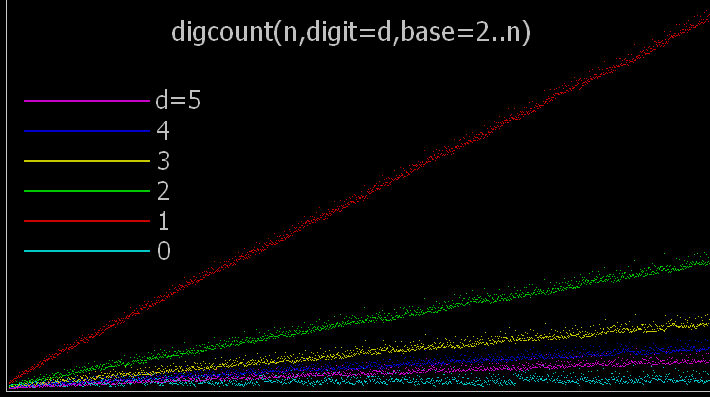
Graph for digcount(n,dig=d,b=2..n)
You could think of the graph as a digital rodeo in which these digits compete with each other. 1 is the clear and permanent winner, 0 the gradual loser. Now recall the procedure introduced at the start: n = n + digcount(n,dig=d,b=2..n). When it’s applied to the digits 0 to 5, these are the sequences that appear:
n = n + digcount(n,dig=0,b=2..n)
2, 3, 4, 7, 8, 13, 15, 18, 27, 34, 42, 51, 59, 62, 66, 80, 94, 99, 111, 117, 125, 132, 151, 158, 163, 173, 180, 204, 222, 232, 244, 258, 279, 292, 307, 317, 324, 351, 364, 382, 389, 400, 425, 437, 447, 454, 466, 475, 483, 494, 509, 517, 536, 553, 566, 576, 612, 637, 649, 669, 679, 693, 712, 728, 753, 768, 801, 822, 835, 849, 862, 869, 883, 895, 906, 923, 932, 943, 949, 957, 967, 975, 999, 1011…
n = n + digcount(n,dig=1,b=2..n)
2, 3, 6, 12, 23, 44, 75, 124, 202, 319, 503, 780, 1196, 1824, 2766, 4191, 6338, 9546, 14383, 21656, 32562, 48930, 73494, 110361, 165714, 248733, 373303, 560214, 840602, 1261237, 1892269, 2838926, 4258966, 6389157, 9584585, 14377879…
n = n + digcount(n,dig=2,b=2..n)
5, 6, 8, 12, 16, 22, 31, 37, 48, 60, 76, 94, 115, 138, 173, 213, 257, 311, 374, 454, 542, 664, 790, 935, 1109, 1310, 1552, 1835, 2167, 2548, 2989, 3509, 4120, 4832, 5690, 6687, 7829, 9166, 10727, 12568, 14697, 17182, 20089, 23470, 27425, 32042, 37477, 43768, 51113, 59687, 69705, 81379, 94998, 110910, 129488, 151153, 176429, 205923, 240331, 280490, 327396, 382067, 445858…
n = n + digcount(n,dig=3,b=2..n)
7, 8, 9, 10, 11, 13, 16, 18, 22, 25, 29, 34, 38, 44, 50, 56, 63, 80, 90, 104, 113, 131, 151, 169, 188, 210, 236, 261, 289, 320, 350, 385, 424, 463, 520, 572, 626, 684, 747, 828, 917, 999, 1101, 1210, 1325, 1446, 1577, 1716, 1871, 2040, 2228, 2429, 2642, 2875, 3133, 3413, 3719, 4044, 4402, 4786, 5196, 5645, 6140, 6673, 7257, 7900, 8582, 9315, 10130, 10998, 11942, 12954, 14058…
n = n + digcount(n,dig=4,b=2..n)
9, 10, 11, 12, 13, 14, 16, 18, 20, 23, 25, 28, 34, 41, 44, 52, 61, 67, 74, 85, 92, 102, 113, 121, 134, 148, 170, 184, 208, 229, 253, 269, 287, 306, 324, 356, 386, 410, 439, 469, 501, 531, 565, 604, 662, 703, 742, 794, 845, 895, 953, 1007, 1062, 1127, 1188, 1262, 1336, 1421, 1503, 1585, 1676, 1777, 1876, 2001, 2104, 2249, 2375, 2502, 2636, 2789, 2938, 3102, 3267, 3444, 3644, 3868, 4099…
n = n + digcount(n,dig=5,b=2..n)
11, 12, 13, 14, 15, 16, 17, 19, 21, 23, 26, 28, 29, 33, 37, 41, 48, 50, 55, 60, 64, 67, 72, 75, 83, 91, 96, 102, 107, 118, 123, 129, 137, 151, 159, 171, 180, 192, 202, 211, 224, 233, 251, 268, 280, 296, 310, 324, 338, 355, 380, 401, 430, 455, 488, 511, 536, 562, 584, 607, 638, 664, 692, 718, 748, 778, 807, 838, 874, 911, 951, 993, 1039, 1081, 1124, 1166, 1216, 1264, 1313, 1370, 1432…