Vigor Mortis

Front cover of The Best of Black Sabbath
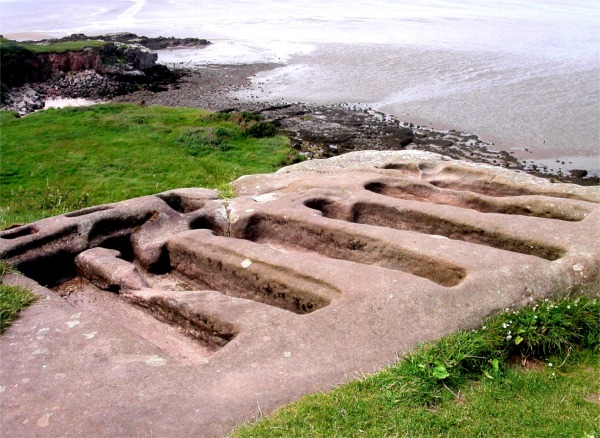
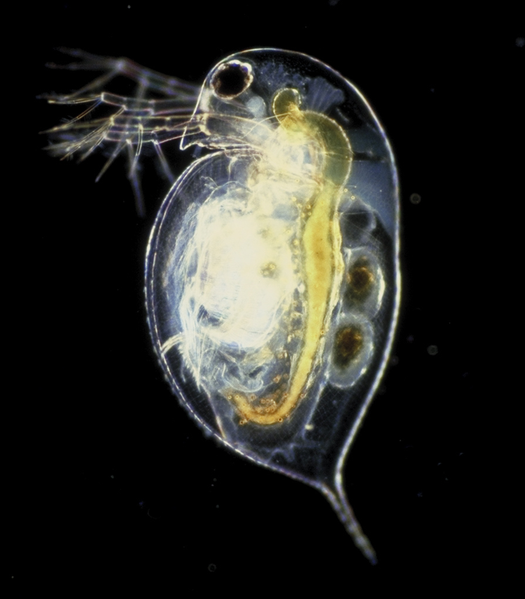
In the Christian religion, the resurrection follows the virgin birth. In the rock-graves at Heysham, the virgin birth follows the resurrection. Or rather: the virgin-births follow the resurrections. There are many of both. The rock-graves at Heysham* are carved in solid rock near the remains of St Patrick’s chapel, an ancient ruin overlooking Morecambe Bay on the coast of Lancashire in England. You may have seen them before, because they appear on the cover of a compilation album by the heavy-metal band Black Sabbath, where they’re filled with ice and look suitably dark and sinister. But the graves are sometimes full of life and activity. In spring, as the rainwater filling them begins to warm, there are resurrections – dozens of them. Tiny crustaceans (a group of animals that includes crabs, shrimps and woodlice) hatch from eggs that have over-wintered in the sediment on the floors of the graves. Some of the crustaceans are called water-fleas, others are called seed-shrimps. Water-fleas, whose scientific name is Daphnia, hop through the water with jerks of their antennae, sieving it for fresh-water plankton. Seed-shrimps, or ostracods, are enclosed in tiny double-sided shells through which their legs protrude. They trundle over the stone sides of the graves, scraping off algae and catching even smaller and simpler animals like rotifers and protozoa.

The rock graves at Heysham (c. 11th century A.D.)

Rock graves at Heysham, Lancs. (c. 1000s)

Water-fleas are famous for parthenogenesis, or their ability to produce offspring without sex. Those that hatch first in spring are female and give birth without mating with any males. A single water-flea in a jar of stagnant water soon becomes a swarm. It’s only later in the year that males are born and the water-fleas mate to produce winter eggs, which sink to the floor of the graves and lie there through the cold weather. The eggs of water-fleas and ostracods can also survive desiccation, or drying-up, and can be blown on the wind to new sites. That is probably how these crustaceans arrived in the rock-graves, which they must have occupied for centuries, through the coldest winters and the hottest summers, dying and being reborn again and again. When a human being or large animal dies, chemical changes in the body make the muscles rigid and wood-like. The scientific term for this is rigor mortis, or the “stiffness of death”. Rigor mortis wears off in time and the body begins to rot. The rock-graves at Heysham are an example of vigor mortis, or the “vigour of death”. Medieval human beings created the graves to bury their dead, but the bodies that were once there have been lost to history. The water-fleas and the seed-shrimps remain, tiny, overlooked and fascinating.

A seed-shrimp or ostracod

A seed-shrimp

A water-flea, Daphnia pulex

A water-flea


*Heysham is pronounced HEE-shum and is an old coastal village near the city of Lancaster, after which Lancashire is named.

Standing on the Sky

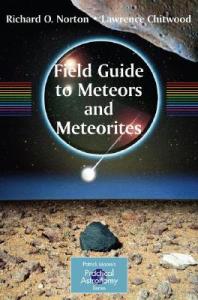
Field Guide to Meteors and Meteorites
Field Guide to Meteors and Meteorites, O. Richard Norton and Lawrence A. Chitwood (2008)

If you want to touch something from outer space, simply form one of your hands into a fist. You will then be touching star-stuff, because every atom in every human was once heavenly. We eat star-cinders, breathe star-fumes and stand on the sky, because all terrestrial matter was once extra-terrestrial. This is because the fusional furnace of a star, unlike an ordinary furnace, creates complexity out of simplicity. Simple atoms like hydrogen and helium go in, complex atoms like oxygen and iron come out. I think that’s one of the important messages to take from this book: Up There is down here and always has been. O. Richard Norton is writing about stones that are special because they fall from the sky, but sometimes those stones are very hard to tell from ordinary stones, as the section called “Meteorwrongs” explains next to a photo of two very similar rocks:

One of these rocks is a meteorite. Note the rounded knobbly shapes in both that look like clusters of grapes. Mundrabilla (right) is an Australian iron meteorite. The knuckle-like knobs are large, randomly orientated iron-nickel crystals of taenite that stand out due to weathering. A pair of Moqui marbles (left) are concretions weathered out of Navajo Sandstone in the southwestern United States. The sand is glued together by the iron oxides, hematite and goethite. They are a terrestrial analogue to the hematite-cemented Martian blueberries seen from the Martian rover Opportunity in 2004. (“A Gallery of Meteorwrongs”, pg. 178)

Unless you’re an expert, distinguishing special sky-stones from ordinary earth-stones can be difficult. But are any stones really ordinary? I don’t think so. They all come ultimately from the belly of a star and they all raise this fascinating question: what is matter? The ultimate answer to that may be: Matter is mathematics. But maths is always present when you study matter and its behaviour, so there is a lot of maths in this book. In fact, the whole book is mathematical, because it’s all about chemistry, geology, petrography and various forms of physics: orbital mechanics, thermodynamics, optics and even acoustics:

The sound of a fireball is an altogether different experience. It is an eerie experience when a fireball begins its rapid journey across the sky. Trees and tall buildings cast long moving shadows… Seconds go by and not a sound is heard. Suddenly, without warning, the fireball explodes, scattering myriads of fragments that briefly maintain their courses among the stars. All of this happens in absolute silence. Seconds and minutes go by. The fireball vanishes. Still, silence. Then, when you least expect it, a tremendous series of explosions rock the silence. The fireball’s shock wave has finally arrived, announcing its presence by a series of ground-shaking sonic booms. These sounds are caused by pressure waves generated in the atmosphere by the hypersonic flight of the fireball. (chapter 3, “Meteoroids to Meteors: Lessons in Survival”, pg. 45)

Fireballs are rare, but meteors fall constantly and many people watch for them and photograph them, so this book is also about sky-stones you can see falling, not just about sky-stones you can pick up or stand on. After all, some never reach the ground. Huge numbers of meteors fall individually and unpredictably, but there are also periodic meteor-showers named after the constellations they seem to fall from, like the Aquarids, Leonids and Taurids, and associated with the debris-trail of comets. These can also be tracked using radar:

In the 1940s military radar operators noticed that meteors caused interruptions in high-frequency broadcasting reception, taking the form of whistles that rapidly dropped in pitch. Most individual meteoroids are too small to reflect radar waves back to the ground. Instead, radar waves sent from the ground were detected as they reflected off much larger targets, in this case, columns of ionized gas left in the wake of a meteor, formed when the particles evaporated passing through the Earth’s upper atmosphere. (ch. 1, “Interplanetary Dust and Meteors”, pg. 19)

In a way, radar was detecting the death-cries of the “Ancient Fragments of the Solar System” described in part one of this book: the asteroidal and cometary grit in the cosmic clockwork of the sun and planets. Bits of that grit have been falling to earth throughout man’s existence, but some sceptics, inspired by Newton’s apparent conquest of the heavens, decided it wasn’t there after all. When two scientists from Connecticut reported a meteorite fall in 1807, Thomas Jefferson famously said: “I would sooner believe that two Yankee professors would lie than that stones would fall from heaven.” He wasn’t just wrong, he was unimaginative too. Two hundred years later, we know better, but some knew better more than two millennia ago:

Diogenites are named for the fifth century B.C. Greek philosopher, Diogenes of Apollonia, considered to be the first person to suggest that meteorites actually came from beyond the Earth. They are called Plutonic since their origin appears to be plutonic rocks deep below the eucrite crust of the asteroid 4 Vesta. (ch. 5, “Primitive and Differentiated Meteorites: Asteroidal Achondrites”, pg. 122)

So fragments of asteroid existed on the earth before astronomers discovered the existence of asteroids. Fragments of Mars and the moon have been found on earth too, as Norton describes: big meteoric impacts there have blasted Mars- and moon-stuff free and some of it has fallen here. But Diogenes’ ancient insight about the origin of sky-stones didn’t influence their name: meteors are so-called because they were thought to be atmospheric phenomena. That is, a shooting star, or meteor, was seen as part of meteorology, not astronomy. When science learnt better, it created two more terms: meteoroid, meaning the physical object in space, and meteorite, meaning the physical object once it’s landed on the earth. You may have meteorites on your windowsills, because some of them are very small: IDPs, or Interplanetary/Interstellar Dust Particles, like the ones that stream from the tail of a comet as it approaches the sun. These drift to earth rather than drop, but they’re hard to tell from terrestrial dust. To study them more easily, scientists had to get away from the surface of the earth and Richard Norton describes how the “University of Washington’s Interplanetary Dust Laboratory” began to use “high flying aircraft” in the 1970s to collect this cometary dandruff (ch. 1, “Interplanetary Dust and Meteors”, pg. 9). Since then, the Stardust probe has actually collected samples from “the periodic Comet Wild 2 (pronounced ‘Vilt’)” and returned them to earth.

This is one part of astronomy that isn’t reliant on the ephemerality of photons, but photons can still tell us a lot about the chemistry of comets and asteroids, because light is influenced by the nature of the matter it bounces off or shines from:

In 1970, T.B. McCord and his coworkers at the Institute of Geophysics and Planetology, University of Hawaii, made astronomical history when they were the first to recognize similar characteristics between the spectra of 4 Vesta and a specific meteorite type. They compared the reflection spectra of the Nuevo Laredo achondrite with the reflection spectra of 4 Vesta. (ch. 2, “Meteorites: Fragments of Asteroids”, pg. 33)

Photons are important in other ways, as you’ll find in chapter 11, “From Hand Lens to Microscope”. Here astronomy meets petrography, or the study of patterns and colours in slices of rock under high magnification. The photographs in this chapter are some of the strangest and most beautiful in the book: “A calcium-rich clinopyroxene glows with bright second order interference colors” (pg. 218). But meteorites can be beautiful to the naked eye too, though sometimes they have to be cut open to become so. There’s gold and silver on page 171, for example, where you’ll see photographs of meteorites like:

Esquel, a main group pallasite. It was found in Argentina 1951 by a farmer while digging for a water tank. The meteorite shows beautiful yellowish green olivine (peridot) crystals… The Glorieta Mountain meteorite. When cut into a thin slab, polished and lighted from behind, this becomes one of the world’s most beautiful pallasites. (ch. 8, “Differentiated Meteorites: Stony-Irons”)

Pallasites aren’t named after the asteroid Pallas, but after the “German naturalist and explorer, Peter Simon Pallas”, who collected samples of a “1,600 lb meteorite found in 1749 near Krasnojarsk, Siberia” (pg. 168). Nearly two hundred years later, the Sikhote-Alin mountains in Siberia experienced a much bigger meteorite, seen as an “enormous fire-ball” on February 12, 1947, then collected as “thousands of beautifully sculpted iron meteorites… Today, Sikhote-Alin meteorites are highly prized in public and private collections throughout the world” (pg. 47). They’re black, not colourful, but the “flow-patterns” and regmaglypts – depressions like thumb-prints – caused by heat make them like attractive modernist sculpture. That Siberian fireball is described in in chapter 3, “Meteoroids to Meteors: Lessons in Survival”, which is about what happens to meteoroids as they plunge through the atmosphere. They heat up and sometimes break up, but they aren’t always sizzling when they hit the ground:

The temperature at 50,000-ft [15-km] altitude is about -50°F [-45°C]. This low temperature aids in rapidly chilling the falling rock. Long before hitting the ground the meteorite’s surface temperature has been reduced to between lukewarm and stone cold. The meteorite may even be coated with a thin layer of ice. In fact, some meteorites have been found minutes after landing, resting on top of a snow bank – without melting the snow. (pg. 45)

But sometimes meteorites are found millennia after landing, so the effects of water and weather are an important topic for meteorite-hunters. So are the effects of magnetism: you can use metal-detectors to hunt for meteorites, as Norton describes in chapter 10, “In the Field”. This is a field-guide, after all, but “field” can mean African desert, Swedish pine-forest and Arctic or Antarctic ice-sheet:

In the continental United States, the best hunting ground is in the southwestern part of the Mojave desert of southern California, where vegetation is relatively sparse and the climate is dry. Look for an old surface, one that has been exposed for a long time. Old dry lakes can be a good place to search. Many meteorites have been found in Rosamond, Muroc, and Lucerne dry lakes. (pg. 183)

The American meteorite-hunter Steve Arnold found his record-breaking “1,400 lb Brenham orientated pallasite” another way: “he dug it up from a depth of seven-and-a-half feet, locating it with the help of a high-tech metal detector” in 2005 (pg. 187). “Brenham orientated” is a reference to the way the meteorite was shaped by “ablation”, or the “removal and loss of… material by heating and vaporization” during its fall to earth (“Glossary”, pg. 267). But meteoroids aren’t just shaped by their encounter with the earth: they can also shape the earth, both geologically and biologically. The earth bears the scars of many past impacts, some of them cataclysmic in scale and epoch-making in their effects. Would man the mammal now rule the earth and watch the sky if it hadn’t been for the asteroid that wiped out the dinosaurs 65 million years ago? Or would an advanced, intelligent species of reptile be collecting and analysing meteorites now?

Questions like that aren’t just of historic interest: stones that fall from the sky are of huge practical importance, because big ones can wipe out not just cities and civilizations, but entire species, including Homo sapiens. The sky gave birth to all life on earth, because without the chemicals created there, life wouldn’t exist here. Life may even have begun there, but the sky has regularly committed infanticide too and man’s name is definitely on the hit-list. Sooner or later another giant sky-stone will hit the earth and cause megadeaths or worse, unless we spot it en route and stop it. That’s another message to take from this book: some meteoroids are beauties and some are beasts. All of them are interesting. This book explains how, what, where, and why, all the way from aphelia and bolides to xenoliths and the Zodiacal light.


Roses Are Golden

Sir Lawrence Alma-Tadema’s painting The Roses of Heliogabalus (1888) is based on an apocryphal episode in the sybaritic life of the Roman Emperor Elagabalus (204-222 A.D.), who is said to have suffocated guests with flowers at one of his feasts. The painting is in a private collection, but I saw it for real in an Alma-Tadema exhibition at the Walker Art Gallery in Liverpool sometime during the late 1990s. I wasn’t disappointed: it was a memorable meeting with a painting I’d been interested in for years. Roses is impressively large and impressively skilful. Close-up, the brush-strokes are obvious, obtrusive and hard to interpret as people and objects. It isn’t till you step back, far beyond the distance at which Alma-Tadema was painting, that the almost photographic realism becomes apparent. But you get more of the many details at close range, like the Latin inscription on a bowl below and slightly to the right of that scowling water-mask. Alas, I forgot to take a note of what the inscription was, though perhaps the memory is still locked away somewhere in my subconscious.

The Roses of Heliogabalus (1888)

The Roses of Heliogabalus (1888)

Whatever it is, I feel sure it is significant, because Roses is rich with meaning. That’s a large part of why I’m interested in it. Yes, I like it a lot as art, but the women would have to be more attractive for it to be higher in the list of my favourite paintings. As it is, I think there are only four reasonably good-looking people in it: the man with the beard on the right; the flautist striding past the marble pillar on the left; the red-headed girl with a crown of white flowers; and Heliogabalus himself, crowned in roses and clutching a handful of grapes beside the overweight man who’s wearing a wreath and sardonically saluting one of the rose-pelted guests in the foreground. When I first wrote about Roses in a pub-zine whose name escapes me, I misidentified the overweight man as Heliogabalus himself, even though I noted that he seemed many years old than Heliogabalus, toppled as a teen tyrant, should have been. It was a bad mistake, but one that, with less knowledge and more excuse, many people must make when they look at Roses, because the overweight man and his sardonic salute are a natural focus for the eye. Once your eye has settled on and noted him, you naturally follow the direction of his gaze down to the man in the foreground, who’s gazing right back.

A comparison between Alma-Tadema's portrayal of Heliogabalus and a bust of Heliogabalus from the Musei Capitolini in Rome

Something Like the Sun

And by following that gaze, you’ve performed a little ratio-ritual, just as Alma-Tadema intended you to do. Yes, Roses is full of meaning and much of that meaning is mathematical. I think the angle of the gaze is one of many references in Roses to the golden ratio, or φ (phi), a number that is supposed to have special aesthetic importance and has certainly been used by many artists and musicians to guide their work. A rectangle with sides in the proportions 8:13, for example, approximates the golden ratio pretty closely, but φ itself is impossible to represent physically, because it’s an irrational number with infinitely many decimal digits, like π or √2, the square root of two. π represents the ratio of a circle’s circumference to its diameter and √2 the ratio of a square’s diagonal to its side, but no earthly circle and no earthly square can ever capture these numbers with infinite precision. Similarly, no earthly rectangle can capture φ, but the rectangle of Roses is a good attempt, because it measures 52″ x 84 1/8". That extra eighth of an inch was my first clue to the painting’s mathematical meaningfulness. And sure enough, 52/84·125 = 416/673 = 0·61812…, which is a good approximation to φ’s never-ending 0·6180339887498948482045868343656…*
A circle with radii at 0 and 222 degrees
That deliberate choice of dimensions for the canvas led me to look for more instances of φ in the painting, though one of the most important and obvious might be called a meta-presence. The Roses of Heliogabalus is dated 1888, or 1666 years after the death of Heliogabalus in 222 AD. A radius at 222º divides a circle in the golden ratio, because 222/360 = 0·616… It’s very hard to believe Alma-Tadema didn’t intend this reference and I also think there’s something significant in 1888 itself, which equals 2 x 2 x 2 x 2 x 2 x 59 = 25 x 59. Recall that 416 is the expanded short side of Roses. This equals 25 x 13, while 673, the expanded long side, is the first prime number after 666. As one of the most technically skilled painters who ever lived, Alma-Tadema was certainly an exceptional implicit mathematician. But he clearly had explicit mathematical knowledge too and this painting is a phi-pie cooked by a master matho-chef. In short, when Roses is read, Roses turns out to be golden.


*φ is more usually represented as 1·6180339887498948482045868343656…, but it has the pecularity that 1/φ = φ-1, so the decimal digits don’t change and 0·6180339887498948482045868343656… is also legitimate.

Appendix I

I’ve looked at more of Alma-Tadema’s paintings to see if their dimensions approximate φ, √2, √3 or π, or their reciprocals. These were the results (ε = error, i.e. the difference between the constant and the ratio of the dimensions).

The Roman Wine Tasters (1861), 50" x 69 2/3": 150/209 = 0·717… ≈ 1/√2 (ε=0·02)
A Roman Scribe (1865), 21 1/2" x 15 1/2": 43/31 = 1·387… ≈ √2 (ε=0·027)
A Picture Gallery (1866), 16 1/8" x 23": 129/184 = 0·701… ≈ 1/√2 (ε=0·012)
A Roman Dance (1866), 16 1/8" x 22 1/8": 43/59 = 0·728… ≈ 1/√2 (ε=0·042)
In the Peristyle (1866), 23" x 16": 23/16 = 1·437… ≈ √2 (ε=0·023)
Proclaiming Emperor Claudius (1867), 18 1/2" x 26 1/3": 111/158 = 0·702… ≈ 1/√2 (ε=0·009)
Phidias and the Frieze of the Parthenon Athens (1868), 29 2/3" x 42 1/3": 89/127 = 0·7… ≈ 1/√2 (ε=0·012)
The Education of Children of Clovis (1868), 50" x 69 2/3": 150/209 = 0·717… ≈ 1/√2 (ε=0·02)
An Egyptian Juggler (1870), 31" x 19 1/4": 124/77 = 1·61… ≈ φ (ε=0·007)
A Roman Art Lover (1870), 29" x 40": 29/40 = 0·725… ≈ 1/√2 (ε=0·034)
Good Friends (1873), 4 1/2" x 7 1/4": 18/29 = 0·62… ≈ φ (ε=0·006)
Pleading (1876), 8 1/2" x 12 3/8": 68/99 = 0·686… ≈ 1/√2 (ε=0·041)
An Oleander (1882), 36 1/2" x 25 1/2": 73/51 = 1·431… ≈ √2 (ε=0·017)
Dolce Far Niente (1882), 9 1/4" x 6 1/2": 37/26 = 1·423… ≈ √2 (ε=0·008)
Anthony and Cleopatra (1884), 25 3/4" x 36 1/3": 309/436 = 0·708… ≈ 1/√2 (ε=0·003)
Rose of All Roses (1885), 15 1/4" x 9 1/4": 61/37 = 1·648… ≈ φ (ε=0·03)
The Roses of Heliogabalus (1888), 52" x 84 1/8": 416/673 = 0·618… ≈ φ (ε<0.001)
The Kiss (1891), 18" x 24 3/4": 8/11 = 0·727… ≈ 1/√2 (ε=0·039)
Unconscious Rivals (1893), 17 3/4" x 24 3/4": 71/99 = 0·717… ≈ 1/√2 (ε=0·019)
A Coign of Vantage (1895), 25 1/4" x 17 1/2": 101/70 = 1·442… ≈ √2 (ε=0·028)
A Difference of Opinion (1896), 15" x 9": 5/3 = 1·666… ≈ φ (ε=0·048)
Whispering Noon (1896), 22" x 15 1/2": 44/31 = 1·419… ≈ √2 (ε=0·005)
Her Eyes Are With Her Thoughts And Her Thoughts Are Far Away (1897), 9" x 15": 3/5 = 0·6… ≈ φ (ε=0·048)
The Baths of Caracalla (1899), 60" x 37 1/2": 8/5 = 1·6… ≈ φ (ε=0·018)
The Year’s at the Spring, All’s Right with the World (1902), 13 1/2" x 9 1/2": 27/19 = 1·421… ≈ √2 (ε=0·006)
Ask Me No More (1906), 31 1/2" x 45 1/2": 9/13 = 0·692… ≈ 1/√2 (ε=0·03)

Appendix II

The Roses of Heliogabalus is based on this section from Aelius Lampridius’ pseudonymous and largely apocryphal Vita Heliogabali, or Life of Heliogabalus, in the Historia Augusta (late fourth century):

XXI. 1 Canes iecineribus anserum pavit. Habuit leones et leopardos exarmatos in deliciis, quos edoctos per mansuetarios subito ad secundam et tertiam mensam iubebat accumbere ignorantibus cunctis, quod exarmati essent, ad pavorem ridiculum excitandum. 2 Misit et uvas Apamenas in praesepia equis suis et psittacis atque fasianis leones pavit et alia animalia. 3 Exhibuit et sumina apruna per dies decem tricena cottidie cum suis vulvis, pisum cum aureis, lentem cum cerauniis, fabam cum electris, orizam cum albis exhibens. 4 Albas praeterea in vicem piperis piscibus et tuberibus conspersit. 5 Oppressit in tricliniis versatilibus parasitos suos violis et floribus, sic ut animam aliqui efflaverint, cum erepere ad summum non possent. 6 Condito piscinas et solia temperavit et rosato atque absentato…

Historia Augusta: Vita Heliogabali

XXI. 1 He fed his dogs on goose-livers. He had pet lions and leopards, which had been rendered harmless and trained by tamers, and these he would suddenly order during the dessert and the after-dessert to get on the couches, thereby causing laughter and panic, for none knew that they were harmless. 2 He sent grapes from Apamea to his stables for the horses, and he fed parrots and pheasants to his lions and other beasts. 3 For ten days in a row, moreover, he served wild sows’ udders with the matrices, at a rate of thirty a day, serving, besides, peas with gold-pieces, lentils with onyx, beans with amber, and rice with pearls; 4 and he also sprinkled pearls on fish and used truffles instead of pepper. 5 In a banqueting-room with a reversible ceiling he once buried his parasites in violets and other flowers, so that some were actually smothered to death, being unable to crawl out to the top. 6 He flavoured his swimming-pools and bath-tubs with essence of spices or of roses or wormwood…

Augustan History: Life of Heliogabalus

Eyes-Cream

Another reprehensible review of this teraticly toxic tomelet:

The Eyes by Jesús Ignacio Aldapuerta

As per the opening kayfabe, The Eyes was written by a deceased madman called Jesús Ignacio Aldapuerta who fashioned sex-toys from the bones of children.

I don’t want to be the guy who says there’s no Santa Claus, but this wouldn’t be the first time someone ghost-wrote an “alternative” book under the name of an imaginary lunatic. The true author of The Eyes is apt to be alive, sane, and well, and has likely done no more than give himself a backrub with the bones of children, if even that.

But that’s neither here nor there. The Eyes is disgusting, unforgettable, hard to read, harder to stop reading. I have read only a few books like it. One of them is Satanskin by James Havoc, another hoax author. He died in 1999… and was so dead that he reappeared in 2009 and started writing books again. Anyway, like Satanskin, The Eyes contains short stories meant to give you an inside view of hell. Some stories offer but a peek. Others give you the grand tour.

Pedophilia, cannibalism, it’s all here. Some stories (“Armful”) are so ugly that a summary would sound hyperbolic no matter what words I use. Generally, the tales in The Eyes provoke one of two reactions. The first is a horrified “WHAT?!” The second is like what you feel immediately after stepping on a nail. You don’t feel much pain, not at first, but there’s the sense that you’ve done yourself severe trauma.

Aldapuerta is one hell of a writer. James Havoc has a tendency to pile on the purple and overwrite beyond the point of self-parody, but The Eyes is lean and to the point. It’s not without a poetic edge. Aldapuerta’s forte is the quickfire mot juste. “Her hot little leaf of a hand.”… “the pale leaping tongues of his semen”…etc. Neat.

“Ikarus” is the most terrible creation in The Eyes, not a story but a black detonation of horror. A man explores the hull of a B-17 bomber, and discovers something that never will be explained, never could be explained, and never should be explained. “Ikarus” is almost a net liability to the book, as the other stories come up short next to it.

As it nears the end (its end, not yours), The Eyes gets increasingly strange. As the nostalgic schoolmaster’s fantasy of “Upright” ends, “The Winnowing” begins, which largely consists of a Czech man filling out a form. The final sentence… what am I supposed to take from that? That he was being sterilised? The book finishes with “Pornoglossia”, a list of words the author has invented for use in your own Marquis-de-Sade ripoff. The verb “Raí”, for example, means using an empty eye-socket as a sexual orifice. These words are in little danger of making their way into Merriam-Websters’ in the near future.

There may not be a hell, but Aldapuerta (or Whitechapel, or whoever wrote this) have proven that it is possible to create one on the page. The Eyes is genuinely amazing. Hopefully some day Aldapuerta will return to life, pick up his child-femur pen, and write a new collection of stories.

Original review


Jesús say: S… I…. M… E…. G…. U… S… T… A…. | M… A… Y… B… E…. I…. C… O… M… E….. H… A… U… N… T…. R… E… V… I… E…. W… E… R…. I… N… L… I… T… T… L… E…. B… I… T….

Performativizing Papyrocentricity #5

Papyrocentric Performativity Presents:

Sherlock’s ShadowThe Conan Doyle Stories, Arthur Conan Doyle (Blitz Editions, 1990)

Dahl “M” for Murder — Alfred Hitchcock Presents Stories to be Read with the Lights On, ed. Harold Q. Masur (1973)

Best-Laid StansUkridge, P.G. Wodehouse (Everyman, 2000)

Mental Marine Music

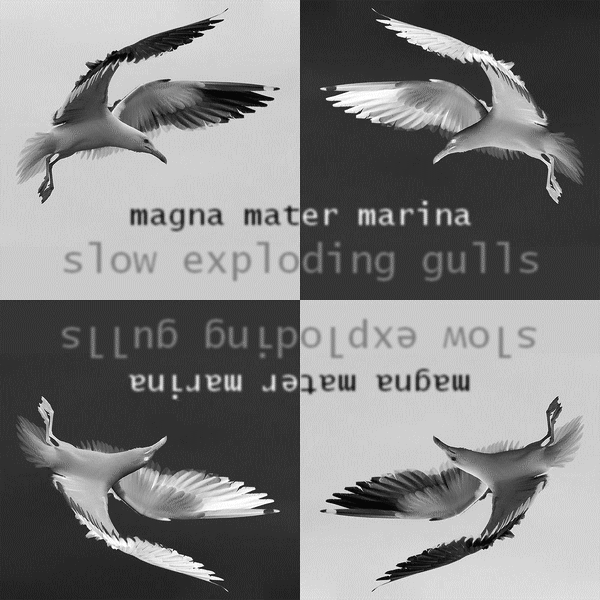
Cover of Magna Mater Marina by Slow Exploding Gulls (CD re-issue)

“Thalassa! Thalassa!” The chant that began the first song on the first side of the first S.E.G. album is still inspiring the group twenty-six years and eighteen albums later. Few fans will need reminding that it is ancient Greek for “The Sea! The Sea!”, as shouted in ecstasy by a mercenary army after a long and dangerous retreat across Asia Minor in 401 BC. Ecstasy is not so much an inspiration to the group as an aspiration. They try to use melody, rhythm and “drowned sound” to take their listeners out of the everyday and into the otherwhere, to sink them “full fathom five” in music as rich and mysterious as the sea. The S.E.G. story begins in 1987, when Joseph Corvin, the ever-present Kapitän und Kappellmeister, as he jokingly calls himself, was living in an old house in the ancient Celto-Roman town of Exeter on the southern English coast. When the sea-wind blew, his living quarters became lowing quarters: “an eerie wailing used to sound from the roof and there were all sorts of weird sound effects in the bathroom, because of air moving in the overflow pipe and the walls. I liked what I heard and I thought I could do something with it, musically speaking.”

Corvin recorded some of the wind-sounds, mixed them with gull-cries and underwater engine-noise, added vocals and electronically treated flute and drums, and put out the results on a cassette-only album called Magna Mater Marina (Latin for Great Marine Mother), under the odd but memorable moniker of Slow Exploding Gulls. The name was inspired by Corvin’s love of the surrealists Salvador Dalí and Max Ernst, but it would dog him and his cohorts for years to come, partly because it pigeon-holed the group as “Kraut-rock” and partly because it suggested cruelty to animals, which was not appreciated by some of his potential audience. Both assumptions were completely wrong: Corvin says, first, that, as a fan, he was then much more into The Cure, The Smiths and Siouxsie and the Banshees than anything electronic or experimental, and, second, that far from advocating cruelty to gulls, he was celebrating them:

Not for one moment was I suggesting any harm to anything with wings or feathers. Gulls are my favourite birds, highly potent symbols of freedom, grace and the life-force. The title was meant to be metaphorical, not literal, and it was partly a reference to the explosion of joy that sudden sight of a flying gull can waken in your heart. There’s something very Nietzschean about them and yeah, I will admit to a Friedrich-fixation in the 1980s, though the Kraut-rock label was an albatross around our necks, no pun intended, for most of the ’90s. It came mainly from a review in the N.M.E. [New Musical Express, one of Britain’s big “pop-papers”] claiming to detect similarities between us and Einstürzende Neubaten, which means “Collapsing New Buildings”. Well, I can’t say there wasn’t a subliminal influence, name-wise, but I’d heard very little by any of the German groups at the time and when I did hear more, I didn’t detect many similarities between their music and ours. We were and always will be inspired by sea-sounds, everything you can hear under and over the water of the British coast. The next label they tried to stick on us was “goth”, on the ground that we made gloomy music and always dressed in black. We didn’t: it was dark blue, it wasn’t all the time and there’s nothing gloomy about our music, if it’s listened to right. (Interview on the fan-site GullSegg, November, 2003)

Corvin’s protests were to no avail: S.E.G.’s next album, A Grey Mist (1989), was reviewed under titles like “Submarine Electro-Goths” and “Solipsistic Entrail-Gazing”. Again he says the press had got hold of the wrong end of the stick: “The title of the album comes from ‘Sea-Fever’, a very beautiful poem by John Masefield, and far from attempting to be gloomy or depressing, it was all about the joy of the sea, the cold in the early morning and the bite of the wind, ‘the white clouds flying’ and mist as a symbol of mystery and possibility, not as anything glum and gothic.” Happily, S.E.G. would outlive that early hostility and journalists’ insistence on labelling, rather than listening to, the music they created, but a lasting effect of both has been the playful name-switching they’ve indulged in since their early days. They’ve released albums under at least eight different names and performed gigs under all those and more, but every name has been based on the acronym S.E.G. and had a maritime theme. 1994’s Mew Upsilon Sigma, for example, came out under the name Swim with Elegant Gods, and 2003’s re-mixed Yr Wylan Ddu (Welsh for The Black Gull) under the name Seaside Excursion Guide. They’ve also recorded songs with titles like “Sunken Etruscan Gold”, “Sailing to Ecstatic Gnosis”, “Submersed in the Eternal Gulf” and “She’s an Exeter Girl” (a reference to Cathleen Orne, Joseph’s then girlfriend, now wife, who is indeed an Exeter girl).

Cover of Silica by Slow Exploding Gulls

This S.E.G. motif means that hardcore fans, of whom they’ve garnered and retained a flighty fair few down the decades, are generally referred to as SEGheads, while their biggest – and best – fan-site is GullSegg, where you can find the earliest and most accurate news on the group’s activities, plus detailed and reasonably objective reviews of every piece of music they’ve ever recorded. So can S.E.G. be described as Shadowy Exeter Goths? No, Soaring Elemental Gods is much closer the mark and I join many mental-marine-music fans in wishing them well in their ambition of recording music in every major sea-side town of the British Isles. Wexford on the eastern coast of Ireland is next, according to GullSegg, and Wassernyxe, album #19 (and German/Greek for “Mermaid-Night”), should be released before the end of the year. It’s unlikely it will sail new seas, or sound new depths, but after twenty-six years of mer-music-making who could expect it to? Yes, never mind the rowlocks! S.E.G.’s Saline Esoterica Gangs on – and gongs on – every time someone plays a classic album like Mew or Thalas/Socratic, their 1996 split-EP with their own whale-song side-project Schatten über Exeter Gruppe (German for “Shadow over Exeter Group”).


Elsewhere other-posted:

• More Musings on Music

Previously pre-posted (please peruse):

Stoch’! (In the Name of Dove)

Proviously post-posted (please peruse):

The Sound of Silex

Hateful, Bestial, Demonic

Who is the world’s saintliest womun? I would say Hillary Clinton, but she’s white, alas, so I’ll go for Aung San Suu Kyi and/or Winnie Mundela instead. But who is the world’s evillest woman? (sic) I don’t know, but I do know someone who is trying damn hard for the title: the keyly committed hate-blogger called HBD-Chick, who engages issues around an über-misanthropic unter-movement called H.B.D. This stands for Human Bio-Diversity, i.e., the hateful, bestial and demonic notion that biological “differences” between groups of humun being can help explain social, cultural and political patterns. HBD-Chick, for example, tries to explain levels of “corruption” and democracy in “different” countries by looking at how “in-bred” their populations are.

’Cuse me while I throw up. Yes, HBD is not just evil, it’s so pseudo-scientific that it makes tea-leaf reading look like gamma-ray astronomy. As proper scientists like Stephen Jay Gould, Jared Diamond, Steven Rose, Richard Lewontin and Karl Marx have taught us, humun beings floated free of biology during the Pleistocene and are best regarded as disembodied social units that just happen (for the time being) to have a corporeal component. It follows from this proper science that all social, cultural and political dysfunction can be explained by racism, sexism, homophobia and other forms of hate-think invented by white male Europeans of Christian heritage. And, like cornered rats baring their yellowed fangs and squealing their defiance, this despicable demographic has created HBD in an attempt to over-turn the hard-won scientific insights of Gould et al. If you’re a good persun, you won’t be taken in by the HBDers’ lies, deceit and pseudo-science. HBD-Chick is plainly a bad person (sic), because she has been taken in. But, as a womun, she isn’t really to blame – here are some of the real vectors of this diseased and depraved ideology:

Steve Surfer – KKKalifornian krank who invented and popularized the term HBD

West Hunter – run by pseudo-scientists Greg Cochran and Henry Harpending, the former of who/whom is responsible for an unspeakably hateful theory about the origins of homosexuality

JayMan – mendaciously claims to have Community-of-Color heritage and has added more hate-think to Cochran’s hate-theory

Evo and Proud – White, Male and Evil, more like

Dienekes – so pseudo-scientific it makes aromatherapy look like quantum physics

’Dith and the Maiden

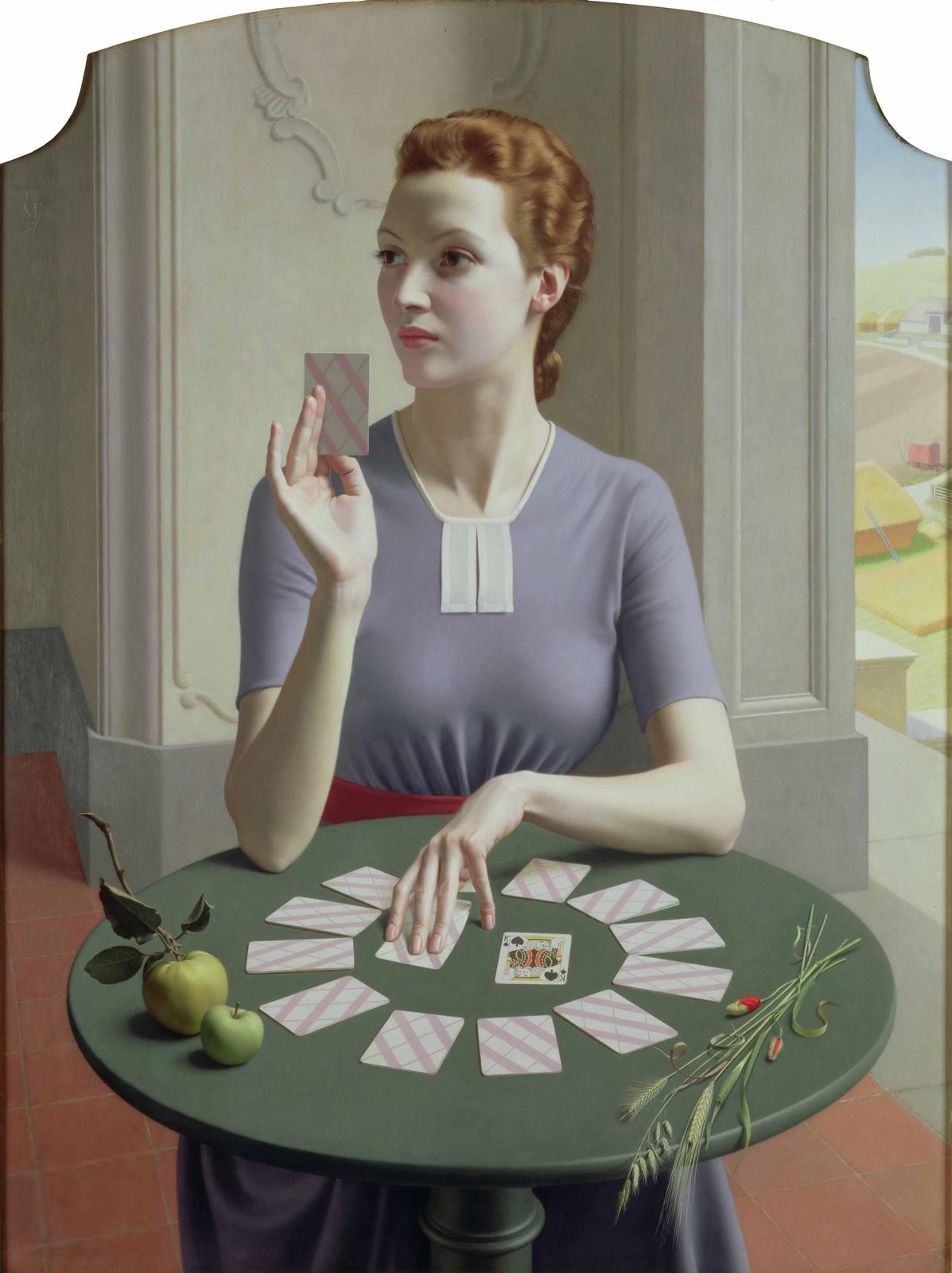
Meredith Frampton's A Game of Patience (1937)

A Game of Patience (1937) by Meredith Frampton (1894-1984), from the Ferens Art Gallery in Kingston-on-Hull, Yorkshire.

Summer-Climb Views

Simple things can sometimes baffle advanced minds. If you take a number, reverse its digits, add the result to the original number, then repeat all that, will you eventually get a palindrome? (I.e., a number, like 343 or 27172, that reads the same in both directions.) Many numbers do seem to produce palindromes sooner or later. Here are 195 and 197:

195 + 591 = 786 + 687 = 1473 + 3741 = 5214 + 4125 = 9339 (4 steps)

197 + 791 = 988 + 889 = 1877 + 7781 = 9658 + 8569 = 18227 + 72281 = 90508 + 80509 = 171017 + 710171 = 881188 (7 steps)

But what about 196? Well, it starts like this:

196 + 691 = 887 + 788 = 1675 + 5761 = 7436 + 6347 = 13783 + 38731 = 52514 + 41525 = 94039 + 93049 = 187088 + 880781 = 1067869 + 9687601 = 10755470 + 7455701 = 18211171 + 17111281 = 35322452 + 25422353 = 60744805 + 50844706 = 111589511 + 115985111 = 227574622 + 226475722 = 454050344 + 443050454 = 897100798 + 897001798 = 1794102596 + 6952014971 = 8746117567 + 7657116478 = 16403234045 + 54043230461 = 70446464506 + 60546464407 = 130992928913 + 319829299031 = 450822227944 + 449722228054 = 900544455998…

And so far, after literally years of computing by mathematicians, it hasn’t produced a palindrome. It seems very unlikely it ever will, but no-one can prove this and say that 196 is, in base 10, a Lychrel number, or a number that never produces a palindrome. In other words, a simple thing has baffled advanced minds.

I don’t know whether it can baffle advanced minds, but here’s another simple mathematical technique: sum all the digits of a number, then add the result to the original number and repeat. How long before a palindrome appears in this case? Sum it and see:

10 + 1 = 11

12 + 3 = 15 + 6 = 21 + 3 = 24 + 6 = 30 + 3 = 33 (5 steps)

13 + 4 = 17 + 8 = 25 + 7 = 32 + 5 = 37 + 10 = 47 + 11 = 58 + 13 = 71 + 8 = 79 + 16 = 95 + 14 = 109 + 10 = 119 + 11 = 130 + 4 = 134 + 8 = 142 + 7 = 149 + 14 = 163 + 10 = 173 + 11 = 184 + 13 = 197 + 17 = 214 + 7 = 221 + 5 = 226 + 10 = 236 + 11 = 247 + 13 = 260 + 8 = 268 + 16 = 284 + 14 = 298 + 19 = 317 + 11 = 328 + 13 = 341 + 8 = 349 + 16 = 365 + 14 = 379 + 19 = 398 + 20 = 418 + 13 = 431 + 8 = 439 + 16 = 455 + 14 = 469 + 19 = 488 + 20 = 508 + 13 = 521 + 8 = 529 + 16 = 545 (45 steps)

14 + 5 = 19 + 10 = 29 + 11 = 40 + 4 = 44 (4 steps)

15 + 6 = 21 + 3 = 24 + 6 = 30 + 3 = 33 (4 steps)

16 + 7 = 23 + 5 = 28 + 10 = 38 + 11 = 49 + 13 = 62 + 8 = 70 + 7 = 77 (7 steps)

17 + 8 = 25 + 7 = 32 + 5 = 37 + 10 = 47 + 11 = 58 + 13 = 71 + 8 = 79 + 16 = 95 + 14 = 109 + 10 = 119 + 11 = 130 + 4 = 134 + 8 = 142 + 7 = 149 + 14 = 163 + 10 = 173 + 11 = 184 + 13 = 197 + 17 = 214 + 7 = 221 + 5 = 226 + 10 = 236 + 11 = 247 + 13 = 260 + 8 = 268 + 16 = 284 + 14 = 298 + 19 = 317 + 11 = 328 + 13 = 341 + 8 = 349 + 16 = 365 + 14 = 379 + 19 = 398 + 20 = 418 + 13 = 431 + 8 = 439 + 16 = 455 + 14 = 469 + 19 = 488 + 20 = 508 + 13 = 521 + 8 = 529 + 16 = 545 (44 steps)

18 + 9 = 27 + 9 = 36 + 9 = 45 + 9 = 54 + 9 = 63 + 9 = 72 + 9 = 81 + 9 = 90 + 9 = 99 (9 steps)

19 + 10 = 29 + 11 = 40 + 4 = 44 (3 steps)

20 + 2 = 22

I haven’t looked very thoroughly at this technique, so I don’t know whether it throws up a seemingly unpalindromizable number. If it does, I don’t have an advanced mind, so I won’t be able to prove that it is unpalindromizable. But an adaptation of the technique produces something interesting when it is represented on a graph. This time, if s > 9, where s = digit-sum(n), let s = digit-sum(s) until s <= 9 (i.e, s < 10, the base). I call this the condensed digit-sum:

140 + 5 = 145 + 1 = 146 + 2 = 148 + 4 = 152 + 8 = 160 + 7 = 167 + 5 = 172 + 1 = 173 + 2 = 175 + 4 = 179 + 8 = 187 + 7 = 194 + 5 = 199 + 1 = 200 + 2 = 202 (15 steps)

Here, for comparison, is the sequence for 140 using uncondensed digit-sums:

140 + 5 = 145 + 10 = 155 + 11 = 166 + 13 = 179 + 17 = 196 + 16 = 212 (6 steps)

When all the numbers (including palindromes) created using condensed digit-sums are shown on a graph, they create an interesting pattern in base 10 (the x-axis represents n, the y-axis represents n, n1 = n + digit-sum(n), n2 = n1 + digit-sum(n1), etc):

(Please open images in a new window if they fail to animate.)

digitsum_b10

condensed_b3_to_b20_etc

And here, for comparison, are the patterns created by uncondensed digit-sums in base 2 to 10:

uncondensed_b2_to_b10