Digital Rodeo

What a difference a digit makes. Suppose you take all representations of n in bases b <= n. When n = 3, the bases are 2 and 3, so 3 = 11 and 10, respectively. Next, count the occurrences of the digit 1:

digitcount(3, digit=1, n=11, 10) = 3

Add this digit-count to 3:

3 + digitcount(3, digit=1, n=11, 10) = 3 + 3 = 6.

Now apply the same procedure to 6. The bases will be 2 to 6:

6 + digitcount(6, digit=1, n=110, 20, 12, 11, 10) = 6 + 6 = 12

The procedure, n = n + digitcount(n,digit=1,base=2..n), continues like this:

12 + digcount(12,dig=1,n=1100, 110, 30, 22, 20, 15, 14, 13, 12, 11, 10) = 12 + 11 = 23
23 + digcount(23,dig=1,n=10111, 212, 113, 43, 35, 32, 27, 25, 23, 21, 1B, 1A, 19, 18, 17, 16, 15, 14, 13, 12, 11, 10) = 23 + 21 = 44
44 + digcount(44,dig=1,n=101100, 1122, 230, 134, 112, 62, 54, 48, 44, 40, 38, 35, 32, 2E, 2C, 2A, 28, 26, 24, 22, 20, 1L, 1K, 1J, 1I, 1H, 1G, 1F, 1E, 1D, 1C, 1B, 1A, 19, 18, 17, 16, 15, 14, 13, 12, 11, 10) = 44 + 31 = 75

And the sequence develops like this:

3, 6, 12, 23, 44, 75, 124, 202, 319, 503, 780, 1196, 1824, 2766, 4191, 6338, 9546, 14383, 21656, 32562, 48930, 73494, 110361, 165714, 248733, 373303, 560214, 840602, 1261237, 1892269, 2838926, 4258966, 6389157, 9584585, 14377879…

Now try the same procedure using the digit 0: n = n + digcount(n,dig=0,base=2..n). The first step is this:

3 + digcount(3,digit=0,n=11, 10) = 3 + 1 = 4

Next come these:

4 + digcount(4,dig=0,n=100, 11, 10) = 4 + 3 = 7
7 + digcount(7,dig=0,n=111, 21, 13, 12, 11, 10) = 7 + 1 = 8
8 + digcount(8,dig=0,n=1000, 22, 20, 13, 12, 11, 10) = 8 + 5 = 13
13 + digcount(13,dig=0,n=1101, 111, 31, 23, 21, 16, 15, 14, 13, 12, 11, 10) = 13 + 2 = 15
15 + digcount(15,dig=0,n=1111, 120, 33, 30, 23, 21, 17, 16, 15, 14, 13, 12, 11, 10) = 15 + 3 = 18
18 + digcount(18,dig=0,n=10010, 200, 102, 33, 30, 24, 22, 20, 18, 17, 16, 15, 14, 13, 12, 11, 10) = 18 + 9 = 27
27 + digcount(27,dig=0,n=11011, 1000, 123, 102, 43, 36, 33, 30, 27, 25, 23, 21, 1D, 1C, 1B, 1A, 19, 18, 17, 16, 15, 14, 13, 12, 11, 10) = 27 + 7 = 34
34 + digcount(34,dig=0,n=100010, 1021, 202, 114, 54, 46, 42, 37, 34, 31, 2A, 28, 26, 24, 22, 20, 1G, 1F, 1E, 1D, 1C, 1B, 1A, 19, 18, 17, 16, 15, 14, 13, 12, 11, 10) = 34 + 8 = 42
42 + digcount(42,dig=0,n=101010, 1120, 222, 132, 110, 60, 52, 46, 42, 39, 36, 33, 30, 2C, 2A, 28, 26, 24, 22, 20, 1K, 1J, 1I, 1H, 1G, 1F, 1E, 1D, 1C, 1B, 1A, 19, 18, 17, 16, 15, 14, 13, 12, 11, 10) = 42 + 9 = 51

The sequence develops like this:

3, 4, 7, 8, 13, 15, 18, 27, 34, 42, 51, 59, 62, 66, 80, 94, 99, 111, 117, 125, 132, 151, 158, 163, 173, 180, 204, 222, 232, 244, 258, 279, 292, 307, 317, 324, 351, 364, 382, 389, 400, 425, 437, 447, 454, 466, 475, 483, 494, 509, 517, 536, 553, 566, 576, 612, 637, 649, 669, 679, 693, 712, 728, 753, 768, 801, 822, 835, 849, 862, 869, 883, 895, 906, 923, 932, 943, 949, 957, 967, 975, 999, 1011…

If you compare it with the sequence for digit=1, it appears that digcount(n,dig=1,b=2..n) is always larger than digcount(n,dig=0,b=2..n). That is in fact the case, with one exception, when n = 2:

digcount(2,dig=1,n=10) = 1
digcount(2,dig=0,n=10) = 1

When n = 10 (in base ten), there are twice as many ones as zeros:

digcount(10,dig=1,n=1010, 101, 22, 20, 14, 13, 12, 11, 10) = 10
digcount(10,dig=0,n=1010, 101, 22, 20, 14, 13, 12, 11, 10) = 5

As n gets larger, the difference grows dramatically:

digcount(100,dig=1,base=2..n) = 64
digcount(100,dig=0,base=2..n) = 16

digcount(1000,dig=1,base=2..n) = 533
digcount(1000,dig=0,base=2..n) = 25

digcount(10000,dig=1,base=2..n) = 5067
digcount(10000,dig=0,base=2..n) = 49

digcount(100000,dig=1,base=2..n) = 50140
digcount(100000,dig=0,base=2..n) = 73

digcount(1000000,dig=1,base=2..n) = 500408
digcount(1000000,dig=0,base=2..n) = 102

digcount(10000000,dig=1,base=2..n) = 5001032
digcount(10000000,dig=0,base=2..n) = 134

digcount(100000000,dig=1,base=2..n) = 50003137
digcount(100000000,dig=0,base=2..n) = 160

In fact, digcount(n,dig=1,b=2..n) is greater than the digit-count for any other digit: 0, 2, 3, 4, 5… (with the exception n = 2, as shown above). But digit=0 sometimes beats digits >= 2. For example, when n = 18:

digcount(18,dig=0,n=10010, 200, 102, 33, 30, 24, 22, 20, 18, 17, 16, 15, 14, 13, 12, 11, 10) = 9
digcount(18,dig=2,n=10010, 200, 102, 33, 30, 24, 22, 20, 18, 17, 16, 15, 14, 13, 12, 11, 10) = 7
digcount(18,dig=3,n=10010, 200, 102, 33, 30, 24, 22, 20, 18, 17, 16, 15, 14, 13, 12, 11, 10) = 4
digcount(18,dig=4,n=10010, 200, 102, 33, 30, 24, 22, 20, 18, 17, 16, 15, 14, 13, 12, 11, 10) = 2
digcount(18,dig=5,n=10010, 200, 102, 33, 30, 24, 22, 20, 18, 17, 16, 15, 14, 13, 12, 11, 10) = 1

But as n gets larger, digcount(0) will fall permanently behind all these digits. However, digcount(0) will always be greater than some digit d, for the obvious reason that some digits only appear when the base is high enough. For example, the hexadecimal digit A (with the decimal value 10) first appears when n = 21:

digcount(21,dig=A,n=10101, 210, 111, 41, 33, 30, 25, 23, 21, 1A, 19, 18, 17, 16, 15, 14, 13, 12, 11, 10) = 1 digcount(21,dig=0,n=10101, 210, 111, 41, 33, 30, 25, 23, 21, 1A, 19, 18, 17, 16, 15, 14, 13, 12, 11, 10) = 5

There is a general rule for the n at which digit d first appears, n = 2d + 1 (this doesn’t apply when d = 0 or d = 1):

d = 2, n = 5 = 2*2 + 1
digcount(5,dig=2,n=101, 12, 11, 10) = 1

d = 3, n = 7 = 2*3 + 1
digcount(7,dig=3,n=111, 21, 13, 12, 11, 10) = 1

d = 4, n = 9 = 2*4 + 1
digcount(9,dig=4,n=1001, 100, 21, 14, 13, 12, 11, 10) = 1

d = 5, n = 11 = 2*5 + 1
digcount(11,dig=5,n=1011, 102, 23, 21, 15, 14, 13, 12, 11, 10) = 1

It should be apparent, then, that the digit-count for a particular digit starts at 1 and gets gradually higher. The rate at which the digit-count increases is highest for 1 and lowest for 0, with digits 2, 3, 4, 5… in between:
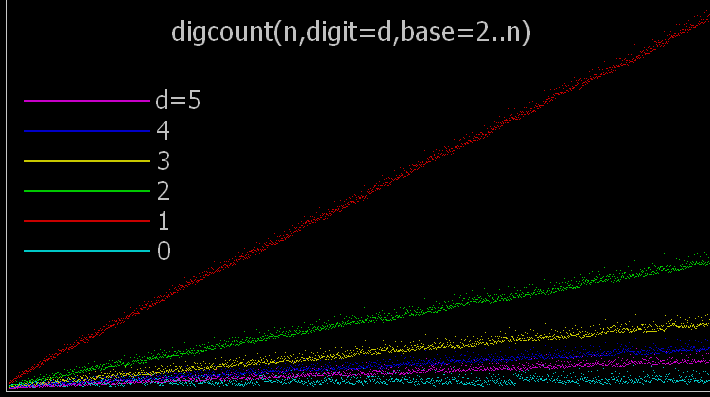
All-Base Graph

Graph for digcount(n,dig=d,b=2..n)


You could think of the graph as a digital rodeo in which these digits compete with each other. 1 is the clear and permanent winner, 0 the gradual loser. Now recall the procedure introduced at the start: n = n + digcount(n,dig=d,b=2..n). When it’s applied to the digits 0 to 5, these are the sequences that appear:

n = n + digcount(n,dig=0,b=2..n)

2, 3, 4, 7, 8, 13, 15, 18, 27, 34, 42, 51, 59, 62, 66, 80, 94, 99, 111, 117, 125, 132, 151, 158, 163, 173, 180, 204, 222, 232, 244, 258, 279, 292, 307, 317, 324, 351, 364, 382, 389, 400, 425, 437, 447, 454, 466, 475, 483, 494, 509, 517, 536, 553, 566, 576, 612, 637, 649, 669, 679, 693, 712, 728, 753, 768, 801, 822, 835, 849, 862, 869, 883, 895, 906, 923, 932, 943, 949, 957, 967, 975, 999, 1011…

n = n + digcount(n,dig=1,b=2..n)

2, 3, 6, 12, 23, 44, 75, 124, 202, 319, 503, 780, 1196, 1824, 2766, 4191, 6338, 9546, 14383, 21656, 32562, 48930, 73494, 110361, 165714, 248733, 373303, 560214, 840602, 1261237, 1892269, 2838926, 4258966, 6389157, 9584585, 14377879…

n = n + digcount(n,dig=2,b=2..n)

5, 6, 8, 12, 16, 22, 31, 37, 48, 60, 76, 94, 115, 138, 173, 213, 257, 311, 374, 454, 542, 664, 790, 935, 1109, 1310, 1552, 1835, 2167, 2548, 2989, 3509, 4120, 4832, 5690, 6687, 7829, 9166, 10727, 12568, 14697, 17182, 20089, 23470, 27425, 32042, 37477, 43768, 51113, 59687, 69705, 81379, 94998, 110910, 129488, 151153, 176429, 205923, 240331, 280490, 327396, 382067, 445858…

n = n + digcount(n,dig=3,b=2..n)

7, 8, 9, 10, 11, 13, 16, 18, 22, 25, 29, 34, 38, 44, 50, 56, 63, 80, 90, 104, 113, 131, 151, 169, 188, 210, 236, 261, 289, 320, 350, 385, 424, 463, 520, 572, 626, 684, 747, 828, 917, 999, 1101, 1210, 1325, 1446, 1577, 1716, 1871, 2040, 2228, 2429, 2642, 2875, 3133, 3413, 3719, 4044, 4402, 4786, 5196, 5645, 6140, 6673, 7257, 7900, 8582, 9315, 10130, 10998, 11942, 12954, 14058…

n = n + digcount(n,dig=4,b=2..n)

9, 10, 11, 12, 13, 14, 16, 18, 20, 23, 25, 28, 34, 41, 44, 52, 61, 67, 74, 85, 92, 102, 113, 121, 134, 148, 170, 184, 208, 229, 253, 269, 287, 306, 324, 356, 386, 410, 439, 469, 501, 531, 565, 604, 662, 703, 742, 794, 845, 895, 953, 1007, 1062, 1127, 1188, 1262, 1336, 1421, 1503, 1585, 1676, 1777, 1876, 2001, 2104, 2249, 2375, 2502, 2636, 2789, 2938, 3102, 3267, 3444, 3644, 3868, 4099…

n = n + digcount(n,dig=5,b=2..n)

11, 12, 13, 14, 15, 16, 17, 19, 21, 23, 26, 28, 29, 33, 37, 41, 48, 50, 55, 60, 64, 67, 72, 75, 83, 91, 96, 102, 107, 118, 123, 129, 137, 151, 159, 171, 180, 192, 202, 211, 224, 233, 251, 268, 280, 296, 310, 324, 338, 355, 380, 401, 430, 455, 488, 511, 536, 562, 584, 607, 638, 664, 692, 718, 748, 778, 807, 838, 874, 911, 951, 993, 1039, 1081, 1124, 1166, 1216, 1264, 1313, 1370, 1432…

Can You Dij It? #1

The most powerful drug in the world is water. The second most powerful is language. But everyone’s on them, so nobody realizes how powerful they are. Well, you could stop drinking water. Then you’d soon realize its hold on the body and the brain.

But you can’t stop using language. Try it. No, the best way to realize the power of language is to learn a new one. Each is a feast with different flavours. New alphabets are good too. The Devanagari alphabet is one of the strongest, but if you want it in refined form, try the phonetic alphabet. It will transform the way you see the world. That’s because it will make you conscious of what you’re already subconsciously aware of.

But “language” is a bigger category that it used to be. Nowadays we have computer languages too. Learning one is another way of transforming the way you see the world. And like natural languages – French, Georgian, Tagalog – they come in different flavours. Pascal is not like Basic is not like C is not like Prolog. But all of them seem to put you in touch with some deeper aspect of reality. Computer languages are like mathemagick: a way to give commands to something immaterial and alter the world by the application of will.

That feeling is at its strongest when you program with machine code, the raw instructions used by the electronics of a computer. At its most fundamental, machine code is simply a series of binary numbers controlling how a computer processes other binary numbers. You can memorize and use those code-numbers, but it’s easier to use something like assembly language, which makes machine-code friendlier for human beings. But it still looks very odd to the uninitiated:

setupnum:
xor ax,ax
xor bp,bp
mov cx,20
clearloop:
mov [di+bp],ax
add bp,2
loop clearloop
ret

That’s almost at the binary bedrock. And machine code is fast. If a fast higher-level language like C feels like flying a Messerschmitt 262, which was a jet-plane, machine-code feels like flying a Messerschmitt 163, which was a rocket-plane. A very fast and very dangerous rocket-plane.

I’m not good at programming languages, least of all machine code, but they are fun to use, quite apart from the way they make you feel as though you’re in touch with a deeper aspect of reality. They do that because the world is mathematics at its most fundamental level, I think, and computer languages are a form of mathematics.

Their mathematical nature is disguised in a lot of what they’re used for, but I like to use them for recreational mathematics. Machine-code is useful when you need a lot of power and speed. For example, look at these digits:

1, 2, 3, 4, 5, 6, 7, 8, 9, 1*, 0*, 1, 1, 1, 2, 1, 3, 1, 4, 1, 5, 1, 6, 1, 7, 1, 8, 1, 9, 2, 0, 2, 1, 2, 2, 2, 3, 2, 4, 2, 5, 2, 6, 2, 7, 2, 8, 2, 9, 3, 0, 3, 1, 3, 2, 3, 3, 3, 4, 3, 5, 3, 6*, 3*, 7, 3, 8, 3, 9, 4, 0, 4, 1, 4, 2, 4…

They’re what the Online Encyclopedia of Integer Sequences (OEIS) calls “the almost natural numbers” (sequence A007376) and you generate them by writing the standard integers – 1, 2, 3, 4, 5, 6, 7, 8, 9, 10, 11, 12, 13… – and then separating each digit with a comma: 1, 2, 3, 4, 5, 6, 7, 8, 9, 1, 0, 1, 1, 1, 2, 1, 3… The commas give them some interesting twists. In a list of the standard integers, the 1st entry is 1, the 10th entry is 10, the 213rd entry is 213, the 987,009,381th entry is 987,009,381, and so on.

But that doesn’t work with the almost natural numbers. The 10th entry is 1, not 10, and the 11th entry is 0, not 11. But the 10th entry does begin the sequence (1, 0). I wondered whether that happened again. It does. The 63rd entry in the almost natural numbers begins the sequence (6, 3) – see the asterisks in the sequence above.

This happens again at the 3105th entry, which begins the sequence (3, 1, 0, 5). After that the gaps get bigger, which is where machine code comes in. An ordinary computer-language takes a long time to reach the 89,012,345,679th entry in the almost natural numbers. Machine code is much quicker, which is why I know that the 89,012,345,679th entry begins the sequence (8, 9, 0, 1, 2, 3, 4, 5, 6, 7, 9):

1, 2, 3, 4, 5, 6, 7, 8, 9, 10, 63, 3105, 43108, 77781, 367573, 13859021, 77911127, 911360799, 35924813703, 74075186297, 89012345679…

And an ordinary computer-language might give you the impression that base 9 doesn’t have numbers like these (apart from the trivial 1, 2, 3, 4, 5, 6, 7, 8, 10…). But it does. 63 in base 10 is a low-hanging fruit: you could find it working by hand. In base 9, the fruit are much higher-hanging. But machine code plucks them with almost ridiculous ease:

1, 2, 3, 4, 5, 6, 7, 8, 10, 570086565, 655267526, 2615038272, 4581347024, 5307541865, 7273850617, 7801234568…

Power Trip

Here are the first few powers of 2:

2 = 1 * 2
4 = 2 * 2
8 = 4 * 2
16 = 8 * 2
32 = 16 * 2
64 = 32 * 2
128 = 64 * 2
256 = 128 * 2
512 = 256 * 2
1024 = 512 * 2
2048 = 1024 * 2
4096 = 2048 * 2
8192 = 4096 * 2
16384 = 8192 * 2
32768 = 16384 * 2
65536 = 32768 * 2
131072 = 65536 * 2
262144 = 131072 * 2
524288 = 262144 * 2
1048576 = 524288 * 2
2097152 = 1048576 * 2
4194304 = 2097152 * 2
8388608 = 4194304 * 2
16777216 = 8388608 * 2
33554432 = 16777216 * 2
67108864 = 33554432 * 2…

As you can see, it’s a one-way power-trip: the numbers simply get larger. But what happens if you delete the digit 0 whenever it appears in a result? For example, 512 * 2 = 1024, which becomes 124. If you apply this rule, the sequence looks like this:

2 * 2 = 4
4 * 2 = 8
8 * 2 = 16
16 * 2 = 32
32 * 2 = 64
64 * 2 = 128
128 * 2 = 256
256 * 2 = 512
512 * 2 = 1024 → 124
124 * 2 = 248
248 * 2 = 496
496 * 2 = 992
992 * 2 = 1984
1984 * 2 = 3968
3968 * 2 = 7936
7936 * 2 = 15872
15872 * 2 = 31744
31744 * 2 = 63488
63488 * 2 = 126976
126976 * 2 = 253952
253952 * 2 = 507904 → 5794
5794 * 2 = 11588
11588 * 2 = 23176
23176 * 2 = 46352
46352 * 2 = 92704 → 9274…

Is this a power-trip? Not quite: it’s a return trip, because the numbers can never grow beyond a certain size and the sequence falls into a loop. If the result 2n contains a zero, then zerodelete(2n) < n, so the sequence has an upper limit and a number will eventually occur twice. This happens at step 526 with 366784, which matches 366784 at step 490.

The rate at which we delete zeros can obviously be varied. Call it 1:z. The sequence above sets z = 1, so 1:z = 1:1. But what if z = 2, so that 1:z = 1:2? In other words, the procedure deletes every second zero. The first zero occurs when 1024 = 2 * 512, so 1024 is left as it is. The second zero occurs when 2 * 1024 = 2048, so 2048 becomes 248. When z = 2 and every second zero is deleted, the sequence begins like this:

1 * 2 = 2
2 * 2 = 4
4 * 2 = 8
8 * 2 = 16
16 * 2 = 32
32 * 2 = 64
64 * 2 = 128
128 * 2 = 256
256 * 2 = 512
512 * 2 = 1024 → 1024
1024 * 2 = 2048 → 248
248 * 2 = 496
496 * 2 = 992
992 * 2 = 1984
1984 * 2 = 3968
3968 * 2 = 7936
7936 * 2 = 15872
15872 * 2 = 31744
31744 * 2 = 63488
63488 * 2 = 126976
126976 * 2 = 253952
253952 * 2 = 507904 → 50794
50794 * 2 = 101588 → 101588
101588 * 2 = 203176 → 23176
23176 * 2 = 46352
46352 * 2 = 92704 → 92704
92704 * 2 = 185408 → 18548

This sequence also has a ceiling and repeats at step 9134 with 5458864, which matches 5458864 at step 4166. And what about the sequence in which z = 3 and every third zero is deleted? Does this have a ceiling or does the act of multiplying by 2 compensate for the slower removal of zeros?

In fact, it can’t do so. The larger 2n becomes, the more zeros it will tend to contain. If 2n is large enough to contain 3 zeros on average, the deletion of zeros will overpower multiplication by 2 and the sequence will not rise any higher. Therefore the sequence that deletes every third zero will eventually repeat, although I haven’t been able to discover the relevant number.

But this reasoning applies to any rate, 1:z, of zero-deletion. If z = 100 and every hundredth zero is deleted, numbers in the sequence will rise to the point at which 2n contains sufficient zeros on average to counteract multiplication by 2. The sequence will have a ceiling and will eventually repeat. If z = 10^100 or z = 10^(10^100) and every googolth or googolplexth zero is deleted, the same is true. For any rate, 1:z, at which zeros are deleted, the sequence n = zerodelete(2n,z) has an upper limit and will eventually repeat.


Update (30×21)

Six years later, I’ve found the answer for z = 3. And uncovered a serious error in this article. See:

Power Trap

Block n Rule

One of my favourite integer sequences uses the formula n(i) = n(i-1) + digsum(n(i-1)), where digsum(n) sums the digits of n. In base 10, it goes like this:

1, 2, 4, 8, 16, 23, 28, 38, 49, 62, 70, 77, 91, 101, 103, 107, 115, 122, 127, 137, 148, 161, 169, 185, 199, 218, 229, 242, 250, 257, 271, 281, 292, 305, 313, 320, 325, 335, 346, 359, 376, 392, 406, 416, 427, 440, 448, 464, 478, 497, 517, 530, 538, 554, 568, 587, 607, 620, 628, 644, 658, 677, 697, 719, 736, 752, 766, 785, 805, 818, 835, 851, 865, 884, 904, 917, 934, 950, 964, 983, 1003…

Another interesting sequence uses the formula n(i) = n(i-1) + digprod(n(i-1)), where digprod(n) multiplies the digits of n (excluding 0). In base 10, it goes like this:

1, 2, 4, 8, 16, 22, 26, 38, 62, 74, 102, 104, 108, 116, 122, 126, 138, 162, 174, 202, 206, 218, 234, 258, 338, 410, 414, 430, 442, 474, 586, 826, 922, 958, 1318, 1342, 1366, 1474, 1586, 1826, 1922, 1958, 2318, 2366, 2582, 2742, 2854, 3174, 3258, 3498, 4362, 4506, 4626, 4914, 5058, 5258, 5658, 6858, 8778, 11914, 11950, 11995…

You can apply these formulae in other bases and it’s trivially obvious that the sequences rise most slowly in base 2, because you’re never summing or multiplying anything but the digit 1. However, there is a sequence for which base 2 is by far the best performer. It has the formula n(i) = n(i-1) + blockmult(n(i-1)), where blockmult(n) counts the lengths of distinct blocks of the same digit, including 0, then multiplies those lengths together. For example:

blockmult(3,b=2) = blockmult(11) = 2
blockmult(28,b=2) = blockmult(11100) = 3 * 2 = 6
blockmult(51,b=2) = blockmult(110011) = 2 * 2 * 2 = 8
blockmult(140,b=2) = blockmult(10001100) = 1 * 3 * 2 * 2 = 12
blockmult(202867,b=2) = blockmult(110001100001110011) = 2 * 3 * 2 * 4 * 3 * 2 * 2 = 576

The full sequence begins like this (numbers are represented in base 10, but the formula is being applied to their representations in binary):

1, 2, 3, 5, 6, 8, 11, 13, 15, 19, 23, 26, 28, 34, 37, 39, 45, 47, 51, 59, 65, 70, 76, 84, 86, 88, 94, 98, 104, 110, 116, 122, 126, 132, 140, 152, 164, 168, 171, 173, 175, 179, 187, 193, 203, 211, 219, 227, 245, 249, 259, 271, 287, 302, 308, 316, 332, 340, 342, 344, 350, 354, 360, 366, 372, 378, 382, 388, 404, 412, 436, 444, 460, 484, 500, 510, 518, 530, 538, 546, 555, 561, 579, 595, 603, 611, 635, 651, 657, 663, 669, 675, 681…

In higher bases, it rises much more slowly. This is base 3:

1, 2, 3, 4, 6, 7, 8, 10, 11, 12, 14, 16, 17, 19, 20, 21, 22, 24, 26, 29, 31, 33, 34, 35, 37, 39, 42, 44, 48, 49, 51, 53, 56, 58, 60, 61, 62, 64, 65, 66, 68, 70, 71, 73, 75, 77, 79, 82, 85, 89, 93, 95, 97, 98, 100, 101, 102, 103, 105, 107, 110, 114, 116, 120, 124, 127, 129, 131, 133, 137, 139, 141, 142, 143, 145, 146, 147, 149, 151, 152, 154, 156, 158, 160, 163…

And this is base 10:

1, 2, 3, 4, 5, 6, 7, 8, 9, 10, 11, 13, 14, 15, 16, 17, 18, 19, 20, 21, 22, 24, 25, 26, 27, 28, 29, 30, 31, 32, 33, 35, 36, 37, 38, 39, 40, 41, 42, 43, 44, 46, 47, 48, 49, 50, 51, 52, 53, 54, 55, 57, 58, 59, 60, 61, 62, 63, 64, 65, 66, 68, 69, 70, 71, 72, 73, 74, 75, 76, 77, 79, 80, 81, 82, 83, 84, 85, 86, 87, 88, 90…

Note how, in bases 3 and 10, blockmult(n) often equals 1. In base 3, the sequence contains [141, 142, 143, 145]:

blockmult(141,b=3) = blockmult(12020) = 1 * 1 * 1 * 1 = 1
blockmult(142,b=3) = blockmult(12021) = 1 * 1 * 1 * 1 = 1
blockmult(143,b=3) = blockmult(12022) = 1 * 1 * 1 * 2 = 2

The formula also returns 1 much further along the sequence in base 3. For example, the 573809th number in the sequence, or n(573809), is 5775037 and blockmult(5775037) = blockmult(101212101212021) = 1^15 = 1. But in base 2, blockmult(n) = 1 is very rare. It happens three times at the beginning of the sequence:

1, 2, 3, 5, 6, 8, 11…

After that, I haven’t found any more examples of blockmult(n) = 1, although blockmult(n) = 2 occurs regularly. For example,

blockmult(n(100723)) = blockmult(44739241) = blockmult(10101010101010101010101001) = 2
blockmult(n(100724)) = blockmult(44739243) = blockmult(10101010101010101010101011) = 2
blockmult(n(100725)) = blockmult(44739245) = blockmult(10101010101010101010101101) = 2

Does the sequence in base 2 return another example of blockmult(n) = 1? The odds seem against it. For any given number of digits in base 2, there is only one number for which blockmult(n) = 1. For example: 1, 10, 101, 1010, 10101, 101010, 1010101… As the sequence increases, the percentage of these numbers becomes smaller and smaller. But the sequence is infinite, so who knows what happens in the end? Perhaps blockmult(n) = 1 occurs infinitely often.

Magistra Rules the Waves

One of my favourite integer sequences has the simple formula n(i) = n(i-1) + digitsum(n(i-1)). If it’s seeded with 1, its first few terms go like this:

n(1) = 1
n(2) = n(1) + digitsum(n(1)) = 1 + digitsum(1) = 2
n(3) = 2 + digitsum(2) = 4
n(4) = 4 + digitsum(4) = 8
n(5) = 8 + digitsum(8) = 16
n(6) = 16 + digitsum(16) = 16 + 1+6 = 16 + 7 = 23
n(7) = 23 + digitsum(23) = 23 + 2+3 = 23 + 5 = 28
n(8) = 28 + digitsum(28) = 28 + 2+8 = 28 + 10 = 38

As a sequence, it looks like this:

1, 2, 4, 8, 16, 23, 28, 38, 49, 62, 70, 77, 91, 101, 103, 107, 115, 122, 127, 137, 148, 161, 169, 185, 199, 218, 229, 242, 250, 257, 271, 281, 292, 305, 313, 320, 325, 335, 346, 359, 376, 392, 406, 416, 427, 440, 448, 464, 478, 497, 517, 530, 538, 554, 568, 587, 607, 620, 628, 644, 658, 677, 697, 719, 736, 752, 766, 785, 805, 818, 835, 851, 865, 884, 904, 917, 934, 950, 964, 983, 1003…

Given a number at random, is there a quick way to say whether it appears in the sequence seeded with 1? Not that I know, with one exception. If the number is divisible by 3, it doesn’t appear, at least in base 10. In base 2, that rule doesn’t apply:

n(1) = 1
n(2) = 1 + digitsum(1) = 10 = 1 + 1 = 2
n(3) = 10 + digitsum(10) = 10 + 1 = 11 = 2 + 1 = 3
n(4) = 11 + digitsum(11) = 11 + 1+1 = 101 = 3 + 2 = 5
n(5) = 101 + digitsum(101) = 101 + 1+0+1 = 111 = 5 + 2 = 7
n(6) = 111 + digitsum(111) = 111 + 11 = 1010 = 7 + 3 = 10
n(7) = 1010 + digitsum(1010) = 1010 + 10 = 1100 = 10 + 2 = 12
n(8) = 1100 + digitsum(1100) = 1100 + 10 = 1110 = 12 + 2 = 14

1, 2, 3, 5, 7, 10, 12, 14, 17, 19, 22, 25, 28, 31, 36, 38, 41, 44, 47, 52, 55, 60, 64, 65, 67, 70, 73, 76, 79, 84, 87, 92, 96, 98, 101, 105, 109, 114, 118, 123, 129, 131, 134, 137, 140, 143, 148, 151, 156, 160, 162, 165, 169, 173, 178, 182, 187, 193, 196, 199, 204, 208, 211, 216, 220, 225, 229, 234, 239, 246, 252, 258, 260, 262, 265, 268, 271, 276, 279, 284, 288, 290, 293, 297, 301, 306, 310, 315, 321, 324, 327, 332, 336, 339, 344, 348, 353, 357, 362, 367, 374…

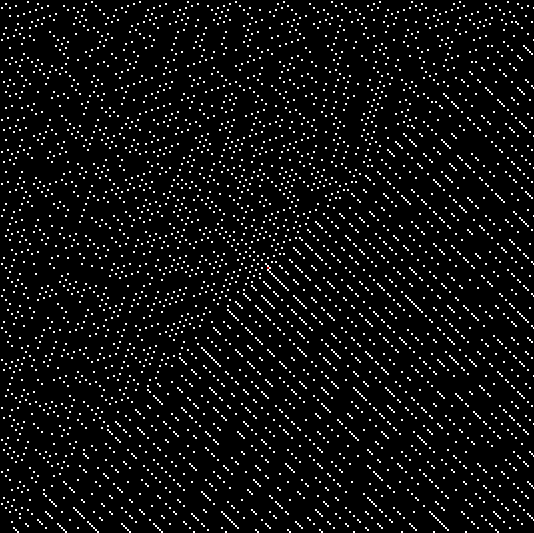
What patterns are there in these sequences? It’s easier to check when they’re represented graphically, so I converted them into patterns à la the Ulam spiral, where n is represented as a dot on a spiral of integers. This is the spiral for base 10:

ulambase10Base 10


And these are the spirals for bases 2 and 3:

ulambase2

Base 2


ulambase3

Base 3


These sequences look fairly random to me: there are no obvious patterns in the jumps from n(i) to n(i+1), i.e. in the values for digitsum(n(i)). Now try the spirals for bases 9 and 33:

ulambase9

Base 9


ulambase33

Base 33


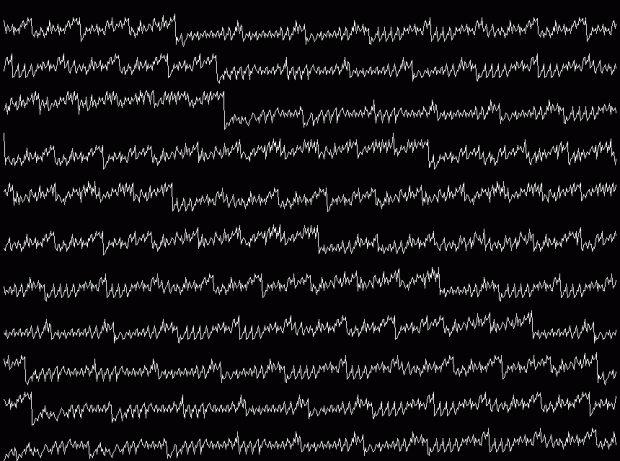
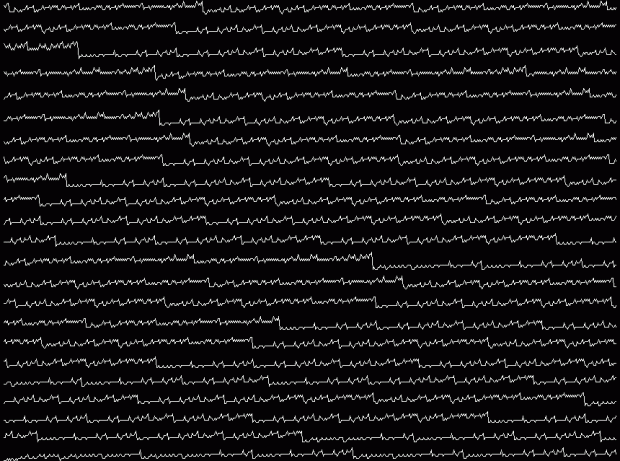
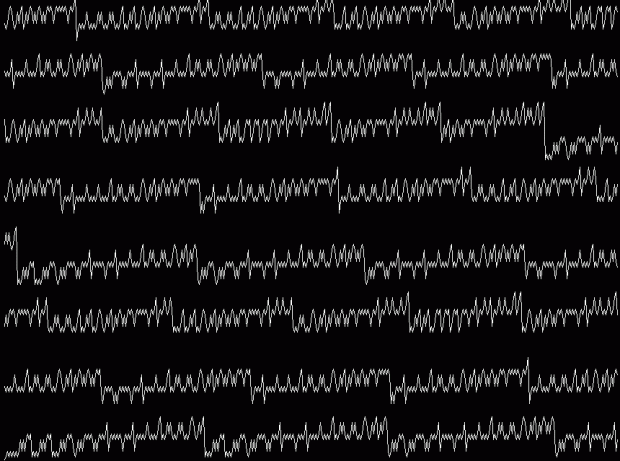
Patterns have appeared: there is some regularity in the jumps. You can see these regularities more clearly if you represent digitsum(n(i)) as a graph, with n(i) on the x axis and digitsum(n(i)) on the y axis. If the graph starts with n(i) = 1 on the lower left and proceeds left-right, left-right up the screen, it looks like this in base 10:

base10

Base 10 (click to enlarge)


Here are bases 2 and 3:

base2

Base 2


base3

Base 3


The jumps seem fairly random. Now try bases 9, 13, 16, 17, 25, 33 and 49:

base9

Base 9


base13

Base 13


base16

Base 16


base17

Base 17


base25

Base 25


base33

Base 33


base49

Base 49


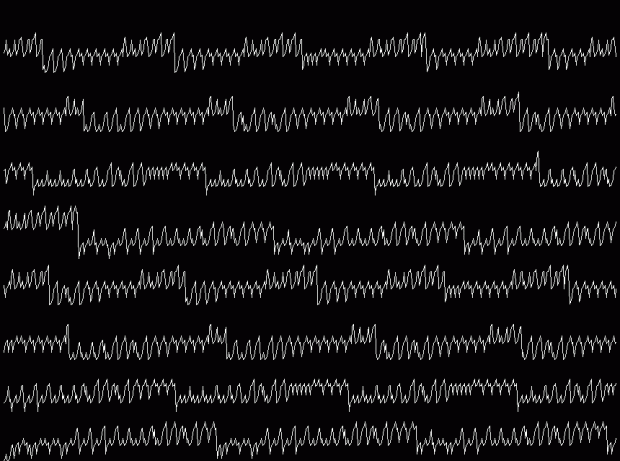
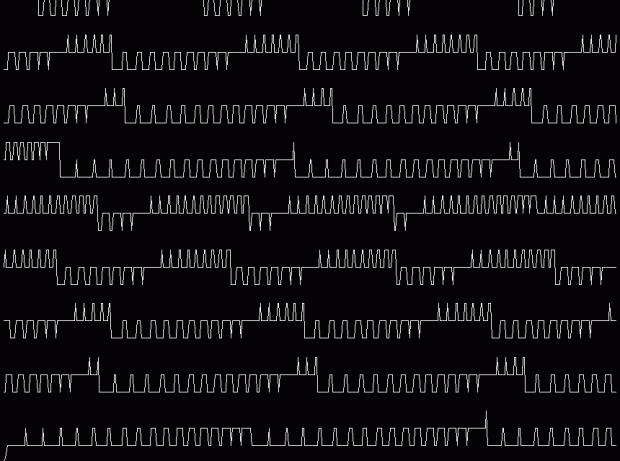
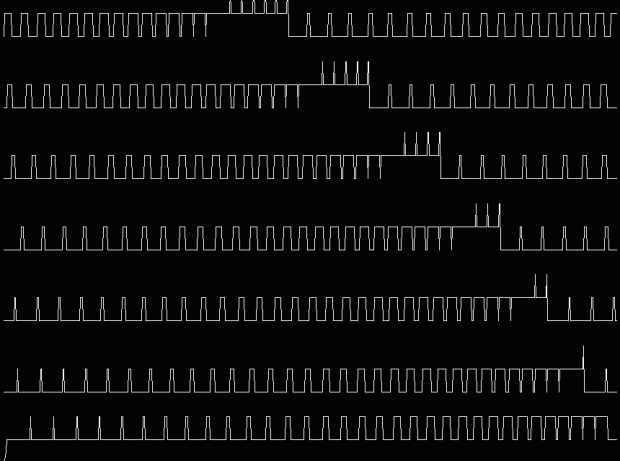
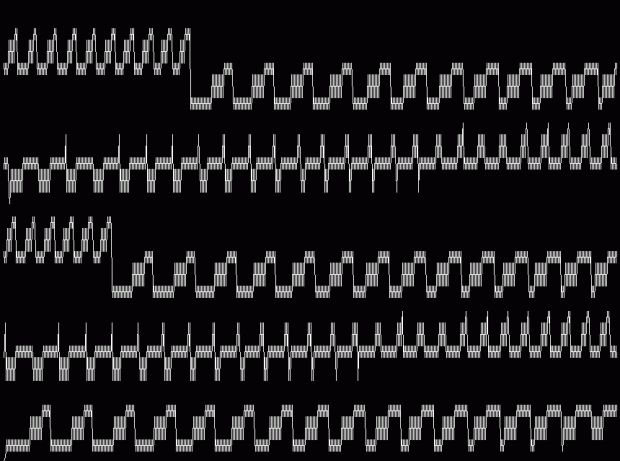
In some bases, the formula n(i) = n(i-1) + digitsum(n(i-1)) generates mild randomness. In others, it generates strong regularity, like waves rolling ashore under a steady wind. I don’t understand why, but regularity seems to occur in bases that are one more than a power of 2 and also in some bases that are primes or squares.


Elsewhere other-posted:

Mathematica Magistra Mundi
8200_idf_insignia

Dig Sum Fib

The Fibonacci sequence is an infinitely rich sequence based on a very simple rule: add the previous two numbers. If the first two numbers are 1 and 1, the sequence begins like this:

1, 1, 2, 3, 5, 8, 13, 21, 34, 55, 89, 144, 233, 377, 610, 987, 1597, 2584, 4181, 6765, 10946, 17711, 28657, 46368, 75025…

Plainly, the numbers increase for ever. The hundredth Fibonacci number is 354,224,848,179,261,915,075, for example, and the two-hundredth is 280,571,172,992,510,140,037,611,932,413,038,677,189,525. But there are variants on the Fibonacci sequence that don’t increase for ever. The standard rule is n(i) = n(i-2) + n(i-1). What if the rule becomes n(i) = digitsum(n(i-2)) + digitsum(n(i-1))? Now the sequence falls into a loop, like this:

1, 1, 2, 3, 5, 8, 13, 12, 7, 10, 8, 9, 17, 17, 16, 15, 13, 10, 5, 6, 11, 8, 10, 9, 10, 10, 2, 3… (length=28)

But that’s in base 10. Here are the previous bases:

1, 1, 2, 2, 2… (base=2) (length=5)
1, 1, 2, 3, 3, 2, 3… (b=3) (l=7)
1, 1, 2, 3, 5, 5, 4, 3, 4, 4, 2, 3… (b=4) (l=12)
1, 1, 2, 3, 5, 4, 5, 5, 2, 3… (b=5) (l=10)
1, 1, 2, 3, 5, 8, 8, 6, 4, 5, 9, 9, 8, 7, 5, 7, 7, 4, 6, 5, 6, 6, 2, 3… (b=6) (l=24)
1, 1, 2, 3, 5, 8, 7, 3, 4, 7, 5, 6, 11, 11, 10, 9, 7, 4, 5, 9, 8, 5, 7, 6, 7, 7, 2, 3… (b=7) (l=28)
1, 1, 2, 3, 5, 8, 6, 7, 13, 13, 12, 11, 9, 6, 8, 7, 8, 8, 2, 3… (b=8) (l=20)
1, 1, 2, 3, 5, 8, 13, 13, 10, 7, 9, 8, 9, 9, 2, 3… (b=9) (l=16)

Apart from base 2, all the bases repeat with (2, 3), which is set up in each case by (base, base) = (10, 10) in that base, equivalent to (1, 1). All bases > 2 appear to repeat with (2, 3), but I don’t understand why. The length of the sequence varies widely. Here it is in bases 29, 30 and 31:

1, 1, 2, 3, 5, 8, 13, 21, 34, 27, 33, 32, 9, 13, 22, 35, 29, 8, 9, 17, 26, 43, 41, 28, 41, 41, 26, 39, 37, 20, 29, 21, 22, 43, 37, 24, 33, 29, 6, 7, 13, 20, 33, 25, 30, 27, 29, 28, 29, 29, 2, 3… (b=29) (l=52)

1, 1, 2, 3, 5, 8, 13, 21, 34, 26, 31, 28, 30, 29, 30, 30, 2, 3 (b=30) (l=18)

1, 1, 2, 3, 5, 8, 13, 21, 34, 25, 29, 54, 53, 47, 40, 27, 37, 34, 11, 15, 26, 41, 37, 18, 25, 43, 38, 21, 29, 50, 49, 39, 28, 37, 35, 12, 17, 29, 46, 45, 31, 16, 17, 33, 20, 23, 43, 36, 19, 25, 44, 39, 23, 32, 25, 27, 52, 49, 41, 30, 41, 41, 22, 33, 25, 28, 53, 51, 44, 35, 19, 24, 43, 37, 20, 27, 47, 44, 31, 15, 16, 31, 17, 18, 35, 23, 28, 51, 49, 40, 29, 39, 38, 17, 25, 42, 37, 19, 26, 45, 41, 26, 37, 33, 10, 13, 23, 36, 29, 35, 34, 9, 13, 22, 35, 27, 32, 29, 31, 30, 31, 31, 2, 3 (b=31) (l=124)

The sequence for base 77 is short like that for base 30:

1, 1, 2, 3, 5, 8, 13, 21, 34, 55, 89, 68, 81, 73, 78, 75, 77, 76, 77, 77, 2, 3 (b=77) (l=22)

But the sequence for base 51 is this:

1, 1, 2, 3, 5, 8, 13, 21, 34, 55, 39, 44, 83, 77, 60, 37, 47, 84, 81, 65, 46, 61, 57, 18, 25, 43, 68, 61, 29, 40, 69, 59, 28, 37, 65, 52, 17, 19, 36, 55, 41, 46, 87, 83, 70, 53, 23, 26, 49, 75, 74, 49, 73, 72, 45, 67, 62, 29, 41, 70, 61, 31, 42, 73, 65, 38, 53, 41, 44, 85, 79, 64, 43, 57, 50, 57, 57, 14, 21, 35, 56, 41, 47, 88, 85, 73, 58, 31, 39, 70, 59, 29, 38, 67, 55, 22, 27, 49, 76, 75, 51, 26, 27, 53, 30, 33, 63, 46, 59, 55, 14, 19, 33, 52, 35, 37, 72, 59, 31, 40, 71, 61, 32, 43, 75, 68, 43, 61, 54, 15, 19, 34, 53, 37, 40, 77, 67, 44, 61, 55, 16, 21, 37, 58, 45, 53, 48, 51, 49, 50, 99, 99, 98, 97, 95, 92, 87, 79, 66, 45, 61, 56, 17, 23, 40, 63, 53, 16, 19, 35, 54, 39, 43, 82, 75, 57, 32, 39, 71, 60, 31, 41, 72, 63, 35, 48, 83, 81, 64, 45, 59, 54, 13, 17, 30, 47, 77, 74, 51, 25, 26, 51, 27, 28, 55, 33, 38, 71, 59, 30, 39, 69, 58, 27, 35, 62, 47, 59, 56, 15, 21, 36, 57, 43, 50, 93, 93, 86, 79, 65, 44, 59, 53, 12, 15, 27, 42, 69, 61, 30, 41, 71, 62, 33, 45, 78, 73, 51, 24, 25, 49, 74, 73, 47, 70, 67, 37, 54, 41, 45, 86, 81, 67, 48, 65, 63, 28, 41, 69, 60, 29, 39, 68, 57, 25, 32, 57, 39, 46, 85, 81, 66, 47, 63, 60, 23, 33, 56, 39, 45, 84, 79, 63, 42, 55, 47, 52, 49, 51, 50, 51, 51, 2, 3… (b=51) (l=304)

Summer Set Sequence

I wondered what would happen if you added to a set of numbers, (a, b, c), the first number that wasn’t equal to the sum of any subset of the numbers: a + b, a + c, c + b, a + b + c. If the set begins with 1, the first number not equal to any subset of (1) is 2. So the set becomes (1, 2). 3 = 1 + 2, so 3 is not added. But 4 is added, making the set (1, 2, 4). The sequence of additions goes like this:

1, 2, 4, 8, 16, 32, 64, 128, 256, 512, 1024, 2048, 4096, 8192, 16384, 32768, 65536…

It’s the powers of 2, because some subset of the powers of 2 < 2^p will equal any number from 1 to (2^p)-1, therefore the first addition will be 2^p = the cumulative sum + 1:

1 (cumulative sum=1), 2 (cs=3), 4 (cs=7), 8 (cs=15), 16 (cs=31), 32 (cs=63), 64 (cs=127), 128 (cs=255), 256 (cs=511), 512 (cs=1023), 1024 (cs=2047), 2048 (cs=4095), 4096 (cs=8191), 8192 (cs=16383), 16384 (cs=32767), 32768 (cs=65535)…

If you seed the sequence with the set (2), the first addition is 3, but after that the powers of 2 re-appear:

2, 3, 4, 8, 16, 32, 64, 128, 256, 512, 1024, 2048, 4096, 8192, 16384, 32768, 65536…

It becomes more complicated if the sequence is seeded with the set (3):

3, 4, 5, 6, 16, 17, 49, 50, 148, 149, 445, 446, 1336, 1337, 4009, 4010, 12028, 12029, 36085, 36086…

You can predict the pattern by looking at the cumulative sums again:

3, 4, 5, 6 (cumulative sum=18), 16, 17 (cs=51), 49, 50 (cs=150), 148, 149 (cs=447), 445, 446 (cs=1338), 1336, 1337 (cs=4011), 4009, 4010 (cs=12030), 12028, 12029 (cs=36087), 36085, 36086 (cs=108258)…

The sequence begins with a block of four consecutive numbers, followed by separate blocks of two consecutive numbers. The first number in each 2-block is predicted by the cumulative sum of the last number in the previous block, according to the formula n = cumulative sum – seed + 1. When the seed is 3, n = cs-3+1.

If the seed is 4, the sequences goes like this:

4, 5, 6, 7, 8, 27, 28, 29, 111, 112, 113, 447, 448, 449, 1791, 1792, 1793, 7167, 7168, 7169…

Now the sequence begins with a block of five consecutive numbers, followed by separate blocks of three consecutive numbers. The formula is n = cs-4+1:

4, 5, 6, 7, 8 (cumulative sum=30), 27, 28, 29 (cs=114), 111, 112, 113 (cs=450), 447, 448, 449 (cs=1794), 1791, 1792, 1793 (cs=7170), 7167, 7168, 7169 (cs=28674)…

And here’s the sequence seeded with (5):

5, 6, 7, 8, 9, 10, 41, 42, 43, 44, 211, 212, 213, 214, 1061, 1062, 1063, 1064, 5311, 5312, 5313, 5314…

5, 6, 7, 8, 9, 10 (cs=45), 41, 42, 43, 44 (cs=215), 211, 212, 213, 214 (cs=1065), 1061, 1062, 1063, 1064 (cs=5315), 5311, 5312, 5313, 5314 (cs=26565)…

Summus

I’m interested in digit-sums and in palindromic numbers. Looking at one, I found the other. It started like this: 9^2 = 81 and 9 = 8 + 1, so digitsum(9^1) = digitsum(9^2). I wondered how long such a sequence of powers could be (excluding powers of 10). I quickly found that the digit-sum of 468 is equal to the digit-sum of its square and cube:

digsum(468) = digsum(219024) = digsum(102503232)

But I couldn’t find any longer sequence, although plenty of other numbers are similar to 468:

digsum(585) = digsum(342225) = digsum(200201625)
digsum(4680) = digsum(21902400) = digsum(102503232000)
digsum(5850) = digsum(34222500) = digsum(200201625000)
digsum(5851) = digsum(34234201) = digsum(200304310051)
digsum(5868) = digsum(34433424) = digsum(202055332032)
digsum(28845) = digsum(832034025) = digsum(24000021451125) […]
digsum(589680) = digsum(347722502400) = digsum(205045005215232000)

What about other bases? First came this sequence:

digsum(2) = digsum(11) (base = 3) (highest power = 2)

Then these:

digsum(4) = digsum(22) = digsum(121) (b=7) (highest power = 3)
digsum(8) = digsum(44) = digsum(242) = digsum(1331) (b=15) (hp=4)
digsum([16]) = digsum(88) = digsum(484) = digsum(2662) = digsum(14641) (b=31) (hp=5)

The pattern continues (a number between square brackets represents a single digit in the base):

digsum([32]) = digsum([16][16]) = digsum(8[16]8) = digsum(4[12][12]4) = digsum(28[12]82) = digsum(15[10][10]51) (b=63) (hp=6)
digsum([64]) = digsum([32][32]) = digsum([16][32][16]) = digsum(8[24][24]8) = digsum(4[16][24][16]4) = digsum(2[10][20][20][10]2) = digsum(16[15][20][15]61) (b=127) (hp=7)
digsum([128]) = digsum([64][64]) = digsum([32][64][32]) = digsum([16][48][48][16]) = digsum(8[32][48][32]8) = digsum(4[20][40][40][20]4) = digsum(2[12][30][40][30][12]2) = digsum(17[21][35][35][21]71) (b=255) (hp=8)
digsum([256]) = digsum([128][128]) = digsum([64][128][64]) = digsum([32][96][96][32]) = digsum([16][64][96][64][16]) = digsum(8[40][80][80][40]8) = digsum(4[24][60][80][60][24]4) = digsum(2[14][42][70][70][42][14]2) = digsum(18[28][56][70][56][28]81) (b=511) (hp=9)

After this, I looked at sequences in which n(i) = n(i-1) + digitsum(n(i-1)). How long could digitsum(n(i)) be greater than or equal to digitsum(n(i-1))? In base 10, I found these sequences:

1 (digitsum=1) → 2 → 4 → 8 → 16 (sum=7) (count=4) (base=10)
9 → 18 (sum=9) → 27 (s=9) → 36 (s=9) → 45 (s=9) → 54 (s=9) → 63 (s=9) → 72 (s=9) → 81 (s=9) → 90 (s=9) → 99 (s=18) → 117 (s=9) (c=11) (b=10)
801 (s=9) → 810 (s=9) → 819 (s=18) → 837 (s=18) → 855 (s=18) → 873 (s=18) → 891 (s=18) → 909 (s=18) → 927 (s=18) → 945 (s=18) → 963 (s=18) → 981 (s=18) → 999 (s=27) → 1026 (s=9) (c=13)

Base 2 does better:

1 → 10 (s=1) → 11 (s=2) → 101 (s=2) → 111 (s=3) → 1010 (s=2) (c=5) (b=2)
16 = 10000 (s=1) → 10001 (s=2) → 10011 (s=3) → 10110 (s=3) → 11001 (s=3) → 11100 (s=3) → 11111 (s=5) → 100100 (s=2) (c=7) (b=2)
962 = 1111000010 (s=5) → 1111000111 (s=7) → 1111001110 (s=7) → 1111010101 (s=7) → 1111011100 (s=7) → 1111100011 (s=7) → 1111101010 (s=7) → 1111110001 (s=7) → 1111111000 (s=7) → 1111111111 (s=10) → 10000001001 (s=3) (c=10) (b=2)
524047 = 1111111111100001111 (s=15) → 1111111111100011110 (s=15) → 1111111111100101101 (s=15) → 1111111111100111100 (s=15) → 1111111111101001011 (s=15) → 1111111111101011010 (s=15) → 1111111111101101001(s=15) → 1111111111101111000 (s=15) → 1111111111110000111 (s=15) → 1111111111110010110 (s=15) → 1111111111110100101 (s=15) → 1111111111110110100 (s=15) → 1111111111111000011 (s=15) → 1111111111111010010 (s=15) → 1111111111111100001 (s=15) → 1111111111111110000 (s=15) → 1111111111111111111 (s=19) → 10000000000000010010 (s=3) (c=17) (b=2)

The best sequence I found in base 3 is shorter than in base 10, but there are more sequences:

1 → 2 → 11 (s=2) → 20 (s=2) → 22 (s=4) → 110 (s=2) (c=5) (b=3)
31 = 1011 (s=3) → 1021 (s=4) → 1102 (s=4) → 1120 (s=4) → 1201 (s=4) → 1212 (s=6) → 2002 (s=4) (c=6) (b=3)
54 = 2000 (s=2) → 2002 (s=4) → 2020 (s=4) → 2101 (s=4) → 2112 (s=6) → 2202 (s=6) → 2222 (s=8) → 10021(s=4) (c=7) (b=3)
432 = 121000 (s=4) → 121011 (s=6) → 121101 (s=6) → 121121 (s=8) → 121220 (s=8) → 122012 (s=8) → 122111 (s=8) → 122210 (s=8) → 200002 (s=4) (c=8) (b=3)
648 = 220000 (s=4) → 220011 (s=6) → 220101 (s=6) → 220121 (s=8) → 220220 (s=8) → 221012 (s=8) → 221111 (s=8) → 221210 (s=8) → 222002 (s=8) → 222101 (s=8) → 222200 (s=8) → 222222 (s=12) → 1000102 (s=4) (c=12) (b=3)

And what about sequences in which digitsum(n(i)) is always greater than digitsum(n(i-1))? Base 10 is disappointing:

1 → 2 → 4 → 8 → 16 (sum=7) (count=4) (base=10)
50 (s=5) → 55 (s=10) → 65 (s=11) → 76 (s=13) → 89 (s=17) → 106 (s=7) (c=5) (b=10)

Some other bases do better:

2 = 10 (s=1) → 11 (s=2) → 101 (s=2) (c=2) (b=2)
4 = 100 (s=1) → 101 (s=2) → 111 (s=3) → 1010 (s=2) (c=3) (b=2)
240 = 11110000 (s=4) → 11110100 (s=5) → 11111001 (s=6) → 11111111 (s=8) → 100000111 (s=4) (c=4) (b=2)

1 → 2 → 11 (s=2) (c=2) (b=3)
19 = 201 (s=3) → 211 (s=4) → 222 (s=6) → 1012 (s=4) (c=3) (b=3)
58999 = 2222221011 (s=15) → 2222221201 (s=16) → 2222222022 (s=18) → 2222222222 (s=20) → 10000000201 (s=4) (c=4) (b=3)

1 → 2 → 10 (s=1) (c=2) (b=4)
4 = 10 (s=1) → 11 (s=2) → 13 (s=4) → 23 (s=5) → 100 (s=1) (c=4) (b=4)
977 = 33101 (s=8) → 33121 (s=10) → 33203 (s=11) → 33232 (s=13) → 33323 (s=14) → 100021 (s=4) (c=5) (b=4)

1 → 2 → 4 → 13 (s=4) (c=3) (b=5)
105 = 410 (s=5) → 420 (s=6) → 431 (s=8) → 444 (s=12) → 1021 (s=4) (c=4) (b=5)

1 → 2 → 4 → 12 (s=3) (c=3) (b=6)
13 = 21 (s=3) → 24 (s=6) → 34 (s=7) → 45 (s=9) → 102 (s=3) (c=4) (b=6)
396 = 1500 (s=6) → 1510 (s=7) → 1521 (s=9) → 1534 (s=13) → 1555 (s=16) → 2023 (s=7) (c=5) (b=6)

1 → 2 → 4 → 11 (s=2) (c=3) (b=7)
121 = 232 (s=7) → 242 (s=8) → 253 (s=10) → 266 (s=14) → 316 (s=10) (c=4) (b=7)
205 = 412 (s=7) → 422 (s=8) → 433 (s=10) → 446 (s=14) → 466 (s=16) → 521 (s=8) (c=5) (b=7)

1 → 2 → 4 → 10 (s=1) (c=3) (b=8)
8 = 10 (s=1) → 11 (s=2) → 13 (s=4) → 17 (s=8) → 27 (s=9) → 40 (s=4) (c=5) (b=8)
323 = 503 (s=8) → 513 (s=9) → 524 (s=11) → 537 (s=15) → 556 (s=16) → 576 (s=18) → 620 (s=8) (c=6) (b=8)

1 → 2 → 4 → 8 → 17 (s=8) (c=4) (b=9)
6481 = 8801 (s=17) → 8820 (s=18) → 8840 (s=20) → 8862 (s=24) → 8888 (s=32) → 10034 (s=8) (c=5) (b=9)

1 → 2 → 4 → 8 → 16 (s=7) (c=4) (b=10)
50 (s=5) → 55 (s=10) → 65 (s=11) → 76 (s=13) → 89 (s=17) → 106 (s=7) (c=5) (b=10)

1 → 2 → 4 → 8 → 15 (s=6) (c=4) (b=11)
1013 = 841 (s=13) → 853 (s=16) → 868 (s=22) → 888 (s=24) → 8[10][10] (s=28) → 925 (s=16) (c=5) (b=11)

1 → 2 → 4 → 8 → 14 (s=5) (c=4) (b=12)
25 = 21 (s=3) → 24 (s=6) → 2[10] (s=12) → 3[10] (s=13) → 4[11] (s=15) → 62 (s=8) (c=5) (b=12)
1191 = 833 (s=14) → 845 (s=17) → 85[10] (s=23) → 879 (s=24) → 899 (s=26) → 8[11][11] (s=30) → 925 (s=16) (c=6) (b=12)

1 → 2 → 4 → 8 → 13 (s=4) (c=4) (b=13)
781 = 481 (s=13) → 491 (s=14) → 4[10]2 (s=16) → 4[11]5 (s=20) → 4[12][12] (s=28) → 521 (s=8) (c=5) (b=13)
19621 = 8[12]14 (s=25) → 8[12]33 (s=26) → 8[12]53 (s=28) → 8[12]75 (s=32) → 8[12]9[11] (s=40) → 8[12][12][12] (s=44) → 9034 (s=16) (c=6) (b=13)

1 → 2 → 4 → 8 → 12 (s=3) (c=4) (b=14)
72 = 52 (s=7) → 59 (s=14) → 69 (s=15) → 7[10] (s=17) → 8[13] (s=21) → [10]6 (s=16) (c=5) (b=14)
1275 = 671 (s=14) → 681 (s=15) → 692 (s=17) → 6[10]5 (s=21) → 6[11][12] (s=29) → 6[13][13] (s=32) → 723 (s=12) (c=6) (b=14)
19026 = 6[13]10 (s=20) → 6[13]26 (s=27) → 6[13]45 (s=28) → 6[13]65 (s=30) → 6[13]87 (s=34) → 6[13][10][13] (s=42) → 6[13][13][13] (s=45) → 7032 (s=12) (c=7) (b=14)

1 → 2 → 4 → 8 → 11 (s=2) (c=4) (b=15)
603 = 2[10]3 (s=15) → 2[11]3 (s=16) → 2[12]4 (s=18) → 2[13]7 (s=22) → 2[14][14] (s=30) → 31[14] (s=18) (c=5) (b=15)
1023 = 483 (s=15) → 493 (s=16) → 4[10]4 (s=18) → 4[11]7 (s=22) → 4[12][14] (s=30) → 4[14][14] (s=32) → 521 (s=8) (c=6) (b=15)
1891 = 861 (s=15) → 871 (s=16) → 882 (s=18) → 895 (s=22) → 8[10][12] (s=30) → 8[12][12] (s=32) → 8[14][14] (s=36) → 925 (s=16) (c=7) (b=15)

1 → 2 → 4 → 8 → 10 (s=1) (c=4) (b=16)
16 = 10 (s=1) → 11 (s=2) → 13 (s=4) → 17 (s=8) → 1[15] (s=16) → 2[15] (s=17) → 40 (s=4) (c=6) (b=16)
1396 = 574 (s=16) → 584 (s=17) → 595 (s=19) → 5[10]8 (s=23) → 5[11][15] (s=31) → 5[13][14] (s=32) → 5[15][14] (s=34) → 620 (s=8) (c=7) (b=16)
2131 = 853 (s=16) → 863 (s=17) → 874 (s=19) → 887 (s=23) → 89[14] (s=31) → 8[11][13] (s=32) → 8[13][13] (s=34) → 8[15][15] (s=38) → 925 (s=16) (c=8) (b=16)

1 → 2 → 4 → 8 → [16] (s=16) → 1[15] (s=16) (c=5) (b=17)

1 → 2 → 4 → 8 → [16] (s=16) → 1[14] (s=15) (c=5) (b=18)
5330 = [16]82 (s=26) → [16]9[10] (s=35) → [16][11]9 (s=36) → [16][13]9 (s=38) → [16][15][11] (s=42) → [16][17][17] (s=50) → [17]2[13] (s=32) (c=6) (b=18)

1 → 2 → 4 → 8 → [16] (s=16) → 1[13] (s=14) (c=5) (b=19)
116339 = [16][18]52 (s=41) → [16][18]75 (s=46) → [16][18]9[13] (s=56) → [16][18][12][12] (s=58) → [16][18][15][13] (s=62) → [16][18][18][18] (s=70) → [17]03[12] (s=32) (c=6) (b=19)

1 → 2 → 4 → 8 → [16] (s=16) → 1[12] (s=13) (c=5) (b=20)
100 = 50 (s=5) → 55 (s=10) → 5[15] (s=20) → 6[15] (s=21) → 7[16] (s=23) → 8[19] (s=27) → [10]6 (s=16) (c=6) (b=20)
135665 = [16][19]35 (s=43) → [16][19]58 (s=48) → [16][19]7[16] (s=58) → [16][19][10][14] (s=59) → [16][19][13][13] (s=61) → [16][19][16][14] (s=65) → [16][19][19][19] (s=73) → [17]03[12] (s=32) (c=7) (b=20)

Reverssum

Here’s a simple sequence. What’s the next number?

1, 2, 4, 8, 16, 68, 100, ?

The rule I’m using is this: Reverse the number, then add the sum of the digits. So 1 doubles till it becomes 16. Then 16 becomes 61 + 6 + 1 = 68. Then 68 becomes 86 + 8 + 6 = 100. Then 100 becomes 001 + 1 = 2. And the sequence falls into a loop.

Reversing the number means that small numbers can get big and big numbers can get small, but the second tendency is stronger for the first few seeds:

• 1 → 2 → 4 → 8 → 16 → 68 → 100 → 2
• 2 → 4 → 8 → 16 → 68 → 100 → 2
• 3 → 6 → 12 → 24 → 48 → 96 → 84 → 60 → 12
• 4 → 8 → 16 → 68 → 100 → 2 → 4
• 5 → 10 → 2 → 4 → 8 → 16 → 68 → 100 → 2
• 6 → 12 → 24 → 48 → 96 → 84 → 60 → 12
• 7 → 14 → 46 → 74 → 58 → 98 → 106 → 608 → 820 → 38 → 94 → 62 → 34 → 50 → 10 → 2 → 4 → 8 → 16 → 68 → 100 → 2
• 8 → 16 → 68 → 100 → 2 → 4 → 8
• 9 → 18 → 90 → 18
• 10 → 2 → 4 → 8 → 16 → 68 → 100 → 2

An 11-seed is a little more interesting:

11 → 13 → 35 → 61 → 23 → 37 → 83 → 49 → 107 → 709 → 923 → 343 → 353 → 364 → 476 → 691 → 212 → 217 → 722 → 238 → 845 → 565 → 581 → 199 → 1010 → 103 → 305 → 511 → 122 → 226 → 632 → 247 → 755 → 574 → 491 → 208 → 812 → 229 → 935 → 556 → 671 → 190 → 101 → 103 (11 leads to an 18-loop from 103 at step 26; total steps = 44)

Now try some higher bases:

• 1 → 2 → 4 → 8 → 15 → 57 → 86 → 80 → 15 (base=11)
• 1 → 2 → 4 → 8 → 14 → 46 → 72 → 34 → 4A → B6 → 84 → 58 → 96 → 80 → 14 (base=12)
• 1 → 2 → 4 → 8 → 13 → 35 → 5B → C8 → A6 → 80 → 13 (base=13)
• 1 → 2 → 4 → 8 → 12 → 24 → 48 → 92 → 36 → 6C → DA → C8 → A4 → 5A → B6 → 80 → 12 (base=14)
• 1 → 2 → 4 → 8 → 11 → 13 → 35 → 5B → C6 → 80 → 11 (base=15)
• 1 → 2 → 4 → 8 → 10 → 2 (base=16)

Does the 1-seed always create a short sequence? No, it gets pretty long in base-19 and base-20:

• 1 → 2 → 4 → 8 → [16] → 1D → DF → [17]3 → 4[18] → 107 → 709 → 914 → 424 → 42E → E35 → 54[17] → [17]5C → C7D → D96 → 6B3 → 3C7 → 7D6 → 6EE → E[16]2 → 2[18]8 → 90B → B1A → A2E → E3[17] → [17]5A → A7B → B90 → AC→ DD → F1 → 2C → C[16] → [18]2 → 40 → 8 (base=19)
• 1 → 2 → 4 → 8 → [16] → 1C → CE → F[18] → 108 → 80A → A16 → 627 → 731 → 13[18] → [18]43 → 363 → 36F → F77 → 794 → 4A7 → 7B5 → 5CA → ADC → CF5 → 5[17]4 → 4[18]B → B[19][17] → [18]1[18] → [18]3F → F5E → E79 → 994 → 4AB → BB9 → 9D2 → 2ED → DFB → B[17]C → C[19]B → C1E → E2[19] → [19]49 → 96B → B7F → F94 → 4B3 → 3C2 → 2D0 → D[17] → [19]3 → 51 → 1B → BD → EF → [17]3 → 4[17] → [18]5 → 71 → 1F → F[17] → [19]7 → 95 → 63 → 3F → [16]1 → 2D → D[17] (base=20)

Then it settles down again:

• 1 → 2 → 4 → 8 → [16] → 1B → BD → EE → [16]0 → 1B (base=21)
• 1 → 2 → 4 → 8 → [16] → 1A → AC → DA → BE → FE → [16]0 → 1A (base=22)
• 1 → 2 → 4 → 8 → [16] → 19 → 9B → C6 → 77 → 7[21] → [22]C → EA → BF → [16]E → [16]0 → 19 (base=23)

Base-33 is also short:

1 → 2 → 4 → 8 → [16] → [32] → 1[31] → [32]0 → 1[31] (base=33)

And so is base-35:

1 → 2 → 4 → 8 → [16] → [32] → 1[29] → [29][31] → [33][19] → [21]F → [16][22] → [23][19] → [20][30] → [32]0 → 1[29] (base=35)

So what about base-34?

1 → 2 → 4 → 8 → [16] → [32] → 1[30] → [30][32] → 10[24] → [24]0[26] → [26]26 → 63[26] → [26]47 → 75[29] → [29]6E → E8A → A9C → CA7 → 7B7 → 7B[32] → [32]C[23] → [23]E[31] → [31][16][23] → [23][18][33] → [33][20][29] → [29][23]D → D[25][26] → [26][27]9 → 9[29][20] → [20][30][33] → [33][33]1 → 21[32] → [32]23 → 341 → 14B → B4[17] → [17]59 → 96E → E74 → 485 → 58[21] → [21]95 → 5A[22] → [22]B8 → 8C[29] → [29]D[23] → [23]F[26] → [26][17][19] → [19][19][20] → [20][21]9 → 9[23]2 → 2[24]9 → 9[25]3 → 3[26]C → C[27]A → A[28][27] → [27][30]7 → 7[32][23] → [24]01 → 11F → F1[18] → [18]2F → F3[19] → [19]4[18] → [18]5[26] → [26]6[33] → [33]8[23] → [23]A[29] → [29]C[17] → [17]E[19] → [19]F[33] → [33][17][18] → [18][19][33] → [33][21][20] → [20][24]5 → 5[26]1 → 1[27]3 → 3[27][32] → [32][28][31] → [31][31][21] → [22]0C → C1[22] → [22]2D → D3[25] → [25]4[20] → [20]66 → 67[18] → [18]83 → 39D → D9[28] → [28]A[29] → [29]C[27] → [27]E[29] → [29][16][29] → [29][19]1 → 1[21]A → A[21][33] → [33][23]6 → 6[25][27] → [27][26][30] → [30][29]8 → 8[31][29] → [29][33]8 → 91[31] → [31]2[16] → [16]4C → C5E → E69 → 979 → 980 → 8[26] → [27]8 → 9[28] → [29]C → E2 → 2[30] → [31]0 → 1[28] → [28][30] → [32][18] → [20]E → F[20] → [21][16] → [17][24] → [25][24] → [26]6 → 7[24] → [25]4 → 5[20] → [20][30] → [32]2 → 3[32] → [33]4 → 62 → 2E → E[18] → [19]C → D[16] → [17]8 → 98 → 8[26] (1 leads to a 30-loop from 8[26] / 298 in base-34 at step 111; total steps = 141)

An alternative rule is to add the digit-sum first and then reverse the result. Now 8 becomes 8 + 8 = 16 and 16 becomes 61. Then 61 becomes 61 + 6 + 1 = 68 and 68 becomes 86. Then 86 becomes 86 + 8 + 6 = 100 and 100 becomes 001 = 1:

• 1 → 2 → 4 → 8 → 61 → 86 → 1
• 2 → 4 → 8 → 61 → 86 → 1 → 2
• 3 → 6 → 21 → 42 → 84 → 69 → 48 → 6
• 4 → 8 → 61 → 86 → 1 → 2 → 4
• 5 → 1 → 2 → 4 → 8 → 62 → 7 → 48 → 6 → 27 → 63 → 27
• 6 → 21 → 42 → 84 → 69 → 48 → 6
• 7 → 41 → 64 → 47 → 85 → 89 → 601 → 806 → 28 → 83 → 49 → 26 → 43 → 5 → 6 → 27 → 63 → 27
• 8 → 61 → 86 → 1 → 2 → 4 → 8
• 9 → 81 → 9
• 10 → 11 → 31 → 53 → 16 → 32 → 73 → 38 → 94 → 701 → 907 → 329 → 343 → 353 → 463 → 674 → 196 → 212 → 712 → 227 → 832 → 548 → 565 → 185 → 991 → 101 → 301 → 503 → 115 → 221 → 622 → 236 → 742 → 557 → 475 → 194→ 802 → 218 → 922 → 539 → 655 → 176 → 91 → 102 → 501 → 705 → 717 → 237 → 942 → 759 → 87 → 208 → 812 → 328 → 143 → 151 → 851 → 568 → 785 → 508 → 125 → 331 → 833 → 748 → 767 → 787 → 908 → 529 → 545 → 955 → 479 → 994 → 6102 → 1116 → 5211 → 225 → 432 → 144 → 351 → 63 → 27 → 63

Block and Goal

123456789. How many ways are there to insert + and – between the numbers and create a formula for 100? With pen and ink it takes a long time to answer. With programming, the answer will flash up in an instant:

01. 1 + 2 + 3 - 4 + 5 + 6 + 78 + 9 = 100
02. 1 + 2 + 34 - 5 + 67 - 8 + 9 = 100
03. 1 + 23 - 4 + 5 + 6 + 78 - 9 = 100
04. 1 + 23 - 4 + 56 + 7 + 8 + 9 = 100
05. 12 - 3 - 4 + 5 - 6 + 7 + 89 = 100
06. 12 + 3 + 4 + 5 - 6 - 7 + 89 = 100
07. 12 + 3 - 4 + 5 + 67 + 8 + 9 = 100
08. 123 - 4 - 5 - 6 - 7 + 8 - 9 = 100
09. 123 + 4 - 5 + 67 - 89 = 100
10. 123 + 45 - 67 + 8 - 9 = 100
11. 123 - 45 - 67 + 89 = 100

And the beauty of programming is that you can easily generalize the problem to other bases. In base b, how many ways are there to insert + and – in the block [12345…b-1] to create a formula for b^2? When b = 10, the answer is 11. When b = 11, it’s 42. Here are two of those formulae in base-11:

123 - 45 + 6 + 7 - 8 + 9 + A = 100[b=11]
146 - 49 + 6 + 7 - 8 + 9 + 10 = 121

123 + 45 + 6 + 7 - 89 + A = 100[b=11]
146 + 49 + 6 + 7 - 97 + 10 = 121

When b = 12, it’s 51. Here are two of the formulae:

123 + 4 + 5 + 67 - 8 - 9A + B = 100[b=12]
171 + 4 + 5 + 79 - 8 - 118 + 11 = 144

123 + 4 + 56 + 7 - 89 - A + B = 100[b=12]
171 + 4 + 66 + 7 - 105 - 10 + 11 = 144

So that’s 11 formulae in base-10, 42 in base-11 and 51 in base-12. So what about base-13? The answer may be surprising: in base-13, there are no +/- formulae for 13^2 = 169 using the numbers 1 to 12. Nor are there any formulae in base-9 for 9^2 = 81 using the numbers 1 to 8. If you reverse the block, 987654321, the same thing happens. Base-10 has 15 formulae, base-11 has 54 and base-12 has 42. Here are some examples:

9 - 8 + 7 + 65 - 4 + 32 - 1 = 100
98 - 76 + 54 + 3 + 21 = 100

A9 + 87 - 65 + 4 - 3 - 21 = 100[b=11]
119 + 95 - 71 + 4 - 3 - 23 = 121

BA - 98 + 76 - 5 - 4 + 32 - 1 = 100[b=12]
142 - 116 + 90 - 5 - 4 + 38 - 1 = 144

But base-9 and base-13 again have no formulae. What’s going on? Is it a coincidence that 9 and 13 are each one more than a multiple of 4? No. Base-17 also has no formulae for b^2 = 13^2 = 169. Here is the list of formulae for bases-7 thru 17:

1, 2, 0, 11, 42, 51, 0, 292, 1344, 1571, 0 (block = 12345...)
3, 2, 0, 15, 54, 42, 0, 317, 1430, 1499, 0 (block = ...54321)

To understand what’s going on, consider any sequence of consecutive integers starting at 1. The number of odd integers in the sequence must always be greater than or equal to the number of even integers:

1, 2 (1 odd : 1 even)
1, 2, 3 (2 odds : 1 even)
1, 2, 3, 4 (2 : 2)
1, 2, 3, 4, 5 (3 : 2)
1, 2, 3, 4, 5, 6 (3 : 3)
1, 2, 3, 4, 5, 6, 7 (4 : 3)
1, 2, 3, 4, 5, 6, 7, 8 (4 : 4)

The odd numbers in a sequence determine the parity of the sum, that is, whether it is odd or even. For example:

1 + 2 = 3 (1 odd number)
1 + 2 + 3 = 6 (2 odd numbers)
1 + 2 + 3 + 4 = 10 (2 odd numbers)
1 + 2 + 3 + 4 + 5 = 15 (3 odd numbers)
1 + 2 + 3 + 4 + 5 + 6 = 21 (3 odd numbers)
1 + 2 + 3 + 4 + 5 + 6 + 7 = 28 (4 odd numbers)

If there is an even number of odd numbers, the sum will be even; if there is an odd number, the sum will be odd. Consider sequences that end in a multiple of 4:

1, 2, 3, 4 → 2 odds : 2 evens
1, 2, 3, 4, 5, 6, 7, 8 → 4 : 4
1, 2, 3, 4, 5, 6, 7, 8, 9, 10, 11, 12 → 6 : 6

Such sequences always contain an even number of odd numbers. Now, consider these formulae in base-10:

1. 12 + 3 + 4 + 56 + 7 + 8 + 9 = 99
2. 123 - 45 - 67 + 89 = 100
3. 123 + 4 + 56 + 7 - 89 = 101

They can be re-written like this:

1. 1×10^1 + 2×10^0 + 3×10^0 + 4×10^0 + 5×10^1 + 6×10^0 + 7×10^0 + 8×10^0 + 9×10^0 = 99

2. 1×10^2 + 2×10^1 + 3×10^0 – 4×10^1 – 5×10^0 – 6×10^1 – 7×10^0 + 8×10^1 + 9×10^0 = 100

3. 1×10^2 + 2×10^1 + 3×10^0 + 4×10^0 + 5×10^1 + 6×10^1 + 7×10^0 – 8×10^1 – 9×10^0 = 101

In general, the base-10 formulae will take this form:

1×10^a +/- 2×10^b +/- 3×10^c +/– 4×10^d +/– 5×10^e +/– 6×10^f +/– 7×10^g +/– 8×10^h +/– 9×10^i = 100

It’s important to note that the exponent of 10, or the power to which it is raised, determines whether an odd number remains odd or becomes even. For example, 3×10^0 = 3×1 = 3, whereas 3×10^1 = 3×10 = 30 and 3×10^2 = 3×100 = 300. Therefore the number of odd numbers in a base-10 formula can vary and so can the parity of the sum. Now consider base-9. When you’re trying to find a block-formula for 9^2 = 81, the formula will have to take this form:

1×9^a +/- 2×9^b +/- 3×9^c +/- 4×9^d +/- 5×9^e +/- 6×9^f +/- 7×9^g +/- 8×9^h = 81

But no such formula exists for 81 (with standard exponents). It’s now possible to see why this is so. Unlike base-10, the odd numbers in the formula will remain odd what the power of 9. For example, 3×9^0 = 3×1 = 3, 3×9^1 = 3×9 = 27 and 3×9^2 = 3×81 = 243. Therefore base-9 formulae will always contain four odd numbers and will always produce an even number. Odd numbers in base-2 always end in 1, even numbers always end in 0. Therefore, to determine the parity of a sum of integers, convert the integers to base-2, discard all but the final digit of each integer, then sum the 1s. In a base-9 formula, these are the four possible results:

1 + 1 + 1 + 1 = 4
1 + 1 + 1 - 1 = 2
1 + 1 - 1 - 1 = 0
1 - 1 - 1 - 1 = -2

The sum represents the parity of the answer, which is always even. Similar reasoning applies to base-13, base-17 and all other base-[b=4n+1].